Contemplative Inquiry

This blog is about contemplative inquiry

Tag: Nature mysticism

GREEN MAY

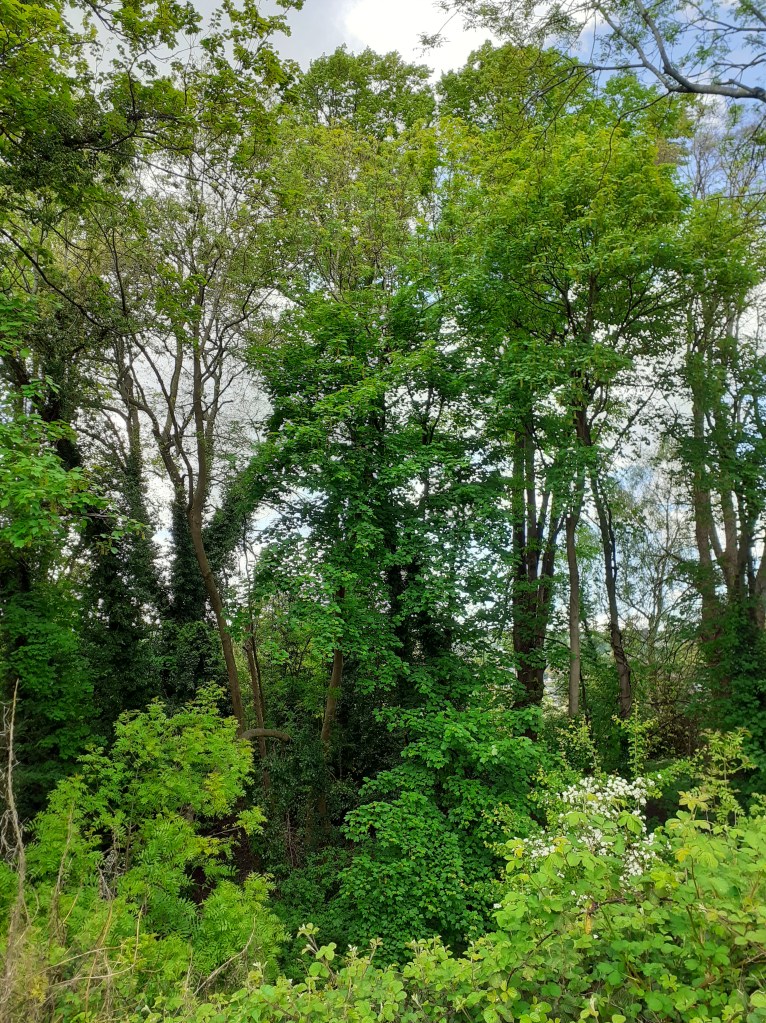
On 1 May I strode out with a spring in step, for my statutory walk. I was stir crazy and determined to meet the day. I made sure to take my camera with me. I wanted both to savour and record the fresh abundance of the green. Although I was in a familiar landscape, both the look and the feel of it had changed. I was in places I hadn’t been in for a week or more, and the world seemed dynamically verdant with a new intensity. I had a transformative hour of it before returning home.

In his Green Man (1), William Anderson reminds us that the Green Man utters life through his mouth. “His words are leaves, the living force of experience … to redeem our thought and our language”. Anderson’s Green Man speaks for the healthy renewing of of our life in and as nature.

He also suggests that the emerging science of ecology – the study of the house-craft of nature – is one such form of utterance. It gives us a language of inquiry into the interdependence of living things. My sense is that 1960’s images of Earth from space have also provided support to concepts like that of a planetary biosphere, and for the revival of Gaia as an honoured name. As a species, quality knowledge, rooted in quality imagination, is our greatest resource. Anderson’s book was published in 1990, based on ideas that had already been maturing over many years. I am sad that we are where we are in 2020. But the message of hope still stands, and the energy of a green May bears witness to it.

(1) William Anderson Green Man: the Archetype of Our Oneness with the Earth London & San Francisco: HarperCollins, 1990 (Photography by Clive Hicks)

SAVED FROM TRASH

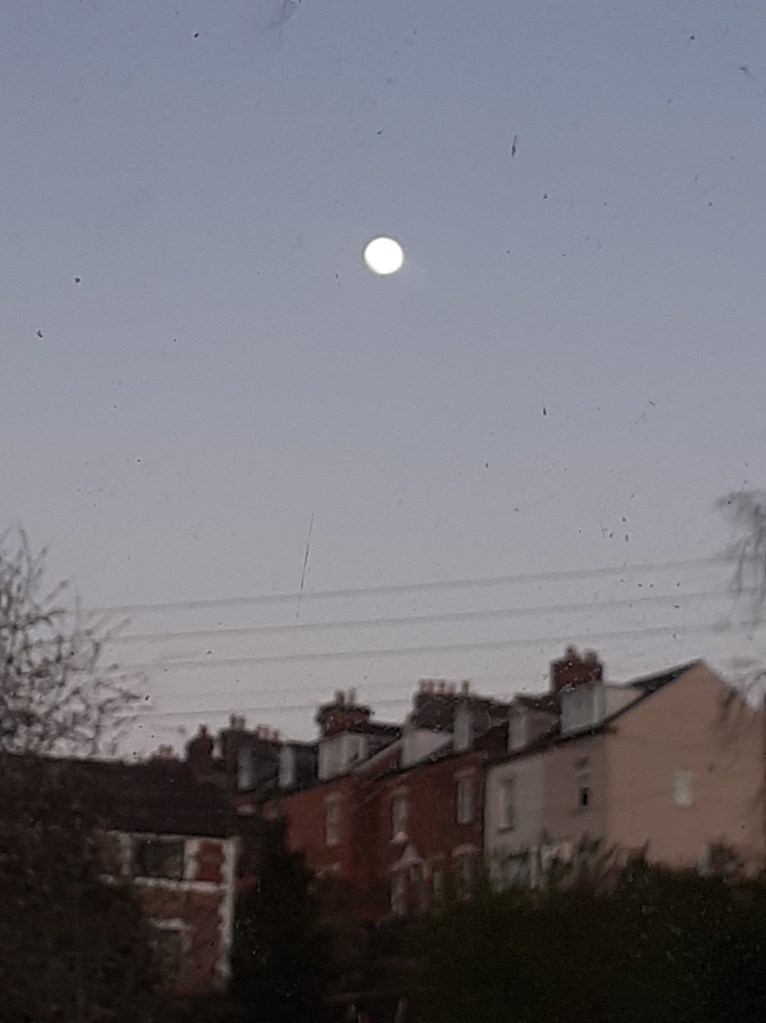
A murky evening moment at a magical time of year. St. George’s Day coming soon, and then Beltane. A seeming failure to get a good image. Street lights come on just as the picture is taken. Freshly green trees are obscured by gathering darkness, and reduced to silhouettes. I am shooting through a window that needs cleaning. I delete the picture. I send it to trash.

Then I find myself haunted by an after image of those apparent pink clouds in the sky. I rescue them. I have better pictures of clouds, but as I imagine them now, these shapes are no longer clouds for me. I see the courtship – I’m oddly sure it’s a courtship – of two beings. In this liminal twilight sky, in a meeting of air and fire, they are materialising in time-bound 3D reality. I might, doubtless incorrectly, call them dragons in my nervous need for naming. In truth I don’t know who or what they are, or where they come from, or how they got here. This is 2020, a twilight zone in itself.

I see no purpose or plan here, though the courtship of these beings is well synchronised for time and place. They are a sign and a wonder. Though their story is unknown, I welcome these beings who are not of this world. I am touched by their appearance and glad to be sharing it.

CONTEMPLATIVE DRUIDRY: REFLECTING ON THE PROJECT

In his foreword to Contemplative Druidry (1) Philip Carr-Gomm talks about “Nature Mysticism, or Natural Mysticism” in modern Druidry. He suggests that such mysticism is grounded in changes in consciousness, and feelings of bliss or oneness, with no accompanying “separation from the physical world in pursuit of the Divine”. For me, it is especially about meeting the moment within the physical world, including our own body/mind. Sometimes the meeting comes through formal practice. Sometimes it is spontaneous and unannounced.

I built the main body of the text in Contemplative Druidry around a series of interviews with practitioners, which I designed, conducted and transcribed in the spring and summer of 2014. I then identified patterns in what people had been saying and decided on themes for chapters. I wasn’t working in an academic role, so my own linking text was a matter of curation rather than analysis. At that time the notion of a ‘contemplative’ approach to Druidry seemed weird to many people. But it was clear to me from the interview material that all the contributors had relevant experiences to talk about. They seemed to point to what PCG subsequently called ‘natural mysticism’ as a domain of personal and cultural experience readily within reach if people want it to be.

This book itself came out of a project I began working on in 2011, when I was a Bard and Ovate mentor in OBOD. I activated it in 2012, when I began to reach out to people with an offer of contemplative sessions, workshops and retreats – continuing with these until the end of 2016. 2012 also saw the birth of this blog and the Contemplative Druidry Facebook group, which I administered for the first year. Looking back from 2020, I feel that the contemplative meme is established within Druidry. ‘Contemplative’ has become a frequently used term in Druid discourse.

In the early days I thought a specific iteration of contemplative Druidry, launched by the project, might become a distinct Druid brand within and beyond the current Druid communities. From this distance it is easier for me to see that my will and energy were for initiating a conversation and modelling a set of possibilities, rather than working to establish a new sub-tradition. At the same time I continue to invite Druids and fellow travellers to be open to their ‘natural mysticism’ in ways that work for them.

(1) James Nichol , Contemplative Druidry: People, Practice and Potential, Amazon/Kindle, 2014.  https://www.amazon.co.uk/contemplative-druidry-people-practice-potential/dp/1500807206/

LUNAR WISDOM

” The moon was the image in the sky that was always changing yet always the same. What endured was the cycle, whose totality could never be seen at any one moment. All that was visible was the constant interplay between light and dark in an ever recurring sequence. Implicitly however, the early people must have come to see every part of the cycle from the perspective of the whole. The individual phases could not be named, nor the relations between them expressed, without assuming the presence of the whole cycle. The whole was invisible, an enduring and unchanging circle, yet it contained the visible phases. Symbolically, it was as if the visible ‘came from’ and ‘returned to’ the invisible – like being born and dying, and being born again.

“The great myth of the bronze age is structured on the distinction between the ‘whole’, personified as the Great Mother Goddess, and the ‘part’, personified as her son-lover or her daughter. She gives birth to her son as the new moon, marries him as the full moon, loses him to the darkness as the waning moon, goes in search of him as the dark moon, and rescues him as the returning crescent. In the Greek myth, in which the daughter plays the role of ‘the part’, the cycle is the same, but the marriage is between the daughter and a god who personifies the dark phase of the moon. The daughter, like the son, is rescued by the mother. In both variations of the myth, The Goddess may be understood as the eternal cycle s a whole: the unity of life and death as a single process. The young goddess or god is her mortal form in time, which, as manifested life, whether plant, animal or human being – is subject to a cyclical process of birth, flowering, decay, death and rebirth.

“The essential distinction between the whole and the part was later formulated in the Greek language by the two different Greek words for life, zoe and bios, as the embodiment of two dimensions co-existing in life. Zoe is infinite, eternal life; bios is finite and individual life. Zoe is infinite ‘being’; bios is the living and dying manifestation of this eternal world in time.”

(1) Anne Baring Anne and Jules Cashford The Myth of the Goddess: Evolution of an Image London: Penguin, Arkana Books, 1993

INQUIRY NOTE: For me this modern interpretation of Bronze Age myth offers a good Pagan way of talking about ‘non-duality’, a strong thread in my inquiry in recent years. In its Sanskrit origin, advaita simply means ‘not two’. It speaks of a unity that is not exactly oneness in the sense of complete assimilation. It points to the sense that we are bios in our transient personal lives yet also zoe the life eternal, both the wave and the ocean. In Western theistic culture this view seems consistent with either pantheism or panentheism. It also fits modern understandings of animism and biocentrism. While I find it useful to know about these models and frameworks, I avoid strong identification with them. There remains an underlying mystery, which is where myth and imagination come into their own.

LIVING OUR EXPERIENCE

“I have been fascinated and waylaid by abstraction, painting the picture I would rather have instead of living the experience I would rather not have.

“What I abstract never comes to be, or only sometimes flickers into life like a watered-down approximation.

“My abstraction is a smoke-screen born from longing or frustration, and it offers me a holiday of dreams. It is always safe and predictable, and an indulgence in the known.

“When abstraction collapses there is what there is … my bodily sensations, the symphony going on. Not necessarily in tune, but nonetheless constantly changing and moving, coming and going. Something is happening here or there … it evaporates and something else takes its place. There is nothing that I can control or manipulate. It is immeasurable and unknown, being and then not being.

“In the same way, if I seem to let go and listen, touch, taste, smell or see, there is no way of knowing beforehand the exact quality of those sensations. I could say that I can anticipate the sound of a bird singing, but it is only on information based on memory.

“It is not alive, vital and unknown. The sound I actually hear, the sound of what is, will not be the same as my abstraction of it. When I first listen to the sound I will try to grasp it and label it in order to control it. When I apparently let go of that control, there is simply the listener and the sound. When the listener is dropped, there is only the sound. I am no longer there – there is simply the naked and vibrant energy of what is. Nothing is needed. All is fulfilled.

“It is within the very alchemy of this beingness that freedom resides.

“Life beckons me. It whispers, it calls to me and in the end it screams at me. The scream of crisis or disease is often what will bring the rediscovery of what I am, for it is difficult to abstract suffering.”

Tony Parsons The Open Secret Shaftsbury: Open Secret Publishing, 1995 (Updated 2011)

NOTE: Tony Parsons describes The Open Secret as “a book declaring that enlightenment is a sudden, direct and energetic illumination that is continuously available. It is the open secret which reveals itself in every part of our lives. No effort, path of purification, process or teaching of any kind can take us there. For the open secret is not about our effort to change the way we live. It is about the rediscovery of what it is that lives”.

See: www.theopensecret.com/

LOOKING THROUGH WINDOWS

There is a world through my window. April has often been a magical month in my year, and 2020 need not be an exception. I link April with intensified and palpable greening, of soft sunsets at an attractive time of day. It is still happening out there and when I lose myself in the image it is happening in here too. Essentially there’s no difference. It is wonderful. of an evening, to follow the sunset process through its many stages of development.

I notice that, here in the UK, some attitudes to the current lockdown have been utilitarian to the point of puritanism. It is not enough for our behaviours to be safe in relation to Covid-19. They have to be ‘essential’, and it seems that essential activities can’t be tainted with any suggestion of idleness or pleasure. I can jog through a beauty spot, but I’m letting the side down if I sit down to rest or enjoy it – even if there’s no-one else around. This goes against everything we know about mental and emotional wellbeing, where such opportunities can be vital resources in the face of stress and depression.

I don’t like this and I am confident that I am right. Yet something in me has been influenced by this atmosphere and has started to feel that outdoors is a forbidden zone. When I do go out, I have to push against this and feel slightly transgressive. Of course, something else in me quite likes that, too. But it’s not the sort of enjoyment I’m really looking for, and I’m experiencing this whole cultural overlay – one that’s arisen so quickly – as saddening.

I like my home and garden and I can enjoy looking out through upstairs windows. I’m concerned that others don’t have this advantage and may be deprived of a vital safety valve. I am also aware that the lockdown has to work, especially since it was initiated later and more haltingly than the pandemic requires, and not in tandem with the testing and contact tracing that have been working well elsewhere. I understand the public policy difficulties in the place where we are.

One way or another, indoors or out, I will not miss out on the magic month of April and the merry month of May. After a rugged winter, I will open myself to nature’s change of energy.

LIVING PRESENCE

In my part of the world, we have begun the greening of the year. But I can’t go out to meet it, or if so, only a little. I can’t go out, so I have to go in. In the greening of my contemplative life, a sense of ‘living presence’ has been the key.

My bespoke liturgy speaks to me and at times asks for change. A section of my morning practice, an affirmation of ‘at-homeness in the present moment’, wants to expand into a ‘celebration of living presence’. At-homeness stood for a place of safety and regeneration. ‘Living presence’ includes that and points to more. In the celebration, I affirm myself as ‘living presence in a field of living presence: here, now and home’. I’ve added a period of walking meditation (20 minutes or so), mindful to breath and footfall and also including liv-ing pres-ence as a mantra over two full breaths.

The Phrase ‘living presence’ came up spontaneously but realising that I didn’t actually make it up, I checked up on where I first came across it. It comes from the Sufi teacher Kabir Edmund Helminski (1). “Presence signifies the quality of consciously being here … the way in which we occupy space. Presence shapes our self-image and emotional tone. Presence determines the degree of our alertness, openness and warmth. Presence decides whether we leak and scatter our energy or embody and direct it”.

For Helminski, presence is also our link to the divine. since in the bigger picture it is “the presence of Absolute Being reflected through the human being. We can learn to activate this presence at will. Once activated, we can find this presence both within and without. Because we find it extending beyond the boundaries of what we thought was ourselves, we are freed from separation, from duality. We can then speak of being in this presence”.

My picture of leaves in light against a darker background is, for me, an image of living presence. It wasn’t intended to look like this, but I’m glad that it does. It said ‘living presence’ to me as soon as I saw it. Each leaf grows out of the tree and is extended by the light of the sun. All are enabled and nourished by ‘interbeing’, the Buddhist teacher Thich Nhat Hanh’s (2) reframe of ‘dependent origination’. But the elements of darkness and shade, whilst delineating the tree trunk, also suggest the mystery of a primordial nature, no-thing in itself yet making everything possible. The picture seems to be saying that the potential for greening is everywhere, outside and within.

(1) Kabir Edmund Helminski Living Presence: A Sufi Way to Mindfulness & the Essential Self New York, NY: Jeremy P. Tarcher/Putnam, 1992

(2) Thich Nhat Hanh The Other Shore: A New translation of the Heart Sutra with Commentaries Berkeley, CA: Palm Leaves Press, 2017

RESILIENCE AND REGENERATION

In my world, early March is a pre-equinoctial period of its own. In the emergence from winter, it manifests both resilience and regeneration. This year I have experienced an elephant’s ears plant (bergenia cordifolia) as an marker for resilience. This evergreen lives close to our back garden gate. It has been flowering, and it leaves have kept shiny, for most of 2020 so far. It has given me a lift every time I have walked past it, in all manner of weather. I feel grateful to it just for being there.

Why have I noticed it this year in particular? In the past I’ve taken this plant for granted. I’ve walked past without seeing it. I’ve only paid attention when the leaves need pruning, having strayed onto a path. Yet now this plant feels like a friend and nourishes me with its presence. It doesn’t just demonstrate its own resilience. It supports mine. I’ve been experiencing 2020 as tough and likely to stay that way, so I suppose that something in me has been looking for ways of feeling resilient. As a result, I’ve been able to notice something that’s been there all along, though largely neglected.

As well a resilience, I’ve been having a sense of regeneration, though the dynamics are a little different. One difference is that I expect to be leaning into regeneration at this time because it’s part of my wheel of the year narrative. I also expect it to be linked to the presence of willow trees (see picture below) because I befriended one many years ago. I have stayed in touch even after moving to a different town. The early re-greening of willow trees is part of my direct experience, and also part of my myth. It feels as if I am being taken by the hand and led towards the equinox.

I don’t want to get there prematurely. A patient, attentive journey emphasises the freshness and novelty of each year. I took the photograph below a couple of days ago on impulse, and it felt like a nudge into a process of renewal that I don’t want to undertake too quickly and don’t want to make assumptions about. Regeneration happens. Although I’m starting to feel my age, I’m still part of it. Let’s see how it goes in 2020.

LIGHT ON TREES

Bright light as a valley experience. Sunlight on trees. February 6, the day I took this picture, provided my first experience of intense sunlight this year. It got through to me even in a shady place. My eyes were dazzled and my head struck by an unexpected warmth.

I noticed mixed feelings. Yes, I celebrated the return of the light. Yes, it was a reference experience for the spring aspect of Imbolc in my part of the world. More visceral than snowdrops, the sun truly reached me and not just my nature-observant sensibilities. It was almost shocking.

Looking out, after that first moment, my world filled up with light on trees. I wondered if they too had any resistance to waking up and being visible and called upon to grow and change and open to the light more fully. I don’t know what it’s like to be a tree. Not really. Withdrawing my projections, I am turned back to my own responses. Parts of me have reservations about immersion in the light. Perhaps they have a wisdom of their own.

BIOCENTRISM

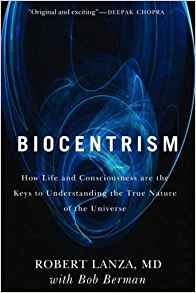
Biocentrism (1) and the follow-up Beyond Biocentrism (2) are science-referenced explorations of cosmos and consciousness. Unusually, they present a ‘consciousness first’ view. In the first book authors Robert Lanza and Bob Berman work through the evidence and identify seven principles of biocentrism.

“If one removes space and time as actual entities rather than subjective, relative and observer-created phenomena, it pulls the rug from the notion that an external world exists within its own independent skeleton. Where is this external objective existence if it has neither time nor space? we can, at this point formulate seven principles:

“First Principle of Biocentrism: What we perceive as reality is a process that involves our consciousness. An ‘external’ reality if it existed, would – by definition – have to exist in space. But this is meaningless, because space and time are not absolute realities but rather tools of the human and animal mind.

“Second Principle of Biocentrism: Our external and internal perceptions are inextricably intertwined. They are different sides of the same coin and cannot be divorced from one another.

“Third Principle of Biocentrism: The behaviour of subatomic particles – indeed all particles and objects – is inextricably linked to the presence of an observer. Without the presence of a conscious observer, they at best exist in an undetermined state of probability waves.

“Fourth Principle of Biocentrism: without consciousness, ‘matter’ dwells in an undetermined state of probability. Any universe that could have preceded consciousness only existed in a probability state.

“Fifth Principle of Biocentrism: the structure of the universe is explainable only through biocentrism. The universe is fine-tuned for life, which makes perfect sense as life creates the universe, not the other way around. The ‘universe’ is simply the complete spatio-temporal logic of the self.

“Sixth Principle of Biocentrism: Time does not have a real existence outside of animal-sense perception. It is the process by which we perceive changes in the universe.

“Seventh Principle of Biocentrism: Space, like time, is not an object or a thing. Space is another form of our animal understanding and does not have an independent reality. We carry space and time around with us like turtles with shells. Thus, there is no absolute self-existing matrix in which physical events occur independent of life.”

Beyond Biocentrism summarises and extends Biocentrism. It does not repeat the principles, but elegantly summarises the perspective of biocentrism and takes the argument into new territory. An appendix to the book lists its major topics as: the exploration of time; the unreality of death; the nonreality of space; the nature of consciousness; science proofs of biocentrism; asking about awareness in machines (probably no) and plants (certainly yes).

When I contemplate biocentric thinking, I feel engaged and intrigued – without taking a stance on its truth claims. I can see how the universe of the space/time continuum, and within it the earth that I love, may be but a bubble of local, provisional reality. In the light of this narrative, simply experiencing life, being part of it, feels vividly magical. The effect is to ground me even more in my earth spirituality, gratefully celebrating the experienced here and now.

(1) Robert Lanza, MD, with Bob Berman Biocentrism: How Life and Consciousness are the Keys to Understanding the True Nature of the Universe Dallas, TX: Benbella Books, 2009

(2) Robert Lanza, MD, with Bob Berman Beyond Biocentrism: Rethinking Time, Space, Consciousness, and the Illusion of Death Dallas, TX: Benbella Books, 2016

Earth Eclectic

music that celebrates Earth and speaks to the heart

Sarah Fuhro Star-Flower Alchemy

Follow the Moon's Cycle

Muddy Feet

Meeting nature on nature's terms

Rosher.Net

A little bit of Mark Rosher in South Gloucestershire, England

Becoming Part of the Land

A monastic polytheist's and animist’s journal

selkiewife

Selkie Writing…

Charlotte Rodgers

Images and words set against a backdrop of outsider art.

Prof Jem Bendell

living purposefully during metacrisis and collapse

Towint

The pagan path. The Old Ways In New Times

The Druids Garden

Spiritual journeys in tending the living earth, permaculture, and nature-inspired arts

The Blog of Baphomet

a magickal dialogue between nature and culture

This Simple Life

The gentle art of living with less

Musings of a Scottish Hearth Druid and Heathen

Thoughts about living, loving and worshiping as an autistic Hearth Druid and Heathen. One woman's journey.

Wheel of the Year Blog

An place to read and share stories about the celtic seasonal festivals

Walking the Druid Path

Just another WordPress.com site

anima monday

Exploring our connection to the wider world

Grounded Space Focusing

Become more grounded and spacious with yourself and others, through your own body’s wisdom

The Earthbound Report

Good lives on our one planet

Hopeless Vendetta

News for the residents of Hopeless, Maine