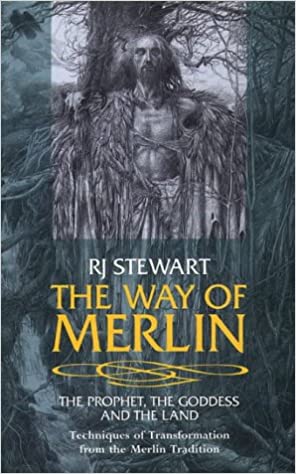
The Way of Merlin came into my hands at the right time. It seeded a number of key understandings, which nudged me onto a Druid path in October 1993. The first is that “sacred space is enlivened by consciousness. Let us be in doubt that all space is sacred, all being. Yet if human beings dedicate and define a zone, a location, something remarkable happens within that defined sphere of consciousness and energy. The space talks back”. Author R. J. Stewart backed this up with the further declaration that “The mystery of Merlin is a backyard mystery, for it declares the smallest, most local space to be sacred, to be alive, to be aware.” I was living in South London at the time and remember being challenged in this book to befriend a spring and a tree. At first, I thought, ‘what?’. Then I found them both, on the day I started looking, in a local park.
Such activities went with the view, “yourself and the land are one”, and that this apparently humble work has a larger context of “holism … identical to the deepest perennial magical and spiritual arts”. Magic is seen as a process of having intent and applying energy and imagery in service to it. Working within mythic frameworks asks for an enabling suspension of disbelief rather than a dogmatic literalism.
I did not work with the suggested programme of visualisations and rituals concerning Merlin, the weaver goddess Ariadne, and other scenes drawn largely from Geoffrey of Monmouth’s Life of Merlin. As practices they seemed too long and formal. But reading Stewart’s text was psychoactive in itself. The weaver goddess Ariadne is a key figure, and the vision of Ariadne reveals a cosmic mother at the threshold of Being and Unbeing. She draws us into the empty silence of the Void, out of which emerges the sound of breath – our own breath and at the same time the breath of all Being. Being breathes through us, “and we realise that we have a body that is the body of all Being. The stars are within us. We are formed of the weaving”.
The specific image of Ariadne never took root in my imagination. But I acknowledged the power of this Pagan Gnostic creation myth. Its sense of our reality emerging from empty potential at the behest of a cosmic mother has stayed with me. My work with Sophia earlier in this inquiry pointed in the same direction. So does my recent post about Dancing Seahorses and Modron (2). I am happiest with the Modron image, because it is less defined and anthropomorphised than those of Ariadne and Sophia. At at the threshold of being and unbeing, she shows us that we are not separate from the divine breath that forms us, or from the creation that is formed. The stars are indeed within us, whether we know it or not.
The Way of Merlin has something like an ancestral role in my spiritual life. R. J. Stewart and I were born in the same year, but he was doing this pioneering work in the 1980’s when I was busy with other things. He influenced me in the period immediately before I embarked on a Druid path, and I have revisited his work over the years. It still has riches to offer.
(1) R. J. Stewart The Way of Merlin: the Prophet, the Goddess and the Land London: The Aquarian Press, 1991
Scotland’s Merlin: A Medieval Legend and its Dark Age Origins, by Tim Clarkson Edinburgh: John Donald, 2016. I find this book a useful resource. Author Tim Clarkson says of Merlin that, “like King Arthur and Robin Hood, he is both familiar and mysterious – an enigmatic figure who seems to stand on the shadowy frontier between history and myth”. Clarkson is firmly on the historical side of that frontier, working clearly and accessibly through the early literature as he quests for the source of the legend. Some of it is a proto-Merlin literature in which the central figure bears other names: Lailoken for the wild man of the Caledonian woods; Emrys for the young prophet of Snowdonia. Myrddin Wyllt is the name given in a group of early Welsh poems to the Scottish Lailoken, and Geoffrey of Monmouth goes on to create the medieval Merlin out of these and other disparate sources. Clarkson provides extensive extracts from the literature, showing how the Merlin of Arthurian literary legend was able to emerge.
Clarkson’s main interest is in the Merlin who, traumatised by his experience of the Battle of Arfderydd, flees to the forest. The battle was an historical event, was fought in C. E. 573 and is well covered by Clarkson, who earned his PhD with a study of warfare in early historic (i.e ‘dark age’) northern Britain. Historically, there is real difficulty in knowing who was fighting against whom, and what their motivations were. In a Scottish hagiography of St. Kentigern, Lailoken is simply a veteran of the battle. Its context is not discussed, and little is said about Lailoken himself, beyond describing his broken wildness. He has occasional encounters with St. Kentigern, who eventually blesses him. Shortly after this he suffers a threefold death, as he himself had prophesied, by falling down the banks of the Tweed onto a sharp stake with his head bent into the water. Everyone praises St. Kentigern for enabling Lailoken’s salvation by blessing him in time.
By contrast, Geoffrey’s Merlin (1) recovers, and he becomes a contemplative forest hermit together with his sister Ganieda. His madness has been a journey, not just a torment. A threefold death is prophesied by Merlin, and occurs. But it is not his own death. Instead, Merlin gets a new lease of life revolving around summers in the woods and winters in an observatory that has been built for him. He is able to have erudite and wide-ranging conversations with his visitor Taliesin, presented as a colleague and peer. But the setting is the same, a specific landscape in south west Scotland, where early British place names are still found – Loch Mabon, the River Nith and Caer Laverock (on Solway Firth at the mouth of the Nith) being three of them, with two ancient god forms thereby remembered. For me, the written records are a demonstration of how culture, and cultural agendas, change over time. Fragments of stories are pressed into the service of new cultural imperatives. The deeper past keeps its secrets, even whilst new understandings are crafted around its after-image.
There is no sense here of the what R. J. Stewart calls the Mystery of Merlin (2) – no suggestion of a local connection with the youthful prophet, though local Mabon names point to one. The Romano-Celtic world (including this region, immediately north of the wall) had Apollo Maponus as a significant deity. Clarkson is good at orienting readers to the general culture of early historic Scotland, and relating his Merlin story to a specific local landscape – with a good selection of maps and plates. He explains that, in the context of the sixth century, ‘Britain’ names an island without any political connotations. The terms ‘British’ or ‘Britons’ describe the native Celtic people who once inhabited the whole island. The story is set in what later Welsh literature described as Hen Ogledd (The Old North), which Clarkson takes to be southern Scotland below the Forth Clyde isthmus, “together with some adjacent parts of what is now England”. He notes that, by 800 C.E., on the eve of the Viking invasions, the British ruled in only three areas: Cornwall, Wales and the Valley of the Clyde.
Clarkson is the author of The Men of the North (4) and The Picts (5) which between them cover much of Scotland in the early historic period. He believes that a kernel of the Merlin/Lailoken story – about battle trauma and flight to the woods – is about an historic individual who took part. He also acknowledges that the story may preserve a memory of early shamanic practices in the locality. Merlin lives on in many different ways.
(1) Mark Walker Geoffrey of Monmouth’s Life of Merlin: A New Verse Translation Stroud: Amberley, 2011
(2) R. J Stewart The Way of Merlin: the Prophet, the Goddess and the Land London: The Aquarian Press, 1991
(3) Tim Clarkson The Men of the North: The Britons of Southern Scotland Edinburgh: Birlinn, 2010
(4) Tim Clarkson The Picts: A History Edinburgh: Birlinn, 2012
This painting, Dancing Seahorses, is by Edinburgh-based artist Marianne Lines. I bought it in 1992 to support a growing interest in Celtic spirituality. The image is taken from a Pictish standing stone in Aberlemno in the county of Angus (1). To this day, the beings portrayed are well-known to Scottish folklore as sea horses, water horses, kelpies or each-uisge. They are also found in Ireland, the Isle of Man, Wales, Brittany and Cornwall. Manifesting in slightly different forms, they can appear in the sea, lakes, rivers and waterfalls.
For me, the painting evokes the primal energies of water, as embodied in these otherworldly seeming beings, who nonetheless might show up from time to time. The pair in the picture are entwined in ways that suggest many possible forms of connection – dancing, embracing, lovemaking, playing, fighting, competing, joining together in tranquillity, or a combination of the above.
I had owned the painting for some while before I began to see a second image, in a sense behind and containing the immediately apparent one. The space where the horses legs are raised defines a shape, suggesting a head. The very emptiness there is a paradoxical mark of presence. To me it became the head of a goddess, with the seahorses then becoming her body. Still clearly appearing as a water being, her arms – if they are arms – are raised in blessing.
The sea-horse image is clear and naturalistic, though stylised and showing creatures we strongly imagine but rarely meet. By contrast, the goddess image needs more work. I see her as Modron, the primal mother, in a marine guise. She seems to come out of a remote past with little story beyond her parenting of Mabon. I am glad not to have inherited too much lore about her. A sense of unfilled space and of mystery is part of what makes her numinous.
I did not make these connections as part of a plan. They grew up over time, feeling increasingly right. They are my own myth-making. I realise that, for me, meeting with an image is simpler and more direct than meeting with a fully developed narrative. There is an immediate impact, followed by a growing familiarity and a fuller relationship. From this, a story may grow, even one about a relative absence of story that points towards silence. Such images can have a lasting power, as this one has certainly had for me.
(1) There are four such stones from different periods. This is from the one listed as ‘Aberlemno 2’, where this image is on the lower right hand side of the front face. The stone is now thought of as being from the mid-ninth century C. E. – rather later than previously believed. The custodians of the stones place it in a genre of ‘zoomorphic designs’ also found in other Celtic Christian art of the time that draws on indigenous themes – for example in the Book of Kells, and in Celtic influenced Northumbrian work. This is in contrast to many Pictish standing stone images, which seem unique to that culture.
On a recent evening I watched lightning, heard thunder, and waited for the rain. It came quickly, fast and hard. It changed my sense of the year. It was as if, at least for some part of me, the blessings of the solstice moment were threatened with cancellation. I remembered autumn and winter last year, and what seemed like relentless wetness. Was our sun kissed respite, itself made strange by Covid-19 and the lockdown, to be so brief?
The wheel of the year, moving through familiar seasons, was once a comfort. Bad things could and did happen. There were big variations from year to year. Yet on a human timescale there seemed to be a pattern. The ritual year told us that nature was reliable within certain limits. The gathering pace of climate change has undermined this perception. In different ways, throughout the globe, the old patterns are being disrupted without settling into new ones – greater changes are to be expected.
The sun will rise at the solstice as it always does. Here in England, I would never have expected to predict the weather of the day. But this year I do feel a raw anxiety about the future. Happily, my at-homeness in the flowing moment is strong enough to hold this anxiety. I accept and welcome it as the experience I am given, mine to live even within the act of resistance itself. Self-compassion and thence a wider compassion arise from this. Yet, as I link my contemplative inquiry to the theme of ageing, I wonder about harvesting and legacy in my own life. Do such notions even make sense?
For the last six months I have rebuilt a specifically Druid practice, restoring the pattern of the circle and four directions, restoring height and depth dimensions, affirming a strong centre. I am working with levels of experience I describe as physical, psychic and causal. I want my spiritual life, which is all my life, to be a coherent witness to my experience and values. In spite of threatening clouds, I remain fired up for this, by an ever rejuvenating sun within, as I approach the decline of the year.
Image from R. J. Stewart’s The Merlin Tarot, illustration by Miranda Grey Aquarian Press, 1992
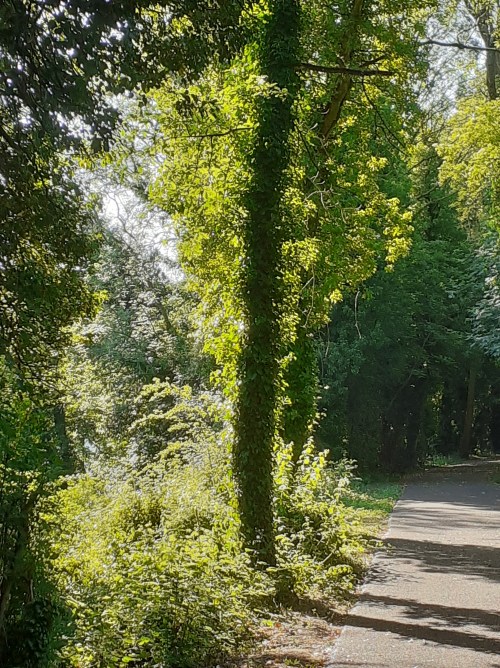
The picture shows the power of sunlight on trees to an observer – me, using my sight and my phone camera. I am not sure what it is like for the trees themselves, but I imagine it to be a positive experience.
This post is about the effects of the same power in my own psychic life. In a personal meditation, “I find myself in a walled garden. It has a fountain at the centre, surrounded by four flower beds of alternating red and white roses. There are fruit trees, apple, pear and plum, trained around the walls. It is a warm and radiant midsummer morning. The full bright sunlight strikes the dazzling water of the fountain, warming and illuminating each drop as it falls. I can hear the plashing of the fountain, and birdsong a little further off. My bare feet are on the lush grass. The air is sweet. The sun is at my back, recharging my energy, in particular activating the sun in my heart”. From that point, the meditation can continue and deepen in a number of ways.
This garden is the Garden of Wisdom, the Wisdom of William Anderson’s Green Man poem (1), a poem of 13 four-line verses, where each line covers a week. Though the Green Man has a lover in the spring, Wisdom is named, as Wisdom, in only one verse.
26 Oct-1 Nov: The reedbeds are flanking in silence the islands
2 Nov–8 Nov: Where meditates Wisdom as she waits and waits.
9 Nov-15 Nov: ‘I have kept her secret’, say the Green Man.
16 Nov -22 Nov: ‘I have kept her secret’, says he.
But at the present time of year, the focus is on the transformation of the Green Man himself, his head having been offed between 25 May and 7 June.
8 June – 14 June: Green Man becomes grown man in flames of the oak
15 June-21 June: As its crown forms his mask and its leafage his features
22 June -28 June: ‘I speak through the oak’, says the Green Man,
29 June – 5 July: ‘I speak through the oak’, says he.
Late in 2019, I stopped calling my inquiry path a ‘Sophian Way’ and re-centred it in Druidry. It was the right decision, and I have found it very fruitful. But at the psychic, Innerworld level, I have experienced a sense of loss concerning aspects of the Sophian Way, especially the space I called Sophia’s Garden. Now, thankfully, I have found that a simple re-naming as Wisdom’s Garden has been enough to re-integrate it within my current Druid practice. A more specific link with William Anderson’s Pagan, earth-centred poem also helps. Wisdom speaks through the wheel of the year, and acts as a companion and guide within my Druid path, on both the physical and psychic levels. She is also Zoe, the life beyond time, and the Green Man Bios, the life which is born, dies and is born again. It seems to me that we are both of them. Perhaps that is Wisdom’s secret.
(1) William Anderson Green Man: Archetype of Our Oneness with the Earth: London and San Francisco: HarperCollins, 1990 (Photography by Clive Hicks)
Highly recommended. Druid author Joanna van der Hoeven writes for the ‘solitary seeker’ who wishes “to explore the magic and mystery” of the earth based spiritualities indigenous to Britain and Ireland. Another reviewer finds, in this book, “a spiritual path that values direct participation with, and first-hand knowledge of, the worlds within us, around us and beyond us”. After reading the book myself, I cannot improve on this as a summary statement.
The book is divided into four sections. The first and longest, ‘Theory’, offers background, context and framing for key concepts, values, and practices. Topics covered include Druids ancient and modern, Awen, Gods, and Ancestors; the three realms of land sea and sky; World Tree, Hedge and Otherworld; the wheel of the year and the four quarters; cycles of the Moon; meditation, prayer, and magic; Animism and connection.
The second section, ‘Practice’, offers a comprehensive range of practices to bring the exploration alive. These include suggestions for daily as well as occasional practice and for working both outside and indoors. The remaining two sections are briefer. ‘Study’ launches the seeker into the area of herblore, ogham and spellcraft. ‘Skills and Techniques’ covers the issues of ethics and peace and the roles of teacher, leader and priest – also looking at the importance of voice, body and movement, not least for practitioners who take on these roles.
Joanna van der Hoeven is an established Druid author, now also a teacher at Druid College UK*. The College works face-to-face with participants over an extended period and is designed for people who seek to be ‘carriers’ of the Druid tradition rather than simply followers This fruitful perspective is also discussed in The Book of Hedge Druidry. Experienced practitioners as well as beginners have something to gain from this book.
Joanna van der Hoeven The Book of Hedge Druidry: A Complete Guide for the Solitary Seeker Woodbury, MN: Llewellyn Publications, 2019
This post presents a poem and extract from The Little Book of the Green Man by Mike Harding, which includes photographs by the author. Most of the images are from English medieval churches, though two are from Paris and some are from different regions of India, from Nepal and from Borneo.
The book was published in 1998 and is still in print. I recommend it to anyone interested in Green Man imagery.
I am the face in the leaves,
I am the laughter in the forest,
I am the king in the wood.
And I am the blade of grass
That thrusts through the stone-cold clay
At the death of winter.
I am before and I am after,
I am always until the end
I am the face in the forest,
I am the laughter in the leaves.
The following extract describes green men in the ends of pews at Bishop’s Lydeard, Somerset, my native county. They were carved in the fifteenth century:
“Unlike many Green Men that are hidden on high in roof bosses or on capitals, the bench ends are close to ground level and would have been immediately on view to everybody entering the church.
“Only in Somerset is this tradition of carved pew-ends so widespread and it would appear that the same carvers worked on a number of churches in the area.
“While I was photographing these images a lady who was in the church arranging flowers came up to me quietly and, making sure that nobody else heard, whispered: ‘It’s nice to see that he’s being accepted again, isn’t it?’”
Mike Harding The Little Book of the Green Man London: Aurum Press, 1998.
Where I live, we are in the last stages of the rising year, the sweet period from Beltane to the Summer Solstice. The sun’s energy is waxing. The days feel abundantly alive and are marked by beauty. It is my favourite time of year, easy to enjoy. It reminds me of my debt to the sun.
Yet this period and its bounty are also fragile and evanescent. They pass soon enough. For me, peonies in a bowl are a perfect representation and celebration of this early summer moment – speaking also to the tender poignancy of impermanence, as the wheel continues to turn.
“There are seven primary materials of the world: the Blue Bard of the Chair has said it.
“The first, earth, from which are every corporeity and hardness, and every firm foundation;
“The second, water, from which are every humour and freshness;
“The third, air, from which are all respiration and motion;
“The fourth, sun, from which are all heat and light;
“The fifth, nwyfre, from which are all feeling, affection, and wantonness;
“The sixth, the Holy Ghost, from Whom are all understanding, reason, awen, and sciences;
“The seventh, God, from Whom are all life, strength, and support, for ever and ever.
“And from these seven primary materials are every existence and animation; and may the whole be under God’s regulation. Amen.” (1)
The Barddas of Iolo Morganwg, by J. Williams Ab Ithel, was published in 1862. It was presented as the lore of traditional Welsh Bardistry going back to Druid times, based on the earlier work of Iolo Morganwg (Edward Williams – 1747-1826). Iolo had organised the first Gorsedd of Bards for several hundred years at Primrose Hill, London, on 21 June 1792, thereby initiating the modern Welsh Eisteddfod movement. He was a personal friend of Tom Paine and George Washington subscribed to his first volume of poetry. He is said to have influenced William Blake’s poetry and Robert Graves’ The White Goddess.
Iolo described himself as a Unitarian Quaker in religion, and a revolutionary Welsh nationalist in politics. In the later 1790’s the Glamorgan magistrates sent the yeomanry (a volunteer cavalry force drawn from the property-owning classes) to break up an open-air Gorsedd led by Iolo in that county. The reason given was that it was being conducted in the Welsh language and allegedly included a toast for Napoleon – then admired by radicals as defender of the French revolution. This is also a time of revolt in Ireland and the birth of Irish republicanism.
Culturally, Iolo was, as well as a poet in his own right, “a first-rate forger of literary Welsh; some have commented that his forgeries were as good or better than the real thing. Furthermore, he wrote much of the Barddas under the influence of laudanum (an opium-based medicine which he took for asthma)” (1). In consequence he has been widely dismissed as an embarrassing fraud. My response is more complicated. There is something poignant for me about ‘forgeries’ that are “as good or better than the real thing”. On the forgery question, I am sad that Iolo could not openly be a catalyst for the creation of new culture inspired by an old one, rather than having to pretend, even to himself, that he was recovering an old one as it had been (in his own mind perhaps through psychic means). As for medicinal laudanum, I wonder why this should be stigmatised in Iolo whilst accepted in his contemporary S. T. Coleridge. It may be is because Coleridge’s work was unambiguously original, and therefore seen differently. The issue of new culture creation in Druidry is a significant one to this day and is well discussed in Philip Carr-Gomm’s preface to Contemplative Druidry (2) where the voices of a number of open culture creators are included.
Going back to The Seven Primary Materials of the World, I feel friendly to this text despite its patriarchal language and its statement of a world view significantly different from my own. In my reading, it suggests a seven-step ladder from matter to the divine, with four material elements that point also to non-material qualities, where the the fourth and highest is not on the Earth. Then there are two subtle elements (though the first finds room for ‘wantonness’) and an ultimate ascent to the divine. It is the kind of evolutionary spiritual scheme that many transcendentalists down the ages have related to. Written at the turn of the eighteenth and nineteenth centuries, and edited in mid Victorian times, it seems to me congruent with the outlook of medieval Welsh Bardistry as expressed in The Book of Taliesin (3), and the theology of the ninth century Irish scholar and contemplative mystic John Scotus Eriugena (4). It is a Christian referenced path that is not sin and fear based, and I am sure that many people involved in Druidry and Celtic Spirituality today would be in essential sympathy with it. Made up by Iolo or not, it reads as a clear and simple expression of a universalist and transcendentalist stance within a specific cultural setting. I find nothing fraudulent about it. It is what I would expect from place, time and person.
Indeed, key concepts remain relevant to my own Druid practice. I work with the wheel of the year and with the four classical elements, including fire. I am concerned with the Earth’s relationship to sun and moon. I work with my body and my sense of energy and think of nwyfre as synonymous with prana or chi, now well-known thanks to the popularity of yoga and Chinese energy arts.
At this stage in my personal journey, I am in renewed inquiry with awen. For the Barddas, it is a distinct higher mental faculty, close to the divine source like Coleridge’s primary imagination. In my own work I get a sense of energised and articulated insight. I do not think of awen as a substance in itself, but rather a quality of how we express ourselves when at our most enlivened and ‘on song’. But this inquiry is far from concluded.
Where the Barddas speaks of God, I speak of nature. I think of the web of life, and of our interbeing within it. I also think of the mysteries of quantum events, dimensions that we cannot perceive directly, galaxies flying apart and the possibility of multiple universes. But to me nature’s most extraordinary phenomenon is the gift of aware experiencing, with all the joy and suffering it brings, in the apparent here and now. To this I add the capacity to bear witness to this miracle through words, non-verbal media, silence, celebration and action. Here, I find myself still using most of the key terms from The Seven Primary Materials of the World. In this sense, I am happy to have The Barddas of Iolo Morganwg as part of my spiritual ancestry.
J. Williams Ab Ithel The Barddas of Ilo Morganwyg, Vol I & II: A Collection of Original Documents, Illustrative of Theology, Wisdom, and Usages of the Bardo-Druidic System of the Isle of Britain Forgotten Books, 2007 www.forgottenbooks.org (First published 1862)
James Nichol Contemplative Druidry: People, Practice and Potential Amazon/Create Space, 2014 (Foreword by Philip Carr-Gomm)
William F. Skene The Four Ancient Books of Wales Forgotten Books, 2007 www.forgottenbooks.org (First published 1868)
“Suppose, Malunkyaputta, a man were wounded by an arrow thickly smeared with poison, and his friends and companions brought a surgeon to treat him, The man would say, ‘I would not pull out the arrow until I know the name and clan of the man who wounded me; whether the bow that wounded me was a long bow or a crossbow; whether the arrow that wounded me was hoof-tipped or curved or barbed’.
“All this would still not be known to that man and in the meanwhile he would die. So too, Maunkyaputta, if anyone should say: ‘I will not lead the noble life under the Buddha until the Buddha declares to me whether the world is eternal or not eternal, finite or infinite; whether the soul is the same as or different from the body; whether an awakened one continues or ceases to exist after death,’ that would still remain undeclared by the Buddha and meanwhile that person would die.” (1)
The Buddhist scholar and teacher Stephen Batchelor, quoting these early words, affirms a Buddha committed to “an existential, therapeutic and liberating agnosticism” concerned “with anguish and the ending of anguish”. He laments the historical tendency of Buddhism to lose this agnostic dimension and to become an institutionalised religion. He believes that “this transformation of Buddhism into a religion obscures and distorts the encounter of the dharma with contemporary agnostic culture. … The dharma in fact might well have more in common with Godless secularism than with the bastions of religion.”
At the same time, the force of the word ‘agnosticism’ has been lost in modern secular culture, becoming complicit with “the attitude that legitimises an indulgent consumerism and and the unreflective conformism dictated by mass media”. T. H. Huxley, who coined the term in 1869, understood agnosticism as “a method realised through the rigorous application of a single principle”. This was to follow our reason as far as it will take us, and not to pretend that conclusions are certain which are not demonstrated or demonstrable. It is a principle that runs through western culture from Socrates to the axioms of modern science. Buddha and Huxley both advocate a method rather than a creed, opening the possibility of a conversation between them.
What does this tell me about my own path now? Contemplative inquiry is a method. It is based on phenomenology as a subjective life-world investigation, and mine tells me that fruitful spiritual practices do not depend on the metaphysical views that are often linked to them. I can interpret and value everything that I have done within a naturalistic framework. It is a significant conclusion for my inquiry.
This does not in itself invalidate the metaphysical views. I have simply withdrawn from my personal engagement with them, except to the extent that they are embedded in the authentic experiences and stories of other people, past and present. I can still value and learn from those. I find imaginative engagement with other points of view quite easy. But in my own spiritual understanding, I seem now to be with Huxley and the Buddha.
Contemplative inquiry is a valued method but I would not call it my path. My path is Druidry, and I have been re-establishing this consciously since the Winter Solstice of 2019. The default position of the Druidry I was trained in is a romantic theosophy, though one in active evolution, rich in variation and re-imagining. In my personal journey, I am now clearly in a naturalistic and secular space, animist in a sense (2) that is “‘naturalist’ rather than metaphysical.” As a result of my inquiry, my Druid note is different than it was before I began.
I am clearer, lighter, more alive. It feels easier to experience the abundance in simplicity that I value. By letting the mystery be, I can immerse myself more deeply in the textured life of the world. Leaning in to naturalistic world view, I expand my sense of ‘at-homeness in the flowing moment’, and my Druid path feels stronger.
(1) Stephen Batchelor Buddhism Without Beliefs: A Contemporary Guide to Awakening London: Bloomsbury, 1998 (First published in the USA in 1997 by Riverhead Books)
(2) Graham Harvey (ed.) The Handbook of Contemporary Animism London & New York: Routledge, 2014 (First published by Acumen in 2013) see also: https://contemplativeinquiry.blog/2020/02/22/