Contemplative Inquiry

This blog is about contemplative inquiry

Tag: Nature mysticism

EXPERIENCING LATE SEPTEMBER

I tend to feel thrown around energetically over two or three days during the autumn equinox period, and then a new calm takes over. I have crossed into the darker half of the year. I reached that place this year on 25 September and went out for a walk at 7.15 a.m., about 20 minutes after sunrise. The temperature was 8 degrees (46.4 F), not exactly cold, but enough to indicate a change in the year. I was glad to be wearing gloves. They demonstrated my acceptance of a new seasonal identity. There have been still lower morning temperatures in more recent days.

Walking by my local canal, I could see that 2020 has been a good year for its swans. I saw ten near-grown cygnets in a 3-4 mile stretch of water: the group of five in the picture, a group of three a couple of miles away, and two others on their own. I’m inclined to think that the full lockdown from late March until early June has played a role in making the swan population safer. A happy thought and a sad one at the same time.

I walked further out of town this time than I had since the beginning of the Covid-19 crisis and went past more open fields. The grass was green but not growing wildly. I saw only subtle signs of a turn in these distant trees, and none really of a fall. The horses were contentedly outside: no need even for coats. It was dry. By this stage of my walk it was a little warmer, though never beyond 10 degrees (50F). The edge created by a cold breeze had gone. For me this image captures a tranquil moment, that represents my sense of this post-harvest moment in the year. The weather is adequately benign. The energy of nature feels partly withdrawn, into a subterranean state of latency.

Among the trees on the canal bank, I found much greater evidence of a turn. This is one of the times when I become particularly drawn to reflections in water, and the way in which they to an extent mirror the world above whilst also offering something of their own. The much quoted phrase, ‘as above, so below’ is altogether too neat and formulaic to describe a living world.

MOR HAFREN

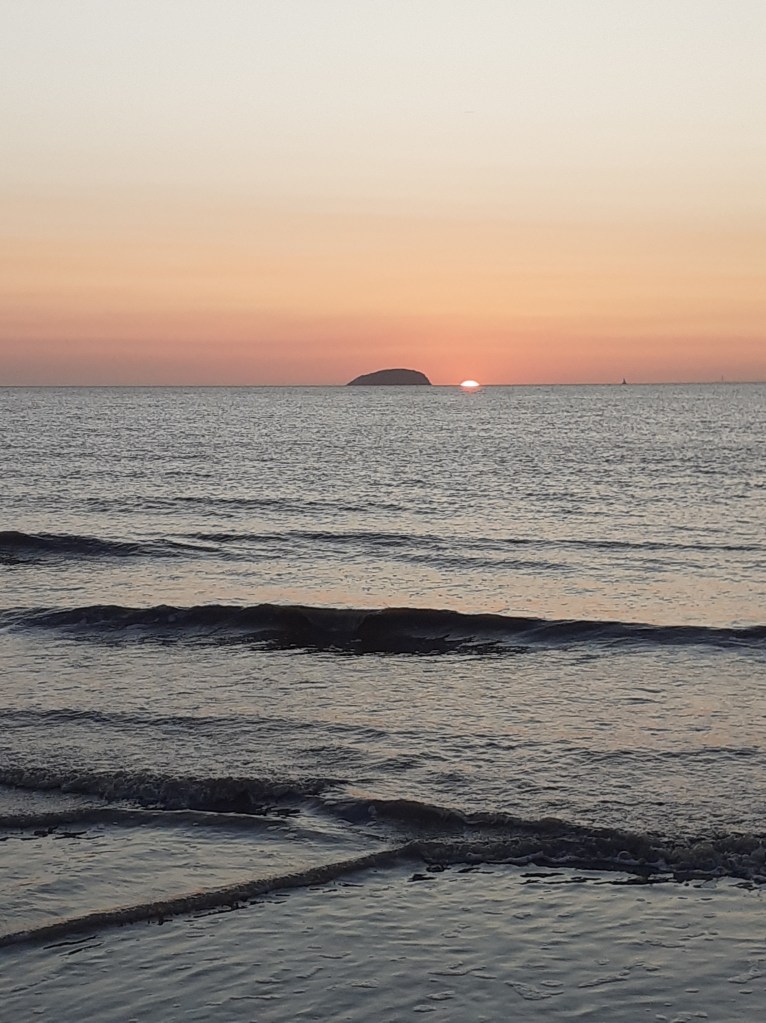
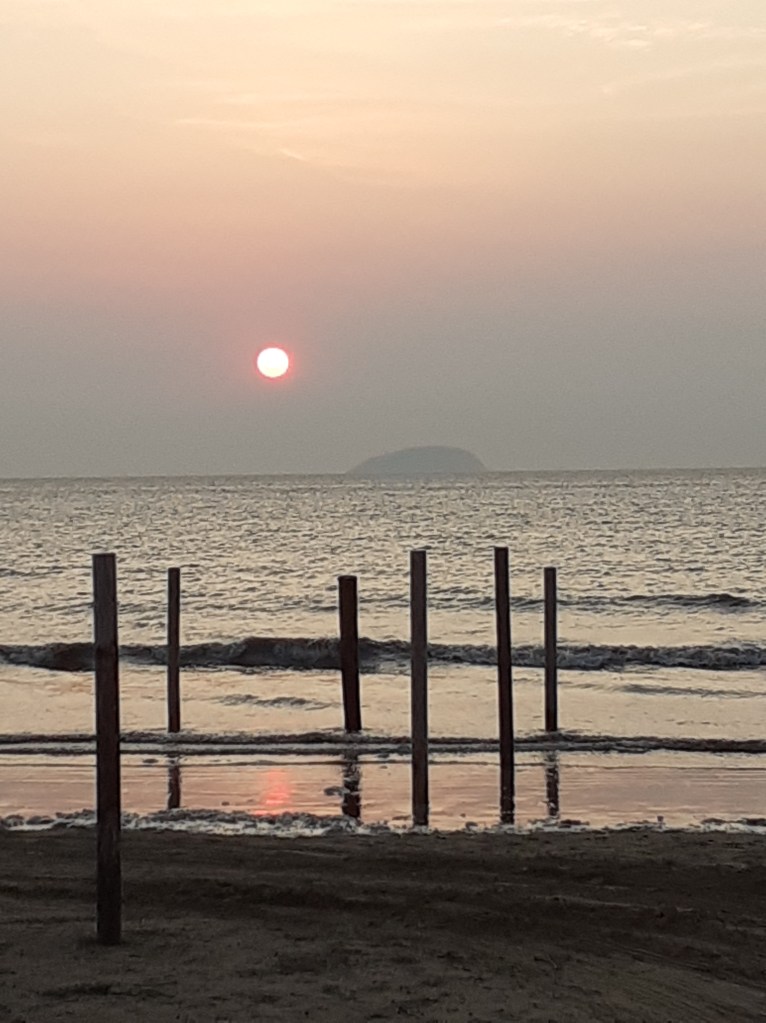
I took this picture on 17 September at Weston-super-Mare, a seaside town located where the Severn estuary becomes what is now called, in English, the Bristol Channel. Weston faces Cardiff, the Welsh capital, on the other shore (too far away to see in the picture). Looking at it gives me a sense of tranquillity whilst also showing clearly the major forces in play. We notice the descent of the sun, as if into the water. A change in the light is linked with this process. In the near distance, not far from our feet, the tide is coming in – rapidly, as it turns out just a little later.

Until Tudor times this stretch of water was known as the Severn Sea in line with the Welsh name Mor Hafren (Cornish Mor Havren). For me, the name ‘Bristol Channel’ makes a claim as much as it describes a place. It disrupts my sense of psychogeography and I am drawn to the Welsh ‘Mor Hafren’ as a name to connect me to these waters. It is older, naturalistic and retains a link with the river.

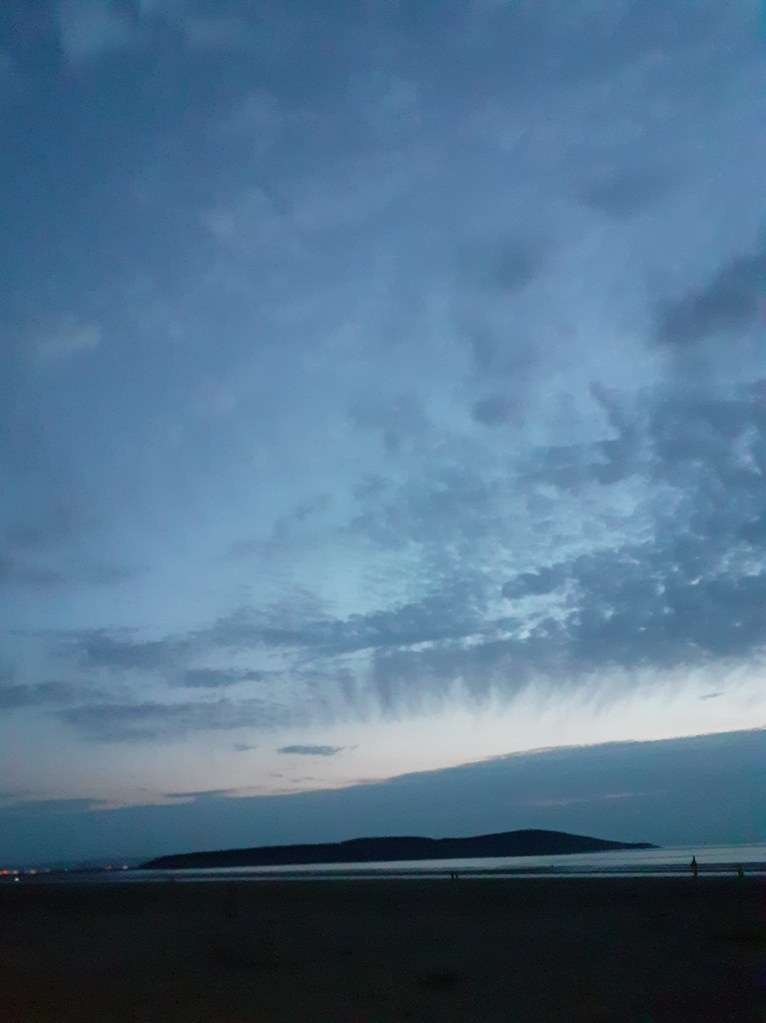
Weston-super-Mare is, by nature, a liminal space, not least of an autumn evening. The picture below is of Brean Down – brilliantly used in Dion Fortune’s occult novel The Sea Priestess – and the sky above it, a little after sunset.

Sky, sea, land. From this distance, the head, like many coastal promontories, has a slightly serpentine or dragon-like look. You half expect it to rear up and move. But it doesn’t. It remains quiescent, power in potential. The active power, here and now, is in the clouds and the afterglow of the sun.

On this visit, I discovered the cycle track, also a pedestrian path, that allows improved access to Brean Down from the Weston side. This helped me to revive a connection to Brean Down which I had allowed to lapse over recent years.

My final picture gives more space to the water element as an incoming tide, whilst recording the sun sinking below the horizon near the island of Steep Holm. The name is of Norse derivation (‘holm’ referring to an island in an estuary). The Welsh name is Ynys Rhonech and the early English called it either Ronech or Steopanreolice – ‘reolice’ being derived from an Irish word referring to a church yard or graveyard, suggesting a sense of a one-time sacred space. These names give a sense of the different peoples who took an interest in this stretch of water in early times. Steep Holm is in England, although Flat Holm, Ynys Echni, a little closer to the opposite shore, is in Wales.


AUTUMN EQUINOX 2020: HAZEL, SALMON, AWEN

In the outer circle of my mandala of the year (1), hazel presides over the days from 16 September to 8 October.

In the middle circle, divided into quarters, the one beginning at Lughnasadh/Lammas is represented by a salmon.

In the inner circle, where there is no sub-division, I have three seed pearls standing for the Awen. The Autumn Equinox is a time when images from the three layers of the mandala line up particularly well. (See NOTE below)

The lore and legend surrounding hazel have a stronger hold on me than the physical tree, though I do find hazels in my locality. For the ancient Celts, the tree was linked with wisdom and known as the food of the gods. Irish tradition (2,3) speaks of the sacred salmon who swim in a pool surrounded by nine hazel trees. This pool was known as Conla’s Well or the Well of Segais and it is the source of the River Boyne. When the trees drop their nuts into the water below, the salmon eats them and so carries them into the sea and back in their annual spawning run. “The cycle was seen as a metaphor for the passing of wisdom from age to age and from person to person” (2). The ancient Druid temples of Newgrange, Knowth and Dowth are to be found in the Boyne Valley.

Ireland and Western Britain are watery places, well-located for intimations of wisdom in watery forms. In modern Druidry, circle work makes links between the west, water and autumn, understood as the quarter following Lughnasadh/Lammas. There are suggestions, too, of love and intuition flowing together in harmony. The Autumn Equinox stands at the point where the light half of the year gives way to the dark half – not suddenly, or violently, but as part of a gentle transition, where the qualities are more or less balanced on both sides of the divide. Tradition also gives us the image of the Well of Segais  as “a shining fountain, with five streams flowing out of it” (3). Here, the invitation, at least for ‘the folk of many arts’, is to drink from the five streams (the five senses) and from the fountain itself (the source of life). In a nutshell, our wisdom is best served by drawing on both the life of the senses and on the flow of inner inspiration (Awen). Neither needs to be sacrificed to the other.

(1) See the ‘house’ section of: https://contemplativeinquiry.blog/2020/08/12/meditation-wisdoms-house/

(2) John Matthews & Will Worthington The Green Man Oracle London: Connections, 2003. Also source of the image at the top.

(3) Philip and Stephanie Carr-Gomm The Druid Animal Oracle: Working with the Sacred Animals of the Druid Tradition London: Fireside, 1994 (Illustrated by Will Worthington)

NOTE The two pictures below give a rough sense of the mandala, and of relationships at the Autumn Equinox, though not the way it looks as a mosaic in my innerworld. The tree images are taken from The Green Man Tree Oracle (2). They stand in for the ones in my mandala, which are more naturalistic and sometimes involve more than one plant: hazel, west; rowan, west-north-west, yew, north-west; elder, north-north-west; holly, north; alder, north-north-east; birch, north-east; ash & ivy, east-north-east; willow, east; blackthorn, east-south-east; hawthorn, south-east; beech & bluebell, south-south-east; oak, south; gorse, south-south-west; apple, south-west; blackberry & vine, west-south-west. The selection as a whole is based on my personal experience of trees in the neighbourhood as well as traditional lore. The elemental images are from R. J Stewart The Merlin Tarot London: Element, 2003. Illustrated by Miranda Grey.

EXPERIENCING EARLY SEPTEMBER

Months, and moments within them, have their own atmosphere and meaning for me. I try to indicate these through pictures. Where I live, early September takes us fully into autumn, and the fruiting of the horse chestnut tree (above) is a marker for the transition.

Early in the month, the sun sets a little after 7.30 p.m. and reminds us that the nights are drawing in more quickly. It still seems early for sunset, but I notice that my sense of ‘evening’ is adjusting to a more autumnal perspective. The picture below was taken on September 3rd.

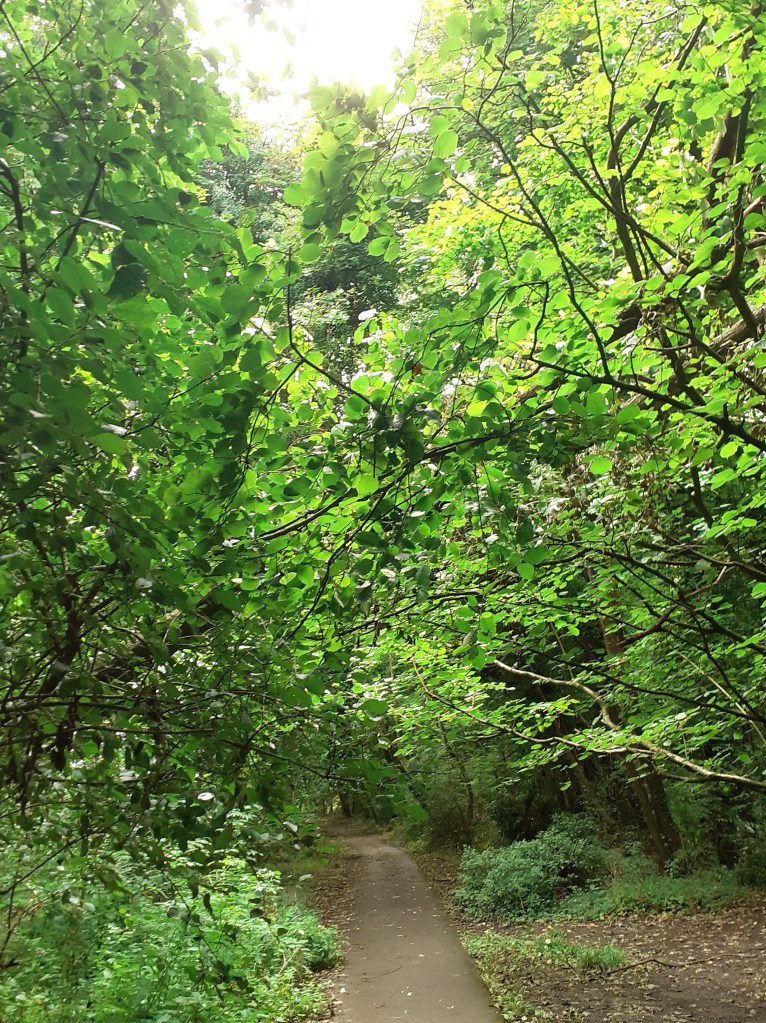
The feeling-tone of this period is not yet equinoctial. Wooded spaces are still vigorously green, still majestic, still imaging what my heart wants more of the world to look like. The light of day remains strong, even though temperatures are characteristically lower. There is a lingering aftertaste of summer at the beginning of the new season.

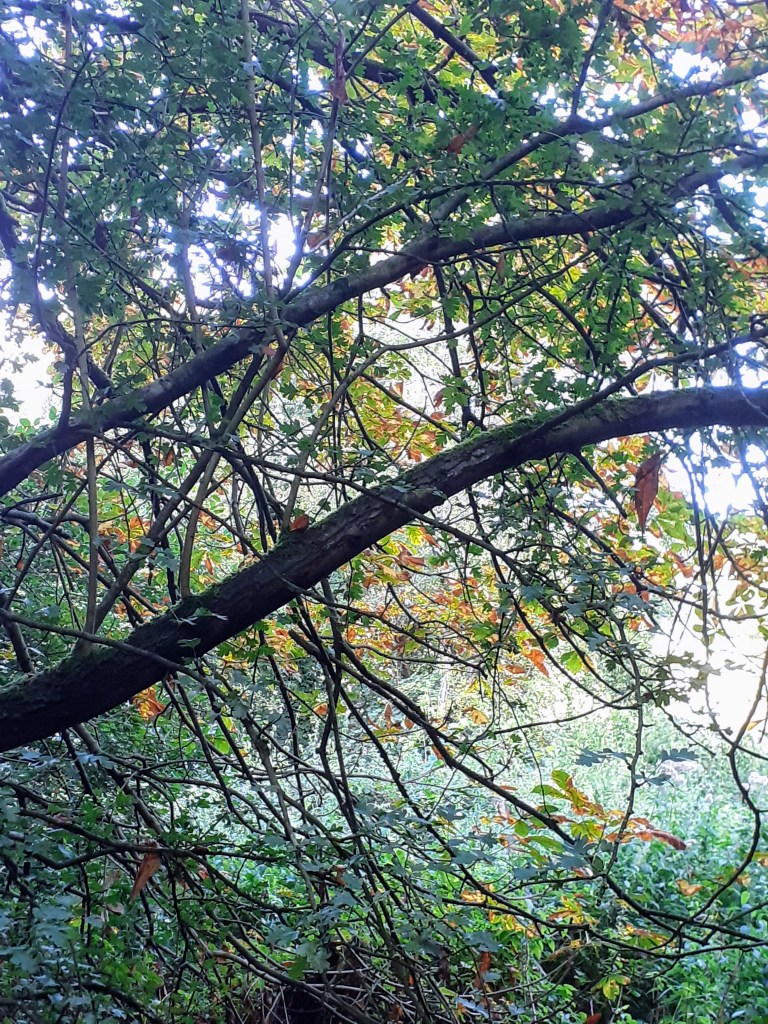
Nonetheless, it is easy to find muted colours leaning in to decay. These have their own fragile and poignantly fleeting beauty, as the alchemy of the waning year does its work. Early September has a character of its own, to be enjoyed while it lasts, as the wheel continues to turn.

MR. BRAMBLE

In my mandala of the year (1), I have sixteen trees. In the quarter from Lughnasadh (or Lammas) to Samhain, these are apples, blackberry, hazel and rowan. Blackberry presides over the days from 24 August to 15 September.

My choices have as much to do with personal memories as with natural processes, traditional lore, or the ogham alphabet in which Blackberry is Muin. In England we have an August Bank Holiday in which the weekend is extended to include the last Monday of the month. This year it will be August 31st. I have early memories of blackberry picking walks during this holiday, with family groups doted around a wooded hillside, and an air of informal ritual. Although balmy days might follow, this was the final act of summer.

The plant, of course, is with us throughout the year. The Druid Plant Oracle (2) names it as Bramble. “If you have ever tried digging up Bramble roots, you will know how tenacious they are – they travel long and deep, and some root systems can cover a wide area and be of great age”. Blackberry was said to be the bush into which Lucifer fell when he was thrown out of Heaven. Bramble provided a challenge for the prince in Sleeping Beauty.

Bramble also provided much needed sustenance for the famished wayfarers in The Voyage of Maeldun. In Joanne Harris’ Blackberry Wine (3) a small rural community in the south of France is saved from unwanted gentrifying ‘development’ through the prickly stubbornness of key individuals. These, quietly supported by most of their community, defend their own vision of how to live in the face of personal, commercial and threatened legal pressures. Neglected flora, overlooked forms of intoxication and a little magic all contribute to the holding of a much loved space. Mr Bramble is a good friend to have.

(1) See the ‘house’ section of: https://contemplativeinquiry.blog/2020/08/12/meditation-wisdoms-house/

(2) Philip and Stephanie Carr-Gomm The Druid Plant Oracle: Working with the Flora of the Druid Tradition London: Connections, 2007 (Illustrated by Will Worthington)

(3) Joanne Harris Blackberry Wine London: Black Swan, 2000

(4) The image at the top is from John Matthews & Will Worthington The Green Man Oracle: Ancient Wisdom from the Greenwood London: Connections, 2003

THREE TREES

On recent walks I have been noticing trees in nearby woodland, and becoming aware of how I experience them at this moment in the year. The three tree pictured in this post illustrate my story for later August.

In the first, I saw my first real hint of autumn, as green starts to turn yellow and brown. At this stage, it is a subtle shift affecting only a few trees. But it is a harbinger, like street lights at 8.30 pm.

My liking for this time goes back to my later childhood. It was still summer and I had a lot of freedom. My hay fever was gone. Temperatures were a little down. It was easier for me to spend longer periods out in the sun. I felt at home in my environment. In these precious days, I felt expansive. The world was on my side, and a hopeful place to be in.

In an earlier post (1) I talked about this as being a time of apples in my Innerworld. This is true of my outer world too. I grew up in Somerset, in England, where apples are abundant. It is cider country, and the summer country of Arthurian romance. My home town, Yeovil, is 19 miles from Glastonbury, aka Avalon. When I was small, I was puzzled by injunctions not to take apples from the tree or eat the ones which fell on the ground, though these might possibly be cooked. Only the ones in shops were truly safe. Commerce made them righteous. For me, this got a little mixed up with forbidden fruit story in Genesis 3, since “the tree in the garden” was identified as an apple in our part of the world.

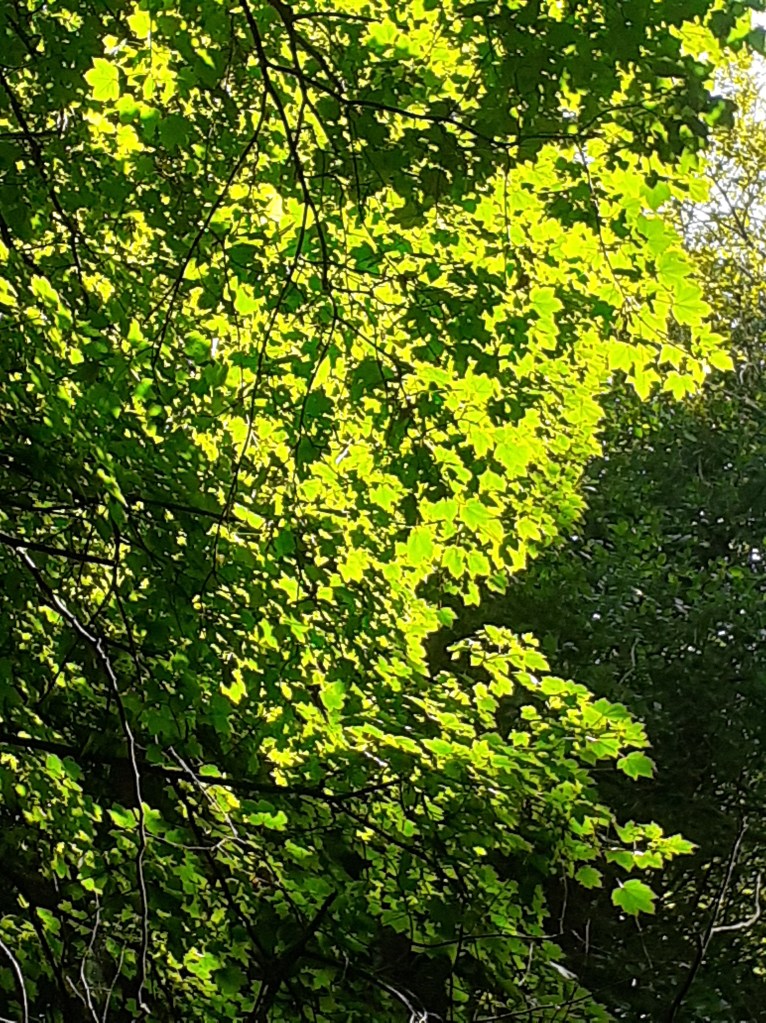
For all the autumnal qualities of this time, it still offers a naturalistic ‘tree of light’ experience if I am open to it. I experience this most when sunlight catches green leaves, especially if they shine from recent rain. I am glad that the metaphor of the tree of light – like those of the tree of life, or world tree – does not remove us far from our experience of the living world. One of my attractions to Druidry is that even its more esoteric, Otherworldly dimension stays loyal to nature.

(1) https://contemplativeinquiry.blog/2020/08/18/harvesting-in-mixed-weather/

BOOK REVIEW: SOUL LAND

Highly recommended to anyone who values the poetry of place. Natalia Clarke’s Soul Land: Nature, Scotland, Love (1) is a chapbook featuring 22 poems about her connection with Scottish landscape. That connection is intense, and shared in these poems through a powerful and distinctive voice.

The poet grew up in Siberia, enjoying “immersive life and experiences with nature and magic” (2), before being exposed to “intense emotions of love and loss at a tender age”. Her journey took her to England and its publishing industry with a later shift into the field of psychotherapy and a personal spiritual awakening. This is the context for the visit to Scotland “that changed me on a profound level”. She fell in love with what she came to call her “Soul Land”.

In the poem Love Everlasting, she writes:

“My knees touched the greenness

of your body and in

awe I stood amidst a stone

circle feeling protected and

contained.

I lowered myself into your

cooling stream imagining I

washed myself anew”.

The words have both erotic and mystical resonances: perhaps it misses the point even to make the distinction. In another poem The Land of Me, she talks of the land “stealing my soul” and how this theft feels like “the gentlest fall into paradise”.

This is not a song of life and work within a landscape and the human culture it has shaped, and which has shaped it in turn. It is a personal I-Thou connection with a sacred space that the poet visits from time to time. Natalia Clarke is clear and sensitive about this, as shown in Through the Eyes of A Highlander, where we find a different consciousness of place, and in his case, its human history: “Where I see beauty he sees barren landscape … where I feel silence he shudders with sorrow”. Natalia Clarke knows that her sense of home, in this for her newly discovered land, is bound up with her own life and longing, and what she brings to the encounter.

In the later poems we find a closer observation of detail – “water silky soft and the colour of silver … green pine needles hitting my senses with clean potent fragrance”. The land feels more maternal – even, in a sense grandmaternal. In the poem In My Dreams You Visit Me the poet finds herself “transformed into the old Cailleach walking the hills and mountains with deer by her side”.

Natalia Clarke feels blessed in this wild space: “inhaling paradise, assured, grounded, humble, in your exquisite perfection”. Although led by her intuition and her feelings, she shows how her experience of the Scottish landscape has indeed grounded her.

“’All is well,’ the land whispers

into my soul spreading her

seasons around me”.

In a prose conclusion to the collection, Natalia Clarke also spells out the conceptual basis of her way of experiencing and relating. The key terms are ‘home’, ‘soul’s calling’ and ‘nature’. Home is “our secure ground, safety and knowing” with a feeling-tone that is “contented and contained”. She speaks here as a person who has lost her link with her “original motherland” and has needed to find ‘home’ elsewhere. A soul call is “very impulse driven, animalistic and instinctual”, asking us “to be more, to feel more” and join “something beyond yourself, new, meaningful and expansive”. Nature is not simply about solace. Deep understanding of nature can bring both peace and turmoil into our souls, “as processes are parallel within nature and if we tune into nature’s rhythms, we risk deeper understanding of ourselves”. True homecoming, the homecoming that involves soul, asks us to take risks as well as offering safety. For Natalia Clarke, Nature favours the brave.

(1) Soul Land: Nature – Scotland -Love Kibworth, UK: Matador, 2020

(2) https://rawnaturespirit.com/ (The collection can be ordered from this site by clicking on ‘publications’.)

LUGNASADH 2020

Lughnasadh (or Lammas) marks an important moment in my year. I move from a season of ripening to a season of bearing fruit. At the point of transition, both of these processes are happening. My distinction between ‘ripening’ and ‘bearing fruit’ is a soft one, allowing for continuities. But I know a harvest when I see one, and I celebrate it when it comes.

The Celtic fire festivals have a stronger hold on me than the solstices and equinoxes, with the exception of midwinter. I don’t know why this is. The quarter beginning in Samhain is one of dying and regeneration. I am happy to start and end my year in the middle of it: I have moved from the dying of the year to its point of regeneration. But it is the quarters that tell the most compelling story: from the time of dying and regeneration, to one of early growth – and then on to those of ripening and of bearing fruit.

August, though very much a summer month, comes with a withdrawal of light and intensity, very noticeable to me, where I live, in the last ten days of the month. September and October continue this whilst including fine and balmy days. Throughout much of my life, this is the quarter that has especially moved me. All periods have their magic. Compared to its predecessor, the quarter beginning with Lughnasadh has, at least for me, a quality of reduced intensity and greater subtlety.

2020 specifically continues to be odd and unsettling. I have not had my usual summer. I was essentially housebound for four months. I have not left my town since February. My upside, as a contemplative, has been an unseasonable permission to turn inwards. I have refreshed my solo Druid practice and I feel re-grounded in Druid culture.

I have recently crafted three forms of sitting meditation for use within my daily practice: I describe them as Light Body, Living Presence and Wisdom’s House. I will write more fully at a later date. This development marks a return to an older contemplative approach – I have moved away from formal sitting meditations in recent years. Each meditation is based on, or descended from, a practice previously used over a long period. This work has tenacious roots yet happily feels new and fresh. I look forward to its fruits.

Photo by Elaine Knight. See also: https://elaineknight.wordpress.com/

DOG DAYS

The dog days of summer are by reputation hot, sultry and ill-aspected. As high summer becomes late summer, we can fall out of love with the season. We may find ourselves less comfortable than we would like to be, on the edge of storms that may or may not break. Nature can seem rank and overblown. Insect life is busy, in ways not always to our taste.

Yesterday I walked on the banks of our local canal between Stroud and Brimscombe. I had not done this walk since early March. At the height of the Covid crisis, I decided to leave the narrow towpath alone. For a long stretch of time through spring and summer this section of canal and I have gone our separate ways. It was early in the morning and not especially hot. The canal itself gave me my dog days feeling. What I noticed was a wild, rank fecundity, not conventionally photogenic. It is as if the space were resisting the (interrupted) attempts to make it navigable once again, sustainably beneficial to us. A different ecology had established itself. In my feelings, and imagination, the ‘dog days’ energy became a counterpoint to convenience conservation.

I like convenience, and I like walking on the towpath. I respect the restoration project, and the volunteers who are making it happen. I also respect the ever-renewing power of nature. I look at the picture below, where evidence of canal can barely be seen – just a suggestion on the far bank. I reflect that this stretch of water was once deep and wide enough for trows, traditional canal boats used on the Severn and Wye rivers. Brimscombe Port was as far east as they could go. The canal going on to Lechlade had a narrower gauge, and cargo had to be transferred to Thames barges. That early industrial world has long gone. The new development, whilst making inroads, has not yet ocupied this space. In the meantime, nature is free to be inconvenient, and to some people doubtless unsightly, whether we like it or not.

VARIETIES OF ONENESS

When I say ‘oneness’, I mean interbeing rather than singularity. I am talking about the web of life, the great song, a field of living presence. Singularity allows only an I. Interbeing has room for I and You and We and They. This recent picture of a half-hidden corner in our garden, taken by my wife Elaine, makes the point. The fact that she took it also reminds me that the mature recognition of ‘you’ is the foundation of true relationship.

This oneness of interbeing does not need a myth of origin to sustain it. Interbeing just is. I’m an intuitive idealist, fascinated by metaphysical questions, including questions of origin, and the systems of myth and metaphor which address them. But I am not spiritually dependent on answers. That is the advantage of Druidry as a practice rooted in nature. Today is a day for celebrating the natural side of my path.

Earth Eclectic

music that celebrates Earth and speaks to the heart

Sarah Fuhro Star-Flower Alchemy

Follow the Moon's Cycle

Muddy Feet

Meeting nature on nature's terms

Rosher.Net

A little bit of Mark Rosher in South Gloucestershire, England

Becoming Part of the Land

A monastic polytheist's and animist’s journal

selkiewife

Selkie Writing…

Charlotte Rodgers

Images and words set against a backdrop of outsider art.

Prof Jem Bendell

living purposefully during metacrisis and collapse

Towint

The pagan path. The Old Ways In New Times

The Druids Garden

Spiritual journeys in tending the living earth, permaculture, and nature-inspired arts

The Blog of Baphomet

a magickal dialogue between nature and culture

This Simple Life

The gentle art of living with less

Musings of a Scottish Hearth Druid and Heathen

Thoughts about living, loving and worshiping as an autistic Hearth Druid and Heathen. One woman's journey.

Wheel of the Year Blog

An place to read and share stories about the celtic seasonal festivals

Walking the Druid Path

Just another WordPress.com site

anima monday

Exploring our connection to the wider world

Grounded Space Focusing

Become more grounded and spacious with yourself and others, through your own body’s wisdom

The Earthbound Report

Good lives on our one planet

Hopeless Vendetta

News for the residents of Hopeless, Maine