Contemplative Inquiry

This blog is about contemplative inquiry

Tag: Spirituality

CONTEMPLATIVE DRUIDRY IN 3 SENTENCES

Elaine and I were recently asked by a non-Druid local group to define contemplative Druidry in 3 sentences.  This is what we came up with.

“Contemplative practice in Druidry supports what has been called ‘the Nature mysticism of modern Druidry’. Our understandings of what this means are provisional and inquiring – those of us who follow the Druid way are encouraged to craft our own practices in accordance with our inner guidance, our needs and wishes. Practices in the Stroud-based group include group meditation, personal sharing, outside walking meditation, chanting and contemplative arts.”

This mix of practices also forms the basis of our retreat days for the wider Druid and fellow-travelling community. This year we are running two such days – one in London on Sunday 7 February and the other in Stroud on Saturday 1 October together with Nimue and Tom Brown. See also http://contemplativedruidevents.tumblr.com

We owe the phrase ‘the Nature mysticism of modern Druidry’ to Philip Carr-Gomm, who leads the Order of Bards, Ovates and Druids (OBOD), who used it in his foreword to Contemplative Druidry: People Practice and Potential. He also pointed out that the Druid way as a whole is one where we take responsibility for crafting our own practices. We see this a something we need to emphasise, since this approach is still unusual in spiritual movements as a whole.
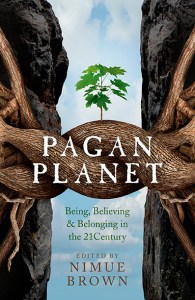
 

BOOK REVIEW: PAGAN PLANET

jhp55ddc04c930d1“For this reason I am doing what I do, working towards …. the more beautiful world our hearts know is possible”. Simon Wakefield is a biologist, Druid and contributor to Pagan Planet: Being, Believing and Belonging in the 21st Century. He talks about the “most profound experience of my life” when observing a nesting sea turtle on a starlit Greek beach. “Putting aside all the requirements to measure and monitor I decided just to be present, and I opened up to an experience of deep time and an ancient longing by another creature simply to be, to express its uniqueness, which has never left me”.

For me, Simon has expressed a point of unity in this diverse collection of essays edited by Nimue Brown and published by Moon Books. The authors come from a variety of Pagan traditions, though with a tilt towards Druidry. Many stand witness to a growing movement of Pagan activism, where people find themselves involved in the demanding, draining and potentially perilous work of resistance, protection and defence. The value of Simon’s words (which he attributes originally to Charles Eisenstein) is to keep an eye on the prize: “the more beautiful world our hearts know is possible”. Beauty, of course, depends on our ability to perceive, name and cherish it. Reading the essays in Pagan Planet, I come away with a sense of this as a unifying Pagan commitment.

What moves me most, I think, is an overall sense of resilience and optimism – not so much an optimism of calculation as an optimism of the heart. In his piece about the foundation of PaganAid, Ian Chandler says: “I have heard people’s stories that make me cry, I have seen destruction that has brought me to my knees with despair. But I have also met people whose dedication against all odds fills me with awe. I have seen achievements that make me want to sing and dance in the street. Now is not the time for us to give up on the future – it is time for us to decide what we want and to make that future happen”. Edwina Hodkinson talks about the frontline herbalism of the Wild Sistas in anti-fracking protection camps. “We dispensed tinctures, teas, creams, cough syrups, health advice, general nurturing and lots of first aid. Protectors who had been injured from interaction with the police wanted treatment for badly bruised ribs and groins, sprained wrists, and grazes … people had great faith in what we did, compliance was good and the results of the herbs spectacular … I’ve come to believe that when we go out of our comfort zones and are prepared to make some kind of sacrifice for ourselves and the earth, the earth responds and works with us”. One of their successes was the ‘warrior drops’ created to deal with trauma, stress and anger on the front line. “Protectors said that these really made a difference in calming them down” and one said “it grounded him and reminded him why he was doing the protest”.

A number of the essays stand witness to the creative energy of Pagan vision and life practice at this moment in history. These include Lorna Smithers’ visionary evocation of Castle Hill, Penwortham, described as “a magical place, in spite of the damage”, whose “alternative story” has been passed on “by its spirits, by decree of the fay king”. Hearth Moon Rising says that “my vision for some time has been to ground modern witchcraft more completely and more concretely in the natural world, to create a deeper understanding of what it means to have an animistic practice”.  Other people are exploring roads less travelled, like Laura Perry in Walking the Modern Minoan Path or Calantirniel in Working with Tolkien, where part of the purpose is to integrate the “Christ energy” into a Pagan path. Irisanya from the Reclaiming tradition offers a piece on Lifestyle/Work/Relationships which is centred on overlapping considerations of gender and peer communication and the magic of knowing how to track the energy in a conversation, when to listen, when to speak up and how to be supportive of voices that are not being heard. There are a number of pieces about the family context, including supporting dependent elders and raising children. In The Teachings of Children, Romany Rivers reports that people ask her whether her spirituality affects her parenting; her view is that it’s the other way round – her parenting affects her spirituality. “I realised how one small person’s emotional state can impact an entire environment. I have learned more about Reiki from working with my children during times of pain and stress, peace and snuggles. I have discovered new reasons to meditate. I have reconnected with the power of imagination. I have found new creative expressions”. She concludes, “I believe that is my children who are Pagan, and it is they who raise me.”

There is much more. I’ve got a piece called Living Presence in a Field of Living Presence: Practicing Contemplative Druidry. I would certainly have thought of it as supporting “the more beautiful world that our hearts know is possible” at the levels of perception, recognition and cherishing. But I didn’t think of it, and have only done so now as a result of reading the rest of this book: the value of community! Because of my involvement, I’m not going to review the book outside this blog or award points. I hope instead that I’ve been able to demonstrate something of its energy, diversity and commitment – and that the Modern Pagan movement from which it comes.


Nimue Brown (ed.) Pagan Planet: Being, Believing & Belonging in the 21st Century Moon Books, 2016

THE GOLDEN FLOWER


“Naturalness is called the Way. The Way has no name or form; it is just the essence, just the primal spirit.” (1)

The Secret of the Golden Flower is a lay manual of Buddhist and Taoist methods for clarifying the mind. It was first published in China towards the end of the eighteenth century. It is the product of the ‘Complete Reality’ School of Taoism (2), which synthesized the internal alchemical arts of longevity, the meditation techniques of Chan (Zen) Buddhism and Confucian ethics. Its key texts included the Tao Te Ching (3) the Prajnaparamita Heart Sutra (4) and a later Taoist work which translates as Cultivating Stillness (5).

The golden flower itself symbolizes the quintessence of the paths of Buddhism and Taoism, as understood by this school. Gold stands for light, the light of the mind itself; the flower represents the blossoming, or opening up, of the light of the mind. Thus the image evokes the awakening of the real self and its hidden potential. Primal spirit is a mode of awareness subtler and more direct than thought or imagination, and it is central to this blossoming. The Secret of the Golden Flower is devoted to the recovery and refinement of primal spirit in the practitioner.

“The beauties of the highest heavens and the marvels of the sublimest realms are all within the heart: this is where the perfectly open and aware spirit concentrates. Confucians call it the open centre, Buddhists call it the pedestal of awareness, Taoists call it the ancestral earth, the yellow court, the mysterious pass, the primal opening.”

In 1920 a thousand copies were reprinted due to a demand by an “esoteric circle” in Beijing according to Richard Wilhelm, who brought it to Europe in a German edition a few years later with a foreword and commentary by C. G. Jung (6). An English edition translated from the German by Cary F. Baynes appeared in 1929. These editions included fragments from a second work, also from the Complete Reality School, called Hui-Ming Ching (7). This adopted the Chan idea that there is no separation between original nature or wisdom-mind (hui = Sanskrit prajna) and stillness (= Sanskrit Samadhi). At the same time hui-ming means uniting wisdom-mind with the energy of life (ming). Contemplative stillness is to be complemented by a system of energetic movement, drawn from Chinese energy arts (chi gung) – an approach consistent with the Taoist understanding of the Tao as simultaneously the underlying permanent reality and the changing flux of things in transformation.

Modern translators recognize the importance of the pioneering Wilhelm/Jung  work, whilst expressing dismay at its level of inaccuracy and misrepresentation. In relation to the Hui-Ming Ching Eva Wong, who was able to translate a complete copy with illustrations, says: “Baynes’ translation is severely biased by Jungian psychology and does not present the work from a Taoist spiritual perspective … the historical and philosophical connections with its major influences … [are] … ignored … we cannot appreciate the spiritual value of a text if we impose a particular perspective, especially one that comes from a different culture … we need to yield to the text and let it speak on its own terms”. Thomas Cleary is equally unhappy on behalf of The Secret of the Golden Flower, using his own notes on the text to compare the older version unfavourably with his own and asserting that “Wilhelm was not familiar with even the most rudimentary lore of Chan Buddhism”.

In a way, Wilhelm and Jung suffer from the downside of being pioneers. Their successors are bound to know the territory better, partly thanks to them. But they were also men of their time in other ways, in their view of the mystic orient. Jung’s introduction began with a section on Difficulties encountered by a European in trying to understand the East. He expressed admiration for Chinese recognition of the “paradoxes and polarity inherent in what is alive. The opposites always balanced each other – a sign of high culture. One-sidedness, though it lends momentum, is a mark of barbarism”. He also used the opportunity to express pleasure that the West was now learning to value feeling and intuition and thereby widen Western consciousness and culture beyond a narrow “tyranny” of intellect. But he also made (to us) embarrassing statements like “measured by it [Western intellect], Eastern intellect can be described as childish … it is sad indeed when the European departs from his own nature and imitates or ‘affects’ it in any way”.

We are now in a globalizing 21st. century where large numbers of Westerners are working with Buddhist meditation and Chinese energy arts and finding them entirely accessible and transforming. China and its place in the world are also very different. We can let go of any residual notion that East is East and West is West and never the twain shall meet. I’ve had a personal involvement with Buddhist meditation and Tantric traditions that have incorporated chi gung exercises.  I do not find them alien. My Western Way is a result both of a personal choice, and perhaps of a personal call. It could easily have been different.

I can learn directly from the East and I find that Taoism has a particular attraction – both that of the early classics and of the much later Complete Reality School: its attempts at inclusivity, its dialogue with Chan, its cultivation of the energy of life, and a Taoist/Chan sensibility in poetry and painting all speak to me. I am aware of a cultural note that is different to mine, yet I can incorporate key lessons directly into my practice. When working with breath, I have become increasingly conscious of a simultaneous movement of the breath and a stillness in the breath. For me this is both an experience and a metaphor. In my terms it feels very Sophian, and I believe I owe the insight to my acquaintance – however superficial – with Taoist tradition.


  1. The Secret of the Golden Flower: the Classic Chinese Book of Life (1991) Translated by Thomas Cleary, with introduction, notes and commentary New York: HarperCollins
  2. Eva Wong (1997) The Shambhala Guide to Taoism Boston & London: Shambhala
  3. Lao Tzu (1998) Tao Te Ching: a Book about the Way and the Power of the Way New version by Ursula K. Le Guin, with the collaboration of J. P. Seaton Boston & London: Shambhala
  4. The Heart Sutra: the Womb of the Buddhas (2004) Translation and commentary by Red Pine Berkeley, CA: Counterpoint
  5. Cultivating Stillness: a Taoist Manual for Transforming Body and Mind (1992) Translated with an introduction by Eva Wong Boston & London: Shambhala
  6. The Secret of the Golden Flower: A Chinese Book of Life (1962) Translated and explained by Richard Wilhelm with a Foreword and Commentary by C. G. Jung, and part of a Chinese meditation text The Book of Consciousness and Life with a foreword by Salome Wilhelm. London & Henley: Routledge & Kegan Paul (revised edition)
  7. Liu Hua-Yang Cultivating the Energy of Life (1998) A translation of the Hui-Ming Ching and its commentaries by Eva Wong Boston & London: Shambhala

WESTERN WAYS: DRUIDRY AND SOPHIA

In my world, Druidry and the Way of Sophia are linked, though not the same. In The Western Way (1,2) authors Caitlin and John Matthews made a distinction between a ‘Native’ Tradition and a ‘Hermetic’ one, which act as “complementary opposites”. The Native Tradition is “the inward spiral of a maze which leads into the heart of ancestral earth-wisdom”. The Hermetic Tradition is the outward spiral of the same maze: a path of evolving consciousness which is informed by the inner resources of our ancestral roots, “augmented in a macrocosmic way” (2).

My original interest in a ‘Celtic’ spiritual thread, developing from the 1980s, wasn’t specifically Druid or Pagan. It came mostly through Celtic and Celtic influenced literature. Although a long tradition in its own right, it post-dates the demise of institutional Druidry and Paganism in Celtic speaking regions. Most of it has been written with at least an element of Christian reference and influence. So we get verses like this from the medieval Welsh Book of Taliesin:

I was at the cross

With Mary Magdalene.

I received the Awen

From Ceridwen’s cauldron. (3)


What I intuitively liked about this was the sense of a culture working to integrate diverse influences rather than attempting to be ‘pure’. Pure culture (or the attempt at it) narrows horizons and banishes possible resources, becoming limited and inflexible in my view. Sophia is both an image of the divine and expresses a blending of Jewish and Greek wisdom traditions. She came to prominence in Alexandria, the largest city of Roman Egypt. She is cosmopolitan. In the verse above Mary Magdalene (an incarnation of Sophia in some gnostic traditions) and Ceridwen (not a traditional Celtic goddess from Pagan times) both have Sophian roles in relation to male figures seen in different ways as light bringers.

Some of the Celtic-derived stories from the medieval period are clearly breaking new cultural ground whilst using resources from the Celtic past. They belong to a realm of creative mythology, as Joseph Campbell called it, whose purpose is “the opening … of one’s own truth and depth to the depth and truth of another in such a way as to establish an authentic community of existence” (4). Twelfth century Western Europe sought to renew itself by drawing on its classical heritage (native in Italy) and Geoffrey of Monmouth drew on it in his Mystic Life of Merlin (5), for example by dedicating a contemplative ‘Observatory’ to the owl deity Minerva, Roman Goddess of Wisdom. It also drew on Celto-Germanic heritage, with the Arthurian mythos – the matter of Britain – taking a prominent place. This mythos does not name Sophia. But it does have the image of the grail and the story of the grail quest. For me the grail represents the presence and energy of Sophia, and Caitlin Matthews has described it as “a prime symbol of Sophia” (6).  Perceval, the grail winner, has to encounter the divine in a new way for himself. At one level his role is to honour and heal the land, renewing its tantric energy. But the Grail Goddess, whilst enabling that traditional collective healing, adds a new and more individuated depth of wisdom and compassion. So although I have always been moved by the scenes and images of the more archaically oriented Peredur (7), I have found a more compelling narrative in Parzival (8). It is the innovative aspect of the story that engages me and the grail image that nourishes me.

In the Gnostic Gospel of Thomas, (9) Jesus of Nazareth asks three leading followers to say what they think he is like. Peter, traditionally Jewish, says “you are like a just messenger” (or righteous angel in other translations). Matthew, familiar with Graeco-Roman ways, says “you are like a wise philosopher”. Thomas says, “my mouth is utterly unable to say what you are like”. The teacher responds, ‘I am not your TeacherBecause you have drunk, you have been intoxicated from the bubbling spring that I have tended’.  As I read this text, it is a confirmation that a lived spirituality is beyond packaging.

In this sense, terms like Druidry, Way of Sophia or Western Way have only a limited use. Joseph Campbell said “the best things cannot be told; the second best are misunderstood; after that comes civilised conversation”. The problem is real yet I believe he overstates his case. I think it is worth the effort of finding words, making distinctions and enabling affiliations in full awareness of the difficulties. Civilised conversation with moments of … something more … feels like an honourable pursuit.

  1. Caitlin & John Matthews (1985) The Western Way: A Practical Guide to the Western Mystery Tradition: Volume 1 – the Native Tradition London: Arkana
  2. Caitlin & John Matthews (1986) The Western Way: A Practical Guide to the Western Mystery Tradition: Volume 2 – the Hermetic Tradition London: Arkana
  3. John Matthews (1991) Taliesin: Shamanism and the Bardic Mysteries in Britain and Ireland London: The Aquarian Press (with additional material by Caitlin Matthews)
  4. Joseph Campbell (1976) The Masks of God: Creative Mythology Harmondsworth: Penguin
  5. R. J. Stewart (1986) The Mystic life of Merlin London: Arkana 
  6. Caitlin Matthews (1986) Sophia Goddess of Wisdom, Bride of God Wheaton, IL: Quest Books
  7. The Mabinogion (1976) Harmondsworth: Penguin (translated with an introduction by Geoffrey Gantz)
  8. Wolfram von Eschenbach, W. (1980) Parzival Harmondsworth: Penguin (translated by A. T. Hatto)
  9. The Gospel of Thomas: the Hidden Sayings of Jesus (1992) San Francisco, CA, USA: Harper San Francisco (translation with introduction, critical edition of the Coptic text and notes by Marvin Meyer; with an interpretation by Harold Bloom)

CONTEMPLATIVE DRUIDRY 2016

The next month is a busy one for contemplative Druidry. Our group in Stroud has its first meeting next Tuesday. Towards the end of January Elaine and I will be working with another local group that meets to explore sacred traditions. Then on 7 February we are running  a Dark of the Moon Workshop day retreat in London, at Treadwell’s Bookshop’s workshop space, 33 Store Street, London WC1 E7BS. Our specific intent is to  greet the dark of the moon at the time of Imbolc and the first stirrings of the Earth. The programme will include contemplative exercises, subtle energy work, silent sitting and Awen space group meditation. As with all of our public events, anyone willing to work within a Druid framework for the day is welcome.

The end of January also sees the publication of a new Moon Books anthology Pagan Planet: Being Believing and Belonging in the 21st. Century – see http://www.moon-books.net  and Nimue Brown’s presentation of the book. I have a piece in it on practising contemplative Druidry. Since I wrote it I have become even more convinced that contemplative Druidry is not a distinct form of Druidry, but rather a flavour, or way of working within it. We can create specific environments and practice frameworks that enable contemplative practice, and understand them as an option within a range of options.

More broadly, I think that the contemplative meme is now well recognised. My 2014 book Contemplative Druidry: People Practice and Potential is still finding new audiences. The Contemplative Druidry Facebook group, which I stopped administering in 2013, continues to thrive, now with a membership of over 1100. Elaine’s blog at http://contemplativedruidevents.tumblr.com/ and the Contemplative Druid Events Facebook page have received increasing increasing attention in the last couple of months, perhaps in part due to the Contemplative Druidry article in the Samhain 2015 edition of Pagan Dawn. Other events are planned for later in the year.

I’ll continue writing about these and other developments in this blog.

KEY WORDS

My very best wishes for 2016 to all readers of this blog. May your year be blessed with peace and loving-kindness.

Like many people I find the change of calendar year a good moment for revising and re-framing what I do. This includes my personal contemplative inquiry.  I remain strongly engaged with my Sophian Way and I am finding means of strengthening it.

At the beginning of contemplative practice I’m now saying: “I open myself to the divine breath: the movement of that breath and the stillness in that breath. I open my heart to the grace of Sophia”.  The key words are breath, movement, stillness, heart, grace and Sophia.

‘Divine breath’ translates the Greek word pneuma which could mean either ‘breath’ or ‘spirit’. It was a favourite with the Gnostics of late antiquity. For me, the divine breath is ordinary breath transformed through practice, awareness and understanding. I feel and taste the knowledge that breath enables life, and that it does so through transcending  the boundary between me and not-me. It allows me an individual life, embodied yet not sealed off. It also connects me to a larger system.

When I follow the movement of the breath, I am  attentive to its inhalation and exhalation. I breathe the cosmos; the cosmos breathes me. The movement of the breath is inherently active, life-giving and relational. There are practices in both Gnosticism and Tantra involving breath exchange with another person which emphasise these aspects of breathing.

The stillness in the breath, in my experience, is held within the movement of the breath. They are not polarised. It is the still point at the heart of being, always present as the activity of breathing is going on. It’s like an inner silence inside a context of sound, or an inner calm inside a context of energetic or emotional arousal. Truly to become open to the divine breath involves a simultaneous awareness of both dimensions.

Opened up to the experience of divine breath (rather than breath awareness as an arbitrary attentional focus) I can open my heart, in the sense offered by Cynthia Bourgeault: “In the wisdom traditions of the Near East, the heart is not the seat of one’s personal emotional life, but an organ of spiritual perception … its purpose is to stay in alignment with the Image of one’s true nature.” (1) Here, the grace of Sophia is Her presence and energy in support of that alignment.

The words cue me in to the experience, though not as a formula, for true contemplative experience is not formulaic. They represent a sensibility of practice, or a culture of practice, rather than a road map. The value of these words, as I continue to use them, will be in what emerges as a result of using them in the coming weeks and months.


(1) Cynthia Bourgeault The Meaning of Mary Magdalene: Discovering the Woman at the Heart of Christianity Boston, MA: Shambhala Publications, 2010


HOLY SOPHIA

I have been on holiday, kissed by a Mediterranean of blue skies, extended midwinter daylight and temperatures into the 20’s. Sparsely populated beaches and warm sand. Water to walk through in lazy delight. The sensuous geometry of Moorish architecture in southern Spain.

I have felt dislocated in a good way, and still do. I’ve been treading an unfamiliar path through this season, this year. It has been accompanied by a contemplative text, which I read and marked before leaving home. It was posted earlier in the month by Rosamonde Ikshvaku Miller in her Gnostic Sanctuary group on Facebook.

“WithIn the depths of the abyss, we find the fountainhead and matrix of the Holy Sophia, pregnant with infinite possibilities. Divinity pours out Its life through her.

“In her womb, Wisdom-Sophia carries the blueprint of all prototypes before matter ever came into being.

“She remains with us in our exile, for She is the tender mother of mercy, great redeemer, and revealer of the mysteries concealed. She is the beginning and she is the end.”

Learning and inwardly digesting these words became the gentle spiritual task of the holiday. I found that the place suited the task, for the words belong to a Mediterranean and Levantine tradition, in which Greek, Jewish and other cultures interweave.

I made my task one of immersion and awareness rather than opinion forming and allegiance. There’s an image of a cosmic goddess (not the same as an earth mother) and a meeting becomes available in the ‘abyss’. The seasonal reference comes through Sophia’s being “pregnant with infinite possibilities … Divinity pours out its life through her”, here understood as a cosmic event in the eternal present. Then there are references to exile, redemption and revelation – not much present in our northern Paganisms. They do of course feature in the mainstream Judeo-Christian tradition that has been profoundly influential for us over a long period of time. They are also classically Gnostic.

I have noticed that I resonate with this text more than I might have expected to. I need to sit with this and explore it further, and really sense into what the attraction is: a direction for my contemplative inquiry.


ST. LUCY’S DAY

“LUCIA PROCESSION” BY FREDRICK MAGNUSSON – ST. LUCY’S DAY, SWEDEN, 2007.

Saint Lucy’s Day is on December 13, part of Advent in the Christian year. I’m posting early because I will be spending the next week or so off the internet.

This feast once coincided with the Winter Solstice, the shortest day of the year before calendar reforms. Her feast day has become a festival of light, something that modern Pagans would perhaps more readily associate with Imbolc. St. Lucy’s Day is celebrated as a major feast day in Scandinavia with its long dark winters.

Lucy is called Lucia and is represented as a woman in a white dress and red sash with a crown or wreath of candles on her head. In both Norway and Sweden, girls dressed as Lucy carry rolls and cookies in procession as songs are sung. Even boys take part in the procession as well, playing different roles associated with Christmas. It is said that to vividly celebrate St. Lucy’s Day will help one live the long winter days with enough light.

I have tended more to link the day to a very different response to the day – John Donne’s poem A Nocturnall Upon St. Lucies Day, Being the Shortest Day. This was composed in the 1590’s, well before calendar reform in England.

The poem is linked to a personal bereavement as well as the season. I share the first two verses. They are very much about the young poet’s own experience, rather than the season or the one who has been lost – though in a sense both the poet’s feelings and the poem itself are a service to her. The words themselves give the dark its voice, capturing the moment of desolation fully, and holding it. They do not move on to any culturally expected renewal, but rather to an alchemical anti-renewal instead. If there is any redemption it is in the writing itself, the expression. Donne was a good English writer in a time of good English writing.


Tis the yeares midnight, and it is the dayes,

Lucies, who scare seaven houres herself unmaskes,

The Sunne is spent, and now his flasks

Send forth light squibs, no constant rayes;

The worlds whole sap is sunke;

The general balme th’hydroptique earth hath drunk,

Whither as to the beds-feete, life is shrunke,

Dead and enterr’d; yet all these seeme to laugh.

Compared to mee, who am their Epitaph.


Study me then, you who shall lovers bee

At the next world, that is, at the next Spring;

For I am every dead thing.

In whom love wrought new Alchimie.

For his art did expresse

A quintessence even from nothingnesse,

From dull privations, and leane emptinesse:

He ruin’d mee, and I am re-begot

Of absence, darkenesse, death; things which are not.


John Hayward (editor) John Donne Dean of St, Paul’s Complete Poetry and Prose London: The Nonesuch Press, 1967 (Donne became Dean of St, Paul’s in London a long time after he wrote this poem).


POEM: WATER AND WAVE

I’m sharing this song of Kabir because I enjoyed it and felt cheered by it.  I liked its devotional and ecstatic note – not my usual one.. I have harmonised it with my way of Sophia by changing a ‘his’ to a ‘her’.


I have been thinking of the difference

Between water

And the waves on it. Rising,

Water’s still water, falling back,

It is water, will you give me a hint

How to tell them apart?


Because someone has made up the word

“Wave”, do I have to distinguish it

From water?


There is a Secret One inside us;

The planets in all the galaxies

Pass through her hands like beads.


That is a string of beads one should look at with

Luminous eyes.


A weaver by trade but a poet-singer by calling, Kabir lived in fifteenth century India. His philosophy incorporated various beliefs of both Muslims and Hindus and later became one of the major influences behind Sikhism. Like Rumi, further to the west and generations earlier, his generously devotional and ecstatic path made him a natural bridge builder between traditions.

Kabir Ecstatic poems Boston, MA: Beacon Press, 1992 The English translations are free enough for Robert Bly to call them ‘versions by Robert Bly’. Given Bly’s freedom I have changed a ‘his’ to a ‘her’ above to support the poetry of my own gnosis. There is an earlier set of translations published by MacMillan in New York in 1915 by Rabindranath Tagore assisted by Evelyn Underhill under the title Songs of Kabir. Whilst I don’t follow Bly in calling the English of the earlier work “useless”, I do find that Bly’s interpretation has more passion and power. The Bly work includes an insightful afterword Kabir and the transcendental Bly by John Stratton Hawley.


POEM: THE MOON IN DEWDROPS

Simplicity and complexity, elegance and wisdom combined in the poetry of Japanese Zen. I notice that I respond more strongly to such poetry than I do to didactic texts about meditation and philosophy.


To what shall

I liken the world?

Moonlight, reflected

In dewdrops,

Shaken from a crane’s bill.


I particularly love this poem. The apparent naturalism of the imagery makes it powerful and accessible to anyone. Yet for me, this poem also brings up wider issues about reading and interpretation. The poet’s location in place, time and culture do make a difference. Ehei Dogen (1200-1253) was one of the first to transmit Zen Buddhism from China to Japan and was founder of the Soto School. His poem is a waka – a 31 syllable form predating the invention of haiku. Dogen is a key figure in both Japanese Buddhism and Japanese literature.

In Mahayana Buddhism, the Buddhism of all Japanese schools including Zen, the moon stands for Buddha-nature. So the poem teaches a familiar Mahayana truth that the moon (Buddha-nature) is completely reflected in every one of the countless dew drops (all things) without discrimination, namely one in all, all in one. This understanding is accompanied by a sense of fragility and impermanence within nature – strongly present in Japanese culture independently of Buddhism and reinforced by Buddhist teaching. Dogen gives us elegance and complexity in a 31 syllable form.

Hee-Jin Kim*, a modern Zen scholar, takes this further, bringing out Dogen’s sensitivity to history as well as to nature. He draws attention to the word ‘shaken’: each dew drop holds a full yet shaken reflection of the moon. Dogen lived in what was seen as a dark and ill-starred time in Japanese history. Many Buddhists thought that even their path was compromised and talked of degenerate dharma (mappo). Kim understands Dogen as resisting this ideology of despair whilst fully aware of the collective turmoil. On this reading, the poem asserts that timelessness is experienced within, and only within, momentariness, even when the times are stressed.


To what shall

I liken the world?

Moonlight, reflected

In dewdrops,

Shaken from a crane’s bill.


* Hee-Jin Kim Dogen on meditation and thinking: a reflection on his view of Zen Albany, New York: State University, 2007 (At the time of publication Hee-Jin Kim was Professor Emeritus of Religious Studies at the University of Oregon. He is also the author of Dogen-Kigen: Mystical Realist).

Earth Eclectic

music that celebrates Earth and speaks to the heart

Sarah Fuhro Star-Flower Alchemy

Follow the Moon's Cycle

Muddy Feet

Meeting nature on nature's terms

Rosher.Net

A little bit of Mark Rosher in South Gloucestershire, England

Becoming Part of the Land

A monastic polytheist's and animist’s journal

selkiewife

Selkie Writing…

Charlotte Rodgers

Images and words set against a backdrop of outsider art.

Prof Jem Bendell

living with metacrisis and collapse

Towint

The pagan path. The Old Ways In New Times

The Druids Garden

Spiritual journeys in tending the living earth, permaculture, and nature-inspired arts

The Blog of Baphomet

a magickal dialogue between nature and culture

This Simple Life

The gentle art of living with less

Musings of a Scottish Hearth Druid and Heathen

Thoughts about living, loving and worshiping as an autistic Hearth Druid and Heathen. One woman's journey.

Wheel of the Year Blog

An place to read and share stories about the celtic seasonal festivals

Walking the Druid Path

Just another WordPress.com site

anima monday

Exploring our connection to the wider world

Grounded Space Focusing

Become more grounded and spacious with yourself and others, through your own body’s wisdom

The Earthbound Report

Good lives on our one planet

Hopeless Vendetta

News for the residents of Hopeless, Maine