Contemplative Inquiry

This blog is about contemplative inquiry

Tag: Poetry

WILD WRITING

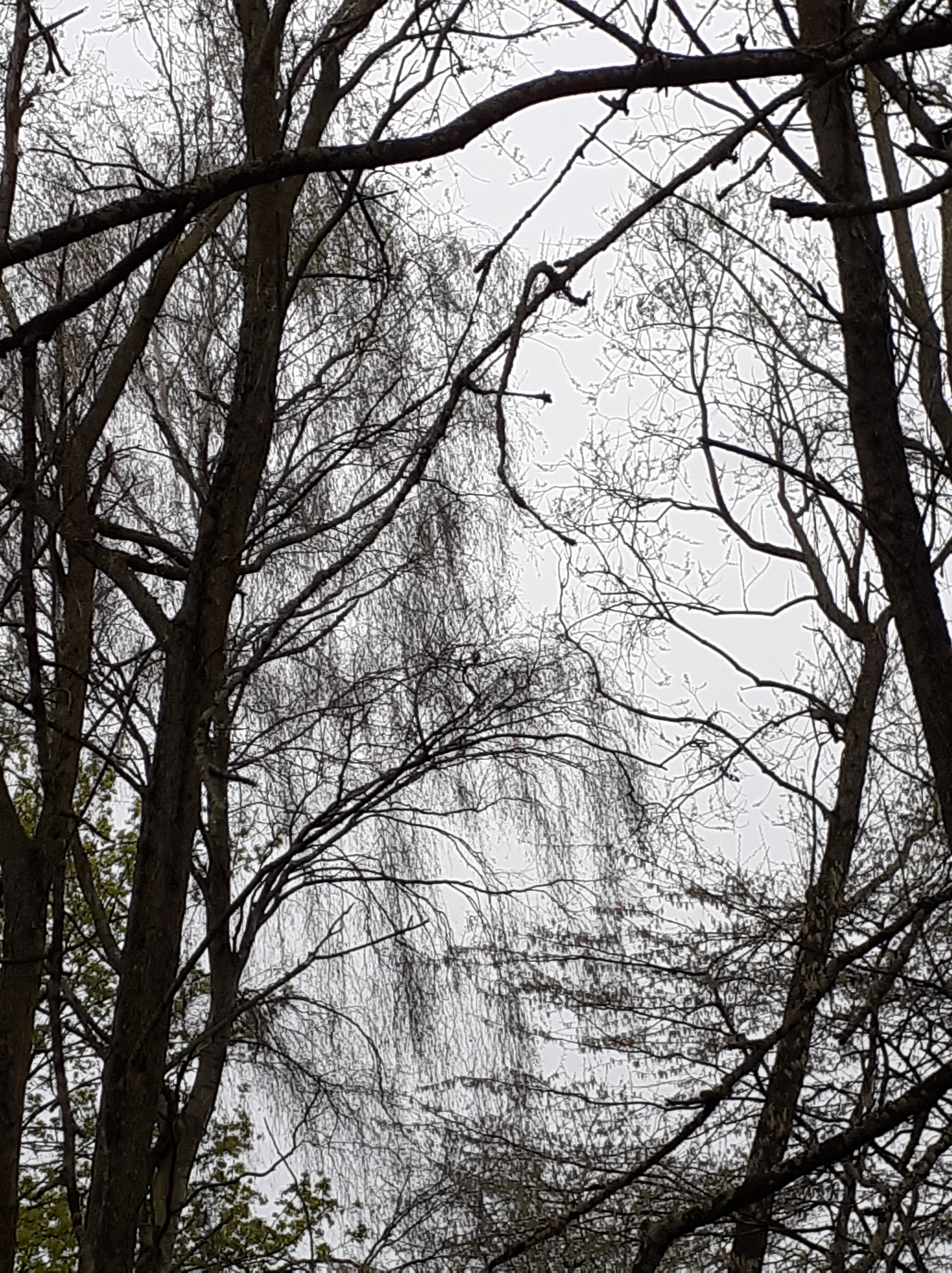
I look at the picture with fresh eyes. It is already a record of the past, and it is much too still. Yet I feel drawn towards this image. I enjoy the tree shapes in their starkness. I sense resilience in the plant life pictured here. I am writing now with sunlight intermittently on my shoulder, and the sounds of wind and rain beyond my strong glass doors.

I am also reflecting on writing as a practice. Natalie Goldberg (1,2) writes books about this and her description of ‘writing practice’ seems to me to have two entirely compatible meanings. The first is that it trains people for the writing of poems, stories and novels. The second points to a form of life practice flowing from the view that “writing is the crack through which you can crawl into a bigger world, into your wild mind” (1).

In Wild Mind: Living the Writer’s Life Natalie Goldberg compares writing practice with journaling. “Journal writing has a fascination with the self, with emotion and situation. It stops there. Writing practice lets everything else run through us; in writing practice, we don’t attach to any of it. We are aware that the underbelly of writing is non-writing. Journal writing seems to be about thought, about rumination and self-analysis. … We want to get below discursive thought to the place where mind – not your mind or my mind but mind itself – is original, fresh. It’s not you thinking. Thoughts just arise impersonally from the bottom of our minds. That is the nature of mind – it creates thoughts. It creates them without controlling them or thinking them … Writing practice knows this, knows how we are not our thoughts, but lets the thoughts, visions, emotions run through us and puts them on the page.” (1)

In her earlier book, Writing Down the Bones: Freeing the Writer Within, Natalie Goldberg quotes Jack Kerouac as saying that a writer should be ‘submissive to everything, open, listening’. She also recommends that “we stay in the trenches with attention to detail”, avoiding escape into abstraction. She points to poetry in particular, “because it brings us back to where we are. It asks us to settle inside ourselves and be awake”. She reproduces the famous William Carlos Williams poem:

“So much depends

upon

a red wheel

barrow

glazed with rain

water

beside the white

chickens.”

I remember this poem from my childhood. I liked it a lot, but couldn’t find anything to say about it in the class room when it was expected that I would. I was embarrassed then. I wouldn’t be now.

Natalie Goldberg also practices Zen Buddhism, with Katagiri Roshi until his death and more recently as an ordained member of the Order of Interbeing founded by Thich Nhat Hanh. She acknowledges the role of Zen in developing her insights into the creative process. I find her approach, including her practical exercises, very helpful.

(1) Natalie Goldberg Wild Mind: Living the Writer’s Life New York, NY: Open Road Integrated Media, 2011 (first published 1990)

(2) Natalie Goldberg Writing Down the Bones: Freeing the Writer Within Boulder, CO: Shambhala, 2016 (30th anniversary edition)

BLUEBELLS BEFORE BELTANE

Seeing bluebells

In verdant grass.

Will summer really come?

RUMI: TWO QUATRAINS ON NIGHT

“Night comes so people can sleep like fish

In black water. Then day.

Some people pick up their tools.

Others become the making itself.”

“Night goes back to where it was.

Everyone returns home sometime.

Night, when you get there,

Tell them how I love you.”

From the collection Unseen Rain: Quatrains of Rumi translated by John Moyne and Coleman Barks Putney, VT: Threshold Books, 1986. The translators note that “in some languages of the Middle East the word for ‘rain’ and the word for ‘grace’ are the same”.

I am very conscious at this time of year not just of darkness, but of a longer night. Here Sufi poet and teacher Rumi evokes qualities of night, suggesting potential forms of relationship with it.

HADEWIJCH THE BEGUINE

How could I believe this

If I had not found it true?

The soul that wanders in free nakedness

Births all that is and will be,

Participates in ecstasy

In engendering the Son

In creation and re-creation

Of all the worlds.

In sublimest mystery

All words drown.

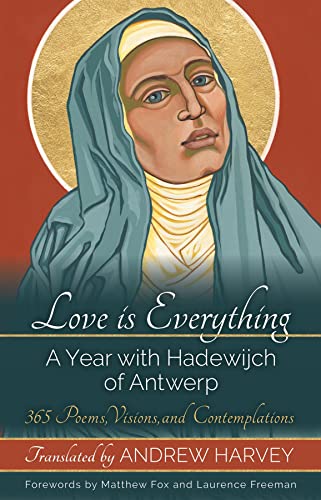
From: Andrew Harvey (translator) Love is Everything: A Year with Hadewijch of Antwerp: 365 Poems Singapore: Medio Media, 2002 (Forewords by Matthew Fox and Laurence Freeman)

Hadewijch of Antwerp lived in the 13th. century. She was a Beguine, part of a women’s lay order who took no religious vows beyond promising not to marry “as long as they lived as Beguines”. They could leave at any time. For a period, they flourished in the Low Countries, France, and the Rhineland. The only definitely known Beguine community (Beguinage) in England was in Norwich in the 15th. century, well after the time of Hadewijch or indeed the English anchoress Julian. Beguines stressed voluntary poverty (though they could keep their own property), care for the sick, and a life of devotion. They worked in the world, for example in the woollen and silk industries, and in laundries. Leading figures such as Hadewijch also wrote for the wider community and effectively developed their own theology.

Andrew Harvey salutes Hadewijch as “one of the most incandescent and inspired of all Christian mystics” and sees her now as pointing the way to an “evolutionary transformation into embodied divinity” that “our devastating global dark night is both urgently demanding and making possible”. Literate in Latin and French as well as the middle Dutch in which she wrote, Hadewijch was well acquainted with with the literature of Christian mysticism and also the works of the troubadour tradition with its own philosophy of love. She is known to have written 31 letters, 14 visions, 45 poems and stanzas, and 16 poems in couplets, initially circulated in the Flemish lowlands and in the Rhineland.

Hadewijch was influential on the historically better known mystics of the 14th. century – particularly Jan Ruusbroec, who acknowledged her influence in his own work, and probably also Meister Eckhart. But she herself was forgotten by the end of the 15th. century and not rediscovered until the middle of the 19th. It is only in recent decades that she has once more received widespread attention.

The church and society of Hadewijch’s day were at best ambivalent about the Beguines and their relative independence. Hadewijch was able to flourish for a time, but “the intensity of her witness to Christ consciousness aroused bitter opposition from both church clerics and from within her own community”. She may have spent time in prison and possibly lived her last years serving and sleeping as an unpaid helper in a leprosarium.

By the early 14th. century, attitudes had become even harder. The French Beguine Marguerite de Porete was burned at the stake in Paris in 1310, as a ‘relapsed heretic’. In her widely popular book The Mirror of Simple Souls, she had written that “a soul, annihilated in the love of the creator could, and should, grant to nature all that it desires”. Her view was that such a soul could desire nothing but good, and was incapable of sin. But her words were interpreted as an invitation to ignore the moral law, and to suggest that one had no need for the Church and its sacraments or its code of ethics.

In 1311-12, the Council of Vienne attacked the Beguines for their alleged tendency to “dispute and preach about the highest Trinity and the divine essence and introduce opinions contrary to the Catholic faith concerning the articles of faith and the sacraments of the Church”. Although the Beguines continued to function, they became more cautious, more mainstream for their time and more likely to be aligned to other Orders. There were no more influential writers that I am aware of. Their wings had been clipped. They were no longer a threat.

I am drawn to Hadewijch’s writing for its eloquence in evoking profound contemplative experiences. Her spiritual boldness and unswerving commitment earn my deepest respect. She reveals the power in contemplative culture. Though not on the same path as Hadewijch, I am sensitive also to the heartbreaking gender, theological and institutional issues raised by her life and work.

My personal take-away is that innovative spiritual movements, however contemplative and mystical, are also part of the social world. They need to develop supportive communities, however precarious and marginal. They are effectively co-creating new culture, and it needs to be nurtured and protected. They also need to avoid turning entirely inwards and degenerating into cults. The Beguines seem to have got this balance about right, despite the highly repressive conditions of their time. This is a source of inspiration in itself.

POEM: CONFRONTED BY CHRYSANTHEMUMS

For his morning tea

A priest sits down

In utter silence –

Confronted by chrysanthemums.

Matsuo Basho The Narrow Road to the Deep North and Other Travel Sketches London: Penguin Books, 1966 (translated with an introduction by Nobuyuki Yuasa)

The introduction names Matsuo Basho (1644-94) as one of the greatest figures in Japanese literature, and describes his life and work. A younger son of a minor samurai family, at nine years old he was sent to the Todo family as page and study-mate for Yoshitada, its eleven year old heir. Yoshitada, born with a delicate constitution, was more interested in literary than in military arts, and he and Basho studied the fashionable art of linked verse under the poet Kigin.

When Yoshitada died at the age of 25, Basho left the service of the Todo family by running away to Kyoto where he spent five years studying Japanese and Chinese classics at Buddhist temples. Later he based himself in the younger city of Edo (now Tokyo) where he felt greater freedom to find his own direction as a poet.

Dissatisfied with the, to him, superficial culture of Edo’s ‘floating world’, Basho turned to Zen and learned meditation from the Zen priest Buccho. Poetry still came first for Basho, but his understanding and practice changed. He wrote of his own work: “What is important is to keep our mind high in the world of true understanding, and returning to the world of our daily experience to seek therein the truth of beauty. No matter what we may be doing at a given moment, we must not forget that it has a bearing upon our everlasting self which is poetry”. Basho is a pen name, and the name of a species of banana tree about which Basho said: “the big trunk of the tree is untouched by the axe, for it is utterly useless as building wood. I love the tree, however, for its very uselessness … I sit underneath it, and enjoy the wind and rain that blow against it”.

Discussing the relationship between the poet and nature, he wrote: “go to the pine if you want to learn about the pine, or to the bamboo if you want to learn about the bamboo. And in doing so, you must leave your subjective pre-occupation with yourself. Otherwise you impose yourself on the object and do not learn. Your poetry issues of its own accord when you and the object have become one – when you have plunged deep enough into the object to see something like a hidden glimmering there. However well phrased your poetry might be – if the object and yourself are separate – then your poetry is not true poetry but merely your subjective counterfeit.”

By the time Basho came to write travel sketches, mixing haiku and prose in the genre known as haibun, he had spent some years casting away his material attachments. Now he had “nothing else to cast away but his own self which was in him as well as around him. He had to cast this self away, for otherwise he was not able to restore his true identity (what he calls ‘the everlasting self which is poetry’ in the passage above). … He left his house ‘caring nought for his provisions in the state of sheer ecstasy'”.

I love the haiku at the top of this post. I love the freshness and naturalness of the priest’s encounter with a flower that is steeped in the formal (and auspicious) symbolism of both Buddhist tradition and Japanese national culture, but is offered here in its simple yet extraordinary essence.

I cannot claim real understanding of traditional Japanese Zen culture and its relationship to creative arts. I have a smattering of knowledge and an awareness of some principles. But I am sure that much is lost in translation. What I do have is the capacity to open myself up to the words and images. Here I find the resonance of a richer experience of being, better grounded whilst also more spacious.

For his morning tea

A priest sits down

In utter silence –

Confronted by chrysanthemums.

JOURNEY AND GOAL

“You’re the journey and the goal –

Exile in the desert

The years of mirage and lightning

And the ecstatic returning to your own house.

You’re the house”

Kabir Engoldenment: A Year with Kabir – 366 Timeless Poems Seattle, WA: KDP Publishing, 2021 (Translated and compiled by Andrew Harvey)

In his introduction, Andrew Harvey writes:

“Kabir is India’s greatest mystic poet and, with Rumi, one of humanity’s two universal prophet poets. He was born to a poor Muslim family of weavers in Benares (now Varanasi) probably around 1440 and died in 1518. Although Kabir refused to belong to any religion, preferring (and championing) a naked direct connection to the Divine, Kabir is revered by Hindus and Muslims alike and 300 of his works were incorporated into the Sikh scriptures. In Varanasi, the holy city where he lived, his songs are still sung by weavers and rickshaw drivers, cigarette sellers, beggars, sadhus and the ‘doms’ that supervise the burning of the dead.

“I asked an old boatman once who was ferrying me on the Ganges and singing Kabir why they loved him. He said, ‘He was one of us. He sang in Hindi, the language of the streets, not Sanskrit. Whoever you are, whatever religion, whatever religion you belong to, he is speaking to you directly.”

See also: https://contemplativeinquiry.blog/2021/01/30/turn-me-to-gold/

POEM: THIS STILL CENTRE

Here, indeed, is no ordinary spot:

no place on the map, in the cosmos,

is anything like it.

This still Centre is the one spot

where energy is actually discovered

welling up out of Nothing.

All the irresistible torrents

which swirl and roar through every other place

rise silently in this place,

never ruffling its perfect calm.

Douglas Harding Everyday Seeing: daily meditations on the One within. London: The Shollond Trust, 2019 (Quotations selected by Richard Lang)

POEM: ASTONISHED BY THE ORDINARY

A discarded flowerhead, wet mud and grass.

I am drawn down into seeing,

And,

Astonished by the ordinary,

I am opened up to awe.

THOMAS TRAHERNE DAY 2021

The image is of two modern stained glass panels in Hereford Cathedral, commissioned in honour and remembrance of the seventeenth century priest, poet and mystic Thomas Traherne. The Anglican Church has dedicated 10 October to his memory. Here is the first verse of Desire, one of his poems:

“For giving me Desire,

An Eager Thirst, a burning Ardent Fire,

A virgin Infant Flame,

A Love with which into this World I came,

An Inward Hidden Heavenly Love,

Which on my Soul did work and Move,

And ever, ever me Enflame,

With restless longing Heavenly Avarice,

That never could be satisfied,

That incessantly a Paradice

Unknown suggest, and som thing undescried

Discern, and bear me to it; be

Thy Name for ever praised by me.” (1)

(1) Denise Inge (ed.) Happiness and Holiness: Thomas Traherne and His Writings London: The Canterbury Press Norwich, 2008 (Canterbury Studies in Spiritual Theology)

NOTE: Thomas Traherne (1636-74) was the son of a prosperous Hereford shoemaker – big house, numerous resident apprentices.  He grew up during the civil war (1642-49) and England’s  republican experiment (1649-1660) in a naturally royalist area. He entered Brasenose College, Oxford, in 1652 (16 being a normal age at the time) under a strictly Puritan head, took  a BA in 1656 and was appointed minister at the Herefordshire Parish of Credenhill by the Commissioners for the Approbation of Public Preachers in 1657. As soon as Charles II returned to England Traherne arranged to be ordained as Credenhill’s Anglican vicar, developed strong links with the renewed life of Hereford Cathedral, and also found time to be Chaplain to Sir Orlando Bridgeman, Charles’ Lord Privy Seal. Denise Inge* describes Traherne as “distinguished from his seventeenth century peers by the fact that he is blissfully untroubled by the tensions, doubts, anxieties that (we are repeatedly told) mark the age in general”.

*Thomas Traherne Poetry and Prose London: Society for Promoting Christian Knowledge, 2002. (Selected and introduced by Denise Inge for the series The Golden Age of Spiritual Writing)

FAREWELL POEM

Passion too deep seems like none.

While we drink, nothing shows but the smile that will not come.

The wax candles feel, suffer at partings:

Their tears drip for us until the sky brightens.

Tu Mu (803-52)

From: Poems of the Late T’ang translated from the Chinese with an introduction by A.C. Graham Harmondsworth: Penguin, 1965

Of this poet, Graham says: “Tu Mu is most admired as the master of chueh-chu, the New Style quatrain with an AABA rhyme scheme, like that of Omar Khayyam. The swift elegance of his verses, running effortlessly within strict formal limits, cannot be captured in my easy-going sprung rhythms.”

Earth Eclectic

music that celebrates Earth and speaks to the heart

Sarah Fuhro Star-Flower Alchemy

Follow the Moon's Cycle

Muddy Feet

Meeting nature on nature's terms

Rosher.Net

A little bit of Mark Rosher in South Gloucestershire, England

Becoming Part of the Land

A monastic polytheist's and animist’s journal

selkiewife

Selkie Writing…

Charlotte Rodgers

Images and words set against a backdrop of outsider art.

Prof Jem Bendell

living with metacrisis and collapse

Towint

The pagan path. The Old Ways In New Times

The Druids Garden

Spiritual journeys in tending the living earth, permaculture, and nature-inspired arts

The Blog of Baphomet

a magickal dialogue between nature and culture

Musings of a Scottish Hearth Druid and Heathen

Thoughts about living, loving and worshiping as an autistic Hearth Druid and Heathen. One woman's journey.

Wheel of the Year Blog

An place to read and share stories about the celtic seasonal festivals

Walking the Druid Path

Just another WordPress.com site

anima monday

Exploring our connection to the wider world

Grounded Space Focusing

Become more grounded and spacious with yourself and others, through your own body’s wisdom

The Earthbound Report

Good lives on our one planet

Hopeless Vendetta

News for the residents of Hopeless, Maine

barbed and wired

All content on this site is now located at www.jonberrywriter.co.uk