Contemplative Inquiry

This blog is about contemplative inquiry

Tag: Paganism

AWEN SPACE

I’ve heard it said that attempting to describe actual spiritual practice is folly. It’s like pinning up butterflies for display – you retain the husk whilst losing the flight. But sometimes the endeavour seems worth the risk. I want to talk about the group practice of ‘awen space’ that forms a part of my Druidry.

My local contemplative Druid group met for two hours last Tuesday, 9 December. We connect for two hours in the afternoon on the second Tuesday of every month, except for May and November – a pattern that has now lasted for just over a year. In those months we meet for a full Saturday, sometime after the festivals of Beltane and Samhain. The days offer the advantage of time for a greater variety of practice, the presence of people from outside our local catchment area, and an introductory space for new members. 19 people are now at least provisionally involved, and we have decided to close the group. The Tuesday sessions offer a greater sense of continuity, a more intimate atmosphere, and even greater focus and simplicity. Attendance currently fluctuates between five and nine. This week eight of us were present.

Our usual structure for a two hour session tends to be

  • Pre-meeting for greetings and refreshments
  • Entry into sacred space through a brief ritual opening
  • Group check in
  • A period of silent sitting meditation (about 20 minutes)
  • A move into the awen field (for about 35-40 minutes)
  • Group check-out
  • Exit from sacred space
  • Farewells

Although our use of ritual is lean and parsimonious, it is a very important part of this process. It is the first step in making our attention intentional, and in turning a domestic hearth into a nemeton. Over time, we have tended to favour putting our personal check-ins and check-outs within the nemeton, since we are entering into sacred relationship as well as sacred space, tuning into each other as part of the practice – not just as a preliminary or warm-up. We use a talking stick process for this, to emphasise the intentional and ritualised aspect of what we are doing.

I think of the awen space as being the most distinctive part of the session. We enter the space through a repeated chanting of awen – how much, or whether we ‘cascade’, depends on our sense of the moment – and then enter silence, consciously together rather than meditating side by side as in the simple sitting meditation that precedes this practice. We may maintain this collective and relational silence or we may choose to sing, chant or say things. In this sense it is an interactive practice albeit a subtle one. It is most powerful when we can hold back from entering into actual dialogue and exchange whilst at the same time moving with the current of communication and relationship which we are generating both through our silence and our utterance. There’s a fine point of balance and tension here. When the awen space is over – it’s over, so it’s not strictly timed. There’s a person whose job it is to lead us both into and out of the space and they make the call. Usually it reflects everyone’s sense of the appropriate ending. We chant awen on our way out of this space as well as into it.

In this context we experience awen, Druidry’s subtle magic, as an energetic field in which we are inspired to be more open and receptive to each other – and at times to find authentic here-and-now language for our felt sense of co-presence and connection within an enlivened space. So it’s something within and between us when we are together, not so much a lightning flash from above. Sometimes our experience completely flows; sometimes it’s more halting. The space gives us a mirror, say rather an echo, of what we bring to it on the day. The physical space matters too – on Tuesday it was a space of wood burner glow and tiny lights in a deepening dusk, and a circle of people working gently together. For me, the feeling-tone and the imagery of this space, lodged in the shifting ever-now of memory, are my key reference point for ‘contemplative Druidry’ as a unique spiritual note. And I am made even more grateful to be able to practice in this way with a group of good companions.
 

A CONTEMPLATIVE DRUID EVENT

Thanks to the interest generated by Contemplative Druidry, members of the Gloucestershire contemplative group have set up an entity called Contemplative Druid Events. So far we have a blog at http://contemplativedruidevents.tumblr.com/ and a forthcoming retreat.

The retreat is being held on the weekend of 17-19 April 2015 at Anybody’s Barn, Birchwood Hall, Storridge, Nr. Malvern, Worcestershire WR13 5EZ.  Details of the retreat can be found on the blog.

I am excited by this prospect. It provides the opportunity to work with a larger group of people and to learn from them. Contemplative Druidry doesn’t come with a long specific tradition or an inherited set of practices and teachings. As modern Druids, we are engaged in an exploratory and co-creative enterprise. Events will extend the experience and understanding of participants and facilitators alike.

At the same time we do have a vision of what we are offering, and a sense of how the retreat will work. We will use the Friday evening to enter sacred space and move into introductions and a culture setting process. I consider the way in which we enter into relationship with the space and each other to be a highly significant part of the event and not just a warm up or preamble. It does much to determine the quality of living presence in the space, as important as any practice or activity. As for practices and activities – there will be sitting meditations and an introduction to what our existing local group calls “Awen Space”. Other offerings may include chanting, sacred movement, outside walking meditation and ‘lectio divina’ from the book of nature. We will likely make use of a fire pit on the Saturday evening.

The retreat also gives us the chance simply to be, alone and with fellow travellers, in a beautiful nurturing space. (After the opening process, every activity is an invitation to the participants, rather than a demand on them.) We will work with a maximum of sixteen people, including ourselves – there are five of us with facilitator roles from the Gloucestershire group. This is not the full capacity of the centre we are using, for we wanted a spacious environment on the physical as well as other levels.

I have a strong belief in this way of working and look forward to sharing it with new people.

CONTEMPLATIVE DRUIDRY: BOOK REVIEW BY MARIA EDE-WEAVING

I like the way in which the reviewer takes the discussion forward whilst also saying nice things about my book!

ContemplativeDruidry copy

A review by Maria Ede-Weaving of  ‘Contemplative Druidry: People, Practice and Potential’ by James Nichol

Modern Druidry is an evolving spirituality; each of its practitioners is continually adding to the breadth and depth of this path through their experiences. What gives a spirituality its power is it practices and approaches, and these are far from static – they live and breathe, grow and change, as we do. For a path to flourish and mature, it requires that we engage, question and explore, remaining open to the possibilities of change whilst honouring the wisdom already shared. James Nichol’s Contemplative Druidry: People, Practice and Potential is a wonderful example of this process in action.

Nichols has gathered a group of Druids to discuss their experiences of contemplative practice. Fifteen Druids share their thoughts about both their solo and group encounters with contemplative meditation and how these have impacted upon their Druidry and wider lives.

The book is in three main sections: ‘People, Practice and Potential’ with contributors not only reflecting on what drew them to contemplative Druidry and how such is expressed in their spiritual practice, but also posing the question of how such approaches might manifest in the wider Druid community, should they be more readily explored.

It is clear from these accounts that sitting meditation is only one part of this approach; mindful walking, chanting, daily offices, communion with nature/the divine and creative activities also play a part in keeping contributors present and connected. There is a real sense that each – for want of an established Druid-based contemplative framework – has been quietly experimenting, acting as pioneers exploring their own frontiers in order to find what works.  In doing so, they have been planting the seeds of a tradition that could potentially flourish into a valid and inspiring area of Druidry, one that until now has been rather ignored. Many have taken their inspiration from other spiritualities such as Buddhism and Christianity, however, their practices have developed a flavour that is distinctly Druidic. It’s a fascinating read and interesting to see how meditative practices give depth to Druid concepts such as the Awen and Nwyvre;  how Druid contemplation and mindfulness might  help to shape, transform or deepen a connection to life and self.

In the Neo-Pagan movement and the Western Mystery Tradition there has been a dominant focus on what might be perceived to be ‘active’ meditation techniques; the use of visualisation and path-working holding a dominant place. The Eastern approach to meditation has often been assumed to facilitate a removal of self from the world in an attempt to transcend its illusions. As such it might be perceived to be at cross purposes with the Druid world view where life and earthly experiences are celebrated. Most of us understand  Druid spiritual practices to be a gateway to deepen one’s involvement with earthly life, as opposed to escaping it via ascetic disciplines, however, what Nichol’s book illustrates is that the contemplative approach, explored from a Druid perspective, can be a tool that moves us into a richer and deeply felt relationship with nature, community and self.

Reading through the book’s many thought-provoking accounts I had that sense of excitement you get when a long-held suspicion about something is validated by another’s experience. My first encounter with meditation came years ago via the practice of Yoga. For me, regardless of how one might interpret the philosophy of Yoga, what its practices illustrated was that these techniques of mindful movement, breath and contemplation could actually help me to feel more embodied and present on this planet. They were immensely practical and useful , not only in aiding my physical well-being but also in creating a healthier flow between my body, mind and emotions, and in doing so, opening the door to my spiritual journey. The book’s examples makes it clear that I am not alone in my view that these techniques are not ring-fenced by any religion or path but are open for all to use. I see no contradiction in including them as part of my Druid practice. It is true that each spiritual path will approach these techniques through their own spiritual lens – and even each individual within each path will bring their own unique focus to bear – but Nichol’s books suggests that there is a rich seam of spiritual nourishment to explore here, and that even if such practices are not for us, then the debate about them can only deepen and widen what Druidry has to offer.

There is much here that gives food for thought. Contemplative Druidry is a valuable springboard for further discussion and a great starting place for those who are interested in including contemplative meditation in their practice. Nichol’s book encourages us to really think about what a contemplative Druidic practice might be. What is clear from each contributor’s experience is that it is an approach that is nature and body affirming, one that offers us a means to engage more fully with self and the world around us. In time, as this discussion deepens, as more people engage with these practices and share the results, I feel sure that many more benefits will become apparent. All this can only add to the richness and diversity of the Druid path.  – Maria Ede-Weaving

James’ book is available from Amazon and will shortly be available from the OBOD shop.

ORPHIC HYMN TO NIGHT

Today, where I live, we changed our clock time. Yesterday’s 7 p.m. is today’s 6 p.m. and the evenings get dark. This introduces the Samhain season for me and all that it brings. Here is a Hymn to Night, conventionally ascribed to Orpheus. According to translator and editor Apostolos Athanassakis, they were most likely written in their present form in the early third century AD in Pergamum, a city in modern Turkey .

I shall sing of Night,

mother of gods and men;

We call Night Kypris,

she gave birth to all.

Hear, O Blessed Goddess,

jet-black and starlit, for you delight in the quiet

and slumber-filled serenity.

Cheerful and delightful, lover

of the nightlong revel, mother of dreams,

you free us from cares,

you offer us welcome respite from toil.

Giver of sleep, beloved of all,

you gleam in the darkness as you drive your steeds.

Ever incomplete, terrestrial,

and then again celestial,

you circle around in pursuit

of sprightly phantoms,

you force light into the nether world,

and then again you flee

into Hades, for dreadful Necessity

governs all things.

But now, O blessed one – beatific,

desired by all – I call on you

to grant a kind ear

to my voice of supplication,

and to come, benevolent,

to disperse the fears that glisten in the night.

Apostolos Athanassakis  talks about Orphic hymns as instances of a devotional mysticism that uses “the power of clustering epithets” for the creation of “an emotional and spiritual crescendo that might raise our human spirit and help us approach the divine”. They remind him of Vedic hymns, Rumi’s verses within the Islamic Sufi world, and aspects of his own Orthodox Christian background. The hymns are beautiful to read – and it is worth remembering that they are designed for group practice in a charged, incense laden atmosphere, with repetition upon repetition, perhaps accompanied by swaying, movement or dance of various kinds.

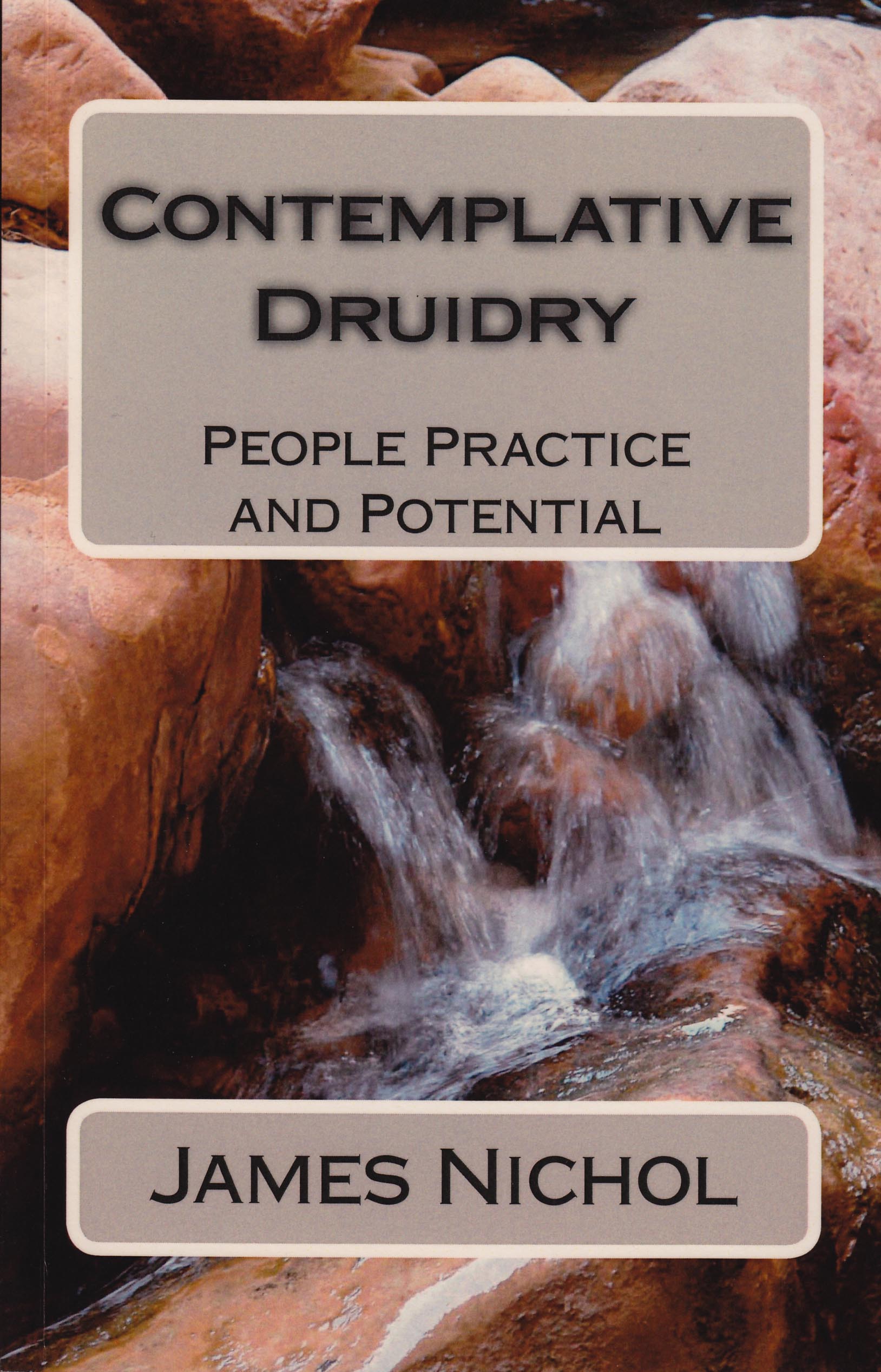
CONTEMPLATIVE DRUIDRY: PEOPLE PRACTICE AND POTENTIAL

Since last February I have been working with others on a book about contemplative Druidry. It has now been published and it is available on Amazon.com and Amazon.co.uk in paperback and on Kindle.

‘Contemplative Druidry: People Practice and Potential’ was written to show that contemplative approaches are growing in modern Druidry, and to look at ways in which they might be fostered. Practices discussed include solo and group meditation, contemplation in natural settings and contemplative arts.

In my approach to this project, I decided to take a snapshot of contemplative Druidry in a particular place and time. The place is England, with a particular (though not exclusive) focus on a Druid contemplative group meeting in Gloucestershire. The time is March-July 2014, where 15 Druids responded to a questionnaire either through face-to-face interviews or in writing.

The questionnaire was designed to let respondents talk freely about their understanding of ‘contemplative Druidry’ and its value in their lives. They first discuss relevant aspects of their early lives, such as love of the outdoors, the literatures that fed them, and forms of numinous and psychic experience that they had but could not language or contextualise. They talk about their spiritual questing, often in the arenas of Paganism, Shamanism and Earth spirituality more widely, as well as their specific attraction to Druidry. Then they discuss their contemplative practice and influences on it, in some cases, from other traditions such as Buddhism, neo-Gnosticism and mystical Christianity. Overall there is the sense of an identifiable contemplative thread within Druidry (or Druid thread within contemplative spirituality). There is a sense of a form of spiritual expression to nurture and develop.

The idea of a book offering a variety of voices was further strengthened by Philip Carr-Gomm, who has led the Order of Bards Ovates and Druids (OBOD) since 1988.  His foreword ‘Deep Peace of the Quiet Earth: the Nature Mysticism of Druidry’ is a significant contribution in its own right, speaking of a contemplative turn in Druidry as “an idea whose time has come”.

With the permission of the posters and commenters, the book includes two threads from the Contemplative Druidry Facebook Group – ‘Contemplation and Mysticism’ and ‘Pilgrimage’ as Appendices. These are more international in flavour, and date from August 2012.

The people who joined me in responding to the questionnaire were: David Popely, Elaine Knight, Eve Adams, JJ Middleway, Joanna Vander Hoeven, Julie Bond, Karen Webb, Katy Jordan, Mark Rosher, Nimue Brown, Penny Billington, Robert Kyle, Rosa Davis and Tom Brown. My heartfelt thanks to all of them and everyone else who has supported this book and the work that stands behind it.

ACTIVE IMAGINATION: BEYOND MICHAELMAS

In my Active Imagination post on 18 August this year, I wrote about an image of a wild park, a tree, deep twilight, the moon, a river, a gorge, and a bridge, a city of lights, a messenger and a message. I owned every feature of the image as part of myself.

I’ve had another one, loosely connected to the first and also numinous for me, and compelling. I’m in a walled garden, now within the city of lights. It’s as if I’ve got the message and crossed the bridge. So there’s an element of journeying in the process after all, hidden behind the images themselves.

The city is surprisingly spacious and offers a sweet slowness as well. It could also be described as a little run down and depopulated. But an easy place to be, not a stressful one. The specific place in which I find myself seems familiar, though subtly changed.  I am in Sophia’s Garden, with its unmistakeable fountain in the centre surrounded by red and white rose beds. And there are fruit trees – apple, pear and plum – trained around the walls. In memory it is a noon time place where bright sunlight shines on the scene and strikes the dazzling water of the fountain.

Now it is late afternoon and the sunlight is muted.  The water from the fountain cascades from its bubbling centre, and individual drops – each the whole of H20 – fly out for their moment in the sun before falling into a pool below. The fountain seems eternal. Its water seems eternal. The roses seem eternal. The rest of the garden is in an advanced autumnal stage – certainly beyond Michaelmas. At best, a limited time (overtime?) left for harvesting. The Goddess is dispersed in everything, as everything. I as observer am very much involved. In this realm I am her eyes and must stand as her wisdom too. There is no one else to do it.  For there is a sense in which, like Neo in The Matrix, we are each the One in our own Universe.

BOOK REVIEW. THE JOURNEY INTO SPIRIT: A PAGAN’S PERSPECTIVE ON DEATH DYING AND BEREAVEMENT

51bkGc06cCL__AA160_An important, multi-layered, deeply rewarding book. Especially useful for Druids and Pagans with any concern for death and dying, bereavement and grief, or what, if anything, lies beyond our 3D existence.  Also of potential interest to people with similar concerns in other spiritual traditions or none. Highly recommended.

Kristoffer Hughes says of himself: “In my spiritual life I have developed into a priest of the dead, a walker between the worlds, a psychopomp.” He is a priest of the Celtic Druid tradition who leads the Anglesey Druid Order. He is also an autopsy technologist working for the UK Crown Coroner’s Service. ‘The Journey into Spirit’, draws on both of these roles. It also draws on other, more closely personal experiences. These include the loss of near kin and friends, shared in a moving, loving way. They include the author’s ‘clairsentience’, a psychic gift that enables a felt sense of presence, or spirit, in relation to those who have died. All of these aspects together make for an unusual richness of narrative and subtlety of approach. The inclusion of ‘contemplations’ – reflective exercises – invites us to extend our own lived understandings. Hughes’ own conclusion is that “through death I have learned the meaning of life, and I am comforted by my understanding and experience of the hereafter”.

The book is divided into four parts, the first three based on the system of three circles of existence outlined in the ‘Barddas of Iolo Morganwg’. The first circle is Abred (AH-bred), the realm of necessity, the physical world of 3D reality. The second is Gwynvyd (goo-IN-vid), the realm of spirit, a psychic/subtle realm usually not perceived yet interwoven with Abred. The third is Ceugant (KAY-gant), the realm of infinity, a source or causal realm.

In the section on Abred, the author quotes the triad: “the three principal calamities of Abred: necessity, forgetfulness, death”. This is where we learn to be human, surrounded by life, subjected to death, governed by the cycle of birth, life and death. The author explores ‘apoptosis’ (the dropping off of petals or leaves) and the need for organic life to die to make room for new growth. Yet a divine spark continues to live in everything. The whole section explores life and the consciousness of death, including fear of it, and our questions about what if anything comes after, drawing on a wealth of knowledge, experience and anecdote.

The section on Gwynvyd looks at the grief process – including a wonderful section on the ‘seasons of grief’, more fluid than familiar ideas about ‘stages’ of grief, let alone medicalized views of grief that now want to treat it as depression after the first 14 days. Part of this is coming to terms with the reality and finality of death. Yet the section also identifies what survives. For the author, the personality dies with the body, yet a substrate of witness consciousness, understood as unchanging, continues in some sense as the stuff of spirit. The forgetfulness of Abred, held in the flow of experience, leads us to forget this substrate. Yet it is eternally there: never born, it cannot die. “What remains constant is the spirit, and upon it is the imprint of the human that lived and breathed here in this world”. This is where a felt sense of connection, if the feelings are strong and the senses attuned, is possible. Gwynvyd is also described as the realm of gods, archetypes, and any beings including discarnate humans who have a role in mediating between Gwynvyd.

Ceugant is the place, or state, of origin. “It is from Ceugant that existence originates and it is to Ceugant that the Universe sings”. Yet it is no-thing, like Ain Sof in the Kabbalah. The author says that this realm, or core reality, can be intuited through visions and meditations, but that no attempt to describe or point to it can be more than an indication. Hughes’ most suggestive metaphor is of a return to a primal sea of potential. In terms of English etymology, he links this to the word ‘soul’, originally a sea-referenced word – and it is universal soul, rather than any personal soul, that he has in mind. He does strongly hold the view that Ceugant represents an ultimate belonging for us all, and so is not something to be achieved through long arduous tasks and learning. It is just there, twice removed from us in our present state.

The final section offers a set of rituals and practices – including a vigil for the dying; preparation of the body; funeral for a Druid; saying goodbye, and a treatment of Samhain as a three day festival of the dead with appropriate practices for each day. Like the rest of the book, these are creative suggestions, based on experience and insight, which we are invited to look at and take on board to whatever extent is right for us.  A welcome text on a sensitive topic.

DRUID CONTEMPLATION AS PAGAN RELIGION?

Up until recently I’ve practised Druidry as a ‘spiritual path’ rather than religion, and I’ve not strongly identified as Pagan. On launching my contemplative inquiry at the end of 2011, I assumed that this stance would be reinforced through the adoption of practices more widely associated with other spiritual families.

Now I’m taking stock. I begin to see my contemplative work as a Pagan religious practice. Three developments in the past year have made a difference. One is the consolidation of the Gloucestershire contemplative group within a regular and more committed meeting cycle. The second is the work of gathering contributions for the ‘Contemplative Druidry’ book due to appear later this year, which I will talk about in later posts. The third is my personal contemplative practice, my main focus in this one. Overall I’m finding a specific Pagan Druid note and seeing it mirrored in others.

Practices change their meaning according to the tradition in which they are located. Meaning-making is as much cultural as personal, though cultures – and particularly sub-cultures – are also influenced by persons.  When a group of contemplative Christians adopted a version of vipassana (insight or mindfulness) meditation from Theravadin Buddhism in the 1970’s, they looked deeply into their own tradition and called the practice ‘centering prayer’.  This was not just a re-branding, but a re-framing. Christian contemplative prayer is a “blind intent stretching to God” according to the English 14th Century ‘Cloud of Unknowing’ (1), a favourite text of centering prayer practitioners. It is a devotional theism, a focused synthesis of love and will. By contrast the Insight Meditation Society, from whom Father Thomas Keating got the practice, talks about “fundamental techniques for sharpening your awareness and releasing painful mental habits” (2), and thereby loosening the hold of pervasive underlying unease (dukka).

The procedure is much the same for both traditions– silent sitting whilst the restless surface mind is asked to attend to the breath and so undergoes an attentional training. But the larger aims are not the same. Christian contemplatives indeed sharpen awareness and release painful habits on the way to more directly encountering the Divine: they call it divine therapy. Buddhist meditators may enter the state of ‘bodhicitta’, the awakened heart – a space that becomes available when enough of this work has been done. Yet at a more fundamental level one tradition holds Deity as central and the other is not concerned with it. Theravadins are strict about this. They do not share the view of ‘Buddha nature’ or ‘original face’ found in Mahayana and Tantric traditions.

So what about me working specifically as a Druid, and not just someone with a background in Druidry who also meditates?  I prefer to talk of meditation rather than prayer, though I like the sense of dedicating the meditation (and myself) as an offering. In my Pagan Druid universe, where logos and mythos work together, the offering is to the Goddess, as the generativity, energy and consciousness of the cosmos.

I like ‘centering’ as an idea – establishing a centre, drawing myself into the still point, almost a vanishing point, at the centre, and radiating out again into 3D reality, bringing some of the stillness with me. For me the still point at the centre is within the heart, making a link to heart awakening (bodhicitta) and heart wisdom, a term used by some champions of centering prayer (3). The heart sits between the belly and sexual/sacral centres below, and the head, the place of reflexivity and self-awareness, above. Heart wisdom draws both into itself, validating and balancing them. For it is a wisdom of organic life in nature, as lived by a human – the life of extended sensory perception and reflective consciousness, always responsively in relationship of some kind, both without and within. In doing this, drawing energy and attention to the centre, heart wisdom contradicts archaic transcendentalist notions of a stairway to heaven.

I think that’s enough to give my practice a distinctive Pagan Druid note, though it’s still a work in progress. I share the work of attentional training, sharpening awareness and releasing painful habits that gets done, within the process, whoever does it. But it’s in the context of a specific and developing view, or meta-narrative.

That being the case, why not call it part of a religion? The core meaning of religion, like yoga, is about being tied or yoked to a discipline: connection to theistic beliefs is secondary. Religion has a tougher and more intentional ring than ‘spirituality’, and now sounds appropriate to me.  So I now call my contemplative practices – solo meditation included – both religious and Pagan. I will continue to learn from any source I value. But my personal inquiry is focused on deepening within my chosen path – deepening in experience and deepening in understanding.

1: Anonymous (late 14th century) A book of contemplation which is called the Cloud of Unknowing, in the which a soul is oned with God. (Edited from the British Museum MS. Harl. 674 with an introduction by Evelyn Underhill) London: John M. Watkins, 1924

2: Salzberg, Sharon & Goldstein, Joseph (1996) Insight Meditation: an in-depth correspondence course Boulder, CO: Sounds True

3: Bourgeault, Cynthia (2011) The Wisdom Jesus: transforming heart and mind – a new perspective on Christ and his message Boston & London: Shambhala

BOOK REVIEW: TREES OF THE GODDESS

jhp52d894a224871Highly recommended. ‘Trees of the Goddess’ is the latest in a series of books written by Elen Sentier for Shaman Pathways. It is both deeply traditional and highly innovative – very much this author’s note. It goes with her championship of the way of the awenyddion, standing for the ever-renewing indigenous seership of Britain.

The innovation is simple yet profound. This book directly concerns our relationship with the trees, rather than letters or divination. That relationship, like everything on the planet, has a context of cycles and seasons. Our life-world, and that of the trees, is defined by the dance of earth, moon and sun. We have this in common with our ancestors, attested by their lore and stories, and it establishes our continuity with them. The book is a reflective celebration of these simple truths and their archetypal resonance. The framework of the ogham tree alphabet provides a strong and focused conceptual foundation, in service to direct experience. The suggested activities at the end – in sections on ways to work with the trees, moon bath, allies, making your ogham staves and spirit keeping, are an invitation to experiential exploration.

The book is traditional in its use of the ogham tree alphabet and largely faithful to Robert Graves’ ‘The White Goddess’. The author endorses his linking of 13 of the trees to Ogham consonants as they move through the 13 months of the lunar year from the winter solstice; and the linking of the 5 Ogham vowels to 5 stations of the solar year (the solstices, equinoxes and Samhain). She largely follows Graves’ trees, in his order, though there are some exceptions – the vine is banished, leaving bramble to take the full weight of Muinn; and there are some changes of terminology, like guelder rose instead of ‘dwarf elder’. I realise that many people today are highly sceptical of Graves’ work, but its problems are for me not relevant to this book. For ‘Trees of the Goddess’ is not much concerned with the history of ogham, its specific cultural origin, or its use as an alphabet. It is about here-and-now relationship with the trees, honouring the Goddess and aware that our ancestors had some such relationship too.

MABON

Druidry has its own view of the magical, redemptive child or youth: the Mabon. Here is my transcription (and I apologise for any inaccuracies) of Mabon, a song recorded by Silver in the Tree as part of their Eye of the Aeon album in 1991 and re-recorded on Dreaming the God in 2007.

I am the Mabon I am the child
I am YR the golden bough
I am the dart the yew lets fly
Three pure rays the pillars of light
I am the Wren the King of Birds
I am Bard and teller of lies
I am a song within the heart
I am a light that will never die
I am stars within the void
I am the Eye of the Aeon

In Celtic times the reference is always to Mabon, son of Modron (Youth, son of Mother), “the primal child who was in existence at the beginning of things” (1). The story of How Culhwch won Olwen (2) includes a section where a search is mounted to find and rescue the lost and imprisoned Mabon. Roman Britain and Gaul record devotion to a youthful male deity called Apollo Maponus, very well described by Lorna Smithers in a From Peneverdant post on 26 December 2012 http://lornasmithers.wordpress.com/2012/12/26/Maponus/.

In the medieval poem Primary Chief Bard – attributed to Taliesin – Christ is referred to as the “merciful Mabon” and the “Maiden’s Mabon” (3) The Taliesin of the Hanes Taliesin (3) is himself a Mabon figure. The area around Loch Maben in Dumfriesshire is tied to stories of Lailoken, the Scottish Merlin (see also https://contemplativeinquiry.wordpress.com/2014/07/15/merlin) and his interaction with St. Kentigern (aka St. Mungo) at the time of Christian conversion (4).  When I visited the Loch at Lochmaben some years ago, the water’s edge, in morning mist, had some of the numinous feel of Llyn Tegid at Bala, though the Scottish loch is much smaller.

Modern Druidry gained momentum as a spiritual tradition at the beginning of the 20th century, a time when, more widely, a ‘Celtic twilight’ current met that of the Hermetic Order of the Golden Dawn (think of W. B. Yeats). Hence in some iterations of modern Druidry, the Mabon can be understood as a Celtic Hermes, birthed within the practitioner as the fruit of inner alchemical work. It may also be that the “Eye of the Aeon” reference at the end of the Mabon song nods in the direction of Aleister Crowley’s view of our ‘new age’ as being the Aeon of Horus (5). The eye of the Aeon is also the ‘I’ of the Aeon, the you and me of the Aeon, because that’s how this age is understood to work. It’s about transformation of consciousness, and if we want to use such a term, divinisation, within the individual – Jung’s journey of individuation, from self to Self.

The Mabon is a primary archetypal image within Druidry, and we can relate to this image – resonance, presence – in many ways. For me, Mabon, the song has power. Ten brief lines, each one a portal in itself. Silver on the Tree can be found at http://www.last.fm/music/Silver+on+the+Tree

1: Matthews, Caitlin & John The western way: a practical guide to the western mystery tradition (volume 1: the native tradition) (1985) London: Arkana

2: Davies, Sioned The Mabinogion (2007) Oxford: The University Press

3: Matthews, John Shamanism and the bardic mysteries in Britain and Ireland (1991) London: the Aquarian Press

4: http://www.everything2.com/title/Saint+Kentigern+and+Lailoken

5: DuQuette, Lon Milo (2003) Understanding Aleister Crowley’s Thoth tarot San Francisco, CA: Red Wheel/Weiser

Earth Eclectic

music that celebrates Earth and speaks to the heart

Sarah Fuhro Star-Flower Alchemy

Follow the Moon's Cycle

Muddy Feet

Meeting nature on nature's terms

Rosher.Net

A little bit of Mark Rosher in South Gloucestershire, England

Becoming Part of the Land

A monastic polytheist's and animist’s journal

selkiewife

Selkie Writing…

Charlotte Rodgers

Images and words set against a backdrop of outsider art.

Prof Jem Bendell

living purposefully during metacrisis and collapse

Towint

The pagan path. The Old Ways In New Times

The Druids Garden

Spiritual journeys in tending the living earth, permaculture, and nature-inspired arts

The Blog of Baphomet

a magickal dialogue between nature and culture

This Simple Life

The gentle art of living with less

Musings of a Scottish Hearth Druid and Heathen

Thoughts about living, loving and worshiping as an autistic Hearth Druid and Heathen. One woman's journey.

Wheel of the Year Blog

An place to read and share stories about the celtic seasonal festivals

Walking the Druid Path

Just another WordPress.com site

anima monday

Exploring our connection to the wider world

Grounded Space Focusing

Become more grounded and spacious with yourself and others, through your own body’s wisdom

The Earthbound Report

Good lives on our one planet

Hopeless Vendetta

News for the residents of Hopeless, Maine