Contemplative Inquiry

This blog is about contemplative inquiry

Tag: Paganism

DANCING SEAHORSES II
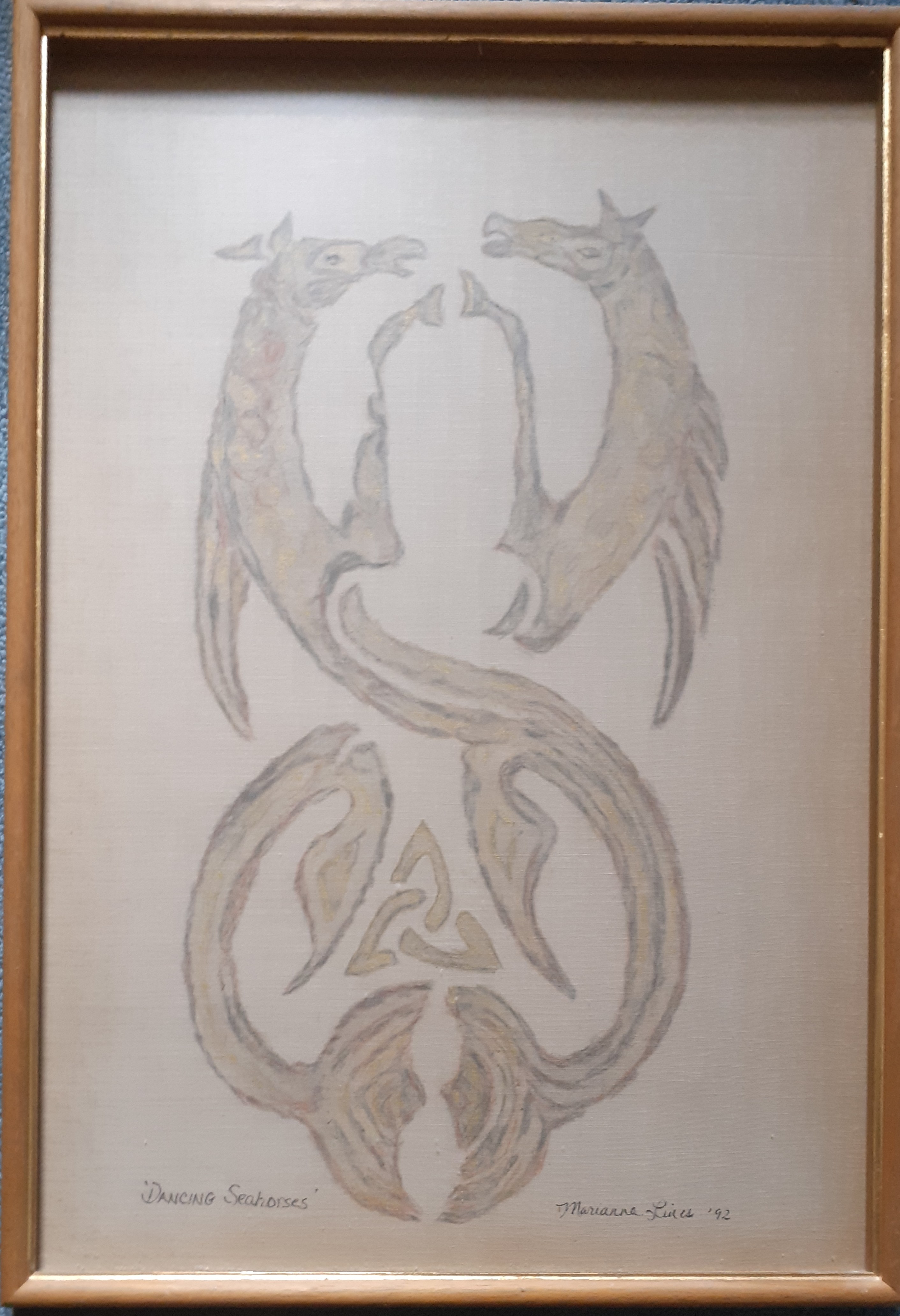
I have already written about the Dancing Seahorses image (1) found on a Pictish stone from Aberlemno in the Scottish county of Angus. After seeing the stone on a visit there, in 1992, I bought Marianne Lines’ painting. I have felt strongly involved with this image ever since. I think of it as a friend and guide. In a sense, this post is about the modern use of archaic images by people, like Druids, who are drawn to them.

I do not know the intentions of the original carver. beyond celebrating beings who are half of this world, half of the otherworld, and who embody powerful water energies for Celtic peoples on the Atlantic coasts of Britain, Ireland and Brittany in ancient times. They are remembered in folklore to this day. I do know that the carving made a strong impression on me, when I first saw it on the stone itself. It stayed in my imagination, and over time has deepened and grown new meanings.

Four years after acquiring the painting, I had the image tattooed on each arm. By that time I knew of the way in which it had influenced the cover design for R. J. Stewart’s The Prophetic Vision of Merlin (2). This variant form was used to refer to the story of the young Merlin at Vortigern’s subsidence prone tower in Snowdonia, prophesying his way out of becoming a human sacrifice, and identifying two contending dragons under the foundations. In the book illustration, there is a yin-yang reference, with a suggestions of interdependent primal forces, each of which already contains the seed of the other, seeking balance and alignment. In the Western Mysteries quest for healing and transfiguration, the energy bodies of the land and of humans are deeply interwoven.

There is another, more recent level of understanding, that I derive from the painting and tattoos, but not evident in The Prophetic Vision of Merlin. I see both the dancing seahorses and a second image, behind and containing the immediately apparent one. As I wrote before, “the space where the horses legs are raised defines a shape, suggesting a head. The very emptiness there is a paradoxical mark of presence. To me it became the head of a goddess, with the seahorses then becoming her body. Still clearly appearing as a water being, her arms – if they are arms – are raised in blessing”. I would now add that in this way, she demonstrates the dance of emptiness and form. They are balanced. Neither is privileged over the other. The Celtic knot points both to interconnection and infinity.

I identified the Goddess whilst gazing directly at the original Dancing Seahorses picture, which hangs of a wall directly above my altar. However I believe I received a subconscious nudge from the High Priestess card in The Druidcraft Tarot (3). She wears the image herself. Her hands are raised. She stands as the Goddess. In the Druidcraft narrative, she “represents the magical power of stillness and depth”. For me, the Goddess in Dancing Seahorses represents the ultimate union of emptiness and form, and the rebirth of the cosmos in each moment. Her representation combines the aware potential of the void and a primal aquatic generativity that can inhabit other elements. The Druidcraft priestess is human, but one who wears an image that bespeaks the divine to me, and her role asks for “stillness and depth”.

In my work, the entry into stillness and depth is, firstly, to enter into I-Thou communion with the primal Goddess (Modron) and then to recognise my own true nature, as (mythically) her divine child (Mabon) – sensitive and busted open to the world. This recognition becomes a prayer of gratitude and a surrender of my passing private concerns to Who I really am.

Words and pictures are not enough, but, cherished and contemplated lovingly over time, together they can point the way..

(1) https://contemplativeinquiry.blog/2020/06/25/dancing-seahorses/

(2) R. J. Stewart The Prophetic Vision of Merlin London & New York: Arkana, 1986

(3) Philip & Stephanie Carr-Gomm The Druidcraft Tarot: Use the Magic of Wicca and Druidry to Guide Your Life London: Connections, 2004 (Illustrated by Will Worthington)

REMEMBERING THE GLASTONBURY THORN

In my wheel of the year tree mandala (1), hawthorn presides from 1-23 May. It celebrates Beltane and the rising strength of the sun. Looking forward to that time, I think particularly of a specific tree, the Glastonbury thorn at Wearyall Hill, to represent that period. But the tree is gone, and is now unlikely to return, though ever-living in my heart and imagination..

It was a variety of common hawthorn (crataegus monogyna biflora) that flowered twice a year – first around Christmas and then in spring. I took the photograph in a misty Imbolc moment in 2007, between flowerings. It is the only one I will ever have, and for that reason I treasure it. The much revered tree was vandalised in 2010. New shoots appearing from March 2011 mysteriously disappeared. A new sapling, grafted from a descendent or the original tree, was planted in 2012 and consecrated – only to be snapped in half and irreparably damaged 16 days later. In May 2019, after some years of hesitation, the tree was entirely removed by the landowner in a final acceptance that the tree was lost. Sacred thorn trees, said to be descended from the same original, can still be found in the ruins of Glastonbury Abbey and at the Church of St. John.

I particularly liked the Wearyall Hill tree, because it was physically removed from the bustle of Glastonbury as a twenty-first century spiritual centre. The hill just seemed quietly natural – pagan, if you wanted to think of it that way, or Christian, if you wanted to link it to the story of Joseph of Arimathea’s staff, and how it came to life and flowered when planted in a new land. I was shocked by the violence against the tree and against other people’s love for it.

An ancestor of thee thorn (the individual plants do not last forever) had been cut down before, probably in 1647 by a Parliamentary soldier in England’s civil war. For the thorn was strongly linked to royal patronage, the miracle of a Christmas flowering, and a link between sacred land and sacred kingship. The kind of Royalism represented by this constellation of ideas and images was strong in Somerset at that time, but so was religious Puritanism, allied to a wish for constitutional change. The war was bitterly fought within the county. The legend of the thorn, cultivated by one group of people, made it vulnerable to another group of people identified with different loyalties.

The modern destruction of the thorn also seems not to have been casual, or it wouldn’t have been repeated so systematically. But I am not sure of the motivation. I find myself understanding a seventeenth century act of violence better than the modern one. Was this venerated tree the victim of a current human culture war? Are there potential lessons for Avalonians? Whatever the case, I am still in mourning.

(1) This mandala is based on my personal experience of trees in the neighbourhood as well as traditional lore. Moving around the summer quarter from Beltane, 1 May, the positions and dates of the four trees are: Hawthorn, south-east, 1-23 May; Beech & Bluebell, south-south-east, 24 May – 15 June; Oak, south, 16 June – 8 July; Gorse, south-south-west, 9 – 31 July. The autumn quarter then starts with Apple at Lughnasadh/Lammas. For a complete list of the sixteen trees, see https://contemplativeinquiry.blog/2020/autumn-equinox-2020-hazel-salmon-awen/

BOOK REVIEW: CERRIDWEN CELTIC GODDESS OF INSPIRATION

Highly recommended. Cerridwen: Celtic Goddess of Inspiration (1) is by Kristoffer Hughes, Chief of the Anglesey Druid Order (2) and a prominent figure in modern Druidry and Paganism. His aim in this book is to “provide you an in-depth exploration of Cerridwen, where she came from, the landscape and peoples that perpetuated her, and who she is today”.

Hughes, born in Anglesey and a first language Welsh speaker. is a scholar and practitioner of his inherited tradition. He has also embraced Druidry as an international movement within modern Paganism. He is at ease, too, with the Cerridwen of modern witchcraft. His whole stance is one of cultural generosity and active support for “appropriate appropriation”.

In its quest for Cerridwen, the book combines close reading of Bardic texts dated from the post-Roman period to early modernity; personal sharing of Hughes’ own path; and opportunities for experiential work. Like many people, my introduction to Cerridwen was through Charlotte Guest’s English version of the late-appearing Hanes Taliesin (Hughes provides his own version early in the book). This shows Cerridwen as a noblewoman skilled in the magical arts, not a Goddess. Like many people, I assumed that this was a demotion going back to the Roman period or the coming of Christianity. Hughes does not share this view. He cannot find Cerridwen among the goddesses of Celtic antiquity, but he welcomes her recent apotheosis within neo-Paganism and witchcraft. He is a devotee himself, and writes: “the New Age traditions, whilst inspired by the distant times, do not need or require to be authenticated by the past; it is a living, breathing spirituality … if it works, keep doing it, and the more you do it, the more life you breath into it”.

Hughes sketches out Cerridwen’s history in the early written material. Sometimes her presence is only implicit – glimpsed, perhaps, as the Annuvian sow (hwch) who guides the magician Gwydion to the base of the world tree in the fourth branch of the Mabinogion. Sometimes we find her lauded and identified as the Mam yr Awen (mother of the Awen). Later, after Wales’ loss of independence and the decay of the Bardic tradition, we find her stigmatised as an evil hag with her connection to Awen erased. But when we come to the Hanes Taliesin, her connection to Awen, and to the initiation of Taliesin (radiant brow) is plain and clear. Her best time is now, though her modern strength lies largely outside her country of origin.

For Hughes, Cerridwen (pronounced Ker ID ven) is a goddess “of angular, bending magic”, and her cauldron is “a vessel of inspiration, a transformative device, a vessel of testing”. This Cerridwen is “the divine conduit of transformative, creative, magical inspiration gleaned from the cauldron of Awen”. Awen itself is “the creative, transformative force of divine inspiration that sings in praise of itself; it is the eternal song that sings all things into existence, and all things call to Awen inwardly”. Gwion, who tastes the three drops distilled from the cauldron in Hanes Taliesin, after a series of further trials becomes Taliesin, “the outward expression of the power, magic and action of the Awen”, indicated by his radiant brow. The final section of the book, Stirring the Cauldron: Ritual and Practise, offers readers a chance to meet Cerridwen and work with her Bardic mysteries themselves.

As issues relevant to Cerridwen and what she stands for, the book looks at the meaning of annwfn and its denizens the andedion. ‘Underworld’ and ‘Otherworld’ are not quite accurate as descriptors, and the andedion, though different from us, are not best thought of as ‘supernatural’. Hughes also explains that medieval Wales, except to a limited extent in the border counties, did not share in the English and continental persecution of witches. Swyngyfaredd (enchantment/sorcery/magic) was part of life and its practitioners respected. This changed only with the early modern Anglicisation of culture. Hughes also includes a chapter on Iolo Morganwyg (Edward Williams, 1747-1826) and his ‘awen-filled legacy’. It was he who invented the awen symbol /|\ and much else in modern Druid and Bardic culture. He is often remembered as a literary forger because he presented his contributions as a rediscovery of lost texts. They nonetheless revitalised a dying culture at a time when sensibilities were changing again, and becoming more receptive to the value of old traditions.

With all these riches, Cerridwen: Celtic Goddess of Inspiration is a must-read for anyone with a serious interest in modern Druidry.

(1) Kristoffer Hughes Cerridwen: Celtic Goddess of Inspiration Woodbury, MN: Llewellyn Publications, 2021

(2) http://www.angleseydruidorder.co.uk/

THE SACRED HEAD OF BLADUD

The historic city of Bath is about thirty miles from where I live and – from another direction – thirty miles from where I was born. It has always been part of my psychogeography. This post concerns both its ‘historical’ and ‘legendary’ past.

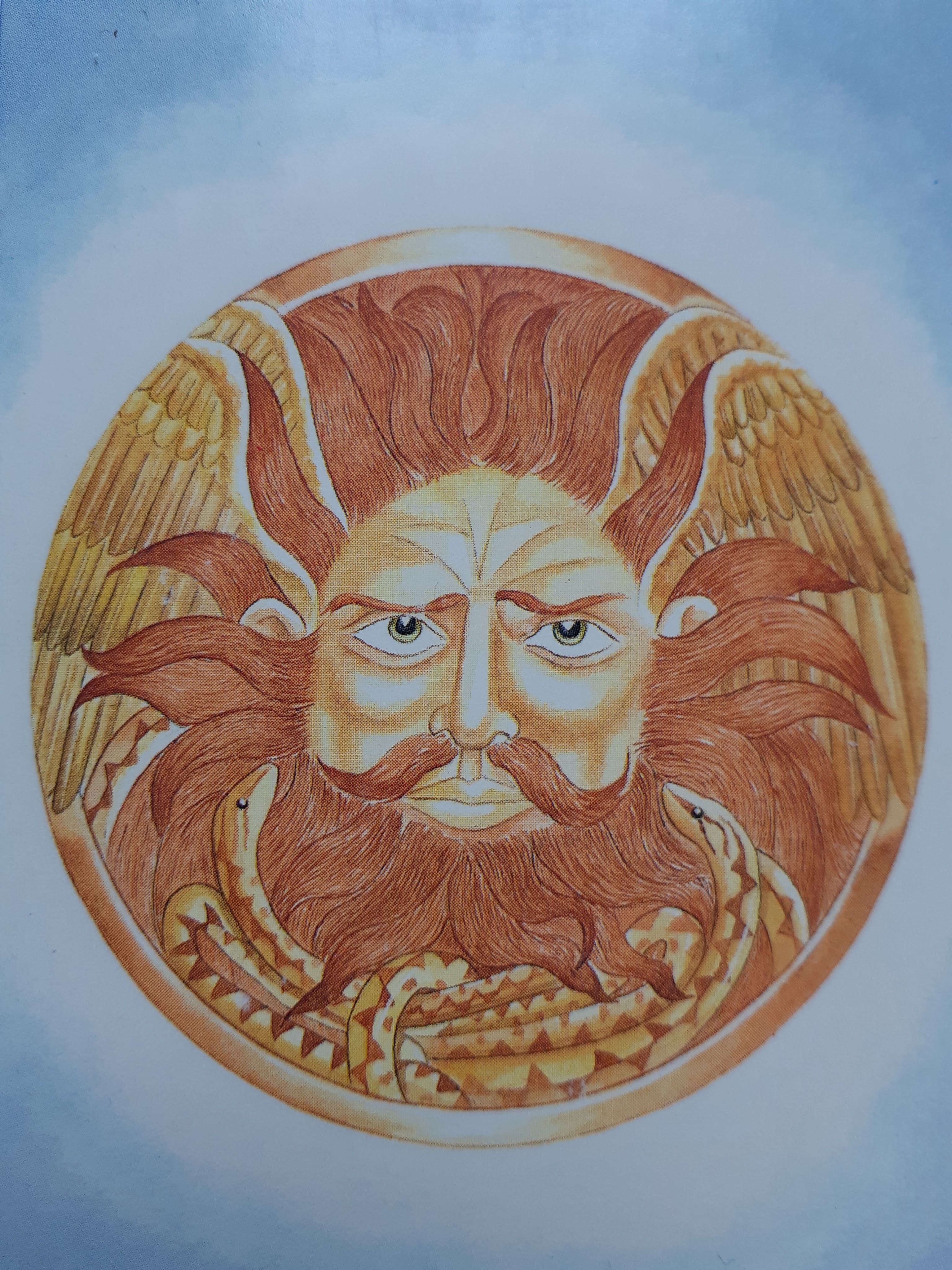
“A satisfying connection between modern archaeology, ancient legend, sacred kingship and Celtic religion is found at Aquae Sulis, the Roman name for Bath, England. In his legendary Historia Regum Britanniae [History of the Kings of Britain] (1) Geoffrey of Monmouth reports that King Bladud, grandfather of Bran and Branwen, founded the site and taught the druidic arts of ancestor magic and flight, eventually crashing to his death on the site of what is now London (the name Bladud means ‘light-dark’ or ‘bright-shadow’). In his Vita Merlini [Life of Merlin] (2), Geoffrey of Monmouth has Bladud and his consort Aleron (‘wings’) presiding over the hot springs of Bath, which are at the centre of the Bardic universe described by Taliesin to Merlin, forming the gateway to the Otherworld.

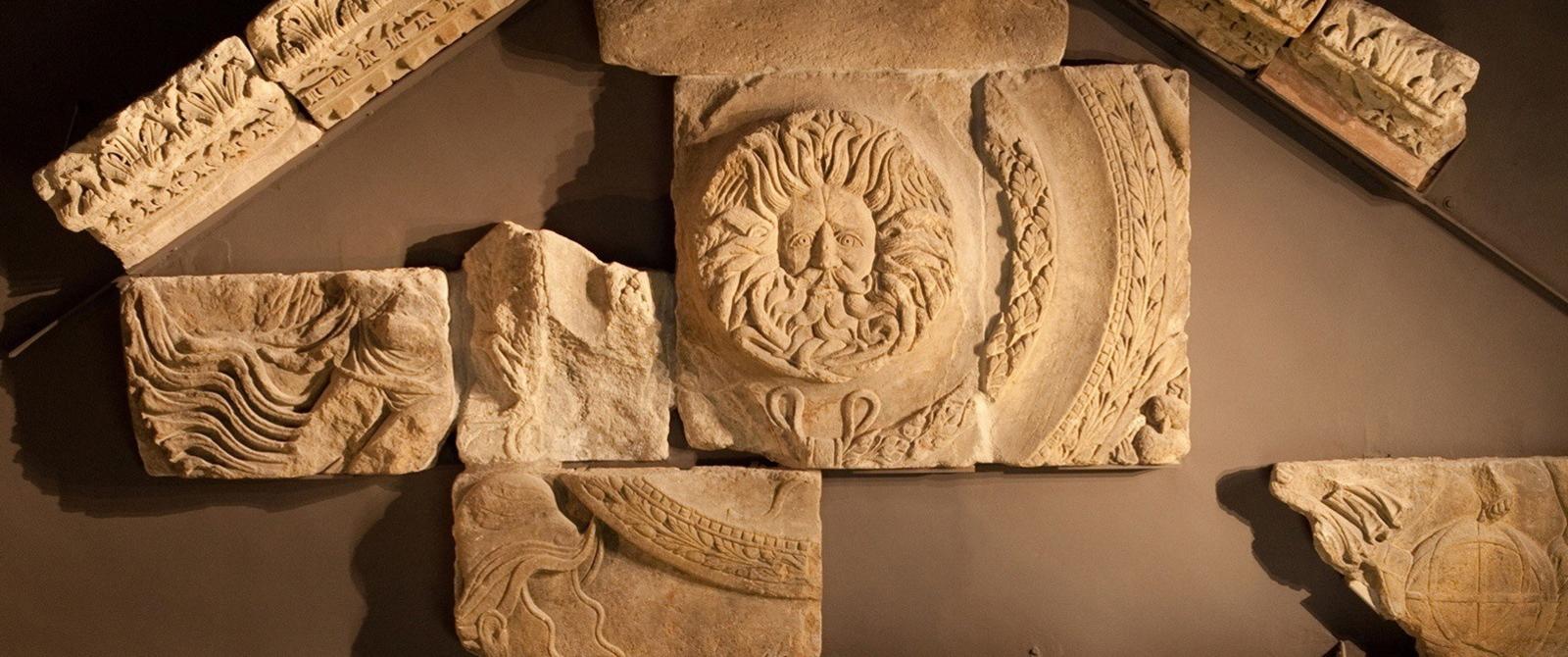
On show in the museum at Bath is a superb Celtic solar head (often inaccurately called a Gorgon’s head). The carving is a circular relief of an imposing male face with wild hair, long moustaches and staring eyes. He has wings on either side of his head and is surrounded by flames. Beneath his chin are two serpents, linked in the manner of a torque, the Celtic symbol of royalty. This solar deity is probably the being called Bladud in the legendary histories, connected to magic, flight and a fall from the heights to the depths. He has upon his brow the mark of the three rays, which are very often described as the primal three powers of universal creation.

The goddess at Bath, presiding over the sacred hot springs, was called Sul or Sulis, which means ‘eye’ or ‘gap’ (with a sexual connotation), for she is a variant of Ceridwen, the goddess of the Underworld. The entire Celtic/Roman complex of Aquae Sulis is an excellent example of ancestral Underworld magic refined by Roman politics into a temple of Minerva.

“The sacred or prophetic head is an embodiment of the relationship between the three worlds, for it is aware in all worlds, through all time. While we may have ideas that an anthropologist would suggest originated in primitive head-hunting magic, the theme of the sacred head becomes an allegory of divine and human perception and declaration.

“There is a further element to the sacred-head theme, for it is also interlinked with beliefs and practices concerning the regeneration of life, particularly with the cauldron. Titanic figures such as Bran, acting as sacred kings and guardians of the land, also partake of the mystery of the sun at midnight, light regenerating out of darkness. And this, after all, is the secret of inspiration, a sudden light born out of fruitful darkness.”

R. J. Stewart and Robin Williamson Celtic Bards, Celtic Druids London: Blandford, 1996

(1) Geoffrey of Monmouth History of the Kings of Britain London: Penguin, 1966 (Translated with an introduction by Lewis Thorpe)

(2) Mark Walker Geoffrey of Monmouth’s Life of Merlin: A New Verse Translation Stroud: Amberley, 2011

NOTE: the first illustration is from R. J. Stewart The Merlin Tarot London: Element, 2003 , illustrated by Miranda Grey. The Bladud image is on the reverse of each card, implicitly re-ascribed to Merlin as embodying the same archetype in a different way. The second illustration can be found on http://www.romanbaths.co.uk – click on discover and then walkthrough.

LATER AUTUMN

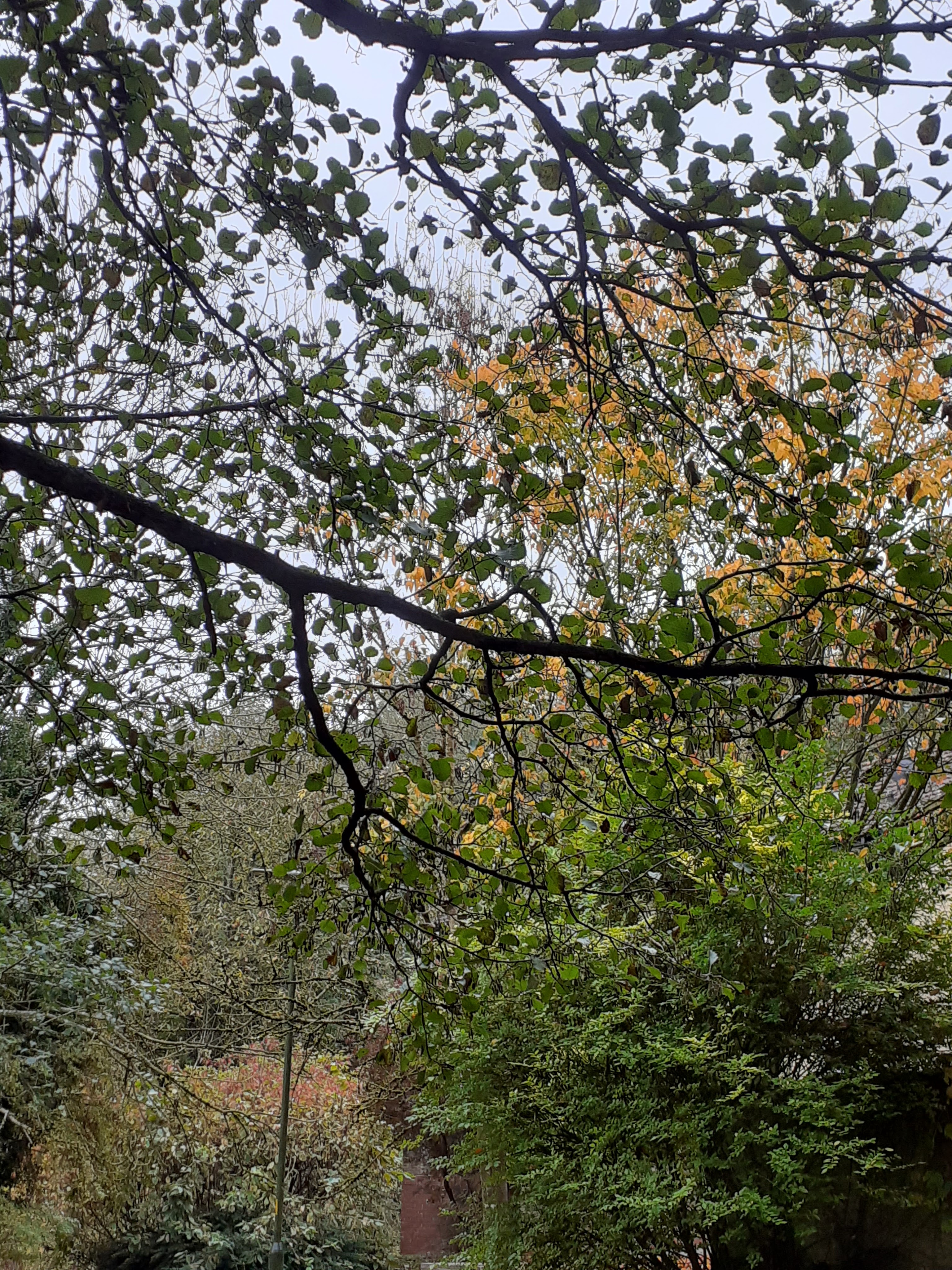
Sunday 18 October, on a walk beginning at 7.20 am. This is a later start than on the previous week (1), and headed in the opposite direction. The day is overcast and the feeling-tone of this walk entirely different. Last week was magical and illuminative. This week is a time of relaxed enjoyment, of simple openness to the world as I find it. I can let go of agendas.

The fall here is still tentative. It mostly happens in November, though there are plenty of leaves falling gently to the ground, and a breeze to encourage them. Overhead, the gaps in the canopy let the light in. The remaining leaves form patterns that draw my attention and raise my spirits in a strange primordial way.

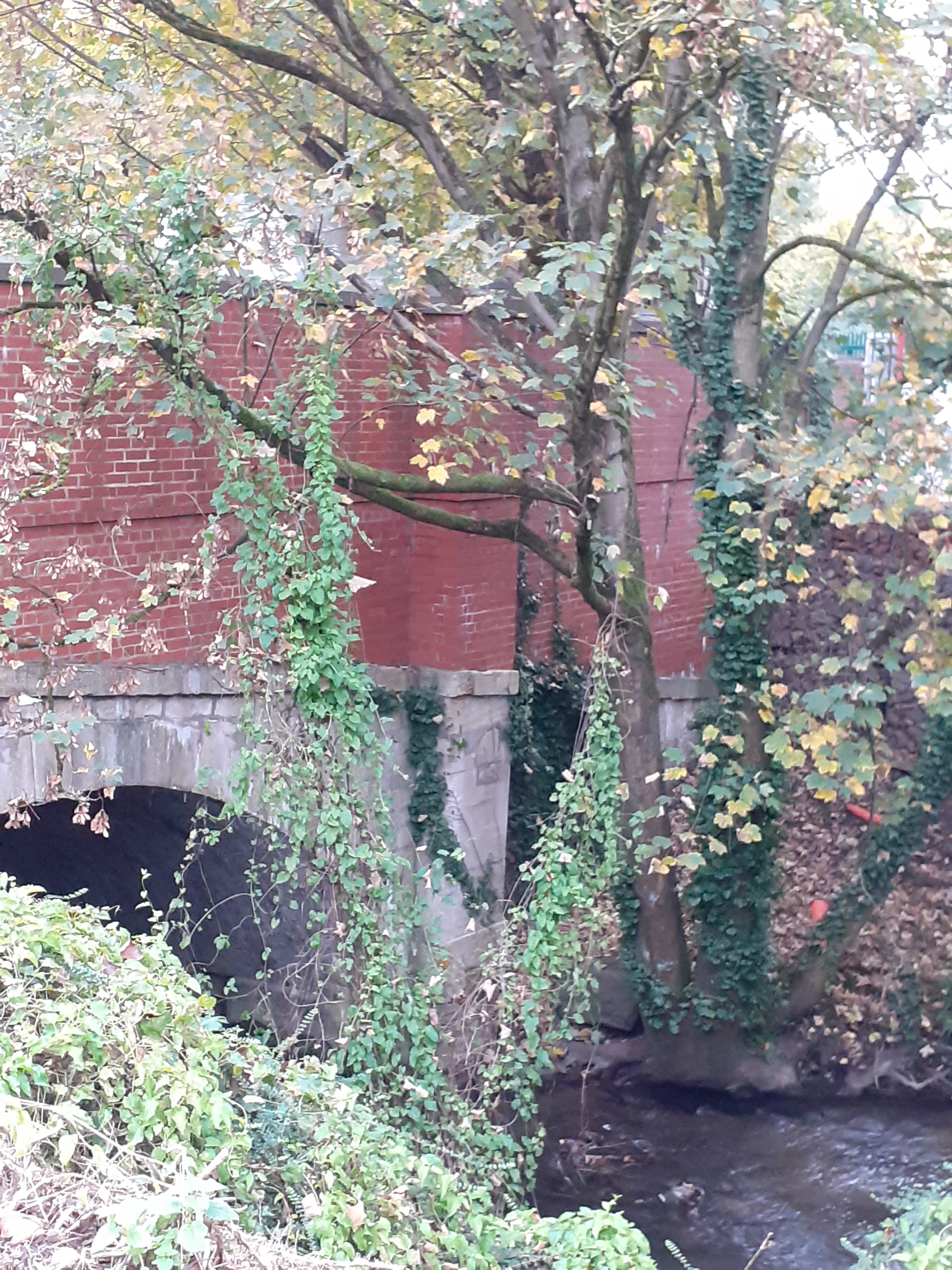
I enjoy built environments up to a certain level of density, when they become oppressive and too much. Here, a canal bridge blends in with ivy, water, trees and undergrowth without any sign of artificial arrangement. The place has been largely left to itself to make its own accommodations and adjustments. They are what they are. They haven’t been created for effect. I notice that I feel in tune with this space.

I live in an urban setting that is not at war with trees. The early morning absence of traffic helps me to appreciate the autumn colours opposite. Today is a day when I am easily pleased by life and I find myself caught up in a moment of spontaneous gratitude.

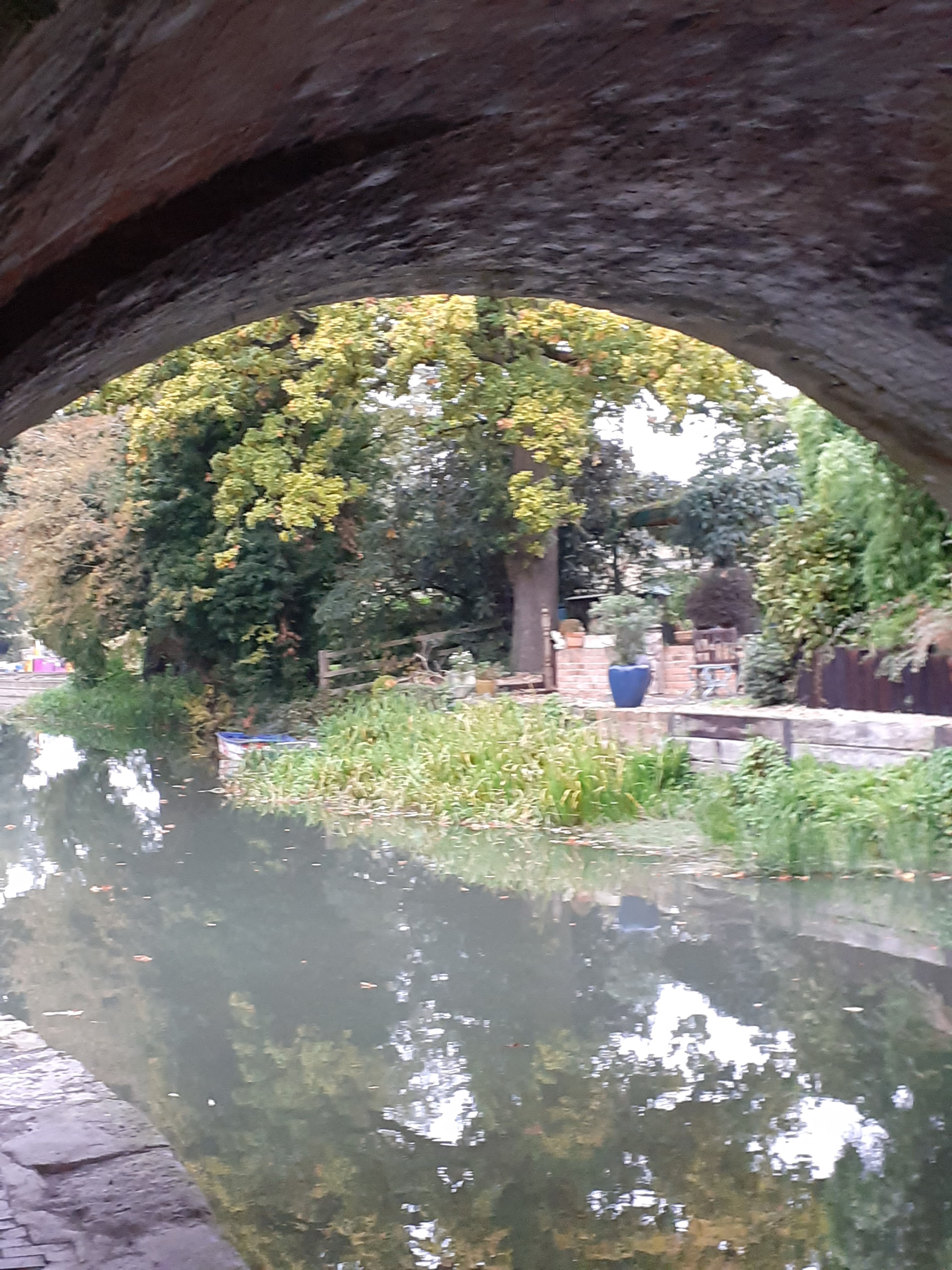
Now, I am under an arch, looking at the canal, at reflections in the water, and at a canal side entrance to somebody’s house. I have the sense of a congenial, inhabited space. The stretch that I have been walking on today is relatively built up, still part of the town. My walk has involved the interplay of town and country. In one way it has been very ordinary. In another it has been a trigger for happiness. I have enjoyed being part of it.

The picture above – somehow, for me, beyond words. I lose myself in it.

(1) https://contemplativeinquiry.blog/2020/10/14/walking-towards-sunrise/

INQUIRY NINE YEARS ON

My contemplative inquiry began as part of a Druid initiative launched nine years ago on 1 November 2011. The inquiry “soon broadened into a wider exploration of contemplative spiritualities, drawing on the enduring wisdom of many times and places.” (1)

By August 2018, I had anchored the discovery of “an ‘at-homeness’ in the flowing moment, which nourishes and illuminates my life. Such at-homeness is not dependent on belief or circumstance, but on the ultimate acceptance that this is what is given. I have found that, for me, the realisation of this at-homeness has supported a spirit of openness, an ethic of interdependence and a life of abundant simplicity.” (1)

This is still my core insight. It does not tell me to be a Druid, or not to be a Druid. It does not give me a metaphysical or religious foundation of any kind, though it is possible to build these around it. It does not make my existential choices for me. I do find myself distant from faith based and devotional approaches to contemplation and spirituality. Recently, I have lost interest in debates about consciousness as foundational, or in distinctions between ‘lower’ and ‘higher’ manifestations of it. I was drawn to this philosophical openness in part by the ancient Greek philosopher Pyrrho of Elis, himself influenced by (probably) Buddhist and Jain teachers in India (2).

Experientially, it is as if I exist within a field of awareness, or presence, whilst also living a human life between earth and sky. Here, I am intimate with the stream of experience, but not fused with it – allowing a space for compassion towards the apparently unwanted sensations, feelings, thoughts, images, and strings of cogitation that continue to arise. Stepping back from demands for ‘healing’ and ‘transformation’, I discover myself to be simply and securely held.

Looking out, I find a living world. I am part of the web of life, deeply interconnected with other lives and with the whole. Here I align myself to those Pagans, identified by Graham Harvey (3,4), who “use ‘animism’ as a shorthand reference to their efforts to re-imagine and re-direct human participation in the larger-than-human, multi-species community. This animism was relational, embodied, eco-activist and often ‘naturalist’ rather than metaphysical.”

Understandings like this have re-anchored me in Druidry and Paganism. The Wheel of the Year is a wonderful basis for outward attention in spirituality. I am now also strongly drawn to questions of culture, history and human imagination, which I will explore more in future. Here again, I find an open and inclusive Druid perspective to be a good base to work from.

I seem to have satisfied myself on the questions with which I started in 2011, though not in the way I expected to. But new questions arise, and I no longer see an end point to my contemplative inquiry.

(1) https://contemplativeinquiry.blog/about/

(2) https://contemplativeinquiry.blog/2019/04/27/pyrrho-scepticism-arne-naess/

(3) Graham Harvey (ed.) The Handbook of Contemporary Animism London & New York: Routledge, 2014 (First published by Acumen in 2013)

(4) https://contemplativeinquiry.blog/2020/02/22/animism-is-a-hard-working-word/

Share this:

POEM: SENT TO A HUA MOUNTAIN MONK

I do not know of a Druid or Pagan currently living contemplatively in a mountain cave. But I would not be surprised to learn of one, somewhere in the world. The poem below comes from the contemplative culture of ancient China, where the Taoist and Ch’an Buddhist traditions, in some ways rivals, developed in a mutually influencing way. I believe that there is something for contemplatively inclined Druids and Pagans to appreciate and learn from these traditions. I like this poem because it is a nature poem as much as a contemplative one. Even the meditative turn towards mind is embedded in its natural setting, as the distinction between ‘inner’ and ‘outer’ is softened to the point of vanishing.

“From afar,

I know your white-rock hermitage,

hidden in a haze

of evergreen trees.

When the moon sets,

it’s mind-watching time;

clouds rise

in your closed eyes.

Just before dawn, temple bells

sound from neighbouring peaks;

waterfalls hang thousands of feet

in emptiness.

Moss and lichen

cover the cliff face;

a narrow, indistinct path

leads to you.”

Poem Sent to a Hua Mountain Monk from When I find you again, it will be in mountains: selected poems of Chia Tao (2000) Somerville, MA, USA: Wisdom Publications. English translation by Mike O’Connor.

Chia Tao (779 – 843) an erstwhile Ch’an monk, became a poet during China’s Tang Dynasty. Ch’an was the Chinese predecessor of Japanese Zen.

MY DRUID PRAYER

I am fond of the Druid prayer despite my discomfort with petitionary prayer as a genre. This post looks at the prayer and describes a recent reframing for solo use.

The prayer dates back to the eighteenth-century origins of modern Druidry. I first encountered it in 1993 on joining OBOD (1). The custom there is to extend the ‘Grant O God’ opening to include Goddess and Spirit as alternatives.

Grant O God/Goddess/Spirit, your protection,

And in protection, strength,

And in strength, understanding,

And in understanding, knowledge,

And in knowledge, the knowledge of justice

And in the knowledge of justice, the love of it

And in the love of it, the love of all existences

And in the love of all existences, the love of God/Goddess/Spirit and all goodness”.

When using the prayer in group settings I use Goddess as a Pagan statement in a world where most religious movements still lean heavily towards patriarchy. I have noticed that Goddess and Spirit tend to be the preferred options among Druids today, with at least a few people finding time to say God and Goddess. God by himself is somewhat out of fashion.

In most religious movements this petitionary pluralism would likely seem disconcerting, but it is one of the things that I have appreciated in OBOD and Druid culture more widely. At a deeper level, I am not at ease with prayers to higher powers however they are named. I do not find myself standing congruently behind them. I can stay in a gathering and participate, acknowledging the good intentions of the occasion, but I am not 100% there, in the moment of petition.

On the other hand I like the values expressed in the prayer, as it develops from its base-line in hoped-for protection into that quality of strength which leads on to understanding, knowledge, justice, and – through the love of justice – the love of all existences. Protection and strength, as values, are thereby dissociated from ideologies of dominance and submission, or of power-over as the answer to anxieties and problems. Instead, they point to something fuller, where strength becomes the basis for a generous stance in life. The prayer both affirms the web of life and promotes justice within the web. The principles of the prayer call strongly to our own time.

My recent work has made it possible for me to use the prayer in solo practice. The key word is the sense of ‘Oneness’ as an expression of universal interbeing, or connectedness, rather than a singularity or monad: a Oneness (which I am willing to capitalise) that can manifest in ‘no boundary’ experiences yet also has room for the arrival and passing of individuals, collectives and relationships.

I am aware that, within the web, we find built-in elements describable as parasitic and predatory. Sentient life is necessarily stressed. But as a human I can be aware of this and create, of my own volition and with the aid of allies and available cultural resources, a values-based response. For me, the recognition of ‘Oneness’, as I have described it, widens the circle of care. This recognition may begin as intuited or as conceptual. Either way, I find that it changes the breadth and depth of experience – its taste, texture, tone and colouration. The state of ‘at-homeness in the flowing moment’ (2) points me to, and enables, the recognition Oneness in this sense. It opens the way to a form of the Druid prayer that I can fully embrace.

In the recognition of Oneness,

May I find protection,

And in protection, strength,

And in strength, understanding,

And in understanding, knowledge,

And in knowledge, the knowledge of justice

And in the knowledge of justice, the love of it

And in the love of it, the love of all existences

And in the love of all existences, the love of Oneness and all goodness.

In the light of recognition, the phrase ‘May I …’ asks me to take responsibility for my part in the Oneness. In one sense I am small and transient, in another sense timeless and unboundaried. There is something available beyond the little me, and I can affirm an intention in its name.

I notice that this approach to the prayer also reframes ‘goodness’. It loses any after echo of childhood obedience and a child’s hope of reward for being good. Indeed, it is not used here primarily as an ethical term – too vague, for one thing: ethical criteria need to be specified and their implications worked through, as in systems like virtue ethics or Buddhism’s eight-fold path. Although implying an ethics of empathy, this goodness is about flourishing at the personal, relational, collective and universal levels. The point of any ethics is to support this flourishing.

I will use and test this version of the prayer, as part of my inquiry, and see how it works as part of my practice.

(1) Order of Bards, Ovates and Druids: http://www.druidry.org/

(2) https://contemplativeinquiry.blog/2019/08/10/at-homeness-revisited/

ROWAN

Walking in the woods yesterday, I was struck by the vitality of rowan leaves and berries. I haven’t done this walk for a while, so I’m not quite sure when the berries became so vivid. All I can say is that they powerfully drew my attention. They were just what I needed, in this time of tentative emergence from Covid-19 lockdown. I look forward to their companionship as the high summer leans into autumn and beyond.

Sometimes I feel ambivalent about tree lore. Too much lore can get in the way of living connection with a tree, or even displace it. But in this case it seems to fit. To me, rowan does look magical, and feels potentially protective. I am not surprised that our ancestors planted it for this use down the ages – to guard stone circles, sacred groves, churchyards and houses. The very name rowan is linked to the Norse runa, meaning ‘charm’. In Ireland, rowan was considered a Druid tree and linked to the blackbird as a Druid bird. The berries themselves present a pentagram image, linking us to notions of magical protection.

Rowan is said to be concerned with wisdom and foresight. Breathing in smoke from the burning wood was an aid to foreseeing danger. Rowan is associated with solar goddesses of wisdom, skill and fire energy: in Ireland, Brigid; and in Britain, Brigantia. Both are said to have possessed arrows of rowan, which could catch fire if necessary.

I find the presence of rowan subtly morale boosting as I negotiate a new normal with my wife Elaine and, together, with the wider world. We work with the knowledge that Covid-19 is not going away and that we do need to re-engage more directly with that world. The very physicality of the rowan tree is an invitation to step out, whilst also encouraging a sense of what to look out for, and how the next phase is likely to be.

ELAINE’S CAULDRON: BURNING DEAD LEAVES

My wife Elaine created this midsummer cauldron fire, now ten days ago. It was fuelled in part by dry dead leaves. She chose the evening of the day itself rather than the traditional eve. The point about midsummer (24 June) is that the sun is on the move again after its moment of stasis, clearly beginning its decline. It acts as the polar opposite of the Sol Invictus or Christmas festival in late December. The Church gives 24 June to John the Baptist, decapitated at the wish of his nemesis Salome.

In our neighbourhood, there is a paradox about July. It is the quintessential summer month, in which the light begins to diminish. At the moment, sunrise is at about 4.50 am., with sunset at 9.20 pm. By Lughnasadh, it will be rising at 5.25 am and setting before 8.50 pm. In August, the process will accelerate while the earth and sea remain warm by North Atlantic standards. Getting up an hour or so after sunrise I am tending to find a dull and cloudy sky. There can be a stillness in the air, disturbed perhaps by blackbird pair flying low amongst the trees. I have a sense of latency.

The inquiry phase beginning at the 2019 winter solstice has settled a number of issues. I am re-confirmed in a modern Druid practice that is held within a circle and seven directions (E, S, W, N, below, above, centre), and is mindful of the wheel of the year. I also settled my approach to ethics at the beginning of this inquiry year (1) drawing on the work of modern Pagan philosopher Brendan Myers with his re-visioning of ancient Greek ‘virtue’ ethics (2). I have deepened in my experience of an at-homeness in the flowing moment, and its therapeutic benefits, which I wrote about last year (3). Fully established in my life, these are no longer fundamental inquiry issues. The uncertainties I formerly had with them are like dead leaves, now safe to burn.

For all that I have gained from other paths – Tantra, Tao, Zen, other forms of Buddhism, and Christian Gnosticism – I know that I will not be practising or following them. I will continue to appreciate their literatures and cite them in this blog, but this will be from the perspective of the appreciative outsider. Here too the active inquiry is over. Uncertainties have shrunken into dead leaves, and are safe to burn.

I know that, in the turbulent, airy mental realm, I have contending gnostic and agnostic energies. They are co-arising twins, and neither is going away. I still have work to do to find a settled home for them both. I am also concerned about how, more elegantly, to fit an ‘emptiness’ understanding into an earth pathway. A feeling about myth, and the truth and beauty of myth, is tied up with this. In the coming phase, I will look again at R. J. Stewart’s Merlin work for help with these questions. This reprise is also part of my older person’s looking back, recalling what I have valued, and asking what role it can still play. It sets my direction for the second half of the year.

(1) https://contemplativeinquiry.blog/2019/12/27/values-for-2020/

(2) https://contemplativeinquiry.blog/2018/07/02/ethics-and-civilization/

(3) https://contemplativeinquiry.blog/2019/06/30/meditation-and-healing/

Earth Eclectic

music that celebrates Earth and speaks to the heart

Sarah Fuhro Star-Flower Alchemy

Follow the Moon's Cycle

Muddy Feet

Meeting nature on nature's terms

Rosher.Net

A little bit of Mark Rosher in South Gloucestershire, England

Becoming Part of the Land

A monastic polytheist's and animist’s journal

selkiewife

Selkie Writing…

Charlotte Rodgers

Images and words set against a backdrop of outsider art.

Prof Jem Bendell

living purposefully during metacrisis and collapse

Towint

The pagan path. The Old Ways In New Times

The Druids Garden

Spiritual journeys in tending the living earth, permaculture, and nature-inspired arts

The Blog of Baphomet

a magickal dialogue between nature and culture

This Simple Life

The gentle art of living with less

Musings of a Scottish Hearth Druid and Heathen

Thoughts about living, loving and worshiping as an autistic Hearth Druid and Heathen. One woman's journey.

Wheel of the Year Blog

An place to read and share stories about the celtic seasonal festivals

Walking the Druid Path

Just another WordPress.com site

anima monday

Exploring our connection to the wider world

Grounded Space Focusing

Become more grounded and spacious with yourself and others, through your own body’s wisdom

The Earthbound Report

Good lives on our one planet

Hopeless Vendetta

News for the residents of Hopeless, Maine