GREYFRIARS PRIORY HAIKU
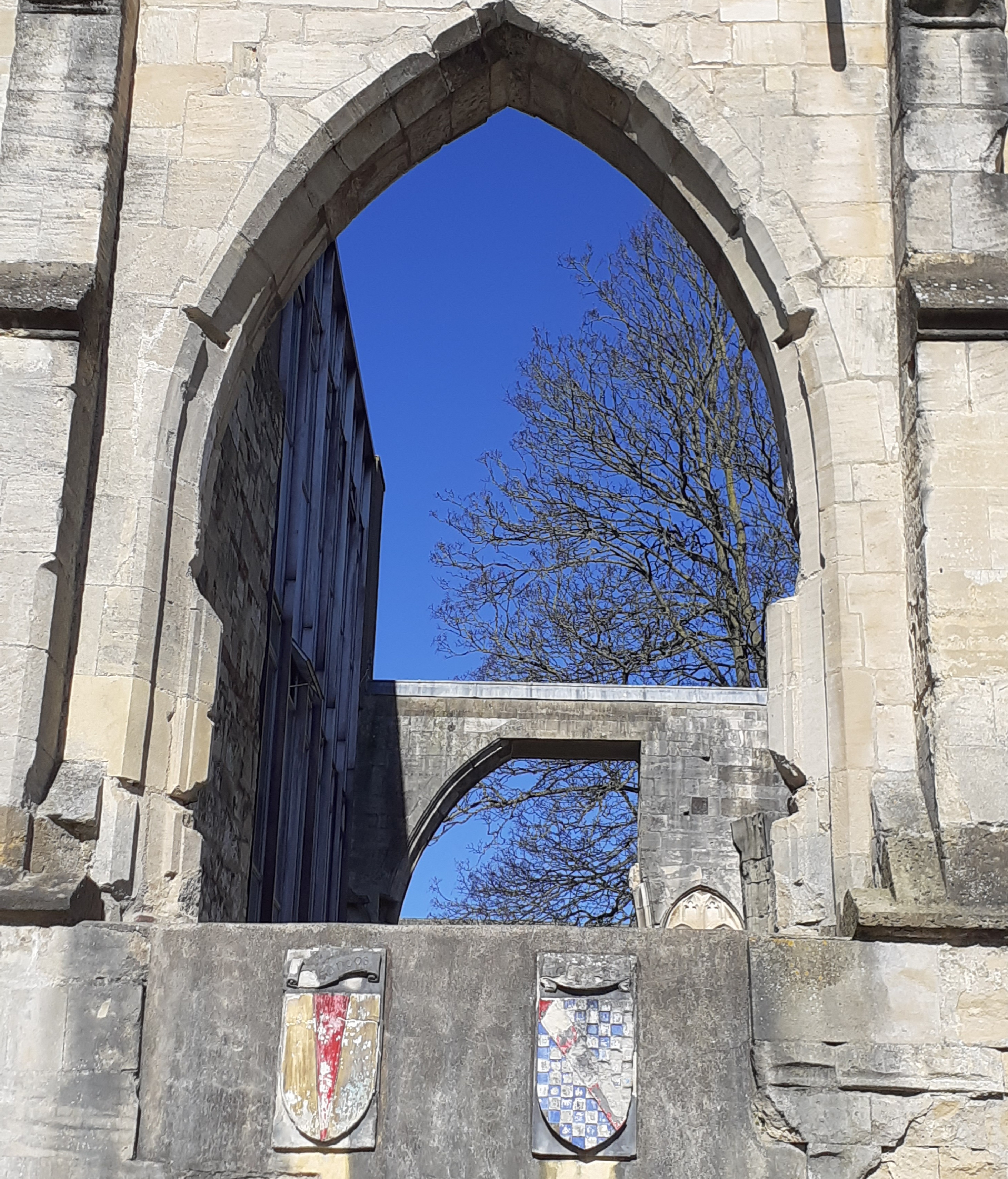
within the Priory ruins
this weathered arch
frames a living sky.
Note: The priory is the Greyfriars Priory, Gloucester, England

within the Priory ruins
this weathered arch
frames a living sky.
Note: The priory is the Greyfriars Priory, Gloucester, England

Birch bark beauty
Between earth and sky,
Greeting another winter.

Tick Tock sounds the clock
Marking the passage of Time
As does the silence.
It is a calendar month since Elaine came home from the Gloucester Royal hospital, after her hip fracture in Gran Canaria on 11 April (1). She is slowly recovering, but still housebound.
Two days before her accident I attended a meeting that signed off on a collection of poetry by local writers (2) to which we had both contributed. Elaine’s haiku below is part of that collection.
(1)See: https://contemplativeinquiry.blog/2024/05/12/unsought-journey/ and https://contemplativeinquiry.blog/2024/06/03/inside-looking-out/ (para 3)
(2) Random Writings by the Wrandom Writers Wroclaw, Poland: Amazon Fulfillment, 2024 (Editorial Copyright J.D. Warner; individual poems copyrighted by the authors).

Saturday morning, 8 July. Gloucester, England. I am warm. I am indoors. I am contentedly lethargic. My gaze turns to a balcony door.
I contemplate Elaine’s balcony garden. The flowers are less dramatic than during the solstice period. Their colours are softer. I see more green. I see raindrops on the other side of the door. They are evidence of a gentle rain falling on this tiny garden.
“I am the movement of the breath and stillness in the breath”, I say in my Druid contemplative liturgy. “Living presence in a field of living presence: here, now and home”. This can be true at any time, but some conditions are more helpful than others. Here and now, I become alive to the balcony garden, fully present. Knowing Elaine as creator of this garden extends my sense of connection. A simple nourishing moment.
Hours later, with a flash and a crash, the heavens opened and my world changed, heralding a new kind of experience.
Raindrops on glass,
Flowers in their pots.
Calm before the storm.

Seeing bluebells
In verdant grass.
Will summer really come?
For his morning tea
A priest sits down
In utter silence –
Confronted by chrysanthemums.
Matsuo Basho The Narrow Road to the Deep North and Other Travel Sketches London: Penguin Books, 1966 (translated with an introduction by Nobuyuki Yuasa)
The introduction names Matsuo Basho (1644-94) as one of the greatest figures in Japanese literature, and describes his life and work. A younger son of a minor samurai family, at nine years old he was sent to the Todo family as page and study-mate for Yoshitada, its eleven year old heir. Yoshitada, born with a delicate constitution, was more interested in literary than in military arts, and he and Basho studied the fashionable art of linked verse under the poet Kigin.
When Yoshitada died at the age of 25, Basho left the service of the Todo family by running away to Kyoto where he spent five years studying Japanese and Chinese classics at Buddhist temples. Later he based himself in the younger city of Edo (now Tokyo) where he felt greater freedom to find his own direction as a poet.
Dissatisfied with the, to him, superficial culture of Edo’s ‘floating world’, Basho turned to Zen and learned meditation from the Zen priest Buccho. Poetry still came first for Basho, but his understanding and practice changed. He wrote of his own work: “What is important is to keep our mind high in the world of true understanding, and returning to the world of our daily experience to seek therein the truth of beauty. No matter what we may be doing at a given moment, we must not forget that it has a bearing upon our everlasting self which is poetry”. Basho is a pen name, and the name of a species of banana tree about which Basho said: “the big trunk of the tree is untouched by the axe, for it is utterly useless as building wood. I love the tree, however, for its very uselessness … I sit underneath it, and enjoy the wind and rain that blow against it”.
Discussing the relationship between the poet and nature, he wrote: “go to the pine if you want to learn about the pine, or to the bamboo if you want to learn about the bamboo. And in doing so, you must leave your subjective pre-occupation with yourself. Otherwise you impose yourself on the object and do not learn. Your poetry issues of its own accord when you and the object have become one – when you have plunged deep enough into the object to see something like a hidden glimmering there. However well phrased your poetry might be – if the object and yourself are separate – then your poetry is not true poetry but merely your subjective counterfeit.”
By the time Basho came to write travel sketches, mixing haiku and prose in the genre known as haibun, he had spent some years casting away his material attachments. Now he had “nothing else to cast away but his own self which was in him as well as around him. He had to cast this self away, for otherwise he was not able to restore his true identity (what he calls ‘the everlasting self which is poetry’ in the passage above). … He left his house ‘caring nought for his provisions in the state of sheer ecstasy'”.
I love the haiku at the top of this post. I love the freshness and naturalness of the priest’s encounter with a flower that is steeped in the formal (and auspicious) symbolism of both Buddhist tradition and Japanese national culture, but is offered here in its simple yet extraordinary essence.
I cannot claim real understanding of traditional Japanese Zen culture and its relationship to creative arts. I have a smattering of knowledge and an awareness of some principles. But I am sure that much is lost in translation. What I do have is the capacity to open myself up to the words and images. Here I find the resonance of a richer experience of being, better grounded whilst also more spacious.
For his morning tea
A priest sits down
In utter silence –
Confronted by chrysanthemums.

This lone shape
emerging from under-wood:
Who am I?
music that celebrates Earth and speaks to the heart
Follow the Moon's Cycle
Meeting nature on nature's terms
A little bit of Mark Rosher in South Gloucestershire, England
A monastic polytheist's and animist’s journal
Selkie Writing…
Images and words set against a backdrop of outsider art.
living purposefully during metacrisis and collapse
The pagan path. The Old Ways In New Times
Spiritual journeys in tending the living earth, permaculture, and nature-inspired arts
a magickal dialogue between nature and culture
The gentle art of living with less
Thoughts about living, loving and worshiping as an autistic Hearth Druid and Heathen. One woman's journey.
An place to read and share stories about the celtic seasonal festivals
Just another WordPress.com site
Exploring our connection to the wider world
Become more grounded and spacious with yourself and others, through your own body’s wisdom
Good lives on our one planet
News for the residents of Hopeless, Maine

