Contemplative Inquiry

This blog is about contemplative inquiry

Tag: Eco-Spirituality

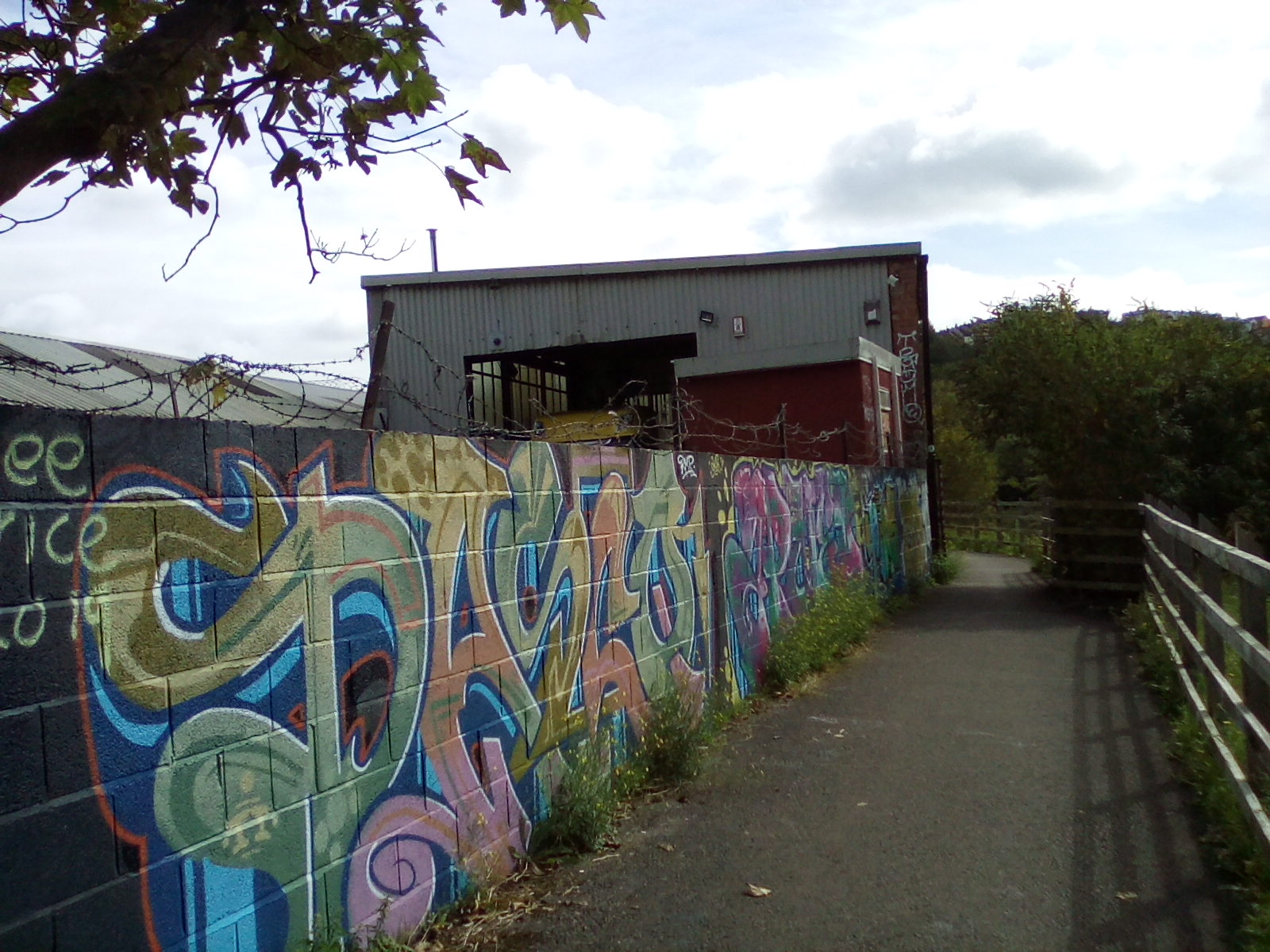
A PICTURE ON THE WALL

I imagine a fairly distant future. People are living underground or in domed settlements. The population, though nothing like today’s, is recovering. It is gaining in confidence and ambition. They hope that by continuing their own genetic modification, and terra-reforming the planet, they will be able to live outside again. They have museums, and the stretch of wall above is a prized artefact from a half-legendary pre-apocalyptic time.

What do observers make of it? What, if anything, do they know about birds? Can they name and recognise a ‘duck’ without expert input? If so, do they have any idea of why the representation on the wall is not entirely naturalistic? What about the conventions of thought bubbles and question marks? Would even the curators know about graffiti, and their role in late pre-apocalyptic culture? How do they stand with the notion of ‘humour’?

Conceivably, they know little about us and our intentions. The memory of us may be disturbing to them. This image may be seen as a riddle and a mystery – somewhat magical, somewhat uncanny. It may create a mixture of fascination and unease, ensuring its place as a guaranteed magnet for visitors.

What stories do our remote descendants tell, when contemplating this relic of the past? What, for them, does the picture on the wall say about us? Would we want to know?

SACRED SOUNDSCAPES

“Concepts of animism can take many forms. … The idea of the land being capable of speaking to humans was probably widespread in ancient sensibility. Sacred soundscapes were simply a natural corollary.

“The basic notion of the land having speech, or being read like a text, was lodged deeply in some schools of Japanese Buddhism – in early medieval Shingon Esoteric Buddhism, founded by Kukei, for instance. He likened the natural landscape around the Chuzenji temple and the lake at the foot of Mount Nantai, near Nikko, to descriptions in the Buddhist scriptures of the Pure Land, the habitation of the buddhas. Kukei considered that the landscape not only symbolised but was of the same essence as the mind of the Buddha. Like the Buddha mind, the landscape spoke in a natural language, offering supernatural discourse: ‘Thus, waves, pebble, winds, and birds were the elementary and unconscious performers of the cosmic speech of buddhas and bodhisattvas,’ explains Allan Grapard (1994).

” …. ….

“Throat singers in Tuvan, an autonomous republic within the Russian Federation, developed their vocal art originally as a means of communicating with their natural environment, not for entertainment. Throat singing involves the production of resonant sounds, overtones and whistles within the throat, nasal cavities, mouth and lips, and was used to provoke echoes or imitate natural sounds like waterfalls or wind. The master throat singers can select precise locations inside caves where the resonances are exactly right to maximise the reverberations of their songs. They even wait until atmospheric conditions are perfect for the greatest effect. It is in essence a technology of echoes. At one locale, where a singer called Kaigal-ool performed in front of a cliff face, ethnomusicologist Theodore Levin reported that ‘the cliff and surrounding features sing back to the musician in what Kaigal-ool calls a kind of meditation, a conversation I have with nature‘ (Levin & Suzukei, 2006).

“It is only in our modern culture that we have stopped listening to the land within a spiritual context. If we could fashion a modern, suitably culturally-ingrained animistic model, we would treat the environment with much more respect.”

Paul Devereux, in his Foreword to Greening the Paranormal: Exploring the Ecology of Extraordinary Experience August Night Press, 2019. Edited by Jack Hunter. See: http://www.augustnightpress.com

FEELINGS AND CONTEMPLATION

“In meditation, when a wave of feeling comes to visit – a grief, a fear, an unexpected anger or melancholy – can you stay present with that wave, breathe into it, let go of trying to ‘let go’ of it, and simply let it be, let it live, let it express itself right now within you? Can you notice the impulse in you to resist it, to refuse it, distract yourself from it and move away from your experience? Don’t judge or shame yourself for that impulse either, for wanting to have a different experience that you’re having – it’s an old habit, this urge to disconnect, this impulse to flee, this addiction to ‘elsewhere’.

” But see, today, if you can stay very close to ‘what is’, see if you can actually connect with the visiting feeling, gently lean in to your experience as it happens. Instead of shutting down, moving away, denying the energy in the body, can you gently open up to it? Can you flush it with curious attention? Let it move in you? Stay present throughout its life cycle, as it is born, expresses what it has to express, and falls back into Presence, its oceanic home?” (1)

The extract above is from a piece by Jeff Foster called When We Push Feelings Away. I support his approach, though I don’t now make firm distinctions between an activity called ‘meditation’ and the spontaneous flow of attention. I can stay present with the wave of feeling, and breathe into it, whether I’m ‘in meditation’ as a defined practice or not.  Meditation, once exotic and formal, has become naturalised. My contemplative life is pared down and minimalist, holding a strong sense of the sacred in daily life, including the work of self-healing. Jeff Foster continues:

“… One day, deep in meditation, perhaps, we remember, all feelings are sacred and have a right to exist in us, even the messiest and most inconvenient and painful ones. And we remember to turn towards our feelings instead of turning away. To soften into them. To make room for them instead of numbing them or ignoring them. …. So much creativity is released, so much relief is felt, when we break this age-old pattern of self-abandonment and repression, go beyond our careful conditioning, and try something totally new: staying close to feelings, as they emerge in the freshness of the living moment, waving to us, calling to us, seeking their true home in our heart of hearts.”

Jeff Foster calls this piece Pushing Feelings Away. I like his concern with holding and acceptance within what he calls Presence. I call my overall path a Sophian Way, and not The Sophian Way, because it is a solitary path that morphs and shifts.  Jeff Foster works with personal feelings from a transpersonal, non-dual  perspective that I find very Sophian, characterised  by wisdom, contemplation and compassion. My own path brings together this approach with the Eco-spirituality – or ‘Nature Mysticism’ – catalysed by my experience of modern Druidry.

(1) Jeff Foster The Joy of True Meditation: words of encouragement for tired minds and wild hearts Salisbury: New Sarum Press, 2019

CONTEMPLATION AND ENGAGEMENT


According to my dictionary, one of the meanings of ‘signature’ is, “a distinctive pattern, product, or characteristic by which someone or something can be identified: the chef produced the pate as his signature dish”.

I want to adjust the signature of this blog. I want now to explore the relationship between contemplation and engagement more explicitly. A blog is itself a form of engagement, and this one has so far combined a strong curatorial thread with personal sharing. Now, for me as for many others, a deepening social and ecological crisis asks for a work of preserving existing life-affirming aspects of our culture and developing new ones. I see this work as enhanced by outward-looking forms of contemplation. I want this blog to contribute.

I started this blog as a Druid. My personal path, which I have described more recently as a Sophian Way, has become more Universalist. I have described it as a path of healing, peace and illumination, which encourages a spirit of openness, an ethic of interdependence and a life of abundant simplicity. Its ‘sacrament of the present moment’ involves resting in a place of underlying stillness, freedom and love within any experience – good experiences, wonderfully, but also bad ones that need active resisting on the ground. For some, this suggests an experience of divine support, or the activation of the divine within us or of the divinity that we truly are. For others it seems to come from a deep wellspring within the psyche that needs no further point of reference. This sacrament is my core practice, to be dropped into at any time. It doesn’t always take a pure form, but it usually makes a difference. In the myth of my own life, it is Sophia’s principal teaching.

At the level of the wider word, I continue to feel a strong sense of alignment with Pagan, Animist, and Earth spiritualities like Druidry – more than to the Buddhist or Gnostic families or to movements like the Headless Way, even though they have given me a lot. Philip Pullman in his The Secret Commonwealth* has a character who says that where we stand revolves around one key question – ‘is the world dead or alive?’ I say ‘alive’ without worrying about scientific definitions or the metaphysics of reality. Something in me just has to say ‘alive’ – alive and interconnected as a web of life. This re-affirmation is important to me, and as a ‘light bulb moment’ on a level with the more seemingly individual aspects of my Sophian Way. I don’t expect to change the blog that much, but there’s enough adjustment of signature here to demand explicit affirmation.

*Philip Pullman The Secret Commonwealth Oxford, David Fickling Books & London, Penguin, 2019 (Vol. 2 of The Book of Dust)


BOOK REVIEW: DRUIDRY AND THE FUTURE

Highly recommended. Druidry and the Future is intended as “antidote to despair” according to author Nimue Brown. She continues:

Druidry & Future 51hWUITk4HL._AC_UY218_ML3_

“This book explores the many ways in which the Druid path can help us to respond to climate chaos, necessary cultural change and political uncertainty. By mixing the spiritual and practical we can be more resilient and resourceful, and aspire to live in regenerative and generous ways.”

An affordably priced and relatively slender volume, Druidry and the Future is full of ideas. It is built around 16 essays covering diverse topics: working with Pagan stories: seasonal living: bardic powers; ‘pragmatic’ animism; working with the elements (three essays); de-colonising your soul; your body is nature; justice and balance; honouring the divine through action; putting ourselves back in the landscape; community solutions; self-care and kindness; trees and wetlands; regeneration and restoration. For me, there is a single overarching theme: enlisting the resources of modern Druid culture to build resilience in the face of climate catastrophe. This resilience includes personal and collective aspects, where humans and their communities are understood as wholly embedded in the wider web of life.

Nimue Brown is clear that “it is not enough to be sustainable”. The crisis invites, or rather requires, a radical change in values and behaviour. Human civilization is ‘just people’ and we have the capacity to live differently. For her, “this is what Druidry means right now. It’s about answering the question of how to put civilization in balance with our living planet. This is Druidry for radical change and I think we’re well placed to take on this work and to inspire others. Philosophy has always been part of Druidry, so has teaching and communication, inspiration and vision. We can, and must make a difference.”

POEM: A SPECIAL DAY (CHOSEN FOR ELAINE)

Today

is a very special day.

Today we celebrate

sun and rain,

light and dark,

the cycles of life,

the great turning

of the wheel.

Today we celebrate

every leaf on every tree,

every feather on every bird,

every drop of water in every stream.

Today we celebrate

green growing ones and winged ones,

two leggeds and four leggeds,

all who walk, crawl,

swim or fly.

We celebrate

each breath of air,

each morsel of food,

each beat of our hearts,

each healthy cell.

We celebrate

the profound miracle

of being alive

in this body

in this moment

on this planet.

Today,

like every other day,

is a very special day.

Kai Siedenburg Poems of Earth and Spirit: 70 Poems and 40 Practices to Deepen your Connection with Nature Our Nature Connection, 2017

(Poem shared on the occasion of my wife Elaine’s birthday. It was transcribed for me  on a card sent to me on my own birthday last month. It prompted me to buy the collection, which I recommend.)


FACING EXTINCTION

My survival is on the line, along with any legacy and any memory of me. This applies to everyone I know and care for, and everyone else too. It applies to everything in culture and nature for which I have an affinity or to which I feel connected. Whenever I let this in, really let it in rather than just acknowledging it, I feel freshly shocked. Threat feels immediate. I have no sense of time.

After the first sense of a physical-energetic punch, there comes a pause, followed by a chaos of feelings, thoughts and images that stream for a while through my being. Eventually the storm passes. I regain some equilibrium, and with it a fuller presence in the flowing moment. There is something in the sheer joy of experiencing that remains unsullied and becomes my anchor. But I still need to ask myself how I stand with this awful knowledge, alongside another awful knowledge of the nuclear threat, and the normal knowledge of my own natural death. How do I respond to any of these? How, specifically, do I respond to ecological breakdown? The timescale here isn’t quite the possible ‘anytime’ of the other threats, and I may not be around. But it’s dangerously close, already compromising the life of the wider world. How do I hold this understanding? What do I do?

For me, this points to the value of psycho-spiritual as well as political work in facing the threat of a mass extinction on planet Earth. Last week I attended a promising taster for a forthcoming online course ‘Facing Reality’ (see https://www.livingfocusing.co.uk/ calendar). This will use Focusing methods to look at what ecological breakdown means “for your life, work and relationships. How is it impacting you? What happens when you take it in?”. It starts from the premise that “many of us are feeling overwhelmed and confused but it’s hard to know what to do about it. In response, we often either turn away or dive into action without seriously confronting our reality and giving enough space to feel into our emotional and intuitive response. By finding the courage to turn towards the mess we are in with a like-minded community, we can empower our response in a more authentic way and build personal agency for our creativity, gifts and action”.

The course leaders quote a saying to the effect that we can avoid reality, but not the consequences of avoiding reality. Courses like this are a good way of facing reality in a supportive environment, and I plan to be part of this one. This one is open to the public. You don’t need a Focusing training to take part.

REVISED ‘ABOUT’ APRIL 2019

Over the lifetime of this blog I have made frequent revisions of its ‘About’ statement. Most are small. Occasionally, I make a major revision which I also publish as a post. Below is my revised and edited ‘About’ of 19 April 2019.

I am James Nichol and I live in Stroud, Gloucestershire, England. The Contemplative Inquiry blog started in August 2012, and includes personal sharing, discursive writing, poetry and book reviews. It explores contemplative themes and their role in human flourishing within the web of life.

In my own journey, I have found an At-Homeness in a flowing now, not linked to any specific doctrine. For me, this experience and stance enable greater presence, healing and peace. They also support imaginative openness and an ethic of aware interdependence.

I began this work within British Druidry. I continue to follow an earth-centred and embodied spiritual path, ‘secular’ rather than ‘religious’. I draw on diverse traditions, especially resonating with naturalist, eco-existentialist, pantheist and animist currents within and beyond modern Paganism.

I am wary of metaphysical truth claims, including materialist ones, with an ultimate stance of openness and unknowing. At the time of this revision, I am exploring a tradition initiated by the Greek Pagan philosopher Pyrrho of Elis, who developed his own school of contemplative scepticism after a visit to India.

My book, Contemplative Druidry: People, Practice and Potential, was published in 2014.  https://www.amazon.co.uk/contemplative-druidry-people-practice-potential/dp/1500807206/

WELL-BEING: CONTEMPLATING ACTION

“In The Spirit Level Richard Wilkinson and Kate Pickett put inequality at the centre of public debate by showing conclusively that less equal societies fare worse than more equal ones across everything from education to life expectancy. The Inner Level explains how inequality affects us individually, how it alters how we think, feel and behave. It sets out the overwhelming evidence that material inequities have powerful psychological effects: when the gap between rich and poor increases, so does the tendency to define and value ourselves and others in terms of superiority and inferiority. A deep well of data and analysis is drawn upon to empirically show, for example, that low social status is associated with elevated levels of stress hormones, and how rates of anxiety and depression are intimately related to the inequality which make that status paramount.” (1)

What links contemplation and action? My answer is creative and powerful ideas. In a recent post (2), I cited Brendan Myers (3) proposition that a flourishing life is ethically desirable and good (a powerful, creative idea), and that it depends on us supporting each other’s well-being and that of the biosphere and the Earth itself (another powerful creative idea). The Spirit Level and The Inner Level concern ‘developed’ countries in the 21st century and to an extent the last two decades of the 20th. They paint a depressing picture, especially for the U.K. and the U.S.A, and for me it shows the need to champion a social ecology that supports health and well-being.

For some years I worked at the interface between public health (i.e. population-based health, largely concerned with prevention work and the creation of more supportive environments) and mental health. So, I am interested in the recent publication of The Inner Level (4) and may write further about it. Thinking about ‘health’ in the bigger picture (with service provision as only one aspect) is a positive way into social justice work, where powerful ideas can (in principle) be realised through ethical passion and political will informed by scientific evidence. It is a notion of how to do public policy that needs to be kept alive.

I know this doesn’t happen much, now, in a culture like ours with high levels of bullying, confusion, distraction and misinformation. We seem to be living with an orchestrated dumbing down of political discourse in the service of oligarchic interests. So, my first action – not always recognised as action – is personal resistance to any onset of cynicism, numbness and despair within myself. My second action – also not always recognised as action – is to work at maintaining an adequate level of knowledge and understanding of what is happening in the world, using the lens of ‘powerful ideas’ to make sense of the information I digest. This includes having an historical perspective – both backwards and forwards – on current events. My third action is to place myself within networks that share my concerns and are responding to them in diverse ways – hopefully modelling cultures of: compassion (including ruthless compassion); openness and creativity; curiosity about the world; and criticality (deconstructive where necessary and appreciative where possible) in the realm of ideas and action. Further developments will come from there, and I will write about them within this blog.

Over time my contemplative life has moved towards a blend of energy work and meditative connection to source, with the practice forms kept simple. It is also the clear, awake space out of which I act in the world.

(1) https://www.equalitytrust.uk/

(2) https://contemplativeinquiry.wordpress.com/2018/07/02/ethics-and-civilization/

(3) Brendan Myers Reclaiming Civilization: A Case for Optimism for the Future of Humanity Winchester, UK & Washington, USA: Moon Books, 2017

(4) Richard Wilkinson and Kate Pickett The Inner Level: How More Equal Societies Reduce Stress, Restore Sanity and Improve Everyone’s Well-being

GARY SNYDER: ‘WILD’

“The word wild is like a grey fox trotting off through the forest, ducking behind bushes, going in and out of site. Up close, first glance, it is ‘wild’ – then further into the woods next glance it’s ‘wyld’ and it recedes and it recedes via Old Norse villr and Old Tuetonic wilthijaz into a faint pre-Tuetonic ghweltijos which means, still, wild and maybe wooded (wald) and lurks back there with possible connections to will, to Latin silva (forest, sauvage) and to the Indo-European root ghwer, base of Latin ferus (feral, fierce), which swings us around to Thoreau’s ‘awful ferity’ shared by virtuous people and lovers. The Oxford English Dictionary has it this way:

Of animals – not tame, undomesticated, unruly

Of plants – not cultivated

Of land – uninhabited, uncultivated

Of foodcrops – produced or yielded without cultivation

Of societies – uncivilized, rude, resisting constituted government

Of individuals – unrestrained, insubordinate, licentious, dissolute, loose. “Wild and wanton widowes”, 1614

Of behavior – violent, destructive, cruel, unruly

Of behavior – artless, free, spontaneous. “Warble his native wood-notes wild” – John Milton

Wild is largely defined in our dictionaries by what – from a human standpoint – it is not. It cannot be seen by this approach for what is is. Turn it the other way:

Of animals – free agents, each with its own endowments, living in natural systems

Of plants – self-propagating, self-maintaining, flourishing in accord with innate qualities

Of land – a place where the original and potential vegetation and fauna are intact and in full interaction and the landforms are entirely the result of non-human forces. Pristine.

Of foodcrops – food supplies made available and sustainable by the natural excess and exuberance of wild plants in their growth and in the production of quantities of fruit and seeds

Of societies – societies whose order has grown from within and is maintained by the force of consensus and custom rather than explicit legislation. Primary cultures, which consider themselves the original and eternal inhabitants of their territory. Societies which resist political and economic domination by civilization. Societies whose economic system is in a close and sustainable relation to the local ecosystem

Of individuals – following local custom, style and etiquette without concern for the standards of the metropolis or nearest trading post. Unintimidated, self-reliant, independent

Of behavior – freely resisting any oppression, confinement or exploitation. Far-out, outrageous, ‘bad’, admirable.

Of behavior – artless, free, spontaneous, unconditioned. Expressive, physical, openly sexual, ecstatic

Most of the senses in this second set of definitions come close to being how the Chinese define the term Dao, the way of Great Nature: eluding analysis, beyond categories, self-organizing, self-informing, playful, surprising, impermanent, insubstantial, independent, complete, orderly, unmediated, freely manifesting, self-authenticating, self-willed, complex, quite simple. Both empty and real at the same time. In some cases, we might call it sacred. It is not far from the Buddhist term Dharma with its original senses of forming and firming.”

Gary Snyder The Practice of the Wild Berkeley, CA: Counterpoint, 1990

In a preface to the 2010 edition, Gary Snyder describes his path as “a kind of old time Buddhism which remains connected to animist and shamanist roots. Respect for all living beings is a basic part of that tradition. I have tried to teach others to meditate and enter into the wild areas of the mind. … Even language can be seen as a wild system”.

Earth Eclectic

music that celebrates Earth and speaks to the heart

Sarah Fuhro Star-Flower Alchemy

Follow the Moon's Cycle

Muddy Feet

Meeting nature on nature's terms

Rosher.Net

A little bit of Mark Rosher in South Gloucestershire, England

Becoming Part of the Land

A monastic polytheist's and animist’s journal

selkiewife

Selkie Writing…

Charlotte Rodgers

Images and words set against a backdrop of outsider art.

Prof Jem Bendell

living with metacrisis and collapse

Towint

The pagan path. The Old Ways In New Times

The Druids Garden

Spiritual journeys in tending the living earth, permaculture, and nature-inspired arts

The Blog of Baphomet

a magickal dialogue between nature and culture

This Simple Life

The gentle art of living with less

Musings of a Scottish Hearth Druid and Heathen

Thoughts about living, loving and worshiping as an autistic Hearth Druid and Heathen. One woman's journey.

Wheel of the Year Blog

An place to read and share stories about the celtic seasonal festivals

Walking the Druid Path

Just another WordPress.com site

anima monday

Exploring our connection to the wider world

Grounded Space Focusing

Become more grounded and spacious with yourself and others, through your own body’s wisdom

The Earthbound Report

Good lives on our one planet

Hopeless Vendetta

News for the residents of Hopeless, Maine