Contemplative Inquiry

This blog is about contemplative inquiry

Tag: contemplation

POEM: A WITHERED TREE

Not a twig or leaf on the old tree,

Wind and frost harm it no more.

A man could pas through a hole in its belly,

Ants crawl searching under its peeling bark.

Its only lodger, the toadstool which dies in a morning,

The birds no longer visit in the twilight.

But its wood can still spark tinder.

It does not care yet to be only the void at its heart.


By Han Yü (768-824)

From: Poems of the Late T’ang translated from the Chinese with an introduction by A.C. Graham Harmondsworth: Penguin, 1965

Han Yü was primarily an essayist and polemicist, and initiated an ultimately successful Confucian revival at a time of Buddhist cultural dominance. When writing verse, he adopted devices traditionally confined to prose and to fu (prose poems) and sought to attend to the social and human content of poetry.

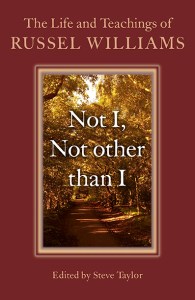
BOOK REVIEW: NOT I NOT OTHER THAN I

Not INot I, Not Other than I is an inspiring story of spiritual awakening. For me, the book has a skilful balance of biography and wisdom in which each throws light on the other. Highly recommended to people involved or interested in contemplative spiritualities.

Russel Williams left school aged 11. Both of his parents were dead and he was too old for Barnado’s.  So he was licensed to work for a living, though in 1932 and the years that followed it was hard to make ends meet. He describes himself in his teenage years as existing but not living. He was angry and aggressive, with no empathy, a quick temper, and prone to getting into fights. What frustrated him most was a sense of his own ignorance.

In 1939 war broke out and Williams joined the British army. He recalls that being a soldier “saved me from a bad end, kept me out of trouble – and most importantly it took away the worry of keeping myself alive. I had regular food and shelter for the first time since my parents died. It was easy, compared me to the life I had before. It also taught me self-discipline to control my emotions”.

After the war he went “walking, walking …” until he making contact with another man, who was starting up a small circus. Williams accepted the job of looking after the horses, and he began to feel a strong connection with them. He wanted to understand them better. “I set my mind to watching and observing every detail, every moment of the day, for days on end”. This process became “more and more concentrated”. He was “not thinking any more”. His mind had “gone quiet”. He was experiencing states of “spontaneity” and “living in the moment”. He began to “look through the horses’ eyes”, as the boundaries fell away, and he became notable for his calming and healing presence when working with them.

Still in his 20’s, Williams began to discern a path in life. Later he framed his life with the horses – 20 hours a day, 7 days a week, for 3 years – as a naturally occurring education in mindfulness meditation: his life a continual service, “with no thought of myself”. He still experienced frustration and disappointment, because he couldn’t find anyone to talk to about this who seemed willing to treat him seriously. But eventually he ran into a small number of kindred spirits, people with whom he could enter into close rapport, and this led to his joining the Manchester Buddhist Society in 1957.

Although the Society made a connection with Thai Buddhism in 1954 (one of their members trained as a monk) Williams himself has kept a distance from formal Buddhism. He has been President of the Society for over 40 years and he still doesn’t call himself a Buddhist. His life and work has included esoteric Christian influences and a resonance with Ramana Maharshi. One of his sayings is that whereas “Buddhism is a belief system … the way of the Buddha is a recognition system”. Acknowledging that Buddha didn’t go beyond dealing with suffering, never mentioning spiritual worlds as such or communicating with other entities, he added “but we do”. Williams’ way of the Buddha is also a way of the free spirit.

Russel Williams is now 93. He is still going strong. My contemplative Druid companion Rosa Davis mentioned this book at our last group meeting. Williams says that his life experience and practice have led him to a “natural state” of oneness with everything, and with the universe itself. “We are part of the unmanifest. We are part of the pure consciousness which has given rise to the whole universe. That consciousness is our true nature, and, when we rest within it, we feel a powerful sense of ease and contentment”. He believes that this is the only meaningful way of understanding the term ‘God’, and what Jesus of Nazareth meant when declaring “I and the Father are one”. This kind of experience, “stillness, pure consciousness, emptiness of being” is the inheritance of us all, and potentially available to us all. It is based on sense-feeling, and on filling the emptiness with loving-kindness.

Williams doesn’t support long meditation practices, though he does believe in frequent ones. He saying “once you get the process going” 10 or 15 minutes should suffice, and recommends doing it 7 times a day. For him, the way in to a full meditative state is through the realm of subtle feeling, and he invites us in with him about a third of the way through the book:

“Feel down here, a little bit above the navel you’ll find the right place. Centre yourself there, in feeling. Observe your breathing, in the sense of the expansion and contraction of the outer part of the body, as if it were a balloon …” From here we are guided to notice the calming and peaceful effects of this “gentle movement, this comfortable gentle movement … absence of agitation, peacefulness … a kind of heartfelt warmth of feeling … it feels homely, as though you belong there … And as though it were a light”.  We then move outwards from the “balloon” to include the whole physical body and then go beyond it. “It reaches out in all directions … and begins to feel at home with all its surroundings, whether it be animate or inanimate … of the same nature” …. And so on into silence for a few minutes. At the end of the meditation the practitioner is asked to draw back into the “very centre”, making sure it is “still peaceful and warm” before returning to normal consciousness.

What I learned from this was the flavour of ‘sense-feeling’, a specifically located warmth, a sense of quiet movement, qualities of gentleness and peace. Nurturing is another favourite Williams word. These qualities fill the body-mind and move beyond it, filling emptiness, engendering loving-kindness. In a group meditation, they can create a deep rapport and subtle meeting place between participants. The aim is to develop “such gentle perception that you could compare it to a finger, soft and warm, touching a snow flake, but so delicate that the flake doesn’t melt”. From there, we begin to see into the nature of things, becoming aware of a different reality, expanding into it until we become “boundless”. This is achieved not by any great effort, but by simply letting go.

‘Sense-feeling’ has already helped me in my own practice. It enriches my experience of ‘presence’ (a key word for me), placing it more clearly beyond witnessing awareness as normally understood. The meditative experience becomes participatory and nurturing in a more complete way, yet one that also seems easy, obvious, almost remembered rather than newly learned. I’m grateful for the recommendation and glad to be passing it on.

Russel Williams (2015) Not I, Not Other than I: the Life and Spiritual Teachings of Russel Williams (Edited by Steve Taylor) Winchester & Washington: O Books


CONTEMPLATIVE DRUIDRY IN 3 SENTENCES

Elaine and I were recently asked by a non-Druid local group to define contemplative Druidry in 3 sentences.  This is what we came up with.

“Contemplative practice in Druidry supports what has been called ‘the Nature mysticism of modern Druidry’. Our understandings of what this means are provisional and inquiring – those of us who follow the Druid way are encouraged to craft our own practices in accordance with our inner guidance, our needs and wishes. Practices in the Stroud-based group include group meditation, personal sharing, outside walking meditation, chanting and contemplative arts.”

This mix of practices also forms the basis of our retreat days for the wider Druid and fellow-travelling community. This year we are running two such days – one in London on Sunday 7 February and the other in Stroud on Saturday 1 October together with Nimue and Tom Brown. See also http://contemplativedruidevents.tumblr.com

We owe the phrase ‘the Nature mysticism of modern Druidry’ to Philip Carr-Gomm, who leads the Order of Bards, Ovates and Druids (OBOD), who used it in his foreword to Contemplative Druidry: People Practice and Potential. He also pointed out that the Druid way as a whole is one where we take responsibility for crafting our own practices. We see this a something we need to emphasise, since this approach is still unusual in spiritual movements as a whole.


WESTERN WAYS: DRUIDRY AND SOPHIA

In my world, Druidry and the Way of Sophia are linked, though not the same. In The Western Way (1,2) authors Caitlin and John Matthews made a distinction between a ‘Native’ Tradition and a ‘Hermetic’ one, which act as “complementary opposites”. The Native Tradition is “the inward spiral of a maze which leads into the heart of ancestral earth-wisdom”. The Hermetic Tradition is the outward spiral of the same maze: a path of evolving consciousness which is informed by the inner resources of our ancestral roots, “augmented in a macrocosmic way” (2).

My original interest in a ‘Celtic’ spiritual thread, developing from the 1980s, wasn’t specifically Druid or Pagan. It came mostly through Celtic and Celtic influenced literature. Although a long tradition in its own right, it post-dates the demise of institutional Druidry and Paganism in Celtic speaking regions. Most of it has been written with at least an element of Christian reference and influence. So we get verses like this from the medieval Welsh Book of Taliesin:

I was at the cross

With Mary Magdalene.

I received the Awen

From Ceridwen’s cauldron. (3)


What I intuitively liked about this was the sense of a culture working to integrate diverse influences rather than attempting to be ‘pure’. Pure culture (or the attempt at it) narrows horizons and banishes possible resources, becoming limited and inflexible in my view. Sophia is both an image of the divine and expresses a blending of Jewish and Greek wisdom traditions. She came to prominence in Alexandria, the largest city of Roman Egypt. She is cosmopolitan. In the verse above Mary Magdalene (an incarnation of Sophia in some gnostic traditions) and Ceridwen (not a traditional Celtic goddess from Pagan times) both have Sophian roles in relation to male figures seen in different ways as light bringers.

Some of the Celtic-derived stories from the medieval period are clearly breaking new cultural ground whilst using resources from the Celtic past. They belong to a realm of creative mythology, as Joseph Campbell called it, whose purpose is “the opening … of one’s own truth and depth to the depth and truth of another in such a way as to establish an authentic community of existence” (4). Twelfth century Western Europe sought to renew itself by drawing on its classical heritage (native in Italy) and Geoffrey of Monmouth drew on it in his Mystic Life of Merlin (5), for example by dedicating a contemplative ‘Observatory’ to the owl deity Minerva, Roman Goddess of Wisdom. It also drew on Celto-Germanic heritage, with the Arthurian mythos – the matter of Britain – taking a prominent place. This mythos does not name Sophia. But it does have the image of the grail and the story of the grail quest. For me the grail represents the presence and energy of Sophia, and Caitlin Matthews has described it as “a prime symbol of Sophia” (6).  Perceval, the grail winner, has to encounter the divine in a new way for himself. At one level his role is to honour and heal the land, renewing its tantric energy. But the Grail Goddess, whilst enabling that traditional collective healing, adds a new and more individuated depth of wisdom and compassion. So although I have always been moved by the scenes and images of the more archaically oriented Peredur (7), I have found a more compelling narrative in Parzival (8). It is the innovative aspect of the story that engages me and the grail image that nourishes me.

In the Gnostic Gospel of Thomas, (9) Jesus of Nazareth asks three leading followers to say what they think he is like. Peter, traditionally Jewish, says “you are like a just messenger” (or righteous angel in other translations). Matthew, familiar with Graeco-Roman ways, says “you are like a wise philosopher”. Thomas says, “my mouth is utterly unable to say what you are like”. The teacher responds, ‘I am not your TeacherBecause you have drunk, you have been intoxicated from the bubbling spring that I have tended’.  As I read this text, it is a confirmation that a lived spirituality is beyond packaging.

In this sense, terms like Druidry, Way of Sophia or Western Way have only a limited use. Joseph Campbell said “the best things cannot be told; the second best are misunderstood; after that comes civilised conversation”. The problem is real yet I believe he overstates his case. I think it is worth the effort of finding words, making distinctions and enabling affiliations in full awareness of the difficulties. Civilised conversation with moments of … something more … feels like an honourable pursuit.

  1. Caitlin & John Matthews (1985) The Western Way: A Practical Guide to the Western Mystery Tradition: Volume 1 – the Native Tradition London: Arkana
  2. Caitlin & John Matthews (1986) The Western Way: A Practical Guide to the Western Mystery Tradition: Volume 2 – the Hermetic Tradition London: Arkana
  3. John Matthews (1991) Taliesin: Shamanism and the Bardic Mysteries in Britain and Ireland London: The Aquarian Press (with additional material by Caitlin Matthews)
  4. Joseph Campbell (1976) The Masks of God: Creative Mythology Harmondsworth: Penguin
  5. R. J. Stewart (1986) The Mystic life of Merlin London: Arkana 
  6. Caitlin Matthews (1986) Sophia Goddess of Wisdom, Bride of God Wheaton, IL: Quest Books
  7. The Mabinogion (1976) Harmondsworth: Penguin (translated with an introduction by Geoffrey Gantz)
  8. Wolfram von Eschenbach, W. (1980) Parzival Harmondsworth: Penguin (translated by A. T. Hatto)
  9. The Gospel of Thomas: the Hidden Sayings of Jesus (1992) San Francisco, CA, USA: Harper San Francisco (translation with introduction, critical edition of the Coptic text and notes by Marvin Meyer; with an interpretation by Harold Bloom)

KEY WORDS

My very best wishes for 2016 to all readers of this blog. May your year be blessed with peace and loving-kindness.

Like many people I find the change of calendar year a good moment for revising and re-framing what I do. This includes my personal contemplative inquiry.  I remain strongly engaged with my Sophian Way and I am finding means of strengthening it.

At the beginning of contemplative practice I’m now saying: “I open myself to the divine breath: the movement of that breath and the stillness in that breath. I open my heart to the grace of Sophia”.  The key words are breath, movement, stillness, heart, grace and Sophia.

‘Divine breath’ translates the Greek word pneuma which could mean either ‘breath’ or ‘spirit’. It was a favourite with the Gnostics of late antiquity. For me, the divine breath is ordinary breath transformed through practice, awareness and understanding. I feel and taste the knowledge that breath enables life, and that it does so through transcending  the boundary between me and not-me. It allows me an individual life, embodied yet not sealed off. It also connects me to a larger system.

When I follow the movement of the breath, I am  attentive to its inhalation and exhalation. I breathe the cosmos; the cosmos breathes me. The movement of the breath is inherently active, life-giving and relational. There are practices in both Gnosticism and Tantra involving breath exchange with another person which emphasise these aspects of breathing.

The stillness in the breath, in my experience, is held within the movement of the breath. They are not polarised. It is the still point at the heart of being, always present as the activity of breathing is going on. It’s like an inner silence inside a context of sound, or an inner calm inside a context of energetic or emotional arousal. Truly to become open to the divine breath involves a simultaneous awareness of both dimensions.

Opened up to the experience of divine breath (rather than breath awareness as an arbitrary attentional focus) I can open my heart, in the sense offered by Cynthia Bourgeault: “In the wisdom traditions of the Near East, the heart is not the seat of one’s personal emotional life, but an organ of spiritual perception … its purpose is to stay in alignment with the Image of one’s true nature.” (1) Here, the grace of Sophia is Her presence and energy in support of that alignment.

The words cue me in to the experience, though not as a formula, for true contemplative experience is not formulaic. They represent a sensibility of practice, or a culture of practice, rather than a road map. The value of these words, as I continue to use them, will be in what emerges as a result of using them in the coming weeks and months.


(1) Cynthia Bourgeault The Meaning of Mary Magdalene: Discovering the Woman at the Heart of Christianity Boston, MA: Shambhala Publications, 2010


ST. LUCY’S DAY

“LUCIA PROCESSION” BY FREDRICK MAGNUSSON – ST. LUCY’S DAY, SWEDEN, 2007.

Saint Lucy’s Day is on December 13, part of Advent in the Christian year. I’m posting early because I will be spending the next week or so off the internet.

This feast once coincided with the Winter Solstice, the shortest day of the year before calendar reforms. Her feast day has become a festival of light, something that modern Pagans would perhaps more readily associate with Imbolc. St. Lucy’s Day is celebrated as a major feast day in Scandinavia with its long dark winters.

Lucy is called Lucia and is represented as a woman in a white dress and red sash with a crown or wreath of candles on her head. In both Norway and Sweden, girls dressed as Lucy carry rolls and cookies in procession as songs are sung. Even boys take part in the procession as well, playing different roles associated with Christmas. It is said that to vividly celebrate St. Lucy’s Day will help one live the long winter days with enough light.

I have tended more to link the day to a very different response to the day – John Donne’s poem A Nocturnall Upon St. Lucies Day, Being the Shortest Day. This was composed in the 1590’s, well before calendar reform in England.

The poem is linked to a personal bereavement as well as the season. I share the first two verses. They are very much about the young poet’s own experience, rather than the season or the one who has been lost – though in a sense both the poet’s feelings and the poem itself are a service to her. The words themselves give the dark its voice, capturing the moment of desolation fully, and holding it. They do not move on to any culturally expected renewal, but rather to an alchemical anti-renewal instead. If there is any redemption it is in the writing itself, the expression. Donne was a good English writer in a time of good English writing.


Tis the yeares midnight, and it is the dayes,

Lucies, who scare seaven houres herself unmaskes,

The Sunne is spent, and now his flasks

Send forth light squibs, no constant rayes;

The worlds whole sap is sunke;

The general balme th’hydroptique earth hath drunk,

Whither as to the beds-feete, life is shrunke,

Dead and enterr’d; yet all these seeme to laugh.

Compared to mee, who am their Epitaph.


Study me then, you who shall lovers bee

At the next world, that is, at the next Spring;

For I am every dead thing.

In whom love wrought new Alchimie.

For his art did expresse

A quintessence even from nothingnesse,

From dull privations, and leane emptinesse:

He ruin’d mee, and I am re-begot

Of absence, darkenesse, death; things which are not.


John Hayward (editor) John Donne Dean of St, Paul’s Complete Poetry and Prose London: The Nonesuch Press, 1967 (Donne became Dean of St, Paul’s in London a long time after he wrote this poem).


POEM: WATER AND WAVE

I’m sharing this song of Kabir because I enjoyed it and felt cheered by it.  I liked its devotional and ecstatic note – not my usual one.. I have harmonised it with my way of Sophia by changing a ‘his’ to a ‘her’.


I have been thinking of the difference

Between water

And the waves on it. Rising,

Water’s still water, falling back,

It is water, will you give me a hint

How to tell them apart?


Because someone has made up the word

“Wave”, do I have to distinguish it

From water?


There is a Secret One inside us;

The planets in all the galaxies

Pass through her hands like beads.


That is a string of beads one should look at with

Luminous eyes.


A weaver by trade but a poet-singer by calling, Kabir lived in fifteenth century India. His philosophy incorporated various beliefs of both Muslims and Hindus and later became one of the major influences behind Sikhism. Like Rumi, further to the west and generations earlier, his generously devotional and ecstatic path made him a natural bridge builder between traditions.

Kabir Ecstatic poems Boston, MA: Beacon Press, 1992 The English translations are free enough for Robert Bly to call them ‘versions by Robert Bly’. Given Bly’s freedom I have changed a ‘his’ to a ‘her’ above to support the poetry of my own gnosis. There is an earlier set of translations published by MacMillan in New York in 1915 by Rabindranath Tagore assisted by Evelyn Underhill under the title Songs of Kabir. Whilst I don’t follow Bly in calling the English of the earlier work “useless”, I do find that Bly’s interpretation has more passion and power. The Bly work includes an insightful afterword Kabir and the transcendental Bly by John Stratton Hawley.


POEM: THE MOON IN DEWDROPS

Simplicity and complexity, elegance and wisdom combined in the poetry of Japanese Zen. I notice that I respond more strongly to such poetry than I do to didactic texts about meditation and philosophy.


To what shall

I liken the world?

Moonlight, reflected

In dewdrops,

Shaken from a crane’s bill.


I particularly love this poem. The apparent naturalism of the imagery makes it powerful and accessible to anyone. Yet for me, this poem also brings up wider issues about reading and interpretation. The poet’s location in place, time and culture do make a difference. Ehei Dogen (1200-1253) was one of the first to transmit Zen Buddhism from China to Japan and was founder of the Soto School. His poem is a waka – a 31 syllable form predating the invention of haiku. Dogen is a key figure in both Japanese Buddhism and Japanese literature.

In Mahayana Buddhism, the Buddhism of all Japanese schools including Zen, the moon stands for Buddha-nature. So the poem teaches a familiar Mahayana truth that the moon (Buddha-nature) is completely reflected in every one of the countless dew drops (all things) without discrimination, namely one in all, all in one. This understanding is accompanied by a sense of fragility and impermanence within nature – strongly present in Japanese culture independently of Buddhism and reinforced by Buddhist teaching. Dogen gives us elegance and complexity in a 31 syllable form.

Hee-Jin Kim*, a modern Zen scholar, takes this further, bringing out Dogen’s sensitivity to history as well as to nature. He draws attention to the word ‘shaken’: each dew drop holds a full yet shaken reflection of the moon. Dogen lived in what was seen as a dark and ill-starred time in Japanese history. Many Buddhists thought that even their path was compromised and talked of degenerate dharma (mappo). Kim understands Dogen as resisting this ideology of despair whilst fully aware of the collective turmoil. On this reading, the poem asserts that timelessness is experienced within, and only within, momentariness, even when the times are stressed.


To what shall

I liken the world?

Moonlight, reflected

In dewdrops,

Shaken from a crane’s bill.


* Hee-Jin Kim Dogen on meditation and thinking: a reflection on his view of Zen Albany, New York: State University, 2007 (At the time of publication Hee-Jin Kim was Professor Emeritus of Religious Studies at the University of Oregon. He is also the author of Dogen-Kigen: Mystical Realist).

THE WOODCARVER

Khing, the master woodcarver, made a bell stand

Of precious wood. When it was finished,

All who saw it were astounded. They said it must be the work of spirits.

The Prince of Lu said to the master carver:

“What is your secret?”

Khing replied, “I am only a workman.

I have no secret. There is only this:

When I began to think about the work you commanded

I guarded my spirit. I did not expend it

On trifles, that were not to the point.

I fasted in order to

Set my heart at rest.

After three days fasting,

I had forgotten gain and success.

After five days,

I had forgotten praise and criticism.

After seven days

I had forgotten my body

With all its limbs.

By this time al thought of your Highness

And of the court had faded away.

Al that might distract me from the work

Had vanished.

I was collected in the single thought of the bell stand.

Then I went into the forest

To see the trees in their own natural state.

When the right tree appeared before my eyes,

The bell stand also appeared in it, clearly, beyond

doubt.

All that I had to do was to put forth my hand

And begin.

If I had not met this particular tree

There would have been

No bell stand at all.

What happened?

My own collected though

Encountered the hidden potential in the wood;

From this live encounter came the work

Which you ascribe to the spirits.”


Merton, Thomas (1965 & 2004) The Way of Chuang Tzu Boston & London: Shambhala.


Chuang Tzu, one of the great figures of early Taoism, lived around 300 BCE. The frontispiece of this edition says: “He used parables and anecdotes, allegory and paradox, to illustrate that real happiness and freedom are found only in understanding Tao or Way of nature, and dwelling in its unity. The respected Trappist monk Thomas Merton spent several years reading and reflecting on four different translations of the Chinese classic that bears Chuang Tzu’s name. The result is this collection of poetic renderings of the great sage’s work.


STOCKTAKING

Golden SeedIn 2014 The Order of Bards Ovates and Druids (OBOD) celebrated its 50th anniversary. It’s now just over 22 years since I first joined. Where am I now?

I remember being reassured by the way in which OBOD was able to hold a point of tension between two seemingly competing narratives. The first was the sense of living relationship with the land and the inheritance of ancestral stories. The second was an open and generous universalism. Without the first, the second could be vague and vapid. Without the second, the first could become culturally inward-turning and defensive. I’ve always been grateful for this balance.

As part of the 50th anniversary year, Sharon Zak and Maria Ede-Weaving put together The Golden Seed: Celebrating 50 Years of OBOD as “an anthology of prose, poetry, images and crafts” (including a DVD) created by OBOD members and friends. It is still referenced at http://www.druidry.org though currently unavailable. In my own entry I said I was more comfortable with a language of “practising OBOD Druidry” than “being an OBOD Druid”. That’s how I still see it and I would now want to add that this practice itself sits within a (for me) larger framework that I would name as the Way of Sophia. This has been true for quite a while, and I will write about it more in the future. Here I just want to say where my Druidry continues to fit.

There are two huge lessons that I draw from Druidry. The first is about how to do solo practice. I can’t now imagine a core solo practice that doesn’t take place in a sacred circle, woven of ritual and liturgy. Allowing a slow evolution of movement and liturgy, I gain insight into my purpose and intent in a way that offers both clarity and embodiment. Within that circle, I include body and energy work and also some form of sitting meditation: the precise forms vary. There’s also an aspect of healing and blessing. Thanks to the OBOD distance learning course, this approach to practice has become second nature. Someone could have given me a list of instructions to this effect on the back of an envelope and I might have had a go with different aspects from time to time before coming across something else on the back of another envelope. But I had the chance to build an evolving practice over an extended period, in a way that was both self-directing (I have an allergy to gurus) and within a tradition that made support and guidance available (I also don’t operate brilliantly if unwitnessed and alone). This combination is quite rare in spiritual education, and it’s a great privilege to have a continuing relationship with this work on the mentoring side. The course covers a lot of other ground as well. But this was the piece that was transformational for me.

The second lesson concerns two intertwining challenges. Both are connected to the contemplative inquiry I’ve been involved in for just over four years. One is the challenge of responding to the Order’s invitation to members to take initiatives and offer varying forms of leadership, whilst still (if we so choose) being held within the collective and feeling part of it. The other is the contemplative journey itself. This has involved the further evolution of solo practice, but more importantly to the co-creation of an innovative house-style in group work and in particular of Day Retreats for small groups. I and my colleagues seem to have a good handle on this now, both within our own local group and in the wider community of Druids and fellow travellers.

These lessons are my guide as to where to put my energy within Druidry, offering contexts of connection, service and nourishment.


Earth Eclectic

music that celebrates Earth and speaks to the heart

Sarah Fuhro Star-Flower Alchemy

Follow the Moon's Cycle

Muddy Feet

Meeting nature on nature's terms

Rosher.Net

A little bit of Mark Rosher in South Gloucestershire, England

Becoming Part of the Land

A monastic polytheist's and animist’s journal

selkiewife

Selkie Writing…

Charlotte Rodgers

Images and words set against a backdrop of outsider art.

Prof Jem Bendell

living with metacrisis and collapse

Towint

The pagan path. The Old Ways In New Times

The Druids Garden

Spiritual journeys in tending the living earth, permaculture, and nature-inspired arts

The Blog of Baphomet

a magickal dialogue between nature and culture

Musings of a Scottish Hearth Druid and Heathen

Thoughts about living, loving and worshiping as an autistic Hearth Druid and Heathen. One woman's journey.

Wheel of the Year Blog

An place to read and share stories about the celtic seasonal festivals

Walking the Druid Path

Just another WordPress.com site

anima monday

Exploring our connection to the wider world

Grounded Space Focusing

Become more grounded and spacious with yourself and others, through your own body’s wisdom

The Earthbound Report

Good lives on our one planet

Hopeless Vendetta

News for the residents of Hopeless, Maine

barbed and wired

All content on this site is now located at www.jonberrywriter.co.uk