Contemplative Inquiry

This blog is about contemplative inquiry

Tag: William Carlos Williams

CONTEMPLATING THE BIRTH OF HAIKU IN ENGLISH

The American born poet Ezra Pound (1885-1972) is credited with the first English language haiku, written in 1913 (1,2). He described it at the time (1) as a ‘hokku-like sentence’ and used two lines rather than three. A title provides some of the context, which differs from Japanese practice.

IN A STATION OF THE METRO

The apparition of these faces in the crowd:

petals on a wet, black bough.

Pound was born in Idaho, USA, but lived for most of his life in England, France and Italy. He was part of a generation eager to learn from China and Japan. Poets and artists alike were seeking inspiration outside their received inheritance of European derived culture. They wanted to shake it up.

Pound became a key figure in the modernist poetry of his age. In the years leading up and into World War 1, he was involved in the brief yet influential Imagist movement (3) whose three key principles were:

1  direct treatment of things, whether subjective or objective.

2 use no word that does not contribute to the presentation

3 regarding rhythm: to compose in sequence of a musical phrase, not in the sequence of a metronome.

It is easy to see how a Japanese Zen form could be a welcome influence, especially concerning the first two principles. But the point was not simply to copy the Japanese form. That would not be possible, and would not support the clarity and authenticity sought after. The languages are different. The Anglophone  poets would not be judged in part on the quality and presence of their calligraphy. The form would need to find a new home in a new language.

My personal attraction to haiku is its brevity and its focus on being in place.  Place is paramount. Time is usually abbreviated to an extended moment allowing for a  minimal narrative. In Pound’s metro station piece, the ‘apparition of faces’ is not fixed. It’s in motion, though very briefly, enough to be perceived by the poet/observer. Then there’s an attention switch to the petals and the bough – but the duration of the switch is likewise minimal. Narrative is confined to an extended moment of living experience.

Within such moments, I find a withdrawal and emptying out of personality and a sensitivity to interbeing (4), where the distinction between observer and observed disappears. They are not exactly one, but they are not separate either.

Hence for me, reading and writing haiku can be a contemplative practice and part of my inquiry. There are of course other ways of using this flexible form, but they all demand a momentary heightening  of focus and attention. 

William Carlos Williams (1883-1962) was an American poet of the same generation as Ezra Pound. One of his best known poems is a disguised haiku, arranged differently than is now conventional. I don’t know exactly what he meant by the opening phrase ‘so much depends upon’, but I like to think of as an invitation to open our doors of perception a little wider.

So much depends

upon

a red wheel

barrow

glazed with rain

water

beside the white

chickens

The unvarnished haiku would be:

A red wheel barrow

glazed with rain water

beside the white chickens

(1) Haiku in English: The First Hundred Years chief editor Jim Kacian, editors Phillip Rowland & Alan Burns. New York & London: W. W Norton & Company, 2013 (Introduction by Billy Collins)

(2) William J. Higginson & Penny Harter The Haiku Handbook: How to Write, Teach, and Appreciate Haiku. Tokyo, New York, London: Kodansha International, 2009 (25th anniversary edition, forward by Jane Reihhold)

(3) https://contemplativeinquiry.blog/2017/08/07/poem-au-vieux-jardin/

(4) https://contemplativeinquiry.blog/2017/06/20/embracing-interbeing/
WILD WRITING

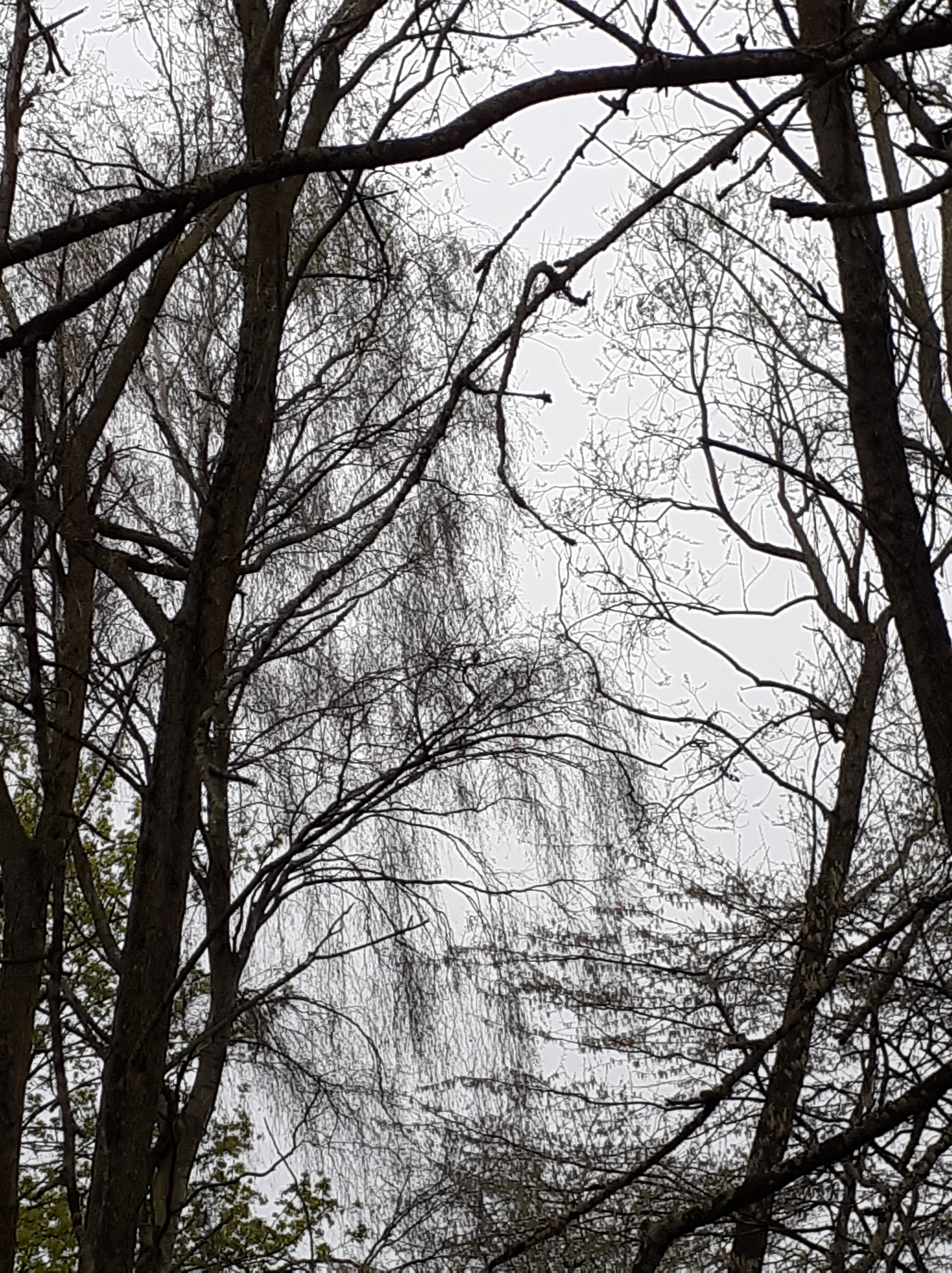
I look at the picture with fresh eyes. It is already a record of the past, and it is much too still. Yet I feel drawn towards this image. I enjoy the tree shapes in their starkness. I sense resilience in the plant life pictured here. I am writing now with sunlight intermittently on my shoulder, and the sounds of wind and rain beyond my strong glass doors.

I am also reflecting on writing as a practice. Natalie Goldberg (1,2) writes books about this and her description of ‘writing practice’ seems to me to have two entirely compatible meanings. The first is that it trains people for the writing of poems, stories and novels. The second points to a form of life practice flowing from the view that “writing is the crack through which you can crawl into a bigger world, into your wild mind” (1).

In Wild Mind: Living the Writer’s Life Natalie Goldberg compares writing practice with journaling. “Journal writing has a fascination with the self, with emotion and situation. It stops there. Writing practice lets everything else run through us; in writing practice, we don’t attach to any of it. We are aware that the underbelly of writing is non-writing. Journal writing seems to be about thought, about rumination and self-analysis. … We want to get below discursive thought to the place where mind – not your mind or my mind but mind itself – is original, fresh. It’s not you thinking. Thoughts just arise impersonally from the bottom of our minds. That is the nature of mind – it creates thoughts. It creates them without controlling them or thinking them … Writing practice knows this, knows how we are not our thoughts, but lets the thoughts, visions, emotions run through us and puts them on the page.” (1)

In her earlier book, Writing Down the Bones: Freeing the Writer Within, Natalie Goldberg quotes Jack Kerouac as saying that a writer should be ‘submissive to everything, open, listening’. She also recommends that “we stay in the trenches with attention to detail”, avoiding escape into abstraction. She points to poetry in particular, “because it brings us back to where we are. It asks us to settle inside ourselves and be awake”. She reproduces the famous William Carlos Williams poem:

“So much depends

upon

a red wheel

barrow

glazed with rain

water

beside the white

chickens.”

I remember this poem from my childhood. I liked it a lot, but couldn’t find anything to say about it in the class room when it was expected that I would. I was embarrassed then. I wouldn’t be now.

Natalie Goldberg also practices Zen Buddhism, with Katagiri Roshi until his death and more recently as an ordained member of the Order of Interbeing founded by Thich Nhat Hanh. She acknowledges the role of Zen in developing her insights into the creative process. I find her approach, including her practical exercises, very helpful.

(1) Natalie Goldberg Wild Mind: Living the Writer’s Life New York, NY: Open Road Integrated Media, 2011 (first published 1990)

(2) Natalie Goldberg Writing Down the Bones: Freeing the Writer Within Boulder, CO: Shambhala, 2016 (30th anniversary edition)

Earth Eclectic

music that celebrates Earth and speaks to the heart

Sarah Fuhro Star-Flower Alchemy

Follow the Moon's Cycle

Muddy Feet

Meeting nature on nature's terms

Rosher.Net

A little bit of Mark Rosher in South Gloucestershire, England

Becoming Part of the Land

A monastic polytheist's and animist’s journal

selkiewife

Selkie Writing…

Charlotte Rodgers

Images and words set against a backdrop of outsider art.

Prof Jem Bendell

living with metacrisis and collapse

Towint

The pagan path. The Old Ways In New Times

The Druids Garden

Spiritual journeys in tending the living earth, permaculture, and nature-inspired arts

The Blog of Baphomet

a magickal dialogue between nature and culture

Musings of a Scottish Hearth Druid and Heathen

Thoughts about living, loving and worshiping as an autistic Hearth Druid and Heathen. One woman's journey.

Wheel of the Year Blog

An place to read and share stories about the celtic seasonal festivals

Walking the Druid Path

Just another WordPress.com site

anima monday

Exploring our connection to the wider world

Grounded Space Focusing

Become more grounded and spacious with yourself and others, through your own body’s wisdom

The Earthbound Report

Good lives on our one planet

Hopeless Vendetta

News for the residents of Hopeless, Maine

barbed and wired

All content on this site is now located at www.jonberrywriter.co.uk