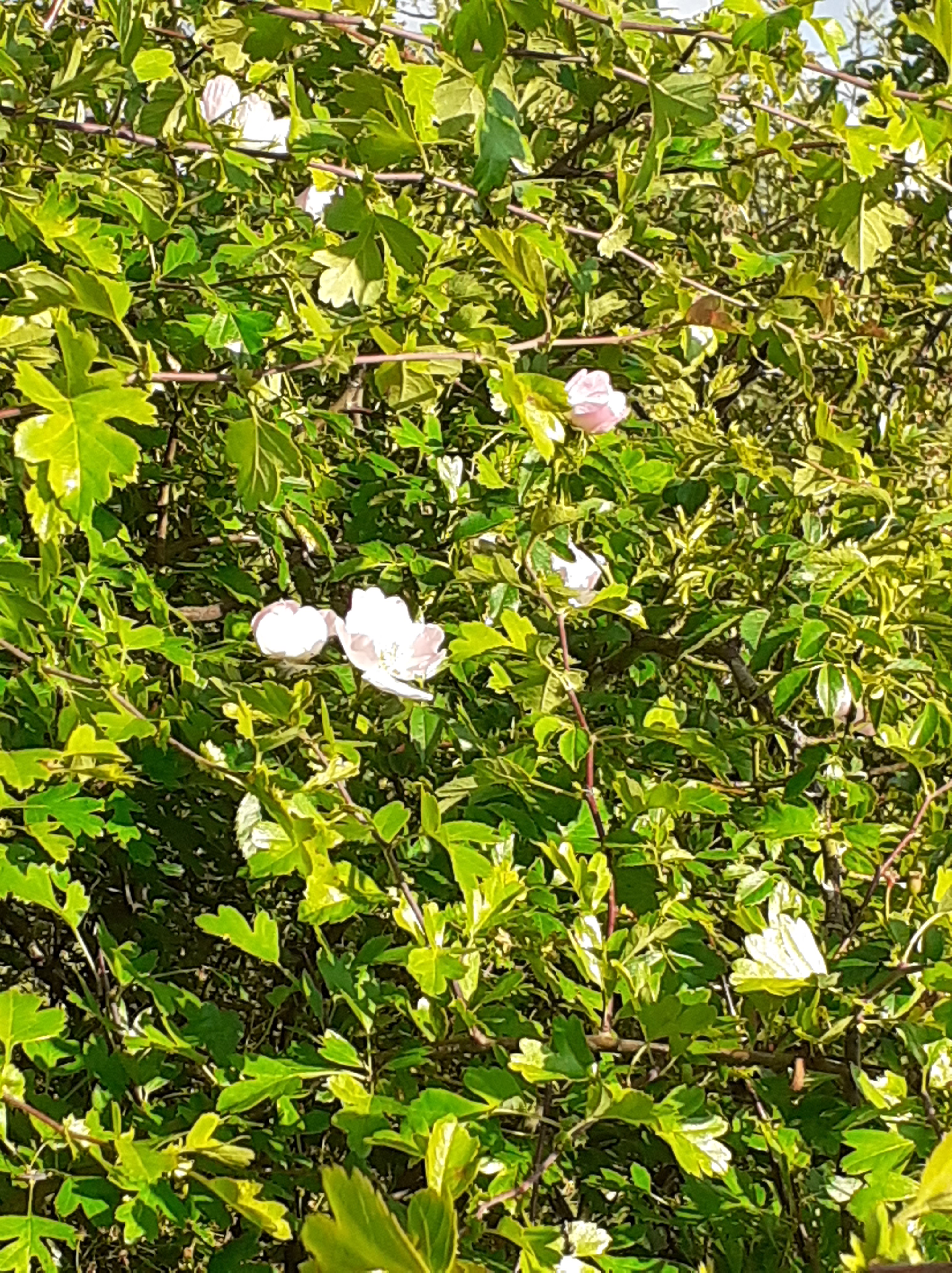
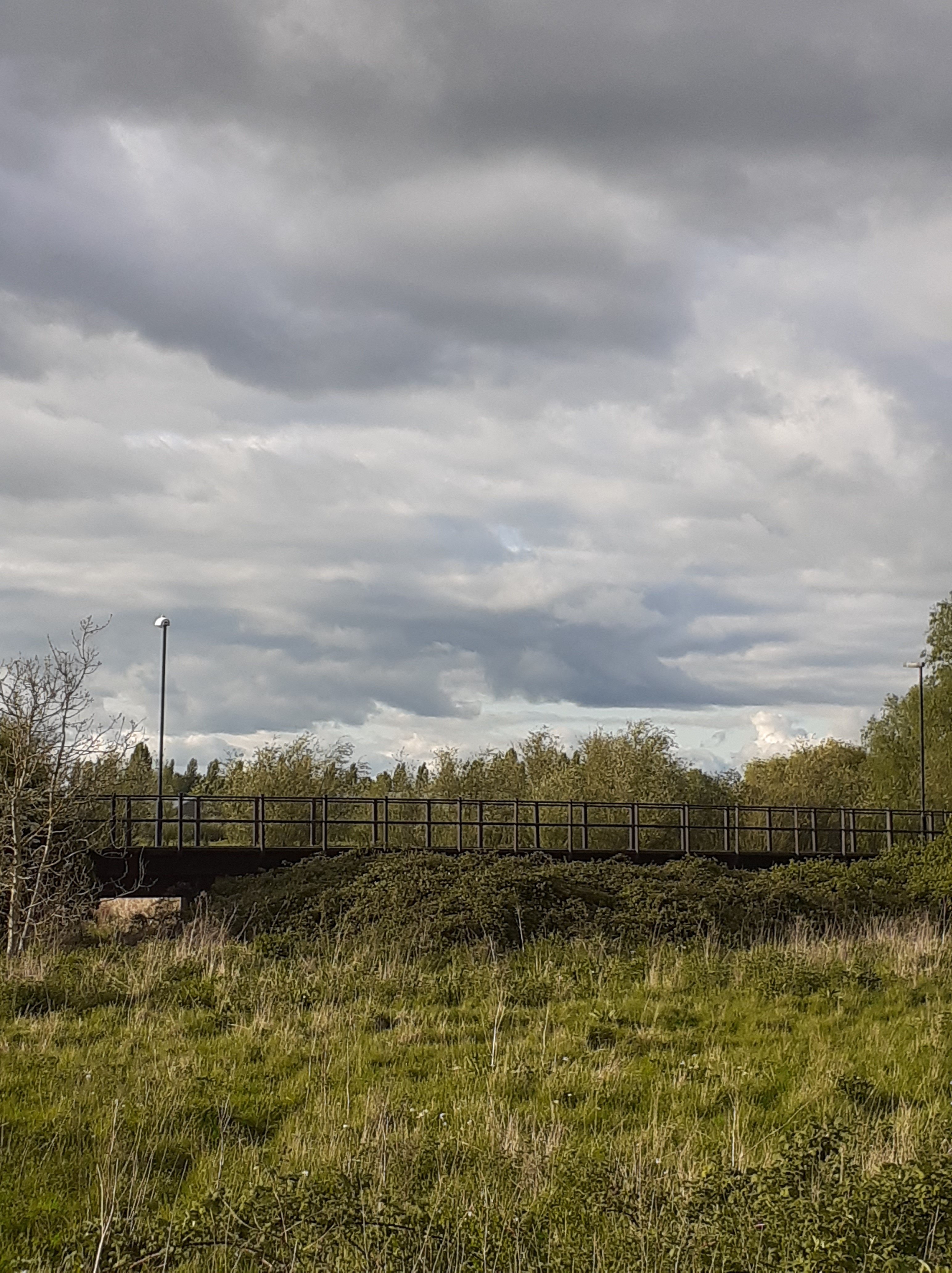
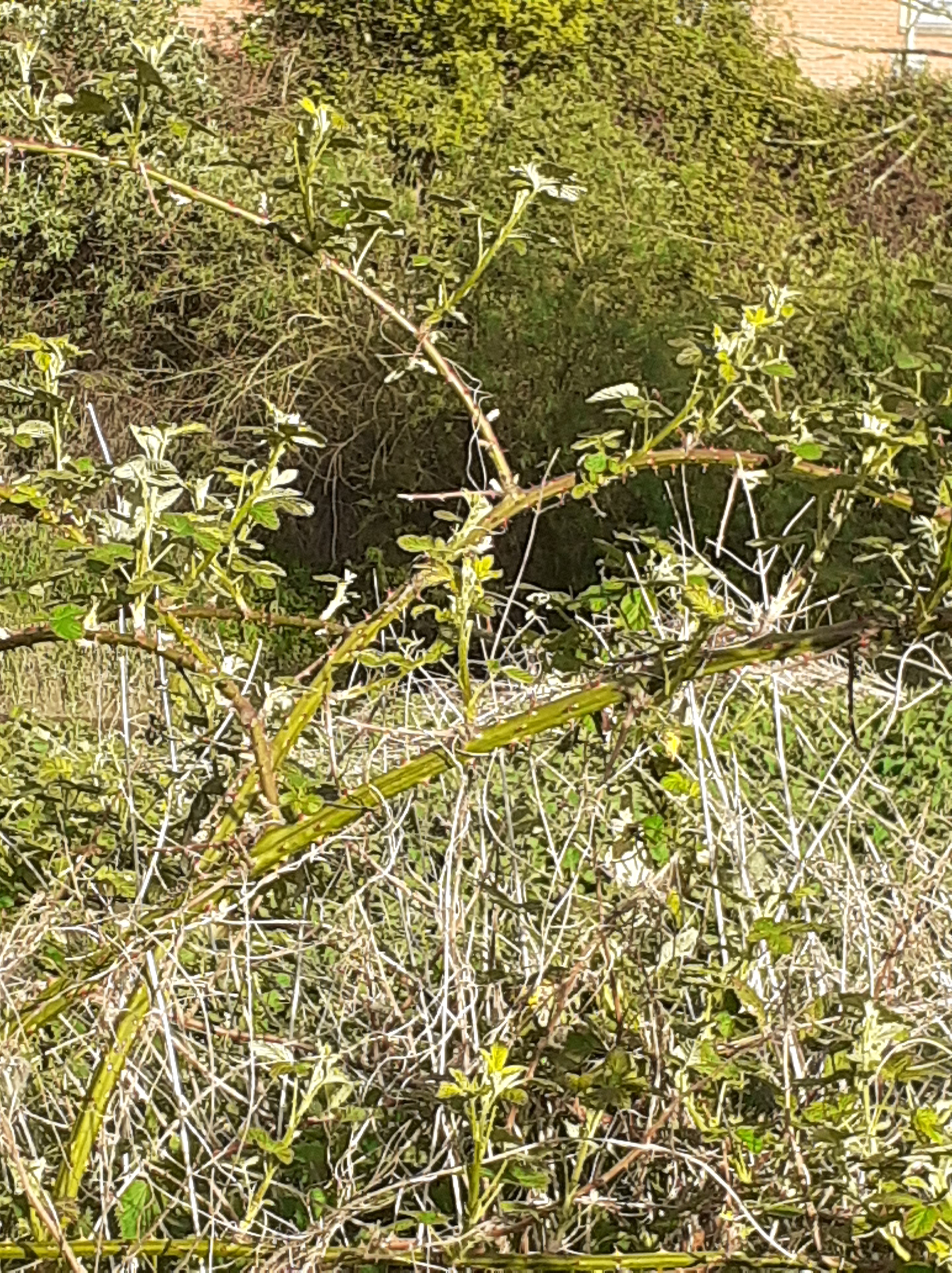
In these parts, there is a week at the end of April – St. George’s Day to Beltane Eve – that I would describe as mature spring. The rising year is leaning in to summer, but not quite there. I came close to missing it this year, at least as an outdoors event. I have made a good, if slightly fluctuating, recovery from the COPD flare-up described in recent posts. I met this moment, on this day, in the open air. At every level I feel better for the experience.
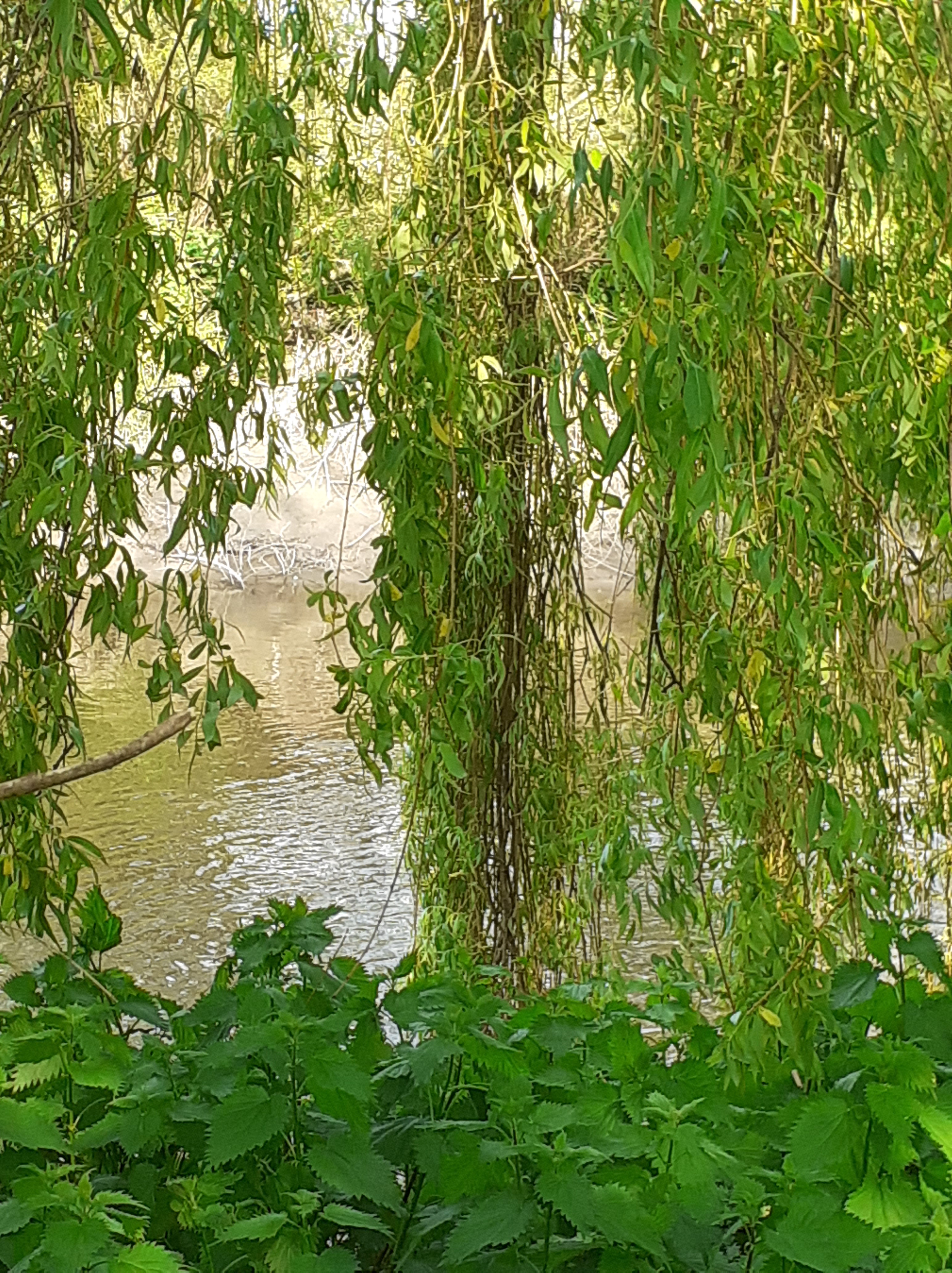
The location is Alney Island, now a nature reserve. The river Severn has divided into east and west channels, with Alney Island between them. Most of my pictures were taken near the (lesser) east channel, which flows into the Gloucester waterfront.
On 24 April 2022, I walked through this almost-city water margin. I was moved by its burgeoning growth, noticing the abundance of green in contrasting shades and forms. For awhile I had given up on going out during this delicious period. The experience, however fragile and transient both I and this space might be, was pure celebration. Taking pictures became an act of celebration, and also of giving thanks.
Two people hold each other in mutual gaze. Both their mutuality and their individuality are very clear. The space between them defines a chalice, or grail. In stillness they are present to each other, within a dynamic field of I-Thou relationship. The gestalt is one of communion. Their world has come alive.
Eckhart Tolle speaks of a wisdom that is not the product of thought, and which comes with the ability to be still. “Just look and listen. No more is needed. Being still, looking and listening activates the non-conceptual intelligence within you. Let stillness direct your words and actions” (1).
He goes on: “wisdom is not the product of thought. The deep knowing that is wisdom arises through the simple act of giving someone or something your full attention. Attention is primordial intelligence, consciousness itself. It dissolves the barriers created by conceptual thought, and with it comes the recognition that nothing exists in and by itself. It joins the perceiver and the perceived in a unifying field of awareness. It is the healer of separation”.
I think of wisdom, in this sense, as the healer in the heart. Not the organ that continues to pump at a not-too-elevated rate when my blood oxygen declines, and therefore a resiliency factor for my physical health. It is, rather, the heart of awareness – personified again as it has been before by a Goddess of Wisdom. She came to me, at night, at a wakeful time when my breathing was particularly laboured and I felt like a freshly landed fish. She acted as a discreetly background presence, pointing me to the vision of a radiant grail, palpably emanating the energy and resources of all four elementary powers.
Pragmatically I felt empowered to weather a challenging experience. Beyond that, the Goddess invites me to let go of identification with the mind-made ‘little me’ as a limited and confining construct. The reward is an expansion into love, joy, creativity and inner peace. I have bounced back from my COPD flare-up in the last few days and will do what I can to rebuild my physical capacity. But the lesson, that healing is not the same as being physically fixed, and asks for a different kind of commitment, applies both in bad times and good.
(1) Eckhart Tolle Stillness Speaks Novato, CA, USA: New World Library & Vancouver, BC, Canada: Namaste Publishing, 2003
Greyfriars is the shell of a church that once belonged to the Franciscan friary founded in Gloucester, England, around 1231 (1). The friars rebuilt their church in 1519. What is left of it, after a series of violent transitions including its final restoration, is a slightly bleak twentieth century heritage ruin, saved for me by its elegant arches. It does, I find, support an aspect of tranquility in this neighbourhood, along with an active Quaker Meeting House purpose built early in the nineteenth century. I live in a city centre, on a densely populated estate, yet it doesn’t feel that way. Good modern insulation helps, but my sense of place suggests an underlying leaning towards calm.
I notice this because I have been more-or-less housebound since I last wrote, with a further deterioration in my health, until a welcome uptick in the last couple of days. The picture, taken on 9 April doesn’t do the building full justice. It is much more substantial than it looks, with both the nave and north aisle in place. But it is the view from my home. My sense of place within the confines of house, block and estate has sharpened. The Greyfriars ruins nourish me, as do sun, shadow and sky in this urban environment.
I have been processing health concerns: the advantages and limitations of having a label (COPD); dealing with health services and new medications; wondering about lifestyle adjustments; considering risk and resiliency factors, what’s in my power to influence and what isn’t; the ecology of relationship, especially thinking of my wife Elaine and challenges I may pose to her as a person with health issues of her own; feelings of relief that our cynically underfunded health system is holding me well, except at the political level where decision makers want to forget about COVID. (People with COPD are prone to infections, and this would not be a good one.) I also ask myself what role, if any, my spiritual view and practice might play. This is a whole line of inquiry in itself, and one to go into as I stabilise, and find a new ‘normal’.
In my world, this is a time of laboured breath and limited capacity for walking. While medical investigations are underway, I am constrained in what I can do. But walking outside, taking slow deep breaths, and drinking plenty of water are medically and spiritually recommended. Today I went outside for the first time in some days, water bottle to hand, and a rhythm of slow, deep breathing established.
I walked in my neighbourhood and a nearby local park. The picture above is a treescape from that park. For me, it is images solidity and endurance alongside blue sky and spring growth. In itself, it occupies a unique niche in the web of life. I enjoy its company, and the opportunity to record its presence here.
My world may seem, at least for the time being, to have shrunken. My own presence in it, and my perceptions when present to it, do not have to shrink along with the physical distance I can cover. A necessary slowing down contains it own opportunities. I have space and time to enjoy the willows here, their leaves, and the shadows of their leaves. I am constrained to take notice. I appreciate the experience of noticing. I am reminded that I am just outside the period assigned to willow in my personal tree mandala (1,2), but of course it is not too late to connect and commune. There are compensations nested in my unwanted condition.
I find the houses and their surrounding plant life photogenic, not least under a blue April sky. The season has been advancing, the equinox now well past. Around me, I find an energetic acceleration towards summer. Hildegard von Bingen called this kind of natural power viriditas. I can recognise and enjoy it even when I’m lagging behind.
Very close to home I encounter the ruins of Gloucester’s Franciscan Priory, sadly with a nondescript mid C20th building tacked on behind them. They are a landmark for me on my return. I’m tired. I’ve about reached my limit. Although I’m sad that my walking distance is so limited, I feel blessed and nourished by what I find within the limitations. I am also glad to sit down and recognise feeling at once refreshed and exhausted.
(2) The mandala is based on my personal experience of trees in the neighbourhood as well as traditional lore. Moving around the spring quarter from 1 February, the positions and dates of the four trees for this quarter are: Birch, north-east, 1-22 February; Ash & Ivy, east-north-east, 23 February – 16 March; Willow, east, 17 March – 7 April; Blackthorn, east-south-east, 8 – 30 April. The summer quarter then starts with Hawthorn at Beltane. For a complete list of the sixteen trees, see https://contemplativeinquiry.blog/2020/autumn-equinox-2020-hazel-salmon-awen/
I contemplate an image is from R. J. Stewart’s The Merlin Tarot (1). It is the Ace of Beasts, the Earth suit. I sense it guiding me to a new phase of my inquiry, I hope a phase of integration. The stag has reached the point of stillness. There is nowhere to run, and no longer any need for running. Between his antlers sits a black mirror, showing the four powers of Life, Light, Love and Law unified by a central fifth. Here, it is the magical implement of the Earth element, an alternative to the shield or pentacle.
Stewart says of this image: “its deep power is that of Law and Wisdom, the Mystery of Night and Winter. Thus it can indicate a force or restriction that leads to liberation …. the Wisdom of endings that bring beginnings”. For the next phase of my formal inquiry practice, I will work through the programme of R. J. Stewart’s The Miracle Tree (2). I am already familiar with it, but I can drop into a beginner’s mind readily enough. The novelty is in being focused and systematic, as I was over the years of my training in OBOD (3), but here with a more closely defined and demarcated programme.
Why this? And why now? The Miracle Tree is based on the Western Way Qabalah, and its version of the Qabalistic crossing practice runs: “In the Name of the Star Father (righthand over forehead) Deep Mother (genitals) True Taker (right shoulder) Great Giver (left shoulder) We are One Being of Light (circle right and downwards from top of forehead to genitals, completing left and upwards to back of forehead)”. I like its integrative quality, and its way of presenting a non-dualist perspective – especially the use of ‘We’ in a statement affirming ‘One Being of Light’. It does not use the Absolute to crush the human and natural. It acknowledges the diversity held in ultimate unity, and embraces multiple forms and dimensions of Being. The Cosmic Tree shelters all, whilst not being separate from any.
Stewart says of this system: “the idea of relationship holds good for all world views and models. It is not so much a matter of their accuracy, for their accuracy is relative and ephemeral, but of their value to us as models of relationship to, and participation within, the greater world of which our human world is a small part”. The way to test the value of the model is experiential, and this is what I will do. For me, contemplative inquiry involves a surrender to, and immersion in, the work, whilst retaining a capacity to track and appreciate its effects. I do not expect this cycle to negate what has gone before but, rather, to complete it. Where appropriate, I will discuss this in the blog from time to time.
(1) R. J. Stewart The Complete Merlin Tarot: Images, Insight and Wisdom from the Age of Merlin: London: The Aquarian Press, 1992 (Illustrated by Miranda Gray)
(2) R. J. Stewart The Miracle Tree: Demystifying the Qabalah Franklin Lakes, NJ: New Page Books,2003
Looking at the nymph statue above, I am reminded of The Lion, the Witch and The Wardrobe. There, the nymph would be one of Narnia’s magical beings, frozen in place as a statue. A malign ruler (for Lewis the witch) is at war with the free abundance of being with which Narnia has been blessed. Liberation, and reanimation, comes only at the end of a hard struggle.
I re-read The Chronicles of Narnia recently, and appreciate the series well enough to look beyond Lewis’ gratingly conservative and patriarchal theology. I like his use of imagination as a force that can bring us spiritually alive. In the sixth chronicle, The Silver Chair, a group of beings is held in a deep underworld realm with no access to the Narnian surface. Here, there is not even a limited or distorted opening to the light. The abundance of Narnia is not simply rejected and fought against. Instead, we find total denial of its existence. Here, there is a seemingly complete lack of access to enabling experiences and understandings. Moreover, this state of affairs is backed up by an active entrancement and policing of the subject population.
There is resistance all the same. Some of the denizens of this realm have been in Narnia, though they have been induced to forget it. Puddleglum, once a lugubrious marsh dweller in the upper world, finds courage and a voice even in this wretchedly dystopian place, infusing it with the promise of life even as he speaks: “Suppose we have only dreamed, or made up, all those things – trees and grass and sun and moon and stars and Aslan himself. Suppose we have. then all I can say is that, in that case, the made-up things seems a good deal more important than the real ones. Suppose this black pit of a kingdom of yours is the only world. Well, it strikes me as a pretty poor one. And that’s a funny thing, when you come to think of it. We’re just babies making up a game, it you’re right. But four babies playing a game can make a play-world which licks your real world hollow. That’s why I’m going to stand by the play-world. I’m on Aslan’s side even if there isn’t any Aslan to lead it. I’m going to live like as like a Narnian as I can even if there isn’t any Narnia. …. We’re leaving your court at once and setting out in the dark to spend our lives looking for the Overland. Not that our lives will be very long, I should think,; but that’s a small loss if the world’s as dull a place as you say” (1).
In such unpromising conditions, a quest is born.
(1) C. S Lewis The Silver Chair: Geoffrey Bles, 1953 (Chronicles of Narnia, Vol 6)
Watching the fast flowing ripples as wind moves over water. Enjoying the power of the elements in this playful mood. For a brief time, delightedly immersed. Then stepping back and taking a brief video and a still picture. Seeing, later, how different they are. Rich moments are not hard to find, it seems, if I’m willing to find them in simple experiences.
‘My spirituality’ (an odd term, though widely used) is becoming simpler and more natural. My defining term, contemplative inquiry, has begun to seem complicated and formal to me, though in essence I still find it valid. It also identifies a thread of continuity in a decade of exploration. I am going to keep it as a description of what I do, even as my specific practice and understanding develop. One of my hopes is to simplify my inquiry process itself, without diminishing it, as I continue to move and change. Ripple images feel relevant somehow, both in themselves and as a metaphor which I can’t quite, as yet, fully decode.
I’ve been unwell for most of this month so far. But now I seem to be mending, and this is partly due to a dream.
I don’t have deeply healing dreams very often, but when they come they affect my whole bodymind. They don’t require much roof brain interpretation. I find it more important to tune in to shifts under the surface, and intuit guidance there. The dream feels like part of my inquiry, offering itself for contemplation, so I have decided to share it here:
“A grey shadow space, unformed … out of which comes a desire, rightly or wrongly framed as a necessity, for an important encounter. Perhaps a revelatory one.
“Now, the descent into a well-defined yet dark (because night-time) space. I am in a large city, which I know to be coastal. There is someone I have to meet within the next 48 hours. I know their name and neighbourhood, but not their address. I have hope, if not confidence, that I will find them. Nonetheless, I am anxious in this night.
“Walking out in the morning, I feel simple pleasure in being at large in the city. An unfamiliar locality approached from a beach suddenly becomes familiar when I realise that I have been here before from another direction. I am on a wide street, actually an avenue with trees. There are shops and businesses of various kinds on both sides. I could eat anything that the world offers, here.
“Later, still in a flaneur rather than questing mode, I become aware that time is passing, and indeed is running out. But instead of becoming anxious, I remain attentive to the scenes in front of my face. They seem like blessing enough, as long as my openness and attention are engaged.
“Now the scene has shifted again. I am in bed in a room, watching a clock with a severe Gothic face. It is two minutes to the midnight on which my time runs out. Then 10 seconds – (it no longer matters about meeting anyone). Ticking down – the clock becomes simpler and friendlier. I’m curious. At the very end I am relaxed and happy.
“Then I wake up, check out my surroundings, and enjoy the feeling of being blessed with a healing dream. I deeply believe that I am on the road to recovery, whatever recovery turns out to mean.”
It is 1 March, a mixed day – bringing together grey sky, bare branches, emerging blossoms and vivid daffodils. It is chilly, and rain is likely, though not just yet. Daffodils (here the strongest sign of a changing year) are linked to St. David, the patron saint of Wales. 1 March is his feast day.
David lived during the sixth century CE, a flourishing time for Celtic Christianity. His defining early achievement was the founding of a Celtic monastic community at Glyn Rhosyn (the Vale of Roses) on the west headland of Pembrokeshire (Si Benfro) where St. David’s Cathedral now stands. He went on to become a Christian leader of great authority, and was eventually canonised in the twelfth century, a different historical period with the church under stronger Vatican control and Welsh identity under threat from the English. David became the patron saint of Wales and his day is celebrated in Wales with parades and other public events.
Gloucester is very much an English city, though not so very far from Wales. Today’s weather conditions would not be out of place there. My wife Elaine and I went out on a morning walk with a sense of the saint’s day and how both the day and the coming of March represent a shift in the year. I noticed, too, how I can honour a saint without thinking of sainthood as a model, or even remotely wanting to be one. I acknowledge that I am on different kind of path, less defined, less heroic, and less religious.
When out walking, I see how the ordinary world seems to transform in the light of a loving gaze. I am looking at the world as it is, not for signs of a creator’s hand or influence or expectations. For me, laid out below – at the micro level – I find grass, earth, twigs, purple crocus and dead leaves. They are simply themselves. All ordinary in an ordinary moment. But an ordinary moment, as we might conventionally call it, is an extraordinary event. It is a small miracle, in its naturalistic way, yet easy to access in a receptive frame of mind.
I do appreciate that a ‘receptive frame of mind’, as a private experience, is facilitated by favourable public conditions, like a well-managed public park. I may not be dependent on such external conditions, but they do make a difference. I am grateful for their current presence in an uncertain world.
I was facing strong sunlight. I even felt warm. I risked taking a picture by angling down into the water. The water rewarded me with a patches of reflected light. I accepted a somewhat darkening effect in the photograph as a whole. The solar reality was brighter to my eyes, almost too much for them, flooding the path before me with intense light. When I looked back to where I had been, the light was gentler. My picture below shows a clear blue sky that I could confidently open up to include.
Though winter is not exactly over, I was experiencing an undoubtedly spring day. I was in a spring frame of mind, welcoming the change of season, as the wheel turns, and welcoming a still new landscape into my life. I have chosen this canal path as a place of regular walks and engagement. Over time, in the rising year, I will get to see and know it better. I seem to be a water margin Druid at heart, and I am finding possibilities in this new, more densely urban context. I find the energy of life everywhere I look – whether land, water, or sky.