Contemplative Inquiry

This blog is about contemplative inquiry

Tag: Sophian Way

THE FLOW OF INQUIRY

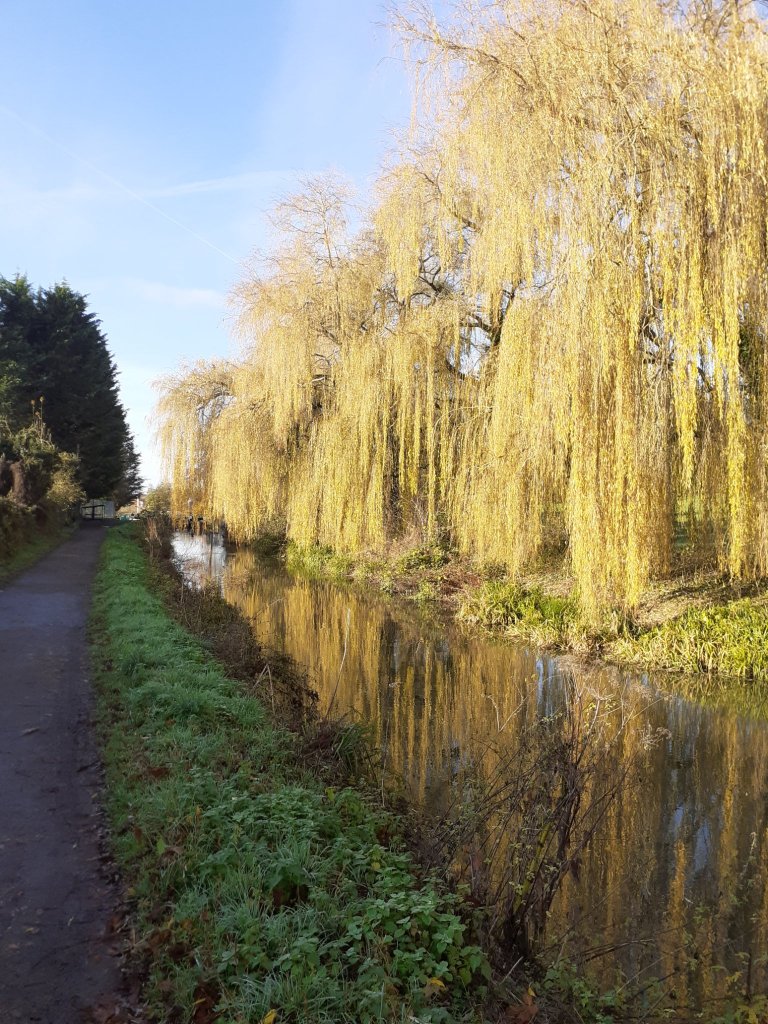
There’s a saying that we never see the same stream twice. It’s true, from a certain perspective. The water is always different. In this recent picture there’s more of it than is usual. The flow is faster and more energised. But in another sense, it is clearly the same stream. There’s a pattern and a placing that make it the same. Not forever. But enough to give it an identity of its own. Enough for us to recognise it, and to be in relationship with it over time.

I think of my inquiry in the same way. It is clearly a process of inquiring, not a thing. It has changed a lot over the years. But I notice, looking back, that it does also have characteristic points of reference and recurring themes. It has its own kind of flow. I see for example that whilst taking up practices of self-inquiry linked to non-dualist movements, I have not embraced the movements. I have gone to them for insight, not belonging. Instead, I have naturalised the insight and reframed it in my own terms – such as stilling into presence, or finding home in the flowing moment. The central focus on Sophia, and the naming of a Sophian Way, has helped here. In my world, contemplative inquiry is a core Sophian practice.

I have also kept a least half a foot in the cultural matrix of modern Druidry, Paganism, animism and eco-spirituality. These movements are closer to my heart and imagination, and feel more like my cultural home. For me, emptiness only has meaning as a home to fullness and and an exuberant multiplicity of forms. The Sophia card (Major Arcana II) in the Byzantine Tarot has a vision of Sophia as present in all of creation and the natural world, and also “watching over the steps of the Holy Fool on his journey and guiding those who seek her blessing to find their own path through the world”*. I am not at all sure about the word ‘holy’, but I see Sophia in the stream, and sense the guidance there.

*John Matthews and Cilla Conway The Byzantine Tarot: Wisdom of an Ancient Empire London: Connections, 2015

EYE OF SPIRIT

I walk my Sophian Way, seeking imagery for the end of November. The willows provide it. I see a dying back of the year, where the withdrawn and conserved life has a beauty of its own.

Stilling into presence, and holding the trees in loving attention, I act as the eye of spirit. I am aware equally of the uniqueness and otherness of the trees, and of my inter-being with them. I feel love, gratitude and wonder. I also feel a poignancy, and a sense of vulnerability – for them, and me, and everyone else.

I am glad to be taking pictures again after a gap of many years. There are dangers of displacing my attention into the process of photography, or of contracting into a collector’s obsession with ‘capturing’ images. My solution is to be artless and spontaneous in pressing the button – and to leave my phone in my pocket for most of the time. Once at home, I do find myself delighting in the record.

NOVEMBER REFLECTIONS

In recent years, I have experienced November as a special month. Moving on from Samhain, it begins winter, and where I live it sees most of the fall. It is a reorientation towards darkness and inwardness. I began my contemplative inquiry, at first limited to OBOD, then to Druidry more widely, finally becoming universal, in November 2011 following a Samhain ritual.

I find November calmer than December, where I tend to feel jangled by the agitated dominance of capitalist consumerism and its appropriation of a Christian festival, itself the appropriation of a Pagan one. The old festivals had an offer for everyone, at least in principle. Now you have to have money to participate, and increasing numbers of people don’t. So I find December an awkward, uneasy time, a ‘festive season’ that, collectively, doesn’t quite ring true.

This sense of a problematic December has made the whole month of November special to me, and powerful for my inquiry. This year I have rejigged my daily practice and replaced a long morning session with shorter sessions in the morning and evening. In the morning I wake up and greet the day with a slightly ritualised (thanks to Druidry) set of exercises. Before going to bed I do a yoga nidra meditation, listening to an audio download. Both practices are grounded in what I would now call a sacrament of presence, and awareness that every experience points towards a source of being from which I am not separate. In this intersection of time and eternity I find my home. I don’t need special ‘spiritual’ experiences. This spirituality doesn’t require them: the work is to enhance my capacity to welcome any experience, including my resistance to negative ones, and find ways to respond. Hence I look to simple, regular practices that provide pragmatic benefits and also remind me of this core insight.

I find that the inquiry aspect of my contemplative inquiry is shifting its focus to personal life, relationships, culture and nature. What’s going on? How am I placed? How am I responding? What difference does my Sophian Way – with contemplative inquiry as its main expression – actually make? These are my November reflections for 2019.

SOPHIAN WAY?

This is my icon of Sophia. The artist is Hrana Janto (1). I call my path a Sophian Way, and the image is emblematic both of the path and the inspiration behind it. At times I wonder whether this name and image are still appropriate. On the whole, I am not focused on deity, gender or celestial realms. If I look within, Sophia dissolves into pure presence at the heart of being, If I look outwards, she dissolves into the web of life. Non-dual awareing removes the need for a cosmic mother, messenger of light, or healer in the heart. Doesn’t it?

And yet …

A young child in me likes this picture very much. He would like to be Sophia’s friend. He senses that she might be the kind of older friend who is also a guide. The whole picture throws open a door to another, more radiant, dimension. He feels relaxed and at home. He loses himself in happiness.

Another part of me, a good bit older, would like to delete the immediately previous paragraph. He wants the post to suggest that the evolution of my inquiry has delegitimatised the Sophian trope, or meme, or whatever word he is reaching for. To be fair to him, his deeper wish is to be in integrity as an inquirer, and to be seen to be so. His intentions are sound, but anxiety and concern to get it right have narrowed his horizons.

A third part, believing in caution, personal privacy and self-compassion, would like to delete both of the last two paragraphs above. He would like to spend more time with the image, and find another approach to talking about it. I can see his point, but I’m not going to take him up this time. The writing process itself has been inquiry in action, belongs on the record, and feels Sophian to me.

(1) Artist Hrana Janto at http://hranajanto.com/ (The image at the top of this post is used with her permission.)

FEELINGS AND CONTEMPLATION

“In meditation, when a wave of feeling comes to visit – a grief, a fear, an unexpected anger or melancholy – can you stay present with that wave, breathe into it, let go of trying to ‘let go’ of it, and simply let it be, let it live, let it express itself right now within you? Can you notice the impulse in you to resist it, to refuse it, distract yourself from it and move away from your experience? Don’t judge or shame yourself for that impulse either, for wanting to have a different experience that you’re having – it’s an old habit, this urge to disconnect, this impulse to flee, this addiction to ‘elsewhere’.

” But see, today, if you can stay very close to ‘what is’, see if you can actually connect with the visiting feeling, gently lean in to your experience as it happens. Instead of shutting down, moving away, denying the energy in the body, can you gently open up to it? Can you flush it with curious attention? Let it move in you? Stay present throughout its life cycle, as it is born, expresses what it has to express, and falls back into Presence, its oceanic home?” (1)

The extract above is from a piece by Jeff Foster called When We Push Feelings Away. I support his approach, though I don’t now make firm distinctions between an activity called ‘meditation’ and the spontaneous flow of attention. I can stay present with the wave of feeling, and breathe into it, whether I’m ‘in meditation’ as a defined practice or not.  Meditation, once exotic and formal, has become naturalised. My contemplative life is pared down and minimalist, holding a strong sense of the sacred in daily life, including the work of self-healing. Jeff Foster continues:

“… One day, deep in meditation, perhaps, we remember, all feelings are sacred and have a right to exist in us, even the messiest and most inconvenient and painful ones. And we remember to turn towards our feelings instead of turning away. To soften into them. To make room for them instead of numbing them or ignoring them. …. So much creativity is released, so much relief is felt, when we break this age-old pattern of self-abandonment and repression, go beyond our careful conditioning, and try something totally new: staying close to feelings, as they emerge in the freshness of the living moment, waving to us, calling to us, seeking their true home in our heart of hearts.”

Jeff Foster calls this piece Pushing Feelings Away. I like his concern with holding and acceptance within what he calls Presence. I call my overall path a Sophian Way, and not The Sophian Way, because it is a solitary path that morphs and shifts.  Jeff Foster works with personal feelings from a transpersonal, non-dual  perspective that I find very Sophian, characterised  by wisdom, contemplation and compassion. My own path brings together this approach with the Eco-spirituality – or ‘Nature Mysticism’ – catalysed by my experience of modern Druidry.

(1) Jeff Foster The Joy of True Meditation: words of encouragement for tired minds and wild hearts Salisbury: New Sarum Press, 2019

CONTEMPLATION AND ENGAGEMENT


According to my dictionary, one of the meanings of ‘signature’ is, “a distinctive pattern, product, or characteristic by which someone or something can be identified: the chef produced the pate as his signature dish”.

I want to adjust the signature of this blog. I want now to explore the relationship between contemplation and engagement more explicitly. A blog is itself a form of engagement, and this one has so far combined a strong curatorial thread with personal sharing. Now, for me as for many others, a deepening social and ecological crisis asks for a work of preserving existing life-affirming aspects of our culture and developing new ones. I see this work as enhanced by outward-looking forms of contemplation. I want this blog to contribute.

I started this blog as a Druid. My personal path, which I have described more recently as a Sophian Way, has become more Universalist. I have described it as a path of healing, peace and illumination, which encourages a spirit of openness, an ethic of interdependence and a life of abundant simplicity. Its ‘sacrament of the present moment’ involves resting in a place of underlying stillness, freedom and love within any experience – good experiences, wonderfully, but also bad ones that need active resisting on the ground. For some, this suggests an experience of divine support, or the activation of the divine within us or of the divinity that we truly are. For others it seems to come from a deep wellspring within the psyche that needs no further point of reference. This sacrament is my core practice, to be dropped into at any time. It doesn’t always take a pure form, but it usually makes a difference. In the myth of my own life, it is Sophia’s principal teaching.

At the level of the wider word, I continue to feel a strong sense of alignment with Pagan, Animist, and Earth spiritualities like Druidry – more than to the Buddhist or Gnostic families or to movements like the Headless Way, even though they have given me a lot. Philip Pullman in his The Secret Commonwealth* has a character who says that where we stand revolves around one key question – ‘is the world dead or alive?’ I say ‘alive’ without worrying about scientific definitions or the metaphysics of reality. Something in me just has to say ‘alive’ – alive and interconnected as a web of life. This re-affirmation is important to me, and as a ‘light bulb moment’ on a level with the more seemingly individual aspects of my Sophian Way. I don’t expect to change the blog that much, but there’s enough adjustment of signature here to demand explicit affirmation.

*Philip Pullman The Secret Commonwealth Oxford, David Fickling Books & London, Penguin, 2019 (Vol. 2 of The Book of Dust)


SOPHIAN REMINISCENCE

For me, sacred images are sometimes filled with life and potency and sometimes not. The important ones  explode as gifts from the hinterlands of the psyche. They are intensely moving, perhaps shocking, certainly state altering. They may be nurturing and easy to welcome. They may be surprising and demand unlooked-for adjustments. Over time they may continue to be influential, changing and developing with me. They may become formal and emblematic – no longer living yet still anchoring insight. Eventually they may fade. Such images are not possessions. Attempts to grasp or hoard them do not work.

I call my path a Sophian Way. I have an icon of Sophia on my desk and I check in with her from time to time. It still feels authentic and makes sense to me. At the same time, I am aware of how much has changed since Sophia erupted into my life twelve years ago.

In the summer of 2007, I was immersed in my OBOD Druid studies. It was one of the few times in my life when I have cleared whole days for ritual work, and whole days for recovering afterwards. I found the work generating its own momentum, in some ways fulfilling the agenda of my course and in some ways pointing in a different-seeming direction. Images and dreams of dove feathers, either falling or lying on the ground – and then their actuality – became very prominent. Key images and ankh images were present as well.

The powerful dove imagery evoked Goddess associations from the Pagan tradition and Holy Spirit from the Judaeo-Christian one. To honour both, I found a reference in a modern Gnostic group ( www.thepearl.org/ ) that seemed to fit:

“Mortals have been created to dwell in the Garden of delights. … In the Garden stands the holy Tree of Life. High in its branches sings a bird. Listen to the voice of the bird, for when you are properly aligned with heaven and earth, she will tell you all things. … This bird or dove is also called Sophia”.

This felt like an authentic, and unifying, message for me because of its attitude towards the Garden. I as a human belong there. My belonging is not in question. There is one tree, the tree of life. The ‘knowledge’ aspect, such a disaster in mainstream Christianity, is very different here. There’s no apple to pick from the bough, but a bird who will sing to me. But something is expected of me, all the same, if I want to enhance my life and understanding. I am asked to align myself with heaven and earth. If I do this, I am assured that “she will tell you all things”. I don’t understand this as a discourse on metaphysics. I understand it as me listening in another key, listening to bird song in this metaphor, and so refining my sensitivity. For me, the imagery of the tree and the singing bird high in its branches is as resonant of a Shamanic or Pagan world view as it is of a Gnostic or Christian one. I do not have to choose.

The Pearl website turns to Joseph Campbell, a modern spokesman for the meaning of myth, on this point. He says: “people say that what we’re all seeking is the meaning of life. I don’t think that’s what we’re really seeking. I think that what we are seeking is an experience of being alive, so that our life experiences on the purely physical plane will have resonances within out innermost being and reality … as we get to know our innermost being we receive the keys that open up a life that is truly Life, for it is everlasting”.

My own sense of the ‘Life everlasting’ doesn’t pre-suppose an afterlife, re-incarnation, or any other world. Eternity, if anywhere, is present in the now. The song of the bird represents a neurosomatic wisdom, not a cognitive one, of living connectedness within one stream of life.

What I like about this reminiscence is that I have been given a chance to renew my sense of Sophia by returning to source. The original work is well-documented, so I haven’t had to rely on memory. I had completely forgotten about the ‘Pearl’ group. I’m also glad that I’ve seen more than first time round in terms of the tree and birdsong. At the time, I just recorded the images and threw down the references. It has renewed my relationship to the Sophia image in the now.

For information about OBOD see

OBOD | Order of Bards, Ovates & Druids | Druidry

LETTING GO

I have been experiencing a pull towards letting go, but until now it hasn’t been very specific. What do I want to let go of? How do I expect to feel and be, once this letting go has happened?

My personal life is already very simple. The pull toward letting go is about my inquiry and spiritual stance. Some aspects of this feel redundant, whilst others have become naturalised and simply part of how things are.

Over my years of inquiry, I have familiarised myself with many spiritual movements and their understandings, practices and literatures. The literatures include overviews of how these movements have evolved over time, place and culture and how they stand in relationship with each other. I’ve never seen them in isolation or selected one as providing a uniquely authoritative guide. I have been blessed with companions along the way, but I no longer seek or belong to a spiritual tribe.

I am now done with the intentional study aspect, having reached the point of diminishing returns. I might read out of cultural interest, but it won’t be as part of my inquiry. I don’t expect to be entering into new mindsets and following new practices. I have a fundamental sense, or understanding, of being held within a greater life. This greater life is a background presence, except when it becomes the foreground and simply what there is, with ‘me’ no longer apparent. It is this sense of a greater life that supports my At-Homeness, and my commitment to leaning into the flowing moment, the fountain of experiencing. That’s enough: ‘just being’, with an open heart. This simple sense provides my internal compass and my practice is also my inquiry.

I wrote recently – https://contemplativeinquiry.wordpress.com/2019/07/17/inquiry-and-heart/ – about ‘inquiry as self-abiding’ and this, essentially, what I am left with after my exploration of traditions; what remains after letting go. With clarity on that point, I can let go with ease.

AT-HOMENESS REVISITED

A year ago, I wrote: “within my Sophian Way, I have found healing and grounding in a flowing now, the site of an unexpected At-Homeness. Everything else grows out of that”(1). This post is to re-affirm this insight and to take it forward.

I wrote of a ‘flowing now’ since ‘now’ is not a frozen unit of time but a living stream of experience. Past and future can indeed be conceived and imagined, but only within the flowing now. The experience of At-Homeness can either steal up of itself or I can invite it by slowing down and attentively companioning the flow as it moves, whatever is going on. It is a way of marking this space and time as sacred. My opening and attention are a sacrament, the means through which the flowing now – all that I can be sure of in this life – is recognised and blessed.

I didn’t invent the term At-Homeness. It comes from the proponents of ‘bio-spirituality’, who say (2) “that the beginning of a bio-spiritual awareness … is finding a way to some larger At-Homeness written deep within bodily knowing”. For them, an enabling and loving attention to the body and its processes gives the felt sense of At-Homeness a chance to ripen. My experience of Focusing over the last 15 months tells me this is true. My experience of Headless Way (3) opens up a world of vivid shapes and colours, all boundaries gone, no self in sight. Immersed in this world, I experience a lightness of being, and stillness in a world of movement. This, too, is At-Homeness in the flowing now.

I sense now, more clearly than before, that I am not at home in the realm of abstractions and absolutes. I do not find Sophia there. I flourish, rather, in processes and relationships. I can stand as awareness only through being aware (a process) of something/someone (a relationship). I find the love and magic in the cosmos, as well as its stresses and horrors, only within the play of movement and connection.

For me, Thich Nhat Hanh’s understanding of ‘Interbeing’ provides the most helpful presentation of a non-dual spirituality (4). “The insight of inter-being is that nothing can exist by itself alone, that each thing exists only in relation to everything else. The insight of impermanence is that nothing is static, nothing stays the same. Interbeing means the absence of a separate self. Looking from the perspective of space, we call emptiness ‘inter-being’; looking from the perspective of time we call it impermanence”. Another modern Buddhist writer adds (5), “if you look at experience there are not fixed elements or even moments; there is simply a process, a transformation … the Buddha called himself tathagata or ‘that which is thus coming and going’. He described himself as merely a flowing occurrence, and the outward form that took was constant, calm, compassionate availability to people who came to him for help.”

Reading this, I am pushed uncomfortably into the recognition of my own volatility. I explored this theme in October 2017 (6). However, because I found Buddhist practice, with its emphasis on long periods of sitting meditation, not right for me, I appear to have lost some of this insight, at least consciously. I am somewhat comforted that ‘At-Homeness in a flowing now’ at least preserves the gist, and the simple practices I’m using work well within an ‘inter-being’ framework. This is not so much because of its Buddhist origin, as because as an approach it seems to me to be on the side of life, relationship and movement. It brings me down to earth and closer to Sophia (Prajnaparamita, Guanyin).

(1) https://contemplativeinquiry.wordpress.com/2018/08/20/

(2) Peter Campbell & Edward McMahon Bio-Spirituality: Focusing as a Way to Grow Chicago, Ill: Loyola Press, 1985

(3) www.headless.org/

(4) Thich Nhat Hanh The Other Shore: a New Translation of the Heart Sutra with Commentaries Berkeley, CA: Palm Leaves Press, 2017

(5) Ben Connelly Inside Vasubandhu’s Yogacara: A Practitioner’s Guide Somerville, MA: Wisdom Publications, 2016

(6) https://contemplativeinquiry.wordpress.com/2017/10/21/the-uses-of-emptiness/

CHILD OF THE NOW

“They said to him

‘Tell us who you are

so that we may believe in you.’

He answered them

You search the face

of heaven and earth,

but you do not recognise

the one who is in your presence

and you do not know how to experience

the present moment.

“We are always asking for signs and omens so that we may believe. It is as if we want to be compelled from outside ourselves. But Yeshua offers no proofs, omens or explanations. He is what he Is. All who question must encounter him in the present if they want to see.

“He reminds us again that what we are looking for is already here and now. Here and now are the place and time to recognize, to experience, to taste the vastness of the present moment in all its dimensions of time, of space and of beyond space-time.

“The Gnostic is the Child of the Now.”

Jean-Yves Leloup The Gospel of Thomas: The Gnostic Wisdom of Jesus Rochester, VT: Inner Traditions, 2005 (Translation from the Coptic and commentary by Jean-Yves Leloup; foreword by Jacob Needleman. English translation by John Rowe. Original French edition published 1986)

Earth Eclectic

music that celebrates Earth and speaks to the heart

Sarah Fuhro Star-Flower Alchemy

Follow the Moon's Cycle

Muddy Feet

Meeting nature on nature's terms

Rosher.Net

A little bit of Mark Rosher in South Gloucestershire, England

Becoming Part of the Land

A monastic polytheist's and animist’s journal

selkiewife

Selkie Writing…

Charlotte Rodgers

Images and words set against a backdrop of outsider art.

Prof Jem Bendell

living with metacrisis and collapse

Towint

The pagan path. The Old Ways In New Times

The Druids Garden

Spiritual journeys in tending the living earth, permaculture, and nature-inspired arts

The Blog of Baphomet

a magickal dialogue between nature and culture

This Simple Life

The gentle art of living with less

Musings of a Scottish Hearth Druid and Heathen

Thoughts about living, loving and worshiping as an autistic Hearth Druid and Heathen. One woman's journey.

Wheel of the Year Blog

An place to read and share stories about the celtic seasonal festivals

Walking the Druid Path

Just another WordPress.com site

anima monday

Exploring our connection to the wider world

Grounded Space Focusing

Become more grounded and spacious with yourself and others, through your own body’s wisdom

The Earthbound Report

Good lives on our one planet

Hopeless Vendetta

News for the residents of Hopeless, Maine