An Tuagh celebrate early Norse as well as Gaelic traditions in northern Scotland. Not only Orkney and Shetland, but also the Western Isles and part of the Scottish mainland were officially in Norway for over two centuries in the early middle ages. Above is the An Tuagh version of Helvegen, featuring the voice of Chris Corrigan.
In an An Tuagh Facebook post on 20 march 2024, and also in a note appended to their YouTube video, Corrigan explains: “Bards and Skalds of ancient times sang songs for others’ birthdays, weddings, funerals and everything in between. This song asks a then pertinent question. Who will sing me (the bard) over to the other side when it is my turn to pass over?” Corrigan’s post includes a personal dedication and Norwegian and English versions of the lyrics.
A chill in the air today reminded me of Helvegen. In April of this year I posted An Tuagh’s version of The Song of Amergin in Old Irish (1). Here I add a representation of the Norse aspect of Scottish tradition as well, though Helvegen is not itself an old song. It was written by Einar Selvik in modern Norwegian in 2013, but using traditional themes. It became widely known through its appearance in the Vikings TV drama series on Netflix.
It is September. I am thinking about my Druid name Muin (blackberry). The plant is flourishing as it always does when given half a chance. But the fruits are less plentiful now and fairly small: thin pickings for the wayside walker. In the human world, we have largely moved on to the making of jam and wine from our existing harvest.
Today, I am thinking about my psychic and imaginal connection to Muin, and why I am standing by this name. For me, a Druid name is neither an alter ego nor a simple add-on to my other names. It is the name that calls me into my Druid identity and practice. In this context, I ask myself: as Muin, who am I? what do I stand for? who might I become? As I asked these questions in an imaginatively opened state, these lines came up. In a way, I believe, Muin is talking to James, whilst being an aspect of him (me) and anyone else who wants to listen.
I first registered Contemplative Inquiry on 28 August 2012 and WordPress have sent me 12th anniversary greetings. That’s a long-term project by my historic standards. True, the first two years were tentative and I took an 8 month break in 2018/9. But my contemplative inquiry, both as blog and as practice, now feels like a settled part of my life. I continue to ground it in a form of modern Druidry with, Janus-like, both pagan and universalist faces.
Through my inquiry, I came over the years to understand myself as, at heart, ‘living presence in a field of living presence in a more than human world’. This may sound like something of a formula, but it is at least my own formula, providing a compressed account of my experience and understanding, It is not connected to any particular belief system, and arose through a simple recognition of what seems to be given to us, in joy and sorrow alike.
When I open and deepen to living presence, a gestalt of self-and-world, not just self, reveals itself in a sometimes transfiguring way. It is not complicated to practice or experience. In consequence I have found myself nudged, however haltingly, towards a spirit of openness, an acceptance that nothing stays the same, an ethic of interdependence and a life of abundant simplicity.
I no longer think of the inquiry as a path or journey. It is more like a deepening, or maturation, in place. Looking back at early blog posts I find seeds of my current view right at the beginning of my inquiry. As early as 2 September 2012 I wrote about Satish Kumar’s experience (1,2) of outdoor walking meditation. It made a strong impression on me. The difference today is that I have internalised it and given it my own unique flavour. This year I celebrate a clearer understanding and a more confident voice. I am grateful both to influences like Satish Kumar and to the version of me who launched this inquiry twelve years ago..
In recent days, I have felt, as much as seen, the retreat of daylight in the evenings. It comes earlier and seems more decisive as the year advances. Mostly, indoors, it has led to a soft and gradual increase of dimness and shadow. I often find this pleasurable and delay resorting to artificial light.
But on Friday 16 August I was caught unawares. I had not been paying attention and it felt as if Night had truly fallen for the first time in my waning year, suddenly and assertively. It wasn’t even fully dark, yet I sensed that Night now ruled.
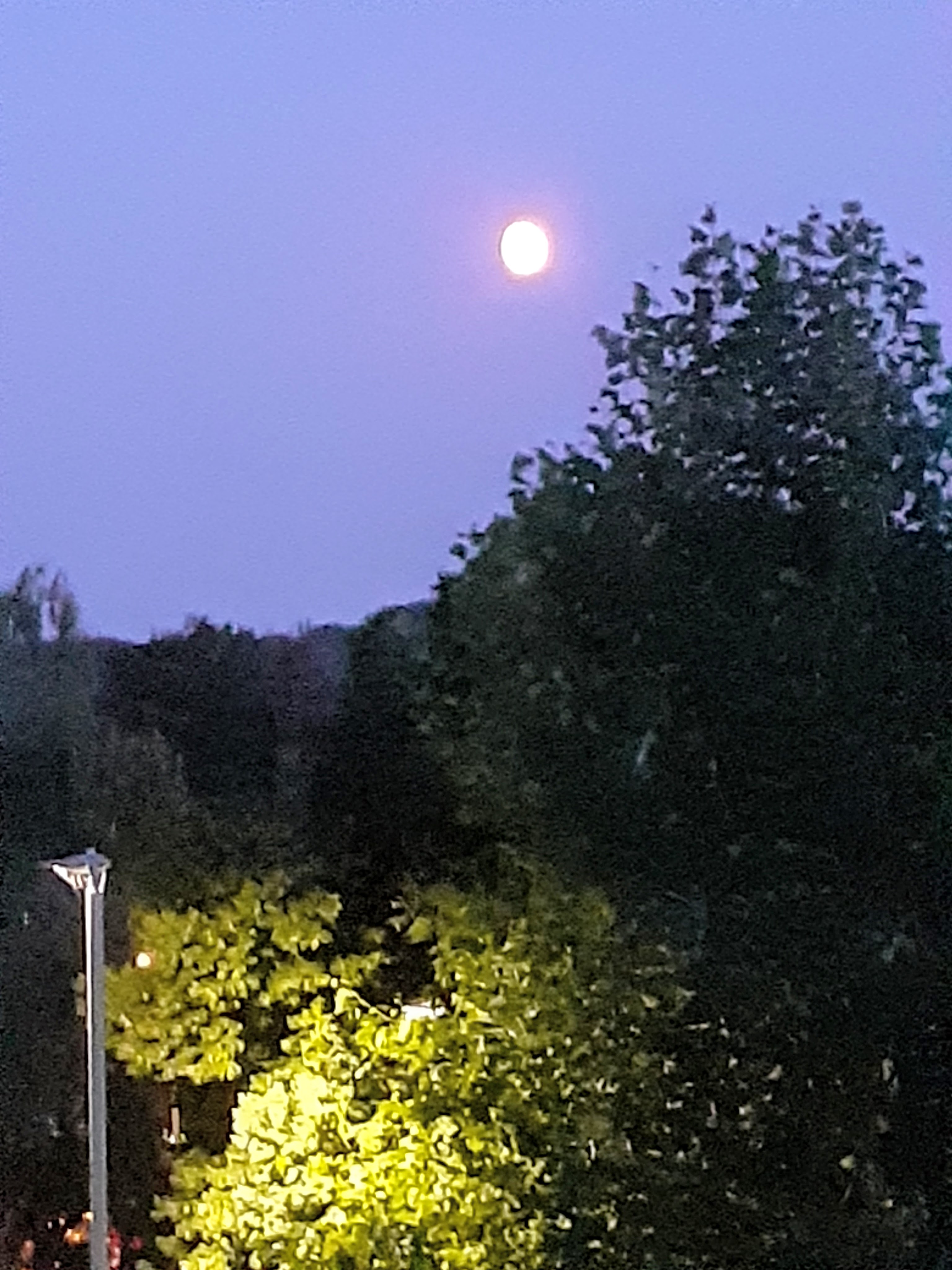
I felt that I was mobilising for a different life. A nocturnal life. To an extent, a lunar life. Standing on an east-facing balcony, I found deep twilight presided over a by a waxing gibbous moon – a super moon, close to the earth, only three days before full.
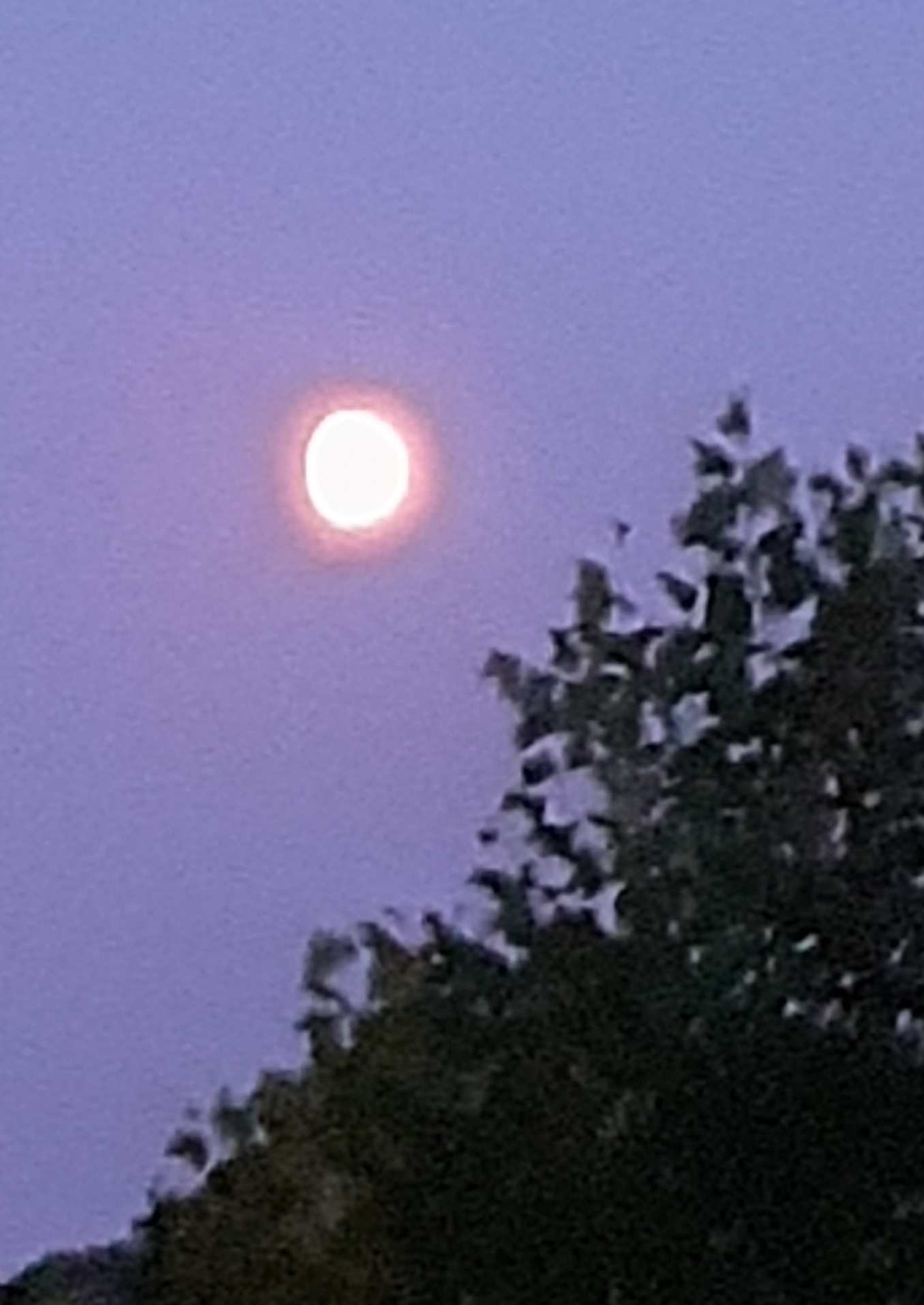
In the picture above, a street lamp seems to compete in brightness. But as I stood in my balcony it was the moon that drew my eye. Its influence was so much greater. The moon persuaded me to take the picture. Indeed I took a second picture (below) of the moon as the only light source. I needed the “radiance of moon” (1) to stand out clearly, in full contrast to the “light of sun”.
Night isn’t just about darkness. It’s about the world that emerges when the sunlight withdraws. Just over a month before the autumn equinox, I have tasted the ‘dark’ half of the year.
(1) From the St. Patrick’s Prayer/Cry of the Deer: “I arise today through the strength of heaven, light of sun, radiance of moon, splendour of fire, speed of lightning, swiftness of wind, depth of sea, stability of earth and firmness of rock”. I begin and end my regular morning practice with these words.
23 June 2024, around 8.15 pm. I’m enjoying my first contemplative walk for some days. I’m looking at an old wall, once part of the Llanthony Priory estate in Gloucester. The day has been one of rising temperatures and humidity. Even now, as the shadows deepen, I feel an energy and expectancy in the evening light.
The Priory here was for a time the largest landlord in the city and its surrounding district. In those days, midsummer was celebrated on 23/24 June. The Church celebrated the birth of John the Baptist, at the opposite end of the year from that of Jesus. (His beheading is remembered on 29 August). Popular celebrations on the evening/night of 23 June involved bonfires, and local festivities could be attributed to the saint, the season, or both.
In many cultures, the year has been divided into two contending halves, whether at the solstices, the equinoxes, or with the Beltane/Samhain division. Traditional Christianity flirts with this theme. I might think of summer and winter kings, king-slaying and the Goddess. I might also think of John, Jesus, and their respective human fates. In the case of John, Salome and her royal mother Herodias are a presence, along with their fateful demand for his head. These stories are not the same, but in the European Christian imagination they have at times been interwoven.
I might also think of the Green Man maturing to the point where he can “speak through the oak”, as “its crown forms his mask and its leafage his features” (1). To speak through the oak is to speak at another level, or from another dimension, a developmental moment that occurs at the year’s zenith (life’s zenith?) This maturation flows from from a willingness to surrender to a greater power. The purely personal direction can only be towards winter and death. But that’s not the whole story, even to a ‘sacred agnostic’ like me (2.) This is the midsummer evening’s tale that intrigues me the most.
The image below comes from a small patch in Llanthony Priory’s current garden, on the site of the original physic garden. I simply found it beautiful.
In the original edition of The Dreampower Tarot (1) The Sleeper is an androgyne figure in a field of corn and poppies. Their face is turned towards the flowers. Their right arm is outstretched, with palm and fingers turning a little towards the ground. Their forefinger hints that we should look to the earth and underworld for healing and inspiration. The whole image evokes deep evening slumber.
In this midsummer period, I’m in a regime of going to bed early, before the light has gone. It reminds me of delicious childhood moments and I feel comforted. During this period I have tended to dream of abstract images and unfathomable events, with background sounds so soft that I can barely hear them.
In these dreams, I have no language and can make no real sense of anything. I’m OK about this, because I’m aware of being aware and safe in awareness without the slightest ability to formulate a sentence like this one. The recognition is primal and wordless. At times, I experience a push towards understanding of a sort, but it is not (yet?) agitated or dominant in consciousness. I seem, in this dreaming (as perhaps once in pre-natal life), to be in realm of divinely simple potential.
When I wake up in the early morning. at this time of year, I find light again, and a different feeling of wonder. Using my resources of language and culture, I am able to make cognitive sense of my world once more. The gift of the dream is that my everyday experience feels, for a while, strange and new. It makes room for the luminosity and magic that I can easily forget in my ‘waking’ hours. The morning light outside my window confirms their presence here. They nourish me, and I am porous to the world.
(1) R. J. Stewart The Dreampower Tarot: The Three Realms of Transformation in the Underworld London: The Aquarian Press, 1993 Illustrated by Stewart Littlejohn
I spend time inside looking out. The sky changes a lot. Its shifts are rapid and dramatic. The trees change too, but over longer periods of time. The high levels of rain this year have encouraged an exceptional verdancy and abundance. Looking out, I can almost forget that I am in a block of newish flats in an old urban area. The person walking on the pavement below seems dwarfed by the splendour of the leaves. The road is very quiet for a late morning. The wheel of the year turns, approaching its summer zenith in this part of the world.
I am settling in to a higher number for my official age. In social gerontology, there are (or have been) three kinds of ‘old’: young-old (50-64), middle-old (65-74) and old-old (75+). I am now old-old and statistically immune from premature death. These classifications don’t quite fit my lived experience, but they are a sort of landmark all the same.
Elaine and I have been together for nine days following her repatriation and subsequent stay in a local hospital. We are learning how to live a new phase of our relationship where she has high needs and is housebound, and I am in a ‘caring’ role in the institutional sense of that term. We are learning as we go along and doing our best to be conscious about our experience as well as practical in an ‘activities of daily living’ sense. I think we are doing OK. We are establishing new patterns of day to day life and Elaine’s capacity is increasing.
Mostly I leave the flat only for shopping and other practical tasks and, because we are so well situated, these don’t take long. On Saturday Elaine and I both felt comfortable and confident with me going out on a one hour recreational walk. I continue with a regular practice and journaling. I still practice within a Druid circle (grove) and I find this healing and re-energising. At the same time my work has been referenced more to five personal commitments rather than to tribal membership, religious devotion or spiritual metaphysics. Recently I have been contemplating my commitments and checking out whether they still work for me. These are:
1. I will work from the stillness of the centre.
2. I will cultivate good will towards self, others, and the wider web of being.
3. I will cultivate positive health and well-being, within whatever constraints may apply.
4. I will cultivate discernment, creativity and wisdom, to the best of my understanding and capacity.
5. I will cultivate a life of abundance in simplicity, living lightly on the earth.
I do see a danger in lists like these: they can become a frozen and pious – an internal rhetorical performance. For me, contemplative inquiry keeps my commitments alive, suggesting revisions if necessary. This is my direction, going forward, in the unfolding chapter of my life.
On 12 May I wrote: “I hope soon to get some sense of how soon Elaine will come home, and what resources we will need for our lives going forward. It’s my 75th birthday on 25 May, and my best present would be to have Elaine home by then.” (1) Today is 25 May, and my wife Elaine is indeed coming home from the Gloucester Royal hospital. It has felt like a long absence for both of us and we are glad to move into a new chapter of our lives.
Yesterday evening I went Alney Island, a Gloucester wetland, for a brief contemplative walk. The footbridge near Gloucester docks has been repaired and after many months the island is easy to reach again. Back on the island, I loved its sense of growth and abundance in the summer evening light. I felt care-free. I had almost forgotten how much experiences like this nourish me.
This is a festive moment in my life: a significant birthday, Elaine’s return, celebrating a moment in the year that makes me glad to be alive. I feel refreshed, heartened and re-energised.
The Song of Amergin, here sung in Old Irish Gaelic, is the oldest known extant song in the Atlantic Archipelago*. The performers here are An Tuagh, whose core focus is the Gaelic-Norse traditions of northern Scotland. They have a YouTube channel, a Facebook page and an Instagram presence. The Song of Amergin is featured in their album Bard and Skald, as is a Beith-Luis-Nun Ogham chant. If you subscribe to the An Tuagh YouTube channel, there are commentaries on both pieces. The one for the Song of Amergin includes both Irish and English texts. However versions vary widely and An Tuagh have copyrighted theirs. I have included an open source English version below, to give some impression of what is being sung.
I am the sea blast I am the tidal wave I am the thunderous surf I am the stag of the seven tines I am the cliff hawk I am the sunlit dewdrop I am the fairest of flowers I am the rampaging boar I am the swift-swimming salmon I am the placid lake I am the summit of art I am the vale echoing voices I am the battle-hardened spearhead I am the God who inflames desire Who gives you fire Who knows the secrets of the unhewn dolmen Who announces the ages of the moon Who knows where the sunset settles
I have listened to An Tuagh’s rendition of the Song of Amergin a number of times, sinking into a sense of shared presence with something preciously archaic and other. An Tuagh are the intermediaries, helping me to catch an after echo of that time. I don’t have fully to understand it, but simply respond. I am grateful both to the old culture, and to skillful modern bards.
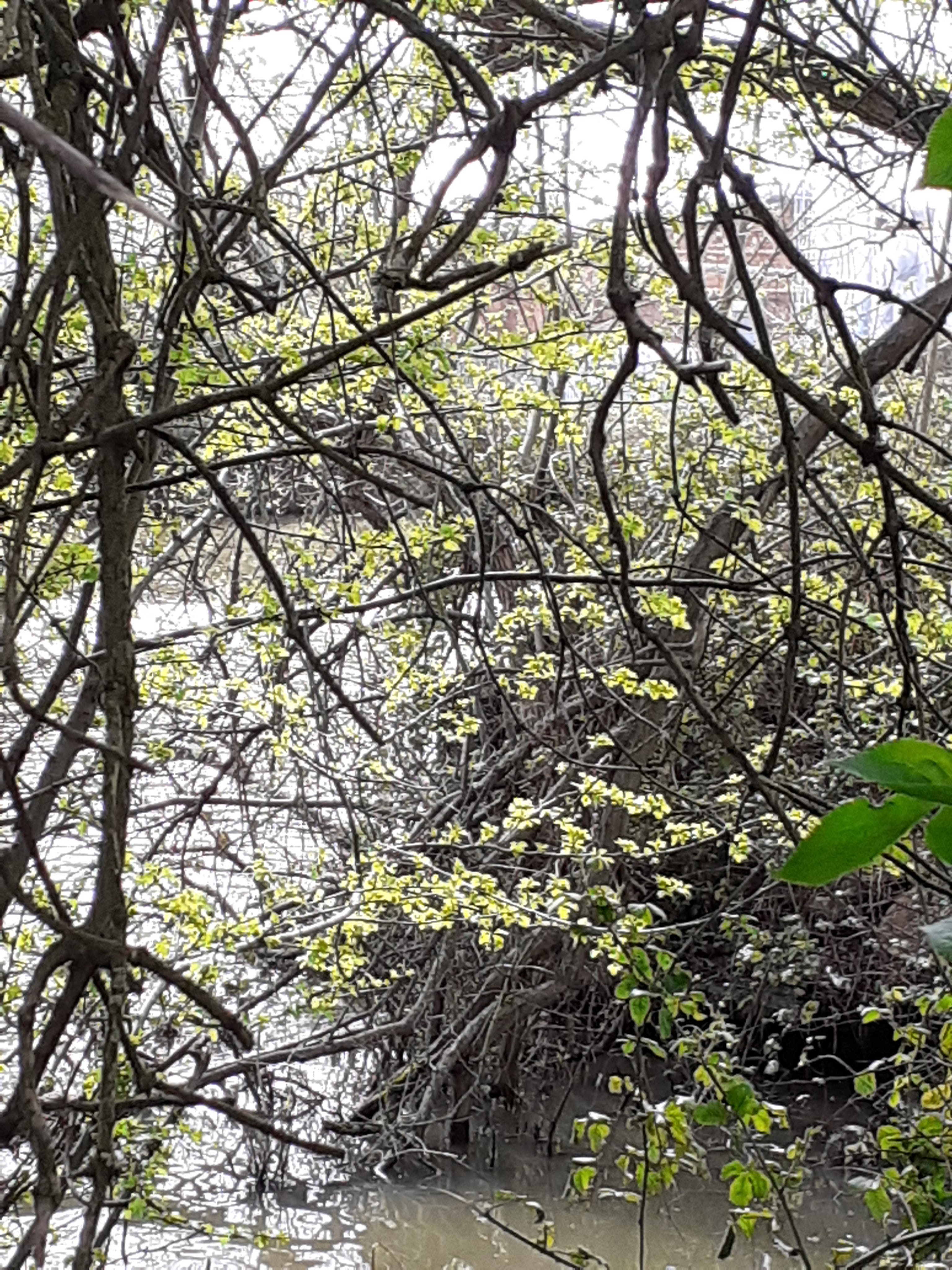
I am walking among trees, feeling refreshed and renewed after a long winter. This feeling is anchored by the return of leaves. I am present in, and to, the presence of new green. It comes every year, at slightly different times. I’m noticing the beginning of a beautiful verdant period. It’s re-appeared a little early this year and I experience this as a great blessing.
Where I live, the early spring has been wet and windy, often with dull skies. Nature has been alive and active throughout this period, but I have remained wintry in important respects. This weekend has changed me. I am aware of new green leaves and a strengthening sun. The latter may be visually dimmed by frequent of heavy cloud, but the leaves reassure me of its power in the rising year. Although we are still far from a full canopy in the woods, the life-force – in modern Druidry often called nwyfre – is strong. It’s a time for celebration.