Contemplative Inquiry

This blog is about contemplative inquiry

Tag: Paganism

POEM: WOLF VOICE

Happy New Year to all readers of this post! My very best wishes for 2015. I offer a poem by Martin Pallot, a wolf’s life-world in the northern winter.

Martin is my fourth poet from the collection ‘Moon Poets: Six Pagan poets’ published by Moon Books and edited by Trevor Greenfield. Martin has been writing poetry since the early 1980s, mainly inspired by Nature and his pagan beliefs. He admires the early poets and story tellers and the way they engaged the ear, as well as the mind of their audience, and encourages people to say his poetry as well as just reading it. The collection as a whole also includes work by Tiffany Chaney, Lorna Smithers, Robin Herne, Romany Rivers and Beverley Price.

Wolf Voice

Wolf, howling to the moon,

The wind hears your words,

The earth feels your voice,

Sending out your spirit sound,

Calling to the great She wolf

Who shakes the stars from her fur.

Loping in the light of her one great eye,

Silver, shadowing the pack path,

Snow, scented by the passing prey,

Guides you on your killing way.

The trackless whiteness,

Sculpted by spirits of the air,

Into shape of deer and bison.

These insubstantial ghosts,

A pulsating presence in your

Preternatural eye.

When the kill is made,

The pack song rises,

To thank the She Wolf

For her gift of life,

To the den of generations.

And the moon,

Resting on a bed

Of winter branches,

Smiles, to hear

The voice of Wolf.

UNCONQUERED SUN

Yesterday’s post from the Antinous for Everybody blog,

M.T.'s avatarAntinous for Everybody

The obscure, mysterious Mother

bears the radiant, obvious Son.

He is glorious in His self-giving,

triumphant sacrifice, but She

is the necessary ground

of His being and of ours.

View original post

POEM: CIRCLE OF THE SOUL

A third poet from the collection ‘Moon Poets: Six Pagan poets’ published by Moon Books and edited by Trevor Greenfield. Tiffany Chaney is a poet and artist residing in North Carolina. Her poetry collection Between Blue and Grey won the 2013 Mother Vine Festival Award for Best in poetry. Tiffany can be found on http://www.tiffanychaney.com/

The collection as a whole also includes work by Lorna Smithers, Robin Herne, Romany Rivers, Martin Pallot and Beverley Price.


Circle of the Soul

Wake,

wake the witness,

silent Sulis

of the pond.

Pretend the nameless

are named.

Pretend the formless

are framed.

Wake,

wake the witness.

Wait,

until it is your turn

of the wheel.

Satiate

the self with

the making of souls,

until having played

pretend you can fall

asleep again.

Wake, and witness,

so we may recall.

POEM: WEPWAWET

Another poem from the collection ‘Moon Poets: Six Pagan poets’ published by Moon Books and edited by Trevor Greenfield. This one is by Robin Herne, “educator, poet, storyteller, artist, dog-owner and Druid”, whose passion for mythologies extends beyond the Celtic world to the ancient Greek and (as in this poem) Egyptian cultures. Robert’s public blog can be found at http://roundtheherne.blogspot.co.uk/

The collection as a whole also includes work by Lorna Smithers, Tiffany Chaney, Romany Rivers, Martin Pallot and Beverley Price.


Wepwawet

Awaken in peace

Beloved of the sun.

Awaken in peace

Follower of the moon.


Desert wanderer

Maker of tracks

In the pathless wastes

Grey light in a red land.


The door is bolted to me

Confined within my mind.

Opener of the ways,

Unlock what I cannot.


Let me ride besides you

In the barque of Re,

Worlds open before us.

Danger abounds, my soul yearns!


Howling in the darkness,

I shiver to your hot breath.

Let me be open, let me be open

And live, let me not sleep.


Robin Herne writes: “the Egyptian deity Wepwawet is known as the Opener of the Ways, and stands at the head of the sun god’s ship unlocking the doors that lead into Dwat, the Underworld, as the sun goes down in the west, and opening the doors back into the land of the living as the sun rises in the East. Establishing Egyptian metre is difficult owing to the uncertainty over precisely how words should be pronounced. However, surviving examples of poetry make use of frequently repeated phrases, much like musical refrains.”

THE MYSTIC SENSE

In his book on Zen Paganism (1), Tom Swiss has a chapter called The Mystic Sense. He includes Mystic, a poem by D.H. Lawrence.


They call all experiences of the

senses mystic, when the

experience is considered.

So an apple becomes mystic

when I taste in it

the summer and the snows, the

wild welter of earth

and the insistence of the sun.


Swiss notes, “one specific, wonderful deep type of beauty comes … from the perception of a relationship between our immediate subjective experience and the broader world”. He adds that depending on our social conditioning and religious training we may come to conceptualise this in terms like ‘cosmic consciousness’, ‘the presence of the divine’, ‘the perception of emptiness’, a feeling of ‘oneness with the universe’, or of ‘sacredness’ or an experience of ‘no-mind’. They are all expressions of the mystical sense, and we have entered a period in which we can let go of any residual belief that this sense is a rare possession, or the exclusive province of a few spiritual specialists and champions.

The way we make meaning and find a language for such experiences may still be heavily conditioned by culture and still be used to justify the truth of dogmas that have in reality “only provided a filter” and “determined what color glasses” we are wearing when we “behold the Clear Light”. But behold it we do, in many different ways, and “with practice we can develop this sense”. Indeed we can “even manage to perceive the mystical experience from multiple perspectives, to swap the glasses for a couple of different colors”. In this context, Swiss reminds us that “this is one of the goals of ceremonial magic, as practised by occultists and Pagans” and not at all confined to still, meditative states.


  1. Swiss, Tom (2013) Why Buddha touched the earth: Zen Paganism for the 21st. century Stafford, UK: Megalithica books

SWEET AWEN: A POEM

Sweet Awen

sing me a song

of direction

down hills,

over terraces,

past old mills

and factories.

Sing me a song

of poppies and bees

where the bramble

unbridled roams

hedgerows with ease.

Sing me a song

where the first fruits

are born by the light

of a sun who has never

known war.

Sing me a song

where loss no longer

beats like a smith

at her forge

in the summer’s heat.

Sing me the years

that I’ll never meet.

Sweet Awen

sing to me

my impossibilities.

A poet’s take on Awen, in the traditional sense of poetic and vatic inspiration, written by Lorna Smithers who is a poet and Druid based in Lancashire. This poem is from the collection ‘Moon Poets: Six Pagan poets’ published by Moon Books and edited by Trevor Greenfield. The collection also includes work by Robin Herne, Tiffany Chaney, Romany Rivers, Martin Pallot and Beverley Price.

AWEN SPACE

I’ve heard it said that attempting to describe actual spiritual practice is folly. It’s like pinning up butterflies for display – you retain the husk whilst losing the flight. But sometimes the endeavour seems worth the risk. I want to talk about the group practice of ‘awen space’ that forms a part of my Druidry.

My local contemplative Druid group met for two hours last Tuesday, 9 December. We connect for two hours in the afternoon on the second Tuesday of every month, except for May and November – a pattern that has now lasted for just over a year. In those months we meet for a full Saturday, sometime after the festivals of Beltane and Samhain. The days offer the advantage of time for a greater variety of practice, the presence of people from outside our local catchment area, and an introductory space for new members. 19 people are now at least provisionally involved, and we have decided to close the group. The Tuesday sessions offer a greater sense of continuity, a more intimate atmosphere, and even greater focus and simplicity. Attendance currently fluctuates between five and nine. This week eight of us were present.

Our usual structure for a two hour session tends to be

  • Pre-meeting for greetings and refreshments
  • Entry into sacred space through a brief ritual opening
  • Group check in
  • A period of silent sitting meditation (about 20 minutes)
  • A move into the awen field (for about 35-40 minutes)
  • Group check-out
  • Exit from sacred space
  • Farewells

Although our use of ritual is lean and parsimonious, it is a very important part of this process. It is the first step in making our attention intentional, and in turning a domestic hearth into a nemeton. Over time, we have tended to favour putting our personal check-ins and check-outs within the nemeton, since we are entering into sacred relationship as well as sacred space, tuning into each other as part of the practice – not just as a preliminary or warm-up. We use a talking stick process for this, to emphasise the intentional and ritualised aspect of what we are doing.

I think of the awen space as being the most distinctive part of the session. We enter the space through a repeated chanting of awen – how much, or whether we ‘cascade’, depends on our sense of the moment – and then enter silence, consciously together rather than meditating side by side as in the simple sitting meditation that precedes this practice. We may maintain this collective and relational silence or we may choose to sing, chant or say things. In this sense it is an interactive practice albeit a subtle one. It is most powerful when we can hold back from entering into actual dialogue and exchange whilst at the same time moving with the current of communication and relationship which we are generating both through our silence and our utterance. There’s a fine point of balance and tension here. When the awen space is over – it’s over, so it’s not strictly timed. There’s a person whose job it is to lead us both into and out of the space and they make the call. Usually it reflects everyone’s sense of the appropriate ending. We chant awen on our way out of this space as well as into it.

In this context we experience awen, Druidry’s subtle magic, as an energetic field in which we are inspired to be more open and receptive to each other – and at times to find authentic here-and-now language for our felt sense of co-presence and connection within an enlivened space. So it’s something within and between us when we are together, not so much a lightning flash from above. Sometimes our experience completely flows; sometimes it’s more halting. The space gives us a mirror, say rather an echo, of what we bring to it on the day. The physical space matters too – on Tuesday it was a space of wood burner glow and tiny lights in a deepening dusk, and a circle of people working gently together. For me, the feeling-tone and the imagery of this space, lodged in the shifting ever-now of memory, are my key reference point for ‘contemplative Druidry’ as a unique spiritual note. And I am made even more grateful to be able to practice in this way with a group of good companions.


A CONTEMPLATIVE DRUID EVENT

Thanks to the interest generated by Contemplative Druidry, members of the Gloucestershire contemplative group have set up an entity called Contemplative Druid Events. So far we have a blog at http://contemplativedruidevents.tumblr.com/ and a forthcoming retreat.

The retreat is being held on the weekend of 17-19 April 2015 at Anybody’s Barn, Birchwood Hall, Storridge, Nr. Malvern, Worcestershire WR13 5EZ.  Details of the retreat can be found on the blog.

I am excited by this prospect. It provides the opportunity to work with a larger group of people and to learn from them. Contemplative Druidry doesn’t come with a long specific tradition or an inherited set of practices and teachings. As modern Druids, we are engaged in an exploratory and co-creative enterprise. Events will extend the experience and understanding of participants and facilitators alike.

At the same time we do have a vision of what we are offering, and a sense of how the retreat will work. We will use the Friday evening to enter sacred space and move into introductions and a culture setting process. I consider the way in which we enter into relationship with the space and each other to be a highly significant part of the event and not just a warm up or preamble. It does much to determine the quality of living presence in the space, as important as any practice or activity. As for practices and activities – there will be sitting meditations and an introduction to what our existing local group calls “Awen Space”. Other offerings may include chanting, sacred movement, outside walking meditation and ‘lectio divina’ from the book of nature. We will likely make use of a fire pit on the Saturday evening.

The retreat also gives us the chance simply to be, alone and with fellow travellers, in a beautiful nurturing space. (After the opening process, every activity is an invitation to the participants, rather than a demand on them.) We will work with a maximum of sixteen people, including ourselves – there are five of us with facilitator roles from the Gloucestershire group. This is not the full capacity of the centre we are using, for we wanted a spacious environment on the physical as well as other levels.

I have a strong belief in this way of working and look forward to sharing it with new people.

CONTEMPLATIVE DRUIDRY: BOOK REVIEW BY MARIA EDE-WEAVING

I like the way in which the reviewer takes the discussion forward whilst also saying nice things about my book!

ContemplativeDruidry copy

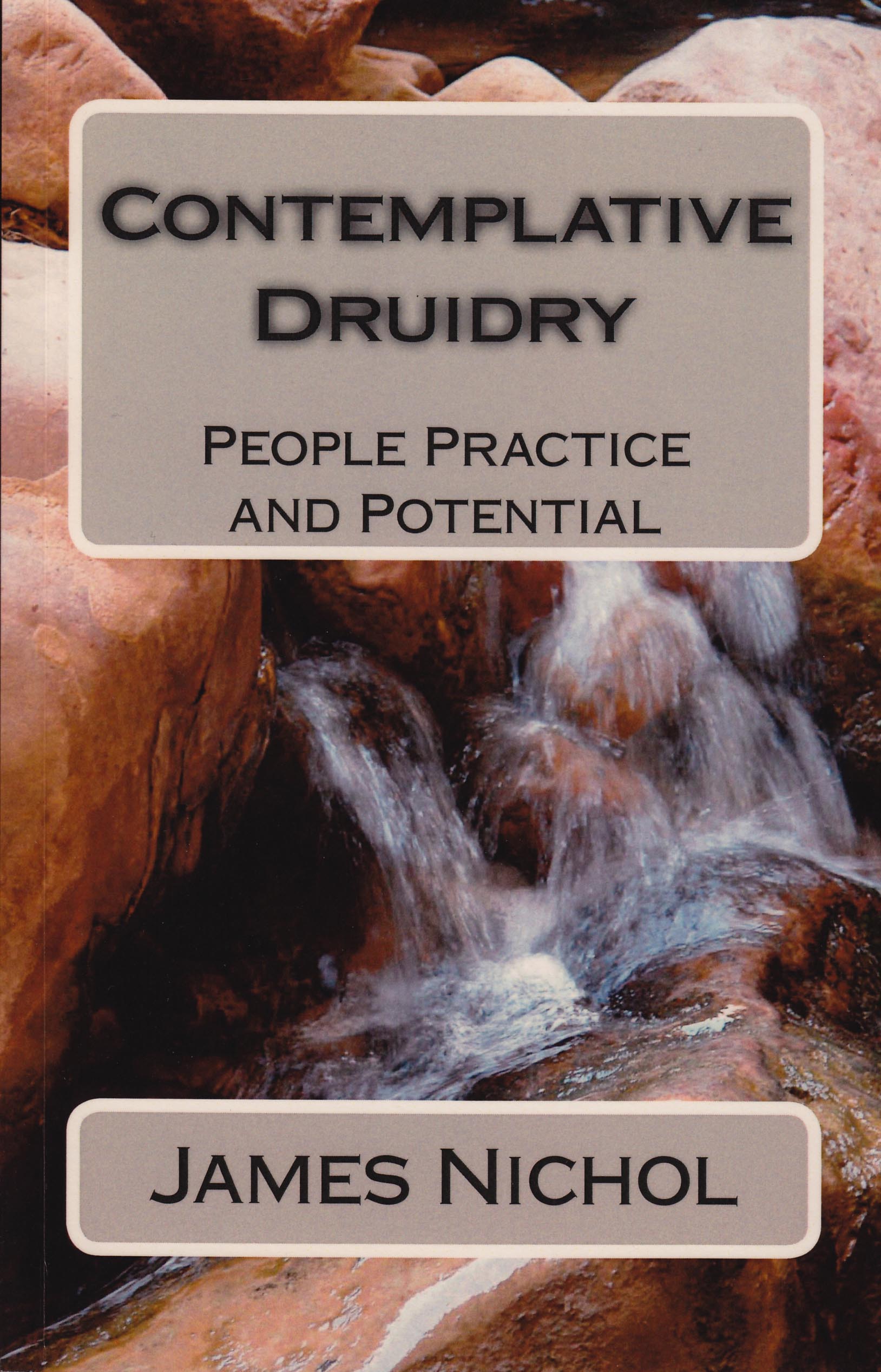
A review by Maria Ede-Weaving of  ‘Contemplative Druidry: People, Practice and Potential’ by James Nichol

Modern Druidry is an evolving spirituality; each of its practitioners is continually adding to the breadth and depth of this path through their experiences. What gives a spirituality its power is it practices and approaches, and these are far from static – they live and breathe, grow and change, as we do. For a path to flourish and mature, it requires that we engage, question and explore, remaining open to the possibilities of change whilst honouring the wisdom already shared. James Nichol’s Contemplative Druidry: People, Practice and Potential is a wonderful example of this process in action.

Nichols has gathered a group of Druids to discuss their experiences of contemplative practice. Fifteen Druids share their thoughts about both their solo and group encounters with contemplative meditation and how these have impacted upon their Druidry and wider lives.

The book is in three main sections: ‘People, Practice and Potential’ with contributors not only reflecting on what drew them to contemplative Druidry and how such is expressed in their spiritual practice, but also posing the question of how such approaches might manifest in the wider Druid community, should they be more readily explored.

It is clear from these accounts that sitting meditation is only one part of this approach; mindful walking, chanting, daily offices, communion with nature/the divine and creative activities also play a part in keeping contributors present and connected. There is a real sense that each – for want of an established Druid-based contemplative framework – has been quietly experimenting, acting as pioneers exploring their own frontiers in order to find what works.  In doing so, they have been planting the seeds of a tradition that could potentially flourish into a valid and inspiring area of Druidry, one that until now has been rather ignored. Many have taken their inspiration from other spiritualities such as Buddhism and Christianity, however, their practices have developed a flavour that is distinctly Druidic. It’s a fascinating read and interesting to see how meditative practices give depth to Druid concepts such as the Awen and Nwyvre;  how Druid contemplation and mindfulness might  help to shape, transform or deepen a connection to life and self.

In the Neo-Pagan movement and the Western Mystery Tradition there has been a dominant focus on what might be perceived to be ‘active’ meditation techniques; the use of visualisation and path-working holding a dominant place. The Eastern approach to meditation has often been assumed to facilitate a removal of self from the world in an attempt to transcend its illusions. As such it might be perceived to be at cross purposes with the Druid world view where life and earthly experiences are celebrated. Most of us understand  Druid spiritual practices to be a gateway to deepen one’s involvement with earthly life, as opposed to escaping it via ascetic disciplines, however, what Nichol’s book illustrates is that the contemplative approach, explored from a Druid perspective, can be a tool that moves us into a richer and deeply felt relationship with nature, community and self.

Reading through the book’s many thought-provoking accounts I had that sense of excitement you get when a long-held suspicion about something is validated by another’s experience. My first encounter with meditation came years ago via the practice of Yoga. For me, regardless of how one might interpret the philosophy of Yoga, what its practices illustrated was that these techniques of mindful movement, breath and contemplation could actually help me to feel more embodied and present on this planet. They were immensely practical and useful , not only in aiding my physical well-being but also in creating a healthier flow between my body, mind and emotions, and in doing so, opening the door to my spiritual journey. The book’s examples makes it clear that I am not alone in my view that these techniques are not ring-fenced by any religion or path but are open for all to use. I see no contradiction in including them as part of my Druid practice. It is true that each spiritual path will approach these techniques through their own spiritual lens – and even each individual within each path will bring their own unique focus to bear – but Nichol’s books suggests that there is a rich seam of spiritual nourishment to explore here, and that even if such practices are not for us, then the debate about them can only deepen and widen what Druidry has to offer.

There is much here that gives food for thought. Contemplative Druidry is a valuable springboard for further discussion and a great starting place for those who are interested in including contemplative meditation in their practice. Nichol’s book encourages us to really think about what a contemplative Druidic practice might be. What is clear from each contributor’s experience is that it is an approach that is nature and body affirming, one that offers us a means to engage more fully with self and the world around us. In time, as this discussion deepens, as more people engage with these practices and share the results, I feel sure that many more benefits will become apparent. All this can only add to the richness and diversity of the Druid path.  – Maria Ede-Weaving

James’ book is available from Amazon and will shortly be available from the OBOD shop.

ORPHIC HYMN TO NIGHT

Today, where I live, we changed our clock time. Yesterday’s 7 p.m. is today’s 6 p.m. and the evenings get dark. This introduces the Samhain season for me and all that it brings. Here is a Hymn to Night, conventionally ascribed to Orpheus. According to translator and editor Apostolos Athanassakis, they were most likely written in their present form in the early third century AD in Pergamum, a city in modern Turkey .

I shall sing of Night,

mother of gods and men;

We call Night Kypris,

she gave birth to all.

Hear, O Blessed Goddess,

jet-black and starlit, for you delight in the quiet

and slumber-filled serenity.

Cheerful and delightful, lover

of the nightlong revel, mother of dreams,

you free us from cares,

you offer us welcome respite from toil.

Giver of sleep, beloved of all,

you gleam in the darkness as you drive your steeds.

Ever incomplete, terrestrial,

and then again celestial,

you circle around in pursuit

of sprightly phantoms,

you force light into the nether world,

and then again you flee

into Hades, for dreadful Necessity

governs all things.

But now, O blessed one – beatific,

desired by all – I call on you

to grant a kind ear

to my voice of supplication,

and to come, benevolent,

to disperse the fears that glisten in the night.

Apostolos Athanassakis  talks about Orphic hymns as instances of a devotional mysticism that uses “the power of clustering epithets” for the creation of “an emotional and spiritual crescendo that might raise our human spirit and help us approach the divine”. They remind him of Vedic hymns, Rumi’s verses within the Islamic Sufi world, and aspects of his own Orthodox Christian background. The hymns are beautiful to read – and it is worth remembering that they are designed for group practice in a charged, incense laden atmosphere, with repetition upon repetition, perhaps accompanied by swaying, movement or dance of various kinds.

Earth Eclectic

music that celebrates Earth and speaks to the heart

Sarah Fuhro Star-Flower Alchemy

Follow the Moon's Cycle

Muddy Feet

Meeting nature on nature's terms

Rosher.Net

A little bit of Mark Rosher in South Gloucestershire, England

Becoming Part of the Land

A monastic polytheist's and animist’s journal

selkiewife

Selkie Writing…

Charlotte Rodgers

Images and words set against a backdrop of outsider art.

Prof Jem Bendell

living with metacrisis and collapse

Towint

The pagan path. The Old Ways In New Times

The Druids Garden

Spiritual journeys in tending the living earth, permaculture, and nature-inspired arts

The Blog of Baphomet

a magickal dialogue between nature and culture

This Simple Life

The gentle art of living with less

Musings of a Scottish Hearth Druid and Heathen

Thoughts about living, loving and worshiping as an autistic Hearth Druid and Heathen. One woman's journey.

Wheel of the Year Blog

An place to read and share stories about the celtic seasonal festivals

Walking the Druid Path

Just another WordPress.com site

anima monday

Exploring our connection to the wider world

Grounded Space Focusing

Become more grounded and spacious with yourself and others, through your own body’s wisdom

The Earthbound Report

Good lives on our one planet

Hopeless Vendetta

News for the residents of Hopeless, Maine