Contemplative Inquiry

This blog is about contemplative inquiry

Tag: Paganism

POEM: ARTHUR

Behind storm-fretted bastions gray and bare

Flame-crested warriors of Cunedda’s line

Feast in a gold ring, – their targes shine

Along the wall and clang to gusts of air;

And in the shadow, torches blown aflare

Reveal a chief, half human, half divine,

With brooding head, starred by the Dragon Sign,

Hung motionless in some undreamed despair.

But when he starts, three torques of twisted gold

Writhe on his breast, for voices all men fear

Wail forth the battle-doom dead kings have borne;

And as the mead-hall fills with sudden cold,

Above the wind-tossed sea his heart can hear

The strange gods calling through their mystic horn.

Arthur is one of Six Celtic Sonnets written by Thomas Samuel Jones and included in From the Isles of Dream: Visionary Stories and Poems of the Celtic Renaissance, selected by John Matthews and with a foreword by Robin Williamson (Floris Books, 1993).

Thomas Samuel Jones (1882-1932) came from Welsh and Irish stock and was born in Oneida County, New York State, near the Adirondack Mountains. Each of the six sonnets reflects a facet of Celtic tradition. They were originally published in 1930 as part of the collection Aknahton and Other Sonnets. For those of us who resonate with Druid and Celtic spirituality, they are part of our modern cultural ancestry.

POEM: A DRUID TOWN

A sunless maze of tangled lanes enfold

The magic dwellings of the forest race,

Whose hidden shapes are flames that leave no trace

At mid-moon when the Druid’s dream is told;

The shadows of enchanted orchards hold

Red thatch of wings and woad-stained doors that face

The wandering stars, and guard the sacred place

Where faery women thread their warps with gold

The dragon knight shall lose his strength of hand

Nor ever raise his long leaf-shapen shield,

If he but follow where the white deer roam;

And never will the mariner reach land

When harps ring seaward as the dawn fires yield

The golden caer upon the ninth wave’s foam.

A Druid Town is one of Six Celtic Sonnets written by Thomas Samuel Jones and included in From the Isles of Dream: Visionary Stories and Poems of the Celtic Renaissance, selected by John Matthews and with a foreword by Robin Williamson (Floris Books, 1993).

Thomas Samuel Jones (1882-1932) came from Welsh and Irish stock and was born in Oneida County, New York State, near the Adirondack Mountains. Each of the six sonnets reflects a facet of Celtic tradition. They were originally published in 1930 as part of the collection Aknahton and Other Sonnets. For those of us who resonate with Druid and Celtic spirituality, they are part of our modern cultural ancestry.

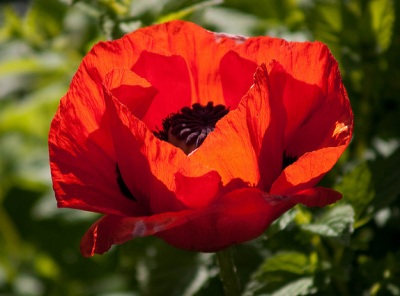
POPPY

red poppy MIA_400x296“We call the poppy ‘vanity’ and we write it down as a weed. It is humiliating to think that, when we are taking ourselves seriously, we are considering our own self-preservation, or the greater scheme for the preservation of mankind. What is it that really matters? For the poppy, that the poppy disclose its red … Seed and fruit and produce, these are only a minor aim: children and good works are a minor aim. Work, in its ordinary meaning, and all effort for the public good, these are the labour of self-preservation, they are only means to an end. The final aim is the flower, the fluttering, singing nucleus which is a bird in spring, the magical spurt of being which is a hare all explosive with fullness of self, in the moonlight; the real passage of a man down the road, no sham, no shadow, no counterfeit, whose eyes shine blue with his own reality, as he moves amongst things free as they are, a being; the flitting under the lamp of a woman incontrovertible, distinct from everything and everybody, as one who is herself, of whom Christ said, ‘to them that have shall be given’.

“The final aim of every living thing, creature, or being is the full achievement of itself. This accomplished, it will produce what it will produce, it will bear the fruit of its nature. Not the fruit however, but the flower is the culmination and climax, the degree to be striven for. Not the work I shall produce, but the real Me I shall achieve, that is the consideration; of the complete Me will come the fruit of me, the work, the children.

“And I know that the common wild poppy has achieved so far its complete poppy-self, unquestionable. It has uncovered its red. Its light, its self, has risen and shone out, has run on the winds for a moment. It is splendid. The world is a world because of the poppy’s red. Otherwise it would be a lump of clay.”

D. H. Lawrence A Study of Thomas Hardy in D. H. Lawrence Complete Works Delphi Classics on Kindle

When reviewing Nature Mystics – https://contemplativeinquiry.wordpress.com/2015/7/6/  – I mentioned D.H. Lawrence and Thomas Hardy as two of the named writers who had become part of my life during my teens. I also wondered how far such free spirited people can be enrolled as ‘properly’ proto-Pagan as suggested by the author. This passage is certainly very Laurentian. In modern terms, it seems to connect with the current conversation about ‘wildness’ rather than religious Paganism or nature mysticism, though of course these are all interconnected. I have certainly enjoyed revisiting Lawrence’s words after a long absence.  They were written early in 1915, with the red poppy simply representing abundant life, and so before its memorialising significance became marked. Lawrence was just under 30 at the time of writing, with  just 15 years left to him.

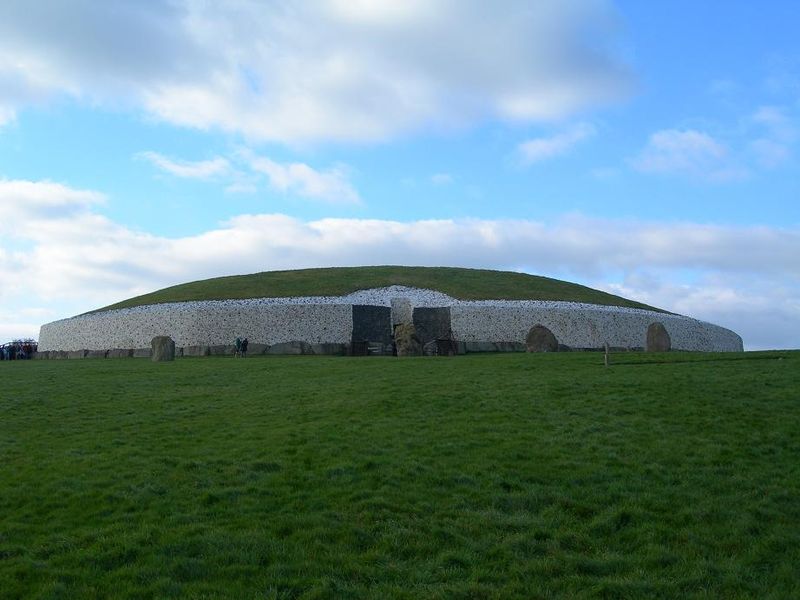
POEM: NEW GRANGE

800px-Newgrange

Picture cc by 2.5 pl – originally uploaded by Shira-commonswiki

The golden hill where long-forgotten kings

Keep lonely watch upon their feasting-floor

Is silent now, – the Dagda’s harp no more

Makes sun and moon move to its murmurous strings;

And never in the leafy star-led Springs

Will Caer and Angus haunt the river shore,

For deep beneath an ogham-carven door

Dust dulls the dew-white wonder of their wings.

Yet one may linger loving the lost dream –

The magic of the heart that cannot die;

Although the Rood destroy the quicken-rods;

To him through earth and air and hollow stream

Wild music whines, as two swans wheeling cry

Above the cromlech of the vanished gods.

New Grange is one of Six Celtic Sonnets written by Thomas Samuel Jones and included in From the Isles of Dream: Visionary Stories and Poems of the Celtic Renaissance, selected by John Matthews and with a foreword by Robin Williamson (Floris Books, 1993).

Thomas Samuel Jones (1882-1932) came from Welsh and Irish stock and was born in Oneida County, New York State, near the Adirondack Mountains. Each of the six sonnets reflects a facet of Celtic tradition. They were originally published in 1930 as part of the collection Aknahton and Other Sonnets. For those of us who resonate with Druid and Celtic spirituality, they are part of our modern cultural ancestry.

BOOK REVIEW: NATURE MYSTICS

jhp54f743a60d1fbHighly recommended. Nature Mystics: the Literary Gateway to Modern Paganism is a new and refreshing departure in Moon Books’ Pagan Portals series. It introduces readers to some of the literature that many modern Pagans perceive to have influenced the culture of their spiritual family. It will be published at the end of this month (31 July 2015) and author Rebecca Beattie dedicates it “to all those Nature Mystics who have come before and continue to inspire us to a spiritual path with their words”.

Selection has clearly been an issue and the author has both used her own judgement and consulted with associates in a ‘Nature Mystic’ blog. Her centre of gravity is England in the closing decades of the nineteenth century and, more particularly, the opening decades of the twentieth. She has chosen five women and five men to represent a place, a time, and a suggested sensibility. There are outliers – John Keats from an earlier time and W. B. Yeats from Ireland – but Beattie shows in her introduction how they fit within the selection. The full list is: John Keats, Mary Webb, Thomas Hardy, Sylvia Townsend Warner, D. H. Lawrence, Elizabeth von Arnim, W. B. Yeats, Mary Butts, J. R. R. Tolkien and E. Nesbit. Each author has a dedicated chapter describing their life, work and cultural setting; exploring specific works in some depth; and discussing both their declared or implied spirituality and ways in which it may inspire modern Pagans. Each is given a remarkably thorough treatment for an introductory book that addresses a larger theme.

I grew up with some of these writers and went on to study English literature for my first degree in the final years of the 1960s. It’s been interesting for me to check back on the writers I knew and those I didn’t, at that time, as a way of checking out how the world has moved on. Four of the men – Keats, Hardy, Lawrence and Yeats – were an important part of my life; Tolkien not so much, though I had read both The Hobbit and Lord of the Rings. E. Nesbit I knew as author of The Railway Children and connected with the Fabian Society, the intellectual voice of respectable British Socialism at the time. Thanks to Nature Mystics, I’ve enjoyed being introduced to her The Accidental Magic: or Don’t Tell All You know and The Story of the Amulet, works for children penned by the Nesbit who was involved, as I knew that Yeats was, with the Hermetic Order of the Golden Dawn. I discovered Mary Webb later, when I went to live in Shropshire where she was remembered. By then I was able to read Precious Bane and Gone to Earth in Virago editions and I later found Sylvia Townsend Warner and Lolly Willows in the same way. I still see these powerful and highly relevant books through a sort of feminist ally lens, as primarily about free-spirited women in outsider positions navigating gender and sexuality in a largely hostile and uncomprehending world, and looking for oases of safety and possible flourishing. Beattie’s book adds to the picture by spelling out Pagan tinged nature mysticism as a spirituality that is congruent with this quest, and also informed by it. I have still not read anything by Elizabeth von Arnim or Mary Butts, and before getting my review copy of this book, knew of them only through their links with other people. Now I’m encouraged to look at their work.

I’ve been delighted to read a work that offers new information and a new lens. The writers concerned are a diverse and free-spirited group. I’m not entirely convinced that they either could or should be enrolled in a league of “properly proto-Pagan” Nature Mystics. It is my belief that most of them would resist the identification. Beattie herself says that Tolkien was dismayed by some of the responses to his work in his own life-time. At the same time I do see a common tendency, in this group, to find the numinous in natural settings and the spirit of place, “that sense of bliss and divine communion that is gained from time spent absorbed in the natural world” as Beattie puts it. I’m sure, too, that there will be a ready assent among many readers to the suggestion that “where Woolf said every woman needed a room of her own, von Arnim would have said every woman needed a garden”.

I will leave the last word to Thomas Hardy, in a brief passage from Tess of the D’Urbervilles, quoted in Nature Mystics. It is about Tess herself, and evokes a moment when a sensitive human consciousness is more fully awakened by a moment in the cycle of the day: “She knew how to hit to a hair’s breadth that moment of evening when the light and darkness are so evenly balanced that the constraint of day and the suspense of night neutralise each other, leaving absolute mental liberty”.

DRUID CAMP, STROUD CONTEMPLATIVE DAY, SMALL GROUPS

I’ve just had a couple of lazy summer days and I feel all the better for them. They’ve been interwoven with a relaxed stocktaking about contemplative Druidry and my part in it. I notice that my main focus is on small groups.

As I write, I’m at peace with my personal life and practice. At the collective level, I’ve had recent good news. My friend and colleague JJ Howell has let me know the specific roles that my partner Elaine Knight and I will be playing at Druid Camp in four weeks’ time. Druid Camp – www.druidcamp.org.uk  – is a large group (200-300 people), but we’ll be working with small groups, offering contemplative sessions from the repertoire built up by our local group over the last year. Meanwhile I also know that an open contemplative day in Stroud, organised by our own outreach arm Contemplative Druid Events –   http://contemplativedruidevents.tumblr.com  – is now viable and will go ahead on 3 October. We have seven people fully booked and three more with strong expressions of interest, with 15 being our max.

The overall position is that we have a flourishing local group, now three years old; a book largely though not exclusively based on the thoughts of its members; and an outreach arm able to offer an annual residential retreat (The Birchwood Retreat) every April and an open contemplative day in October 2015, which might become annual too. In all cases the events concerned will have no more than 15 participants. We could do a little bit more – providing small group sessions at other larger events, or offering more contemplative days either locally or elsewhere. But my sense is that we need to respect limitations in our capacity, stick to the small group approach, and make sure that all our work is experiential and not simply discursive. People need to taste it.

For me perhaps the greatest value of the small group is the opportunity for all participants to introduce ourselves and be heard. For that to work fully, we need a quality of listening which itself becomes a practice and part of our culture, and whose intention is to ensure that no one is either misrecognised or ignored. This in itself is counter to mainstream communication, including ours, and needs conscious practice. It will include mis-steps from time to time within our own groups. So it’s not about ‘getting it right’ all the time: the point is to be conscious. In a contemplative context, we can hope to go further: establishing a level of trust that opens the door to deeper I-Thou recognition and communion. It’s a different opportunity to those provided when large numbers of people become immersed together in prayer, song, ritual or formal meditation. It’s more personal, in the best sense of that term. I find it both more challenging and rewarding, whilst believing that all of these approaches have their honoured place.

Small groups have other advantages too. It is easier to be flexible on programming within the event. It is easier to offer activities which demand time for reflection and debriefing. It is easier to become aware of other people as spiritual companions, even if we have not met them before or do not know them well. I think, too, that it’s easier to learn, not least when in a facilitative role, because the style of the event can be person centred rather than goal centred. Activities are designed to support us in our human, and therefore spiritual, flourishing. They are not Everests to be climbed so we can say that we ‘knocked the bastard off’.

I think this is why we have not oriented our contemplative Druidry around long meditations or meditation training. It was one way to go, and in some ways the obvious one. It would certainly be the most traditional one and my solo practice is very much tilted that way. But the group context changes things. Pragmatically, our local group is about evenly divided between people who gain from long meditations and those who don’t. We would lose people by taking this approach. More importantly, the group is co-creating a culture in which the blessing of space and silence is received differently – through short meditations, attunement to the seasonal moment, silent walks, or activities like ‘Awen space’ in which we sit with each other, open to spirit, and can speak, chant or sing into the silence when so moved. We can also explore co-creation from silence into sound and story, or find different ways of awakening to the fields of energy and presence within us, between us, and around us. It’s a subtle and sensitive kind of work. It needs times of stillness and silence. It also needs times of movement, sound and speech. It needs times of reflection and relaxation.

In my view, we are still at an early stage of this exploration. We have a name – Contemplative Druidry – to hold us. We have literature – Contemplative Druidry and also Nimue Brown’s Druidry and Meditation – to support us. We have a dedicated group and an outreach arm. The small group approach has evolved quite naturally and I see it as a critically important aspect of how we work.

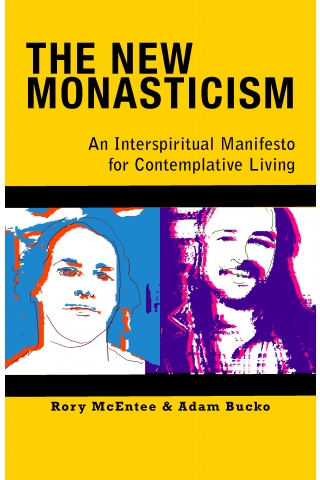
BOOK REVIEW: THE NEW MONASTICISM

New_MonasticismHighly recommended. I knew I would be in business with this book as soon as I got wind of it, and it will take further contemplation and inward digestion before I fully understand my relationship with it. I believe that this is the kind of effect that what The New Monasticism: an Interspiritual Manifesto for Contemplative Living intends to create.

‘Monasticism’ is refreshingly used here “simply to denote a level of commitment to a spiritual life”. It is not about specific beliefs or a specific lifestyle. It asks us to free ourselves from our cultural conditioning and an unquestioning and un-questing life. Avoiding identification with material success, living in the midst of a contemporary society that does not support such a calling, we may enter a space of “radical profundity and divine transformative energy”. We seek simplicity not through renunciation but through ‘integration’.  We do need retreat space, so some people will indeed be called as specialists to hold the “containers of silence”. But most will pursue vocation in the world, in a life made up of contemplative practice, heartfelt conversation and sacred activism.

Authors Rory McEntee and Adam Bucko are situated within the Roman Catholic tradition, in an emancipatory strand which is reaching out to others and hoping to transcend itself. The term ‘interspirituality’ was coined by Brother Wayne Teasdale, an ordained Christian Sannyasin who  presided over an ashram in India. The authors see interspirituality as “humbly placing itself in partnership and collaborative discernment with our time-honoured religious traditions”.  In the last decade we have also seen the linking of Father Thomas Keating (who developed ‘centering prayer’ as a Christian answer to Buddhist-style meditation) with Ken Wilber’s Integral Life project, which is itself increasingly seeking alliance with like-minded Christian communities. Indeed a lot of the philosophy, psychology and social science in this book comes straight from Ken Wilber and the stance of the Integral movement. The authors come from a collectively confident and mature spiritual base, and there are advantages in that. The book is rich with specific suggestions about life and practice in the new monasticism, drawing for its core inspiration on an ‘Interspiritual Manifesto for Contemplative Life in the 21st. Century’ following a week long dialogue with Father Thomas Keating at his monastery in Colorado in 2012.

McEntee and Bucko are both “under 40” and feel a connection with the younger generation now coming into adulthood. Bucko works with young homeless men in New York City. They see a potentially emergent spiritual culture that is: “spiritual not religious”; this worldly and concerned with nature and the fate of the earth; has (post) modern commitments to personal ‘authenticity’; and finds the sacred in the secular. They believe that these values can be championed within a further development of their own tradition, transforming the tradition itself. For them the path is as much about the life and health of the earth as it is with an individual communion with the Divine: indeed, it is false to separate the two. Realisation is less a “gnostic quest for truths beyond the world” than “a reflection on certain processes taking place within the world”. Interspirituality wants to be the midwife of this, and in doing so become attractive to people, especially young people, who would not be drawn to more traditional approaches.

The New Monasticism is a valuable contribution to the re-visioning of spirituality and concomitant life practices. Given its provenance, it is not surprising that the reaching out to other traditions is quite selective. Beyond Christianity, the traditions being engaged with are neo-Vedanta, Tibetan Buddhism and to a lesser extent Zen, modern Sufism and to some degree the Hasidic movement in Judaism and Martin Buber. ‘Indigenous religions’ are mentioned in two inclusivity lists, without definition or description. Shamanism is mentioned as a particular model of spiritual service. There is nothing specific from the Western Way outside Christianity.  Within Christianity, much is drawn from the contemplative strand in Orthodoxy, including an understanding of theosis (or divinisation) and the role of Sophia as guide. This is accompanied by an intent to “claim the wisdom dimension of all traditions and let the wisdom guide you” – a view which they attribute to Matthew Fox. Ethics is seen as “the call to active co-operation with the sophianic transfiguration of the world”. Quaker processes also get a mention because of their democratic and dialogical way of bringing people into Presence with each other. Since I am personally positioned in modern Druidry, Paganism and Earth Spirituality I have to express some disappointment here. However I don’t feel deliberately excluded. It’s just that these authors have their attention focused elsewhere.

I do have a worry, all the same, an area where I think that Earth and Goddess traditions could do with being heard. This is when McEntee and Bucko talk about ‘axial ages’, a view of spiritual/religious history once again taken from Ken Wilber. It depends on an evolutionary view of human culture as an aspect of a Divine awakening. In this view, the first axial age, from 800 BCE – 200 CE was a time of radical transformation marked by the appearance of great teachers who catalysed major literatures: Lao-Tzu, Confucius, Buddha, Mahavir (of the Jains), Zoroaster, the Jewish prophets and Greek philosophy, as well as Jesus and the gospels. These people could stand apart from the tribe, question the worldview they had been given, and think for themselves. They could also wake up from the trance of complete immersion in nature and objectify it – seen here as a positive step, albeit one with a shadow side. They represented the coming of reflexive subjectivity and the technology (writing) that made it sustainable. Admittedly, the narrative goes, this tended to take world denying, sex denying, misogynist and more generally oppressive forms. But overall it is read as a cultural gain. Now we are seen to be in a second axial age where the perceived challenge is to transcend the limitations of the first whilst preserving the gains, and thus renew our overall movement onward. “We need both our individuality … and an understanding of our intrinsic belonging within a vast Kosmos”. I’ve been aware of Wilber’s position on this since he wrote Up from Eden in the mid 1980’s. It has always read to me as a one-eyed narrative, the mirror image of the primitive matriarchy still espoused by many Pagans.  One of its effects has been to offer a language of canny and limited concession by hitherto dominant traditions as they respond to an unstoppable shift in culture. Here is where the Earth traditions could have a role in the dialogue, to support a view of individuality and inter-connectedness, indeed, but which is less masculinist in language (I’m thinking about how the book suggests “dialogical sophiology” as the way of meeting with the divine feminine), more open, and more widely informed than this.

I am glad to be living in a time of spiritual ferment. It breathes life and hope in an otherwise darkening time. I acknowledge and celebrate the achievement of The New Monasticism and am already involved in exploring contemplative life in Druidry. I notice that I, and others who I have been linked with, have in some ways come to similar conclusions about life and practice, if not entirely of view. This book, although from a very different background, has stimulated and encouraged me. I hope it has this role for many other readers.

BOOK REVIEW: PAGAN DREAMING

jhp551bfc27c579fHighly recommended. Pagan Dreaming: The Magic of Altered Consciousness, to give it its full title, is an informed and thought provoking introduction to dreams and dream work. Although tailored specifically to a Pagan-oriented audience, it will be of interest to many other people as well.

Author Nimue Brown follows her familiar path of avoiding hackneyed or formulaic approaches to the subject. Instead, she draws on a rich variety of sources including her own experience of dreaming and working with dreams to ask fruitfully open questions and invite dreamers to explore this territory for themselves. She says of herself: “I am not a scientist or psychologist. I have not trained as a counsellor or psychoanalyst. … I am simply a Druid who has always worked with dreams, and I am sharing what I have. There is no dogma here, just ideas”. Whilst being clear that she is not writing as a therapist, she does indicate that dream work can have triggering (and therefore potentially therapeutic) effects, so that people doing it may want professional support in some circumstances.

The book discusses the physical, emotional and meaning-making aspects of dreams, emphasising how dreams work differently for different people – suggesting that standard schema for interpretation are of very limited use. Everyone has their own dream language and needs first to listen in to this. Only then are they in a position to interpret their own dream symbolism and develop their own dream work. The author includes a chapter on ‘Exploring a Dream Diary’ where she shares extensively from her own, and shows how to assess and draw conclusions from the material presented by the recorded dreams. She includes “daydreaming … along the edges of sleep” within the overall umbrella of dream work, and identifies this as a significant and creative state for her.

After a chapter on ‘Dreams and Magic’ (though “not the kind of magic that leads to definite outcomes”) the book concludes with ‘Into the Wilderness’, which explores the idea of “re-wilding your sleep” – physically, mentally, spiritually and socially. She moves on to speculation about where dreams come from – products of our own minds? The universe whispering to us as we sleep? The gods of dreaming as they carry us into other-worlds? Ancestral memories? She ends by saying: “none of these explanations is any less miraculous than any of the others”. That sense of an open and affirmatively questioning stance towards the ‘miraculous’ is for me the defining feature of this book: a refreshing treatment of a fascinating topic.

OLD MIDSUMMER’S DAY

485px-Andrea_Solari_Salomè_riceve_la_testa_di_Giovanni_Battista24 June is a special day for me. When I was quite small, someone told me that it was Old Midsummer’s Day without telling me when the new one was. So it was Midsummer’s Day for me. ‘Old’ just gave it depth and perspective in my imagination. I was told in the presence of oak trees too, in a sun-ripened afternoon , sultry like high summer. Old.

A year or two later I found out that it was St. John the Baptist’s Day too. I had two vivid images of him at the time. The slightly less vivid one was of him baptising Jesus, the anointed one who was to follow him. The slightly more vivid one was a version of Andrea Solari’s depiction above (1507): John beheaded as requested by Salome, at the command of King Herod. It is a strange story in some ways, for Salome means ‘peace’ in Semitic languages and she’s not depicted in an obviously peaceful light.

In any event, the church awarded John the Baptist 24 June as his day, placed at the opposite end of the year to Christmas, days which are in each case placed at a time when the sun has just started moving again. The old story about the conflict of a winter and summer king alternating in their mirror image enjoyment of dominance and death is now somewhat discredited as a universal theme. But it is clearly a strong part of our cultural inheritance, just like our experience of the changing seasons themselves.

Old Midsummer’s Day is a time when the sundered halves of the western way come together, with a common theme handled in different ways and with different understandings.  That, and the fact that the day has been present in my imagination since I was very young, give this day a special kind of magic. I was glad to mark it today with my partner Elaine, in a completely informal way.

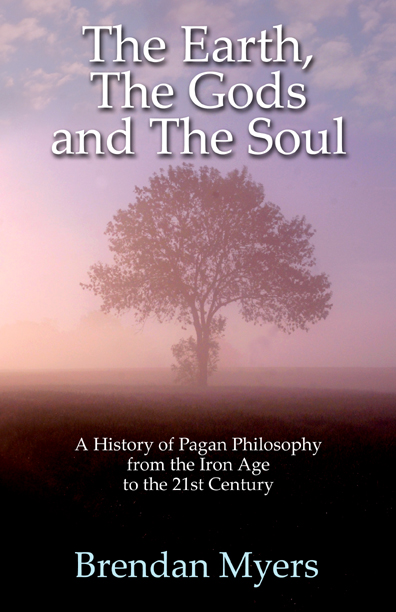
BOOK REVIEW: THE EARTH, THE GODS AND THE SOUL

jhp51efa580a1aafThe Earth, the Gods and the Soul: a History of Pagan Philosophy, from the Iron Age to the 21st Century by Brendan Myers fully justifies the ambition of its title. I see it as a must-read for anyone with an interest in pagan ideas and culture – past and present. Part of the author’s  mission is to demonstrate that “a pagan culture can be artistically vibrant, environmentally conscious, intellectually stimulating, and socially just”.

Myers provides useful working definitions of both ‘pagan’ and ‘philosophy’, whilst also showing the complexities involved in each term. He limits ‘pagan’ to people in the nations of the west and their predecessor societies in Europe and the Mediterranean, whose religion is non-Abrahamic (not Judaism, Christianity and Islam). This may now be complicated by patterns of migration and the Western impact of dharmic religions, but it works well enough if you are looking for a specific pagan tradition and its origins. Modern paganism, according to Myers, is informed by three families of ideas – pantheism, neo-Platonism, and humanism: these address the “immensities”, respectively, of Earth, Gods and Soul.

‘Philosophy’, for Myers, is an intellectual discipline that seeks answers to the ultimate questions about ‘life, the universe and everything’ using reason rather than the authority of dogma or an intuited divine source. He usefully lists 7 branches of this discipline: logic, ethics, epistemology, metaphysics, phenomenology, aesthetics and the history of ideas. Western philosophy’s origins are in Greece, and linked to the ‘know yourself’ injunction outside the temple of the Delphic Oracle. Myers sees this as a basic ethical demand for an honestly examined life, especially when wishing to enter the presence of a god. It leads to a wider view that self-knowledge heals, enlightens and empowers, though it may also at times judge and condemn.

The book is arranged as if musically, in an overture and six movements. The people chosen for inclusion are in many cases neither philosophers not pagans, and in many others only one of the two. But they have helped to define modern pagan ideas, culture and sensibility. Each movement covers a different historical period:

  1. A look at the old northern (‘barbarian’) world includes the Anglo-Saxon poem The Wanderer, Iceland’s Elder Edda, early writings about Druids, Irish wisdom texts and the Pelagian heresy (an early Christian heresy popular in the Celtic lands). There is no direct voice from a pagan culture in north west Europe, so Christians with half a foot in the old pagan world, or (in the case of the Druids) Greek and Roman authors are cited.
  2. A substantial collection of pagan Greek or Greek influenced philosophers from the early pre-Socratic period to the pagan martyr Hypatia of Alexandria. Also included are the Irish Christian neo-Platonist John Scotus Eriugena, and a section on the much later Italian renaissance. The people in this section, up to and including Hypatia, are both pagans (as we use that word today)and philosophers (in the ancient Greek understanding of that term).
  3. This movement is called ‘Pantheism in the Age of Reason’ and includes 18th century figures like John Toland, Edward Williams (aka Iolo Morganwg) and the Platonist and translator Thomas Taylor – as well as the more famous Jean-Jacques Rousseau. For the nineteenth century, we have Emerson, Thoreau, Whitman, Schopenhauer and Nietzsche.
  4. A movement on pagan ‘resurgence, reinvention and rebirth’ begins with Helena Blavatsky and the launch of 19th century Theosophy, going on to include J.G. Fraser of The Golden Bough, Robert Graves of The White Goddess, George William (A.E.) Russell of A Vision and Aleister Crowley. It goes on to look at the background to Gerard Gardner’s work and the Book of Shadows, then at the appearance of American Feminist Witchcraft and also at the separate stream of Eco-Spirituality and Deep Ecology.
  5. The fifth movement comprises ‘living voices’, so Stewart Farrar and Isaac Bonewits are placed at the end of the fourth, whereas Janet Farrar and Gavin Bone appear here. So too do Starhawk, Emma Restall-Orr, John Michael Greer, Vivianne Crowley, Michael York and Gus diZerega. There is also a section on ‘the critique of monotheism’. Myers praises Emma Restall-Orr for her work on ethics, its spirit of critical inquiry and her formal use of philosophical sources.
  6. Here we find Brendan Myers’ personal commentary. He talks about a hoped-for development of a critical tradition on paganism, and the value of ‘institutions’ in maintaining such a tradition. (He acknowledges that this may go somewhat against the grain of paganism as a dissident culture). He talks about modern to paganism’s history of ‘faulty ideas’, and promotes the development of better ideas for the future.  He also celebrates the health of a ‘will to live in an enchanted world’. Myers has ‘no special teachings’ of his own. A declared pagan philosopher, he builds his personal inquiry around four questions: how shall I dwell upon the earth? How shall I converse with all people? How shall I emerge from my loneliness? How shall I face my mortality? He then goes on to discuss what these questions bring up for him.

Myers ends his book by saying: “the best music is made with humanity, integrity and wonder – everyone has instruments to hand … When I hear music I share it … when I make music I share it too … I hope that my people will celebrate with me and play along … when I make dissonant or offending sounds, I trust my people will warm me, so I can make amends … nothing more, perhaps, could be asked of anyone. And, perhaps, nothing less”.

The Earth, the Gods and the Soul is a well-informed and simply written history of pagan ideas, which tells modern pagans a lot about the shoulders we sit on. It is a great reference book. But what it did mostly for me was to get me thinking about my own relationship to philosophy and its working methods. I call my own journey a contemplative inquiry. How could I use tools from philosophy’s  toolkit to improve my own inquiry in service of a pagan critical tradition? That’s where there’s an inspiration for me – because I sense an invitation there, from a professional philosopher, to make use of this toolkit. Myers’ forward includes a reference to Clear and Present Thinking, written by him with support from a number of University colleagues for a general audience, and freely downloadable. It’s another good job, and very useful to have.

Earth Eclectic

music that celebrates Earth and speaks to the heart

Sarah Fuhro Star-Flower Alchemy

Follow the Moon's Cycle

Muddy Feet

Meeting nature on nature's terms

Rosher.Net

A little bit of Mark Rosher in South Gloucestershire, England

Becoming Part of the Land

A monastic polytheist's and animist’s journal

selkiewife

Selkie Writing…

Charlotte Rodgers

Images and words set against a backdrop of outsider art.

Prof Jem Bendell

living with metacrisis and collapse

Towint

The pagan path. The Old Ways In New Times

The Druids Garden

Spiritual journeys in tending the living earth, permaculture, and nature-inspired arts

The Blog of Baphomet

a magickal dialogue between nature and culture

This Simple Life

The gentle art of living with less

Musings of a Scottish Hearth Druid and Heathen

Thoughts about living, loving and worshiping as an autistic Hearth Druid and Heathen. One woman's journey.

Wheel of the Year Blog

An place to read and share stories about the celtic seasonal festivals

Walking the Druid Path

Just another WordPress.com site

anima monday

Exploring our connection to the wider world

Grounded Space Focusing

Become more grounded and spacious with yourself and others, through your own body’s wisdom

The Earthbound Report

Good lives on our one planet

Hopeless Vendetta

News for the residents of Hopeless, Maine