On completing a breath exercise I sometimes say, ‘I am the movements of the breath and stillness in the breath; living presence in a field of living presence in a more than human world: here, now, home’. This is both my most parsimonious and most spacious sense of home in a world where nothing lasts forever or stays the same. I find my ultimate feeling of home in simple breath and awareness.
Yet my body and feelings, my heart and my imagination cannot thrive on breath and awareness alone. I need love, loyalty and connection inside the turbulence and uncertainty of the world. For me, the risk of getting hurt is an acceptable price to pay.
Thinking simply of ‘home’ spaces, I have lived at my current address for two and a half years. Not long, but enough to establish familiarity and loyalty. The picture above was taken very close to the building I live in. Our estate has planted lavender and let the grasses grow wild. I have come to love this. Our public library building, opened in 1896, is in a simplified and elegant form of 19th century Gothic in its last stage. I know it as a busy and widely loved place. I also know that it won’t be used for its present purpose much longer. Yet I continue to experience it as ‘home’.
Earlier in the year, I wrote about a small group of birch trees growing up beside our flat. Then, they had a bare look apart from a few catkins (1). Now, in the picture below, they are in full leaf. I love the way they are now and also the way they have changed. Without impermanence and mutability nothing can happen. These very characteristics enable ‘living presence in a field of living presence in a more than human world’. They too are a necessary part of ‘home’.
Sufism is often referred to as the Way of the Heart. Hazrat Inayat Khan was a Sufi teacher and musician from Gujarat, India, who took his teaching to the West in the early 20th century. His combination of spiritual teaching, philosophy and music was normal in this culture and tradition. In his own life and work, Hazrat Inayat Khan created a Universal Sufi movement independent of its Islamic origins, though always inspired by them. Practitioners from his movement created the Dances for Universal Peace.
The image above is the Ace of Cups from Ayeda Husain’s The Sufi Tarot (1). Ayeda Hussain is a teacher in the Ineyatiyya, a global organisation dedicated to Universal Sufism as taught by Hazrat Inayat Khan. She sees Sufism and Tarot as two systems of healing and transformation that can be valuably brought together. She treats Tarot as a vehicle for spiritual teaching, going so far as to include contemplations and affirmations for each card.
Referring to her Ace of Cups, she says: ‘In Sufi poetry, the cup is the heart that must be emptied before the beloved can pour the Divine nectar into it. Just as a cup that is filled cannot be poured into, neither can a heart filled with limiting impressions. The work of the mystic then, is to clear impressions that clutter and cloud the heart, so that it may be able to receive. As the heart opens, we become aware of new offers and opportunities in both love and spiritual growth’.
I came to The Sufi Tarot by an indirect route. When I began working with my Ceile De (2) beads, I didn’t at first expect to use them for mantra meditation and I looked at a collection of fuinn (sacred chants) as an option for working with the beads. Fuinn tend to be brief and I thought that a single fonn might work for me. They are in Scottish Gaelic and frequently use heart language, as in:
Gun tigeadh, solas nan solas
(Goon tee-guch, sol-us nan sol-us)
Air mo chridhe
(Air mo chree)
This translates into English as Come light of lights, to my heart.
I found this fonn beautiful though somehow not right for my purpose. But the phrase air mo chridhe would not leave me. As soon as I heard it, in the old language, it needed no translation, and I felt I had known it forever.
What I did in my own practice, having decided on the Soham mantra for the beads, was to create a version of the modern Druid peace prayer as a love prayer.
Deep within my innermost being, may I find love.
Silently in the stillness of this space, may I nurture love.
Heartfully, in the wider web of life, my I live in love.
Now using this prayer, I felt the desire for friendly guidance in this work of the heart. I felt prompted to search for ‘Sufi Tarot’, and was surprised when came up immediately. When I received the pack, I was quickly reassured that I had had been given what I asked for. I look forward to this new thread within my contemplative inquiry.
(1) Ayeda Husain The Sufi Tarot Carlsbad, CA; New York, NY; London; Sydney; New Delhi: Hay House, 2022. Art team Nazish Abbas, Hassaan Aftab, Momina Khan
In my Druid circle, I associate the northern quarter with faith. The quality and context of faith are not defined. They could simply mean faith in the practice and path. My contemplative inquiry overall has tended towards a stance of ‘sacred agnosticism’ (1), in which faith is not emphasised. This has served me in many ways. I have avoided mixing up the idea of ‘faith’ with affiliation to authoritarian movements, mandated beliefs, or the surrender of self-responsibility and personal discernment. I have been alert to the metaphysical group think and consensus collusion that can show up in any spiritual movement (other kinds of movement too). I have done my best to gather and evaluate information skilfully, when developing principles about how to live ethically and gracefully in an increasingly scary world.
And yet … this is not the whole story, or I would feel spiritually malnourished. In recent months I have experienced a strong felt sense of the divine. When I describe myself as ‘living presence in a field of living presence in a more than human world’ – an animist identification – the identification now seems more than animist, though the animism is still there. I pray more congruently to the Goddess as Ancient Mother and talk, less anthropomorphically, about the ‘bubbling source from which I spring’. The Divine is beyond name, form or description – and some people prefer a specialist, capitalised use of rather abstract terms like Consciousness, Awareness, Void, Ground of Being. But the ones from my own practice are the ones that work for me. They come from the intuitive heart and the imagination. To me they offer a deeper knowing, though I am personally cautious about the use of the word gnosis. For me, it can reduce the sense of mystery, banishing the creative role of faith itself.
I have become a provisional panentheist, experiencing intimations of a divine which is everywhere and no-where, and from which we are not separate. This partly reprises work I did in the earlier days of my inquiry using the framework of non-duality. Now I find panentheism a better term than non-duality for affirming both the divine and the world. The earth spirituality in the Druid tradition is in no way compromised by a panentheist perspective. If anything it is enhanced.
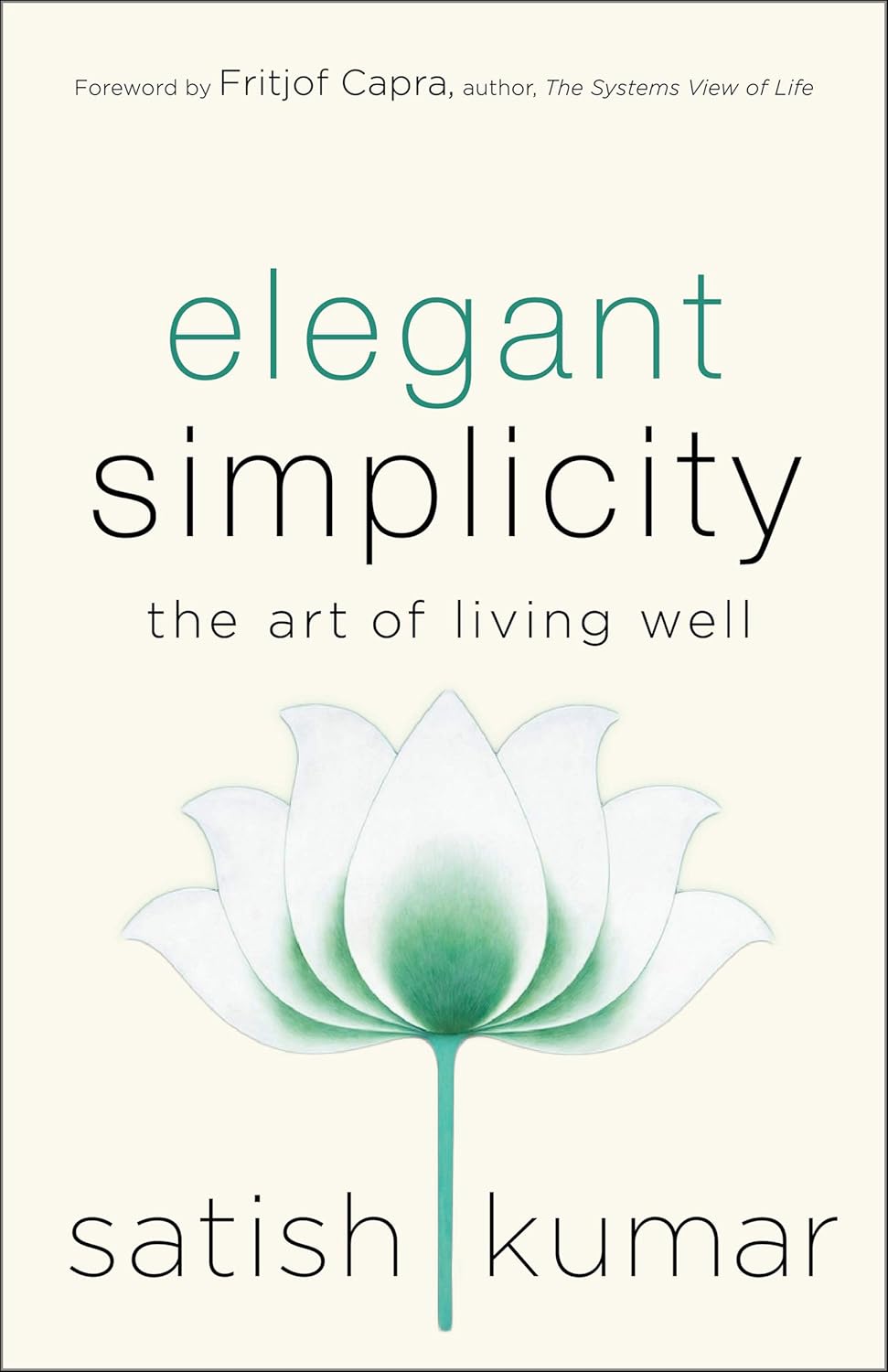
Highly recommended. Satish Kumar (born in 1936) published Elegant Simplicity: the Art of Living Well in 2019 (1). It begins with a foreword by Fritjof Capra and a preface by the author Let’s be Simple which quotes the 1848 Shaker song ‘Tis the gift to be simple, ‘Tis the gift to be free. The book summarises the author’s personal story as well as discussing his values. I have written posts based on some of his other work before (2). I especially recommend this book to anyone interested in knowing more about Satish Kumar’s practice (grounded in Jain spirituality and Gandhi’s non-violent activism) and his influence on deep ecology, creative arts and education.
Elegant Simplicity has a summarising quality, looking back on decades devoted to sacred activism in different forms. It is divided into fourteen chapters: Each is preceded by a brief and relevant quotation from another thinker. The chapter then becomes a meditation on the quote:
1 My Story: Beginnings – ‘True happiness lies in contentment’ Mahatma Gandhi.
2 Simplicity of Walking – ‘All truly great thoughts are conceived by walking’ Friedrich Nietzsche.
3 Life is a Pilgrimage – ‘Faith is not the clinging to a shrine but an endless pilgrimage of the heart’ Abraham Joshua Heschel.
4 Elegant Simplicity – ‘Any fool can make things complicated, it requires a genius to make them simple’ E. F. Schumacher.
5 A Society of Artists – ‘This world is but a canvas to our imagination’ Henry David Thoreau.
6 Yoga of Action – ‘Life is a process not a product’ Brian Goodwin.
7 Learning is Living – ‘Education is not preparation for life; education is life itself’ Thomas Dewey.
8 Right Relationships – ‘We are all related – relationships based on obligation lack dignity’ Wayne Dwyer.
9 Love Unlimited – ‘There is no charm equal to tenderness of the heart’ Jane Austin.
10 Power of Forgiveness – ‘It’s one of the greatest gifts you can give yourself, to forgive. Forgive everybody.’ Maya Angelou.
11 Dance of Opposites – ‘Life and death are one as the river and the sea are one’ Kahlil Gibran.
12 Deep Seeing – ‘To see clearly is poetry, prophecy, and religion, all in one’ John Ruskin.
13 Union of Science and Spirituality– ‘Science is not only compatible with spirituality; it is a profound source of spirituality’ Carl Sagan.
14 Soil, Soul and Society – ‘We live in an interconnected world and in an interconnected time so we need holistic solutions to our interconnected problems‘ Naomi Klein.
Fellow activist and author Vandana Shiva describes Elegant Simplicity as “the distillation” of Satish Kumar’s ideas and actions. “It shows the intimate connections between the inner and the outer world, soil, soul and society, beauty joy and non-violence. It indicates that the solutions to the big problems of our time – climate change, hate, violence, hopelessness and despair – lie in thinking and living with elegant simplicity, reducing our ecological footprint while enlarging our hearts and minds”.
For me, Satish Kumar is an inspiration rather than a direct model. Even in the conditions of the early 1960’s I would not have walked, or aspired to walk, from New Delhi to Washington DC without carrying any money. Yet Satish Kumar and his companion E. P. Menon succeeded and made a huge public impact at the time. Their peace pilgrimage gave oxygen to the campaign for nuclear disarmament. No state gave up its arms, but treaties limiting the numbers and testing of nuclear arms became normalised for some decades. Satish Kumar’s initiatives in deep ecology and education, especially the ‘small school’ and Schumacher College, have changed lives. Directly and indirectly, his influence has awakened many people from the dystopian trance of our dominant cultures. Satish Kumar is a widely revered elder: a peaceful warrior for a more liveable, generous and creative world.
(1) Satish Kumar Elegant Simplicity: The Art of Living Well New Society Publishers (https://www.newsociety.com): Gabriola Island, BC, Canada: 2019
NOTE: “Satish Kumar (born 9 August 1936)[1] is an Indian British activist and speaker. He has been a Jain monk, nuclear disarmament advocate and pacifist.[3]Now living in England, Kumar is founder and Director of Programmes of the Schumacher College international center for ecological studies, and is Editor Emeritus of Resurgence & Ecologist magazine. His most notable accomplishment is the completion, together with a companion, E. P. Menon, of a peace walk of over 8,000 miles in June 1962 for two and a half years, from New Delhi to Moscow, Paris, London, and Washington, D.C., the capitals of the world’s earliest nuclear-armed countries.[4][5] He insists that reverence for nature should be at the heart of every political and social debate.” (Wikipedia)
“There is a pervasive feeling of poignancy. It is like the cosmic hum, the radiation left over after the Big Bang. It is always present. It is the feeling of existence. We recognize ourselves as open awareness when we stand in the mystery of this feeling. This is our true nature, our open heart. We are searching for this total openness. We’re running from it too.
“….
“We try to run from the poignancy at the heart of existence into plans, projects, fantasies, worries, regrets and images of serenity and peace. Or we try to perfect it, ‘tweak’ it somehow. But it is already perfect, in that it transcends any concept we would have of it. If we must have a project, we can appreciate the mystery of existence without trying to resolve it into a specific feeling or understanding that we will then articulate, control or repeat.”
J. Jennifer Mathews (2010) Radically Condensed Instructions for Being Just As You Are.
For me, the skilful patterning of experience provides a gateway to re-enchantment. It reminds me that there are multiple ways of seeing the world, some obvious and others more occluded. The early morning can be a time of affirmation through ritual patterning that makes a mark on the day.
Mine begins with a morning circle which emphasises peace. Peace, here, is an active energy, not a passive absence of overt conflict, or a blind eye to dysfunction and injustice. Peace has to struggle, in this world, through skilful means that do not compromise its essence. Ritual can be one. I describe my morning circle below.
I go into my practice space, stand in the east facing west, ring my Tibetan hand bells and say the St. Patrick’s prayer (aka Cry of the Deer).
I arise today through the strength of heaven, light of sun, radiance of moon, splendour of fire, speed of lightning, swiftness of wind, depth of sea, stability of earth and firmness of rock.
Then I cast a Druid circle, calling on the four directions, each associated with a cosmic power, an element, a power animal, a quality, a time and a season.
East: May there be peace in the east, power of life, element of air, domain of the hawk, quality of vision, time of sunrise, season of spring and early growth.
South: May there be peace in the south, power of light, element of fire, domain of the dragon, quality of purpose, time of midday, season of summer and of ripening.
West:, May there be peace in the west, power of love, element of water, domain of the salmon, quality of wisdom, time of sunset, season of autumn and bearing fruit.
North: May there be peace in the north, power of liberation, element of earth, domain of the bear, quality of faith, time of midnight, season of winter, of dying and regeneration.
I also call the Below, the Above and the Centre, to make seven directions in all. Moving to the vertical dimension indicates a deepening, enacted by my spinning in place before bringing it in, and by the use of mythic names for the Below and Above.
Below: May there be peace below, in Annwn , realm of the the deep earth and underworld.
Above: May there be peace above, in Gwynvid, realm of the starry heavens.
This is followed by a further deepening into the centre, enacted through another spinning in place. Here, I am no longer calling for peace, but standing in its source.
I stand in the peace of the centre, the bubbling source from which I spring, and heart of living presence. Awen (chanted as aah-ooo-wen)
After a pause, I walk the circle, sunwise, east to east, and say I cast this circle in the sacred grove of Druids. May there be peace throughout the world. At this point I have established my sacred grove, my nemeton. All that follows is within this dedicated space until I uncast the circle on completion of my practice.
This ritual patterning, made substantial both physically and verbally, includes a celebration of sacred nature, provides a structure and a set of meanings to hold and guide me, and emphasises the commitment to peace.. Although I have personally customised this framework, most of it – anything to do with personality and external world – anchors me in modern Druid culture.
The centre is different. The centre is universal. It is the point where Oneness is recognised. “The bubbling source from which I spring” has a naturalistic feel whilst also referencing Jean-Yves Leloup’s translation of the Thomas Gospel, logion 13, where Yeshua says to Thomas: “I am no longer your master, because you have drunk , and become drunken, from the same bubbling source from which I spring” (1). ‘Heart’, as used here, is neither the physical heart nor the heart chakra, but “the Great Heart that contains All-that-is … the consciousness that underlies all forms” (2). ‘Living presence’ too points to the state of underlying conscious awareness that is here being recognised (3,4). For ritual language that honours that recognition, I draw on the mystical inheritance of the world and place myself in a wider circle of care.
At one time I tended to experience casting circles as a preliminary to practice, whilst also ‘knowing’ in a roof-brain kind of way that this was a mistake. Now I find it a powerful means of bringing me into the new day. Above all, it affirms my core understanding of world and life with every sunrise.
(1) The Gospel of Thomas: the Gnostic Wisdom of Jesus (Translation from the Coptic, introduction and commentary by Jean-Yves LeLoup. English translation by Joseph Rowe. Foreword by Jacob Needleman) Rochester, VT: Inner Traditions, 2005
(2) Sally Kempton Meditation for the Love of It: Enjoying Your Own Deepest Experience Boulder, CO: Sounds True, 2011
(3) Kabir Edmund Kabinski Living Presence: A Sufi Way to Mindfulness & the Essential Self New York, NY: Penguin Putnam, 1992
(4) Eckhart Tolle Oneness with All Life: Awaken to a Life of Purpose and Presence Penguin Random House UK, 2018 (First ed. published 2008)
“When a pendulum swings, there is a fraction of a moment at the end of each swing when the movement stops, before the pendulum starts to swing back. That moment of pause is the madhya, the central still point out of which the pendulum’s movement arises. All movement – whether the swing of an axe, the movement of the breath, or the flow of thought – arises out of such a point of stillness.
“That still point is an open door to the heart of the universe, a place where we can step into the big Consciousness beyond our small consciousness. As the medieval English saint Julian of Norwich wrote, ‘God is at the midpoint between all things’.
“… Such points exist at many different moments. One of these is the pause between sleeping and waking, the moment where we first wake up before we become fully conscious. Another is the moment before a sneeze or at the high point of a yawn. Another is the space between thoughts.” (1)
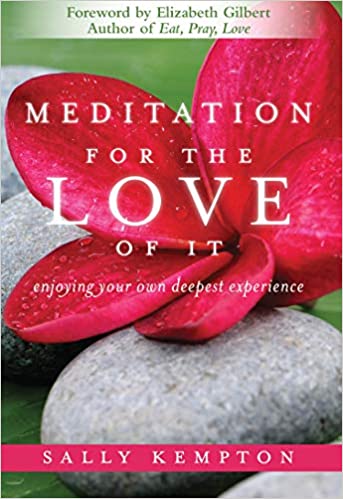
For Sally Kempton, this is the inner realm that mystics and sages have called the Heart – not the physical heart, or even the heart chakra, but “the Great Heart that contains All-that-is … the consciousness that underlies all forms”. Her recommendation to meditators is to follow the breath, and to enter the madhya in the spaces between the inhalation and the exhalation, and between the exhalation and the inhalation. Focusing on the sound of the breath with a subtle and relaxed attention, we find the gaps and over time, without forcing the process, we find them expanding.
Sally Kempton’s Meditation for the Love of It has companioned me for the better part of a decade, and I am grateful for her influence on me as a contemplative practitioner. I do not follow her path of Kashmir Shaivism and the Tantric philosophy that underpins it. But I have always liked her framing of ‘meditation for the love of it’, which I see as a Druid and Pagan friendly approach. I also like the quality of her writing, and many of her practical recommendations.
In the present instance, I have found that the space between breaths is indeed a portal – placing me, in my own language, as ‘living presence in a field of living presence’. My experience is that the discovery of the space between breaths can lead on to a discovery of stillness even within the breath as it rises and falls. Stillness in the breath, co-existent with the movement of the breath, is potentially available at all times. It is largely through Sally Kempton’s work that I learned this lesson, and I am grateful to her for the experience and insight that I have gained.
(1) Sally Kempton Meditation for the Love of It: Enjoying Your Own Deepest Experience Boulder, CO: Sounds True, 2011
“Friend, please, Do not try to decide now. Do not shut any possibility out of your heart. Honour this place of not-knowing. Bow before this bubbling mess of creativity.
“Slow down. Breathe. Sink into wonderment. Befriend the very place where you stand. Any decision will make itself, in time. Any choice will happen when your defences are down. Answers will appear only when they are ready. When the questions have been fully honoured, and loved.
“Do not label this place ‘indecision’. It is more alive than that. It is a place where possibilities grow. It is a place where uncertainty is sacred.
“There is courage in staying close. There is strength in not knowing.
“Friend, please know, There is simply no choice now.
“Except to breathe, and breathe again, And trust this Intelligence beyond mind.”
The Empress Wu Zetian ruled the Chinese empire alone from 690-705, the only woman ever to do so. It was the time of the Tang dynasty, when China was open to central Asian and Indian cultural influence. Wu herself had a strong Buddhist commitment.
She was curious about the world view of an esoteric Buddhist school, the Hwa Yen. In this view, all the universes were seen as a single living organism, characterised by mutually interdependent and interpenetrating processes of becoming and unbecoming. The Empress asked for a simple and practical demonstration of this complex vision.
The Hwa Yen sage Fa-tsang was given a palace room in which he placed eight large mirrors, each at one of the eight points of the compass. He placed a ninth mirror on the ceiling and a tenth on the floor. Then he suspended a candle from the ceiling in the centre of the room. The Empress was delighted at the effects thus created. ‘How beautiful! How marvellous!’ she cried. Fa-tsang explained how the reflection of the flame in each of the ten mirrors demonstrated the relationship of the One and the many, and also how each mirror also reflected the reflections of the flame in all the other mirrors, until myriad flames filled them all. The reflections were mutually identical. In one sense they were interchangeable; in another sense they existed individually. Then Fa-tsang covered one of the reflections to show the significant consequences this had for the whole. He described the relationship between the reflections as ‘One in All; All in One; One in One; All in All ‘.
Hwa Yen Buddhists also spoke of ‘The Great Compassionate Heart’. They understood it as a quality of awareness that sees all phenomena including ourselves as arising out of Emptiness, remaining part of the Emptiness whilst assuming a temporal form, and finally falling back into Emptiness and being reabsorbed. “It is a quality of awareness that quite naturally expresses itself in acts of deepest, yet quite unsentimental reverence and compassion for all that is, the just and the unjust, humans, animals, plants and stones”.*
Fa-tsang was careful to provide a ‘the-map-is-not-the-territory’ caveat. “Of course, I must point out, Your Majesty, that this is only a rough approximation and static parable of the real state of affairs in the universe – for the universe is limitless and in it an all is in perpetual, multidimensional motion”. Yet he had still taken care to provide his Empress with a beautiful, memorable and instructive map. Such maps, and the sense of ‘Great Compassionate Heart’ which they foster are of great value. They can nourish the seeker and illuminate the way, for rulers and non-rulers alike.
*Richard Miller Yoga Nidra: a Meditative Practice for Deep Relaxation and Healing Boulder, CO: Sounds True, 2005 (A more extended version of the story is included in this book.)
Recently I have noticed a change in my notion of inquiry. I experience, at the same time, both a greater precision and a softening in my understanding of ‘inquiry’. Rupert Spira (1) makes a helpful point.
“This path is sometimes referred
to as self-inquiry or self-investigation. However, these terms – translations
of the Sanskrit term atma vichara – are potentially misleading. They
imply an activity of the mind rather than, as Ramana Maharshi described it, a
sinking or relaxing of the mind into ‘the heart’, that is, into its source of
pure Awareness and Consciousness. The term may, therefore, be more accurately
be described as ‘self-abiding’ or ‘self-resting’, and is the essence of what is
known in various spiritual and religious traditions as prayer, mediation,
self-remembering, Hesychasm in the Greek Orthodox Church, or the practice of
the presence of God in the mystical Christian tradition.”
At the time of writing, I have
three means of heart inquiry by this definition. The first is quintessentially
Sophian – a repetition, synchronised with the breath, of the name Ama-Aima (pronounced
ahh-mah-ahee-mah). In its tradition of origin (2). this Aramaic name for the
Divine Mother brings together Her transcendental and immanent aspects, and the
repetition of the name invokes Her light energy and presence, which is the
light energy and presence of the cosmos. As I breathe the name, entering into
its pulse and vibration, I begin to find that this presence-energy is breathing
me, until the distinctions themselves disappear. I treat this work formally, as
a sacrament or mystery, and part of a daily practice.
The second is Seeing, and the
practices of the Headless Way, described as ‘experiments’ in that family. – see
www.headless.org/. I use a variety of
these practices depending on the circumstances. The advantage of Seeing is that
I can drop into it at any time during the day.
The third is the rawer approach
laid out by Jeff Foster (https://lifewithoutacentre.com/
), which turns the ‘Light of Oneness’, back onto the experience of the
struggling human. It flows from his own journey of “venturing into the darkness
of myself” (3), before “breaking through the veil of dualistic mind to a Light that had been there all along”. Here,
we enter into a loving encounter with whatever experience is happening and finding
a way to accept – not the content of the
experience itself, which may be horrible and need resisting – but the reality
that this is the experience that is happening, the one demanding
attention. Loving attention to our struggles may not stop suffering but can
make them more workable. As with Seeing, I can drop into this meditation at any
time – by slowing down, breathing and just being there, with loving curiosity
and attention. It works with mixed and good experiences too.
I find that a combination of these practices serves me well. Reading, writing and digital media of relevance to the practices support my sense od direction and my understanding.
(1) Rupert Spira Transparent Body, Luminous World: The Tantric Yoga of Sensation and Perception Oxford: Sahaja Publications, 2016
(2) Tau Malachi Gnosis of the Cosmic Christ: a Gnostic Christian Kabbalah Saint Paul, MN: Llewellyn Publications, 2005
(3) Jeff Foster The Joy of True Meditation: Words of Encouragement for Tired Minds and Wild Hearts Salisbury, UK: New Sarum Press, 2019




 Contemplative Inquiry