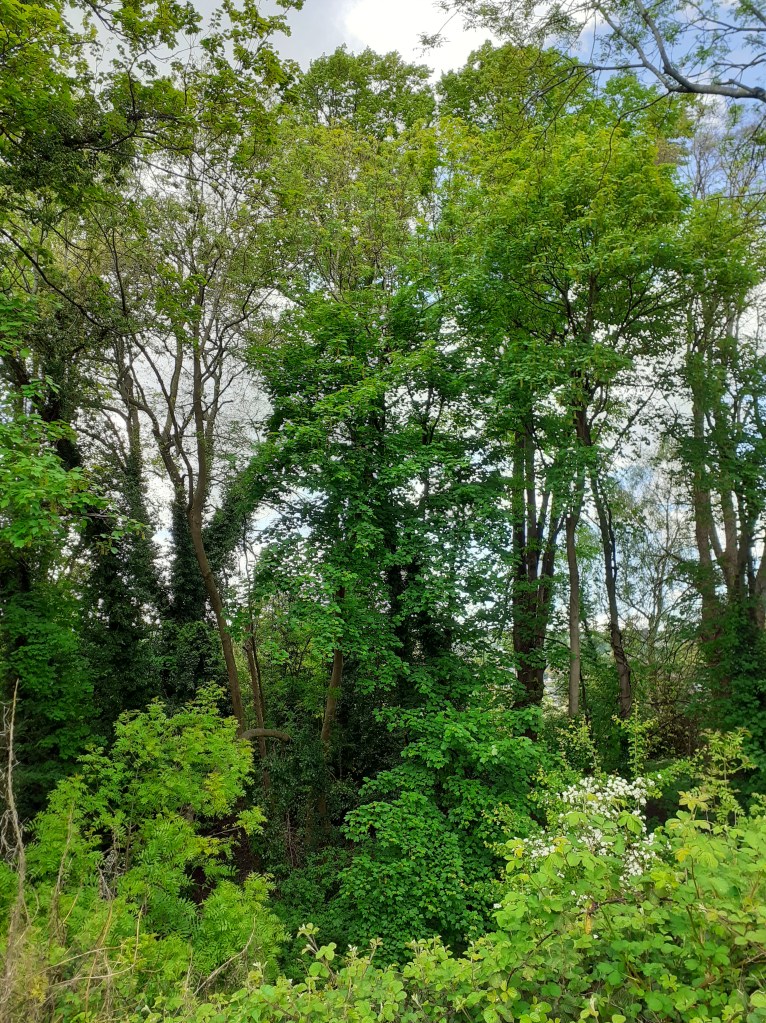
When I say ‘oneness’, I mean interbeing rather than singularity. I am talking about the web of life, the great song, a field of living presence. Singularity allows only an I. Interbeing has room for I and You and We and They. This recent picture of a half-hidden corner in our garden, taken by my wife Elaine, makes the point. The fact that she took it also reminds me that the mature recognition of ‘you’ is the foundation of true relationship.
This oneness of interbeing does not need a myth of origin to sustain it. Interbeing just is. I’m an intuitive idealist, fascinated by metaphysical questions, including questions of origin, and the systems of myth and metaphor which address them. But I am not spiritually dependent on answers. That is the advantage of Druidry as a practice rooted in nature. Today is a day for celebrating the natural side of my path.
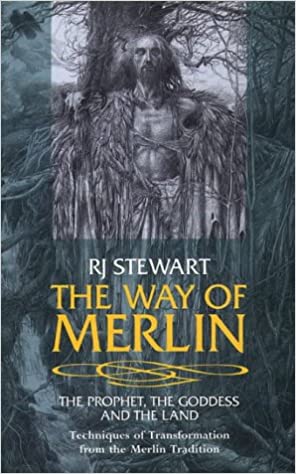
The Way of Merlin came into my hands at the right time. It seeded a number of key understandings, which nudged me onto a Druid path in October 1993. The first is that “sacred space is enlivened by consciousness. Let us be in doubt that all space is sacred, all being. Yet if human beings dedicate and define a zone, a location, something remarkable happens within that defined sphere of consciousness and energy. The space talks back”. Author R. J. Stewart backed this up with the further declaration that “The mystery of Merlin is a backyard mystery, for it declares the smallest, most local space to be sacred, to be alive, to be aware.” I was living in South London at the time and remember being challenged in this book to befriend a spring and a tree. At first, I thought, ‘what?’. Then I found them both, on the day I started looking, in a local park.
Such activities went with the view, “yourself and the land are one”, and that this apparently humble work has a larger context of “holism … identical to the deepest perennial magical and spiritual arts”. Magic is seen as a process of having intent and applying energy and imagery in service to it. Working within mythic frameworks asks for an enabling suspension of disbelief rather than a dogmatic literalism.
I did not work with the suggested programme of visualisations and rituals concerning Merlin, the weaver goddess Ariadne, and other scenes drawn largely from Geoffrey of Monmouth’s Life of Merlin. As practices they seemed too long and formal. But reading Stewart’s text was psychoactive in itself. The weaver goddess Ariadne is a key figure, and the vision of Ariadne reveals a cosmic mother at the threshold of Being and Unbeing. She draws us into the empty silence of the Void, out of which emerges the sound of breath – our own breath and at the same time the breath of all Being. Being breathes through us, “and we realise that we have a body that is the body of all Being. The stars are within us. We are formed of the weaving”.
The specific image of Ariadne never took root in my imagination. But I acknowledged the power of this Pagan Gnostic creation myth. Its sense of our reality emerging from empty potential at the behest of a cosmic mother has stayed with me. My work with Sophia earlier in this inquiry pointed in the same direction. So does my recent post about Dancing Seahorses and Modron (2). I am happiest with the Modron image, because it is less defined and anthropomorphised than those of Ariadne and Sophia. At at the threshold of being and unbeing, she shows us that we are not separate from the divine breath that forms us, or from the creation that is formed. The stars are indeed within us, whether we know it or not.
The Way of Merlin has something like an ancestral role in my spiritual life. R. J. Stewart and I were born in the same year, but he was doing this pioneering work in the 1980’s when I was busy with other things. He influenced me in the period immediately before I embarked on a Druid path, and I have revisited his work over the years. It still has riches to offer.
(1) R. J. Stewart The Way of Merlin: the Prophet, the Goddess and the Land London: The Aquarian Press, 1991
My wife Elaine created this midsummer cauldron fire, now ten days ago. It was fuelled in part by dry dead leaves. She chose the evening of the day itself rather than the traditional eve. The point about midsummer (24 June) is that the sun is on the move again after its moment of stasis, clearly beginning its decline. It acts as the polar opposite of the Sol Invictus or Christmas festival in late December. The Church gives 24 June to John the Baptist, decapitated at the wish of his nemesis Salome.
In our neighbourhood, there is a paradox about July. It is the quintessential summer month, in which the light begins to diminish. At the moment, sunrise is at about 4.50 am., with sunset at 9.20 pm. By Lughnasadh, it will be rising at 5.25 am and setting before 8.50 pm. In August, the process will accelerate while the earth and sea remain warm by North Atlantic standards. Getting up an hour or so after sunrise I am tending to find a dull and cloudy sky. There can be a stillness in the air, disturbed perhaps by blackbird pair flying low amongst the trees. I have a sense of latency.
The inquiry phase beginning at the 2019 winter solstice has settled a number of issues. I am re-confirmed in a modern Druid practice that is held within a circle and seven directions (E, S, W, N, below, above, centre), and is mindful of the wheel of the year. I also settled my approach to ethics at the beginning of this inquiry year (1) drawing on the work of modern Pagan philosopher Brendan Myers with his re-visioning of ancient Greek ‘virtue’ ethics (2). I have deepened in my experience of an at-homeness in the flowing moment, and its therapeutic benefits, which I wrote about last year (3). Fully established in my life, these are no longer fundamental inquiry issues. The uncertainties I formerly had with them are like dead leaves, now safe to burn.
For all that I have gained from other paths – Tantra, Tao, Zen, other forms of Buddhism, and Christian Gnosticism – I know that I will not be practising or following them. I will continue to appreciate their literatures and cite them in this blog, but this will be from the perspective of the appreciative outsider. Here too the active inquiry is over. Uncertainties have shrunken into dead leaves, and are safe to burn.
I know that, in the turbulent, airy mental realm, I have contending gnostic and agnostic energies. They are co-arising twins, and neither is going away. I still have work to do to find a settled home for them both. I am also concerned about how, more elegantly, to fit an ‘emptiness’ understanding into an earth pathway. A feeling about myth, and the truth and beauty of myth, is tied up with this. In the coming phase, I will look again at R. J. Stewart’s Merlin work for help with these questions. This reprise is also part of my older person’s looking back, recalling what I have valued, and asking what role it can still play. It sets my direction for the second half of the year.
This painting, Dancing Seahorses, is by Edinburgh-based artist Marianne Lines. I bought it in 1992 to support a growing interest in Celtic spirituality. The image is taken from a Pictish standing stone in Aberlemno in the county of Angus (1). To this day, the beings portrayed are well-known to Scottish folklore as sea horses, water horses, kelpies or each-uisge. They are also found in Ireland, the Isle of Man, Wales, Brittany and Cornwall. Manifesting in slightly different forms, they can appear in the sea, lakes, rivers and waterfalls.
For me, the painting evokes the primal energies of water, as embodied in these otherworldly seeming beings, who nonetheless might show up from time to time. The pair in the picture are entwined in ways that suggest many possible forms of connection – dancing, embracing, lovemaking, playing, fighting, competing, joining together in tranquillity, or a combination of the above.
I had owned the painting for some while before I began to see a second image, in a sense behind and containing the immediately apparent one. The space where the horses legs are raised defines a shape, suggesting a head. The very emptiness there is a paradoxical mark of presence. To me it became the head of a goddess, with the seahorses then becoming her body. Still clearly appearing as a water being, her arms – if they are arms – are raised in blessing.
The sea-horse image is clear and naturalistic, though stylised and showing creatures we strongly imagine but rarely meet. By contrast, the goddess image needs more work. I see her as Modron, the primal mother, in a marine guise. She seems to come out of a remote past with little story beyond her parenting of Mabon. I am glad not to have inherited too much lore about her. A sense of unfilled space and of mystery is part of what makes her numinous.
I did not make these connections as part of a plan. They grew up over time, feeling increasingly right. They are my own myth-making. I realise that, for me, meeting with an image is simpler and more direct than meeting with a fully developed narrative. There is an immediate impact, followed by a growing familiarity and a fuller relationship. From this, a story may grow, even one about a relative absence of story that points towards silence. Such images can have a lasting power, as this one has certainly had for me.
(1) There are four such stones from different periods. This is from the one listed as ‘Aberlemno 2’, where this image is on the lower right hand side of the front face. The stone is now thought of as being from the mid-ninth century C. E. – rather later than previously believed. The custodians of the stones place it in a genre of ‘zoomorphic designs’ also found in other Celtic Christian art of the time that draws on indigenous themes – for example in the Book of Kells, and in Celtic influenced Northumbrian work. This is in contrast to many Pictish standing stone images, which seem unique to that culture.
On a recent evening I watched lightning, heard thunder, and waited for the rain. It came quickly, fast and hard. It changed my sense of the year. It was as if, at least for some part of me, the blessings of the solstice moment were threatened with cancellation. I remembered autumn and winter last year, and what seemed like relentless wetness. Was our sun kissed respite, itself made strange by Covid-19 and the lockdown, to be so brief?
The wheel of the year, moving through familiar seasons, was once a comfort. Bad things could and did happen. There were big variations from year to year. Yet on a human timescale there seemed to be a pattern. The ritual year told us that nature was reliable within certain limits. The gathering pace of climate change has undermined this perception. In different ways, throughout the globe, the old patterns are being disrupted without settling into new ones – greater changes are to be expected.
The sun will rise at the solstice as it always does. Here in England, I would never have expected to predict the weather of the day. But this year I do feel a raw anxiety about the future. Happily, my at-homeness in the flowing moment is strong enough to hold this anxiety. I accept and welcome it as the experience I am given, mine to live even within the act of resistance itself. Self-compassion and thence a wider compassion arise from this. Yet, as I link my contemplative inquiry to the theme of ageing, I wonder about harvesting and legacy in my own life. Do such notions even make sense?
For the last six months I have rebuilt a specifically Druid practice, restoring the pattern of the circle and four directions, restoring height and depth dimensions, affirming a strong centre. I am working with levels of experience I describe as physical, psychic and causal. I want my spiritual life, which is all my life, to be a coherent witness to my experience and values. In spite of threatening clouds, I remain fired up for this, by an ever rejuvenating sun within, as I approach the decline of the year.
Image from R. J. Stewart’s The Merlin Tarot, illustration by Miranda Grey Aquarian Press, 1992
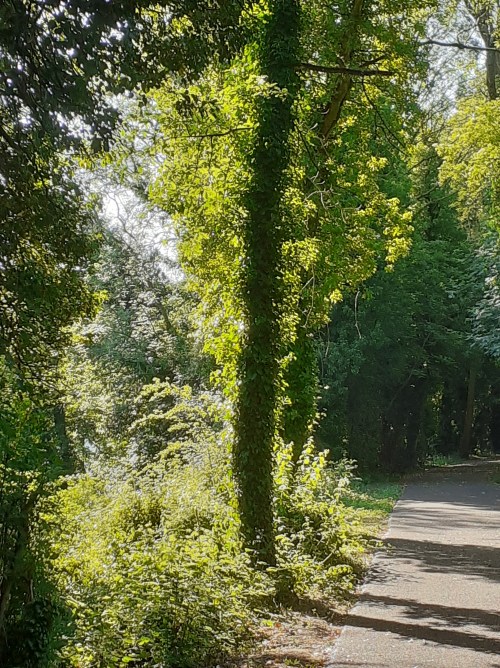
The picture shows the power of sunlight on trees to an observer – me, using my sight and my phone camera. I am not sure what it is like for the trees themselves, but I imagine it to be a positive experience.
This post is about the effects of the same power in my own psychic life. In a personal meditation, “I find myself in a walled garden. It has a fountain at the centre, surrounded by four flower beds of alternating red and white roses. There are fruit trees, apple, pear and plum, trained around the walls. It is a warm and radiant midsummer morning. The full bright sunlight strikes the dazzling water of the fountain, warming and illuminating each drop as it falls. I can hear the plashing of the fountain, and birdsong a little further off. My bare feet are on the lush grass. The air is sweet. The sun is at my back, recharging my energy, in particular activating the sun in my heart”. From that point, the meditation can continue and deepen in a number of ways.
This garden is the Garden of Wisdom, the Wisdom of William Anderson’s Green Man poem (1), a poem of 13 four-line verses, where each line covers a week. Though the Green Man has a lover in the spring, Wisdom is named, as Wisdom, in only one verse.
26 Oct-1 Nov: The reedbeds are flanking in silence the islands
2 Nov–8 Nov: Where meditates Wisdom as she waits and waits.
9 Nov-15 Nov: ‘I have kept her secret’, say the Green Man.
16 Nov -22 Nov: ‘I have kept her secret’, says he.
But at the present time of year, the focus is on the transformation of the Green Man himself, his head having been offed between 25 May and 7 June.
8 June – 14 June: Green Man becomes grown man in flames of the oak
15 June-21 June: As its crown forms his mask and its leafage his features
22 June -28 June: ‘I speak through the oak’, says the Green Man,
29 June – 5 July: ‘I speak through the oak’, says he.
Late in 2019, I stopped calling my inquiry path a ‘Sophian Way’ and re-centred it in Druidry. It was the right decision, and I have found it very fruitful. But at the psychic, Innerworld level, I have experienced a sense of loss concerning aspects of the Sophian Way, especially the space I called Sophia’s Garden. Now, thankfully, I have found that a simple re-naming as Wisdom’s Garden has been enough to re-integrate it within my current Druid practice. A more specific link with William Anderson’s Pagan, earth-centred poem also helps. Wisdom speaks through the wheel of the year, and acts as a companion and guide within my Druid path, on both the physical and psychic levels. She is also Zoe, the life beyond time, and the Green Man Bios, the life which is born, dies and is born again. It seems to me that we are both of them. Perhaps that is Wisdom’s secret.
(1) William Anderson Green Man: Archetype of Our Oneness with the Earth: London and San Francisco: HarperCollins, 1990 (Photography by Clive Hicks)
Highly recommended. Druid author Joanna van der Hoeven writes for the ‘solitary seeker’ who wishes “to explore the magic and mystery” of the earth based spiritualities indigenous to Britain and Ireland. Another reviewer finds, in this book, “a spiritual path that values direct participation with, and first-hand knowledge of, the worlds within us, around us and beyond us”. After reading the book myself, I cannot improve on this as a summary statement.
The book is divided into four sections. The first and longest, ‘Theory’, offers background, context and framing for key concepts, values, and practices. Topics covered include Druids ancient and modern, Awen, Gods, and Ancestors; the three realms of land sea and sky; World Tree, Hedge and Otherworld; the wheel of the year and the four quarters; cycles of the Moon; meditation, prayer, and magic; Animism and connection.
The second section, ‘Practice’, offers a comprehensive range of practices to bring the exploration alive. These include suggestions for daily as well as occasional practice and for working both outside and indoors. The remaining two sections are briefer. ‘Study’ launches the seeker into the area of herblore, ogham and spellcraft. ‘Skills and Techniques’ covers the issues of ethics and peace and the roles of teacher, leader and priest – also looking at the importance of voice, body and movement, not least for practitioners who take on these roles.
Joanna van der Hoeven is an established Druid author, now also a teacher at Druid College UK*. The College works face-to-face with participants over an extended period and is designed for people who seek to be ‘carriers’ of the Druid tradition rather than simply followers This fruitful perspective is also discussed in The Book of Hedge Druidry. Experienced practitioners as well as beginners have something to gain from this book.
Joanna van der Hoeven The Book of Hedge Druidry: A Complete Guide for the Solitary Seeker Woodbury, MN: Llewellyn Publications, 2019
This post presents a poem and extract from The Little Book of the Green Man by Mike Harding, which includes photographs by the author. Most of the images are from English medieval churches, though two are from Paris and some are from different regions of India, from Nepal and from Borneo.
The book was published in 1998 and is still in print. I recommend it to anyone interested in Green Man imagery.
I am the face in the leaves,
I am the laughter in the forest,
I am the king in the wood.
And I am the blade of grass
That thrusts through the stone-cold clay
At the death of winter.
I am before and I am after,
I am always until the end
I am the face in the forest,
I am the laughter in the leaves.
The following extract describes green men in the ends of pews at Bishop’s Lydeard, Somerset, my native county. They were carved in the fifteenth century:
“Unlike many Green Men that are hidden on high in roof bosses or on capitals, the bench ends are close to ground level and would have been immediately on view to everybody entering the church.
“Only in Somerset is this tradition of carved pew-ends so widespread and it would appear that the same carvers worked on a number of churches in the area.
“While I was photographing these images a lady who was in the church arranging flowers came up to me quietly and, making sure that nobody else heard, whispered: ‘It’s nice to see that he’s being accepted again, isn’t it?’”
Mike Harding The Little Book of the Green Man London: Aurum Press, 1998.
On 1 May I strode out with a spring in step, for my statutory walk. I was stir crazy and determined to meet the day. I made sure to take my camera with me. I wanted both to savour and record the fresh abundance of the green. Although I was in a familiar landscape, both the look and the feel of it had changed. I was in places I hadn’t been in for a week or more, and the world seemed dynamically verdant with a new intensity. I had a transformative hour of it before returning home.
In his Green Man (1), William Anderson reminds us that the Green Man utters life through his mouth. “His words are leaves, the living force of experience … to redeem our thought and our language”. Anderson’s Green Man speaks for the healthy renewing of of our life in and as nature.
He also suggests that the emerging science of ecology – the study of the house-craft of nature – is one such form of utterance. It gives us a language of inquiry into the interdependence of living things. My sense is that 1960’s images of Earth from space have also provided support to concepts like that of a planetary biosphere, and for the revival of Gaia as an honoured name. As a species, quality knowledge, rooted in quality imagination, is our greatest resource. Anderson’s book was published in 1990, based on ideas that had already been maturing over many years. I am sad that we are where we are in 2020. But the message of hope still stands, and the energy of a green May bears witness to it.
(1) William Anderson Green Man: the Archetype of Our Oneness with the Earth London & San Francisco: HarperCollins, 1990 (Photography by Clive Hicks)
Greetings and Blessings for the fast approaching festival of Beltane/Samhain. May we all find ways to stay safe and to flourish! This post focuses on my sense of the Wheel at Beltane – aware also that each season contains the seed of its opposite.
For The Wildwood Tarot, Beltane is the moment when “the polarised energies of the land interweave and intertwine around the staff of the heavens, generating the pulse of life”. It is also concerned with balance, and linked to the traditional trump for temperance. There’s a call to discover what balance, balancing and re-balancing might look like in 2020. Where might different balancing acts take us? How does ‘balance’ apply collectively, with a continuing public health crisis?
In the card, the primal energies of the serpents, echoing both the caduceus symbol and the double helix, are vividly in the foreground. By contrast the mask-like human head towards the bottom of the picture is almost hidden. For me, it is sombre, an image inviting uncertainty and unknowing rather than ‘balance’ or any steady state. Beltane 2020 finds a world in flux. Anything is possible. At the personal level, balance might morph into a kind of poise, without attachment to specific outcomes, yet with a preparedness to navigate uncharted waters.