Contemplative Inquiry

This blog is about contemplative inquiry

Tag: Earth spirituality

EXPERIENCING EARLY SEPTEMBER

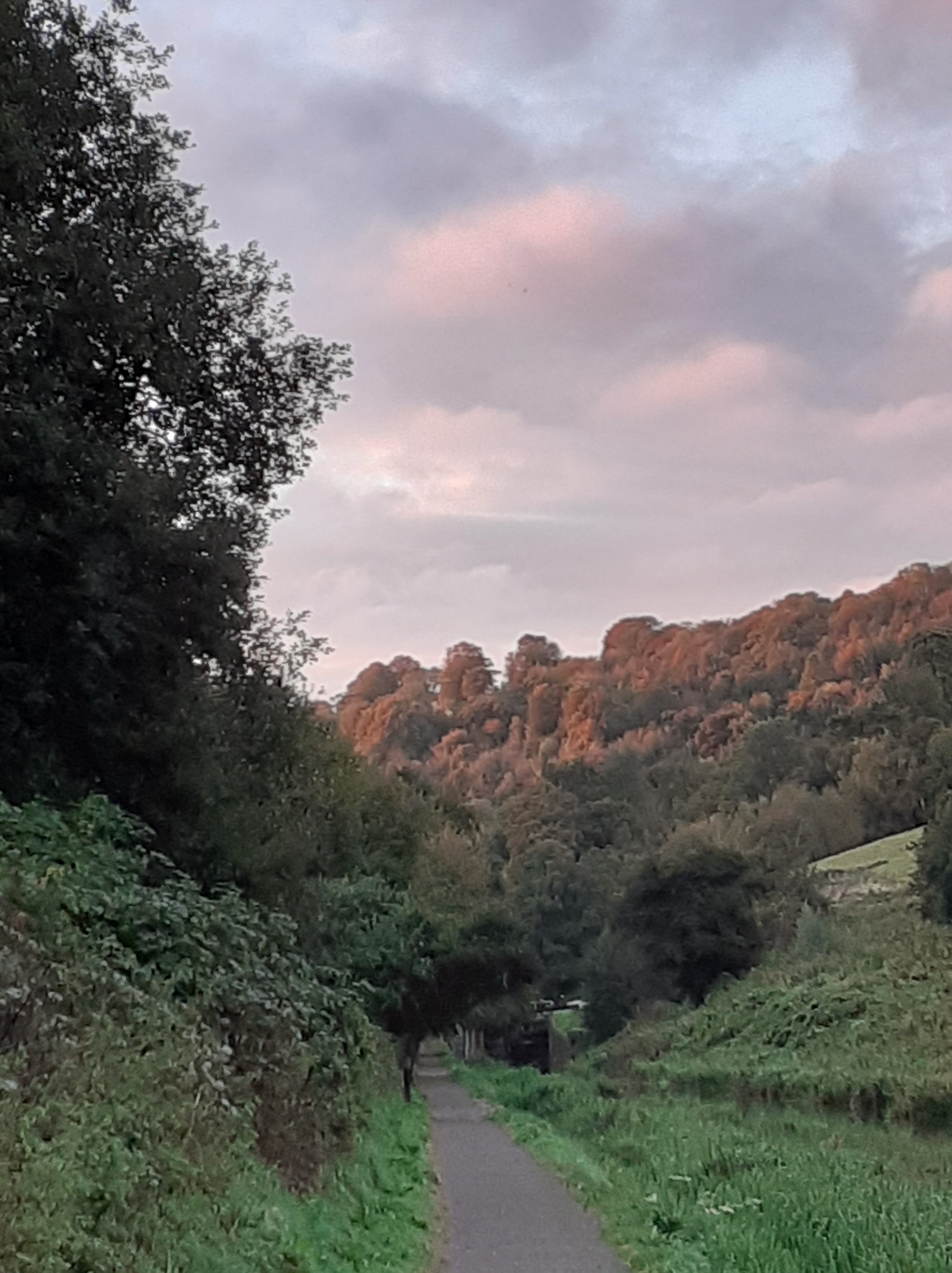
Months, and moments within them, have their own atmosphere and meaning for me. I try to indicate these through pictures. Where I live, early September takes us fully into autumn, and the fruiting of the horse chestnut tree (above) is a marker for the transition.

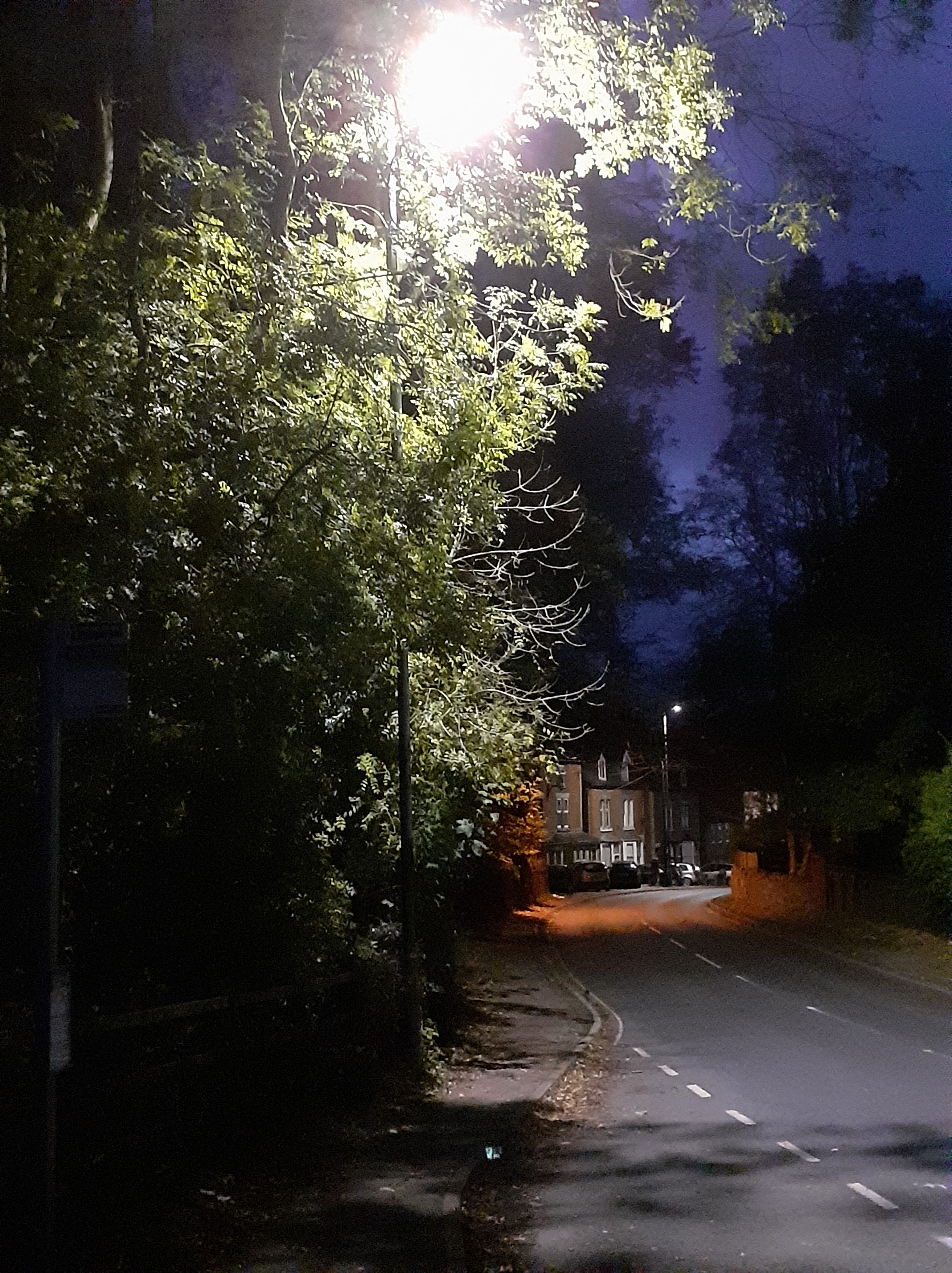
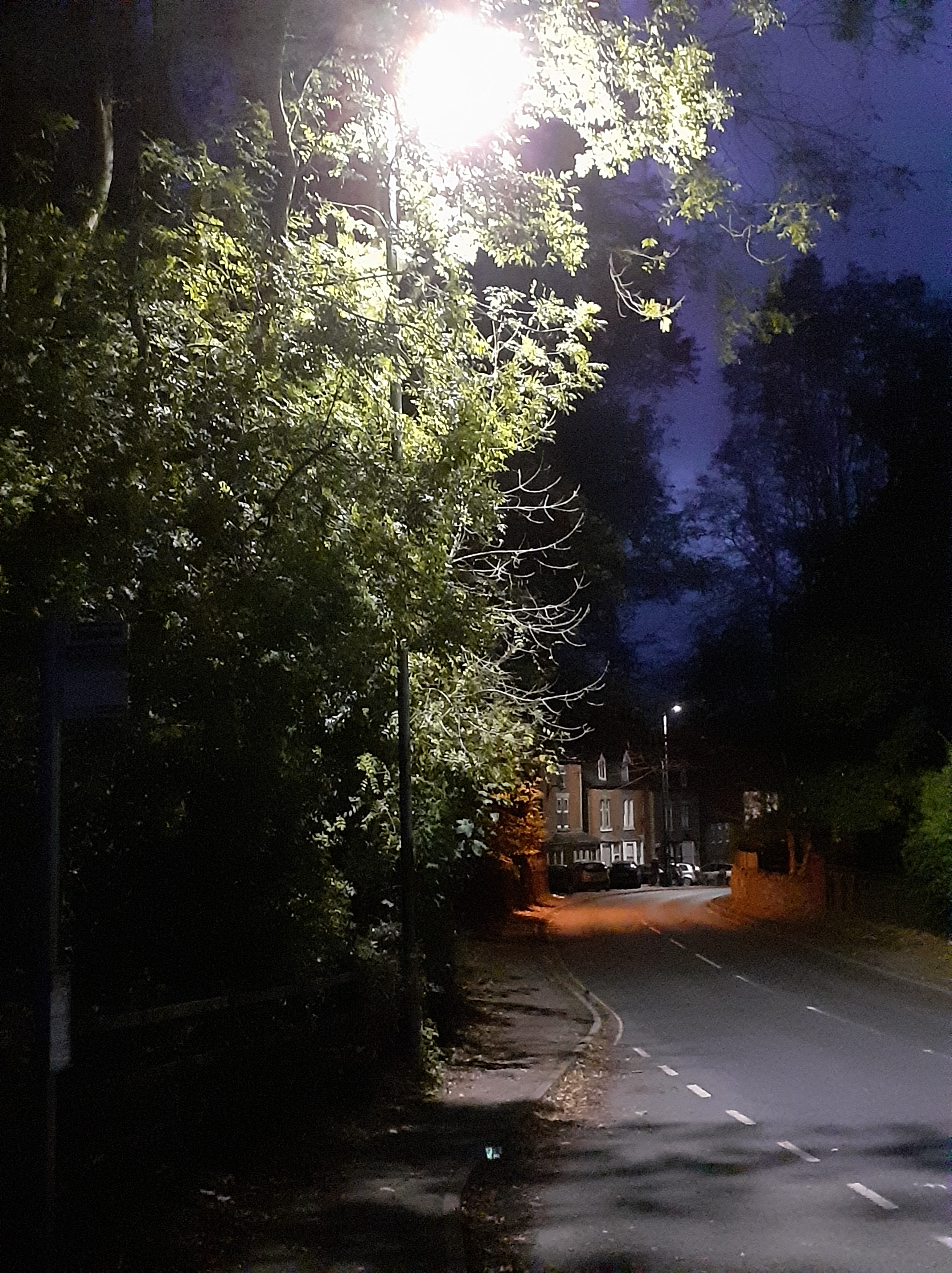
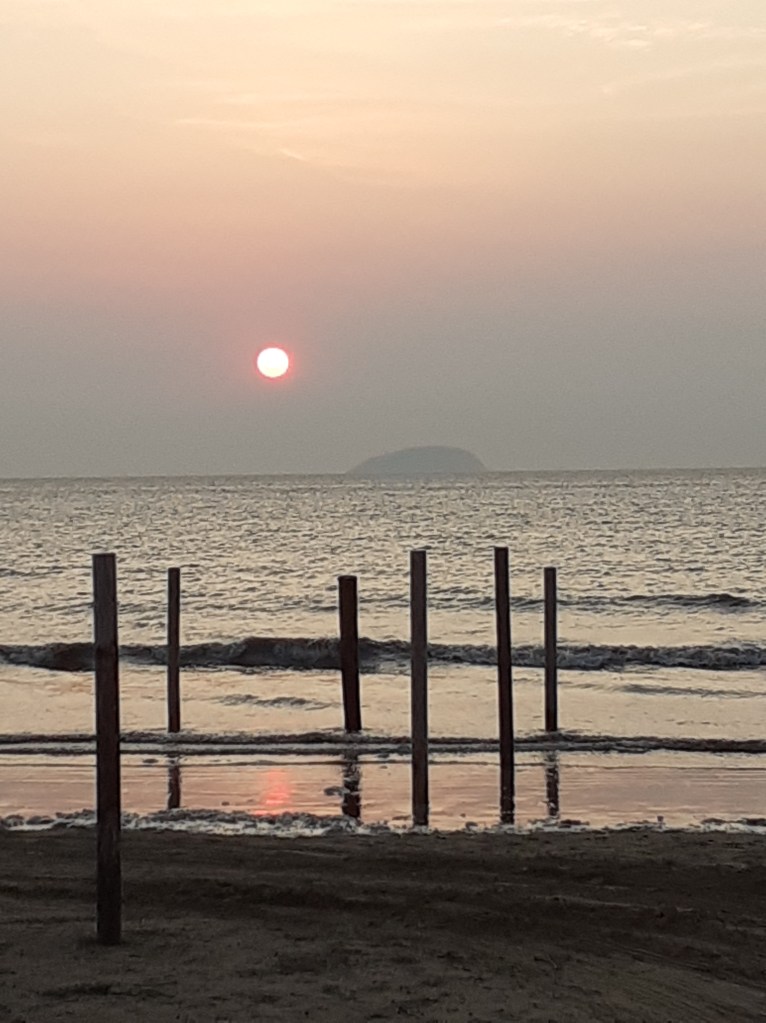
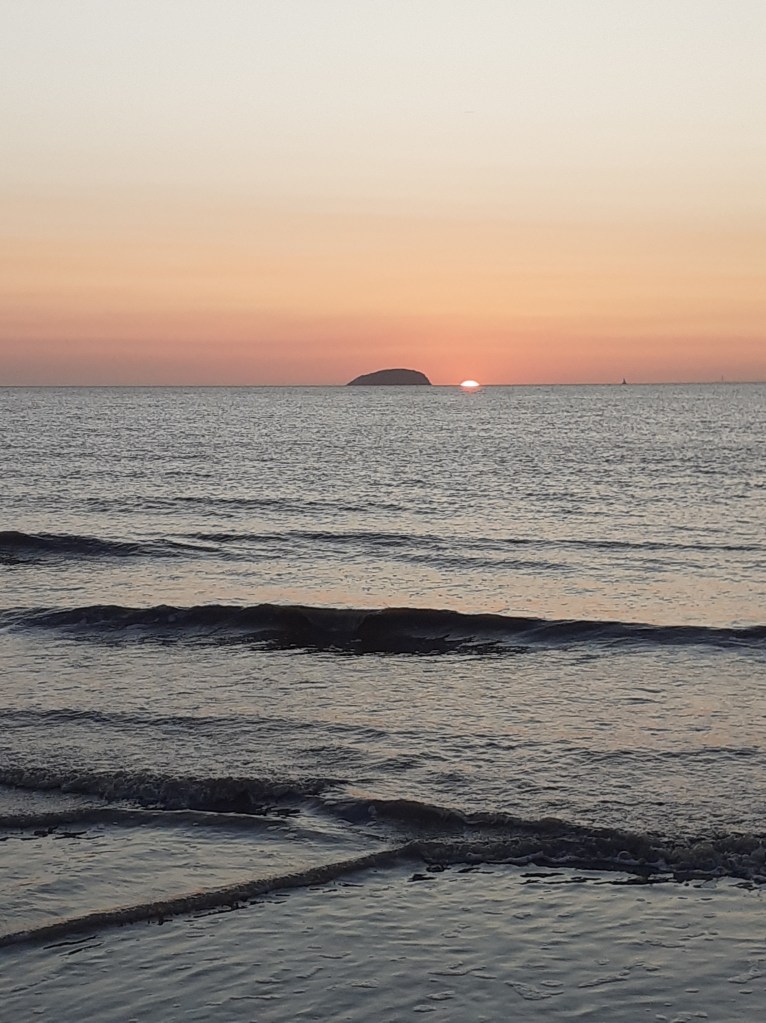
Early in the month, the sun sets a little after 7.30 p.m. and reminds us that the nights are drawing in more quickly. It still seems early for sunset, but I notice that my sense of ‘evening’ is adjusting to a more autumnal perspective. The picture below was taken on September 3rd.

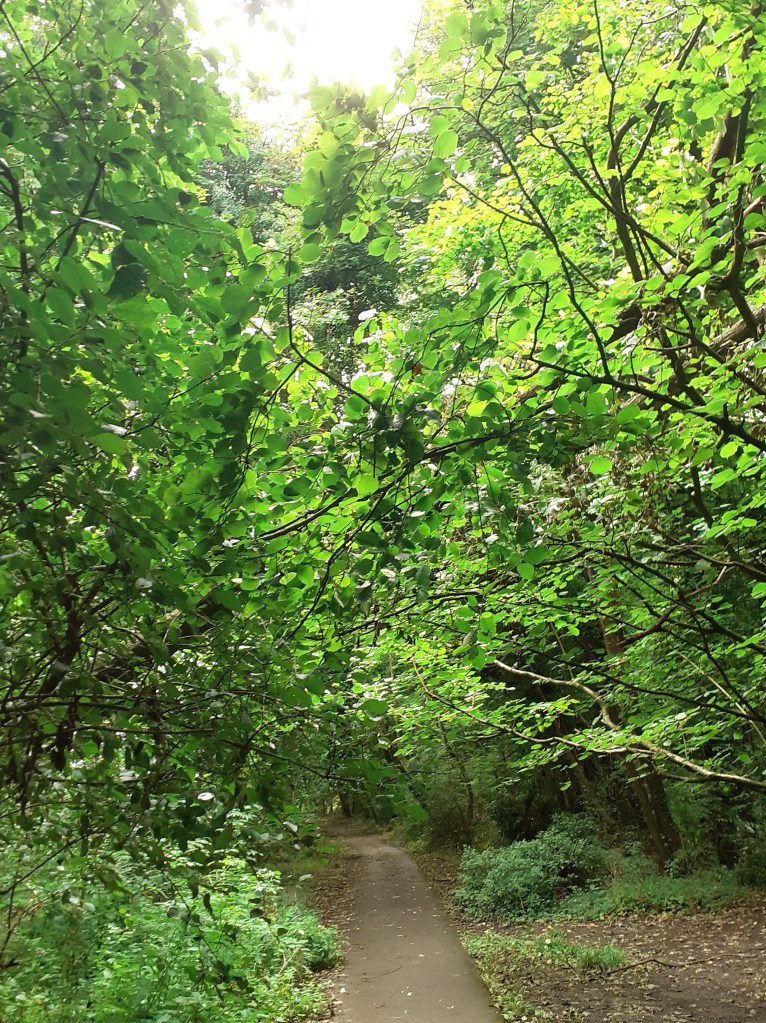
The feeling-tone of this period is not yet equinoctial. Wooded spaces are still vigorously green, still majestic, still imaging what my heart wants more of the world to look like. The light of day remains strong, even though temperatures are characteristically lower. There is a lingering aftertaste of summer at the beginning of the new season.

Nonetheless, it is easy to find muted colours leaning in to decay. These have their own fragile and poignantly fleeting beauty, as the alchemy of the waning year does its work. Early September has a character of its own, to be enjoyed while it lasts, as the wheel continues to turn.

THREE TREES

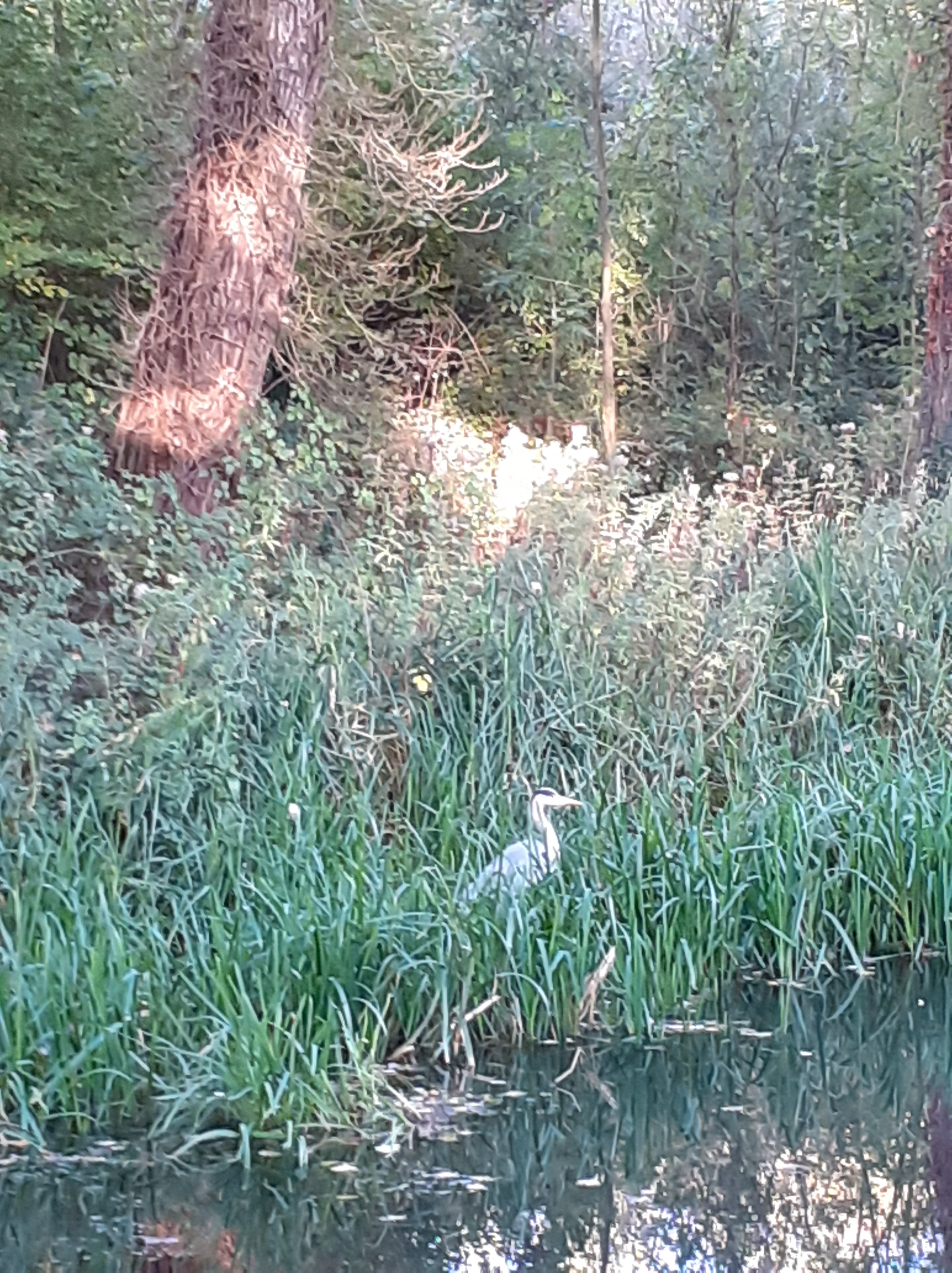
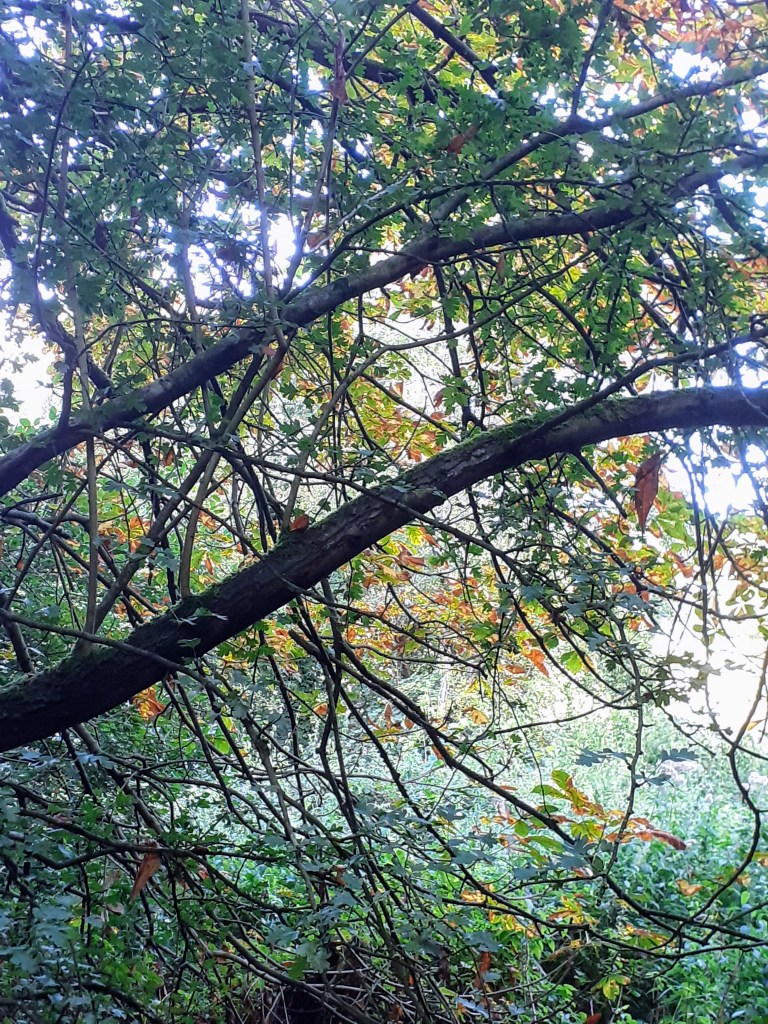
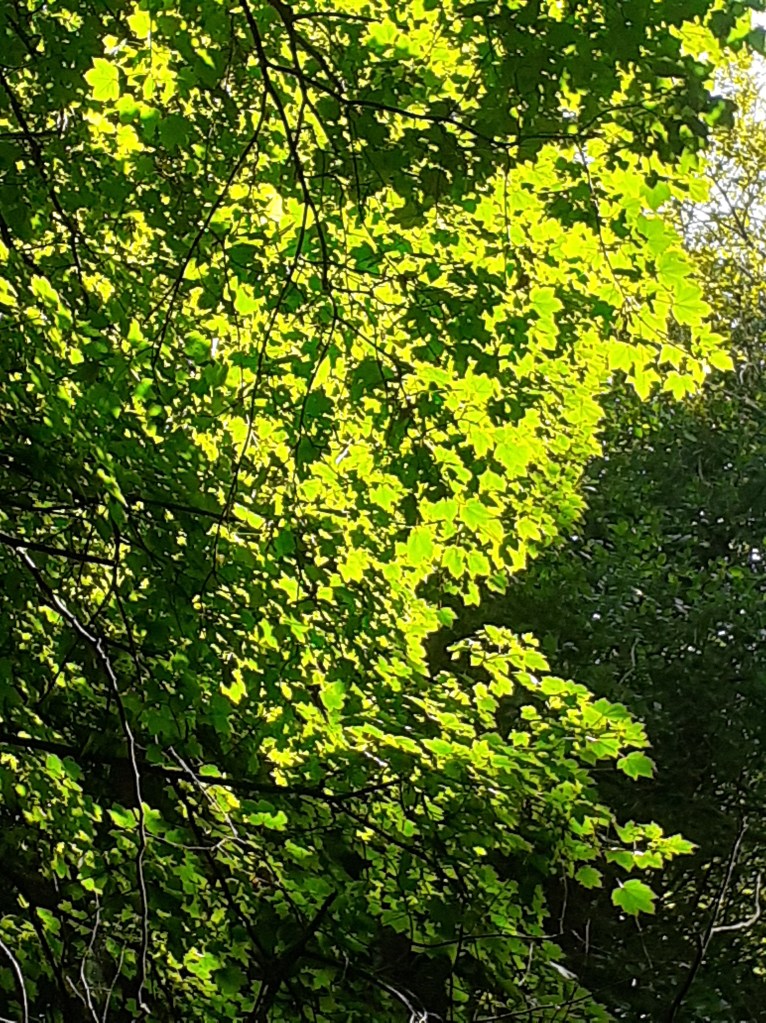
On recent walks I have been noticing trees in nearby woodland, and becoming aware of how I experience them at this moment in the year. The three tree pictured in this post illustrate my story for later August.

In the first, I saw my first real hint of autumn, as green starts to turn yellow and brown. At this stage, it is a subtle shift affecting only a few trees. But it is a harbinger, like street lights at 8.30 pm.

My liking for this time goes back to my later childhood. It was still summer and I had a lot of freedom. My hay fever was gone. Temperatures were a little down. It was easier for me to spend longer periods out in the sun. I felt at home in my environment. In these precious days, I felt expansive. The world was on my side, and a hopeful place to be in.

In an earlier post (1) I talked about this as being a time of apples in my Innerworld. This is true of my outer world too. I grew up in Somerset, in England, where apples are abundant. It is cider country, and the summer country of Arthurian romance. My home town, Yeovil, is 19 miles from Glastonbury, aka Avalon. When I was small, I was puzzled by injunctions not to take apples from the tree or eat the ones which fell on the ground, though these might possibly be cooked. Only the ones in shops were truly safe. Commerce made them righteous. For me, this got a little mixed up with forbidden fruit story in Genesis 3, since “the tree in the garden” was identified as an apple in our part of the world.

For all the autumnal qualities of this time, it still offers a naturalistic ‘tree of light’ experience if I am open to it. I experience this most when sunlight catches green leaves, especially if they shine from recent rain. I am glad that the metaphor of the tree of light – like those of the tree of life, or world tree – does not remove us far from our experience of the living world. One of my attractions to Druidry is that even its more esoteric, Otherworldly dimension stays loyal to nature.

(1) https://contemplativeinquiry.blog/2020/08/18/harvesting-in-mixed-weather/

HARVESTING IN MIXED WEATHER

This picture was taken early one morning, at a moment slightly defended from the heat of early August. I was walking through woods to shelter from the sun.

Those days, intense in their moment, have already receded into the past. After a period of somewhat lower temperatures, and of flashes and rumblings in the sky followed by modest rainfall, we found ourselves in a flash flood on Sunday evening. For a relatively brief period, the A46 (a main road, locally) turned into a fast-flowing river not far from our house. Guttering held, but needs attention.

It was as if, following a period of contest, water had succeeded fire as the prevailing element. Now, the situation is less clear cut. But we are in a cooler and wetter place than we were at the beginning of the month. Daylight hours are reducing. We are leaning in to autumn.

During this time I have been busy with my own harvesting. The meditations presented in my last three posts (1) complete a basic repertoire of formal solo practice in my renewed Druidry. I have been fruitfully indoors during both heat wave (beyond my comfort zone) and the return of rain. I have been inwardly focused.

In my own Innerworld wheel of the year, apple presides over the first three weeks or so of the post Lughnasadh/Lammas quarter. Apple, in many traditions, is a Goddess tree, associated with both wisdom and healing (2). It is linked to a visionary ability to see beyond the surface: perceptions grow wiser and the heart sees further than it might otherwise do.

In Irish myth, Lugh was sent to collect apples from a Tree of Light found in the Otherworld. In Britain, after the Battle of Camlann, Arthur was taken by three Celtic goddesses to be healed on the Isle of Avalon (=Island of Apples).

In a more everyday way, my meditations serve the same goals. The timing of my work on them wasn’t exactly planned. But it doesn’t surprise me that my commitment to living the wheel of the year has led to this result.

(1) Links to the meditations:

MEDITATION: LIVING PRESENCE

MEDITATION: WISDOM’S HOUSE

MEDITATION: ENERGY BODY

(2) See: John Matthews & Will Worthington The Green Man Tree Oracle: Ancient Wisdom from the Greenwood London: Conections, 2003

BOOK REVIEW: SOUL LAND

Highly recommended to anyone who values the poetry of place. Natalia Clarke’s Soul Land: Nature, Scotland, Love (1) is a chapbook featuring 22 poems about her connection with Scottish landscape. That connection is intense, and shared in these poems through a powerful and distinctive voice.

The poet grew up in Siberia, enjoying “immersive life and experiences with nature and magic” (2), before being exposed to “intense emotions of love and loss at a tender age”. Her journey took her to England and its publishing industry with a later shift into the field of psychotherapy and a personal spiritual awakening. This is the context for the visit to Scotland “that changed me on a profound level”. She fell in love with what she came to call her “Soul Land”.

In the poem Love Everlasting, she writes:

“My knees touched the greenness

of your body and in

awe I stood amidst a stone

circle feeling protected and

contained.

I lowered myself into your

cooling stream imagining I

washed myself anew”.

The words have both erotic and mystical resonances: perhaps it misses the point even to make the distinction. In another poem The Land of Me, she talks of the land “stealing my soul” and how this theft feels like “the gentlest fall into paradise”.

This is not a song of life and work within a landscape and the human culture it has shaped, and which has shaped it in turn. It is a personal I-Thou connection with a sacred space that the poet visits from time to time. Natalia Clarke is clear and sensitive about this, as shown in Through the Eyes of A Highlander, where we find a different consciousness of place, and in his case, its human history: “Where I see beauty he sees barren landscape … where I feel silence he shudders with sorrow”. Natalia Clarke knows that her sense of home, in this for her newly discovered land, is bound up with her own life and longing, and what she brings to the encounter.

In the later poems we find a closer observation of detail – “water silky soft and the colour of silver … green pine needles hitting my senses with clean potent fragrance”. The land feels more maternal – even, in a sense grandmaternal. In the poem In My Dreams You Visit Me the poet finds herself “transformed into the old Cailleach walking the hills and mountains with deer by her side”.

Natalia Clarke feels blessed in this wild space: “inhaling paradise, assured, grounded, humble, in your exquisite perfection”. Although led by her intuition and her feelings, she shows how her experience of the Scottish landscape has indeed grounded her.

“’All is well,’ the land whispers

into my soul spreading her

seasons around me”.

In a prose conclusion to the collection, Natalia Clarke also spells out the conceptual basis of her way of experiencing and relating. The key terms are ‘home’, ‘soul’s calling’ and ‘nature’. Home is “our secure ground, safety and knowing” with a feeling-tone that is “contented and contained”. She speaks here as a person who has lost her link with her “original motherland” and has needed to find ‘home’ elsewhere. A soul call is “very impulse driven, animalistic and instinctual”, asking us “to be more, to feel more” and join “something beyond yourself, new, meaningful and expansive”. Nature is not simply about solace. Deep understanding of nature can bring both peace and turmoil into our souls, “as processes are parallel within nature and if we tune into nature’s rhythms, we risk deeper understanding of ourselves”. True homecoming, the homecoming that involves soul, asks us to take risks as well as offering safety. For Natalia Clarke, Nature favours the brave.

(1) Soul Land: Nature – Scotland -Love Kibworth, UK: Matador, 2020

(2) https://rawnaturespirit.com/ (The collection can be ordered from this site by clicking on ‘publications’.)

MERLIN’S TRANSFORMATION

The hermit card from The Merlin Tarot (1,2) shows a traditional image of the contemplative. The accompanying narrative points to evolution beyond the life of this world, whilst still in service to it. Stories of this kind characterise many spiritual paths. This one is Druid friendly, alive in my heart and imagination. Here, I want both to pay homage to heritage and to note a personal divergence.

Merlin has reached the top of the mountain, the austere end of his ascending path. All that remains is to bid the outer world farewell, “not as an inspired youth or madman seeking nature, but in full understanding”. The understanding is that of the Great Mother herself, typified by simplicity, clarity, and a will to withdraw from manifest existence. This is the moment to relinquish the earthly plane. A simple leap will do it. But Merlin’s destiny is not to abandon the world. In a greening of Mahayana Buddhism’s bodhisattva concept, Merlin, discarnate, will continue to serve the Goddess and the land.

Even as hermit, in this frozen moment on the cusp of anticipated transformation, Merlin is not quite alone. The seer is steadied by his staff, a branch from the tree of life itself. A wren, sacred bird of kingship and blessed of the Great Mother, has companioned and witnessed him throughout his journey. Soon it will be free to return to the green safety of its beloved low hedges. Merlin contemplates a crystal lamp – crystal being the underworld’s mineral equivalent of light. Caught inside the lamp, two primal dragons, dynamic yin and yang energies, underworld born, are held in a static balance that is described as “perfect”. A heretical thought arises: is the candidate for transformation, at the very last moment, questioning the ‘perfection’ of this absolute, frozen, stillness? What price the infinite?

In The Merlin Tarot, this is the last we see of Merlin. But for us, there is the path of descent, right down to its completion in an image of embodied realisation. The Tarot trump following that of the hermit Merlin, and complementary to him, is the Innocent, a young Sophian wisdom figure. Linking with the active energy of a Star Father who seeds the cosmos, she initiates pathways of giving and sharing on the descent, so that the earth itself may be changed.

R. J. Stewart is in a line of Western Mysteries teachers including Dion Fortune, Israel Regardie and W. C. Gray. In this tradition, discarnate beings linked to a cosmic hierarchy and dwelling on other, more spiritual planes, are real. They are not metaphors, aspects of the human psyche, or opportunities to think with stories. R. J. Stewart is clear about this, and I have always had to take respectful note of this view whilst not committed to sharing it. But I am moved and inspired by stories. On the contemplative path, the rational mind has at best an ancillary role. It doesn’t do well by itself. One option is to move into stillness and silence, and sometimes I do that. Another is to engage the heart and imagination, which are fed and watered by stories, their resonance, and their play intrapsychic relationships. The story told in The Merlin Tarot has nourished me for a long time, and continues to do so, in ways that satisfy me, without my wanting to be him.

(1) R. J. Stewart The Complete Merlin Tarot: Images, Insight and Wisdom from the Age of Merlin London: The Aquarian Press, 1992 . Illustrated by Miranda Grey ISBN 1 85538 091 9 No cards, but a full explanation and discussion of the system and its imagery.

(2) R. J Stewart The Merlin Tarot London: Element, 2003. Illustrated by Miranda Grey ISBN 000 716562 5 (First published by London: The Aquarian Press, 1992). Cards, handbook and notebook for record keeping.

DOG DAYS

The dog days of summer are by reputation hot, sultry and ill-aspected. As high summer becomes late summer, we can fall out of love with the season. We may find ourselves less comfortable than we would like to be, on the edge of storms that may or may not break. Nature can seem rank and overblown. Insect life is busy, in ways not always to our taste.

Yesterday I walked on the banks of our local canal between Stroud and Brimscombe. I had not done this walk since early March. At the height of the Covid crisis, I decided to leave the narrow towpath alone. For a long stretch of time through spring and summer this section of canal and I have gone our separate ways. It was early in the morning and not especially hot. The canal itself gave me my dog days feeling. What I noticed was a wild, rank fecundity, not conventionally photogenic. It is as if the space were resisting the (interrupted) attempts to make it navigable once again, sustainably beneficial to us. A different ecology had established itself. In my feelings, and imagination, the ‘dog days’ energy became a counterpoint to convenience conservation.

I like convenience, and I like walking on the towpath. I respect the restoration project, and the volunteers who are making it happen. I also respect the ever-renewing power of nature. I look at the picture below, where evidence of canal can barely be seen – just a suggestion on the far bank. I reflect that this stretch of water was once deep and wide enough for trows, traditional canal boats used on the Severn and Wye rivers. Brimscombe Port was as far east as they could go. The canal going on to Lechlade had a narrower gauge, and cargo had to be transferred to Thames barges. That early industrial world has long gone. The new development, whilst making inroads, has not yet ocupied this space. In the meantime, nature is free to be inconvenient, and to some people doubtless unsightly, whether we like it or not.

VARIETIES OF ONENESS

When I say ‘oneness’, I mean interbeing rather than singularity. I am talking about the web of life, the great song, a field of living presence. Singularity allows only an I. Interbeing has room for I and You and We and They. This recent picture of a half-hidden corner in our garden, taken by my wife Elaine, makes the point. The fact that she took it also reminds me that the mature recognition of ‘you’ is the foundation of true relationship.

This oneness of interbeing does not need a myth of origin to sustain it. Interbeing just is. I’m an intuitive idealist, fascinated by metaphysical questions, including questions of origin, and the systems of myth and metaphor which address them. But I am not spiritually dependent on answers. That is the advantage of Druidry as a practice rooted in nature. Today is a day for celebrating the natural side of my path.

HONOURING ‘THE WAY OF MERLIN’

The Way of Merlin came into my hands at the right time. It seeded a number of key understandings, which nudged me onto a Druid path in October 1993. The first is that “sacred space is enlivened by consciousness. Let us be in doubt that all space is sacred, all being. Yet if human beings dedicate and define a zone, a location, something remarkable happens within that defined sphere of consciousness and energy. The space talks back”. Author R. J. Stewart backed this up with the further declaration that “The mystery of Merlin is a backyard mystery, for it declares the smallest, most local space to be sacred, to be alive, to be aware.” I was living in South London at the time and remember being challenged in this book to befriend a spring and a tree. At first, I thought, ‘what?’. Then I found them both, on the day I started looking, in a local park.

Such activities went with the view, “yourself and the land are one”, and that this apparently humble work has a larger context of “holism … identical to the deepest perennial magical and spiritual arts”. Magic is seen as a process of having intent and applying energy and imagery in service to it. Working within mythic frameworks asks for an enabling suspension of disbelief rather than a dogmatic literalism.

I did not work with the suggested programme of visualisations and rituals concerning Merlin, the weaver goddess Ariadne, and other scenes drawn largely from Geoffrey of Monmouth’s Life of Merlin. As practices they seemed too long and formal. But reading Stewart’s text was psychoactive in itself. The weaver goddess Ariadne is a key figure, and the vision of Ariadne reveals a cosmic mother at the threshold of Being and Unbeing. She draws us into the empty silence of the Void, out of which emerges the sound of breath – our own breath and at the same time the breath of all Being. Being breathes through us, “and we realise that we have a body that is the body of all Being. The stars are within us. We are formed of the weaving”.

The specific image of Ariadne never took root in my imagination. But I acknowledged the power of this Pagan Gnostic creation myth. Its sense of our reality emerging from empty potential at the behest of a cosmic mother has stayed with me. My work with Sophia earlier in this inquiry pointed in the same direction. So does my recent post about Dancing Seahorses and Modron (2). I am happiest with the Modron image, because it is less defined and anthropomorphised than those of Ariadne and Sophia. At at the threshold of being and unbeing, she shows us that we are not separate from the divine breath that forms us, or from the creation that is formed. The stars are indeed within us, whether we know it or not.

The Way of Merlin has something like an ancestral role in my spiritual life. R. J. Stewart and I were born in the same year, but he was doing this pioneering work in the 1980’s when I was busy with other things. He influenced me in the period immediately before I embarked on a Druid path, and I have revisited his work over the years. It still has riches to offer.

(1) R. J. Stewart The Way of Merlin: the Prophet, the Goddess and the Land London: The Aquarian Press, 1991

(2) https://contemplativeinquiry.blog/2020/06/25/dancing-seahorses/

ELAINE’S CAULDRON: BURNING DEAD LEAVES

My wife Elaine created this midsummer cauldron fire, now ten days ago. It was fuelled in part by dry dead leaves. She chose the evening of the day itself rather than the traditional eve. The point about midsummer (24 June) is that the sun is on the move again after its moment of stasis, clearly beginning its decline. It acts as the polar opposite of the Sol Invictus or Christmas festival in late December. The Church gives 24 June to John the Baptist, decapitated at the wish of his nemesis Salome.

In our neighbourhood, there is a paradox about July. It is the quintessential summer month, in which the light begins to diminish. At the moment, sunrise is at about 4.50 am., with sunset at 9.20 pm. By Lughnasadh, it will be rising at 5.25 am and setting before 8.50 pm. In August, the process will accelerate while the earth and sea remain warm by North Atlantic standards. Getting up an hour or so after sunrise I am tending to find a dull and cloudy sky. There can be a stillness in the air, disturbed perhaps by blackbird pair flying low amongst the trees. I have a sense of latency.

The inquiry phase beginning at the 2019 winter solstice has settled a number of issues. I am re-confirmed in a modern Druid practice that is held within a circle and seven directions (E, S, W, N, below, above, centre), and is mindful of the wheel of the year. I also settled my approach to ethics at the beginning of this inquiry year (1) drawing on the work of modern Pagan philosopher Brendan Myers with his re-visioning of ancient Greek ‘virtue’ ethics (2). I have deepened in my experience of an at-homeness in the flowing moment, and its therapeutic benefits, which I wrote about last year (3). Fully established in my life, these are no longer fundamental inquiry issues. The uncertainties I formerly had with them are like dead leaves, now safe to burn.

For all that I have gained from other paths – Tantra, Tao, Zen, other forms of Buddhism, and Christian Gnosticism – I know that I will not be practising or following them. I will continue to appreciate their literatures and cite them in this blog, but this will be from the perspective of the appreciative outsider. Here too the active inquiry is over. Uncertainties have shrunken into dead leaves, and are safe to burn.

I know that, in the turbulent, airy mental realm, I have contending gnostic and agnostic energies. They are co-arising twins, and neither is going away. I still have work to do to find a settled home for them both. I am also concerned about how, more elegantly, to fit an ‘emptiness’ understanding into an earth pathway. A feeling about myth, and the truth and beauty of myth, is tied up with this. In the coming phase, I will look again at R. J. Stewart’s Merlin work for help with these questions. This reprise is also part of my older person’s looking back, recalling what I have valued, and asking what role it can still play. It sets my direction for the second half of the year.

(1) https://contemplativeinquiry.blog/2019/12/27/values-for-2020/

(2) https://contemplativeinquiry.blog/2018/07/02/ethics-and-civilization/

(3) https://contemplativeinquiry.blog/2019/06/30/meditation-and-healing/

DANCING SEAHORSES

This painting, Dancing Seahorses, is by Edinburgh-based artist Marianne Lines. I bought it in 1992 to support a growing interest in Celtic spirituality. The image is taken from a Pictish standing stone in Aberlemno in the county of Angus (1). To this day, the beings portrayed are well-known to Scottish folklore as sea horses, water horses, kelpies or each-uisge. They are also found in Ireland, the Isle of Man, Wales, Brittany and Cornwall. Manifesting in slightly different forms, they can appear in the sea, lakes, rivers and waterfalls.

For me, the painting evokes the primal energies of water, as embodied in these otherworldly seeming beings, who nonetheless might show up from time to time. The pair in the picture are entwined in ways that suggest many possible forms of connection – dancing, embracing, lovemaking, playing, fighting, competing, joining together in tranquillity, or a combination of the above.

I had owned the painting for some while before I began to see a second image, in a sense behind and containing the immediately apparent one. The space where the horses legs are raised defines a shape, suggesting a head. The very emptiness there is a paradoxical mark of presence. To me it became the head of a goddess, with the seahorses then becoming her body. Still clearly appearing as a water being, her arms – if they are arms – are raised in blessing.

The sea-horse image is clear and naturalistic, though stylised and showing creatures we strongly imagine but rarely meet. By contrast, the goddess image needs more work. I see her as Modron, the primal mother, in a marine guise. She seems to come out of a remote past with little story beyond her parenting of Mabon. I am glad not to have inherited too much lore about her. A sense of unfilled space and of mystery is part of what makes her numinous.

I did not make these connections as part of a plan. They grew up over time, feeling increasingly right. They are my own myth-making. I realise that, for me, meeting with an image is simpler and more direct than meeting with a fully developed narrative. There is an immediate impact, followed by a growing familiarity and a fuller relationship. From this, a story may grow, even one about a relative absence of story that points towards silence. Such images can have a lasting power, as this one has certainly had for me.

(1) There are four such stones from different periods. This is from the one listed as ‘Aberlemno 2’, where this image is on the lower right hand side of the front face. The stone is now thought of as being from the mid-ninth century C. E. – rather later than previously believed. The custodians of the stones place it in a genre of ‘zoomorphic designs’ also found in other Celtic Christian art of the time that draws on indigenous themes – for example in the Book of Kells, and in Celtic influenced Northumbrian work. This is in contrast to many Pictish standing stone images, which seem unique to that culture.

Earth Eclectic

music that celebrates Earth and speaks to the heart

Sarah Fuhro Star-Flower Alchemy

Follow the Moon's Cycle

Muddy Feet

Meeting nature on nature's terms

Rosher.Net

A little bit of Mark Rosher in South Gloucestershire, England

Becoming Part of the Land

A monastic polytheist's and animist’s journal

selkiewife

Selkie Writing…

Charlotte Rodgers

Images and words set against a backdrop of outsider art.

Prof Jem Bendell

living with metacrisis and collapse

Towint

The pagan path. The Old Ways In New Times

The Druids Garden

Spiritual journeys in tending the living earth, permaculture, and nature-inspired arts

The Blog of Baphomet

a magickal dialogue between nature and culture

Musings of a Scottish Hearth Druid and Heathen

Thoughts about living, loving and worshiping as an autistic Hearth Druid and Heathen. One woman's journey.

Wheel of the Year Blog

An place to read and share stories about the celtic seasonal festivals

Walking the Druid Path

Just another WordPress.com site

anima monday

Exploring our connection to the wider world

Grounded Space Focusing

Become more grounded and spacious with yourself and others, through your own body’s wisdom

The Earthbound Report

Good lives on our one planet

Hopeless Vendetta

News for the residents of Hopeless, Maine

barbed and wired

All content on this site is now located at www.jonberrywriter.co.uk