Contemplative Inquiry

This blog is about contemplative inquiry

Tag: Earth spirituality

LETTING GO OF MAY 2023

Where I live, the hawthorn is losing its blossom. It looks like a kind of death, but is in fact just another phase in the life cycle of this plant. Its goal is to bear fruit. For many years, as part of my regular Druid practice, I worked with a wheel of the year mandala involving sixteen plants (mostly trees, many of these being ogham trees (1,2). Hawthorn covered the period from 1-23 May. In a previous post I have also looked at the special case of the Glastonbury thorn, with which I felt a strong personal relationship before it was vandalised (3).

In his The Underworld Initiation (4), R. J. Stewart suggests that we see all members of the rose family as sharing the same symbolism – showing in nature a sequence of promise, pain and fulfilment: blossom, thorn and fruit. (For me it seems that the apparent dying back to bear fruit is the ‘pain’, if that’s the right word, rather than the slightly extraneous thorns. Maybe that’s too literal, or maybe I’m identifying too much with the plant as subject).

I notice that my own tree mandala, developing from a kind of dream time, includes three members of the family: blackthorn (8-30 April), hawthorn (1-23 May) and apple (1-23 August). Indeed my original version had the wild rose for midsummer (16 June – 8 July), before I replaced it with the more conventional oak. Yet in my heart’s imagination, the rose is my solarised midsummer and midday plant. More widely, this plant family, both naturally and imaginally, has been vividly important to me over the years.

R. J. Stewart was inspired by Scottish Border ballads, especially Thomas the Rhymer and Tam Lin. I like what he says about working with traditional sources. “One of the most damaging attacks that can be made upon a tradition is to ‘restore’ it, or to ‘prove’ an original model … restoration implies the withdrawal of the vivifying spirit into another world, leaving only a shadow behind … such a restoration can only be made within ourselves, by bringing our imaginations alive with the traditional symbols” and developing them in the way our inspiration prompts. Here and now, I can begin to let go of May 2023, and allow the peak of the light time to come in. The rose family is still there, as companion and teacher.

(1) https://contemplativeinquiry.blog/2020/09/20/autumn-equinox-2020-hazel-salmon-awen/ (A note at the end of the post explains the whole mandala)

(2) https://contemplativeinquiry.blog/2020/08/12/meditation-wisdoms-house (Explains the contemplative context of my tree mandala work)

(3) https://contemplativeinquiry.blog/2021/04/23/remembering-the-glastonbury-thorn/

(4) R. J. Stewart The Underworld Initiation: A Journey Towards Psychic Transformation Wellingborough: The Aquarian Press, 1985

‘SOLITUDE: SEEKING WISDOM IN EXTREMES’: SHAPING THE STORY

This post is a continuation of the last (1). During his experimental year of radical wilderness solitude in Patagonia, Robert Kull maintained a journal. The complete journal was 900 pages long, and he had not only to review it but also to write an edited version. Both the original writing and the editing involved a careful process of selection. Even the original entries told only “one among many possible tales”. Kull says: “I have, though, both in the original journal entries and in the editing process, tried to tell my truth as I lived it”. He is very conscious of the way in which “the magic of words”, and cultural expectations about narratives, including the motif of the ‘hero’s journey’, can come between the experience and the record. These considerations influence what he brings back from his year, and what we can learn from it. I feel moved by, and respectful of, the way he works through these concerns.

“In the journal, a saga of physical adventure and spiritual transformation runs parallel to and weaves through the drifting account of daily life – the autobiographical quest of the hero. This is a recognized, even expected, storytelling mode for someone spending a year alone in the wilderness, and I could have enhanced the heroic saga during editing. But instead I’ve allowed that tidy narrative to remain interrupted over and over by the unruly wildness of the ‘hero’s’ soul.

“In the messier story, the hero’s cultural ideals of personal success, social progress, and free will are questioned in view of the cyclic storms of depression, rage, fear, and doubt about his place in society and a felt lack of spiritual development. Despite differences in theology, moral orientation and self-discipline, the man in that pedestrian tale may have more in common with St. Augustine and his surrender of personal agency to Divine Will than with the stereotypical self-oriented striving of modern culture’s secular hero.

“My goal in the wilderness was not to conquer either the external world or my own inner nature, but to give up the illusion of ownership and control and to experience myself as part of the ebb and flow of something greater than the individual ego. But the goal of attaining enlightenment was elusive – except when it was not. Through a shift in consciousness, my quest came to an end as I realized there was nowhere to go and nothing to get. The notion of a holy grail out there – or even within – was illusory, and what I was seeking I always already had: I was not a special hero, but simply a speck of life like all other specks – unless I was not. Personal agency always reasserted itself, and these two aspects of my being struggled and then tentatively began to dance together.

“Stories of spiritual seekers or solitaries in the wilderness are often portrayals of heroic adventure. It’s difficult not to slip into this mode, but I’ve tried. We already have enough of such writing, and in its most blatant form it’s little better than checkout-counter publications flaunting the amazing lives of superhuman ‘stars’. When I read such stories and compare them to my own actual life, I feel diminished. ‘That’s not how my life is. What’s wrong with me?’ I’m also pulled out of my own life and into vicariously living the imaginary life of another. What I offer instead is a more human account so perhaps we can wander the spaces and silences of wilderness solitude together.” (1)

(1) https://contemplativeinquiry.blog/2023/05/23/radical-wilderness-solitude-an-experiment/

(2) Robert Kull Solitude: Seeking Wisdom in Extremes – A Year Alone in the Patagonian Wilderness Novato, CA: New World Library, 2008

WHEEL OF THE DAY

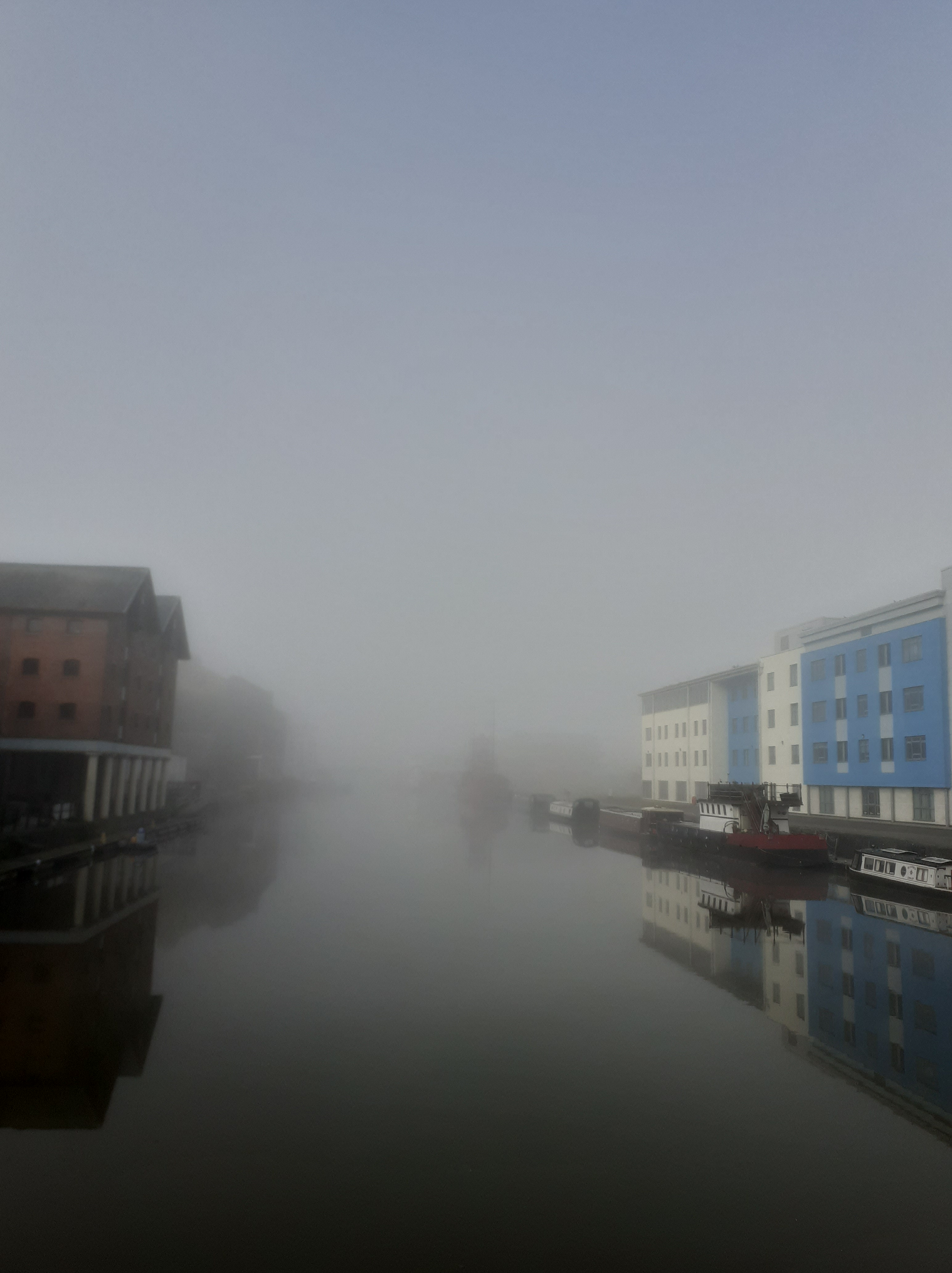
Two pictures taken 12 hours apart in neighbouring locations. 7.30 am above and 7.30 pm below. The wheel of the day following its course in the light time of the year. Dawn is well past regardless of mist, and sunset yet to come even if shadows are lengthening.

Delighting in these experiences. No further narrative.

CELEBRATING THE MONTH OF MAY

The Irish name for May is Bealtaine. Linguistically at least, the May Day festival sets the scene for a calendar month. As I experience the wheel of the year in my own life, this feels right. May, the merry month, has always been special to me. Born towards the end of the month in 1949, I continue to feel newer and fresher in May, with a heightened sense of life. Changes happening around me, in the rest of nature, feed that sense. I’m part of something bigger.

The demarcation of time might be a product of human counting and naming, but it doesn’t feel arbitrary to me. Counting and naming have a powerful magic of their own. On 14 May 2023 I went on a morning walk, reaching a small wooded area at about 7.45 am. It was a time of dispersing mists and strengthening light. A time of warming up. I enjoyed it from the start, but there came a moment when my experience of the walk changed radically.

I see the wood. I stand at its edge. Hawthorn invites me in, decked in the green and white of the May season. I understand this as a moment for slowing down and shifting into a softer, more intuitive connection with the realm I am entering. I am moving into a kind of sacrament – a communion with nature in a unique time and place. I feel a joyful kind of reverence here, free of solemnity and unction. As I continue slowly on the path, sunlight, striking a slender tree trunk, illuminates my way.

Then comes a tanglewood immersion. Variations in wood. Variations in green. Variations in light – especially light. This place could be dark and dank. At times, no doubt, it appropriately is. But it is May now, and wonderfully backlit. There’s a yellowing of green that points to new light and growth rather than their decay. I have a strong sense of participating in a living world. My own vitality is boosted.

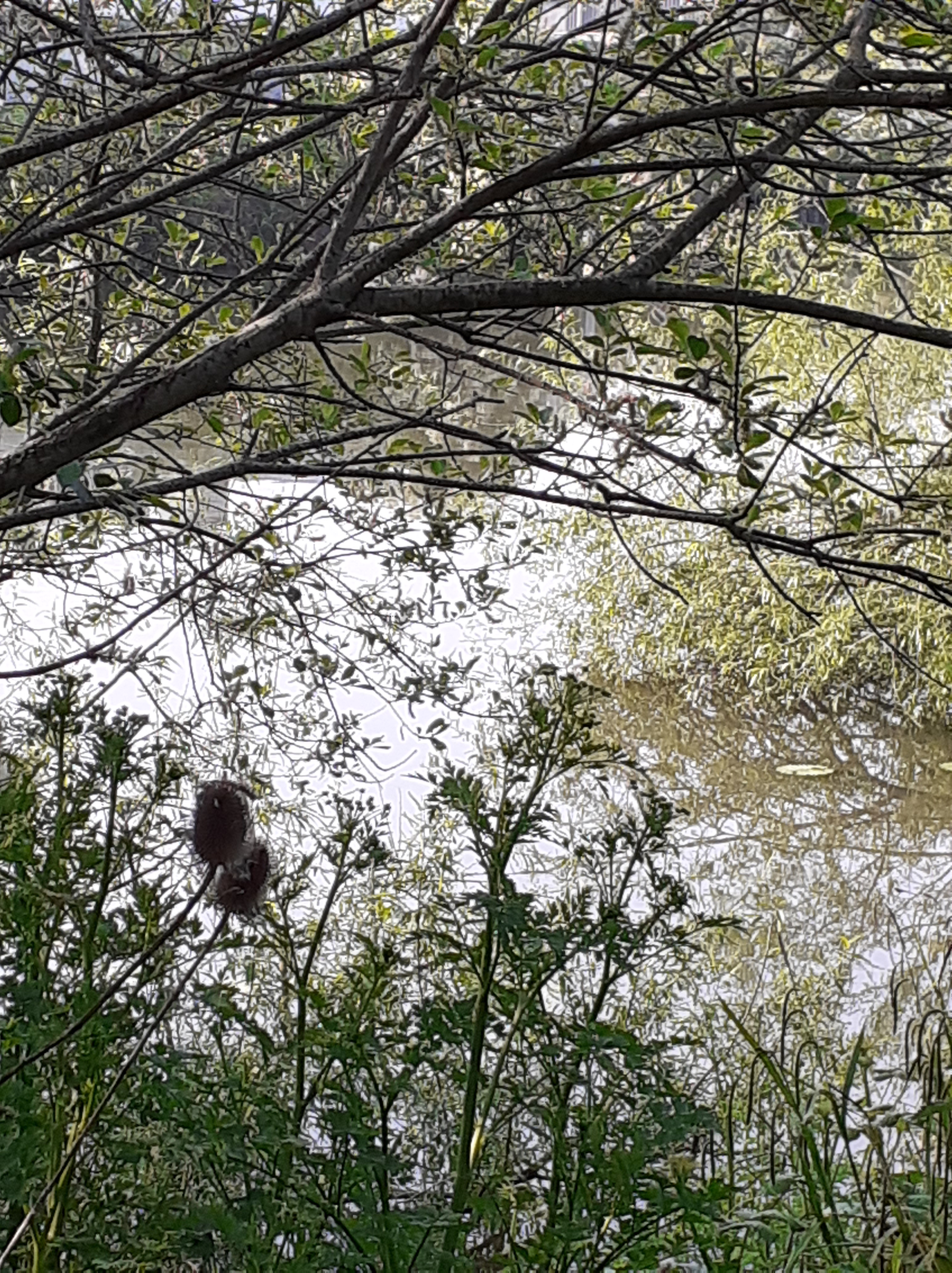
I am now drawn towards water. Again, some foliage is shaded. Other foliage is vividly lit up. On the water, the mist is still clearing. It is still fairly early in the day. It is at times like this that I feel most Druidic, very at home and blessed in this quiet connectedness.

A little later, I crouch at the water margin’s edge. Whereas the previous scene had a spacious serenity, this has intimations of activity, a small but crowded world of its own, with thriving plants and and a thriving sub aquatic realm beside them. Even in this small space, life is complex and abundant. The same holds, on a somewhat expanded scale, to this vulnerable scrap of woodland as a whole. I emerge from my sacrament refreshed and renewed, with the imprint of Bealtaine 2023 upon me.

EVENING LIGHT IN APRIL

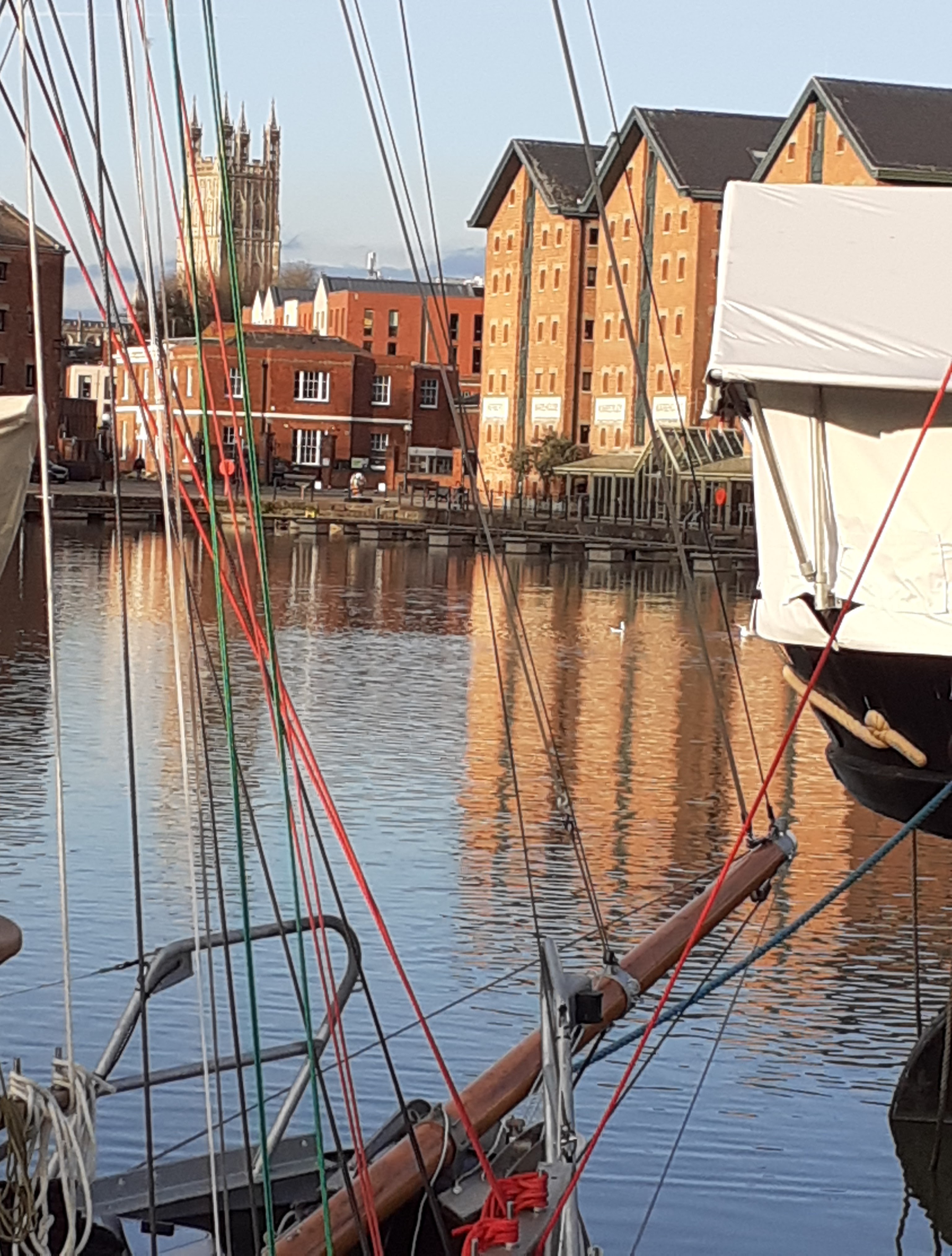
In Gloucester, England, we are entering the four lightest months of the year. The pictures above and below were taken after 7 pm. This lightness, and the long evening twilight that follows, still feel novel. The day-to-day weather here has been volatile, making evening sunshine all the more precious when it comes. I feel naturally enlivened and blessed, somehow shifted into a more immersive experience of the world around me.

I live in a flat where I have good views of the sky, the sun, the moon and their changes from indoors. This has subtly altered my experience of daily life from before dawn until after sunset – following the wheels both of day and year from a slightly elevated level. But there’s something also in experiencing the effects of April evening light at ground level. It’s an urban, curated landscape and I am (mostly) an urban Druid. I am fond of such spaces when they are done well and preserve a human scale.

In the docks I notice rigging on a sailing boat at rest and brick warehouses reflected in tranquil sunlit water. The cathedral tower is in the distance, still the tallest building in sight. On Brunswick Road, I look into the grassy city garden of Brunswick Square, mostly in sunlight, partly in shade. Immediately in front of me there’s a cherry tree in blossom. Across the square, I enjoy an 1820’s terrace. At this moment in the year, I discover both freshness and familiarity. For me, the experience of an evening like this is an ideal way of being and belonging in place.

BLUEBELLS BEFORE BELTANE

Seeing bluebells

In verdant grass.

Will summer really come?

ME AND MY INQUIRY

My inquiry moves slowly. But it doesn’t stand still. So from time to time I update the ABOUT section of my blog. Sometimes I discuss my changes in a post. Occasionally it seems as if the blog has its own life and writes itself through me. I’m not sure that I would claim the word Awen here, but I can end up surprised at what appears.

This time there seems to be a settling, an emphasis on continuity. I recommit to a contemplative inquiry, grounded in modern Druidry and with the inquiry process itself as my core practice. I am now assuming that this will be lifelong. In the past I have tended to believe that the inquiry would eventually lead to a conclusion of some kind, or become redundant for other reasons. Another project would then emerge – or maybe I would retire from projects and put my feet up. That belief has gone, for my inquiry is no longer a ‘project’.

As I was writing this morning, I became conscious of the change. ‘My inquiry’, I wrote ‘has shifted from a focused experiential investigation into a more relaxed, at times meandering process that brings illumination, healing and peace’. I have always had, in the back of my mind, prestigious models of both academic and spiritual inquiry that do not encourage relaxed meandering. In the academic models, results like ‘illumination, healing and peace’ are beside the point. In the spiritual ones, they are mostly reckoned to be very hard-won. But there it is. I am moving into a life-lived-as-inquiry space by softening and reframing my idea of inquiry. I seek support and nourishment rather than new and different ‘results’. Looking at these words now, they seem obvious, not even new – but I’ve only just caught up. It does seem, experientially, as if the blog has become the voice (spirit?) of the inquiry and intervened to educate me. It’s an odd feeling.

Here is the new ABOUT text:

“I am James Nichol and I live in the city of Gloucester, England. My contemplative inquiry began in 2012. It is grounded in modern Druidry, though I have drawn on the enduring wisdom of many times and places. I am also influenced by the current turn towards an eco-spirituality that meets our own historical moment. The inquiry itself is my core practice. I see it as a lifelong journey. In my blog I include personal sharing, discursive writing, photographs, poetry, and book reviews.

“Over the years, my inquiry has shifted from a focused experiential investigation into a more relaxed, at times meandering process that nonetheless brings illumination, healing and peace. In the contemplative moment,  I am living presence in a field of living presence, at home in a living world. This is not dependent on belief or circumstance, but on the recognition of what is given, in joy and sorrow alike. I find that this simple recognition encourages a spirit of openness, the acceptance that nothing stays the same, an ethic of interdependence and a life of abundant simplicity.

“My book, Contemplative Druidry: People, Practice and Potential, was published in 2014. It includes a foreword, Deep Peace of the Quiet Earth, by Philip Carr-Gomm. There are major contributions in the main text from 14 other Druids offering diverse perspectives on the topic: https://www.amazon.co.uk/contemplative-druidry-people-practice-potential/dp/1500807206/

APRIL AND ‘DRUID MINDFULNESS’

Where I live, April 2023 brings qualities and freshness and new growth. My heart meets the moment as I walk in the bracing breeze. Sunny and overcast periods succeed each other. Moving through this enlivening space, I naturally welcome the energy of change it embodies.

But it’s not quite that simple. There’s an underlying turbulence too, which can easily challenge my balance. Slogans like ‘I am the sky. Everything else is weather’ aren’t enough. I, as natural man, have to ground and embody them. They have be be aligned with my felt sense.

I wasn’t sure how to talk about this when I discovered that someone else had done it for me. Philip Carr-Gomm, who until recently led OBOD (Order of Bards, Ovates and Druids), offers a regular podcast: Tea with a Druid. No 249 is about ‘finding calm in chaos’. It is up on YouTube as: https://www.youtube.com/watch?v=Ew4pD3OJen8

Philip suggests that the best way to deal with chaos, turbulence, or the everyday stress of modern life, is to turn to the stillness inside. Then it becomes possible to stay in the moment whilst expecting nothing. It takes work to get there – to identify ways of finding stability and calm even when all around is unstable and unpredictable.

Philip understands modern Druidry as a tradition of ‘mindfulness in natural settings’, whether real or visualised. The stillness found in those settings isn’t a dead stillness but a living one – leaves rustle, waves crash. The refreshment is somewhat different from that of a more abstract meditation where we sit with thoughts and feelings, finding the space beyond. In the podcast, Philip takes us through a meditation of the kind he describes. I thoroughly recommend it to anyone, whether or not involved in Druidry.

Returning to my recent walk, and the record of it, I see branches, buds and sky. I remember the movement in the sky, and a slight quivering of the wood. Records have their limitations. The stillness wasn’t one of complete stasis, as it may appear below. My current response is complicated by the human gift of memory, which is not the original experience. I am also absorbing someone else’s input. I am in a completely different here and now. But I am held within an enlivened tranquility, not at all that of the ‘tranquiliser’, and this is certainly a wonderful resource. Gratitude to the culture that has enabled it.

GREENING

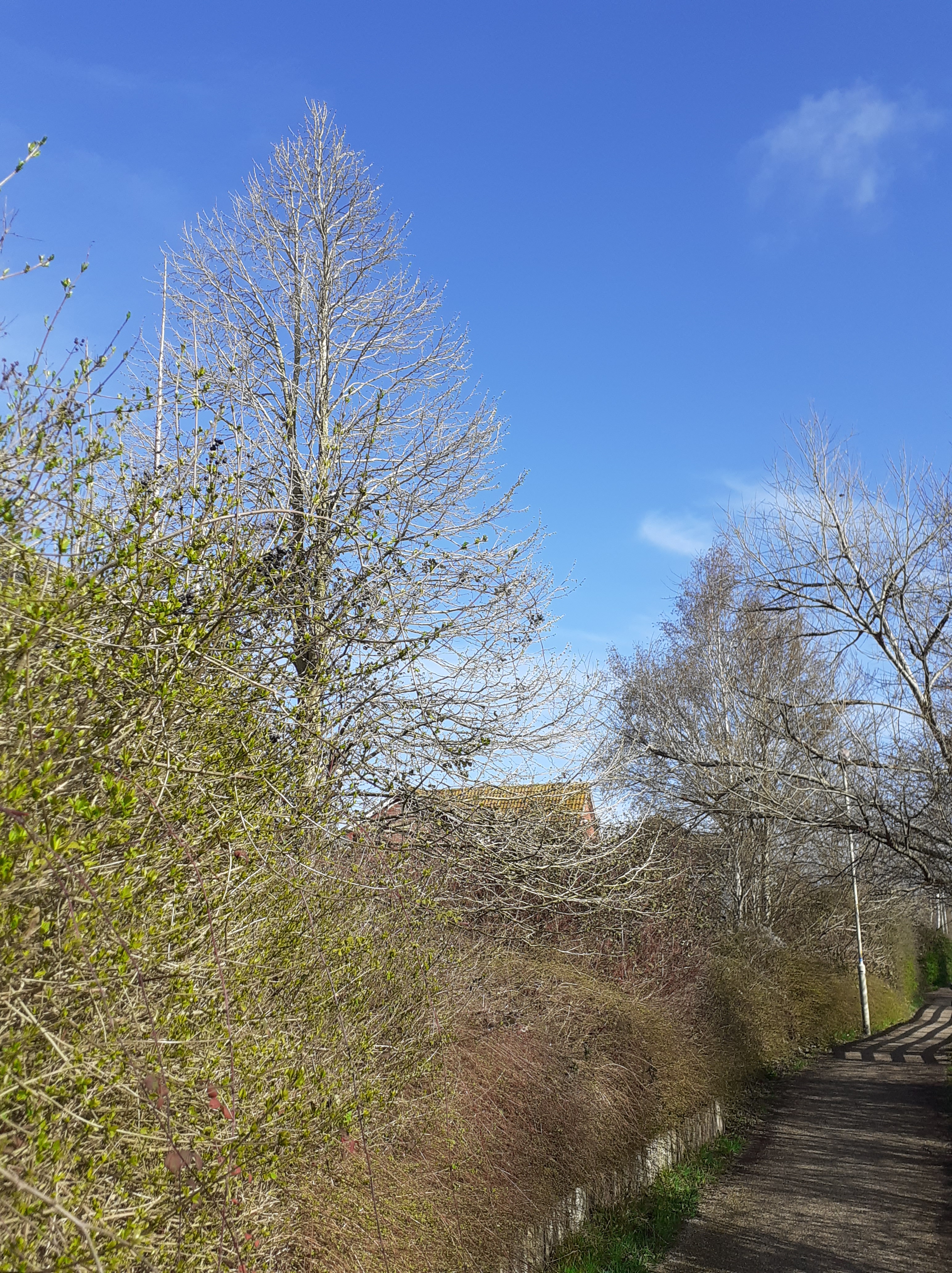
Lately I have been seeing more catkins and leaves amongst the elegant branches of their trees. A vivid green is present on the ground. As yet the changes are tentative. But they hold the promise of new life and growth. There’s a freshness here, enhanced by strong breeze. I notice and feel energised, walking down the path.

The changes have not gone very far, but the trend is now clear. For me, it shows up well against a blue sky. In this changeable season, I see possibilities for my own life, now that I am settled and in good health. These too are in their early stages, showing signs of promise more than accomplishment. My inner wisdom warns me not to move past ‘promise’ into ‘accomplishment’ too speedily or strivingly. Promise has its own season.

EMERSON: ‘IMMORTAL BEAUTY’

“Crossing a bare common, in snow puddles, at twilight, under a clouded sky, without having in my thoughts any occurrence of special good fortune, I have enjoyed a perfect exhilaration. I am glad to the brink of fear. In the woods too, a man casts off his years, as the snake his slough, and at what period soever of life, is always a child. In the woods, is perpetual youth.

“Within these plantations of God, a decorum and sanctity reign, a perennial festival is dressed, and the guest sees not how he should tire of them in a thousand years. In the woods, we return to reason and faith. There I feel that nothing can befall me in life, – no disgrace, no calamity, (leaving me my eyes), which nature cannot repair.

“Standing on the bare ground, – my head bathed by the blithe air, and uplifted into infinite space, – all mean egotism vanishes. I become a transparent eye-ball; I am nothing; I see all; the currents of the Universal Being circulate through me; I am a part or particle of God. The name of the nearest friend sounds then foreign and accidental: to be brothers, to be acquaintances, – master or servant, is then a trifle and a disturbance. I am the lover of an uncontained and immortal beauty.” (1)

In the first paragraph above, I hear my own experience, described in a mid 19th century American voice. I share the sense that the exhilaration comes partly from the land, woods and sky themselves and partly from the continuing life of the child within us.

In the second paragraph, I feel at home with with the overall sentiment, whilst having to work a little with Emerson’s terminology. At the beginning I am not sure what he means by ‘God’. I do understand that ‘plantations of God’ restores innocence, as well as wildness, to the term ‘plantation’. (Emerson was a notable abolitionist.) I also note that the woods are a domain where reason and faith are brought together, in a time and culture where they seemed to be in conflict. Nature isn’t just a word for material reality. Nature is a source of protection and healing that goes beyond the mundane.

The third paragraph makes Emerson’s transcendentalism clear, and with it the true power of contemplation. ‘Standing on the bare ground … uplifted into infinite space – all mean egotism vanishes. I become a transparent eyeball. I am nothing: I see all”. God and Nature become Universal Being, from which ‘I’ am not separate. To be simply present in this space, with no agenda and nothing in mind, is to be “the lover … of an uncontained and immortal beauty”. The nature of our experience is a living nature we perceive, are part of, and relate to – not a reified externality. An open, enlivened receptivity to this reality can allow a deeper awareness (for Emerson, that of the Divine in us) to declare its presence.

(1) Ralph Waldo Emerson Nature Boston, Mass: Thurston, Torry and Company, 1849

NOTE: According to Wikipedia, Ralph Waldo Emerson (1803-82) “was an American essayist, lecturer, philosopher, abolitionist and poet who led the transcendentalist movement of the mid-19th century” who gradually moved away from the religious and social beliefs of his contemporaries, formulating and expressing the philosophy of transcendentalism in his 1836 essay Nature”. He wrote most of his important essays as lectures first and then revised them for print. “Emerson’s ‘nature’ was more philosophical than naturalistic. … Emerson is one of several figures who took a more pantheist or pandeist approach by rejecting the view of God as separate from the world”.

Earth Eclectic

music that celebrates Earth and speaks to the heart

Sarah Fuhro Star-Flower Alchemy

Follow the Moon's Cycle

Muddy Feet

Meeting nature on nature's terms

Rosher.Net

A little bit of Mark Rosher in South Gloucestershire, England

Becoming Part of the Land

A monastic polytheist's and animist’s journal

selkiewife

Selkie Writing…

Charlotte Rodgers

Images and words set against a backdrop of outsider art.

Prof Jem Bendell

living purposefully during metacrisis and collapse

Towint

The pagan path. The Old Ways In New Times

The Druids Garden

Spiritual journeys in tending the living earth, permaculture, and nature-inspired arts

The Blog of Baphomet

a magickal dialogue between nature and culture

Musings of a Scottish Hearth Druid and Heathen

Thoughts about living, loving and worshiping as an autistic Hearth Druid and Heathen. One woman's journey.

Wheel of the Year Blog

An place to read and share stories about the celtic seasonal festivals

Walking the Druid Path

Just another WordPress.com site

anima monday

Exploring our connection to the wider world

Grounded Space Focusing

Become more grounded and spacious with yourself and others, through your own body’s wisdom

The Earthbound Report

Good lives on our one planet

Hopeless Vendetta

News for the residents of Hopeless, Maine

barbed and wired

All content on this site is now located at www.jonberrywriter.co.uk