Contemplative Inquiry

This blog is about contemplative inquiry

Tag: Druidry

A NEW WINTER

I’ve been in transit to winter for the last three weeks. Today is the day that I got here. The part of me that senses this movement is aware of only two seasons, summer and winter. There is a debatable zone twice a year, over varying lengths of time depending on events on the ground. I notice that the heavens are less important – sun, moon and stars impact only through the way they look and feel to me, and the way they affect my light. I am not, in this mode, a maker of calculations.

I’m not bringing in cattle for preservation or slaughter, the classic harbinger of Samhain. So I look for other signs. This year’s process began on my visit to Yeovil, where I was born and lived with my parents many decades ago. They are long gone, but I have naturally been thinking about them, and the life that we had there. Our old home is desolate and the picture above is a shop front from the same street. The Unknown sign is from well after my time, presumably once a catchy name for a modest business. Now it too is stripped out and empty, so that I don’t even know what Unknown once meant. This unknown is scripted only as a single word, a fuller story hard to find.

Yet there the sign is – Unknown – on the door, and I cannot help but wonder about it. Imaginatively I entered that door when I took the picture, in the limited sense that I’ve been conscious of it for the last three weeks, and it has flavoured my experience. I knew that I would write about it at some point. I’ve had dreams of disconnection, dislocation and dissolution. They haven’t stimulated anything so gothic as terror, but they have created a low level discombobulation, a sense of the times being out of joint. Two people close to me have had to weather unexpected misfortunes. There has been a theme of grey skies and heavy rain, interspersed though with jewel-like periods of sunshine in the continuing fall.

I recognised the decisive shift to winter when I saw ice today, outside the kitchen door. I embraced winter, and surrendered to it: a simple act of will, as I responded to the sight of ice. To some extent, during today, I have felt, briefly, the reassurance of being in a ‘season’, where the world follows its appointed course. Winter is here. It happens every year. But I still see that bleak door marked Unknown. The much celebrated wheel of the year, with its times and seasons, basis for a bedrock practice in modern Druidry and Paganism, is itself volatile and perceptibly changing. I don’t find much comfort or certainty there. I feel as if I have been woken out of a trance – and am called to a fuller relationship with unknowns and unknowing.
FEELINGS AND CONTEMPLATION

“In meditation, when a wave of feeling comes to visit – a grief, a fear, an unexpected anger or melancholy – can you stay present with that wave, breathe into it, let go of trying to ‘let go’ of it, and simply let it be, let it live, let it express itself right now within you? Can you notice the impulse in you to resist it, to refuse it, distract yourself from it and move away from your experience? Don’t judge or shame yourself for that impulse either, for wanting to have a different experience that you’re having – it’s an old habit, this urge to disconnect, this impulse to flee, this addiction to ‘elsewhere’.

” But see, today, if you can stay very close to ‘what is’, see if you can actually connect with the visiting feeling, gently lean in to your experience as it happens. Instead of shutting down, moving away, denying the energy in the body, can you gently open up to it? Can you flush it with curious attention? Let it move in you? Stay present throughout its life cycle, as it is born, expresses what it has to express, and falls back into Presence, its oceanic home?” (1)

The extract above is from a piece by Jeff Foster called When We Push Feelings Away. I support his approach, though I don’t now make firm distinctions between an activity called ‘meditation’ and the spontaneous flow of attention. I can stay present with the wave of feeling, and breathe into it, whether I’m ‘in meditation’ as a defined practice or not.  Meditation, once exotic and formal, has become naturalised. My contemplative life is pared down and minimalist, holding a strong sense of the sacred in daily life, including the work of self-healing. Jeff Foster continues:

“… One day, deep in meditation, perhaps, we remember, all feelings are sacred and have a right to exist in us, even the messiest and most inconvenient and painful ones. And we remember to turn towards our feelings instead of turning away. To soften into them. To make room for them instead of numbing them or ignoring them. …. So much creativity is released, so much relief is felt, when we break this age-old pattern of self-abandonment and repression, go beyond our careful conditioning, and try something totally new: staying close to feelings, as they emerge in the freshness of the living moment, waving to us, calling to us, seeking their true home in our heart of hearts.”

Jeff Foster calls this piece Pushing Feelings Away. I like his concern with holding and acceptance within what he calls Presence. I call my overall path a Sophian Way, and not The Sophian Way, because it is a solitary path that morphs and shifts.  Jeff Foster works with personal feelings from a transpersonal, non-dual  perspective that I find very Sophian, characterised  by wisdom, contemplation and compassion. My own path brings together this approach with the Eco-spirituality – or ‘Nature Mysticism’ – catalysed by my experience of modern Druidry.

(1) Jeff Foster The Joy of True Meditation: words of encouragement for tired minds and wild hearts Salisbury: New Sarum Press, 2019

CONTINUITY AND CHANGE

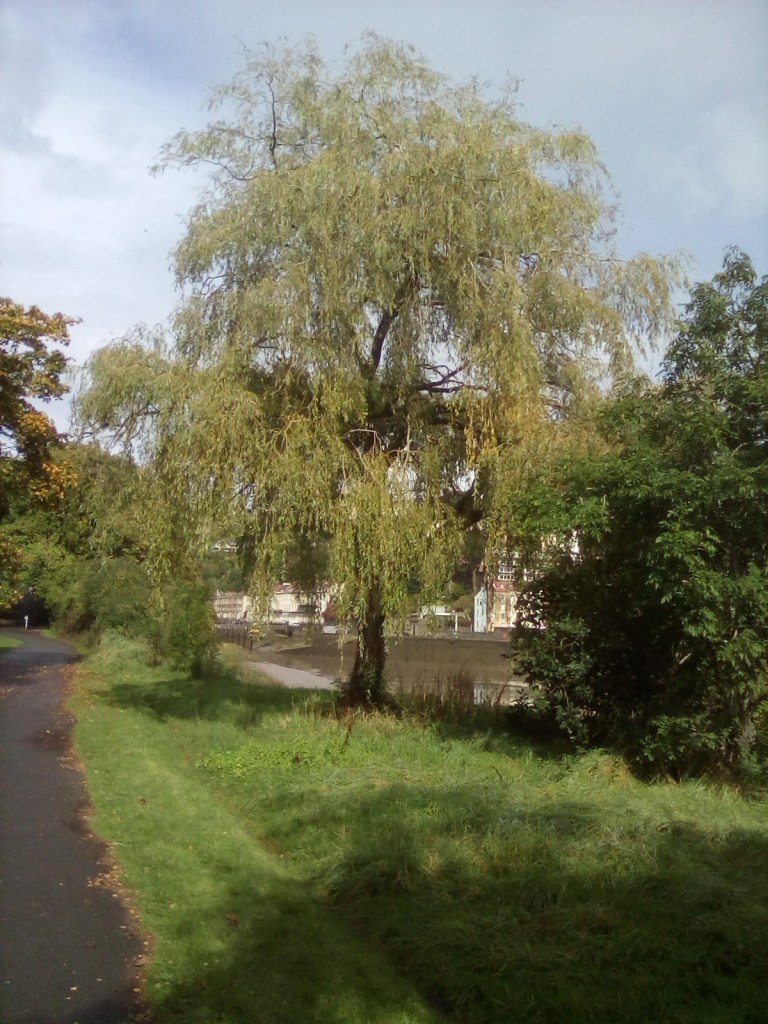
IMG_20191001_124254

I took this picture on 1 October this year. The subject is a willow tree I befriended many years ago as part of my Druid training. It lives in Bristol beside the Avon as the river begins to leave the city, passing through the Clifton gorge and under the suspension bridge. The path, here at the edge of a park, is also a cycle track and continues towards the Severn estuary beside the river. Although I no longer live in Bristol, I continue to visit the willow from time to time and renew the contact.

My strongest link with the tree was in early spring. where I got the most powerful sense of its pulse and vibration, felt especially whilst touching the trunk with the palms of my hands. But I was careful to follow it through a year of regular communion during which it lost a substantial branch to a violent storm. I learned to associate this tree with regeneration, resilience and  generativity. The tree re-established its balance. The dead branch rotted gently in the ground, and contributed to other forms. Nothing was lost.

I’m about to go on a rare visit to my home town, partly to contemplate the continuities and discontinuities of my life and consider future directions. The image of the willow is with me.


CONTEMPLATION AND ENGAGEMENT


According to my dictionary, one of the meanings of ‘signature’ is, “a distinctive pattern, product, or characteristic by which someone or something can be identified: the chef produced the pate as his signature dish”.

I want to adjust the signature of this blog. I want now to explore the relationship between contemplation and engagement more explicitly. A blog is itself a form of engagement, and this one has so far combined a strong curatorial thread with personal sharing. Now, for me as for many others, a deepening social and ecological crisis asks for a work of preserving existing life-affirming aspects of our culture and developing new ones. I see this work as enhanced by outward-looking forms of contemplation. I want this blog to contribute.

I started this blog as a Druid. My personal path, which I have described more recently as a Sophian Way, has become more Universalist. I have described it as a path of healing, peace and illumination, which encourages a spirit of openness, an ethic of interdependence and a life of abundant simplicity. Its ‘sacrament of the present moment’ involves resting in a place of underlying stillness, freedom and love within any experience – good experiences, wonderfully, but also bad ones that need active resisting on the ground. For some, this suggests an experience of divine support, or the activation of the divine within us or of the divinity that we truly are. For others it seems to come from a deep wellspring within the psyche that needs no further point of reference. This sacrament is my core practice, to be dropped into at any time. It doesn’t always take a pure form, but it usually makes a difference. In the myth of my own life, it is Sophia’s principal teaching.

At the level of the wider word, I continue to feel a strong sense of alignment with Pagan, Animist, and Earth spiritualities like Druidry – more than to the Buddhist or Gnostic families or to movements like the Headless Way, even though they have given me a lot. Philip Pullman in his The Secret Commonwealth* has a character who says that where we stand revolves around one key question – ‘is the world dead or alive?’ I say ‘alive’ without worrying about scientific definitions or the metaphysics of reality. Something in me just has to say ‘alive’ – alive and interconnected as a web of life. This re-affirmation is important to me, and as a ‘light bulb moment’ on a level with the more seemingly individual aspects of my Sophian Way. I don’t expect to change the blog that much, but there’s enough adjustment of signature here to demand explicit affirmation.

*Philip Pullman The Secret Commonwealth Oxford, David Fickling Books & London, Penguin, 2019 (Vol. 2 of The Book of Dust)


BOOK REVIEW: DRUIDRY AND THE FUTURE

Highly recommended. Druidry and the Future is intended as “antidote to despair” according to author Nimue Brown. She continues:

Druidry & Future 51hWUITk4HL._AC_UY218_ML3_

“This book explores the many ways in which the Druid path can help us to respond to climate chaos, necessary cultural change and political uncertainty. By mixing the spiritual and practical we can be more resilient and resourceful, and aspire to live in regenerative and generous ways.”

An affordably priced and relatively slender volume, Druidry and the Future is full of ideas. It is built around 16 essays covering diverse topics: working with Pagan stories: seasonal living: bardic powers; ‘pragmatic’ animism; working with the elements (three essays); de-colonising your soul; your body is nature; justice and balance; honouring the divine through action; putting ourselves back in the landscape; community solutions; self-care and kindness; trees and wetlands; regeneration and restoration. For me, there is a single overarching theme: enlisting the resources of modern Druid culture to build resilience in the face of climate catastrophe. This resilience includes personal and collective aspects, where humans and their communities are understood as wholly embedded in the wider web of life.

Nimue Brown is clear that “it is not enough to be sustainable”. The crisis invites, or rather requires, a radical change in values and behaviour. Human civilization is ‘just people’ and we have the capacity to live differently. For her, “this is what Druidry means right now. It’s about answering the question of how to put civilization in balance with our living planet. This is Druidry for radical change and I think we’re well placed to take on this work and to inspire others. Philosophy has always been part of Druidry, so has teaching and communication, inspiration and vision. We can, and must make a difference.”

BOOK REVIEW: SEEK TEACHINGS EVERYWHERE

This post is about Philip Carr-Gomm’s Seek Teachings Everywhere: Combining Druid Spirituality with Other Traditions. I highly recommend this book to anyone interested in the specific topic and/or the development of modern spiritual movements more generally.

Elegantly and accessibly presented, the book testifies both to a personal journey and a key role in developing modern British Druidry. Both the journey and the role are an interweaving of Pagan and Universalist threads. PCG’s approach has been to adopt Druidry as a ‘meta-path’, one able “to transcend religious distinctions”, and allowing of involvement in other paths as well. The Jain path, shared with his Druid mentor Ross Nichols, is the one given the greatest individual attention in the book, in a long section on Druidry and Dharmic traditions. This section touches also on other Indian derived movements and practices (Buddhism, Yoga Nidra) and speculates on ancient cultural and linguistic resonances between early Indian traditions and early European Druidry. PCG dedicates other sections of the book to Christianity and Wicca, with suggestions about how they too can harmonise with Druidry.

This overall approach is reflected in the lived culture of the Order of Bards, Ovates and Druids (OBOD), which PGC has led for thirty years. He is now in a process of stepping down from the role, and so the book is a timely account of both vision and legacy. He says: “each spiritual way has gifts to offer, and some people find in Druidry all the spiritual nourishment they need. Others combine their Druidry with other approaches, such as Wicca, Taoism, Christianity, Buddhism, Hinduism or Jainism”. OBOD’s ancestry as a movement derives from Celtic and Western Way currents within early twentieth century theosophy. The Order remains true to that heritage – as evidenced by a website that actively describes synergies with other paths and provides links to them – see www.druidry.org/ .

My personal takeaway from the book concerns PCG’s substantial presentation of Jain ethics, grounded in three key principles: ahimsa, aparigraha and anekant, here described as the Triple A. PCG explains: “Ahimsa is the doctrine of harmlessness or non-violence, made famous by Gandhi, and espoused by the other Dharmic traditions of Buddhism and Hinduism”. Aparigraha, the doctrine of non-attachment, non-possessiveness or non-acquisition, likewise appears in these other schools. Anekant, a doctrine of many-sidedness, multiple viewpoints, non-absolutism or non-one-sidedness, is unique to The Jains. The three principles can be seen as completing each other – with many-sidedness an aspect of non-violence and non-attachment, and so on.

PCG recommends these principles for our time. They inform his own vision of Druidry. “We know that the world suffers from too much conflict, too much fundamentalism, and too much consumption. This suffering can be alleviated by applying the Triple A doctrines: seeking non-violent solutions, respecting and learning from others’ opinions and beliefs, and reducing consumption to sustainable levels”. In the Jain tradition, such an approach to life is supported by practices of ritual and meditation that work towards the release of negative attachments. PCG recommends versions of these as well.

Part of the beauty of this book is that different readers will find different reasons to take note and learn from it. I have found it valuable both as an authoritative record of a current in modern Druidry, and as a personal inspiration.

Philip Carr-Gomm Seek Teachings Everywhere: Combining Druid Spirituality with Other Traditions Lewes, UK: Oak Tree Press, 2019 (Foreword by Peter Owen Jones)

SOPHIAN REMINISCENCE

For me, sacred images are sometimes filled with life and potency and sometimes not. The important ones  explode as gifts from the hinterlands of the psyche. They are intensely moving, perhaps shocking, certainly state altering. They may be nurturing and easy to welcome. They may be surprising and demand unlooked-for adjustments. Over time they may continue to be influential, changing and developing with me. They may become formal and emblematic – no longer living yet still anchoring insight. Eventually they may fade. Such images are not possessions. Attempts to grasp or hoard them do not work.

I call my path a Sophian Way. I have an icon of Sophia on my desk and I check in with her from time to time. It still feels authentic and makes sense to me. At the same time, I am aware of how much has changed since Sophia erupted into my life twelve years ago.

In the summer of 2007, I was immersed in my OBOD Druid studies. It was one of the few times in my life when I have cleared whole days for ritual work, and whole days for recovering afterwards. I found the work generating its own momentum, in some ways fulfilling the agenda of my course and in some ways pointing in a different-seeming direction. Images and dreams of dove feathers, either falling or lying on the ground – and then their actuality – became very prominent. Key images and ankh images were present as well.

The powerful dove imagery evoked Goddess associations from the Pagan tradition and Holy Spirit from the Judaeo-Christian one. To honour both, I found a reference in a modern Gnostic group ( www.thepearl.org/ ) that seemed to fit:

“Mortals have been created to dwell in the Garden of delights. … In the Garden stands the holy Tree of Life. High in its branches sings a bird. Listen to the voice of the bird, for when you are properly aligned with heaven and earth, she will tell you all things. … This bird or dove is also called Sophia”.

This felt like an authentic, and unifying, message for me because of its attitude towards the Garden. I as a human belong there. My belonging is not in question. There is one tree, the tree of life. The ‘knowledge’ aspect, such a disaster in mainstream Christianity, is very different here. There’s no apple to pick from the bough, but a bird who will sing to me. But something is expected of me, all the same, if I want to enhance my life and understanding. I am asked to align myself with heaven and earth. If I do this, I am assured that “she will tell you all things”. I don’t understand this as a discourse on metaphysics. I understand it as me listening in another key, listening to bird song in this metaphor, and so refining my sensitivity. For me, the imagery of the tree and the singing bird high in its branches is as resonant of a Shamanic or Pagan world view as it is of a Gnostic or Christian one. I do not have to choose.

The Pearl website turns to Joseph Campbell, a modern spokesman for the meaning of myth, on this point. He says: “people say that what we’re all seeking is the meaning of life. I don’t think that’s what we’re really seeking. I think that what we are seeking is an experience of being alive, so that our life experiences on the purely physical plane will have resonances within out innermost being and reality … as we get to know our innermost being we receive the keys that open up a life that is truly Life, for it is everlasting”.

My own sense of the ‘Life everlasting’ doesn’t pre-suppose an afterlife, re-incarnation, or any other world. Eternity, if anywhere, is present in the now. The song of the bird represents a neurosomatic wisdom, not a cognitive one, of living connectedness within one stream of life.

What I like about this reminiscence is that I have been given a chance to renew my sense of Sophia by returning to source. The original work is well-documented, so I haven’t had to rely on memory. I had completely forgotten about the ‘Pearl’ group. I’m also glad that I’ve seen more than first time round in terms of the tree and birdsong. At the time, I just recorded the images and threw down the references. It has renewed my relationship to the Sophia image in the now.

For information about OBOD see

OBOD | Order of Bards, Ovates & Druids | Druidry

POEM: RAPT FORM

FIRE upon Night the way flashing

Cove within Earth the seed receiving

South into North of us –

Eagle upon mountain and the light ascending

The Bowl of the daily dark descending

Stars beyond the shore of us

The Centre stays and the pattern fixes

The Centre moves and the diagram mixes

For many and more of us.

The Eye shines as the cast is shining

The Bowl gathers darkness as the shade is spreading

The Pentagram weaves its tent overheading

The stars and the Polestar turning and twining

Until the rotating of day.

O day and night O night of time

[the weft upon the warp of rhyme}

I backward step to the abyss

Where Form ends and Nothing is –

Where Nothing ends and All-Thing is.

Ross Nichols Prophet Priest and King: The Poetry of Ross Nichols Lewes: The Oak Tree Press, 2001 (Edited and introduced by Jay Ramsay)

“Ross Nichols, who was a contemporary of Eliot, and rated highly by many including Edwin Muir, was Chief of the Order of Bards, Ovates and Druids (OBOD) until his sudden and unexpected death in 1975. An accomplished prose writer, essayist, editor and water colourist who exhibited at the Royal Academy, we can now see him as one of the ‘Apocalypse poets’ of the 1940’s As Chief of the Order from 1964, his contribution was substantial, re-introducing into modern Druid practice the Winter Solstice Festival and the four Celtic Fire Festivals, which he led at London and in Glastonbury.”(Book blurb)

For information about OBOD see http://www.druidry.org/

LADY OF WOODS AND MISTRESS OF WILD THINGS: MARY MAGDALENE IN PROVENCE

“In the new land, Mary loved to go into the woods for prayer and meditation, just as, in the Holy Land, she had enjoyed retreats into the wilderness of the desert”. Today, 22 July, is St. Mary Magdalene’s day. To honour this, I have chosen to focus on an old tradition that she went to in southern Gaul (France) sometime after Jesus was gone.

The suggestion is that she needed to get away from people in power and a section of the new movement that didn’t want her to teach. It seems she went to Massilia (modern Marseilles). Like Alexandria, the city was a significant Mediterranean port, a Greek foundation with a thriving Jewish community, now under Roman rule. It explains why the Celtic Druids of the region wrote commercial correspondence in Greek, the common language of Mediterranean trade at the time. The city is an entirely plausible choice for an exile in Mary’s position at that time.

Legend says that Mary did not stay in the city but went out into the Gallic hinterland and began a teaching and healing mission. It is not surprising that her lore has incorporated indigenous themes (1):

“One time a young disciple followed her into the woods, wishing to be near her and to see what she was doing. When she passed through a clearing and went into the treeline on the other side, the disciple lost site of her. He ran to catch up, and just as he entered among the trees he found himself surrounded by a pack of wolves, each wolf staring at him in silence. He was frozen with fear and dare not move for fear the wolves would swiftly be upon him. The Lady Mary appeared and said to him, ‘I did not ask for your company. Why are you following me?’ He responded, ‘My Lady I sought only to be near you and see what you were doing’. She said to him, ‘it is dangerous to draw near to a queen without the permission of the king or the queen herself, for her guards are likely to kill a man intruding on her privacy. I go out to meet with my Beloved and it is a private matter. It is unbecoming that you have followed me. Return to your place, and do not come out or go in unless the Spirit of the Lord moves you. Having said this, Lady Mary vanished into the woods. The wolves vanished with her, leaving the young man in awe. Needless to say, the young disciple never followed the Lady Mary into the woods again.

“There were many times the disciples saw wolves going along with the Holy Bride in the woods, as well as other wild beasts. …. There were so many stories of people seeing Our Lady with wild creatures in the woods that many called her the Lady of the Forest, others called her the Mistress of Wild Things and sometimes Lady of the Beasts.”

(1) Tau Malachi St. Mary Magdalene: The Gnostic Tradition of the Holy Bride Woodbury, MN: Llewellyn Publications, 2006

A modern naturalistic account of Mary’s life, including later years in southern France, can be found in: Michele Roberts The Secret Gospel of Mary Magdalene London: Vintage Books, 2007 (originally published by Methuen is 1984 as The Wild Girl)

SEEING: CONTEMPLATIVE DRUIDRY

There is a dance between experience and meaning. Experience informs meaning, yet the meaning given to significant experiences can change over time, in the light of later experiences. Looking back at my introduction to Contemplative Druidry (1), I now sense that my contemplative journey was triggered by a kind of Wild Seeing, long before I encountered the work of Douglas Harding (www.headless.org/ ). Here is what I wrote.

“On 22 June 2007 my centre of gravity shifted. It was late morning. I was just outside the Scottish Border town of Melrose, drawn in three possible directions. One was up the hills at the back of the town – the Eildon Hills, the hollow hills where the Queen of Efland took Thomas the Rhymer; True Thomas as he became. The second was the fine, if half-ruined, Abbey and its grounds; a place of Green Man carvings, fruit trees, and the heart of Robert the Bruce. The third was the banks of the Tweed.

“I took the third option and walked into a wholly unexpected and not at all dramatic epiphany. It was triggered simply by noticing and contemplating a wild rose, growing on the banks of the river. It lasted a few moments, just long enough for me to register it, and to experience a subtle shift of awareness in consequence. For some weeks I woke up every day with a sense of joy and connection. Months later, I wrote the verse that expressed it:

I am Rose. I am wild Rose.

I am Rose at Midsummer.

The river flows by me.

Fragile, I shiver in the wind.

And I am the heart’s core, mover of mountains.”

I was aware at the time that I was contrasting three choices in a fairy tale kind of way. The first was the path of magic (the Queen of Elfland). The second was the path of contemplative religion (Melrose Abbey). The third was the path of direct experience (wild rose on the riverbank). I chose the third. The poem best shows the import of this deceptively simple experience, especially in the last line. ‘I am the heart’s core; mover of mountains’ is more than a nature mysticism. I speak not only as the rose, but as the heart’s core, mover of mountains. I speak from the source.

During its collective life, contemplative Druidry did take its stand in direct experience. It was also very open – we talked of being of like intent rather than like mind; there was no consensus cosmology or belief. On the whole we were naturalistic, but not quite in the humanist or materialist sense. The use of terms like ‘Earth spirituality. ‘nature mysticism’. pantheism’ and ‘animism’ pointed to something more expansive. Now my experiences of  Seeing, support the view advocated by Douglas Harding and described as nondualist and panentheist. In everyday terms we can say that we have two identities, one as humans and the other as the ground of being. Ultimately, there is no separation and so only one true identity. Seeing is offered as a skilful means of learning to recognise this identity, and then to live from it.

My Sophian Way is now firmly in this territory. My challenge is to cleave to the experiential practice and its fruits whilst staying open about metaphysical claims. The intelligence of the heart is nourished by this view and is attracted by the reassurance of a clear and simple narrative. The mind wants to stay agnostic and provisional. When mobilised, it can ferret out weaknesses in the view. The Sophian Way is a way of wisdom, as well as a salute to the cosmic mother and healer in the heart. Wisdom invites me to trust the process – maintaining just enough scepticism to avoid attachment to views.

(1) James Nichol , Contemplative Druidry: People, Practice and Potential, Amazon/Kindle, 2014.  https://www.amazon.co.uk/contemplative-druidry-people-practice-potential/dp/1500807206/

Earth Eclectic

music that celebrates Earth and speaks to the heart

Sarah Fuhro Star-Flower Alchemy

Follow the Moon's Cycle

Muddy Feet

Meeting nature on nature's terms

Rosher.Net

A little bit of Mark Rosher in South Gloucestershire, England

Becoming Part of the Land

A monastic polytheist's and animist’s journal

selkiewife

Selkie Writing…

Charlotte Rodgers

Images and words set against a backdrop of outsider art.

Prof Jem Bendell

living with metacrisis and collapse

Towint

The pagan path. The Old Ways In New Times

The Druids Garden

Spiritual journeys in tending the living earth, permaculture, and nature-inspired arts

The Blog of Baphomet

a magickal dialogue between nature and culture

This Simple Life

The gentle art of living with less

Musings of a Scottish Hearth Druid and Heathen

Thoughts about living, loving and worshiping as an autistic Hearth Druid and Heathen. One woman's journey.

Wheel of the Year Blog

An place to read and share stories about the celtic seasonal festivals

Walking the Druid Path

Just another WordPress.com site

anima monday

Exploring our connection to the wider world

Grounded Space Focusing

Become more grounded and spacious with yourself and others, through your own body’s wisdom

The Earthbound Report

Good lives on our one planet

Hopeless Vendetta

News for the residents of Hopeless, Maine