Contemplative Inquiry

This blog is about contemplative inquiry

Tag: Druidry

BOOK REVIEW: THE GREATEST ACHIEVEMENT IN LIFE (REVISED AND UPDATED EDITION)

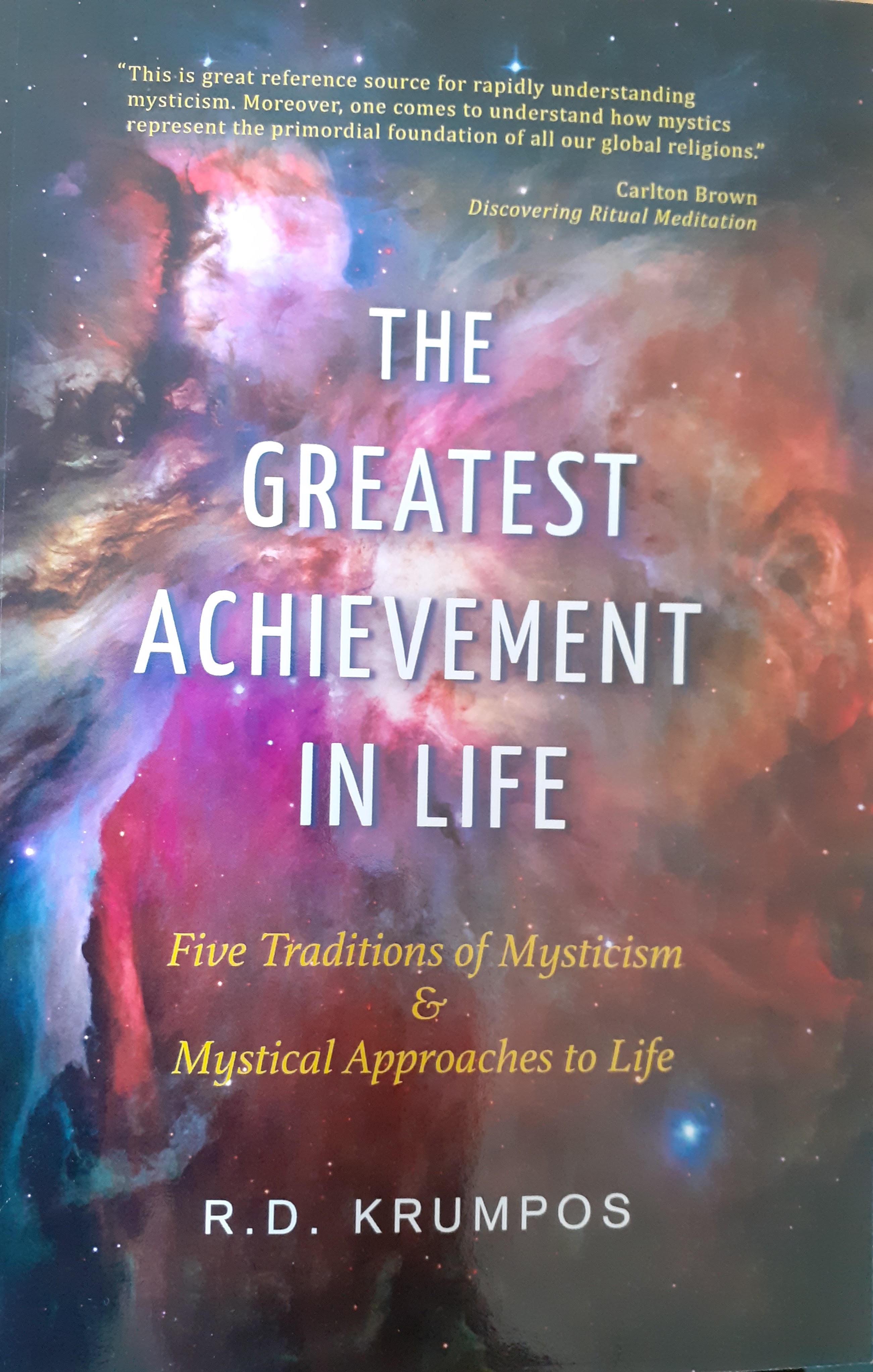
Highly recommended for anyone drawn to contemplative and mystical traditions. R. D. Krumpos’ The Greatest Achievement in Life: Five Traditions of Mysticism & Mystical Approaches to Life (1) is now available in print, in a new revised edition. I like having it now as an old-fashioned physical book that I can leaf through easily both for reference and for inspiration.

The book explores the mystical traditions embedded within Hinduism (Vedanta, Tantra), Buddhism (Zen, Vajrayana), Judaism (Hasidism, Kabbalah), Christianity (Gnostic and Contemplative currents) and Islam (Sufism). Krumpos shows how, underneath their manifold differences, they share an understanding of mysticism as the direct intuition or experience of God, or of an ultimate Reality not conceived as God.

Mystics are described as people whose spiritual lives are grounded “not merely on an accepted belief and practice, but on what they regard as first-hand knowledge”. Krumpos spells out the uncompromising idealism of this project. “Mysticism is the great quest for the ultimate ground of existence, the absolute nature of being itself. True mystics transcend apparent manifestations of the theatrical production called ‘this life’. Theirs is not simply a search for meaning, but discovery of what is i,e, the Real underlying the seeming realities. Their objective is not heaven, gardens, paradise or other celestial places. It is not being where the divine lives, but to be what the divine essence is here and now”.

The book is divided into two main sections: Five Traditions of Mysticism and Mystical Approaches to Life. Within these sections there is a further division into short essays, which can be read either in sequence or independently of the whole. The essays are based both on conversations with mystics and engagement with mystical literatures. Krumpos draws directly on the words of well-known mystics themselves, with 120 quotations interspersed with the essays. He also offers his own commentary and reflections. The book can either be seen as a source and reference book, or as a practitioner aide. It includes sentences and paragraphs that can themselves be used as a basis for formal contemplation. It is not just an ‘about’ book, though it serves that purpose well.

The traditions presented are seen as having much in common at the core, and The Great Achievement bears witness to that commonality. Yet there is enough interior diversity to make it clear that mystics in these traditions are not all the same, or saying the same thing, in the way that is sometimes lazily claimed. Overall Ron Krumpos’ sense of ‘direct experience’ and his definition of gnosis describe a gold standard for what ‘the greatest achievement’ is, based on the accounts of the mystics cited and discussed. In the second half of this book, the focus valuably shifts from the nature of mystical experience itself, to a consideration of its implications for how to live and serve.

For me, the cultural moment in which The Great Achievement has been offered is significant one. Perennialism’s ideas have been popularised and repackaged over the period since World War II at an ever increasing rate. There is now an extraordinary global spiritual hunger at least partly influenced by the spiritual paths that it includes – some, indeed, speak of a ‘spiritual market place’. This is a promising development, yet one with its downside. Krumpos’ work reminds us what these older traditions are and where they stand. For readers in new (or new-old) spiritual traditions with a different approach, the book offers opportunities for comparing and contrasting the fruits of the five traditions with those of their own chosen paths. Krumpos does acknowledge the value of shamanic and indigenous traditions, and practitioners within these traditions, reading this book, might be inspired to develop this conversation further.

(1) R. D. Krumpos The Greatest Achievement in Life: Five Traditions of Mysticism & Mystical Approaches to Life Tucson, AZ: Palomar Print Design, 2022. (Originally a free e-book available from http://www.suprarational.org/ as a printable pdf, published in 2012).

NB This review is a revision of my review of the original edition. See:

https://contemplativeinquiry.blog/2021/03/06/

WATER MEADOW WALK

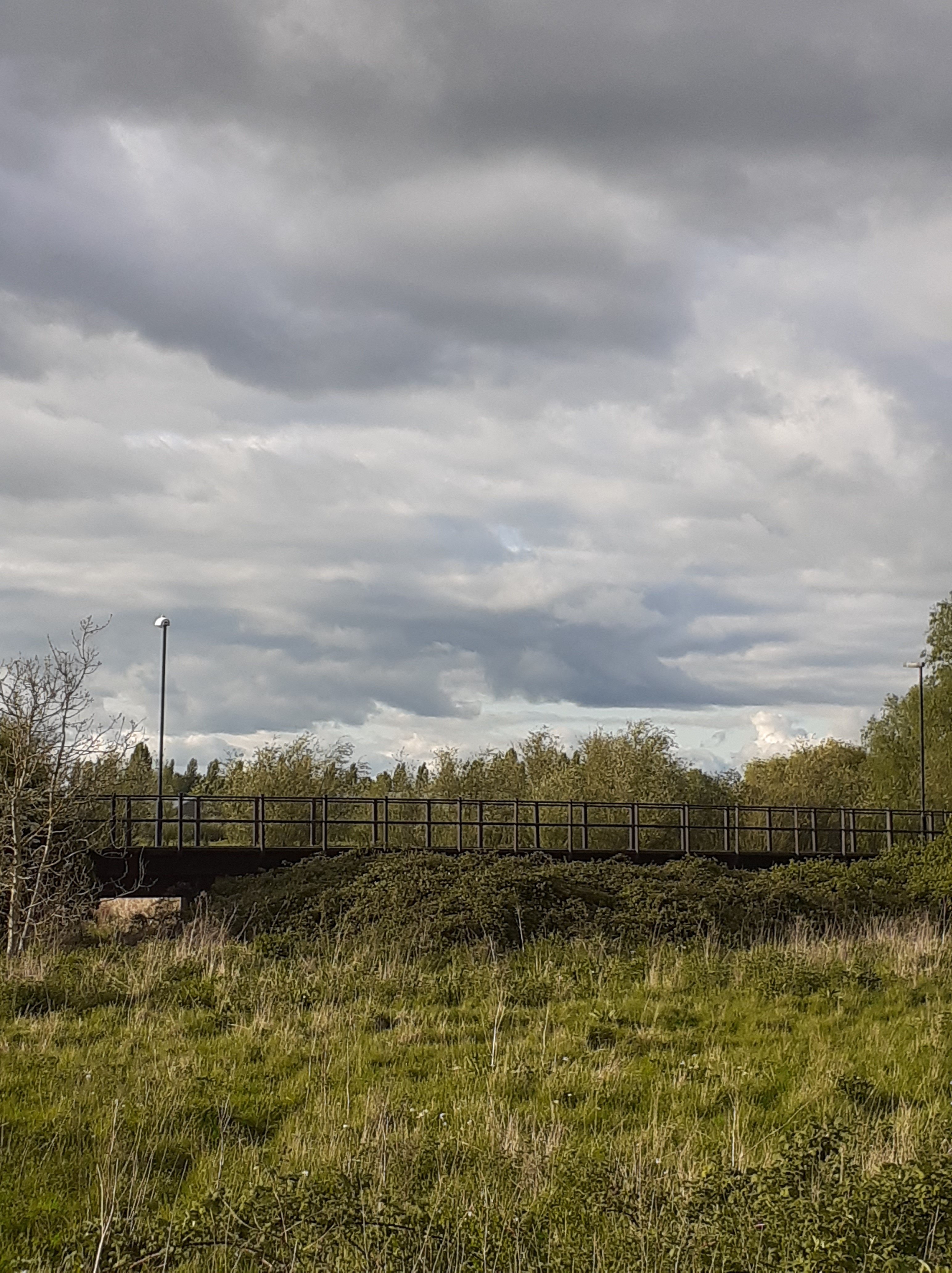
A water meadow during a dry spell. A secluded space on the fringe of the old city. Luckily for its own life, it facilitates the management of flooding. This space is available to the public, and on this walk it seems less frequented than I would have expected. It is not grandly wild, but feels different from anywhere else I have discovered in easy walking distance from my home. I like its flatness, its greenness, and its openness to the sky.

I walk here in the early evening, grateful for the path, challenging the pollen to do its worst. Lifelong hay fever has made me less of a nature boy than I might have been, certainly at this time of year. But I don’t like feeling restricted, even with my new health complications. Walking in an open space like this, particularly when there is a good breeze, lifts my spirits.

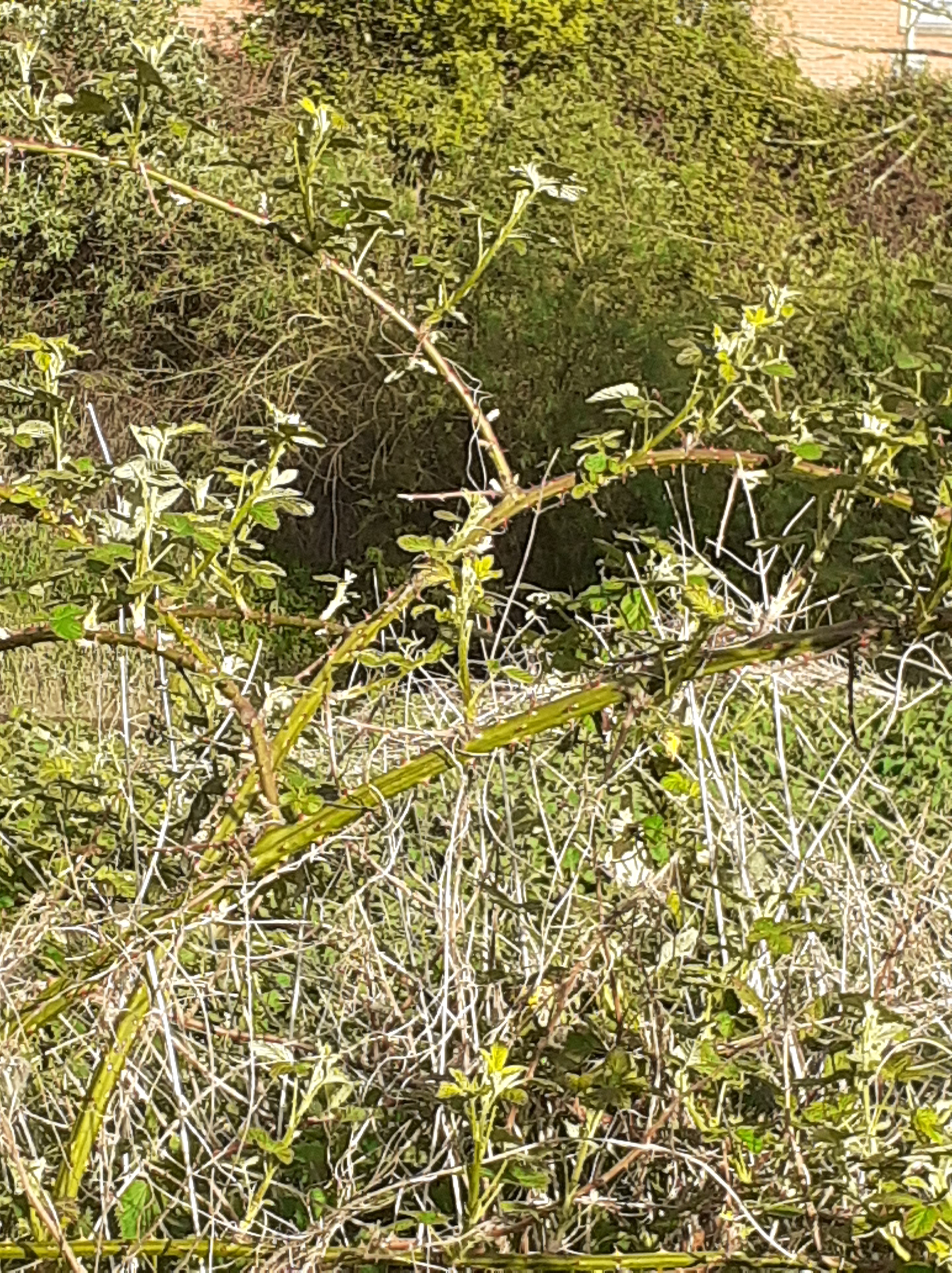
From a contemplative perspective, I am in very friendly territory. My senses relax into a more porous relationship with my surroundings. I begin to disappear into the landscape, losing myself in the experience of the moment. Very briefly, I am the path, the sky and the bramble.

Back in my envelope of skin I see grey above me, and I start to wonder about rain. I am not dressed for it. Luckily, at least for me, no rain falls. I do notice that the riot of life around me might like a good fresh soaking. But I’m conscious of my own interests now. I head for the shelter of my home.

A CELTIC MIRROR

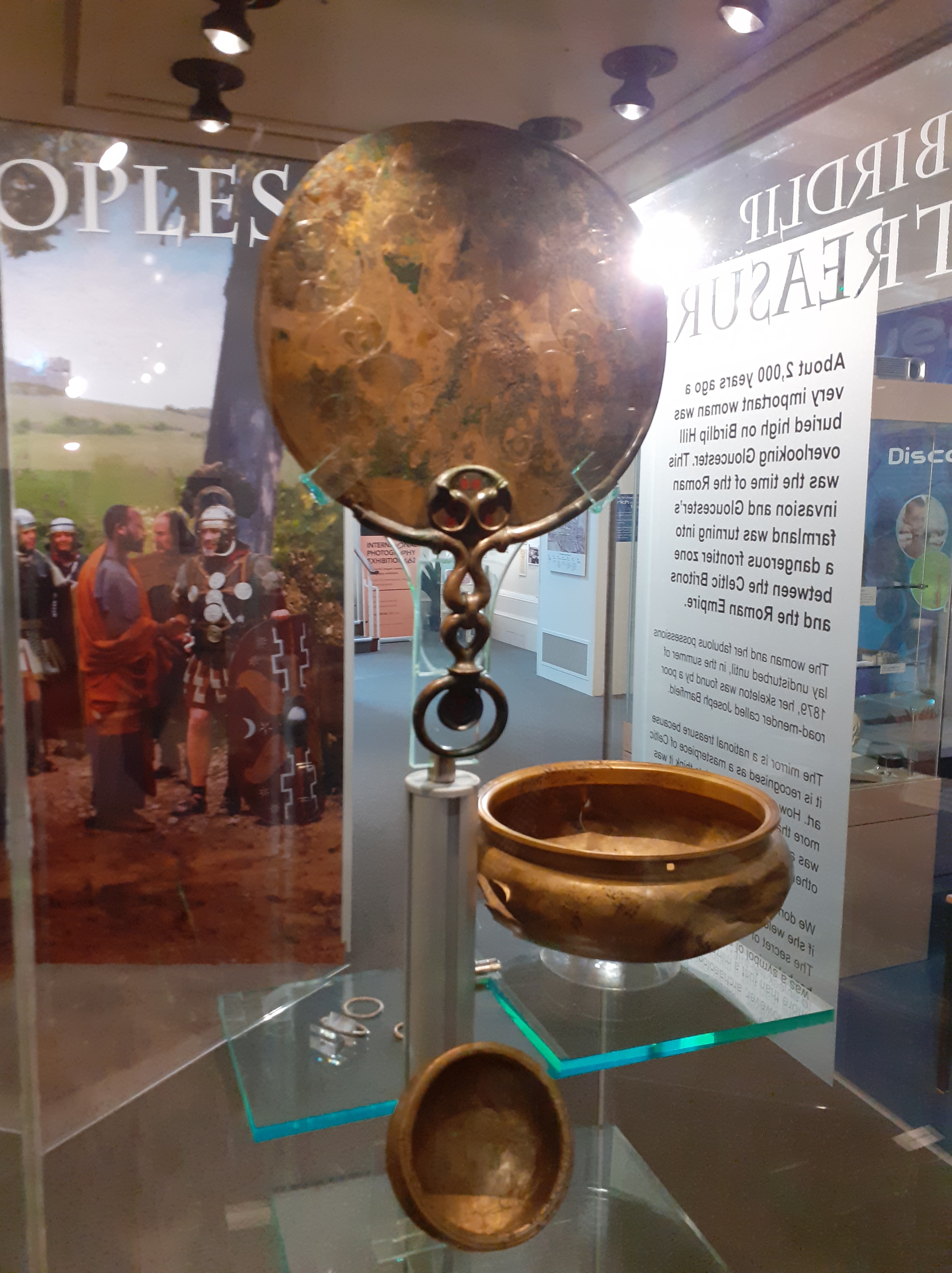
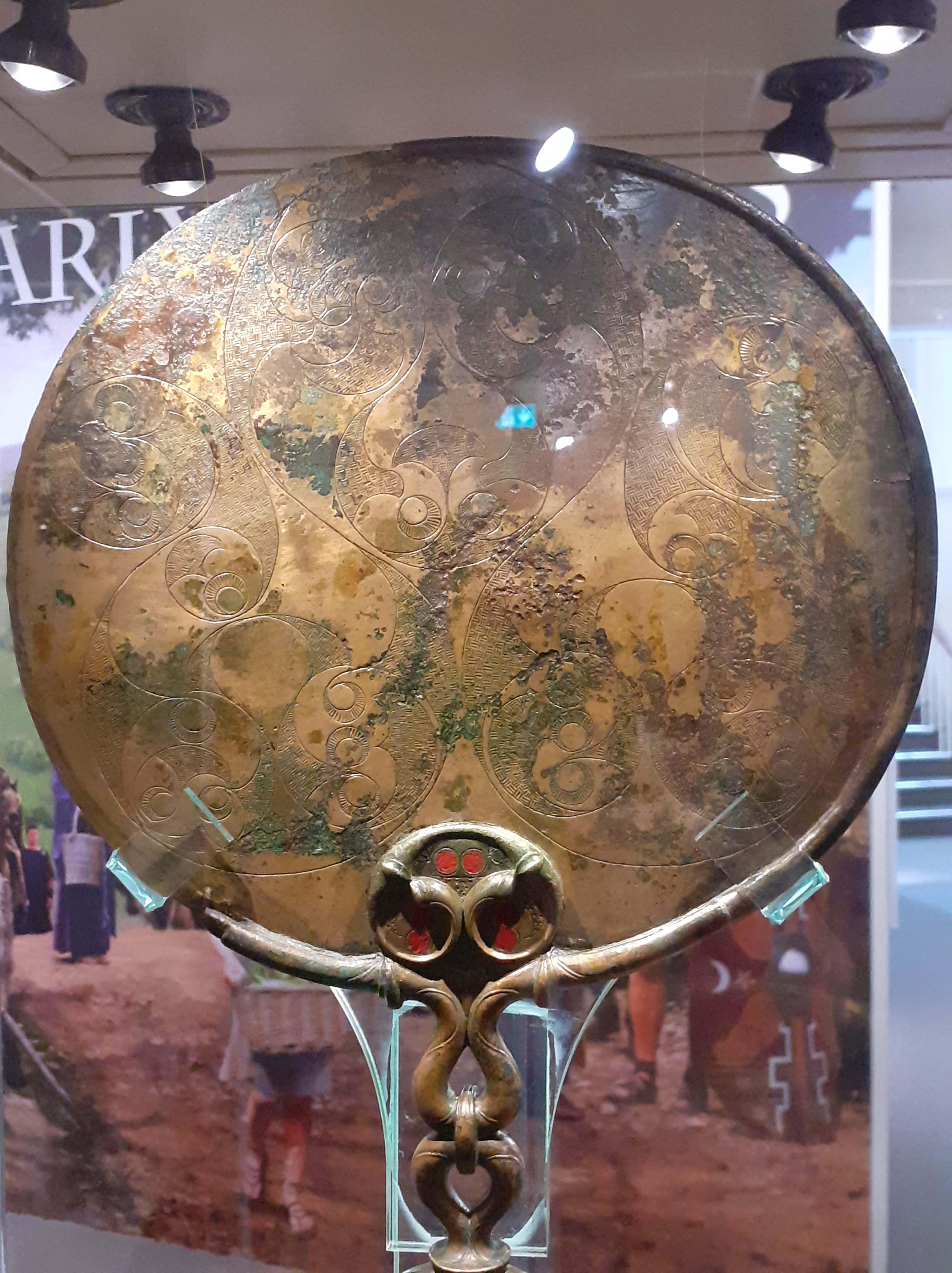
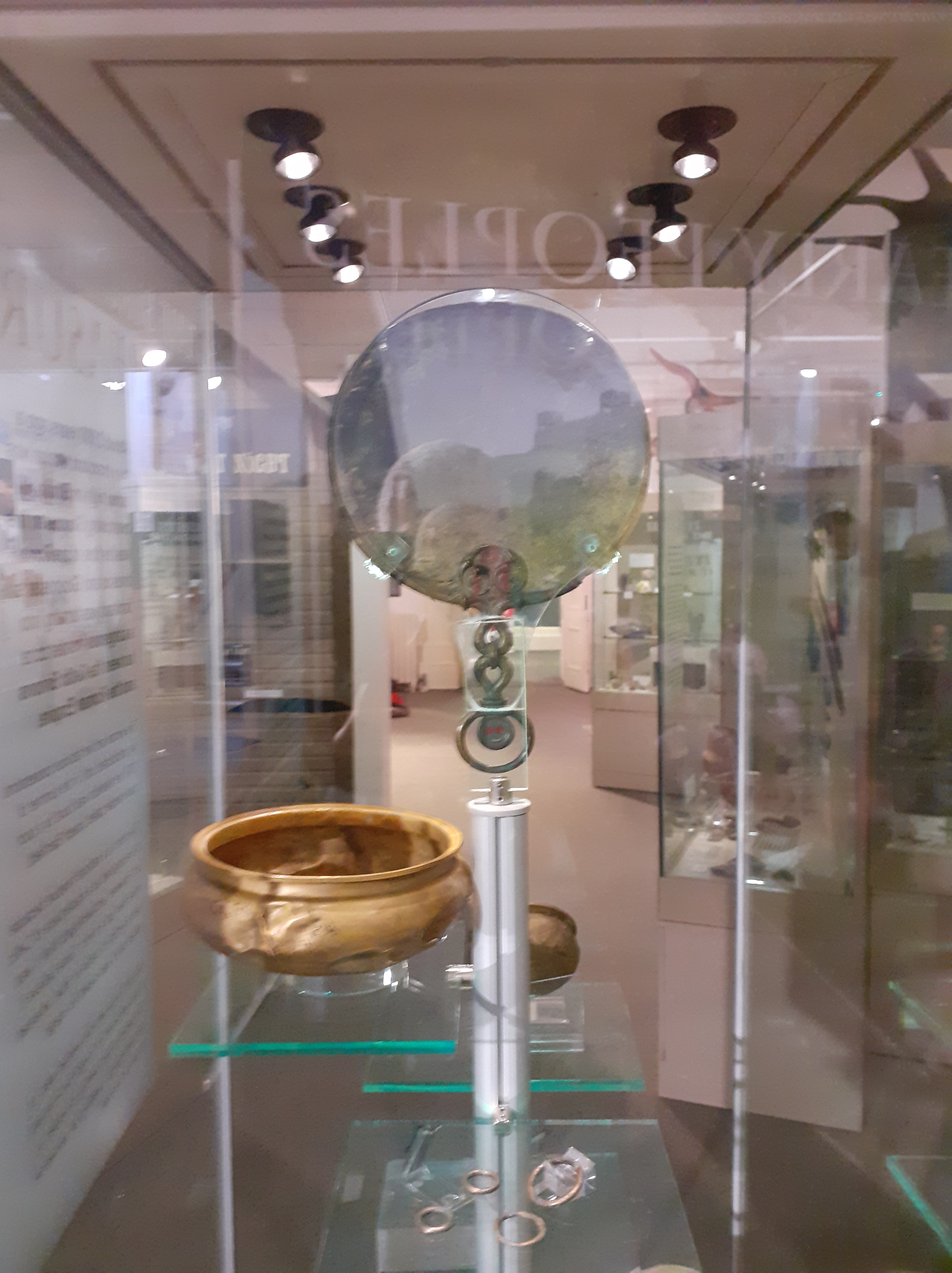
“About 2,000 years ago a very important woman was buried high on Birdlip Hill overlooking Gloucester. This was the time of the Roman invasion and Gloucester’s farmland was turning into a dangerous frontier between the Celtic Britons and the Roman Empire.” The mirror and bowls on display above are part of her grave goods. I used a mirror of my own to read the Gloucester Museum’s information about what has now become an ‘exhibit’.

Naturally enough, people want to know more than this. Stories connect ‘the very important woman’ to Boudicca, whose campaign against the Romans two decades after their initial takeover was well-documented and is well-remembered. But the location and manner of her death after her eventual defeat are not clear and have provided space for all manner of speculation. This gives improbable possibilities a certain amount of traction.

I turn my attention back to the mirror, as the undoubted product of an iron age culture with a wealthy aristocracy who spoke a Brythonic Celtic language. The designs on the back of the mirror (below) reflect the tastes of that culture. To me, they seem almost alive. They give me a tenuous sense of connection with a real person who was in this neighbourhood (and I would guess came from it) 2,000 years ago.

Being connected by place but separated by time is an odd feeling, even more complicated for me than being connected by time and separated by space. I have to be careful not to let my imagination colonise the past. It can be a distorting and invasive mirror. At the same time I do want a relationship with the past. I want to acknowledge it and be open to what it might teach me. In this case, perhaps, a commitment to beauty in a time of turmoil and danger. Or a commitment to different ways of looking, in a world where past and future may not exist in quite the ways that they appear to do.

STRENGTH IN SIMPLICITY

In recent days, living a pared down life, I have seen the strength in simplicity. Both my contemplation and my inquiry are reflecting this. I have a few simple practices adapted from a variety of sources. At first under the pressure of illness, I have moved away from the kind of system building that was drawing my attention a month ago (1). Now I have reminded myself that customising, using a light touch, and keeping practice relatively simple has been my generally preferred way of responding to influences. It helps me to avoid half-awarely ventriloquising teachers and to maintain my own discernment.

As an example (2), I describe a simple meditation. It focuses on the breath because that is something I am busy with – and ambivalent about thanks to my COPD. In it I draw on the understanding that breath and spirit share the same word in some languages (e.g pneuma in Greek). No more than ten minutes is needed for a session.

Although simple, the practice does have a liturgical framing – for instance adapting one of Stewart’s Qabalistic crossing forms from The Miracle Tree. I also draw on my OBOD background, especially the commitment to finding peace. This kind of framing helps. In formal practices like this, I am not just plunging into raw experience. I have other opportunities for that. Rather, the practice affirms an already existing perspective, developed over time, and this is what the words proclaim.

(1) https://contemplativeinquiry.blog/2022/04/05/towards-an-integration/

(2) See text below:

Crossing, using my right hand, I say: In the name of Wisdom (forehead), Love (pubic bone), Justice (right shoulder), Mercy (left shoulder), and the Living Breath (both hands over upper chest). I enter stillness. Then I say: Deep within my innermost being, I find peace. Silently, within the stillness of this space, I cultivate peace. Heartfully, within the wider web of life, may I radiate peace.

I do a breath exercise*, and then say: I am a movement of the breath and stillness in the breath; living presence in a field of living presence: here, now, and home.

Then, I begin slow, deep breathing, as if inviting the Cosmos to breathe through me. I may use the I AM mantra. For me it affirms the non-separation of the finite life and the Source, and the gift of a place within the ecology of being.

On completion I repeat the Crossing and say: I give thanks for this meditation. May it nourish and illuminate my life. May there be peace throughout the world.

*11x breathe in through nose, counting to 8; hold, counting to 8; out through mouth, counting to 8, hold, counting to 8.

MEETING THE SEASON

In these parts, there is a week at the end of April – St. George’s Day to Beltane Eve – that I would describe as mature spring. The rising year is leaning in to summer, but not quite there. I came close to missing it this year, at least as an outdoors event. I have made a good, if slightly fluctuating, recovery from the COPD flare-up described in recent posts. I met this moment, on this day, in the open air. At every level I feel better for the experience.

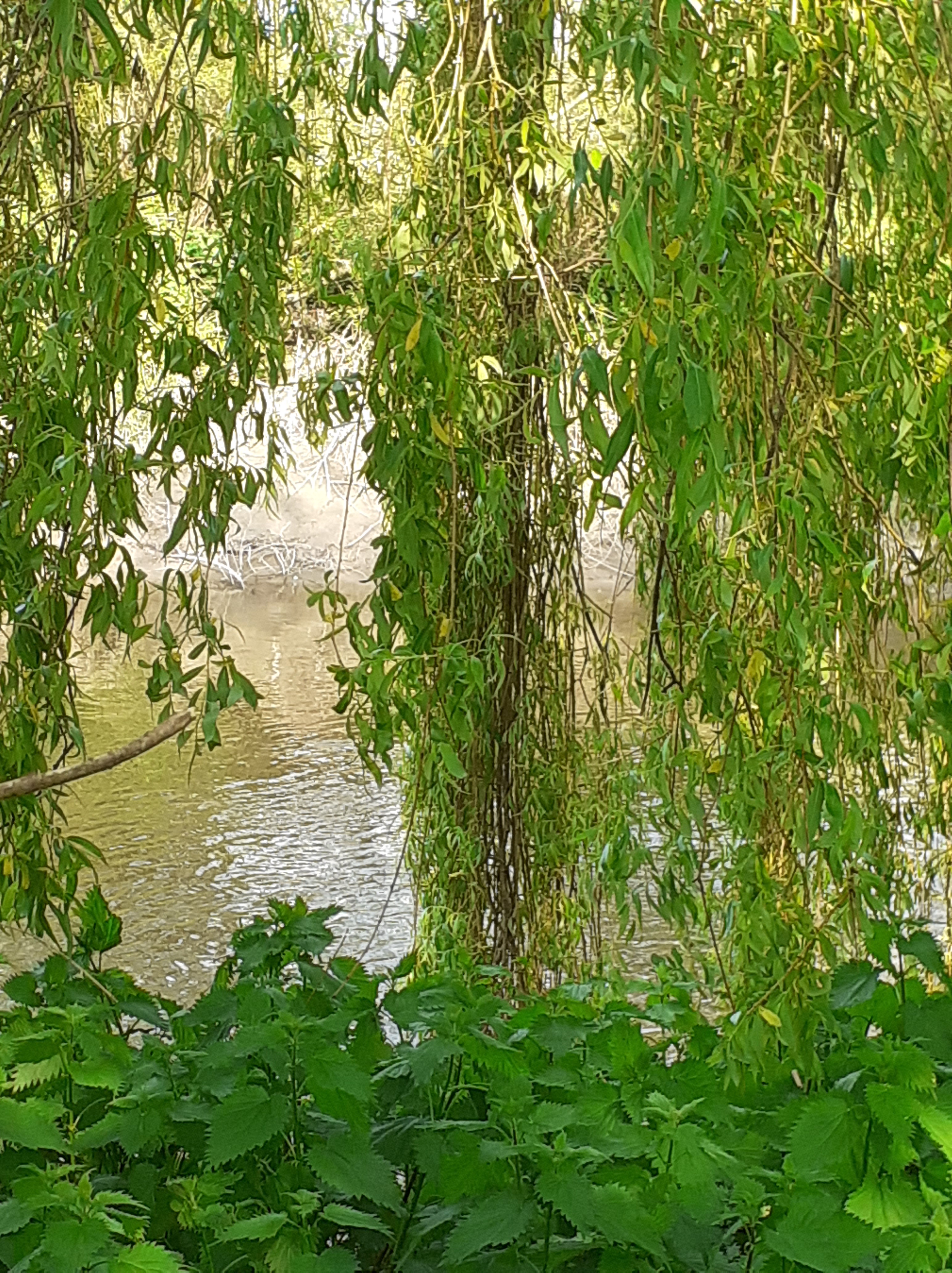
The location is Alney Island, now a nature reserve. The river Severn has divided into east and west channels, with Alney Island between them. Most of my pictures were taken near the (lesser) east channel, which flows into the Gloucester waterfront.

On 24 April 2022, I walked through this almost-city water margin. I was moved by its burgeoning growth, noticing the abundance of green in contrasting shades and forms. For awhile I had given up on going out during this delicious period. The experience, however fragile and transient both I and this space might be, was pure celebration. Taking pictures became an act of celebration, and also of giving thanks.

LIMITS AND BLESSINGS

In my world, this is a time of laboured breath and limited capacity for walking. While medical investigations are underway, I am constrained in what I can do. But walking outside, taking slow deep breaths, and drinking plenty of water are medically and spiritually recommended. Today I went outside for the first time in some days, water bottle to hand, and a rhythm of slow, deep breathing established.

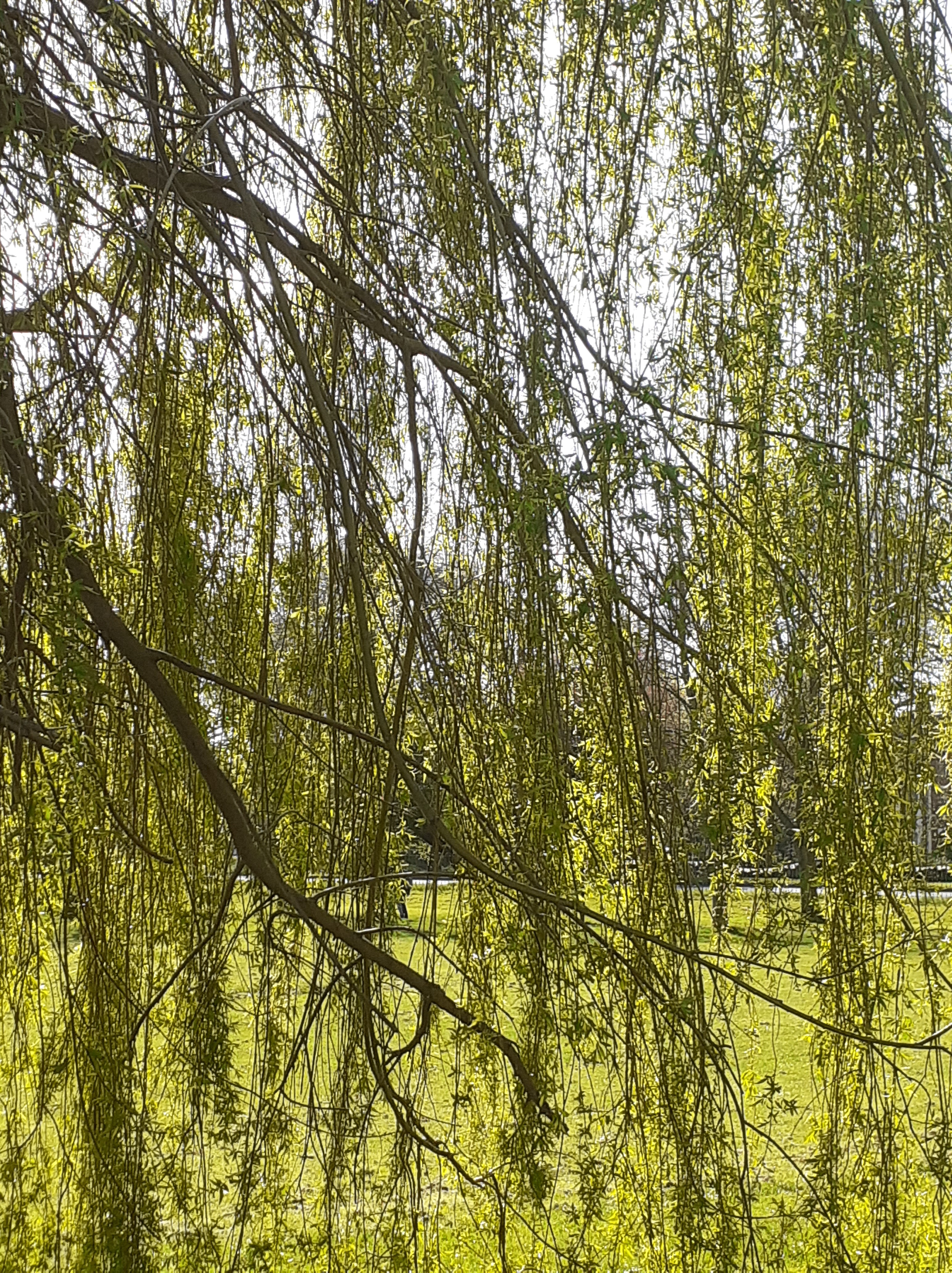
I walked in my neighbourhood and a nearby local park. The picture above is a treescape from that park. For me, it is images solidity and endurance alongside blue sky and spring growth. In itself, it occupies a unique niche in the web of life. I enjoy its company, and the opportunity to record its presence here.

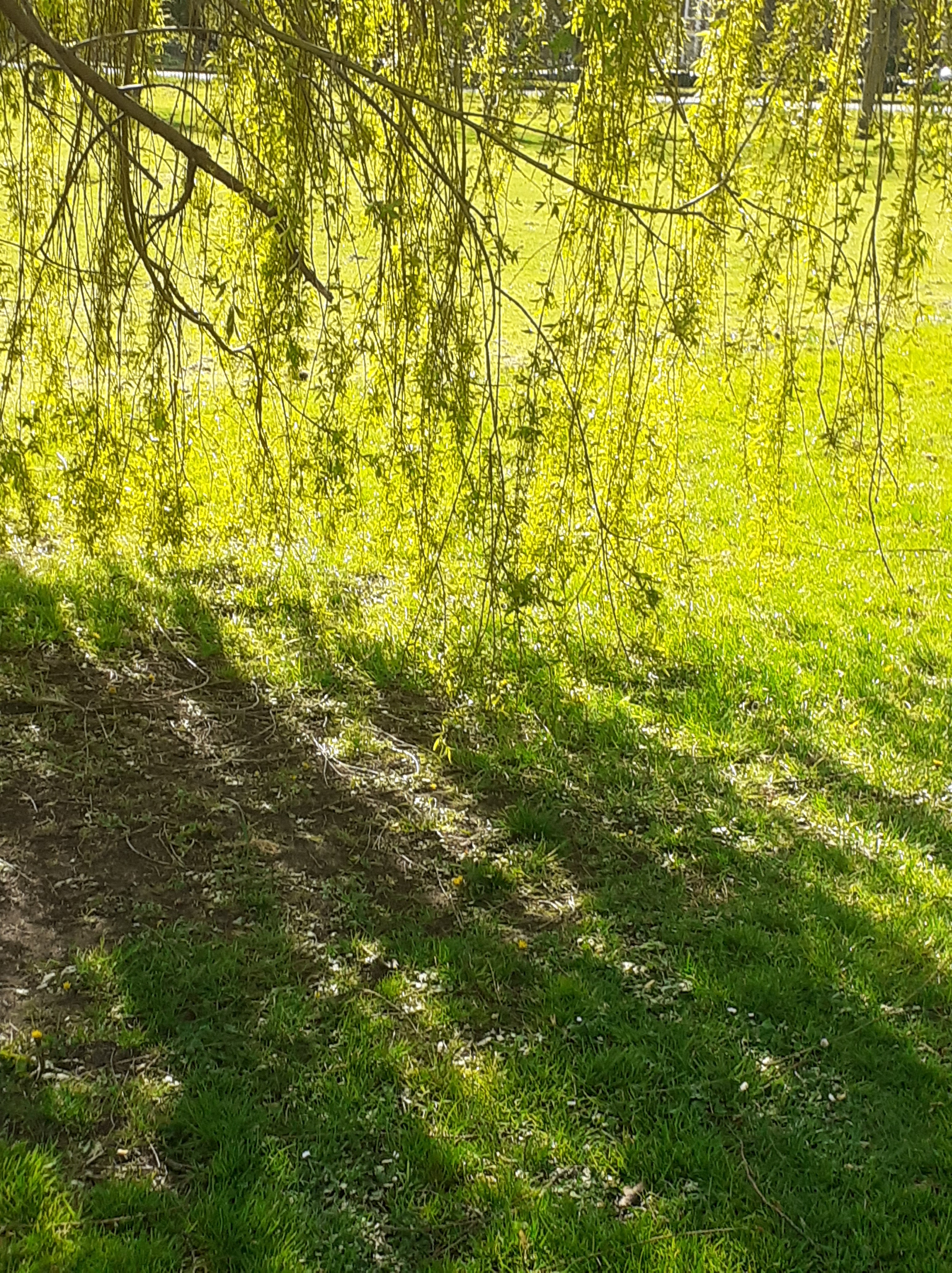
My world may seem, at least for the time being, to have shrunken. My own presence in it, and my perceptions when present to it, do not have to shrink along with the physical distance I can cover. A necessary slowing down contains it own opportunities. I have space and time to enjoy the willows here, their leaves, and the shadows of their leaves. I am constrained to take notice. I appreciate the experience of noticing. I am reminded that I am just outside the period assigned to willow in my personal tree mandala (1,2), but of course it is not too late to connect and commune. There are compensations nested in my unwanted condition.

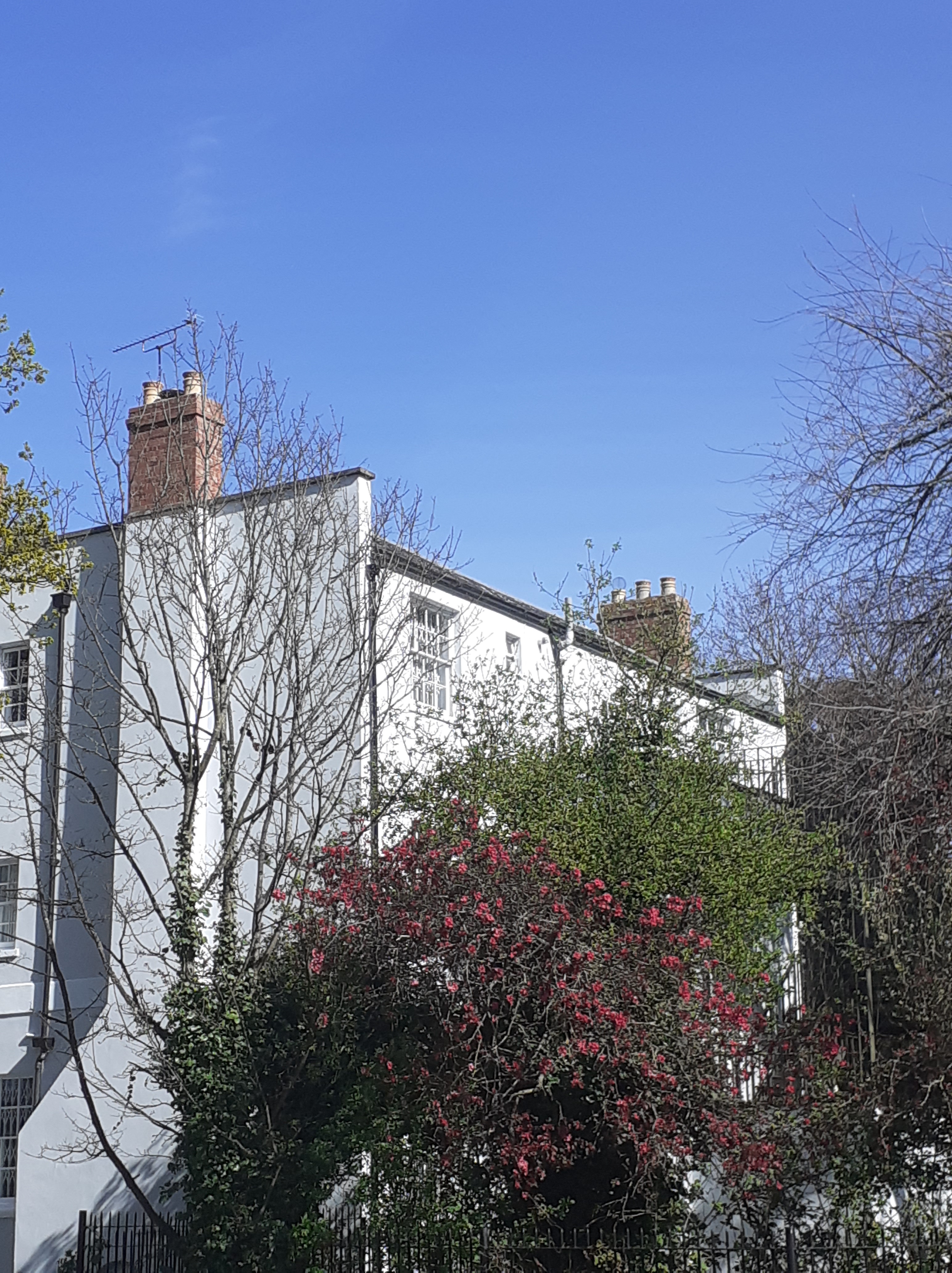
I find the houses and their surrounding plant life photogenic, not least under a blue April sky. The season has been advancing, the equinox now well past. Around me, I find an energetic acceleration towards summer. Hildegard von Bingen called this kind of natural power viriditas. I can recognise and enjoy it even when I’m lagging behind.

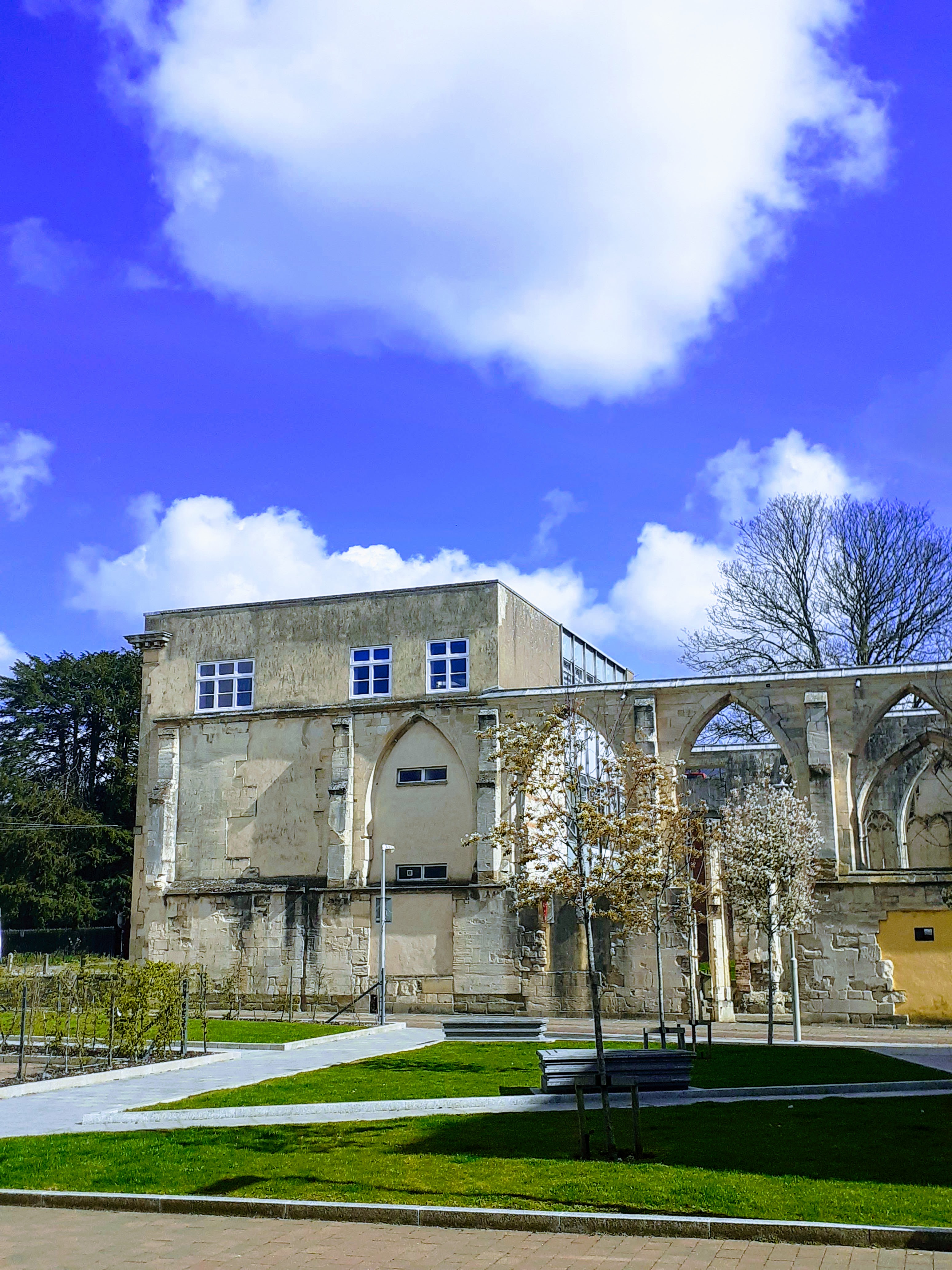
Very close to home I encounter the ruins of Gloucester’s Franciscan Priory, sadly with a nondescript mid C20th building tacked on behind them. They are a landmark for me on my return. I’m tired. I’ve about reached my limit. Although I’m sad that my walking distance is so limited, I feel blessed and nourished by what I find within the limitations. I am also glad to sit down and recognise feeling at once refreshed and exhausted.

(1) https://contemplativeinquiry.blog/2021/tree-mandala/willow/

(2) The mandala is based on my personal experience of trees in the neighbourhood as well as traditional lore. Moving around the spring quarter from 1 February, the positions and dates of the four trees for this quarter are: Birch, north-east, 1-22 February; Ash & Ivy, east-north-east, 23 February – 16 March; Willow, east, 17 March – 7 April; Blackthorn, east-south-east, 8 – 30 April. The summer quarter then starts with Hawthorn at Beltane. For a complete list of the sixteen trees, see https://contemplativeinquiry.blog/2020/autumn-equinox-2020-hazel-salmon-awen/

TOWARDS AN INTEGRATION?

I contemplate an image is from R. J. Stewart’s The Merlin Tarot (1). It is the Ace of Beasts, the Earth suit. I sense it guiding me to a new phase of my inquiry, I hope a phase of integration. The stag has reached the point of stillness. There is nowhere to run, and no longer any need for running. Between his antlers sits a black mirror, showing the four powers of Life, Light, Love and Law unified by a central fifth. Here, it is the magical implement of the Earth element, an alternative to the shield or pentacle.

Stewart says of this image: “its deep power is that of Law and Wisdom, the Mystery of Night and Winter. Thus it can indicate a force or restriction that leads to liberation …. the Wisdom of endings that bring beginnings”. For the next phase of my formal inquiry practice, I will work through the programme of R. J. Stewart’s The Miracle Tree (2). I am already familiar with it, but I can drop into a beginner’s mind readily enough. The novelty is in being focused and systematic, as I was over the years of my training in OBOD (3), but here with a more closely defined and demarcated programme.

Why this? And why now? The Miracle Tree is based on the Western Way Qabalah, and its version of the Qabalistic crossing practice runs: “In the Name of the Star Father (right hand over forehead) Deep Mother (genitals) True Taker (right shoulder) Great Giver (left shoulder) We are One Being of Light (circle right and downwards from top of forehead to genitals, completing left and upwards to back of forehead)”. I like its integrative quality, and its way of presenting a non-dualist perspective – especially the use of ‘We’ in a statement affirming ‘One Being of Light’. It does not use the Absolute to crush the human and natural. It acknowledges the diversity held in ultimate unity, and embraces multiple forms and dimensions of Being. The Cosmic Tree shelters all, whilst not being separate from any.

Stewart says of this system: “the idea of relationship holds good for all world views and models. It is not so much a matter of their accuracy, for their accuracy is relative and ephemeral, but of their value to us as models of relationship to, and participation within, the greater world of which our human world is a small part”. The way to test the value of the model is experiential, and this is what I will do. For me, contemplative inquiry involves a surrender to, and immersion in, the work, whilst retaining a capacity to track and appreciate its effects. I do not expect this cycle to negate what has gone before but, rather, to complete it. Where appropriate, I will discuss this in the blog from time to time.

(1) R. J. Stewart The Complete Merlin Tarot: Images, Insight and Wisdom from the Age of Merlin: London: The Aquarian Press, 1992 (Illustrated by Miranda Gray)

(2) R. J. Stewart The Miracle Tree: Demystifying the Qabalah Franklin Lakes, NJ: New Page Books,2003

(3) Order of Bards, Ovates and Druids – https://www.druidry.org/

ST DAVID’S DAY 2022: A WALK IN THE PARK

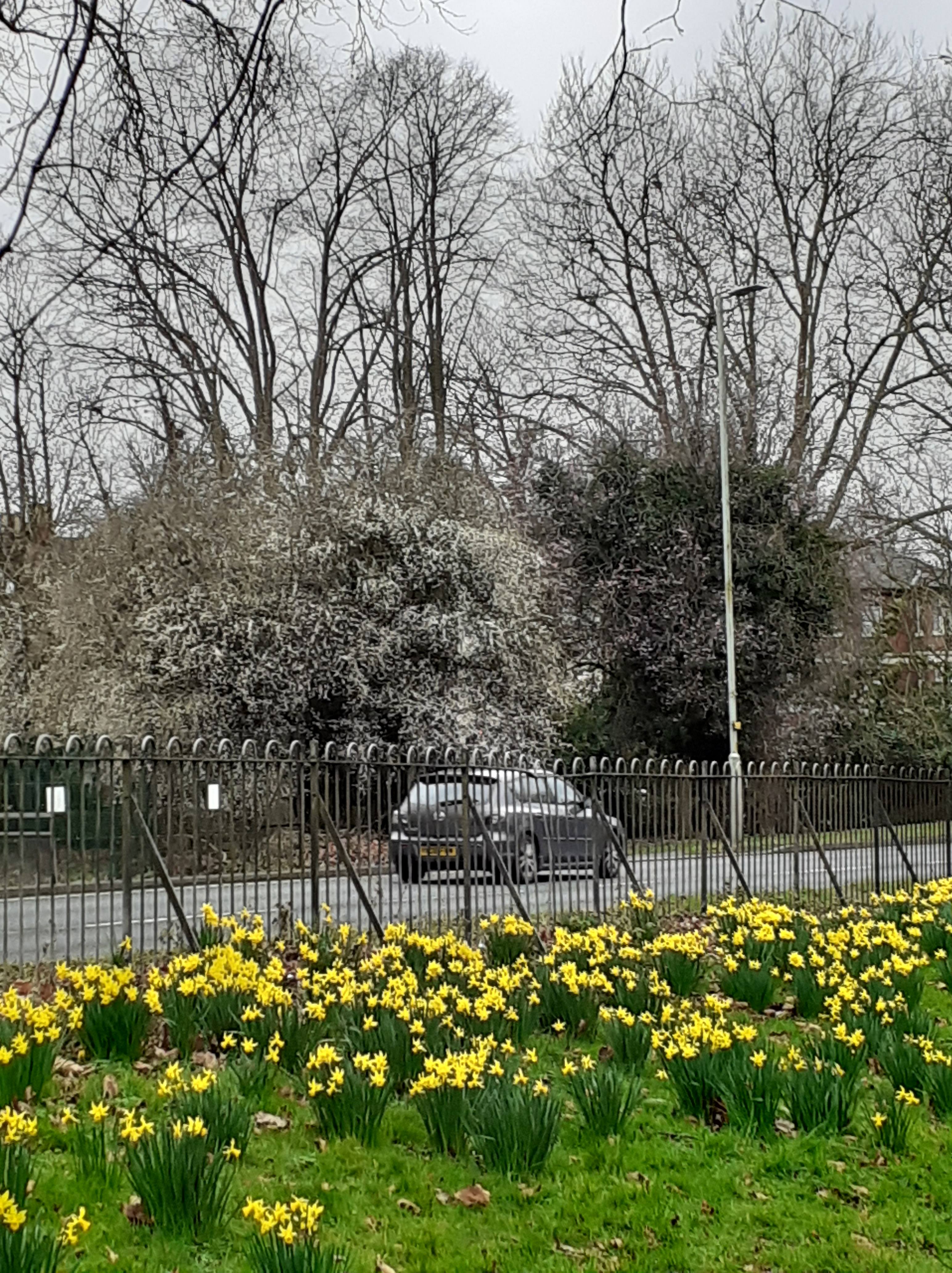
It is 1 March, a mixed day – bringing together grey sky, bare branches, emerging blossoms and vivid daffodils. It is chilly, and rain is likely, though not just yet. Daffodils (here the strongest sign of a changing year) are linked to St. David, the patron saint of Wales. 1 March is his feast day.

David lived during the sixth century CE, a flourishing time for Celtic Christianity. His defining early achievement was the founding of a Celtic monastic community at Glyn Rhosyn (the Vale of Roses) on the west headland of Pembrokeshire (Si Benfro) where St. David’s Cathedral now stands. He went on to become a Christian leader of great authority, and was eventually canonised in the twelfth century, a different historical period with the church under stronger Vatican control and Welsh identity under threat from the English. David became the patron saint of Wales and his day is celebrated in Wales with parades and other public events.

Gloucester is very much an English city, though not so very far from Wales. Today’s weather conditions would not be out of place there. My wife Elaine and I went out on a morning walk with a sense of the saint’s day and how both the day and the coming of March represent a shift in the year. I noticed, too, how I can honour a saint without thinking of sainthood as a model, or even remotely wanting to be one. I acknowledge that I am on different kind of path, less defined, less heroic, and less religious.

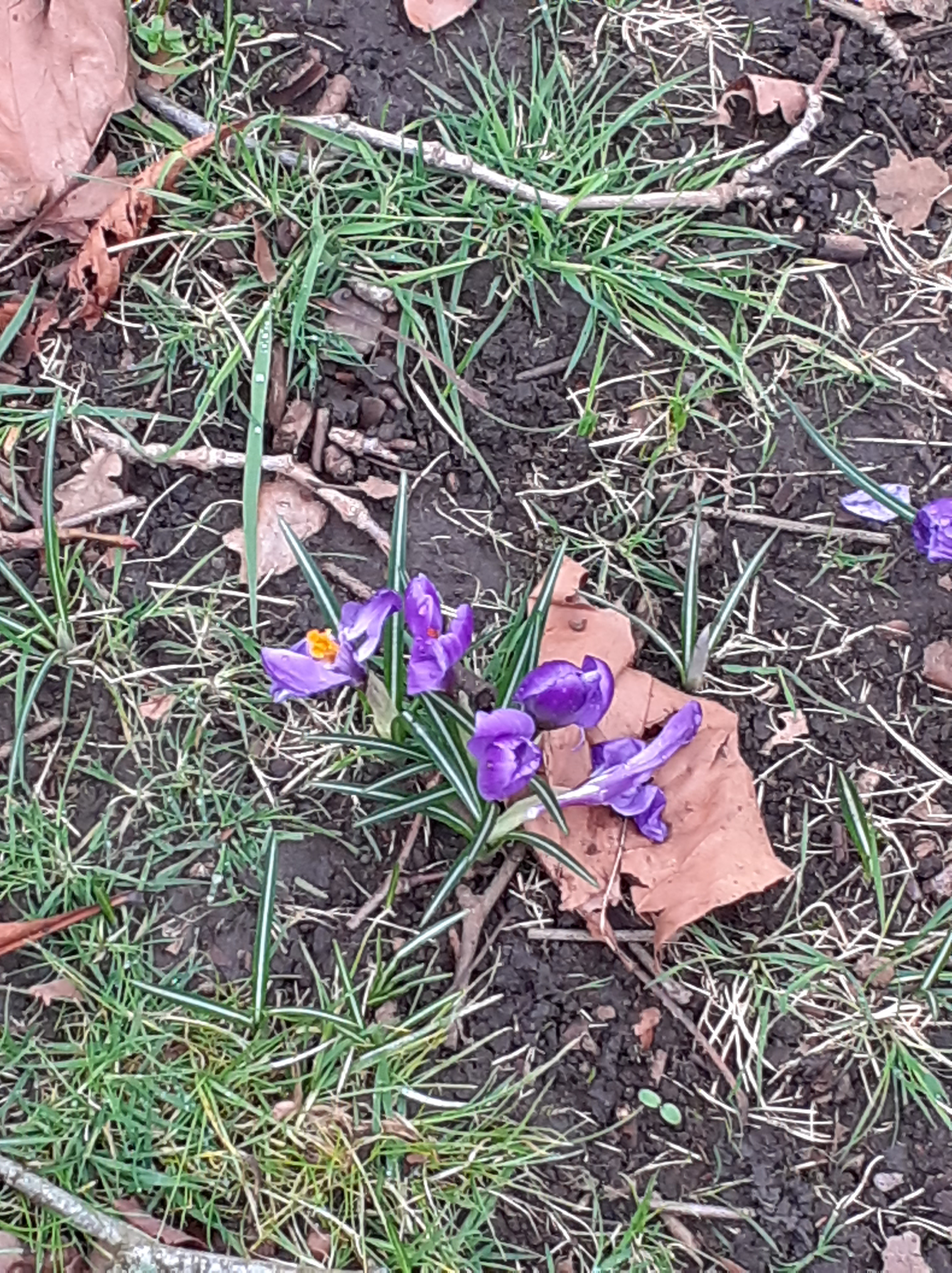
When out walking, I see how the ordinary world seems to transform in the light of a loving gaze. I am looking at the world as it is, not for signs of a creator’s hand or influence or expectations. For me, laid out below – at the micro level – I find grass, earth, twigs, purple crocus and dead leaves. They are simply themselves. All ordinary in an ordinary moment. But an ordinary moment, as we might conventionally call it, is an extraordinary event. It is a small miracle, in its naturalistic way, yet easy to access in a receptive frame of mind.

I do appreciate that a ‘receptive frame of mind’, as a private experience, is facilitated by favourable public conditions, like a well-managed public park. I may not be dependent on such external conditions, but they do make a difference. I am grateful for their current presence in an uncertain world.

WATER MARGIN: TUNING IN TO PLACE

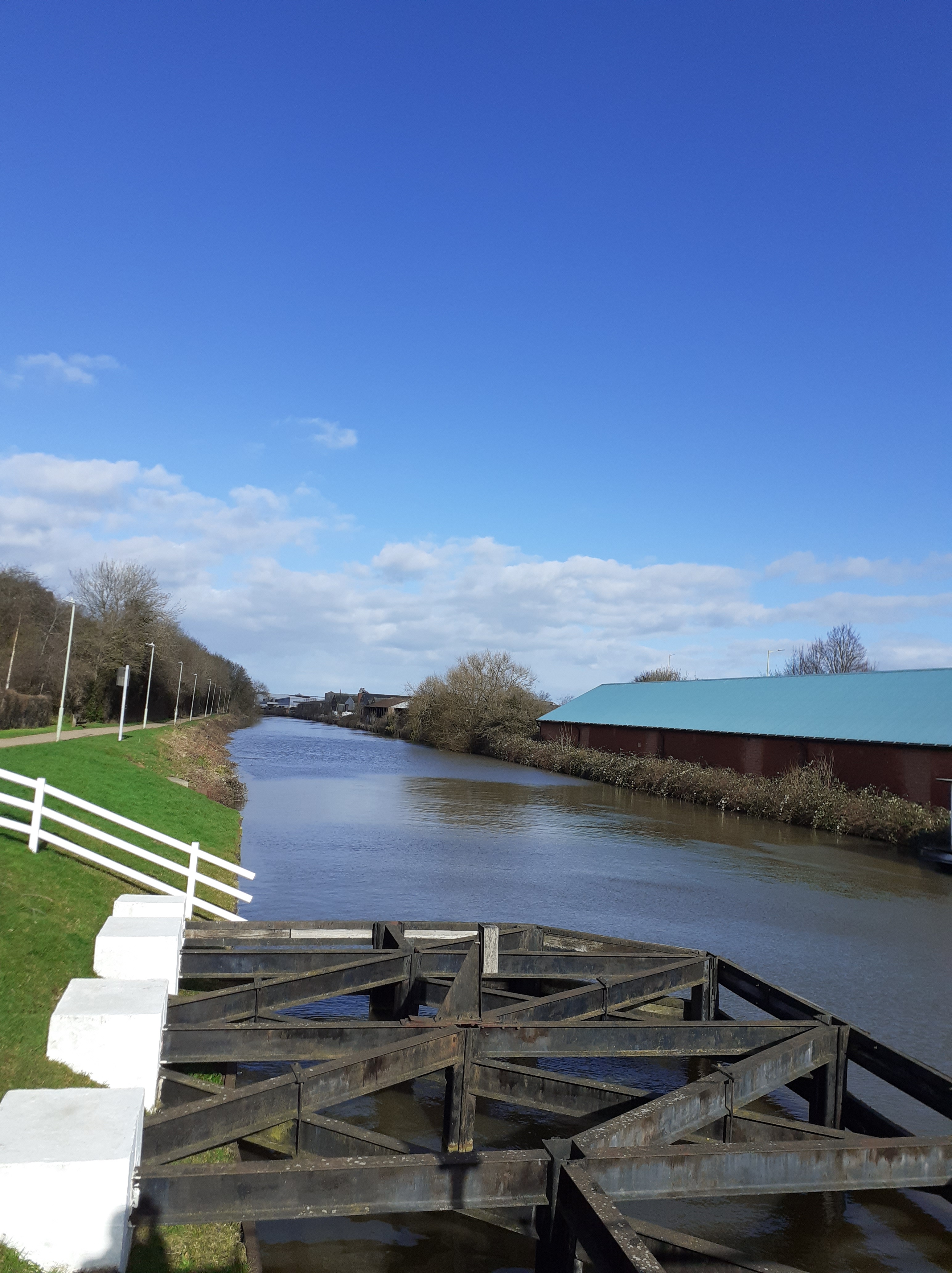
I was facing strong sunlight. I even felt warm. I risked taking a picture by angling down into the water. The water rewarded me with a patches of reflected light. I accepted a somewhat darkening effect in the photograph as a whole. The solar reality was brighter to my eyes, almost too much for them, flooding the path before me with intense light. When I looked back to where I had been, the light was gentler. My picture below shows a clear blue sky that I could confidently open up to include.

Though winter is not exactly over, I was experiencing an undoubtedly spring day. I was in a spring frame of mind, welcoming the change of season, as the wheel turns, and welcoming a still new landscape into my life. I have chosen this canal path as a place of regular walks and engagement. Over time, in the rising year, I will get to see and know it better. I seem to be a water margin Druid at heart, and I am finding possibilities in this new, more densely urban context. I find the energy of life everywhere I look – whether land, water, or sky.

WISDOM AND NON-VIOLENCE

“The nature of reality is multidimensional and creative. … Our spontaneous experience is so rich and deep that we can never give a complete account of it in any language, be it mathematics, science, music or art” – Alan Drengson’s introduction to Arne Naess’ Ecology of Wisdom (1).

Arne Naess (1912-2009) was chair of philosophy at the University of Oslo, Norway, before resigning to devote himself to environmental problems and pioneer the field of deep ecology. For him, philosophy is deep exploration of our whole lives and context, “in a loving pursuit of living wisely” (1). His book Scepticism (2), is focused on Sextus Empiricus (150-225 CE), the last known known representative of a philosophy school founded by Pyrrho of Elis (c360-c272 BCE). Pyrrho himself spent time with Jains (gymnosophists = naked philosophers) and, probably, Buddhists, on an extended visit to India, and was influenced by them.

Pyrrhonists neither made truth claims nor denied the possibility of making them. Instead, they cultivated an attitude of suspension of judgement (epoche), allowing possibilities to stand open within the process of continuing inquiry. This turning away from the drive for intellectual closure enables peace of mind (ataraxia) in our engagement with the richness and diversity of experience. Pyrrhonists left questions open, without leaving the question. Naess says of Sextus: “he has given up his original, ultimate aim of gaining peace of mind by finding truth because it so happened that he came to peace of mind in another way”.

In his account of the Jains, Philip Carr-Gomm (3), shows how they might have influenced Pyrrho. Jain ethics is grounded in three principles: ahimsa, aparigraha, and anekant. Ahimsa is the doctrine of harmlessness or non-violence. Aparigraha is the doctrine of non-attachment, non-possessiveness or non-acquisition. Anekant is the doctrine of many-sidedness, multiple viewpoints, non-absolutism, or non-one-sidedness. The three principles can be seen as complementing and completing each other, with non-absolutism as the intellectual aspect of non-violence and non-attachment. The Pyrrhonist tradition, and its influence on Naess, seems to combine the Jain view of non-absolutism with the Buddhist view of equanimity and freedom from dukkha (suffering or dis-ease).

The approach – which I sometimes lose sight of myself – allows me to avoid what the Buddhist scholar Stephen Batchelor (4) calls “the language game ‘In Search of Truth'”, where “one is … tacitly encouraged to take a further step of affirming a division between ‘believers’ and ‘nonbelievers’, between those who have gained access to the truth and those who have not. This establishes the kind of cultish solidarity as well as hatred for others who fail to share one’s views. ‘When the word truth is uttered’ remarked the Italian philosopher Gianni Vattimo, ‘a shadow of violence is cast’. (4)

I have written on this topic at earlier points in my inquiry*. I have come back to it now, because I want to refine my understanding of ‘peace’ as a quality of inquiry. The liturgy of my daily Druid practice asks for ‘peace throughout the world’. How might I better demonstrate peace in the inquiry process itself? Inquiry processes, and even contemplative spiritualities, can include their own kinds of dogmatism and aggression. I have work to do, wisdom work, hopefully gentle to self and others, in this domain.

(1) Arne Naess Ecology of Wisdom UK: Penguin Books, 2016 (Penguin Modern Classic. First published 2008)

(2) Arne Naess Scepticism Abingdon, UK: Routledge, 1968

(3) Philip Carr-Gomm Seek Teachings Everywhere: Combining Druid Spirituality with Other Traditions Lewes, UK: Oak Tree Press, 2019 (Foreword by Peter Owen Jones)

(4) Stephen Batchelor Secular Buddhism: Imagining the Dharma in an Uncertain World New Haven & London: Yale University Press, 2017

*See also:

https://contemplativeinquiry.blog/25/04/19/spiritual-truth-claims/

https://contemplativeinquiry.blog/03/05/19/arne-naess-as-philosophical-vagabond/

https://contemplativeinquiry.blog/11/06/19/greg-goode-and-joyful-irony/

https://contemplativeinquiry.blog/19/01/20/scepticism-openness-and-flow/

Earth Eclectic

music that celebrates Earth and speaks to the heart

Sarah Fuhro Star-Flower Alchemy

Follow the Moon's Cycle

Muddy Feet

Meeting nature on nature's terms

Rosher.Net

A little bit of Mark Rosher in South Gloucestershire, England

Becoming Part of the Land

A monastic polytheist's and animist’s journal

selkiewife

Selkie Writing…

Charlotte Rodgers

Images and words set against a backdrop of outsider art.

Prof Jem Bendell

living purposefully during metacrisis and collapse

Towint

The pagan path. The Old Ways In New Times

The Druids Garden

Spiritual journeys in tending the living earth, permaculture, and nature-inspired arts

The Blog of Baphomet

a magickal dialogue between nature and culture

This Simple Life

The gentle art of living with less

Musings of a Scottish Hearth Druid and Heathen

Thoughts about living, loving and worshiping as an autistic Hearth Druid and Heathen. One woman's journey.

Wheel of the Year Blog

An place to read and share stories about the celtic seasonal festivals

Walking the Druid Path

Just another WordPress.com site

anima monday

Exploring our connection to the wider world

Grounded Space Focusing

Become more grounded and spacious with yourself and others, through your own body’s wisdom

The Earthbound Report

Good lives on our one planet

Hopeless Vendetta

News for the residents of Hopeless, Maine