Contemplative Inquiry

This blog is about contemplative inquiry

Tag: contemplative practice

WILD WRITING

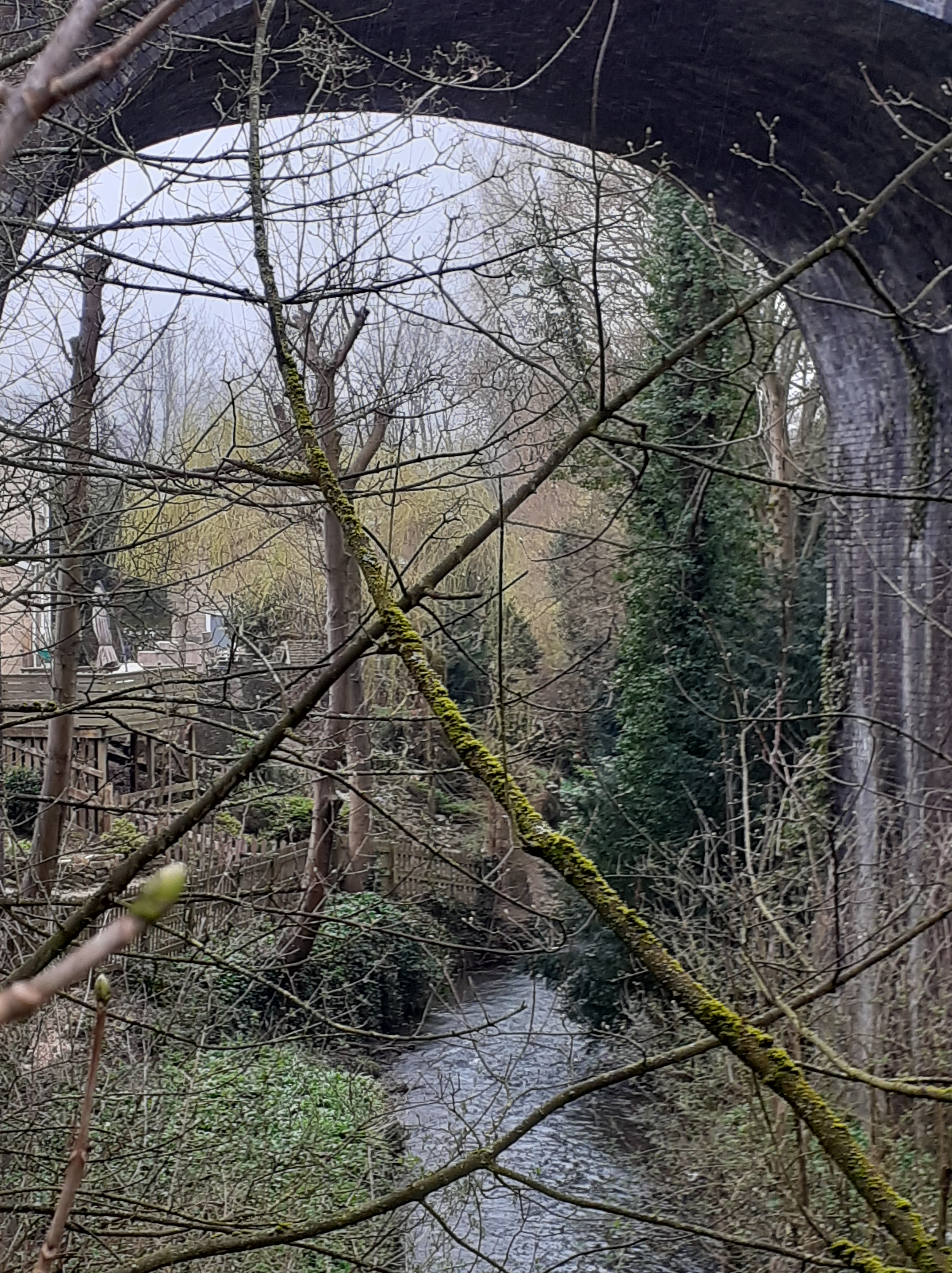
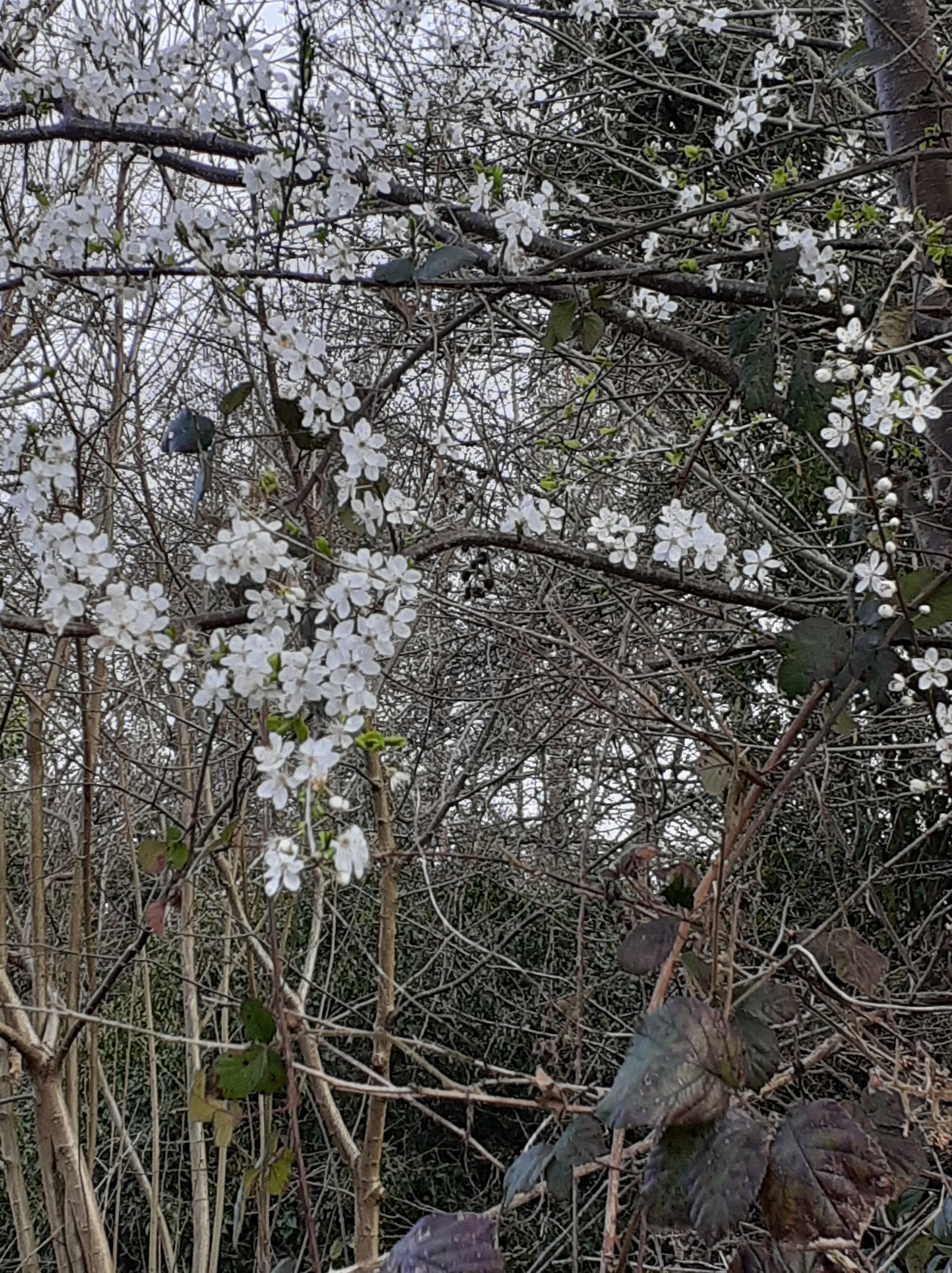
I look at the picture with fresh eyes. It is already a record of the past, and it is much too still. Yet I feel drawn towards this image. I enjoy the tree shapes in their starkness. I sense resilience in the plant life pictured here. I am writing now with sunlight intermittently on my shoulder, and the sounds of wind and rain beyond my strong glass doors.

I am also reflecting on writing as a practice. Natalie Goldberg (1,2) writes books about this and her description of ‘writing practice’ seems to me to have two entirely compatible meanings. The first is that it trains people for the writing of poems, stories and novels. The second points to a form of life practice flowing from the view that “writing is the crack through which you can crawl into a bigger world, into your wild mind” (1).

In Wild Mind: Living the Writer’s Life Natalie Goldberg compares writing practice with journaling. “Journal writing has a fascination with the self, with emotion and situation. It stops there. Writing practice lets everything else run through us; in writing practice, we don’t attach to any of it. We are aware that the underbelly of writing is non-writing. Journal writing seems to be about thought, about rumination and self-analysis. … We want to get below discursive thought to the place where mind – not your mind or my mind but mind itself – is original, fresh. It’s not you thinking. Thoughts just arise impersonally from the bottom of our minds. That is the nature of mind – it creates thoughts. It creates them without controlling them or thinking them … Writing practice knows this, knows how we are not our thoughts, but lets the thoughts, visions, emotions run through us and puts them on the page.” (1)

In her earlier book, Writing Down the Bones: Freeing the Writer Within, Natalie Goldberg quotes Jack Kerouac as saying that a writer should be ‘submissive to everything, open, listening’. She also recommends that “we stay in the trenches with attention to detail”, avoiding escape into abstraction. She points to poetry in particular, “because it brings us back to where we are. It asks us to settle inside ourselves and be awake”. She reproduces the famous William Carlos Williams poem:

“So much depends

upon

a red wheel

barrow

glazed with rain

water

beside the white

chickens.”

I remember this poem from my childhood. I liked it a lot, but couldn’t find anything to say about it in the class room when it was expected that I would. I was embarrassed then. I wouldn’t be now.

Natalie Goldberg also practices Zen Buddhism, with Katagiri Roshi until his death and more recently as an ordained member of the Order of Interbeing founded by Thich Nhat Hanh. She acknowledges the role of Zen in developing her insights into the creative process. I find her approach, including her practical exercises, very helpful.

(1) Natalie Goldberg Wild Mind: Living the Writer’s Life New York, NY: Open Road Integrated Media, 2011 (first published 1990)

(2) Natalie Goldberg Writing Down the Bones: Freeing the Writer Within Boulder, CO: Shambhala, 2016 (30th anniversary edition)

APRIL AND ‘DRUID MINDFULNESS’

Where I live, April 2023 brings qualities and freshness and new growth. My heart meets the moment as I walk in the bracing breeze. Sunny and overcast periods succeed each other. Moving through this enlivening space, I naturally welcome the energy of change it embodies.

But it’s not quite that simple. There’s an underlying turbulence too, which can easily challenge my balance. Slogans like ‘I am the sky. Everything else is weather’ aren’t enough. I, as natural man, have to ground and embody them. They have be be aligned with my felt sense.

I wasn’t sure how to talk about this when I discovered that someone else had done it for me. Philip Carr-Gomm, who until recently led OBOD (Order of Bards, Ovates and Druids), offers a regular podcast: Tea with a Druid. No 249 is about ‘finding calm in chaos’. It is up on YouTube as: https://www.youtube.com/watch?v=Ew4pD3OJen8

Philip suggests that the best way to deal with chaos, turbulence, or the everyday stress of modern life, is to turn to the stillness inside. Then it becomes possible to stay in the moment whilst expecting nothing. It takes work to get there – to identify ways of finding stability and calm even when all around is unstable and unpredictable.

Philip understands modern Druidry as a tradition of ‘mindfulness in natural settings’, whether real or visualised. The stillness found in those settings isn’t a dead stillness but a living one – leaves rustle, waves crash. The refreshment is somewhat different from that of a more abstract meditation where we sit with thoughts and feelings, finding the space beyond. In the podcast, Philip takes us through a meditation of the kind he describes. I thoroughly recommend it to anyone, whether or not involved in Druidry.

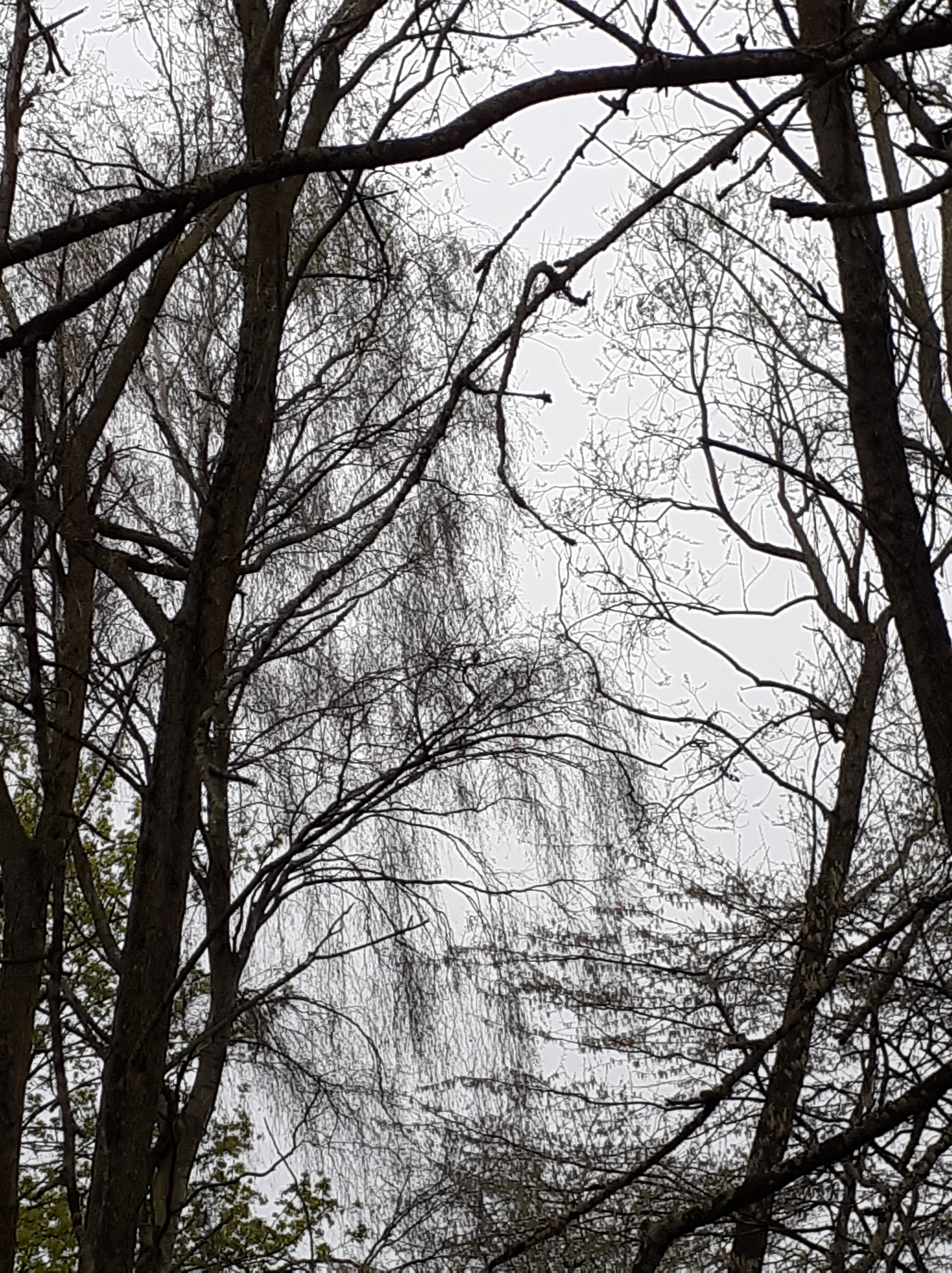
Returning to my recent walk, and the record of it, I see branches, buds and sky. I remember the movement in the sky, and a slight quivering of the wood. Records have their limitations. The stillness wasn’t one of complete stasis, as it may appear below. My current response is complicated by the human gift of memory, which is not the original experience. I am also absorbing someone else’s input. I am in a completely different here and now. But I am held within an enlivened tranquility, not at all that of the ‘tranquiliser’, and this is certainly a wonderful resource. Gratitude to the culture that has enabled it.

DOUGLAS HARDING: THE MIRACLE OF EXISTENCE

“Besides the countless particular miracles that we comprise, there is that supreme irregularity – the fact that anything exists at all. Most unnaturally, there is not just Nothing. How adroit for It to happen! How deserving of our congratulations It is, for having arranged its quite impossible existence! After that, what are a few billion universes more or less.”

These words are from Douglas Harding’s epilogue to The Hierarchy of Heaven & Earth (1) published on the recommendation of C. S. Lewis, distinguished scholar and Inkling. Lewis’ introduction places it among “philosophies that have some of the same qualities as works of art”, and he is reminded in that respect of Hermann Hesse’s Glass Bead Game.

Harding describes his work as “an unconventional attempt to discover, for myself and in my own way, what I am and what I amount to in the universe. What am I? That is the question. Let me answer it as honestly and simply as I can, forgetting the ready-made answers.”

Harding also has the courage to declare that he has not found an answer. Instead, he has entered a state of “amazed reverence” that reveals his whole inquiry as both “absurd” and “a needful absurdity”. He finds that “because all my roots are in the Undiscoverable, I also am undiscoverable: I will not bear inspection, and can never make head or tail of myself. Self-knowledge is the smouldering wick that is left after the light of wonder has been put out. … If this book quenches the feeblest flame of awe, of direct awareness, in myself or anyone else, then it were better never to have written it”.

Harding did not end his inquiry with The Hierarchy of Heaven & Earth. Instead, he went on to become a midwife of direct awareness, and The Headless Way (https://www.headless.org) was born. Where The Hierarchy of heaven & Earth is concerned with exuberant yet disciplined system building, Harding’s later work challenges each of us to ‘look for yourself’ using a set of experiments, now accessible on The Headless Way website. I reported an early, intensive experience of them on return from a four day retreat with the Headless Way in 2016 – https://contemplativeinquiry.blog/2016/07/28/look-for-yourself/ Interestingly, my wrap-around commentary, especially the post-workshop phase, would now be a little different from the one in that post, while my report of the direct experience remains the same. In my current practice, I particularly draw on a seven point version of the experiments presented in Head Off Stress (2).

I never met Douglas Harding in person – my discovery of the Headless Way is too recent. But his writing and recorded material show never-ending wonder at the miracle of existence. They also show his passion for facilitating a transformative recognition of who we really are, and then to live from that recognition.

“I certainly don’t find myself

on the brink of a bottomless abyss,

trying to make up my mind

whether to let go and take that dreadful plunge.

I am already clear of the brink

and free-falling,

and have never been otherwise.

To see this,

all I have to do is look for myself,

and fail to find myself, and find instead

the treasure that has no name

in the well

at the world’s end.”

(1) D. E. Harding The Hierarchy of Heaven & Earth London: The Shollond Trust, 2011 Introduction by C. S. Lewis. (Abridged edition – original edition published by Faber & Faber in 1952)

(2) D. E. Harding Head Off Stress: Beyond the Bottom Line London: The Shollond Trust, 2009 (Originally published by Arkana in 1990)

(3) Douglas Harding Everyday Seeing: daily meditations on the One within London: The Shollond Trust, 2019 (Quotations selected by Richard Land)

AFTER THE EQUINOX

After the equinox comes a deepening of autumn. Light, colour, texture – my sense of the world is different. Images of this moment in the year shape my sense of time as well as of place. I savour the turning of the wheel. All time is transitional, yet every time has its own uniqueness.

Contemplating images like this is for me a way of sustaining what modern Druids sometimes call a re-enchantment with and of the world. Simple attention to the living world is a renewing experience, and protects the heart from what can seem like the half-life of a Wasteland culture. Opening to a living cosmos, I plead guilty, with pride, to the charge of Romanticism.

It is after 9 a.m. on Sunday 26 September, Locally I enjoy orange as a colour of ripening, rich and shiny with life, as the season of bearing fruit moves on.

There are trees whose leaves have already turned, but will stay on their branches for awhile, giving these woods a more mixed, autumnal appearance.

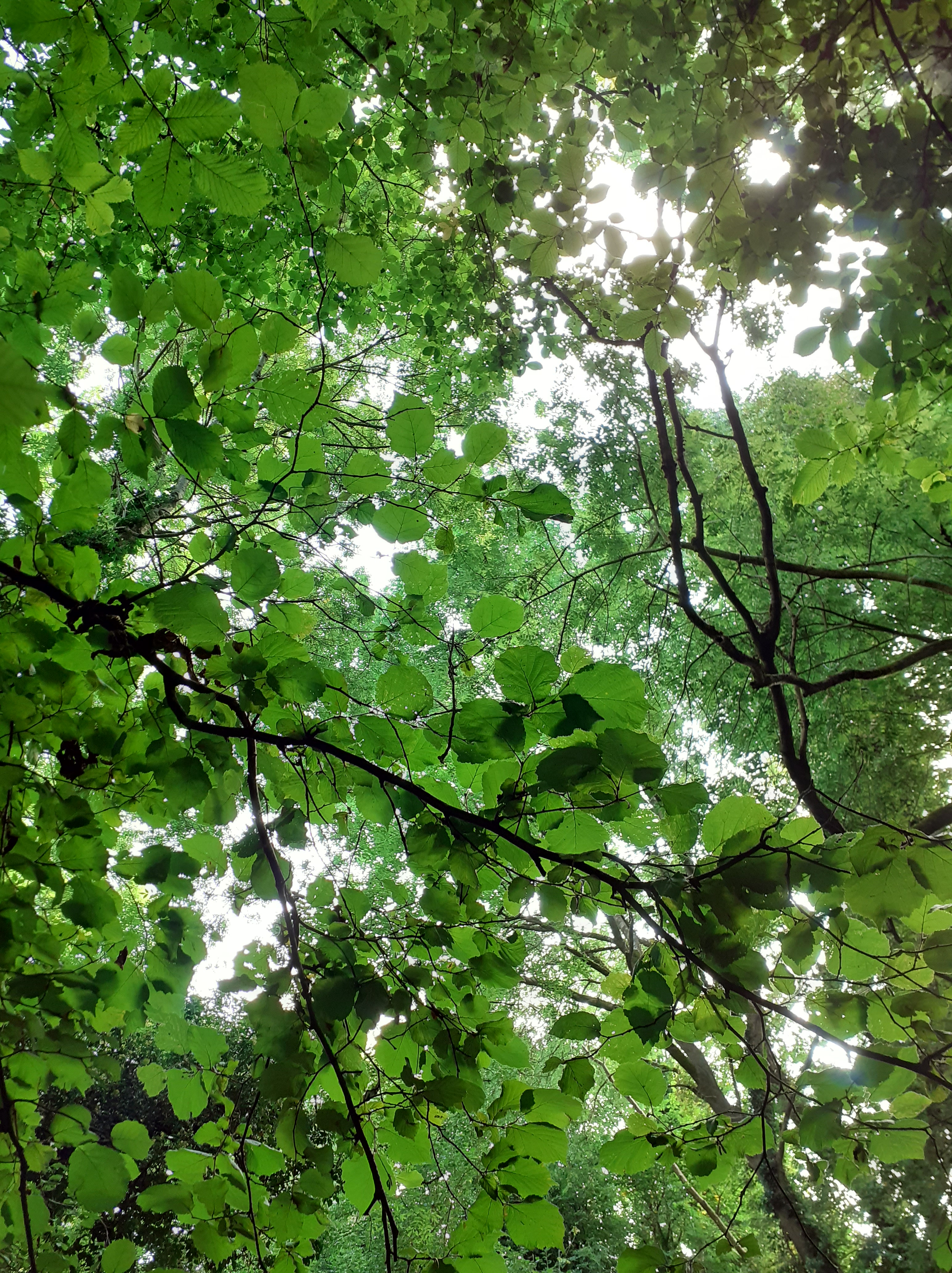
But there is still a preponderance of green, some of it surprisingly fresh. Here it provides a canopy of green light and shade.

The season is also asserting a downward pull, towards the earth and dissolution – a process, however, still in its early stages. The broken fence seems almost to be sharing this, beginning a return to the land.

Then there is the undergrowth, with its mix of living and dead wood, living and dead leaves, and the soil that holds them. The evergreen leaves are defiantly vivid. Taking pictures, I celebrate the time of year.

CATCHING A MOMENT

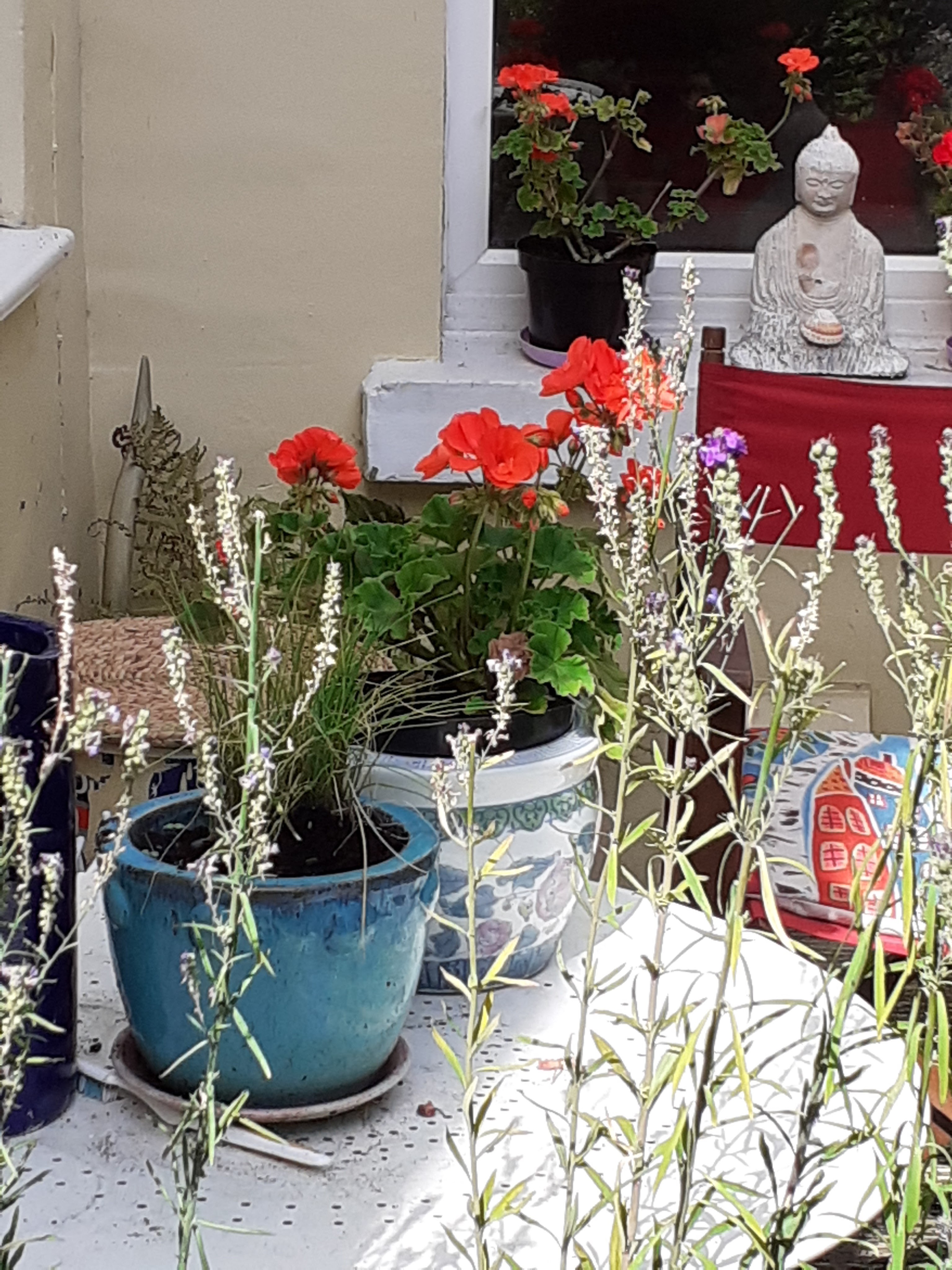
Above, inside looking out. Below, outside looking in – with added reflections.

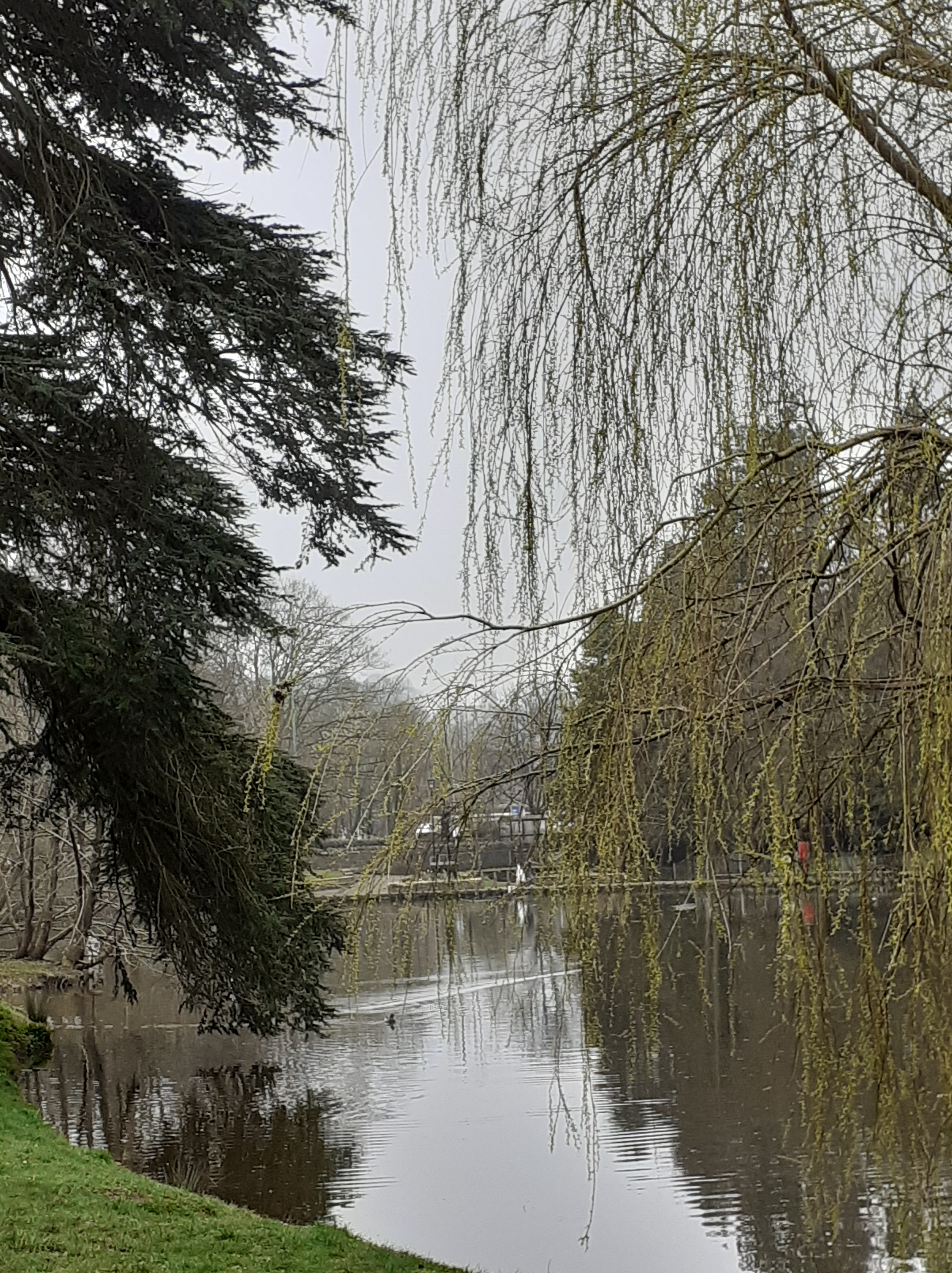
Below again, from a little further back, the full richness of a sunlit moment, in a particular time and place. For me, it becomes the image and feeling-tone of its day, and, later on, a soft thought in memory.

BEING AND PERSPECTIVE

“To have a perspective, a sense of Being has to be there first.

Is there any perspective if there is no sense of Beingness or sense of aliveness?

That same aliveness underlies every perspective.

The Questions – Does it help? Is it of value? –

are questions which people will have their own perspective on.

So, a wordless experience of being that is available to turn to 24/7,

not dependant on a particular feeling, thought or perspective,

All of which come and go.

Not being an attainment

it is not dependent on effort

but when consciously noticed

it is constant and obvious.”

These words from Steve Palmer of the Headless Way summarise my learning from that family when crafting a contemplative Druidry through my inquiry process. The noticing he talks about towards the end is at the centre. Everything else radiates out, re-visioned by the noticing.

http://www.headless.org/

SILENT SITTING MEDITATION

There is the moment, and there is the flow. The photograph holds the moment and the image at first seems still. Looking more closely, we can infer the turbulence that accompanies flow. All those ripples, and wavelets and swirls. They testify to the life of the stream in time.

I have taken up silent sitting meditation after a long break, making a commitment to myself of at least thirty minutes a day. I have incorporated silent sitting meditation into both my morning and evening practices, so the individual sessions need not be long. I am not made for long meditations. but I do now find that an element of silent sitting meditation enriches my contemplative life and inquiry.

I like the term ‘silent sitting meditation’ for its plainness and descriptive accuracy. I am distinguishing this meditation from the ones that I learned through Druidry, which, even when not guided, depend on visualisation and narrative. At the same time I am avoiding close identification with the ‘mindfulness’ brand. It feels like a prescriptive pre-shaping of my lived experience as a meditator. A strong intuition, gift perhaps of the Goddess in her Wisdom, wants the meditative life to be free of such labels.

So I sit. With two sessions a day, I find that my natural length of session is from 20-35 minutes and so with two sessions I am overshooting my commitment. That’s a good indication that I am not straining myself. I don’t want my meditation to be goal-oriented. Rather, I open myself to the energy of living experience, and let it lead me.

I do begin, conventionally, with a breath focus, following the sensations and the gaps after in-breath and out-breath, with loving attention. I also open myself to other sensations, which (with my eyes closed) will mostly be internal body sensations or external sounds. I think that the love in loving attention matters. There are people within the mindfulness movement who think it might better have been called heartfulness. This introduces a sense of compassion for everything that arises. Within the experience, I can feel whole, at home in the Heart of Being which holds up and informs my human life. When I am consciously present, it is a place of peace, joy and inspiration.

In the course of a session, I will taste this state from time to time. At other times I find myself engaged with images (some seeming otherworldly), or narrative streams, that I also value. These experiences seem to have an authentic energy that I cannot simply dismiss as distractions. I want to allow them in and engage with them. Indeed, even where the passing content of experience seems entirely mundane or even distressed, I will welcome it and keep it company. I will hold it in love. Outside the meditation, it may provide a cue for some more dedicated healing or inquiry process.

It may be for this reason that I do not characteristically find distress distorted thoughts and feelings hijacking or sabotaging the meditative flow. They know my willingness to meet them. This means that the other experience, the wellspring of my life, is rarely far away and never forgotten. It doesn’t even require formal meditation. For me, silent sitting meditation supports a fuller life, lived from the Heart of Being. But it is not, by any means, a requirement for it.

SIMPLY SEEING

Something happens when I simply see the world in front of me. Simply seeing involves the whole of my attention, with a de-cluttering of thoughts and other distractions. There is no tension in this spacious clarity.

But it doesn’t have to last long. Simply seeing is at heart a timeless act of recognition. There is no need to hold on to any particular state. I find it wiser to let the flow of experience move on.

If I am present to my immediate experience, it works as well for a photograph as it does in the original setting. Simply seeing the picture is not a recollection of my earlier walk. It is a unique moment of experience, and a joy in itself.

BOOK REVIEW: CERRIDWEN CELTIC GODDESS OF INSPIRATION

Highly recommended. Cerridwen: Celtic Goddess of Inspiration (1) is by Kristoffer Hughes, Chief of the Anglesey Druid Order (2) and a prominent figure in modern Druidry and Paganism. His aim in this book is to “provide you an in-depth exploration of Cerridwen, where she came from, the landscape and peoples that perpetuated her, and who she is today”.

Hughes, born in Anglesey and a first language Welsh speaker. is a scholar and practitioner of his inherited tradition. He has also embraced Druidry as an international movement within modern Paganism. He is at ease, too, with the Cerridwen of modern witchcraft. His whole stance is one of cultural generosity and active support for “appropriate appropriation”.

In its quest for Cerridwen, the book combines close reading of Bardic texts dated from the post-Roman period to early modernity; personal sharing of Hughes’ own path; and opportunities for experiential work. Like many people, my introduction to Cerridwen was through Charlotte Guest’s English version of the late-appearing Hanes Taliesin (Hughes provides his own version early in the book). This shows Cerridwen as a noblewoman skilled in the magical arts, not a Goddess. Like many people, I assumed that this was a demotion going back to the Roman period or the coming of Christianity. Hughes does not share this view. He cannot find Cerridwen among the goddesses of Celtic antiquity, but he welcomes her recent apotheosis within neo-Paganism and witchcraft. He is a devotee himself, and writes: “the New Age traditions, whilst inspired by the distant times, do not need or require to be authenticated by the past; it is a living, breathing spirituality … if it works, keep doing it, and the more you do it, the more life you breath into it”.

Hughes sketches out Cerridwen’s history in the early written material. Sometimes her presence is only implicit – glimpsed, perhaps, as the Annuvian sow (hwch) who guides the magician Gwydion to the base of the world tree in the fourth branch of the Mabinogion. Sometimes we find her lauded and identified as the Mam yr Awen (mother of the Awen). Later, after Wales’ loss of independence and the decay of the Bardic tradition, we find her stigmatised as an evil hag with her connection to Awen erased. But when we come to the Hanes Taliesin, her connection to Awen, and to the initiation of Taliesin (radiant brow) is plain and clear. Her best time is now, though her modern strength lies largely outside her country of origin.

For Hughes, Cerridwen (pronounced Ker ID ven) is a goddess “of angular, bending magic”, and her cauldron is “a vessel of inspiration, a transformative device, a vessel of testing”. This Cerridwen is “the divine conduit of transformative, creative, magical inspiration gleaned from the cauldron of Awen”. Awen itself is “the creative, transformative force of divine inspiration that sings in praise of itself; it is the eternal song that sings all things into existence, and all things call to Awen inwardly”. Gwion, who tastes the three drops distilled from the cauldron in Hanes Taliesin, after a series of further trials becomes Taliesin, “the outward expression of the power, magic and action of the Awen”, indicated by his radiant brow. The final section of the book, Stirring the Cauldron: Ritual and Practise, offers readers a chance to meet Cerridwen and work with her Bardic mysteries themselves.

As issues relevant to Cerridwen and what she stands for, the book looks at the meaning of annwfn and its denizens the andedion. ‘Underworld’ and ‘Otherworld’ are not quite accurate as descriptors, and the andedion, though different from us, are not best thought of as ‘supernatural’. Hughes also explains that medieval Wales, except to a limited extent in the border counties, did not share in the English and continental persecution of witches. Swyngyfaredd (enchantment/sorcery/magic) was part of life and its practitioners respected. This changed only with the early modern Anglicisation of culture. Hughes also includes a chapter on Iolo Morganwyg (Edward Williams, 1747-1826) and his ‘awen-filled legacy’. It was he who invented the awen symbol /|\ and much else in modern Druid and Bardic culture. He is often remembered as a literary forger because he presented his contributions as a rediscovery of lost texts. They nonetheless revitalised a dying culture at a time when sensibilities were changing again, and becoming more receptive to the value of old traditions.

With all these riches, Cerridwen: Celtic Goddess of Inspiration is a must-read for anyone with a serious interest in modern Druidry.

(1) Kristoffer Hughes Cerridwen: Celtic Goddess of Inspiration Woodbury, MN: Llewellyn Publications, 2021

(2) http://www.angleseydruidorder.co.uk/

THE PEACE OF THE GODDESS

This post follows on from my recent post on Patterns and Peace (1). There, I discussed the role of ritual patterning in a sunrise practice. Here, I discuss the role of meditation in a sunset one. In both cases I experience peace as an active energy – empowering, nourishing, and close to the Source.

In the evening I do not cast a circle. I simply sit down facing my altar and say: May there be peace in the seven directions. May I be present in this space. I say the Druids’ prayer, affirming the commitments to a love of justice and the love of all existences. I see them as the necessary context for the manifestation of true peace in the world.

I talk myself in to the meditation itself with other words customised from Druid tradition: Deep in my innermost Being, I find peace. Silently, in the stillness of this space, I cultivate peace. Abundantly, within the wider web of Being, may I radiate peace.

Starting with a focus on my heels, extended to include my feet as a whole, I tune in to my felt sense of body and life energy. Moving gradually up my body, I pay close attention to my emerging experience of a physical and energetic field, which I find to be light and spacious. I also notice the breath. Surrendering to this universe of internal experience, I can enter an awareness of deep peace, joy, and wonder at the miracle of experiencing. This is beyond ‘At-Homeness in the flowing moment’. I call it the Peace of the Goddess.

Coming out of meditation, I say I give thanks for this meditation. May it nourish and illuminate my life. May there be peace in the seven directions. May I be capacity for the world.

I do not meditate for long periods. This whole practice, including liturgy and meditation, takes about half an hour. The phrase ‘capacity for the world’ uses the language of the Headless Way (2) and indicates that if we enter into our true nature as clear awake space, we become, in our everyday lives, ‘capacity for the world’. The meditation is both the experience that it is, and a resource for life and contribution to the world.

I have done meditations of this kind for many years. Recently, this meditation has become richer and more focused. I believe this to be partly due to practice and partly to the season – I find both equinoxes enabling for meditation. But there is also the benefit of increased understanding. I am grateful to Eckhart Tolle, whose work I have begun to engage with, when he says: “What I call the ‘inner body’ isn’t really the body any more but life energy, the bridge between form and formlessness … When you are in touch with the inner body, you are not identified with your body any more, nor are you identified with your mind. … You are moving away from identification to formlessness, which we may also call Being. It is your essence identity”.

(1) https://contemplativeinquiry.blog/2021/03/12/patterns-and-peace/

(2) http://www.headless.org

(3) Eckhart Tolle A New Earth: Create a Better Life Penguin Random House UK, 2016 (First edition 2005)

Re Druids’ prayer see: https://contemplativeinquiry.blog/2021/02/22/ripple-effects-where-prayer-can-be-valid/

Earth Eclectic

music that celebrates Earth and speaks to the heart

Sarah Fuhro Star-Flower Alchemy

Follow the Moon's Cycle

Muddy Feet

Meeting nature on nature's terms

Rosher.Net

A little bit of Mark Rosher in South Gloucestershire, England

Becoming Part of the Land

A monastic polytheist's and animist’s journal

selkiewife

Selkie Writing…

Charlotte Rodgers

Images and words set against a backdrop of outsider art.

Prof Jem Bendell

living with metacrisis and collapse

Towint

The pagan path. The Old Ways In New Times

The Druids Garden

Spiritual journeys in tending the living earth, permaculture, and nature-inspired arts

The Blog of Baphomet

a magickal dialogue between nature and culture

This Simple Life

The gentle art of living with less

Musings of a Scottish Hearth Druid and Heathen

Thoughts about living, loving and worshiping as an autistic Hearth Druid and Heathen. One woman's journey.

Wheel of the Year Blog

An place to read and share stories about the celtic seasonal festivals

Walking the Druid Path

Just another WordPress.com site

anima monday

Exploring our connection to the wider world

Grounded Space Focusing

Become more grounded and spacious with yourself and others, through your own body’s wisdom

The Earthbound Report

Good lives on our one planet

Hopeless Vendetta

News for the residents of Hopeless, Maine