Contemplative Inquiry

This blog is about contemplative inquiry

Tag: contemplative Paganism

POPPY

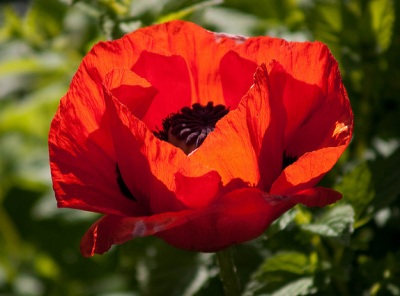
red poppy MIA_400x296“We call the poppy ‘vanity’ and we write it down as a weed. It is humiliating to think that, when we are taking ourselves seriously, we are considering our own self-preservation, or the greater scheme for the preservation of mankind. What is it that really matters? For the poppy, that the poppy disclose its red … Seed and fruit and produce, these are only a minor aim: children and good works are a minor aim. Work, in its ordinary meaning, and all effort for the public good, these are the labour of self-preservation, they are only means to an end. The final aim is the flower, the fluttering, singing nucleus which is a bird in spring, the magical spurt of being which is a hare all explosive with fullness of self, in the moonlight; the real passage of a man down the road, no sham, no shadow, no counterfeit, whose eyes shine blue with his own reality, as he moves amongst things free as they are, a being; the flitting under the lamp of a woman incontrovertible, distinct from everything and everybody, as one who is herself, of whom Christ said, ‘to them that have shall be given’.

“The final aim of every living thing, creature, or being is the full achievement of itself. This accomplished, it will produce what it will produce, it will bear the fruit of its nature. Not the fruit however, but the flower is the culmination and climax, the degree to be striven for. Not the work I shall produce, but the real Me I shall achieve, that is the consideration; of the complete Me will come the fruit of me, the work, the children.

“And I know that the common wild poppy has achieved so far its complete poppy-self, unquestionable. It has uncovered its red. Its light, its self, has risen and shone out, has run on the winds for a moment. It is splendid. The world is a world because of the poppy’s red. Otherwise it would be a lump of clay.”

D. H. Lawrence A Study of Thomas Hardy in D. H. Lawrence Complete Works Delphi Classics on Kindle

When reviewing Nature Mystics – https://contemplativeinquiry.wordpress.com/2015/7/6/  – I mentioned D.H. Lawrence and Thomas Hardy as two of the named writers who had become part of my life during my teens. I also wondered how far such free spirited people can be enrolled as ‘properly’ proto-Pagan as suggested by the author. This passage is certainly very Laurentian. In modern terms, it seems to connect with the current conversation about ‘wildness’ rather than religious Paganism or nature mysticism, though of course these are all interconnected. I have certainly enjoyed revisiting Lawrence’s words after a long absence.  They were written early in 1915, with the red poppy simply representing abundant life, and so before its memorialising significance became marked. Lawrence was just under 30 at the time of writing, with  just 15 years left to him.

BOOK REVIEW: NATURE MYSTICS

jhp54f743a60d1fbHighly recommended. Nature Mystics: the Literary Gateway to Modern Paganism is a new and refreshing departure in Moon Books’ Pagan Portals series. It introduces readers to some of the literature that many modern Pagans perceive to have influenced the culture of their spiritual family. It will be published at the end of this month (31 July 2015) and author Rebecca Beattie dedicates it “to all those Nature Mystics who have come before and continue to inspire us to a spiritual path with their words”.

Selection has clearly been an issue and the author has both used her own judgement and consulted with associates in a ‘Nature Mystic’ blog. Her centre of gravity is England in the closing decades of the nineteenth century and, more particularly, the opening decades of the twentieth. She has chosen five women and five men to represent a place, a time, and a suggested sensibility. There are outliers – John Keats from an earlier time and W. B. Yeats from Ireland – but Beattie shows in her introduction how they fit within the selection. The full list is: John Keats, Mary Webb, Thomas Hardy, Sylvia Townsend Warner, D. H. Lawrence, Elizabeth von Arnim, W. B. Yeats, Mary Butts, J. R. R. Tolkien and E. Nesbit. Each author has a dedicated chapter describing their life, work and cultural setting; exploring specific works in some depth; and discussing both their declared or implied spirituality and ways in which it may inspire modern Pagans. Each is given a remarkably thorough treatment for an introductory book that addresses a larger theme.

I grew up with some of these writers and went on to study English literature for my first degree in the final years of the 1960s. It’s been interesting for me to check back on the writers I knew and those I didn’t, at that time, as a way of checking out how the world has moved on. Four of the men – Keats, Hardy, Lawrence and Yeats – were an important part of my life; Tolkien not so much, though I had read both The Hobbit and Lord of the Rings. E. Nesbit I knew as author of The Railway Children and connected with the Fabian Society, the intellectual voice of respectable British Socialism at the time. Thanks to Nature Mystics, I’ve enjoyed being introduced to her The Accidental Magic: or Don’t Tell All You know and The Story of the Amulet, works for children penned by the Nesbit who was involved, as I knew that Yeats was, with the Hermetic Order of the Golden Dawn. I discovered Mary Webb later, when I went to live in Shropshire where she was remembered. By then I was able to read Precious Bane and Gone to Earth in Virago editions and I later found Sylvia Townsend Warner and Lolly Willows in the same way. I still see these powerful and highly relevant books through a sort of feminist ally lens, as primarily about free-spirited women in outsider positions navigating gender and sexuality in a largely hostile and uncomprehending world, and looking for oases of safety and possible flourishing. Beattie’s book adds to the picture by spelling out Pagan tinged nature mysticism as a spirituality that is congruent with this quest, and also informed by it. I have still not read anything by Elizabeth von Arnim or Mary Butts, and before getting my review copy of this book, knew of them only through their links with other people. Now I’m encouraged to look at their work.

I’ve been delighted to read a work that offers new information and a new lens. The writers concerned are a diverse and free-spirited group. I’m not entirely convinced that they either could or should be enrolled in a league of “properly proto-Pagan” Nature Mystics. It is my belief that most of them would resist the identification. Beattie herself says that Tolkien was dismayed by some of the responses to his work in his own life-time. At the same time I do see a common tendency, in this group, to find the numinous in natural settings and the spirit of place, “that sense of bliss and divine communion that is gained from time spent absorbed in the natural world” as Beattie puts it. I’m sure, too, that there will be a ready assent among many readers to the suggestion that “where Woolf said every woman needed a room of her own, von Arnim would have said every woman needed a garden”.

I will leave the last word to Thomas Hardy, in a brief passage from Tess of the D’Urbervilles, quoted in Nature Mystics. It is about Tess herself, and evokes a moment when a sensitive human consciousness is more fully awakened by a moment in the cycle of the day: “She knew how to hit to a hair’s breadth that moment of evening when the light and darkness are so evenly balanced that the constraint of day and the suspense of night neutralise each other, leaving absolute mental liberty”.

DRUID CAMP, STROUD CONTEMPLATIVE DAY, SMALL GROUPS

I’ve just had a couple of lazy summer days and I feel all the better for them. They’ve been interwoven with a relaxed stocktaking about contemplative Druidry and my part in it. I notice that my main focus is on small groups.

As I write, I’m at peace with my personal life and practice. At the collective level, I’ve had recent good news. My friend and colleague JJ Howell has let me know the specific roles that my partner Elaine Knight and I will be playing at Druid Camp in four weeks’ time. Druid Camp – www.druidcamp.org.uk  – is a large group (200-300 people), but we’ll be working with small groups, offering contemplative sessions from the repertoire built up by our local group over the last year. Meanwhile I also know that an open contemplative day in Stroud, organised by our own outreach arm Contemplative Druid Events –   http://contemplativedruidevents.tumblr.com  – is now viable and will go ahead on 3 October. We have seven people fully booked and three more with strong expressions of interest, with 15 being our max.

The overall position is that we have a flourishing local group, now three years old; a book largely though not exclusively based on the thoughts of its members; and an outreach arm able to offer an annual residential retreat (The Birchwood Retreat) every April and an open contemplative day in October 2015, which might become annual too. In all cases the events concerned will have no more than 15 participants. We could do a little bit more – providing small group sessions at other larger events, or offering more contemplative days either locally or elsewhere. But my sense is that we need to respect limitations in our capacity, stick to the small group approach, and make sure that all our work is experiential and not simply discursive. People need to taste it.

For me perhaps the greatest value of the small group is the opportunity for all participants to introduce ourselves and be heard. For that to work fully, we need a quality of listening which itself becomes a practice and part of our culture, and whose intention is to ensure that no one is either misrecognised or ignored. This in itself is counter to mainstream communication, including ours, and needs conscious practice. It will include mis-steps from time to time within our own groups. So it’s not about ‘getting it right’ all the time: the point is to be conscious. In a contemplative context, we can hope to go further: establishing a level of trust that opens the door to deeper I-Thou recognition and communion. It’s a different opportunity to those provided when large numbers of people become immersed together in prayer, song, ritual or formal meditation. It’s more personal, in the best sense of that term. I find it both more challenging and rewarding, whilst believing that all of these approaches have their honoured place.

Small groups have other advantages too. It is easier to be flexible on programming within the event. It is easier to offer activities which demand time for reflection and debriefing. It is easier to become aware of other people as spiritual companions, even if we have not met them before or do not know them well. I think, too, that it’s easier to learn, not least when in a facilitative role, because the style of the event can be person centred rather than goal centred. Activities are designed to support us in our human, and therefore spiritual, flourishing. They are not Everests to be climbed so we can say that we ‘knocked the bastard off’.

I think this is why we have not oriented our contemplative Druidry around long meditations or meditation training. It was one way to go, and in some ways the obvious one. It would certainly be the most traditional one and my solo practice is very much tilted that way. But the group context changes things. Pragmatically, our local group is about evenly divided between people who gain from long meditations and those who don’t. We would lose people by taking this approach. More importantly, the group is co-creating a culture in which the blessing of space and silence is received differently – through short meditations, attunement to the seasonal moment, silent walks, or activities like ‘Awen space’ in which we sit with each other, open to spirit, and can speak, chant or sing into the silence when so moved. We can also explore co-creation from silence into sound and story, or find different ways of awakening to the fields of energy and presence within us, between us, and around us. It’s a subtle and sensitive kind of work. It needs times of stillness and silence. It also needs times of movement, sound and speech. It needs times of reflection and relaxation.

In my view, we are still at an early stage of this exploration. We have a name – Contemplative Druidry – to hold us. We have literature – Contemplative Druidry and also Nimue Brown’s Druidry and Meditation – to support us. We have a dedicated group and an outreach arm. The small group approach has evolved quite naturally and I see it as a critically important aspect of how we work.

ETHICS AND THE ENDLESS KNOT

Exploring ethics through contemplative trance and active imagination

In Clear and Present Thinking (1) a book about logic, Brendan Myers includes a Chapter on Moral Reasoning. In this chapter he talks about Virtue Theory as one “where the weight of moral concern is on the character and identity of the person who acts and chooses, as well as the habits he or she develops and discharges through her actions and their consequences”.

Some days after reading this, I found myself in my inner sacred space, a heart space, the garden of the Goddess. I was not doing any formal practice. I was just there. When the garden first emerged, it was specifically as Sophia’s garden. And so it was this time.

There was a banner hanging from a tree branch, hawthorn I think. It was red, with a gold pentangle inscribed on it. I recognised it as the heraldic emblem from Gawain’s shield in Sir Gawain and the Green Knight (2). In this 14th century English poem the pentangle is introduced as a token of fidelity first devised by King Solomon. It is unbroken anywhere, and known in England as the ‘endless knot’. The poem involves an interrogation of ‘virtue’ as understood both in King Arthur’s Camelot and in the older world of the Green Knight far to the north. Gawain will have to navigate both physical perils and moral ambiguities.

Why did I find this device, as a spontaneously emerging image, in Sophia’s Garden? Firstly, I had been thinking about virtue ethics as described by Brendan Myers. Secondly, the pentangle in this form has been a significant image for me ever since I encountered the poem in my late teens. I’ve revisited it from time to time ever since, and this includes the reading of John Matthews’ Sir Gawain: Knight of the Goddess (3) which makes the link with Sophia. “In the Gnostic system, Sophia, the divine emanation of the Godhead, would not permit anyone to enter her Realm of Light, unless they were in complete balance, and bore the sign of the pentangle upon them”.

The offered meaning, as I see it, is that when addressing virtue ethics, I can’t rely on reason alone. Virtue ethics is up close and personal, more than an abstract principle or set of rules. I need to mobilise more of myself. In Sophia’s Garden I’m in a deepened form of awareness, and can contemplate the imagery using heart and intuition as well as rationality. They all work together.

Allowing the vision, I entered a light trance, with the image firmly in mind. I lay down with pen and paper near. I fell asleep for a short period – not part of the plan, but cleansing and useful. On waking I had words: Love/Wisdom. Sophia is Goddess of Love/Wisdom. The love is the greater quality, and it is an Eros fuelled love, for Sophia is the emanation of the Divine who ‘fell’ and then recovered (4). There must an opening up and movement towards someone or something, however slight and tentative, for it to be ‘love’. Whereas I owe justice and a pre-supposition of basic good will towards sentient beings, love is in my experience beyond command and does not result from a conscious act of will – though I can certainly work at expanding my potential to be a conduit. Wisdom is connected to this love, acting as a detector of distortions – empty or ungrounded sentiment, unaware compulsion, possessive attachment, ‘spiritual’ love as world rejecting flight, or driven and reckless forms of generosity lacking in self-care.

But love modifies wisdom too. Wisdom here is too energised to be altogether prudential. Counting the cost may make sense, but it’s not the only criterion. Wisdom uses the head yet is lodged in the heart. At the same time, wisdom also knows that ‘Love’ and ‘Wisdom’ as words can begin to solidify into things, always a problem with ‘nouning’. They can become wooden idealisations devoid of context and process, accessories to self-image, identity performance and external reputation. They can become alienated and commodified. They can even turn and be turned against us. So wisdom guards herself and love by guarding against too much reference to ‘Wisdom’ and ‘Love’.

At this stage I’m thinking again of the pentangle and wanting to use it to bring the virtues into relationship with each other rather than separating them out. I’m feeling happy about using this traditional framework so long as I can be playful with it. For I understand this to be the Sophian Way – with solemnity seen as having a stupefying effect, anaesthetising awareness. So in this ethics of the endless knot, I place love at the apex of the pentangle as I look at the banner, I move down to the base on my right, igniting the love/wisdom link.

Then, moving diagonally up left from the base I come to justice, for love and wisdom need justice in the world for the sake of their own flourishing: injustice inhibits the free flow of love and wisdom. I’ve already named justice, and fairness, as something I owe to all on a personal level, based on a presupposition of basic good will. I’m also clear about the need to work for justice in the wider world. On this, my vision is of a justice is careful of its methods, or it risks licensing revenge, both in power and opposition. Care about language and imagery are themselves a work for justice. Injustice wants to constrain and police these great resources. It seeks to close down their emancipatory magic. Working for justice is rational activity in service to love and wisdom. Sophia has always cried out against injustice, false justice and no justice. She has an ambivalent relationship with the law.

The classical virtue following on from justice, as I move in a straight line from left to right, is courage. What kind of courage am I looking at? For me it’s not about ‘warriorship’, with its theatricality and somewhat militaristic associations, however reframed for current values and conditions. (Perhaps that’s why my pentangle is inscribed on a banner rather than a shield.) Rather, it combines resilience with witnessing. Early Taoism captures the resilience aspect: “true goodness is like water … it goes right down to the low loathsome places, and so finds the way” and “the hard sword fails, the stiff tree’s felled. The hard and great go under. The soft and weak stay up” (5). I understand witnessing in a ‘truth to power’ sense and link it to my notion of care about emancipatory, life and world-expanding language and imagery and the need to guard them. This witnessing courage, to be honourable, may involve the willing loss of recognised honour and standing in a world that is formally virtuous. So it depends on a strong inner authority and a willingness to go against tribal custom. This is the courage I would tie in with love, wisdom and justice.

Moving down diagonally from courage, we come to the base of the golden pentangle on the left hand side, where I place temperance. In the course of its long history, ‘temperance’ has tended to shift from ideas of moderation to ideas of abstinence, as culture and religion have changed. Here and now, I have a resonance of ‘treading lightly on the earth’, in two senses. One is about limiting demands on material resources for the health and flourishing of the earth and its inhabitants. The other is about an ultimate non-attachment to material goods, contents of consciousness and the self-image they create. For me, there is a balance here which is why the word temperance comes in. I can love my possessions, my ideas and visions, my loved ones, my neighbours and my sense of who I am. But I am not fundamentally identified, not wholly immersed, in them. For these forms of love, if they are to flourish, demand some space around them, and there is a sense in which I am alone even within these nourishing interconnections. In another sense I am not. For I can go back to the simplicity of aware being and loving, timelessly arising from the fertile latency of the void. In this way I complete the endless knot.

This vision and reflection are only a beginning. I intend to continue engaging with this ethical approach, integrating it into my contemplative inquiry.

References

  1. Brendan Myers, Charlotte Elsby, Kimberly Baltzer-Jaray & Nola Semczyszyn Clear and Present Thinking: a Handbook in Logic and Rationality, Version 1.1 (21st May 2013) Available via brendanmyers.net or Amazon/Kindle
  2. Licensed under the Creative Commons Attribution-NoDerivs 3.0 Unported License – see creativecommons.org/licenses/by-nd/3.0/
  3. Sir Gawain and the Green Knight edited with an introduction, prose translation and notes by W. R. J. Barron. (Revised edition) Manchester, England: Manchester University Press, 1998
  4. John Matthews Sir Gawain Knight of the Goddess (Revised edition) Rochester, Vermont: Inner Traditions, 1998
  5. Pistis Sophia: a Gnostic Gospel translated into English with an introduction and annotated bibliography by G. R. S. Mead. Blauvelt, New York: Spiritual Science Library, 1984 (New Foreword for American Edition by Richard K. Russell
  6. Lao Tzu Tao Te Ching: a Book about the Way and the Power of the Way Shambhala: Boston & London, 1998 (A new English version by Ursula K. LeGuin)

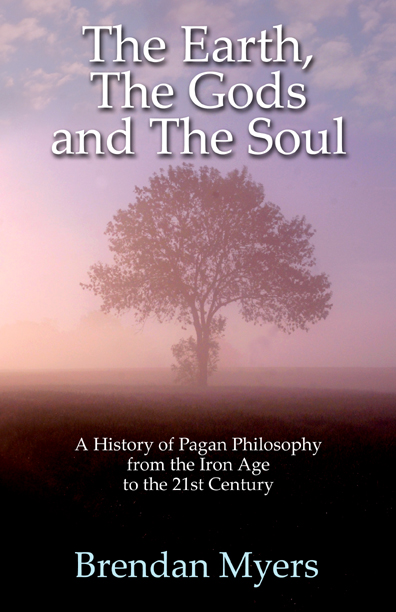
BOOK REVIEW: THE EARTH, THE GODS AND THE SOUL

jhp51efa580a1aafThe Earth, the Gods and the Soul: a History of Pagan Philosophy, from the Iron Age to the 21st Century by Brendan Myers fully justifies the ambition of its title. I see it as a must-read for anyone with an interest in pagan ideas and culture – past and present. Part of the author’s  mission is to demonstrate that “a pagan culture can be artistically vibrant, environmentally conscious, intellectually stimulating, and socially just”.

Myers provides useful working definitions of both ‘pagan’ and ‘philosophy’, whilst also showing the complexities involved in each term. He limits ‘pagan’ to people in the nations of the west and their predecessor societies in Europe and the Mediterranean, whose religion is non-Abrahamic (not Judaism, Christianity and Islam). This may now be complicated by patterns of migration and the Western impact of dharmic religions, but it works well enough if you are looking for a specific pagan tradition and its origins. Modern paganism, according to Myers, is informed by three families of ideas – pantheism, neo-Platonism, and humanism: these address the “immensities”, respectively, of Earth, Gods and Soul.

‘Philosophy’, for Myers, is an intellectual discipline that seeks answers to the ultimate questions about ‘life, the universe and everything’ using reason rather than the authority of dogma or an intuited divine source. He usefully lists 7 branches of this discipline: logic, ethics, epistemology, metaphysics, phenomenology, aesthetics and the history of ideas. Western philosophy’s origins are in Greece, and linked to the ‘know yourself’ injunction outside the temple of the Delphic Oracle. Myers sees this as a basic ethical demand for an honestly examined life, especially when wishing to enter the presence of a god. It leads to a wider view that self-knowledge heals, enlightens and empowers, though it may also at times judge and condemn.

The book is arranged as if musically, in an overture and six movements. The people chosen for inclusion are in many cases neither philosophers not pagans, and in many others only one of the two. But they have helped to define modern pagan ideas, culture and sensibility. Each movement covers a different historical period:

  1. A look at the old northern (‘barbarian’) world includes the Anglo-Saxon poem The Wanderer, Iceland’s Elder Edda, early writings about Druids, Irish wisdom texts and the Pelagian heresy (an early Christian heresy popular in the Celtic lands). There is no direct voice from a pagan culture in north west Europe, so Christians with half a foot in the old pagan world, or (in the case of the Druids) Greek and Roman authors are cited.
  2. A substantial collection of pagan Greek or Greek influenced philosophers from the early pre-Socratic period to the pagan martyr Hypatia of Alexandria. Also included are the Irish Christian neo-Platonist John Scotus Eriugena, and a section on the much later Italian renaissance. The people in this section, up to and including Hypatia, are both pagans (as we use that word today)and philosophers (in the ancient Greek understanding of that term).
  3. This movement is called ‘Pantheism in the Age of Reason’ and includes 18th century figures like John Toland, Edward Williams (aka Iolo Morganwg) and the Platonist and translator Thomas Taylor – as well as the more famous Jean-Jacques Rousseau. For the nineteenth century, we have Emerson, Thoreau, Whitman, Schopenhauer and Nietzsche.
  4. A movement on pagan ‘resurgence, reinvention and rebirth’ begins with Helena Blavatsky and the launch of 19th century Theosophy, going on to include J.G. Fraser of The Golden Bough, Robert Graves of The White Goddess, George William (A.E.) Russell of A Vision and Aleister Crowley. It goes on to look at the background to Gerard Gardner’s work and the Book of Shadows, then at the appearance of American Feminist Witchcraft and also at the separate stream of Eco-Spirituality and Deep Ecology.
  5. The fifth movement comprises ‘living voices’, so Stewart Farrar and Isaac Bonewits are placed at the end of the fourth, whereas Janet Farrar and Gavin Bone appear here. So too do Starhawk, Emma Restall-Orr, John Michael Greer, Vivianne Crowley, Michael York and Gus diZerega. There is also a section on ‘the critique of monotheism’. Myers praises Emma Restall-Orr for her work on ethics, its spirit of critical inquiry and her formal use of philosophical sources.
  6. Here we find Brendan Myers’ personal commentary. He talks about a hoped-for development of a critical tradition on paganism, and the value of ‘institutions’ in maintaining such a tradition. (He acknowledges that this may go somewhat against the grain of paganism as a dissident culture). He talks about modern to paganism’s history of ‘faulty ideas’, and promotes the development of better ideas for the future.  He also celebrates the health of a ‘will to live in an enchanted world’. Myers has ‘no special teachings’ of his own. A declared pagan philosopher, he builds his personal inquiry around four questions: how shall I dwell upon the earth? How shall I converse with all people? How shall I emerge from my loneliness? How shall I face my mortality? He then goes on to discuss what these questions bring up for him.

Myers ends his book by saying: “the best music is made with humanity, integrity and wonder – everyone has instruments to hand … When I hear music I share it … when I make music I share it too … I hope that my people will celebrate with me and play along … when I make dissonant or offending sounds, I trust my people will warm me, so I can make amends … nothing more, perhaps, could be asked of anyone. And, perhaps, nothing less”.

The Earth, the Gods and the Soul is a well-informed and simply written history of pagan ideas, which tells modern pagans a lot about the shoulders we sit on. It is a great reference book. But what it did mostly for me was to get me thinking about my own relationship to philosophy and its working methods. I call my own journey a contemplative inquiry. How could I use tools from philosophy’s  toolkit to improve my own inquiry in service of a pagan critical tradition? That’s where there’s an inspiration for me – because I sense an invitation there, from a professional philosopher, to make use of this toolkit. Myers’ forward includes a reference to Clear and Present Thinking, written by him with support from a number of University colleagues for a general audience, and freely downloadable. It’s another good job, and very useful to have.

ORPHIC HYMN TO NEMESIS

This Orphic hymn to the goddess Nemesis comes from a collection likely to have been compiled in the third century CE, and offers a glimpse of Greek-inspired pagan religion in what turned out to be its last phase.

ORPHIC HYMN TO NEMESIS

Nemesis, I call upon you,

O goddess, O great queen,

Your all-seeing eye looks upon

The lives of man’s many races.

Eternal and revered,

You alone rejoice in the just,

You change and vary,

You shift your word.

All who bear the yoke

Of mortality fear you,

You care about the thoughts of all;

The arrogant soul,

The reckless one,

Finds no escape.

You see all, you hear all,

You arbitrate all.

O sublime deity,

In whom dwells justice for men,

Come, blessed and pure one,

Ever helpful to the initiates,

Grant nobility of mind,

Put an end to repulsive thoughts,

Thoughts unholy,

Fickle and haughty.

From The Orphic Hymns: translation, introduction and notes by Apostolos N. Athanasskis and Benjamin M. Wolkow Baltimore: Maryland, USA: The John Hopkins Press, 2013.

In his introduction to this collection, Apostolos Athanassakis talks about Orphic hymns as instances of a devotional mysticism that uses “the power of clustering epithets” for the creation of “an emotional and spiritual crescendo that might raise our human spirit and help approach the divine”. They remind him of Vedic hymns, Rumi’s verses within the Islamic Sufi world, and aspects of his own Christian Orthodox upbringing. The hymns are beautiful to read – though it is worth remembering that they are designed for group practice in a charged, incense laded atmosphere, with repetition upon repetition, perhaps accompanied by swaying, movement or dance of various kinds.

In the ancient Greek and Greek-influenced world, Nemesis was primarily seen as the goddess of retribution against hubris, arrogance before the gods. She was also called Adrasteia (the inescapable) and at times attracted the epithet Erinys (implacable). In early times she was thought of as the distributor of fortune, and Aphrodite was sometimes called Aphrodite Nemesis. Later she appears as a maiden goddess of proportion and avenger of crime, equipped with measuring rod, bridle, scales, sword and scourge.

The Orphic hymns probably date from the third century CE, a time of philosophical and religious change in the Roman Empire. They were popular for as long as it was possible to maintain a syncretistic religion forged of traditional pagan elements in those parts of the world (chiefly the Eastern Roman sphere) where it was practised. The hymns name specific pagan deities, yet appeal to universal spiritual powers. In this instance Nemesis seems to be seen as a goddess, or personification, of something akin to karma. Devotees are not praying directly for a change in their fate, but in their own thoughts and feelings, in the hope that the energy of the goddess may assist them.

GROUP WORK IN CONTEMPLATIVE DRUIDRY

In a recent blog post on https://contemplativeinquiry.wordpress.com/2015/4/26/ I discussed the first weekend retreat offered by Contemplative Druid Events. I talked three about “developing a tradition” but I didn’t say much about the kind of work we did. Here I look at group practice in Contemplative Druidry and where I see my own place and contribution.

For me the retreat confirmed an existing sense of what a Contemplative Druid group looks like, certainly as developed through Contemplative Druid Events so far.

  • We are offering something different from a collective extension of solo practice. My solo practice is fairly typical of contemplative work in any tradition: a specific ritual and liturgical framework holds long periods of sitting meditation, with shorter periods of walking meditation, exercise and energy work. The group practice we’ve developed includes these, whilst being more outward-looking and interactive – more relational.
  • Our approach is especially suited to small groups – about 8-12 people – allowing time for people to build community and to share and process experience. We also place value on formal sharing, getting to know each other through introductory and check-in processes, reconnecting each morning through a process called ‘overnight phenomena’ and engaging in specific exercises where we have the opportunity to reveal a bit more about ourselves (or not) with supportive attention.
  • We practice ‘lean ritual’, minimalist and powerful, thoroughly grounded in Druid and Pagan tradition, which holds us in a dedicated Contemplative Druid circle and marks transitions in our group process within that circle. We build periods of silent attunement, 5-10 minutes long, into our ritual and transitioning spaces.
  • As a defining group practice, we have ‘Awen space’ and we chant the Awen for a period when entering and exiting that space. We open ourselves, becoming more receptive and sensitive, more present to what is in us, between us and in the space. Whatever follows will be whatever it is. Some of the time we remain silently aware of group and space; some of the time we chant, talk or sing, surrounded by silent attention which continues into the after echo of the sound. On this retreat we had a 45 minute Awen space following directly on from a 15 minute meditation
  • We are in some sense an experimental group. We’ve looked at various ways of incorporating sound, music and movement. We have used both ‘Lectio Divina from the Book of Nature’ and ‘Animist Hermetics’ – similar activities with different pedigrees and different philosophical assumptions, and looked at the different results that they produce. We have included long silent walking meditations outdoors and are looking to add a long narratised walking meditation outdoors later this year. What difference will that make? We have had one led session of ‘belly-breathing’ meditation (actually belly-heart-head with belly first and foremost) that seems highly congruent with Earth spiritualities and Druidry in particular. It isn’t the cauldron of Poesy (being more naturalistic), but it has a certain cousinship to it: another valuable exploration.
  • We have started to build a cadre of facilitators who, amongst our many roles in life and Druidry, are able to co-lead groups under the banner of Contemplative Druid Events.

It is likely – and desirable – that we will see other people picking up the ‘contemplative’ meme in Druidry and Paganism more widely.  There will be many approaches. But I’m clear that my personal focus and fealty are to the stream of work I’ve been involved in since the first Contemplative Druid day in July 2012. The work described above has followed on from that and it is still very much a work in progress.

For information on Contemplative Druid Events, or the books Contemplative Druidry and Druidry and Meditation, please see http://contemplativedruidevents.tumblr.com/.

CITIES AND NATURE

Reflections by Crafter Yearly on avoiding “the dualism between the Nature and the human-made world”.

NaturalisticPaganism's avatarNaturalistic Paganism

(Above: Design and think tank group, Rollerhaus, re-imagines an eco-centric future vision of Chicago.)

resize-5

Since I was small, I have always loved cities. When I am in them, I feel a kind of expansiveness that is unique to my experience of a city. When I walk down streets surrounded by tall buildings, or when I wait for a train, I feel small in the best possible way. Human activity feels big. Limitless. The impossibility of knowing everyone or everything happening in that moment is humbling and exciting. Like there are possibilities too numerous to even consider. Thousands of lives I could choose for myself, magnified and made more intoxicating because of my close proximity to thousands or millions of others, each with their own set of impossibly diverse opportunities for building a life and a self.

I am an advocate for cities. And given the option, I would choose…

View original post 843 more words

POEM: THE OLD PEONY STALK

Seeming old dry stick

and yet …

a whole ecology

of

moist earth

tiny insects

a little live stem

whiskers and bones

whiskers and bones

dying back to the earth

without fuss

and not too fast

enough life left to feel/hear its

resonance

… a  subtle one.

Stillness allowing movement

permitting earth, moisture, fragmentation

in slow process

easy not to notice

yet, in softened, mutated from –

Part of the Song.

One of the cultural values of the Druid path is that those of us who are not dedicated, specialised poets and artists are encouraged to write poetry and to practise in the arts. I wrote this yesterday after participating in a ‘Lectio Divina from the Book of Nature’ practice with my partner Elaine. This practice was first introduced to us by our colleague Julie Bond and Elaine has adapted it. She will be offering it at our Contemplative Druid Retreat this weekend (17-19 April). I enjoyed rehearsing the practice with her very much, and am glad to have this record of its fruits.

IMBOLC LIGHTS

I’m reflecting on the difference between ‘Light’ and ‘lights’.  Yesterday evening my partner Elaine and I had an Imbolc ritual. We’ve decided to move through the seasonal festivals in this way, customising a joint practice as we go.

I reflect now on our time in the festive circle as in part a feast of lights. Not ‘Light’, but lights. We can have Light at the throw of a switch, one easy taken-for-granted ‘Let there be Light’ gesture. It’s very powerful and very useful – and effortlessly normal in our culture, at least for the time being.

But it isn’t a feast of lights. A feast of lights requires multiple, small sources. It requires the co-presence of darkness and shadow. It requires variation, degrees of light and darkness. It requires change and play.

We had two basic light sources, during the ritual. The one that attracted my attention most was an array of night lights positioned around the room in various ways. We had nine on the altar (one at the centre, eight at the circumference – with one at each station of the eightfold wheel of the year). And there were others around the room, grouped in threes. Very simple. Very traditional. Very minimal. Very meaningful. Very beautiful. These lights tended to be bright and a high yellow, glinting in some moments, softer and more diffuse at others. Each had its own aura. All tended to flicker in even the smallest current of air. And each had its sphere of influence, fading porously into the surrounding dusk, with no clearly defined or specific boundary – the transitions being so gradual, so gentle. Thus light and darkness were differentiated without being polarised and they cheerfully shared their debatable lands. The play of ambiguity was part of the feast.

The second source was the fire, a wood burner, well-established by the time we began the ritual and happily placed in a north-easterly hearth. Also very traditional. Very simple. Very minimal. Very meaningful. Very beautiful. And for the most part, in this mature phase, a deep red, in a way a dull red, though the word isn’t right. A potent light, a subliminal light, almost a kinaesthetic light. Not a very light sort of light at all. Its presence radiated through the room, bringing our centre of gravity, even in terms of luminosity, closer to the earth.

And that is a feast of lights. It was almost a shock, in the tidying up aftermath of the ritual, to return to the Light.

Earth Eclectic

music that celebrates Earth and speaks to the heart

Sarah Fuhro Star-Flower Alchemy

Follow the Moon's Cycle

Muddy Feet

Meeting nature on nature's terms

Rosher.Net

A little bit of Mark Rosher in South Gloucestershire, England

Becoming Part of the Land

A monastic polytheist's and animist’s journal

selkiewife

Selkie Writing…

Charlotte Rodgers

Images and words set against a backdrop of outsider art.

Prof Jem Bendell

living with metacrisis and collapse

Towint

The pagan path. The Old Ways In New Times

The Druids Garden

Spiritual journeys in tending the living earth, permaculture, and nature-inspired arts

The Blog of Baphomet

a magickal dialogue between nature and culture

This Simple Life

The gentle art of living with less

Musings of a Scottish Hearth Druid and Heathen

Thoughts about living, loving and worshiping as an autistic Hearth Druid and Heathen. One woman's journey.

Wheel of the Year Blog

An place to read and share stories about the celtic seasonal festivals

Walking the Druid Path

Just another WordPress.com site

anima monday

Exploring our connection to the wider world

Grounded Space Focusing

Become more grounded and spacious with yourself and others, through your own body’s wisdom

The Earthbound Report

Good lives on our one planet

Hopeless Vendetta

News for the residents of Hopeless, Maine