Contemplative Inquiry

This blog is about contemplative inquiry

Tag: Contemplative inquiry

SUMMER’S GATEWAY 2021

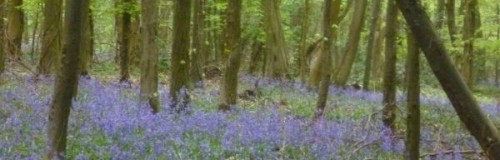
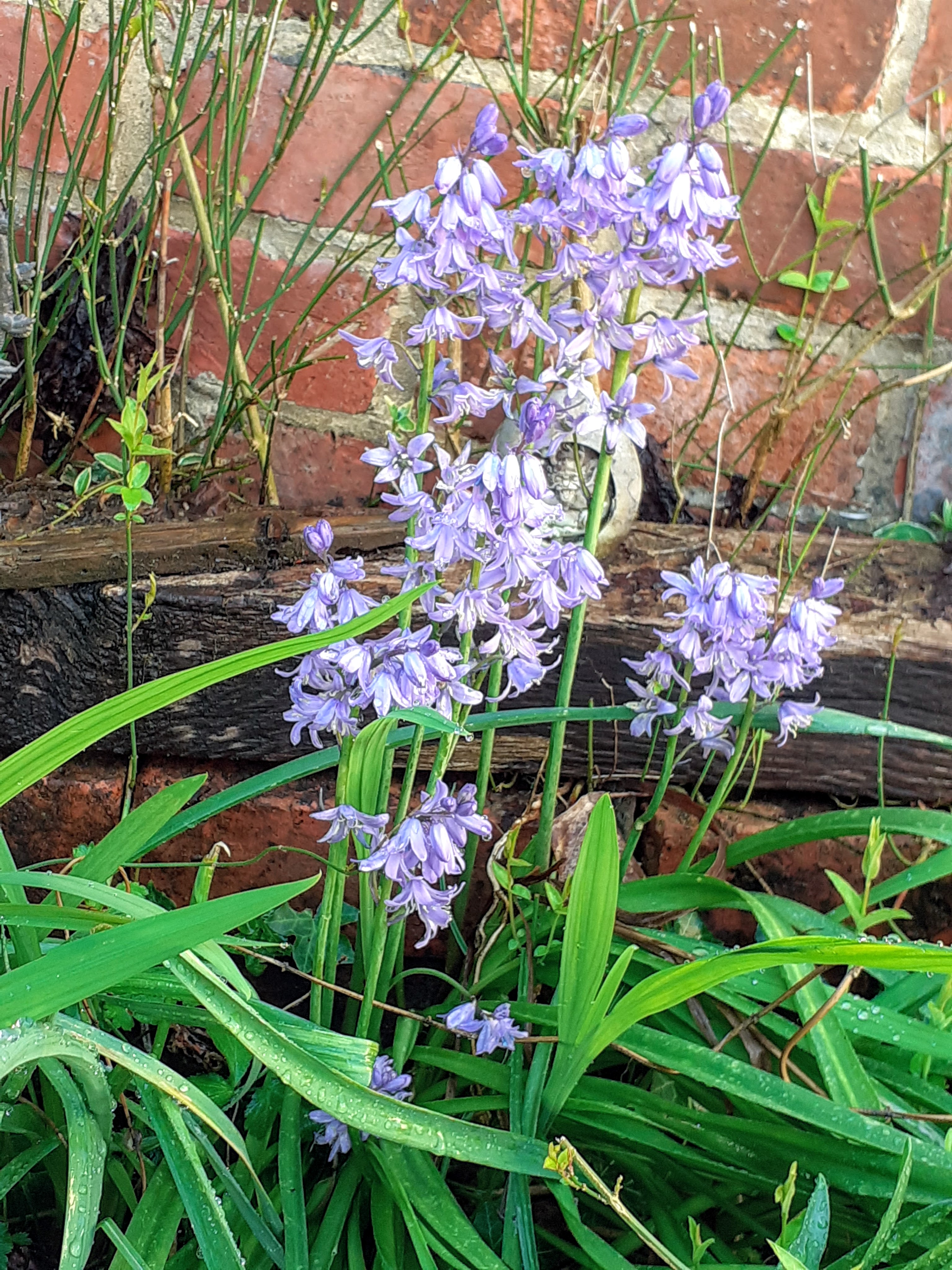
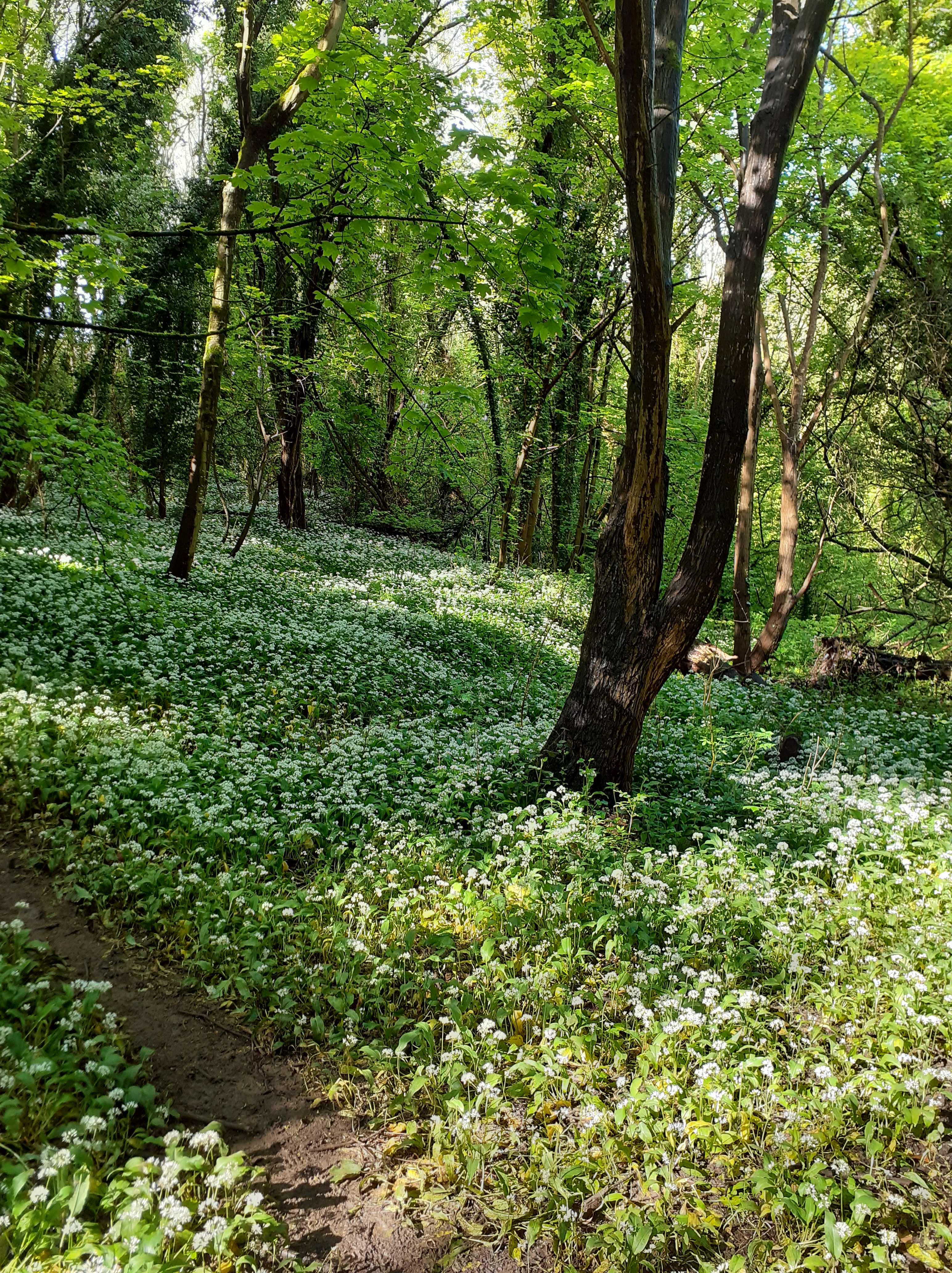
For me, 2021 has been a testing year so far. Part of the test has been a cold, wet and hesitant spring – very different from the tantalising splendour of 2020 and the first lockdown. But this morning, 19 May, I had two hours of what I most love in the transition from spring into summer. It was a refreshing and healing experience to be in the woods, hard to describe in words. I am letting pictures do most of the work.

The woodland I walk in is hardly pristine. It grows in a long-disused railway cutting, now refashioned into a cycle track. At this time of year, and throughout the summer, it is wonderfully green and vital. Here, in this early stage, it feels especially fresh and alive.

Although it is limited in size and partly defined by a path, there is enough room in this little domain for both a tangle wood effect and for a spacious carpet of wild garlic among the trees.

Since I was very young, hawthorn and cow parsley have been a feature of this time, in woods and hedgerows. I was pleased at their presence today, and glad to be able to show up and be present for them.

The overall effect was one of exuberant abundance, a life that will declare its power and beauty given any chance. I will give the last image to the hawthorn.

BEING AND PERSPECTIVE

“To have a perspective, a sense of Being has to be there first.

Is there any perspective if there is no sense of Beingness or sense of aliveness?

That same aliveness underlies every perspective.

The Questions – Does it help? Is it of value? –

are questions which people will have their own perspective on.

So, a wordless experience of being that is available to turn to 24/7,

not dependant on a particular feeling, thought or perspective,

All of which come and go.

Not being an attainment

it is not dependent on effort

but when consciously noticed

it is constant and obvious.”

These words from Steve Palmer of the Headless Way summarise my learning from that family when crafting a contemplative Druidry through my inquiry process. The noticing he talks about towards the end is at the centre. Everything else radiates out, re-visioned by the noticing.

http://www.headless.org/

STILL MOMENTS FROM THE FLOW

In the dance of stillness and movement, I feel immersed in movement. I am open to this turn in experience. It’s fundamentally fine. But part of it involves pushing against limited energy in unfamiliar ways. I am needing to work at balancing self-care with getting things done.

I remain still at heart, with space for all the surface tensions, yet there’s an efforting in the day-to-day. I hardly know whether to resist or welcome this. I am living with elements of both. Self-compassion asks that both the resistence and the welcome be given their space.

For many years now, I have lived my spiritual life as a Druid contemplative inquiry. Contemplation is the receptive element and inquiry the active one. Nature, including mine, is the setting. Somehow, I find myself held.

I took this picture recently on a canal walk – the image is of an adjacent stream. Gazing into it now, I see a power and a swirl in this still image, whilst recalling the rapid movement and change of the stream at the time of picturing it. I find that the image evokes a sense of wonder at the power and beauty of moving water, revealing shapes and relationships that shifted too quickly to register fully on the day. In swiftly changing times, stilling and reflection offer a restorative experience.

SUNSET LATENCY

In the rich evening of my life, I’m experiencing a sense of latency. Good – in its suggestion of possibilities. Uncomfortable, in a context of possibilities deferred.

The context is that, for most of this year, I’ve been experiencing breath problems. Once I knew that I didn’t have Covid, I assumed they would go away with winter. But they haven’t. Next week I’ll be having a battery of tests including an electrocardiogram, blood tests and a chest X-ray. I want to find out what is going on, what if any formal medical intervention is required, and how to manage my health going forward. There may be a new normal to accept and work with. I try to cultivate a Druid sensitivity to the life energy within me and a sense of how to nurture it.

Meanwhile, I find that breathing exercises help. They are the same breathing exercises I use to connect with stillness, and rest in the heart of Being – an interesting state of affairs in itself. One one level I am semi-grounded by a degree of impairment and a lack of knowledge about what it implies. On another I am called to intensify my spiritual practice. Problem and opportunity in the same package. Whatever happens, I feel that the opportunity is greater, though it doesn’t always feel that way.

On another level again, my wife Elaine and I, both now twice vaccinated, are wanting to step out into the world again. Our eyes are looking north, towards York, the Tyne and Wear coast, and Scotland – specifically Edinburgh and the Lothians. We have family up there and want to live a little closer to them. We would also like to live closer to the sea. This is quite an old idea, interrupted at first by the uncertainties of Brexit, the pandemic, and Scotland’s future. One thing we have learned is to stop worrying about uncertainties, or we’ll die before making a move. But Elaine’s physical health is also compromised – she was very seriously ill in January, still recovering now – and we have to work to find the energy to make our house presentable, sell it, and settle in another part of the country. We are taking steps whilst being careful not to over-tax ourselves and push the river. A northern tour is planned for early June.

I notice that I am not going on local walks and taking pictures as much as for most of the last eighteen months. In some ways I regret that. In others, I am allowing a change of focus. I am conscious that 2021 has been slower to wake up and bloom here than in the wonderful late spring and early summer of the first lockdown. Cold northerly winds bringing hail and sleet have been a feature. Normally this wouldn’t be a deterrent to me. I like bracing weather and don’t mind getting wet. But this year I’m being cautious. There is a great deal going on, a lot to attend to, another life waiting to break through. I will be 72 later this month, and I’m calculating that I have time for a new worldly adventure, shared with Elaine. We cannot be certain of this, yet I have rarely felt so alive.

SLOW HEALING BREATH: CHANTING HELPS TOO

“When Buddhist monks chant their most popular mantra Om Mani Padme Hum, each spoken phrase lasts six seconds, with six seconds to inhale before the chant starts again. The traditional chant of Om, the “sacred sound of the universe” in Jainism and other traditions, takes six seconds to sing, with a pause of about six seconds to inhale. The sa ta ma na chant, one of the best-known techniques in Kundalini Yoga, also takes six seconds to vocalize, followed by six seconds to inhale. Then there are the ancient Hindu hand and tongue poses called mudras. A technique called khechari, intended to help boost physical and spiritual health and overcome disease, involves placing the tongue above to soft palate so that it’s pointed towards the nasal cavity. The deep, slow breaths taken during this khechari each take six seconds.

“Japanese, African, Hawaiian, Native American, Buddhist, Taoist, Christian – these cultures and religions all had somehow developed the same prayer techniques, using the same breathing patterns. And they all likely benefitted from the same calming effect.

“In 2001, researchers at the University of Pavia in Italy gathered two dozen subjects, covered them with sensors to measure blood flow, heart rate and nervous system feedback and then had them all recite a Buddhist mantra as well as the original Latin version of the rosary, the Catholic prayer cycle of the Ave Maria, which is repeated half by a priest and half by the congregation. They were stunned to find that the average number of breaths for each cycle was ‘almost exactly’ identical, just a bit quicker than the pace of the Hindu, Taoist, and Native American prayers: 5.5 breaths a minute”. [I find the same when chanting the awen – aah-ooo-wen – in Druidry: JN]

“But what was even more stunning was what breathing like this did to the subjects. Whenever they followed this slow breathing pattern, blood flow to the brain increased and the systems in the body entered into a state of coherence, when the functions of heart, circulation and nervous system are coordinated to peak efficiency. The moment the subjects returned to spontaneous breathing or talking, their hearts would beat a little more erratically, and the integration of these systems would slowly fall apart. A few more slow and relaxed breaths, and it would return again.

“A decade after the Pavia tests, two renowned professors and doctors in New York, Patricia Gerbarg and Richard Brown, used the same breathing pattern on patients with anxiety and depression, minus the praying. Some of these patients had trouble breathing, so Gerbarg and Brown recommended that they start with an easier rhythm of three-second inhales with at least the same length exhale. As the patients got more comfortable, they breathed in and breathed out longer.

“It turned out that the most efficient breathing rhythm occurred when both the length of respirations and total breaths per minute were locked into a spooky symmetry: 5.5-second inhales followed by 5.5 second exhales, which works out almost exactly to 5.5 breaths a minute. This was the same as the pattern as the rosary. The results were profound, even when practised for just five to ten minutes a day”.

Extract from James Nestor Breath: The New Science of a Lost Art Riverhead Books: USA & Penguin Life, UK: 2020 (Kindle edition)

DANCING SEAHORSES II

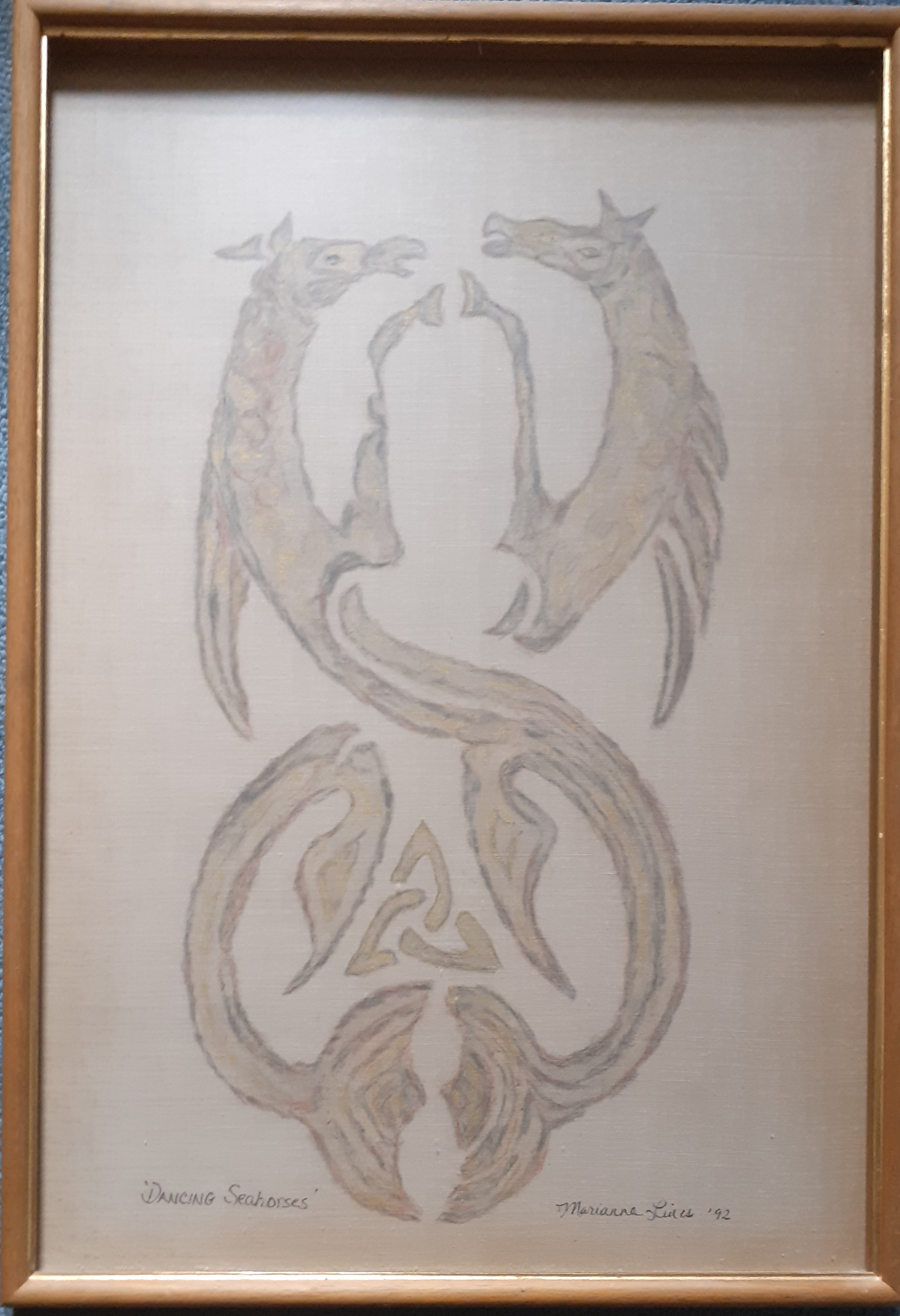
I have already written about the Dancing Seahorses image (1) found on a Pictish stone from Aberlemno in the Scottish county of Angus. After seeing the stone on a visit there, in 1992, I bought Marianne Lines’ painting. I have felt strongly involved with this image ever since. I think of it as a friend and guide. In a sense, this post is about the modern use of archaic images by people, like Druids, who are drawn to them.

I do not know the intentions of the original carver. beyond celebrating beings who are half of this world, half of the otherworld, and who embody powerful water energies for Celtic peoples on the Atlantic coasts of Britain, Ireland and Brittany in ancient times. They are remembered in folklore to this day. I do know that the carving made a strong impression on me, when I first saw it on the stone itself. It stayed in my imagination, and over time has deepened and grown new meanings.

Four years after acquiring the painting, I had the image tattooed on each arm. By that time I knew of the way in which it had influenced the cover design for R. J. Stewart’s The Prophetic Vision of Merlin (2). This variant form was used to refer to the story of the young Merlin at Vortigern’s subsidence prone tower in Snowdonia, prophesying his way out of becoming a human sacrifice, and identifying two contending dragons under the foundations. In the book illustration, there is a yin-yang reference, with a suggestions of interdependent primal forces, each of which already contains the seed of the other, seeking balance and alignment. In the Western Mysteries quest for healing and transfiguration, the energy bodies of the land and of humans are deeply interwoven.

There is another, more recent level of understanding, that I derive from the painting and tattoos, but not evident in The Prophetic Vision of Merlin. I see both the dancing seahorses and a second image, behind and containing the immediately apparent one. As I wrote before, “the space where the horses legs are raised defines a shape, suggesting a head. The very emptiness there is a paradoxical mark of presence. To me it became the head of a goddess, with the seahorses then becoming her body. Still clearly appearing as a water being, her arms – if they are arms – are raised in blessing”. I would now add that in this way, she demonstrates the dance of emptiness and form. They are balanced. Neither is privileged over the other. The Celtic knot points both to interconnection and infinity.

I identified the Goddess whilst gazing directly at the original Dancing Seahorses picture, which hangs of a wall directly above my altar. However I believe I received a subconscious nudge from the High Priestess card in The Druidcraft Tarot (3). She wears the image herself. Her hands are raised. She stands as the Goddess. In the Druidcraft narrative, she “represents the magical power of stillness and depth”. For me, the Goddess in Dancing Seahorses represents the ultimate union of emptiness and form, and the rebirth of the cosmos in each moment. Her representation combines the aware potential of the void and a primal aquatic generativity that can inhabit other elements. The Druidcraft priestess is human, but one who wears an image that bespeaks the divine to me, and her role asks for “stillness and depth”.

In my work, the entry into stillness and depth is, firstly, to enter into I-Thou communion with the primal Goddess (Modron) and then to recognise my own true nature, as (mythically) her divine child (Mabon) – sensitive and busted open to the world. This recognition becomes a prayer of gratitude and a surrender of my passing private concerns to Who I really am.

Words and pictures are not enough, but, cherished and contemplated lovingly over time, together they can point the way..

(1) https://contemplativeinquiry.blog/2020/06/25/dancing-seahorses/

(2) R. J. Stewart The Prophetic Vision of Merlin London & New York: Arkana, 1986

(3) Philip & Stephanie Carr-Gomm The Druidcraft Tarot: Use the Magic of Wicca and Druidry to Guide Your Life London: Connections, 2004 (Illustrated by Will Worthington)

BOOK REVIEW: KLARA AND THE SUN

Klara and the Sun (1), is Kazuo Ishiguru’s most recent novel. It is a careful exploration of sentience, relationship and affection in a world increasingly reliant on artificial intelligence and genetic ‘enhancement’.

I found this book brilliant and haunting, with its combination of formal restraint and devastating insight. For readers familiar with Ishiguru’s work, its greatest resonance is with Never Let Me Go, though there are also echoes of The Remains of the Day. Klara is an AF (Artificial Friend), manufactured to befriend young people of the elite class during their adolescent years. These children themselves are, in most cases ‘lifted’ through genetic enhancement, to gain access to the colleges which act as gateways to elite roles in adulthood. In almost all cases, ‘lifting’ is a requirement for entry. Unfortunately, lifting is also hazardous for the young people concerned.

We meet Klara in the store where she is waiting to be bought. She has been manufactured to be sensitive, empathetic and observant. She watches and learns as customers come and go. Solar powered, she also develops an animistic devotion to the sun. She loves being close to the shop window. It improves her chances of purchase. It allows her to watch the street and its life. Above all improves her access to the sun and his nourishment. From the perspective of the reader, she is excruciatingly hopeful and content with her lot.

Most of the book is about Klara’s relationship with Josie, who chooses her as Artificial Friend. Klara has an unstinting love and loyalty for Josie, which is genuinely reciprocated to a degree, though not entirely reliably. Josie has had problems with being uplifted and her health is poor. As different characters come into play, we learn more about life in the elite of Klara’s world, their varying attitudes to Artificial Friends, and the place of non-elite humans. The story unfolds. Klara retains her love and loyalty towards Josie, and her devotional faith in the sun and his nourishment, from beginning to end.

Ishiguru creates a world that has fairy tale aspect, so his book is not exactly speculation about a possible future. Nonetheless, his themes are pertinent to possible futures, especially in the realm of AI. The writing combines beauty, economy and precision, all the better to wring the heart of the sensitive reader. My hope lies in the intimation that sentient beings can indeed find nourishment, even in a dystopic world.

(1) Kazuo Ishiguru Clara and the Sun London: Faber & Faber, 2021

REMEMBERING THE GLASTONBURY THORN

In my wheel of the year tree mandala (1), hawthorn presides from 1-23 May. It celebrates Beltane and the rising strength of the sun. Looking forward to that time, I think particularly of a specific tree, the Glastonbury thorn at Wearyall Hill, to represent that period. But the tree is gone, and is now unlikely to return, though ever-living in my heart and imagination..

It was a variety of common hawthorn (crataegus monogyna biflora) that flowered twice a year – first around Christmas and then in spring. I took the photograph in a misty Imbolc moment in 2007, between flowerings. It is the only one I will ever have, and for that reason I treasure it. The much revered tree was vandalised in 2010. New shoots appearing from March 2011 mysteriously disappeared. A new sapling, grafted from a descendent or the original tree, was planted in 2012 and consecrated – only to be snapped in half and irreparably damaged 16 days later. In May 2019, after some years of hesitation, the tree was entirely removed by the landowner in a final acceptance that the tree was lost. Sacred thorn trees, said to be descended from the same original, can still be found in the ruins of Glastonbury Abbey and at the Church of St. John.

I particularly liked the Wearyall Hill tree, because it was physically removed from the bustle of Glastonbury as a twenty-first century spiritual centre. The hill just seemed quietly natural – pagan, if you wanted to think of it that way, or Christian, if you wanted to link it to the story of Joseph of Arimathea’s staff, and how it came to life and flowered when planted in a new land. I was shocked by the violence against the tree and against other people’s love for it.

An ancestor of thee thorn (the individual plants do not last forever) had been cut down before, probably in 1647 by a Parliamentary soldier in England’s civil war. For the thorn was strongly linked to royal patronage, the miracle of a Christmas flowering, and a link between sacred land and sacred kingship. The kind of Royalism represented by this constellation of ideas and images was strong in Somerset at that time, but so was religious Puritanism, allied to a wish for constitutional change. The war was bitterly fought within the county. The legend of the thorn, cultivated by one group of people, made it vulnerable to another group of people identified with different loyalties.

The modern destruction of the thorn also seems not to have been casual, or it wouldn’t have been repeated so systematically. But I am not sure of the motivation. I find myself understanding a seventeenth century act of violence better than the modern one. Was this venerated tree the victim of a current human culture war? Are there potential lessons for Avalonians? Whatever the case, I am still in mourning.

(1) This mandala is based on my personal experience of trees in the neighbourhood as well as traditional lore. Moving around the summer quarter from Beltane, 1 May, the positions and dates of the four trees are: Hawthorn, south-east, 1-23 May; Beech & Bluebell, south-south-east, 24 May – 15 June; Oak, south, 16 June – 8 July; Gorse, south-south-west, 9 – 31 July. The autumn quarter then starts with Apple at Lughnasadh/Lammas. For a complete list of the sixteen trees, see https://contemplativeinquiry.blog/2020/autumn-equinox-2020-hazel-salmon-awen/

‘WHIRLPOOL’: THE POWER OF AN IMAGE

For R. J. Stewart (1), the deepest vision and reality of the Underworld is “that the stars are within the Earth, within ourselves, not distant and remote”. He explains a vision in which our habitual awareness, personal and collective, “is on the surface of existence” and that “the primal reality is in the depths, not only of ourselves, but of the land and planet, which are of the universal Being. So we do not reach out and away from ourselves, but plunge into the otherworld that is the source of our own and, more important, is the source of the stars themselves.  In the Whirlpool realm, we find the deepest intimations of our inherent universal Being. It leads us to the sacredness of the planet, of the body, for deep within is all that is, the source of the four Powers emerging from the Void”*.

The Dreampower Tarot, which Stewart devised together with artist Stuart Littlejohn, is structured around a descent from the surface through three realms: stone, pearl and whirlpool. To a large extent these correspond to the traditional western distinctions of body, soul and spirit, though emphasising a journey of descent rather than ascent. The Whirlpool realm, and the individual Whirlpool card, involve a quest “for truth and reality that reaches within towards the source of Being. In this sense it also shows wonder and awe, the Mystery within that turns all existence, setting the worlds in motion through the cycle of the Powers and Elements.” Hence the Whirlpool can be called an archetypal image – putting a star field in the foundational depths of consciousness. The use of the term ‘whirlpool’ for a “spiralling nebula of stars” skilfully introduces water references into the picture, offering further disruptions of common sense for the imagination to make use of.

In an earlier work (2), Stewart places a star field at the centre of a creation myth, one that begins with darkness and void until light begins to appear, and “the light that spreads through the darkness is starlight, and we find that we are in the centre of a vast wheel of stars, rising and falling all around us”. Here he introduces the Goddess Ariadne, “Weaver of Being and Unbeing”, creator of form. Her description is too specific and too anthropomorphic for me. But there is something in the process which unfolds that resonates: “Out of the silence a sound emerges … It is the sound of breath. We become aware of a breathing in and out, and realize that this breathing is our breath and yet the breath of all Being. We breathe, Being breathes. Slowly we feel form assemble from the breathing, and realize that we have a body which is the body of all Being.  The stars are within us, we are formed of the Weaving.” 

I have a powerful sense of the motherhood of the cosmos, and of being companioned, though not instructed, in learning to breathe. I have intrauterine and early post natal experiences – not readily accessible, but held within me – to influence my shaping of experience. I have adult experiences of rebirthing and holotropic breathing that have enabled me to reprise the original process and helped me distinguish personal from transpersonal and universal elements. Today I can add the sense of a universe born with every breath, here and now. Somewhere here I do indeed find the Goddess, as I also find her in everything around me.

(1) R. J. Stewart The Dreampower Tarot: The Three Realms of Transformation in the Underworld London: The Aquarian Press, 1993 Illustrated by Stewart Littlejohn

(2) R. J. Stewart The Way of Merlin: the Prophet, the Goddess and the Land London: The Aquarian Press, 1991

*In this vision the Void is the source of all being, and the four powers are life, light, love and law – with the last being alternately understood as liberation. These powers are associated with the four elements, respectively air, fire, water and earth.

FAREWELL POEM

Passion too deep seems like none.

While we drink, nothing shows but the smile that will not come.

The wax candles feel, suffer at partings:

Their tears drip for us until the sky brightens.

Tu Mu (803-52)

From: Poems of the Late T’ang translated from the Chinese with an introduction by A.C. Graham Harmondsworth: Penguin, 1965

Of this poet, Graham says: “Tu Mu is most admired as the master of chueh-chu, the New Style quatrain with an AABA rhyme scheme, like that of Omar Khayyam. The swift elegance of his verses, running effortlessly within strict formal limits, cannot be captured in my easy-going sprung rhythms.”

Earth Eclectic

music that celebrates Earth and speaks to the heart

Sarah Fuhro Star-Flower Alchemy

Follow the Moon's Cycle

Muddy Feet

Meeting nature on nature's terms

Rosher.Net

A little bit of Mark Rosher in South Gloucestershire, England

Becoming Part of the Land

A monastic polytheist's and animist’s journal

selkiewife

Selkie Writing…

Charlotte Rodgers

Images and words set against a backdrop of outsider art.

Prof Jem Bendell

living purposefully during metacrisis and collapse

Towint

The pagan path. The Old Ways In New Times

The Druids Garden

Spiritual journeys in tending the living earth, permaculture, and nature-inspired arts

The Blog of Baphomet

a magickal dialogue between nature and culture

Musings of a Scottish Hearth Druid and Heathen

Thoughts about living, loving and worshiping as an autistic Hearth Druid and Heathen. One woman's journey.

Wheel of the Year Blog

An place to read and share stories about the celtic seasonal festivals

Walking the Druid Path

Just another WordPress.com site

anima monday

Exploring our connection to the wider world

Grounded Space Focusing

Become more grounded and spacious with yourself and others, through your own body’s wisdom

The Earthbound Report

Good lives on our one planet

Hopeless Vendetta

News for the residents of Hopeless, Maine

barbed and wired

All content on this site is now located at www.jonberrywriter.co.uk