Contemplative Inquiry

This blog is about contemplative inquiry

Tag: contemplation

POEM: WEPWAWET

Another poem from the collection ‘Moon Poets: Six Pagan poets’ published by Moon Books and edited by Trevor Greenfield. This one is by Robin Herne, “educator, poet, storyteller, artist, dog-owner and Druid”, whose passion for mythologies extends beyond the Celtic world to the ancient Greek and (as in this poem) Egyptian cultures. Robert’s public blog can be found at http://roundtheherne.blogspot.co.uk/

The collection as a whole also includes work by Lorna Smithers, Tiffany Chaney, Romany Rivers, Martin Pallot and Beverley Price.


Wepwawet

Awaken in peace

Beloved of the sun.

Awaken in peace

Follower of the moon.


Desert wanderer

Maker of tracks

In the pathless wastes

Grey light in a red land.


The door is bolted to me

Confined within my mind.

Opener of the ways,

Unlock what I cannot.


Let me ride besides you

In the barque of Re,

Worlds open before us.

Danger abounds, my soul yearns!


Howling in the darkness,

I shiver to your hot breath.

Let me be open, let me be open

And live, let me not sleep.


Robin Herne writes: “the Egyptian deity Wepwawet is known as the Opener of the Ways, and stands at the head of the sun god’s ship unlocking the doors that lead into Dwat, the Underworld, as the sun goes down in the west, and opening the doors back into the land of the living as the sun rises in the East. Establishing Egyptian metre is difficult owing to the uncertainty over precisely how words should be pronounced. However, surviving examples of poetry make use of frequently repeated phrases, much like musical refrains.”

THE MYSTIC SENSE

In his book on Zen Paganism (1), Tom Swiss has a chapter called The Mystic Sense. He includes Mystic, a poem by D.H. Lawrence.


They call all experiences of the

senses mystic, when the

experience is considered.

So an apple becomes mystic

when I taste in it

the summer and the snows, the

wild welter of earth

and the insistence of the sun.


Swiss notes, “one specific, wonderful deep type of beauty comes … from the perception of a relationship between our immediate subjective experience and the broader world”. He adds that depending on our social conditioning and religious training we may come to conceptualise this in terms like ‘cosmic consciousness’, ‘the presence of the divine’, ‘the perception of emptiness’, a feeling of ‘oneness with the universe’, or of ‘sacredness’ or an experience of ‘no-mind’. They are all expressions of the mystical sense, and we have entered a period in which we can let go of any residual belief that this sense is a rare possession, or the exclusive province of a few spiritual specialists and champions.

The way we make meaning and find a language for such experiences may still be heavily conditioned by culture and still be used to justify the truth of dogmas that have in reality “only provided a filter” and “determined what color glasses” we are wearing when we “behold the Clear Light”. But behold it we do, in many different ways, and “with practice we can develop this sense”. Indeed we can “even manage to perceive the mystical experience from multiple perspectives, to swap the glasses for a couple of different colors”. In this context, Swiss reminds us that “this is one of the goals of ceremonial magic, as practised by occultists and Pagans” and not at all confined to still, meditative states.


  1. Swiss, Tom (2013) Why Buddha touched the earth: Zen Paganism for the 21st. century Stafford, UK: Megalithica books

SWEET AWEN: A POEM

Sweet Awen

sing me a song

of direction

down hills,

over terraces,

past old mills

and factories.

Sing me a song

of poppies and bees

where the bramble

unbridled roams

hedgerows with ease.

Sing me a song

where the first fruits

are born by the light

of a sun who has never

known war.

Sing me a song

where loss no longer

beats like a smith

at her forge

in the summer’s heat.

Sing me the years

that I’ll never meet.

Sweet Awen

sing to me

my impossibilities.

A poet’s take on Awen, in the traditional sense of poetic and vatic inspiration, written by Lorna Smithers who is a poet and Druid based in Lancashire. This poem is from the collection ‘Moon Poets: Six Pagan poets’ published by Moon Books and edited by Trevor Greenfield. The collection also includes work by Robin Herne, Tiffany Chaney, Romany Rivers, Martin Pallot and Beverley Price.

AWEN SPACE

I’ve heard it said that attempting to describe actual spiritual practice is folly. It’s like pinning up butterflies for display – you retain the husk whilst losing the flight. But sometimes the endeavour seems worth the risk. I want to talk about the group practice of ‘awen space’ that forms a part of my Druidry.

My local contemplative Druid group met for two hours last Tuesday, 9 December. We connect for two hours in the afternoon on the second Tuesday of every month, except for May and November – a pattern that has now lasted for just over a year. In those months we meet for a full Saturday, sometime after the festivals of Beltane and Samhain. The days offer the advantage of time for a greater variety of practice, the presence of people from outside our local catchment area, and an introductory space for new members. 19 people are now at least provisionally involved, and we have decided to close the group. The Tuesday sessions offer a greater sense of continuity, a more intimate atmosphere, and even greater focus and simplicity. Attendance currently fluctuates between five and nine. This week eight of us were present.

Our usual structure for a two hour session tends to be

  • Pre-meeting for greetings and refreshments
  • Entry into sacred space through a brief ritual opening
  • Group check in
  • A period of silent sitting meditation (about 20 minutes)
  • A move into the awen field (for about 35-40 minutes)
  • Group check-out
  • Exit from sacred space
  • Farewells

Although our use of ritual is lean and parsimonious, it is a very important part of this process. It is the first step in making our attention intentional, and in turning a domestic hearth into a nemeton. Over time, we have tended to favour putting our personal check-ins and check-outs within the nemeton, since we are entering into sacred relationship as well as sacred space, tuning into each other as part of the practice – not just as a preliminary or warm-up. We use a talking stick process for this, to emphasise the intentional and ritualised aspect of what we are doing.

I think of the awen space as being the most distinctive part of the session. We enter the space through a repeated chanting of awen – how much, or whether we ‘cascade’, depends on our sense of the moment – and then enter silence, consciously together rather than meditating side by side as in the simple sitting meditation that precedes this practice. We may maintain this collective and relational silence or we may choose to sing, chant or say things. In this sense it is an interactive practice albeit a subtle one. It is most powerful when we can hold back from entering into actual dialogue and exchange whilst at the same time moving with the current of communication and relationship which we are generating both through our silence and our utterance. There’s a fine point of balance and tension here. When the awen space is over – it’s over, so it’s not strictly timed. There’s a person whose job it is to lead us both into and out of the space and they make the call. Usually it reflects everyone’s sense of the appropriate ending. We chant awen on our way out of this space as well as into it.

In this context we experience awen, Druidry’s subtle magic, as an energetic field in which we are inspired to be more open and receptive to each other – and at times to find authentic here-and-now language for our felt sense of co-presence and connection within an enlivened space. So it’s something within and between us when we are together, not so much a lightning flash from above. Sometimes our experience completely flows; sometimes it’s more halting. The space gives us a mirror, say rather an echo, of what we bring to it on the day. The physical space matters too – on Tuesday it was a space of wood burner glow and tiny lights in a deepening dusk, and a circle of people working gently together. For me, the feeling-tone and the imagery of this space, lodged in the shifting ever-now of memory, are my key reference point for ‘contemplative Druidry’ as a unique spiritual note. And I am made even more grateful to be able to practice in this way with a group of good companions.


TREE AT MY WINDOW PICTURES

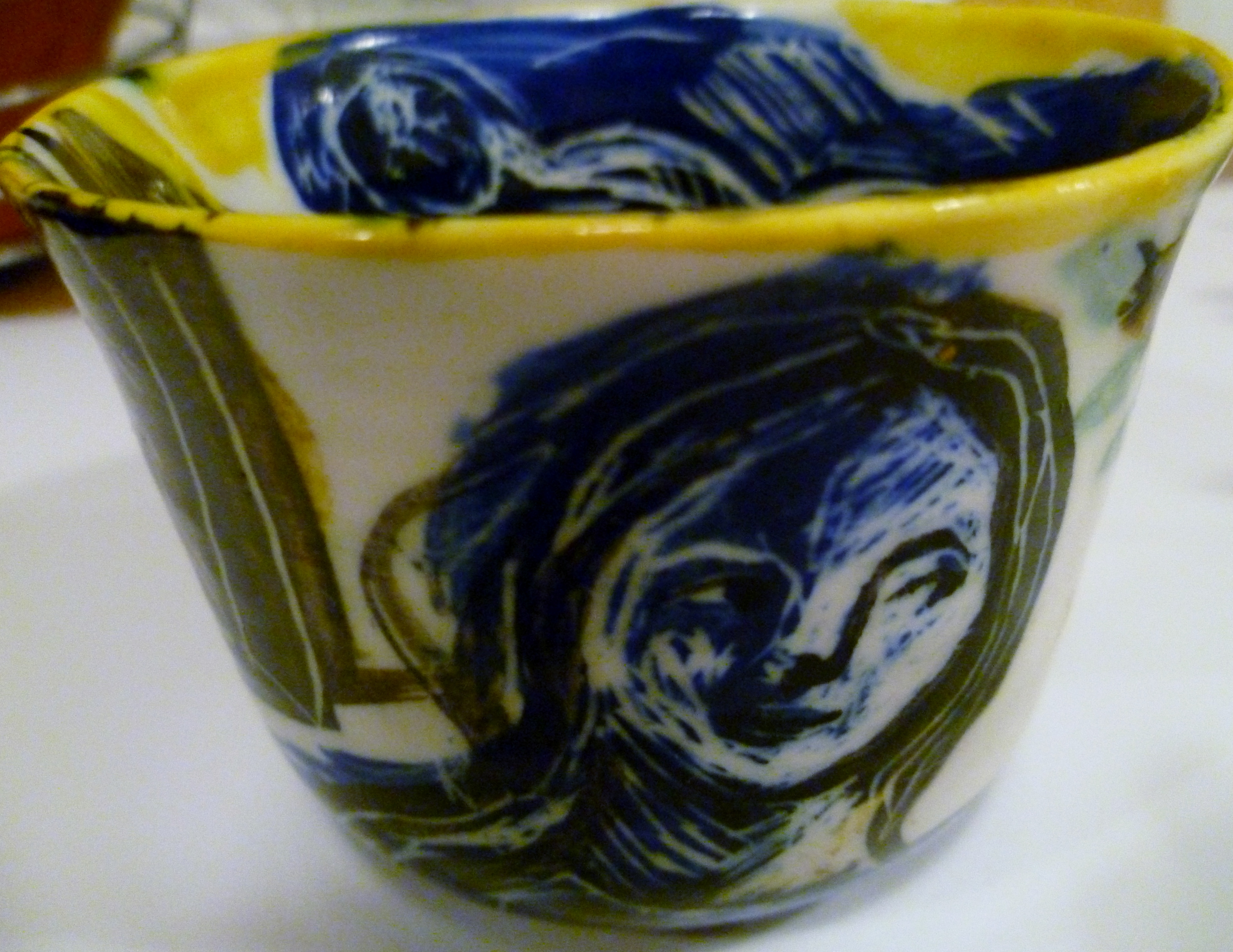
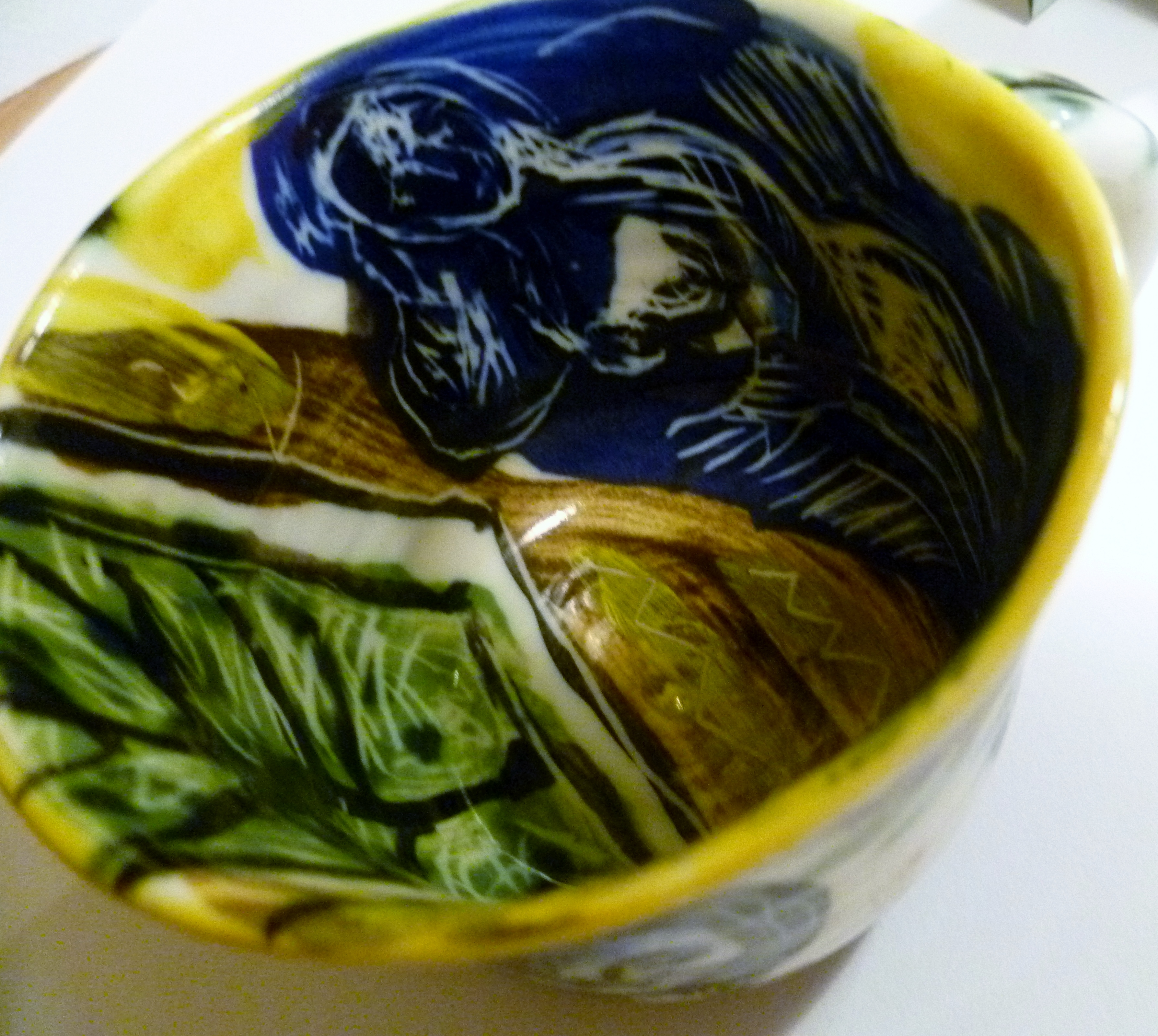
The cup I talked about in my previous post was made by Jitka Palmer – website http://www.jitkapalmer.co.uk/

Here are some images of the cup:

P1020518P1020517P1020516

TREE AT MY WINDOW

Last Saturday I went with my partner Elaine to an art trail in Bristol – a weekend event in which artists open their homes to the public to look at their work, and special street maps are made to help us find our way around. In one of life’s small magic moments, Elaine discovered a tea cup whose imagery really drew her, by a ceramicist (also sculptor and painter) we were visiting, and I bought it for her. It illustrates a poem by Robert Frost – Tree at My Window.

Tree at my window, window tree,

My sash is lowered when night comes on;

But never let there be curtain drawn

Between you and me.

Vague dream-head lifted out of the ground,

And thing next most diffuse to cloud,

Not all of your light tongues talking aloud

Could be profound.

But, tree, I have seen you taken and tossed,

And if you have seen me when I slept,

You have seen me when I was taken and swept

And all but lost.

That day she put our heads together,

Fate had her imagination about her,

Your head so much concerned with outer,

Mine with inner, weather.

ROSA DAVIS: A VISION

Rosa Davis is a member of our local contemplative Druid group and a mentor for Bards and Ovates in OBOD (the Order of Bards, Ovates and Druids). She is also an artist who works in felt, and she has agreed to let me post one of her images.  For our group, the contemplative path very much includes contemplative arts. For many of us it also includes subtle energetics and its poetry.

Rosa image 4 crop

KABIR & BHAKTI: THE ECSTASY OF DEVOTION

 A weaver by trade but a poet-singer by calling, Kabir lived in fifteenth century India. His philosophy incorporated various beliefs of both Muslims and Hindus and later became one of the major influences behind Sikhism. Like Rumi, further to the west and generations earlier, he followed a devotional and ecstatic path, and like Rumi he was a bridge builder between traditions. The poem below expresses the spirit in his spirituality.

Have you heard the music that no fingers enter into?

Far inside the house

Entangled music – what is the sense of leaving your house?

Suppose you scrub your ethical skin until it shines,

But inside there is no music,

Then what?

Mohammed’s son pores over words, and points out this

And that,

But if his chest is not soaked with love,

Then what?

The Yogi comes along in his famous orange.

But if inside he is colourless, then what?

Kabir says: Every instant that the sun us risen,

If I stand in the temple, or on a balcony,

In the hot fields, or in a walled garden,

My own Lord is making love with me.

Kabir Ecstatic poems Boston, MA: Beacon Press, 1992 (The English translations are free enough for Robert Bly to call them ‘versions by Robert Bly’. There is an earlier set of translations published by MacMillan in New York in 1915 by Rabindranath Tagore assisted by Evelyn Underhill under the title Songs of Kabir – now republished by in the BiblioBazaar Reproduction Series. Whilst I don’t follow Bly in calling the English of the earlier work “useless”, I do find that Bly’s interpretation has more passion and power. The Bly work includes an insightful afterword Kabir and the transcendental Bly by John Stratton Hawley).

BOOK REVIEW: THE AWEN ALONE

jhp53e87afc5058eThe Awen Alone, by Joanna van der Hoeven, is an economically and elegantly written introduction to modern Druidry for readers with a serious interest in practising. I like the use of awen, Druidry’s subtle magic, as the key word in the title. In the way that the author uses the term, it gets us straight to the point of why we practice.

The introduction skilfully builds rapport by bringing us into the rhythm of a normal working day. Only it isn’t quite everybody’s normal – it’s a reframed normal for a re-enchanted world and an intentional relationship with it. Joanna starts, in a matter-of-fact way, with a “Hail to the Day and Days Sons; farewell to Night and her Daughters” and ends with “Farewell to Day and Day’s Sons; hail to night and her Daughters”.  In between, there are grumbles about the price of ethical toiletries alongside an affirmation of their value; a commitment to emotional intelligence amidst the stresses of working life, a noticing of what is going on in the landscape whilst travelling and in the garden at home, a soft threshold prayer to Nemetona, Lady of the Sanctuary, and a period of formal meditation.

The messages I would get from this as an inquiring reader are the intended ones. Druid life is shown to be the same life as anyone else’s, albeit lived with a distinctive quality of wonder and attention. Moreover, it is entirely possible to live such a life without being part of a Druid community.

The book is carefully structured into three parts.

  • The first is about the basics of Druidry. It covers current views of Druid history; looks at what Druidry is; investigates the meaning of the key term awen (more about this below); explores deity in Druidry (some modern Druids are theistic and others not); affirms connection to ancestors (of blood, place and tradition); and describes the eightfold wheel of the year and its celebration.
  • The second is about Druidry in practice. This looks at the roles of meditation, prayer, inner pathworking (guided meditation), outer pathworking (walking with awareness outside); altar creation and sacred space; seasonal rituals and other work connected with the seasons; and craft names.
  • The third is about creating one’s own path and includes chapters on designing Druid ritual, daily practice and a more general consideration of “walking your own path”.

All of this work is well presented and gives a good overview of the way many Druids today think and practice. For me however, the really distinctive feature of this book is its discussion of awen. Awen is classically thought of as creative inspiration in a sudden, lightning flash form. But Joanna links awen, as inspiration, to the breath. The air we breathe is all around us. We take it in and give it back, a little bit changed. “The inspired Druid exhales the inspiration gained”. Awen is right here, in the web of what is, inherently present in the communication and relationships which make our interdependence work, enabling our creative choices and their results. For Joanna, awen is therefore linked also to our responsibility for personal awakening:

“Awake to our own energy and stretching out towards the energy of nature around us, we begin to see just what awen is.  It is the opening of oneself … to see into the nature of all beings and indeed to see into the nature of simply being. … For awen to exist there must be relationship. We cannot be inspired unless we are open and we cannot be open unless we are in relationship, whether that is with the thunder, the blackbird or a god”. Joanna develops this theme further, seeing a cyclical process of giving and receiving at the heart of awen as we release ourselves “into the flow”. Ultimately we can be so attuned to “the threads that connect us all” that we can be inspired all the time – moving into the “bigger picture” of a compassionate and integrated life.

With this view of awen, at least as I understand it from reading the book, Joanna integrates her ‘Zen’ more fully into her Druidry. In the original Zen Druidry book, ground breaking as it was, I still had a sense of their being on parallel tracks. Thus The Awen Alone, although an introductory book, also offers an evolutionary step in the ‘Zen’ iteration of Druidry. For this reason it has importance not only to the inquirer and the newcomer, but to also to any Druid practitioner interested in the questions raised by this valuable work. Highly recommended.

Joanna van der Hoeven (2014) The Awen alone: walking the path of the solitary Druid Winchester: Moon Books

OVERNIGHT STAY WITH K’O-KUNG

For me, this poem by Chia Tao is a contrasting twin to Poems Just Dotted Down in my last blog. On the one hand it is more self-conscious and struggling, and on the other more poignant and touching with the human face revealed. I like to read them together.

For ten li

I’ve been searching for the hidden temple

Up branches

Of the cold stream.

Monks sit Ch’an,

One with the snowy night;

Wild geese, approaching Ts’ao-t’ang,

Fly within hearing.

With lamp flames dying,

Our words are subdued;

The rest of our lives

Should be clouds and high peaks.

Up to now,

I’ve been sick a lot,

And the Enlightened Prince

Does not know my name.

From When I find you again, it will be in mountains: selected poems of Chia Tao (2000) Somerville, MA, USA: Wisdom Publications

Chia Tao (779 – 843) an erstwhile Ch’an monk, became a poet during China’s Tang Dynasty. Ch’an was the Chinese predecessor of Japanese Zen.

English translation by Mike O’ Connor.

Earth Eclectic

music that celebrates Earth and speaks to the heart

Sarah Fuhro Star-Flower Alchemy

Follow the Moon's Cycle

Muddy Feet

Meeting nature on nature's terms

Rosher.Net

A little bit of Mark Rosher in South Gloucestershire, England

Becoming Part of the Land

A monastic polytheist's and animist’s journal

selkiewife

Selkie Writing…

Charlotte Rodgers

Images and words set against a backdrop of outsider art.

Prof Jem Bendell

living with metacrisis and collapse

Towint

The pagan path. The Old Ways In New Times

The Druids Garden

Spiritual journeys in tending the living earth, permaculture, and nature-inspired arts

The Blog of Baphomet

a magickal dialogue between nature and culture

This Simple Life

The gentle art of living with less

Musings of a Scottish Hearth Druid and Heathen

Thoughts about living, loving and worshiping as an autistic Hearth Druid and Heathen. One woman's journey.

Wheel of the Year Blog

An place to read and share stories about the celtic seasonal festivals

Walking the Druid Path

Just another WordPress.com site

anima monday

Exploring our connection to the wider world

Grounded Space Focusing

Become more grounded and spacious with yourself and others, through your own body’s wisdom

The Earthbound Report

Good lives on our one planet

Hopeless Vendetta

News for the residents of Hopeless, Maine