While we drink, nothing shows but the smile that will not come.
The wax candles feel, suffer at partings:
Their tears drip for us until the sky brightens.
Tu Mu (803-52)
From: Poems of the Late T’ang translated from the Chinese with an introduction by A.C. Graham Harmondsworth: Penguin, 1965
Of this poet, Graham says: “Tu Mu is most admired as the master of chueh-chu, the New Style quatrain with an AABA rhyme scheme, like that of Omar Khayyam. The swift elegance of his verses, running effortlessly within strict formal limits, cannot be captured in my easy-going sprung rhythms.”
I am feeling more at home in a number of ways. A much loved view through a bedroom window is enough. I can look out and lose myself, holding an image both of continuity and change as the seasons move. One way in which I experience the year is in two halves. Beltane initiates the summer half of a two season year, with Samhain beginning winter.
I often find the extended six months ‘winter’ to be productive for my contemplative inquiry. In the six months now about to end, I have completed an important shift, a shift that reframes an inquiry insight dating from 2018. At that time I said: “I discovered an ‘at-homeness’ in the flowing moment, which nourishes and illuminates my life. Such at-homeness is not dependent on belief or circumstance, but on the ultimate acceptance that this is what is given.”
My view then was that it is best to steer away from metaphysical commitments, as the Buddha is said to have done. “At-homeness in the flowing moment” could work as a dignified existential choice for a humanist, an agnostic or a person with a stance of ‘sustainable nihilism’ (1). It could also work for people firmly based in contemplative versions of monotheist and polytheist spiritual traditions. Indeed it could work for anyone and would be blissfully light on doctrine and opportunities for argument and dissension.
That said, whist still fully embracing the original insight, I now find it incomplete. I have for some time been filled with the sense of a living cosmos, in a way that cuts across the grain of the culture I come from, with its parsimonious definition of ‘life’. I am animist in sharing Thich Nhat Hanh’s understanding of ‘Interbeing’, where everything is interconnected and nothing is really born, lives or dies in a state of separate selfhood (2). Life just changes. Now I have taken to heart the sense that the life which changes has a Source, or ground of Being, in which the whole web of life is embedded.
Hence I am human and I am also that ground of Being. Being cannot be found as an object, but I can apprehend Being in two ways. One is by looking in and finding my primordial and true nature in and as Being. The second is by looking out and finding Being everywhere and in everything. In each case, the inside/outside distinction finally dissolves. Humanly, I am distinct but not separate from Being, temporarily individuated in the world of space and time, as is everything else in this world. At the deepest level, as Being, I am no thing and yet present in and as everything.
I have reached a commitment to this view partly as a result of contemplative inquiry and partly as an act of faith, trusting my deepest understanding. In the wider world, this understanding is called ‘non-dual’ or ‘panentheist’. It is neither demonstrable nor falsifiable as a proposition, and I continue to appreciate that the map is not the territory. All words feel somehow wrong, just as the Tao Te Ching warns when it begins with “the name you can say isn’t the real name” (3). Yet Lao Tzu persisted with his writing, and gave the world one of its most loved scriptures. From time to time, the effort with language has to be made.
Modern movements (4,5) have made the experiential recognition of our true nature, or ultimate divinity, available to ordinary people through skilful means developed for our time. I have made connections with such movements, but I still anchor myself in Druidry. Humanly, a conscious I-I relationship with Source, or dwelling in and as Source, is not everything to me. I am drawn, too, to I-Thou relationship, honouring a devotional need that wants to be expressed. The Indian sages who first developed non-duality as a spiritual philosophy did not challenge or abandon the flourishing polytheism of their culture. They continued the practice of deity yoga. It serves the dance of being and becoming in this world. This, I believe, is the role of the Goddess in my life (6). I have much still to learn here. Meanwhile my at-homeness grows stronger.
(2) Thich Nhat Hanh The Other Shore: a New Translation of the Heart Sutra with Commentaries Berkeley, CA: Parallax Press, 2017
(3) Lao Tzu Tao Te Ching: A Book About the Way and the Power of the Way Boston & London: Shambhala, 1998 (New English version by Ursula K. Le Guin with the collaboration of J. P. Seaton)
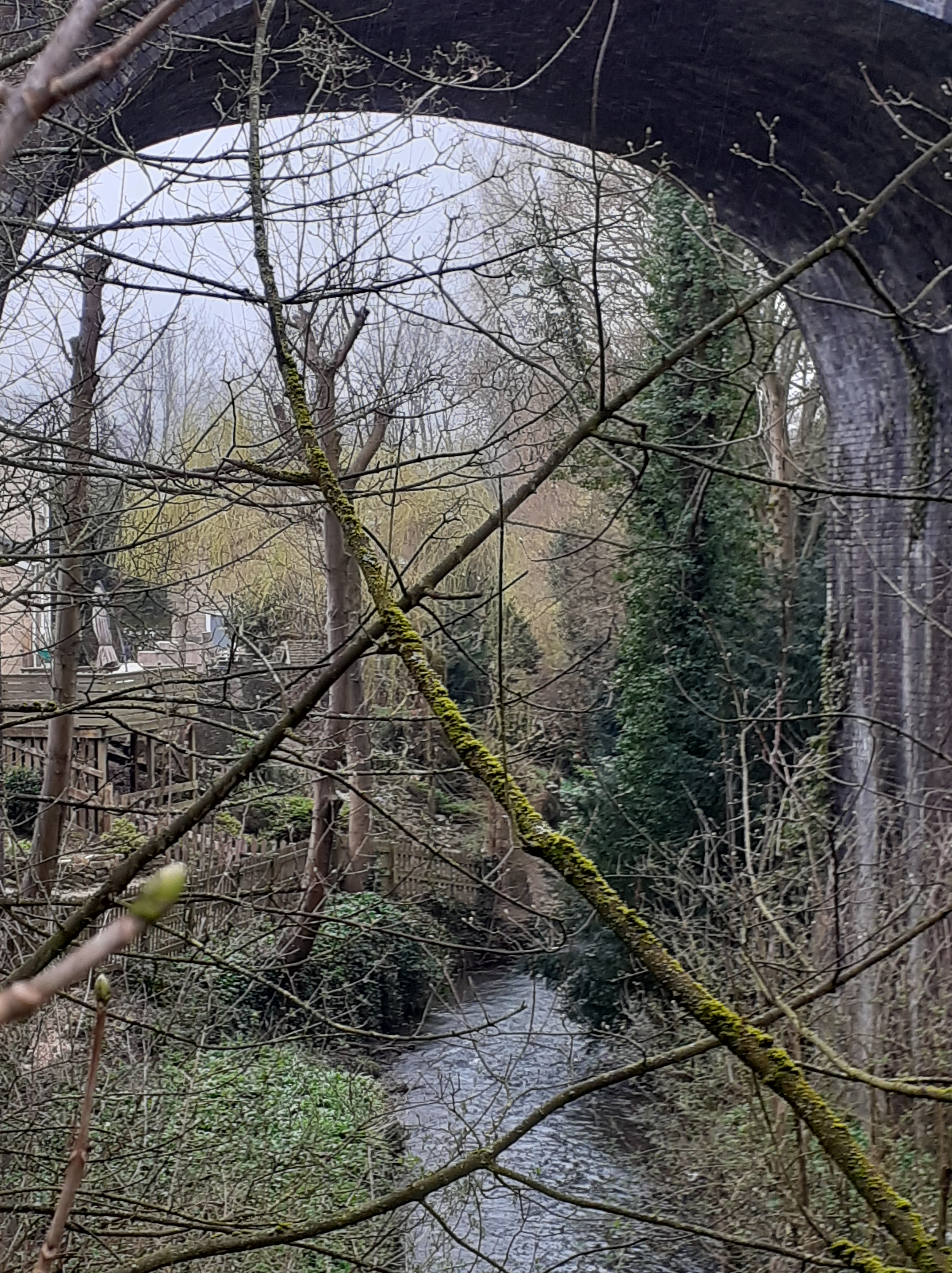
There is the moment, and there is the flow. The photograph holds the moment and the image at first seems still. Looking more closely, we can infer the turbulence that accompanies flow. All those ripples, and wavelets and swirls. They testify to the life of the stream in time.
I have taken up silent sitting meditation after a long break, making a commitment to myself of at least thirty minutes a day. I have incorporated silent sitting meditation into both my morning and evening practices, so the individual sessions need not be long. I am not made for long meditations. but I do now find that an element of silent sitting meditation enriches my contemplative life and inquiry.
I like the term ‘silent sitting meditation’ for its plainness and descriptive accuracy. I am distinguishing this meditation from the ones that I learned through Druidry, which, even when not guided, depend on visualisation and narrative. At the same time I am avoiding close identification with the ‘mindfulness’ brand. It feels like a prescriptive pre-shaping of my lived experience as a meditator. A strong intuition, gift perhaps of the Goddess in her Wisdom, wants the meditative life to be free of such labels.
So I sit. With two sessions a day, I find that my natural length of session is from 20-35 minutes and so with two sessions I am overshooting my commitment. That’s a good indication that I am not straining myself. I don’t want my meditation to be goal-oriented. Rather, I open myself to the energy of living experience, and let it lead me.
I do begin, conventionally, with a breath focus, following the sensations and the gaps after in-breath and out-breath, with loving attention. I also open myself to other sensations, which (with my eyes closed) will mostly be internal body sensations or external sounds. I think that the love in loving attention matters. There are people within the mindfulness movement who think it might better have been called heartfulness. This introduces a sense of compassion for everything that arises. Within the experience, I can feel whole, at home in the Heart of Being which holds up and informs my human life. When I am consciously present, it is a place of peace, joy and inspiration.
In the course of a session, I will taste this state from time to time. At other times I find myself engaged with images (some seeming otherworldly), or narrative streams, that I also value. These experiences seem to have an authentic energy that I cannot simply dismiss as distractions. I want to allow them in and engage with them. Indeed, even where the passing content of experience seems entirely mundane or even distressed, I will welcome it and keep it company. I will hold it in love. Outside the meditation, it may provide a cue for some more dedicated healing or inquiry process.
It may be for this reason that I do not characteristically find distress distorted thoughts and feelings hijacking or sabotaging the meditative flow. They know my willingness to meet them. This means that the other experience, the wellspring of my life, is rarely far away and never forgotten. It doesn’t even require formal meditation. For me, silent sitting meditation supports a fuller life, lived from the Heart of Being. But it is not, by any means, a requirement for it.
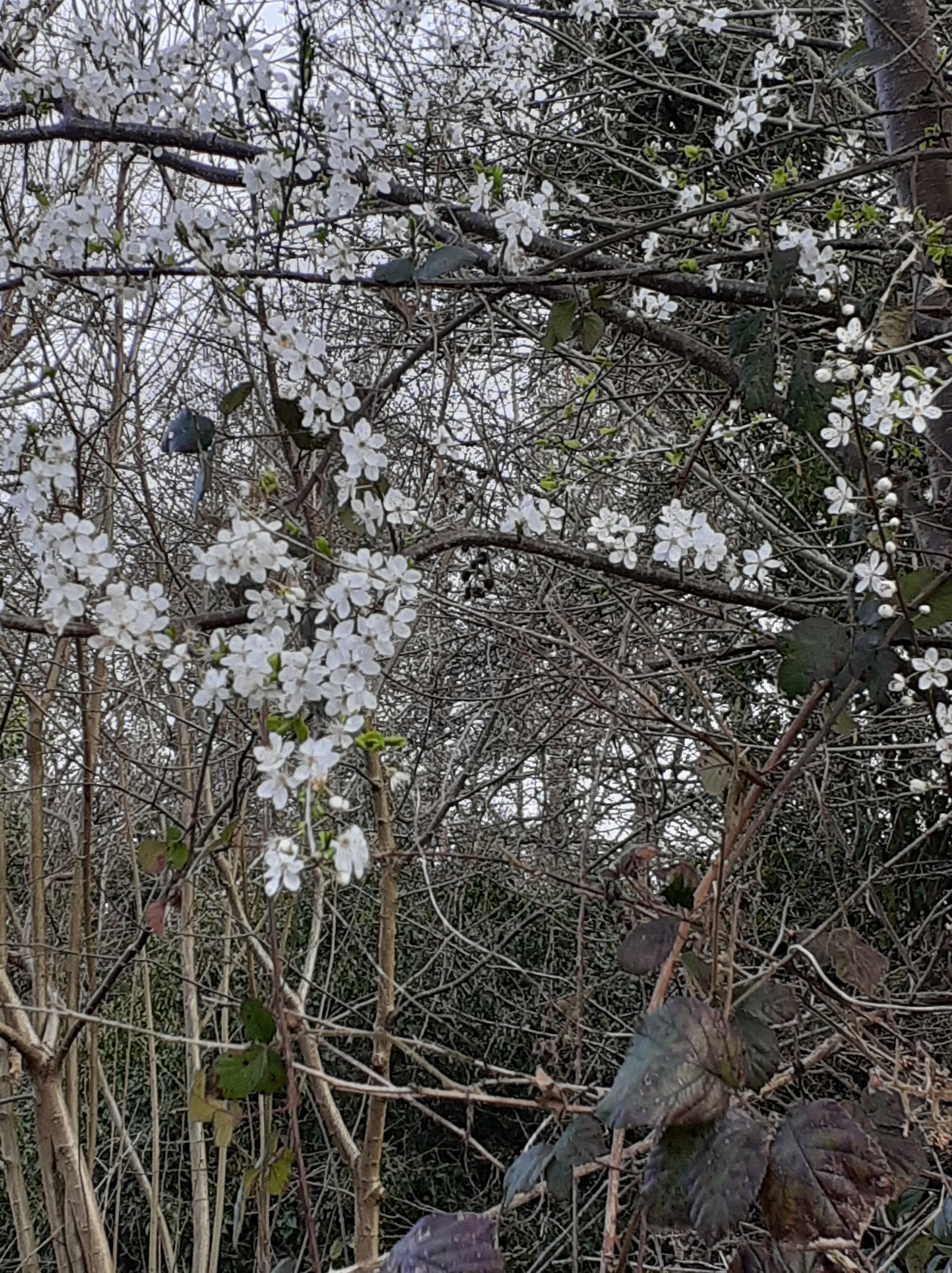
In my wheel of the year tree mandala (1), blackthorn (ogham, straif) covers 8-30 April, the final twenty-three days before Beltane. It has a beautiful white flower and elegant sharp thorns. I have seen descriptions of the latter as ‘vicious’, but they only hurt us if we invade the blackthorn’s space. The plant is not a triffid. It doesn’t come after us. So I don’t follow the line of tradition that links blackthorn to harsh fate. Blackthorn doesn’t ask to be turned into guardian hedges or crowns of thorn. That is down to our fellow humans.
The picture above comes from my magic year of 2007, happily well documented, when I was much engaged with trees and Druid study. I felt a pull towards blackthorn, more than towards the generality of hawthorn during that period. (I will write about the Glastonbury Thorn, the exception, at Beltane, my last tree mandala with a ‘memory lane’ theme).
I am drawn particularly to the strand of tradition that links blackthorn to powerfully creative magic – for it was long used in the making of wizards’ staffs. The text of The Green Man Oracle (2) suggests that “we have forgotten the magic that lies within us”. Blackthorn in particular has the ability to “foster waking dreams”. The Oracle adds that, “to access this personal magic, we must step away from busy, surface consciousness, and sink deeply into the ever flowing stream of our magical dreams. The ideas, scenes and presences that throng the deepest levels of our understanding require intense listening” Such magic, the Oracle continues, brings a light into the darkest places. For me that would mean just enough light to illuminate them, and not so much as to dazzle them into negation. How otherwise can the denizens of the dark be offered a welcome home if they want it, and in any event a better understanding?
(1) This mandala is based on my personal experience of trees in the neighbourhood as well as traditional lore. Moving around the spring quarter from 1 February, the positions and dates of the four trees are: Birch, north-east, 1-22 February; Ash & Ivy, east-north-east, 23 February – 16 March; Willow, east, 17 March – 7 April; Blackthorn, east-south-east, 8 – 30 April. The summer quarter then starts with Hawthorn at Beltane. For a complete list of the sixteen trees, see https://contemplativeinquiry.blog/2020/autumn-equinox-2020-hazel-salmon-awen/
(2) John Matthews & Will Worthington The Green Man Oracle London: Connections, 2003.
April has been called the cruellest month. But I am experiencing a much hoped-for kindness right now. I am expansive and energised. Finally, it feels like spring in my neighbourhood. Spring as it is meant to be.
The natural world is changing, and a tentatively recovering human population is beginning to reclaim the outdoors. Now is a moment for celebrating the life force – nwyfre, viriditas, whatever we may want to call it. I find my own feelings reflected back in the vitality and vigour of the world I see around me.
The greening of the trees, and hence much of my local landscape, has started. I hope for a fuller transformation by Beltane – now less than four weeks away.
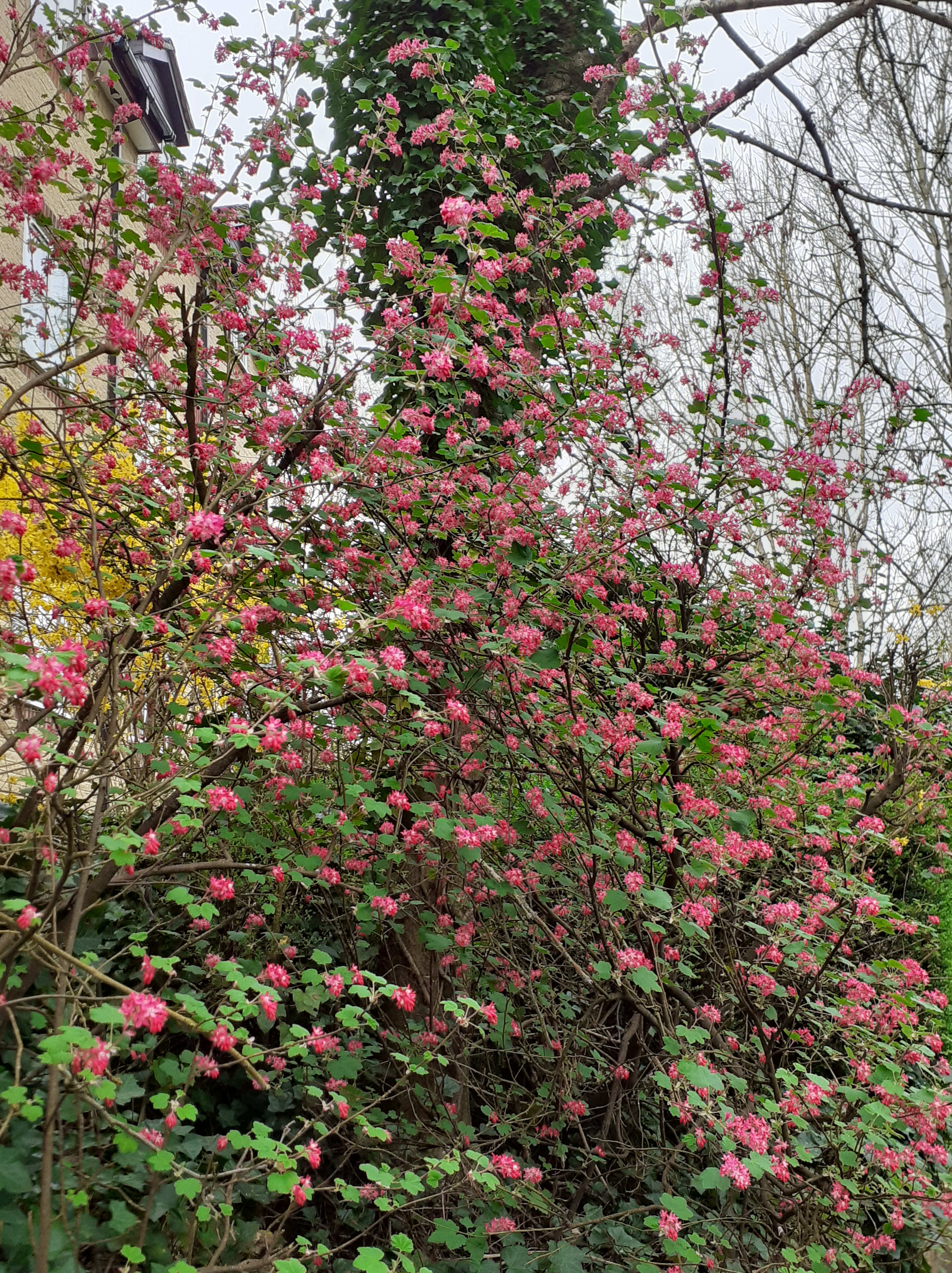
There is an abundance of colour in the woods, with the emphasis changing from the delicate blossoms we have already seen to more robust and stronger coloured flowers.
Even entering a built environment, floral energy arches across the paths.
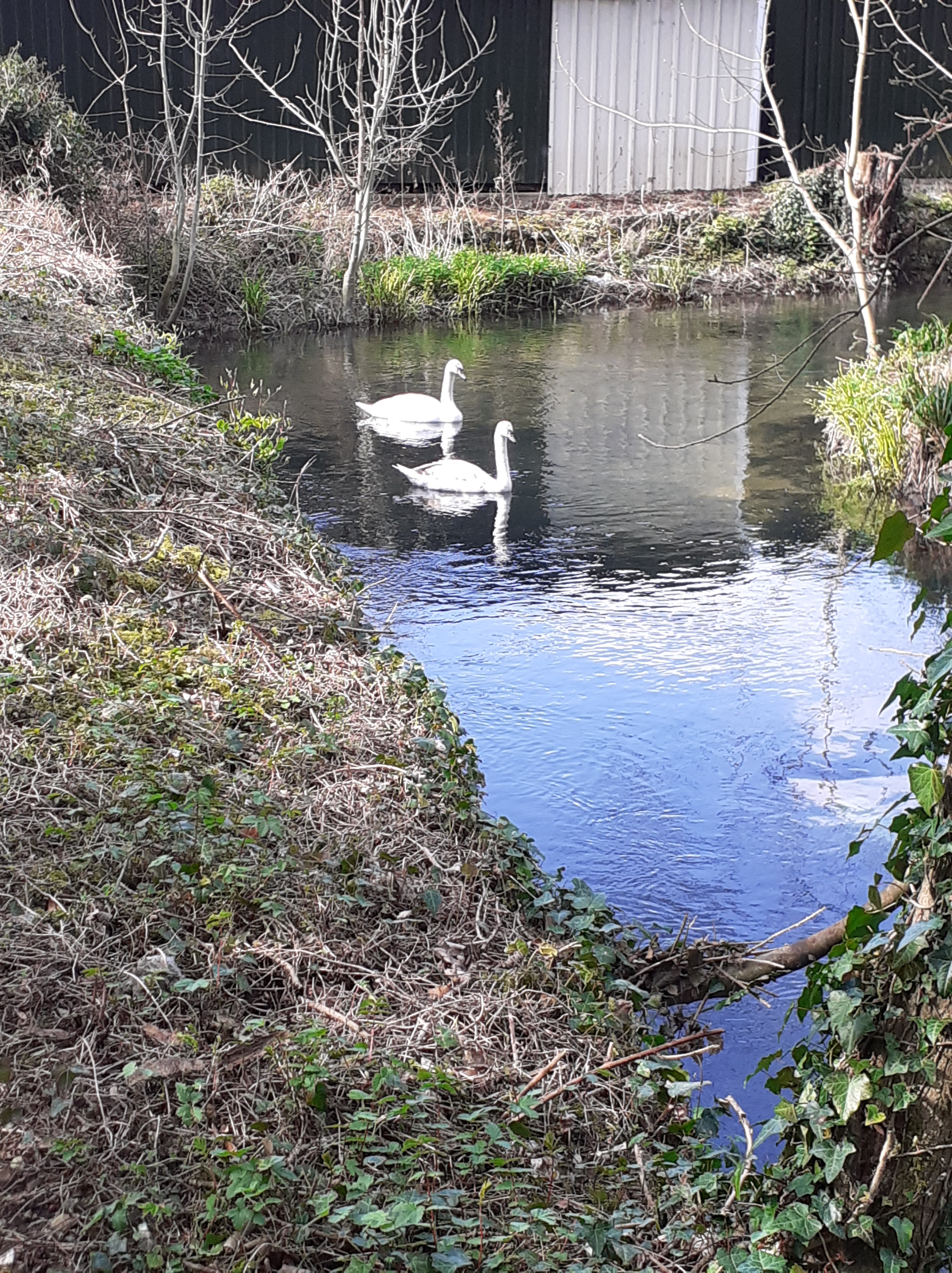
In the animal kingdom, life is stirring too. On the canal, rivers and ponds around me, swans are now pairing and nesting. I hope they have another good year.
It almost hurts to know that life – so fleeting and variable – can be so good.
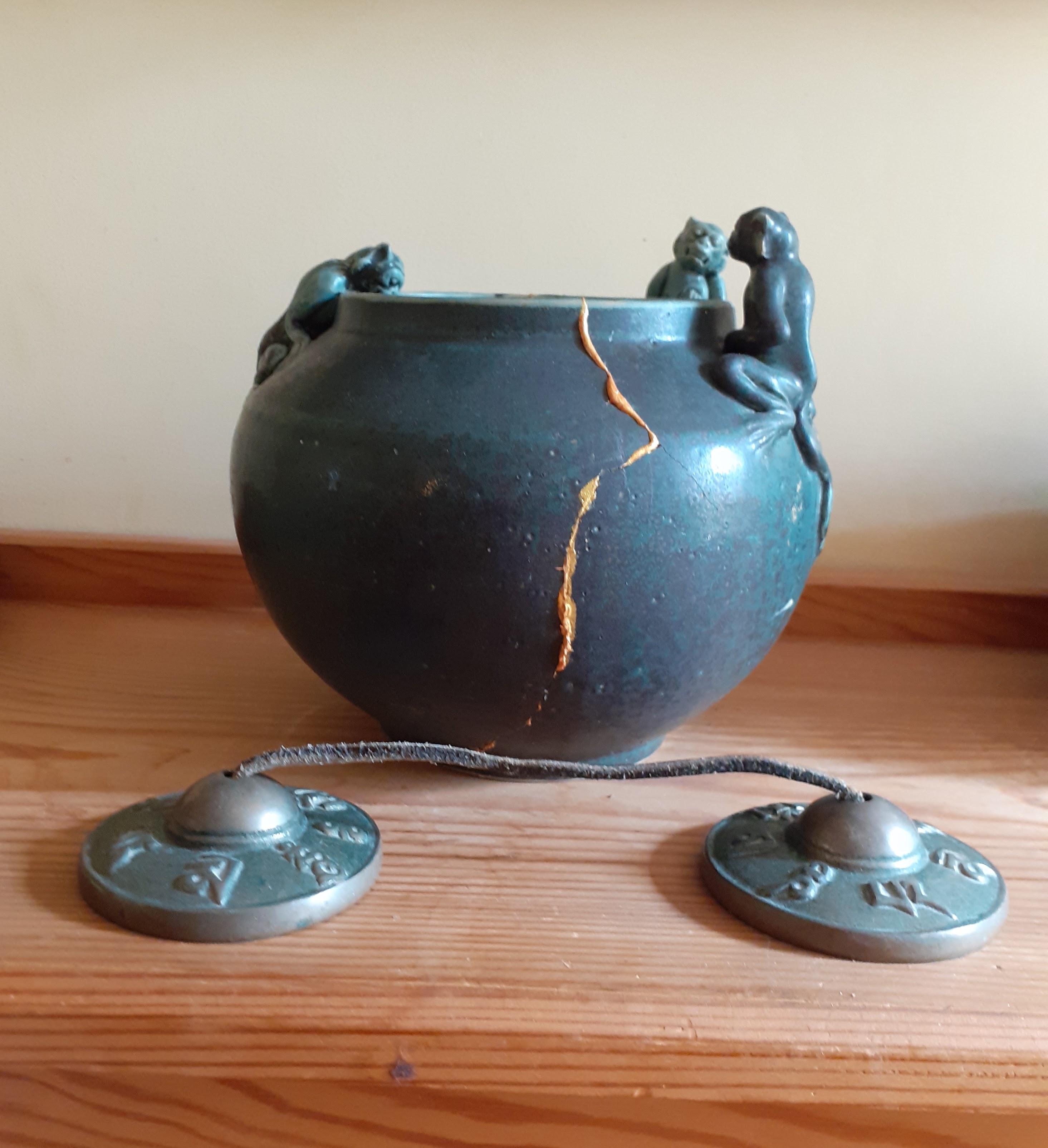
The pot belongs to my wife Elaine*, and used to live outdoors. Late in the winter it filled with rain. Then there were days of frost and the water turned into ice. The ice needed more room, and pushed against the sides of the pot. When the ice melted the pot fell apart in two neat halves. Nature in action, over time.
As part of her work, Elaine knows something about kintsugi, which literally means “golden joinery”. This treats breakage and repair as part of the history of an object, rather than something to disguise. Culturally, the approach is an aspect of wabi-sabi, the acceptance of transience and imperfection. Elaine’s repair, applying kintsugi, is literally illuminated.
The result reminds me of the refrain in Leonard Cohen’s Anthem.
“Ring the bells that still can ring.
“Forget your perfect offering.
“There is a crack in everything.
“That’s where the light gets in.”
After some hesitation, I added my Tibetan bells to the picture above. The cord attaching the two bells is about half its original length due to wear and tear. But the bells still ring. My ownership of them, here and now, is almost certainly the result of Tibet’s collective disaster and the resultant Tibetan diaspora. In the world of biological life and time, disaster and repair are a common theme. If the crack is where the light gets in, the work of repair is sacred.
Something happens when I simply see the world in front of me. Simply seeing involves the whole of my attention, with a de-cluttering of thoughts and other distractions. There is no tension in this spacious clarity.
But it doesn’t have to last long. Simply seeing is at heart a timeless act of recognition. There is no need to hold on to any particular state. I find it wiser to let the flow of experience move on.
If I am present to my immediate experience, it works as well for a photograph as it does in the original setting. Simply seeing the picture is not a recollection of my earlier walk. It is a unique moment of experience, and a joy in itself.
This post follows on from my recent post on Patterns and Peace (1). There, I discussed the role of ritual patterning in a sunrise practice. Here, I discuss the role of meditation in a sunset one. In both cases I experience peace as an active energy – empowering, nourishing, and close to the Source.
In the evening I do not cast a circle. I simply sit down facing my altar and say: May there be peace in the seven directions. May I be present in this space. I say the Druids’ prayer, affirming the commitments to a love of justice and the love of all existences. I see them as the necessary context for the manifestation of true peace in the world.
I talk myself in to the meditation itself with other words customised from Druid tradition: Deep in my innermost Being, I find peace. Silently, in the stillness of this space, I cultivate peace. Abundantly, within the wider web of Being, may I radiate peace.
Starting with a focus on my heels, extended to include my feet as a whole, I tune in to my felt sense of body and life energy. Moving gradually up my body, I pay close attention to my emerging experience of a physical and energetic field, which I find to be light and spacious. I also notice the breath. Surrendering to this universe of internal experience, I can enter an awareness of deep peace, joy, and wonder at the miracle of experiencing. This is beyond ‘At-Homeness in the flowing moment’. I call it the Peace of the Goddess.
Coming out of meditation, I say I give thanks for this meditation. May it nourish and illuminate my life. May there be peace in the seven directions. May I be capacity for the world.
I do not meditate for long periods. This whole practice, including liturgy and meditation, takes about half an hour. The phrase ‘capacity for the world’ uses the language of the Headless Way (2) and indicates that if we enter into our true nature as clear awake space, we become, in our everyday lives, ‘capacity for the world’. The meditation is both the experience that it is, and a resource for life and contribution to the world.
I have done meditations of this kind for many years. Recently, this meditation has become richer and more focused. I believe this to be partly due to practice and partly to the season – I find both equinoxes enabling for meditation. But there is also the benefit of increased understanding. I am grateful to Eckhart Tolle, whose work I have begun to engage with, when he says: “What I call the ‘inner body’ isn’t really the body any more but life energy, the bridge between form and formlessness … When you are in touch with the inner body, you are not identified with your body any more, nor are you identified with your mind. … You are moving away from identification to formlessness, which we may also call Being. It is your essence identity”.
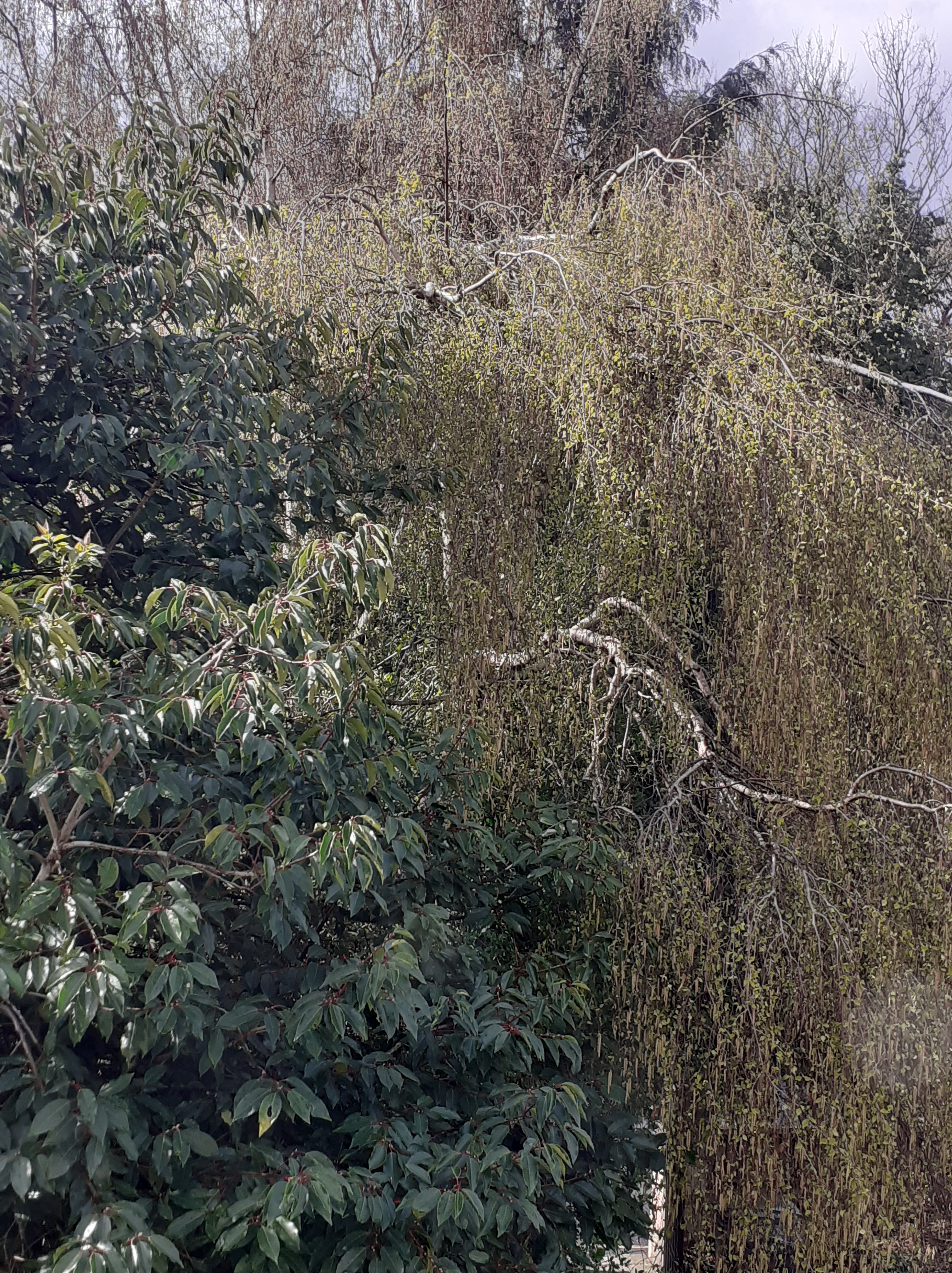
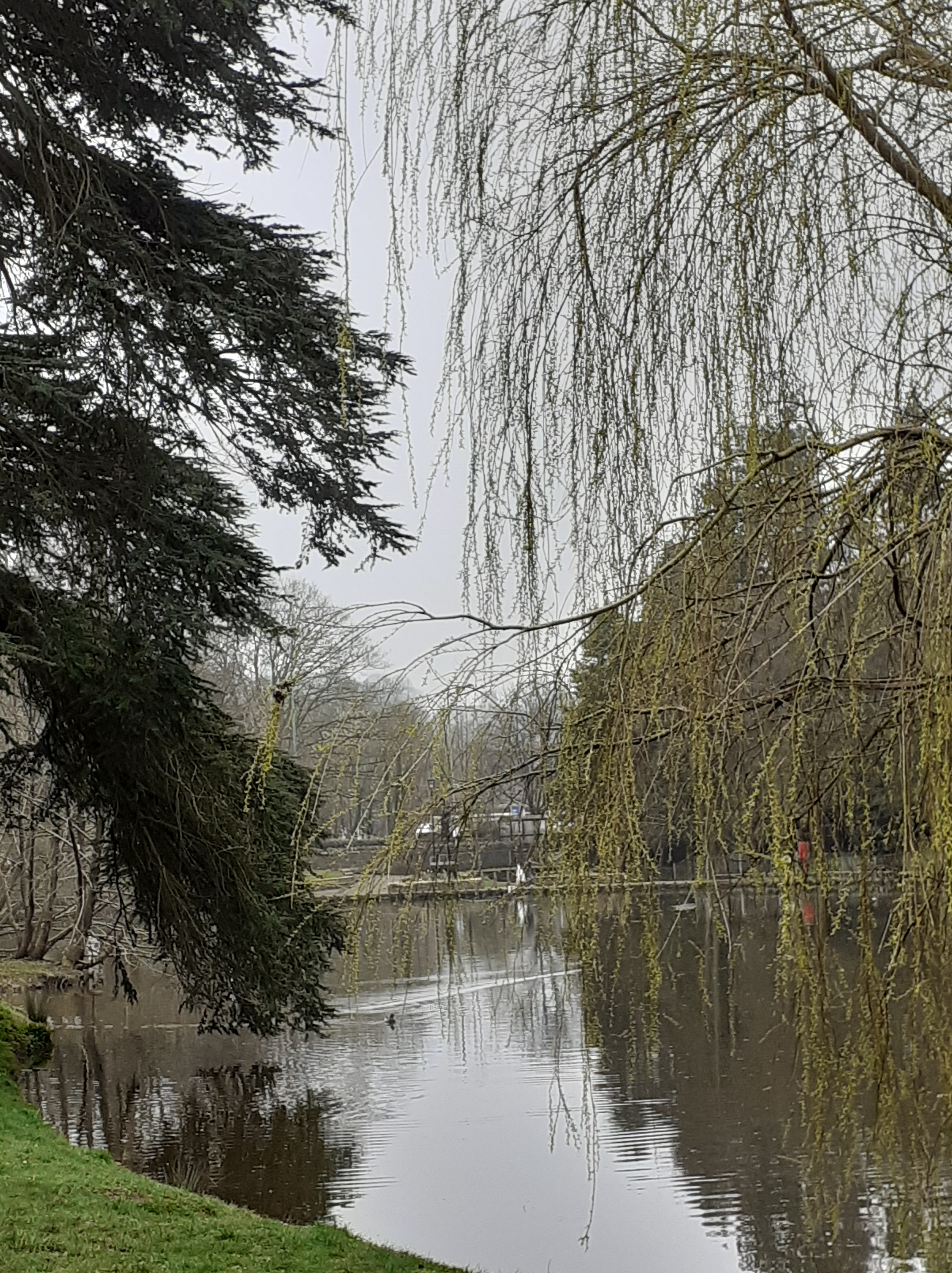
I walk past these willows and they awaken my joy in natural beauty. Their full splendour may yet be to come, but they are already abundant with new life and growth. I am lifted by the promise that’s in them.
In my mandala of the year (1), willow presides over period from 17 March to 7 April. Working with trees in my Druid training, I developed a close contact with a willow near to where I then lived in Bristol. I also made a willow wand, from a dead branch I found lying around in another part of town.
In the course of this work I developed a sense of willow that does not exactly match our inherited lore. My records tell me that my main personal impressions concerning willow were of “resilience and generativity” and of “vibrancy in early spring”. Those impressions still stand. I don’t link myself so much to associations with the dark side of the moon (and moon goddess) or the many uses of wicker.
I do make connections between willow and the energy of water, and I can know of willow as a portal to gently magical experiences. Below, I offer a digitised picture of my Bristol tree, taken on 21 March 2007, and an account of time spent with it that afternoon. I enjoy the chance to share this fourteen year old memory, and bring a small piece of my personal Druid history into the present. Intentional reminiscence can be a deeply satisfying here-and-now experience.
“This afternoon I went out to see the trees – beautiful sunshine. The willow I’ve connected with looked very willowy – buds, leaves, catkins. It seemed solid, vibrant, pulsing. Leaning against the trunk from shoulder to hip, I sensed a resonance connected to the contact. Tuning in, I began to make a sound. The note that developed was light and optimistic, but strong enough fully to reach me in the belly. It had a potency that surprised me. I felt carefree, I could take in the cool equinoctial breeze with the warm equinoctial sun and enjoy a moment of holy idleness after a time of rushing around and work.”
I avoid talking about this experience in the language of relationship with the tree, though part of me would like to. I do not know what it is like to be a willow tree, but I am sure it is like something. I know of no way to check in with the tree that allows it to contradict my own precious intimations of communion, should it want to. I suspect that it barely noticed me. Yet the experience felt healing, and I have never forgotten it.
(1) This mandala is based on my personal experience of trees in the neighbourhood as well as traditional lore. Moving around the spring quarter from 1 February, the positions and dates of the four trees are: Birch, north-east, 1-22 February; Ash & Ivy, east-north-east, 23 February – 16 March; Willow, east, 17 March – 7 April; Blackthorn, east-south-east, 8 – 30 April. The summer quarter then starts with Hawthorn at Beltane. For a complete list of the sixteen trees, see https://contemplativeinquiry.blog/2020/autumn-equinox-2020-hazel-salmon-awen/
Spiritual commitment – faith in the path, and the perspectives underpinning it – need not depend on received understandings of ‘belief’. Buddhist teacher Stephen Batchelor discusses this issue below.
“The views that I hold about the things that really matter to me – meaning, truth, happiness, goodness, beauty – are finely woven tissues of belief and opinion. These views enable me to get by in my workaday world but would not stand up to a great deal of scrutiny from someone who was not sympathetic to them. I am prepared to defend some of them with greater vigor and passion than others. I drift and swim through life on a tide of derivative beliefs that I share with others who belong to the same kind of cultures as myself.
“Most Buddhists throughout Asia are and always have been polytheists. They believe in the existence of a range of spirits and gods whose worlds intersect with our own. These entities do not have a merely symbolic existence: they are real beings with consciousness, autonomy and agency … But since many of these spirits are fickle beings like ourselves, they cannot ultimately be trusted. On formally becoming a Buddhist, one ‘takes refuge’ in the Buddha, Dharma and Sangha, thereby renouncing reliance on those beings. But the spirits and gods are only downgraded, not abolished. They continue to play a role in one’s personal and social life. This is the thought-world one finds throughout the Pali Canon. Siddattha Gotama did not reject the existence of the gods, he marginalised them. He may have mocked their conceits, but he acknowledged their presence. At times they even functioned as inspirational voices that prompted him to act.
“However tempting it is for me to dismiss the existence of gods and spirits as outdated nonsense, I need to be aware of the equally tenuous foundations of my own beliefs. If challenged I would be incapable of persuading someone who does not already share my view of the universe or of human life that my beliefs about them are true. I once spent a couple of hours trying to persuade a learned and intelligent Tibetan lama that the world is spherical in shape – but with little success. I would have had even less success had I tried to convince him of other beliefs I held: those about the Big Bang, evolution by natural selection, or the neural foundations of consciousness. I believed in these on much the same ground as he believed in disembodied gods and spirits. Just as I unquestioningly accepted the authority of distinguished scientists, so he accepted the authority of eminent Buddhist teachers. Just as I trusted that what the scientist claimed to be true can be backed up by observation and experiment, so he trusted that what his teachers claim to be true can be backed up by direct meditational insight. I had to recognize that many of my truth claims were no more or less reasonable than his.
“Following the example of William James, John Dewey and Richard Rorty, I have relinquished the idea that a ‘true’ belief is one that corresponds to something that exists ‘out there’ or is beyond reality somewhere. For pragmatist philosophers such as these, a belief is valued as true because it is useful, because it works, because it brings tangible benefits to human beings and other creatures. Siddattha Gotama’s Four Noble Truths are ‘true’ not because the correspond to something real somewhere, but because, when put into practice, they can enhance the quality of your life. … What draws me to Buddhism is not because it has a more convincing explanation of the nature of reality than other religions, but that it offers a methodology which might actually work in addressing the question of suffering.” (1)
(1) Stephen Batchelor Confession of a Buddhist Atheist New York: Spiegel & Grau, 2011







 Contemplative Inquiry