This is the face of dawn outside my window, just after 6.30 a.m. I welcome the mid September day, appreciating this moment in the year. I like the infusion of pink into grey clouds, and the suggestion of warmth in the old church tower.
I have now grown used to getting up in the dark, and to beginning my morning practice with an awareness of darkness outside. The nurturing dark and enabling light are both part of my experience. A transient time of balance has begun. It feels numinous to me, and a time of great potential. I am energetically alert and alive.
Later, a little before 9 a.m., I am walking by the Gloucester-Sharpness canal. I notice light on leaves, and its influence on the gaps between trunks. The view, here, is over water. But it is the influence of sunlight that makes the greatest impression on me – captured in the picture as well as in real time.
By contrast, the spaces furthest away from the light source are able to show their earthiness, their woodiness and the depth of their green. The light is everywhere, but it is subtle and not over-bearing. It reveals its influence in different ways. Rather than radiating raw power, it allows possibilities in this small, fragile habitat. Contemplating autumnal states of light, as I approach the autumn equinox, I have been shown something about power and its manifestation.
I am in Alney Island again, on the River Severn as it passes through the ancient city of Gloucester. Above, I am looking at the weaker, eastern channel of the river as it flows around the island. After rain, the water level seems adequate if relatively low, and the willows still seem lush. At first glance, as I walk past, the plant life seems healthy in this watery habitat. Stopping to look more closely, the scars of a summer both hot and dry become evident. The horse chestnut leaves, below, are dramatically shrivelled and their conkers are appearing early. Summer is becoming autumn swiftly and abruptly this year.
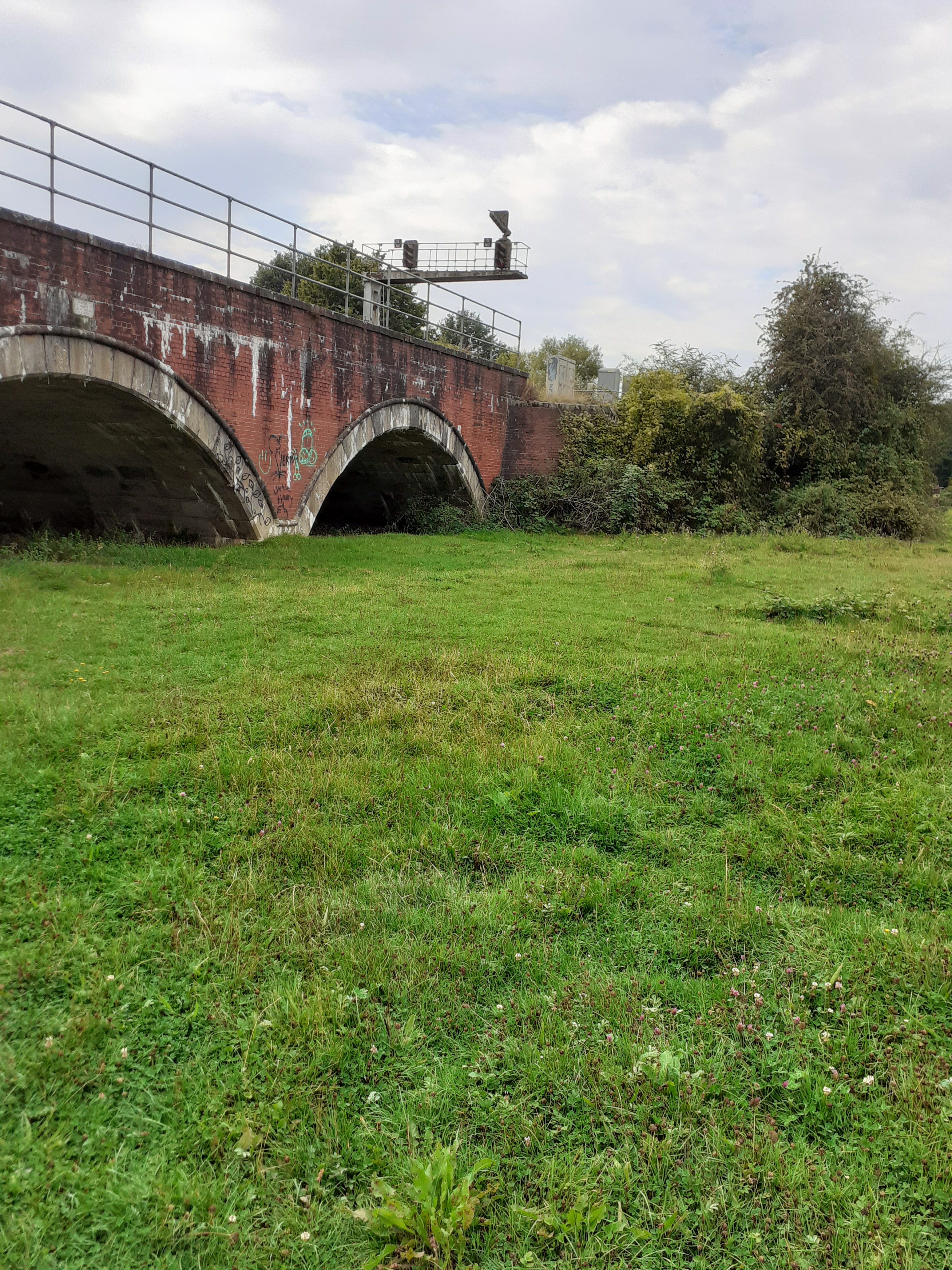
Much of Alney island is rough water meadow, as below, and it is a joy to see green grass. Normal? No longer a useful word in this, as other, contexts. In a time of climate chaos fatefully intertwined with runaway wealth, ‘normal’ loses shape and definition. Half-reluctantly, I am adjusting to a new, more dislocating and unpredictable reality.
On this walk I discovered a woodland on the island, shown below. It is far from ancient, being planted in 1983 to commemorate the 500th anniversary of a charter given to the people of Gloucester by King Richard III. A rare monument to the monarch in question.
Richard’s Wood is pleasant enough, although subject to somewhat whimsical curation. A decision was first made to plant non-native trees – red oak, turkey oak and horse chestnut; then to add native trees as well; and later still to thin out the trees so as to create a “wood/pasture habitat to contrast with the wetland meadows on the rest of the reserve”. ‘Rare breed’ cattle were introduced, though I have yet to see any.
I may be doing an injustice, but I get a sense of conservation by human taste and fancy, the manufacture of ‘scenery’ on a handy piece of wasteland that isn’t safe to build on. I don’t get any organic sense of the island, its history or its potential. I don’t get any sense of a wondering about what trees might be brought together to create a viable and self-sustaining woodland community, ‘native’ or otherwise. The horse chestnut, imported from Turkey in the sixteenth century, is now a well-loved English tree. The turkey oak is better suited to the southern England of today than the native species. I suspect they are a good choice. But I’m sorry about the thinning out. There’s no shortage of pasture in England. Overall I believe this kind of management to be a relatively innocent manifestation of the very mindset that is killing us.
Perhaps the trees will have a chance to develop in their own way. My feeling on being among them is gentle but muted. If I compare them with the crowded and chaotic wood that has grown up beside the Stroud cycle path, I sense a relative lack of viriditas – Hildegard of Bingen’s word for the green life energy in nature. It is a relative lack, not absolute. But as I go home, I feel a certain sadness all the same.
After the equinox comes a deepening of autumn. Light, colour, texture – my sense of the world is different. Images of this moment in the year shape my sense of time as well as of place. I savour the turning of the wheel. All time is transitional, yet every time has its own uniqueness.
Contemplating images like this is for me a way of sustaining what modern Druids sometimes call a re-enchantment with and of the world. Simple attention to the living world is a renewing experience, and protects the heart from what can seem like the half-life of a Wasteland culture. Opening to a living cosmos, I plead guilty, with pride, to the charge of Romanticism.
It is after 9 a.m. on Sunday 26 September, Locally I enjoy orange as a colour of ripening, rich and shiny with life, as the season of bearing fruit moves on.
There are trees whose leaves have already turned, but will stay on their branches for awhile, giving these woods a more mixed, autumnal appearance.
But there is still a preponderance of green, some of it surprisingly fresh. Here it provides a canopy of green light and shade.
The season is also asserting a downward pull, towards the earth and dissolution – a process, however, still in its early stages. The broken fence seems almost to be sharing this, beginning a return to the land.
Then there is the undergrowth, with its mix of living and dead wood, living and dead leaves, and the soil that holds them. The evergreen leaves are defiantly vivid. Taking pictures, I celebrate the time of year.
Walking in the woods yesterday I saw the coming of autumn, in the sky and in the trees. I felt it too, and not just in my physical sensation of coolness. I experienced a mood of loss and ending, not limited to the summer of 2021.
The natural wheel of the year, where I live, has classically been one of soft transitions. Our seasons have merged gently into each other, with September as a modified extension of summer. Leaves gently turn, but there is not much of a fall. For much of my life I enjoyed the sense of a predictable pattern in the the turning of the wheel. That sense has eroded in recent years and has now reached vanishing point. Hence the feeling of loss.
Summer 2021 seemed to die in August, after a short and faltering life. It may be succeeded by a once unseasonable hot spell, or it may not. Considering the effects of the climate crisis in other parts of the world, this is hardly dramatic. But this weird summer season, including a background awareness of developments elsewhere, has ended my already weakened feeling of security. The phrase ‘winds of change’ comes to mind. I think, what next? And when?
I feel challenged to be open to whatever happens, without obsolete expectations to confuse me. In the state of openness, I find that an inner peace and clarity are present. They act as my guides through a shifting, changing, world.
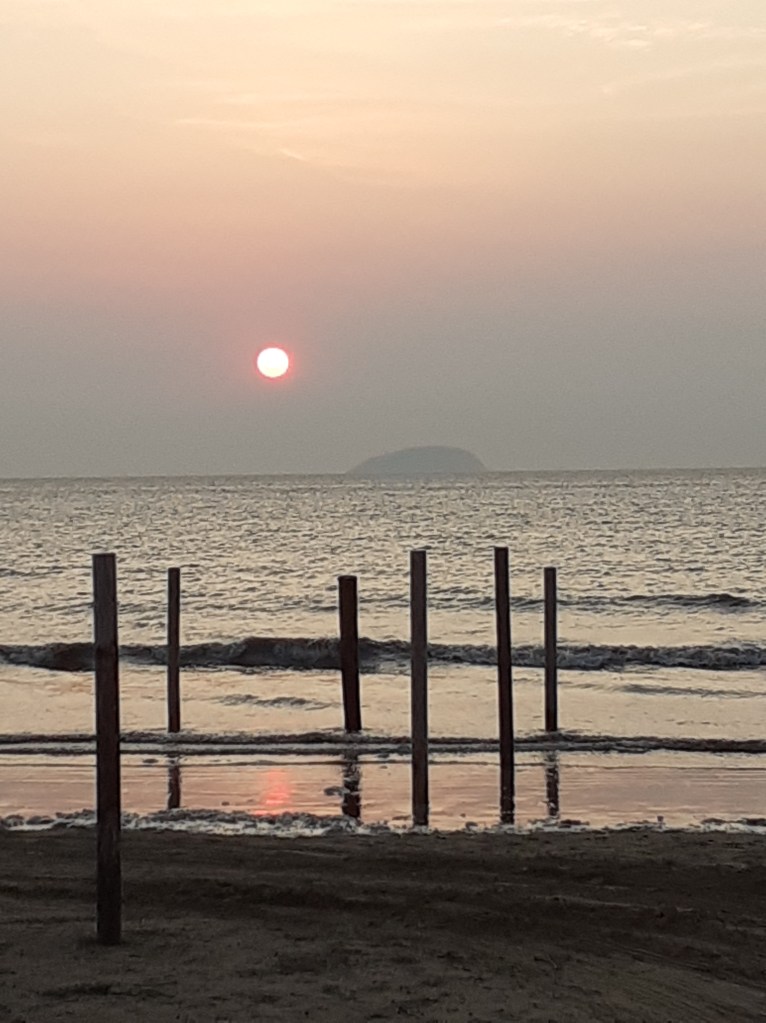
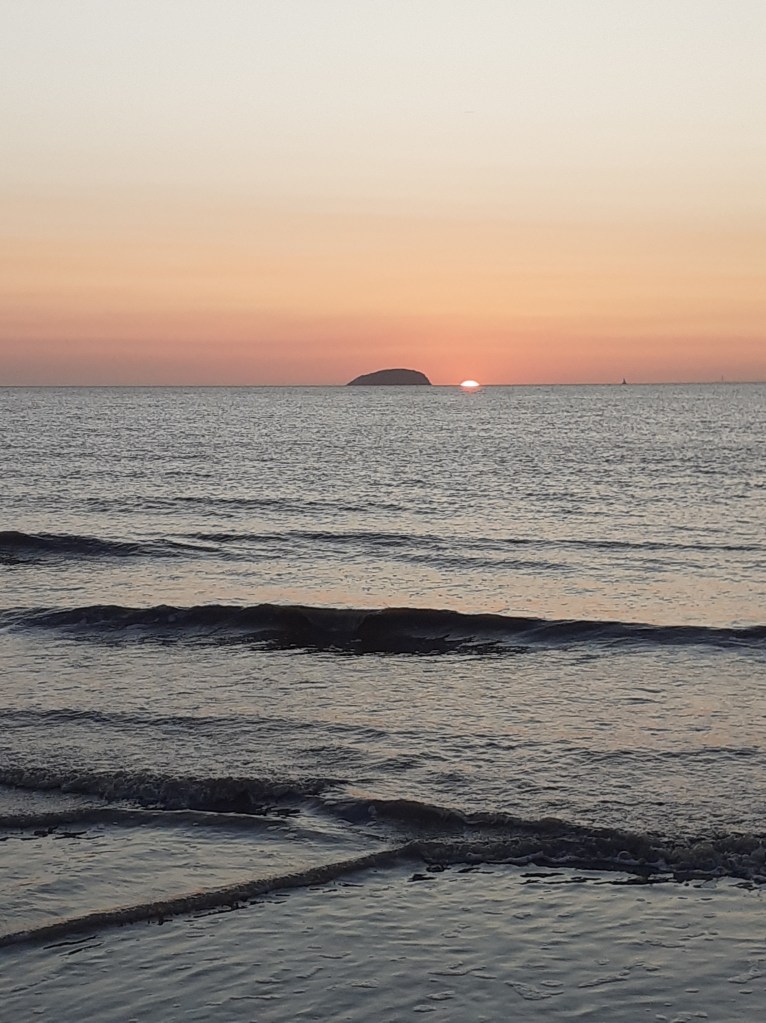
I took this picture on the North Somerset coast (UK) last September. It is an autumnal and sunset picture, which paradoxically offers me a vision of renewal. The location is Weston-super-Mare, at the Brean Down end and facing the Island of Steep Holm. It is a place that draws me, and I wrote about it at the time (1).
Elaine and I will be spending time there in September this year, investigating a possible move. We both have reasons for wanting this, and it has been in our minds for awhile. But the uncertainties of Covid-19, its wayward management in England, and our own separate health problems have slowed us down.
I have become unused to moving. On my return to the UK in 2003, I lived in Bristol before coming to Stroud at the end of 2008. By that time I was already familiar with this old Cotswold mill town, more recently the birthplace of Extinction Rebellion.. For many years I was essentially living a Stroud/Bristol life. It hardly felt like moving.
In the new plan, Bristol will still be our city. But I’m a different person now, and the move feels like a major operation. Almost daunting. I feel stable and secure in my current home, and a part of me is tempted to cleave to the apparent stability and security of a familiar property and community.
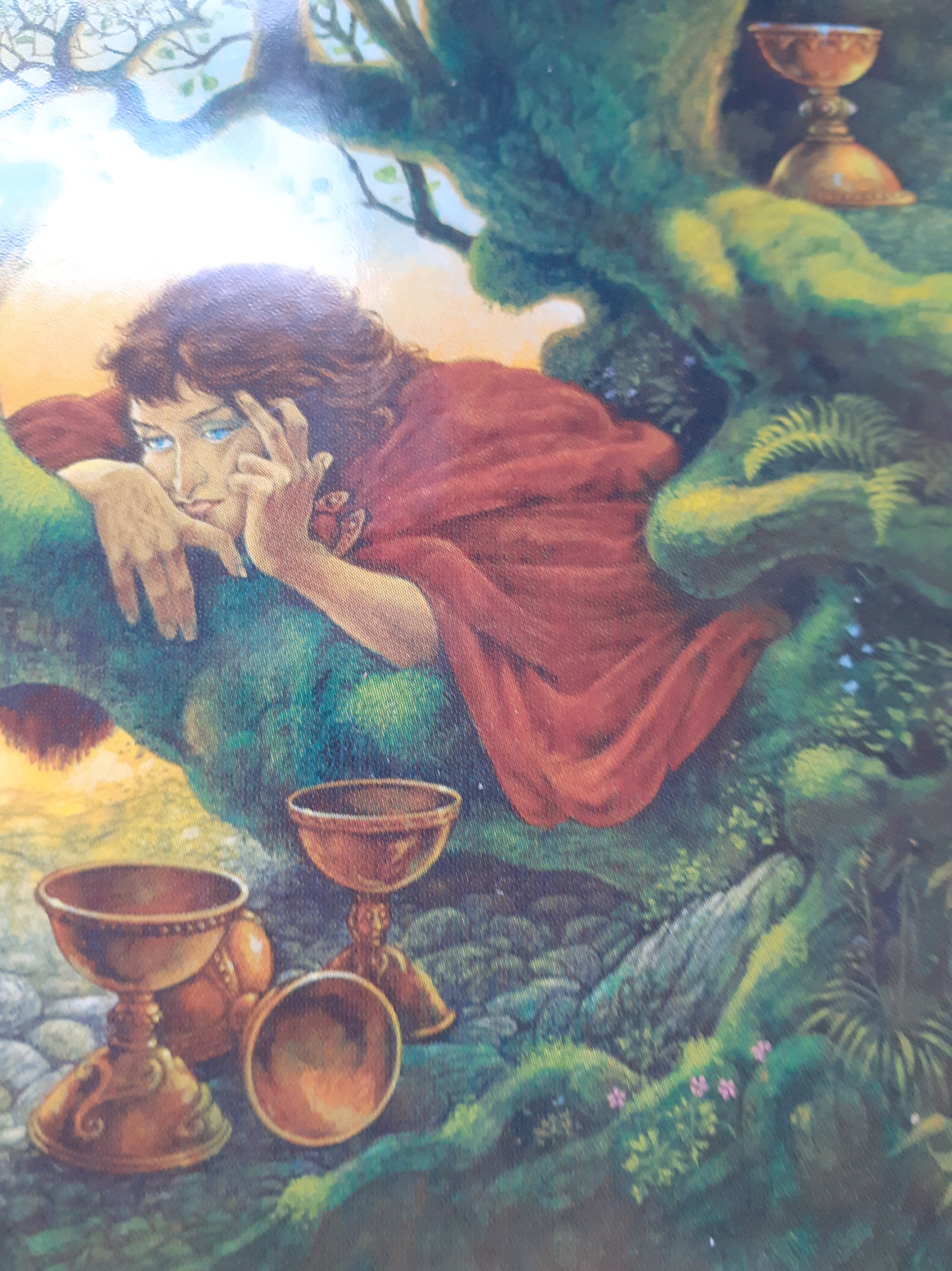
Another part is concerned with the energetic costs of stagnation. Yesterday I drew the 4 of Cups card from The Duidcraft Tarot (2). I am using the pack as a simple psychic mirror, rather than for classical divination. I draw a card when I feel a need to check-in with the oracle. In this instance, I found myself faced with a jaded youth. I am neither jaded nor a youth, But I do feel as if I have been in Stroud for long enough. I catch myself at times in moods of lassitude and an undefined discontent. I am looking for a different experience, and knowing this helps me to raise my energy levels and recover a willingness to take risks. Writing about it is an energiser.
The risks themselves are modest. Weston is familiar to us and the distance not great. There are shared pragmatic reasons for the choice. Beyond these, we both look forward to open ourselves to the local energy of earth, sea and sky in the liminal space where they meet. I also like the notion of living in the English west country, where I was born, and having the opportunity to re-connect with the psychogeography of the region and in particular its coasts, more deeply.
I vividly remember seeing this solitary crow on last year’s visit. It was busy, head down, making a living on the muddy, still estuarial beach. It was a peaceful moment, framed between sunlight and shade. I stepped into peace myself, better to capture the moment and to avoid disturbing the bird. I felt alive and receptive to the setting, which even then felt like a potential home.
(2) Philip and Stephanie Carr-Gomm The DruidCraft Tarot: Use the Magic of Wicca and Druidry to Guide Your Life London: Connections, 2004. Illustrated by Will Worthington.
Sunday 18 October, on a walk beginning at 7.20 am. This is a later start than on the previous week (1), and headed in the opposite direction. The day is overcast and the feeling-tone of this walk entirely different. Last week was magical and illuminative. This week is a time of relaxed enjoyment, of simple openness to the world as I find it. I can let go of agendas.
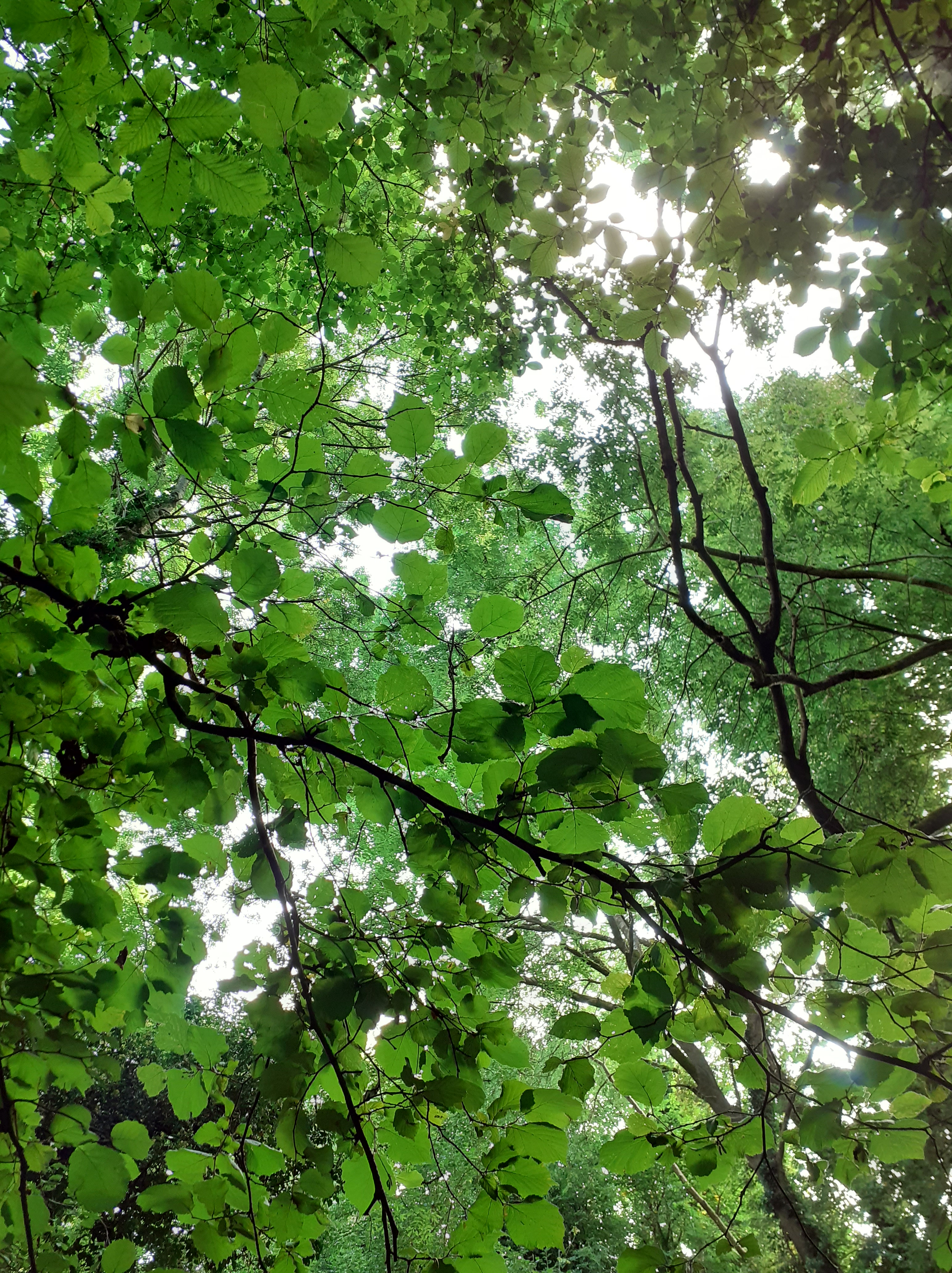
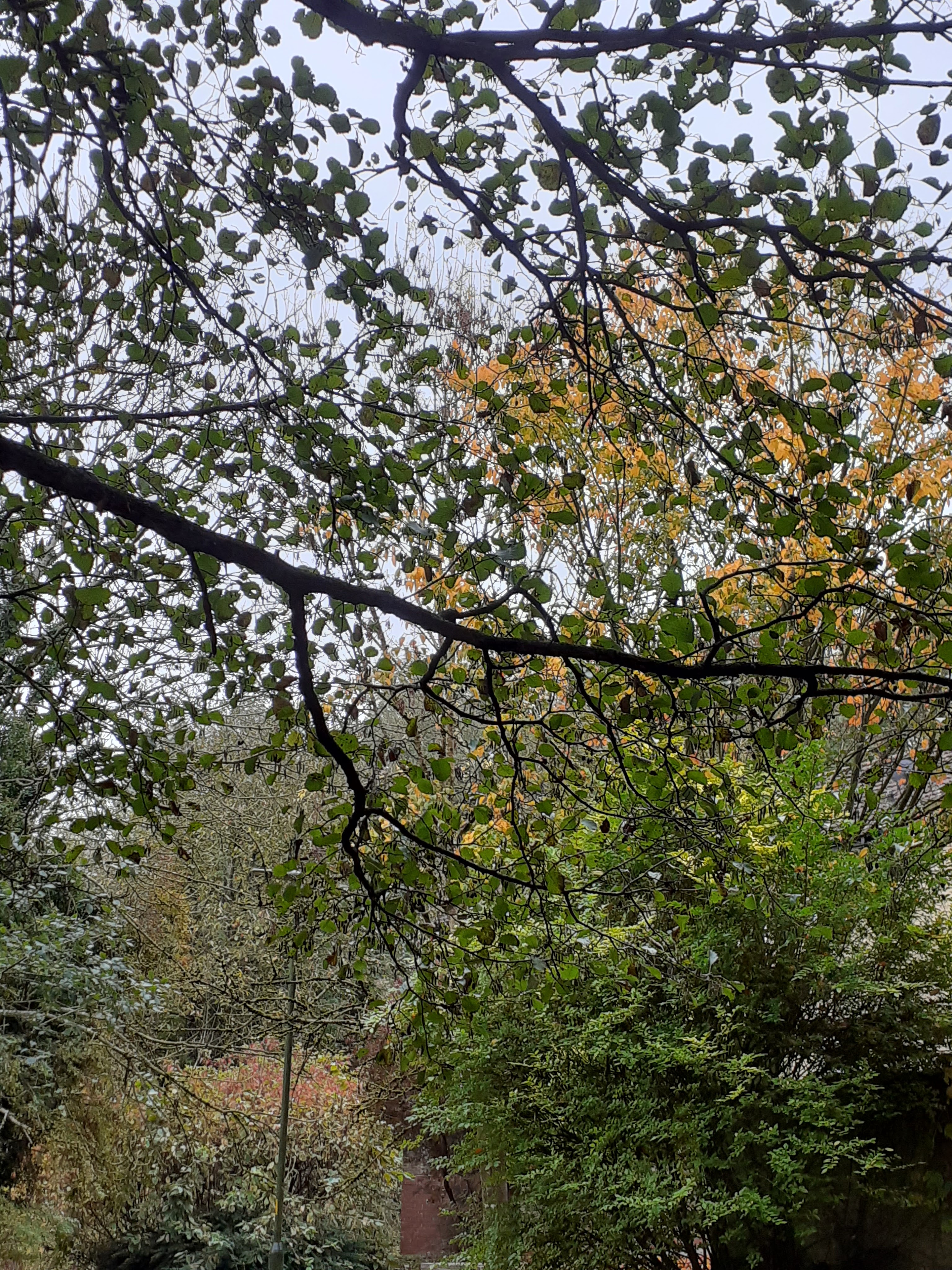
The fall here is still tentative. It mostly happens in November, though there are plenty of leaves falling gently to the ground, and a breeze to encourage them. Overhead, the gaps in the canopy let the light in. The remaining leaves form patterns that draw my attention and raise my spirits in a strange primordial way.
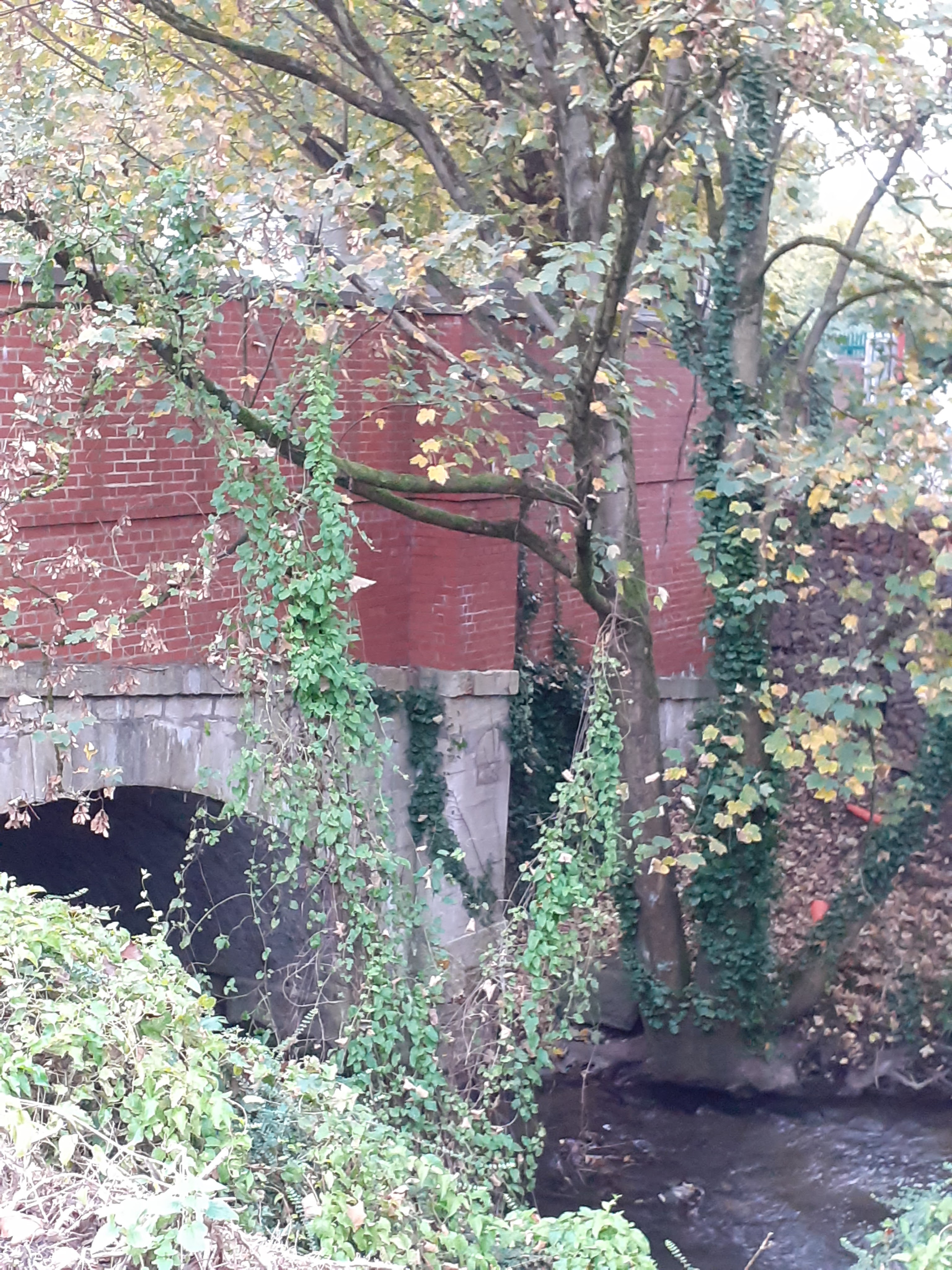
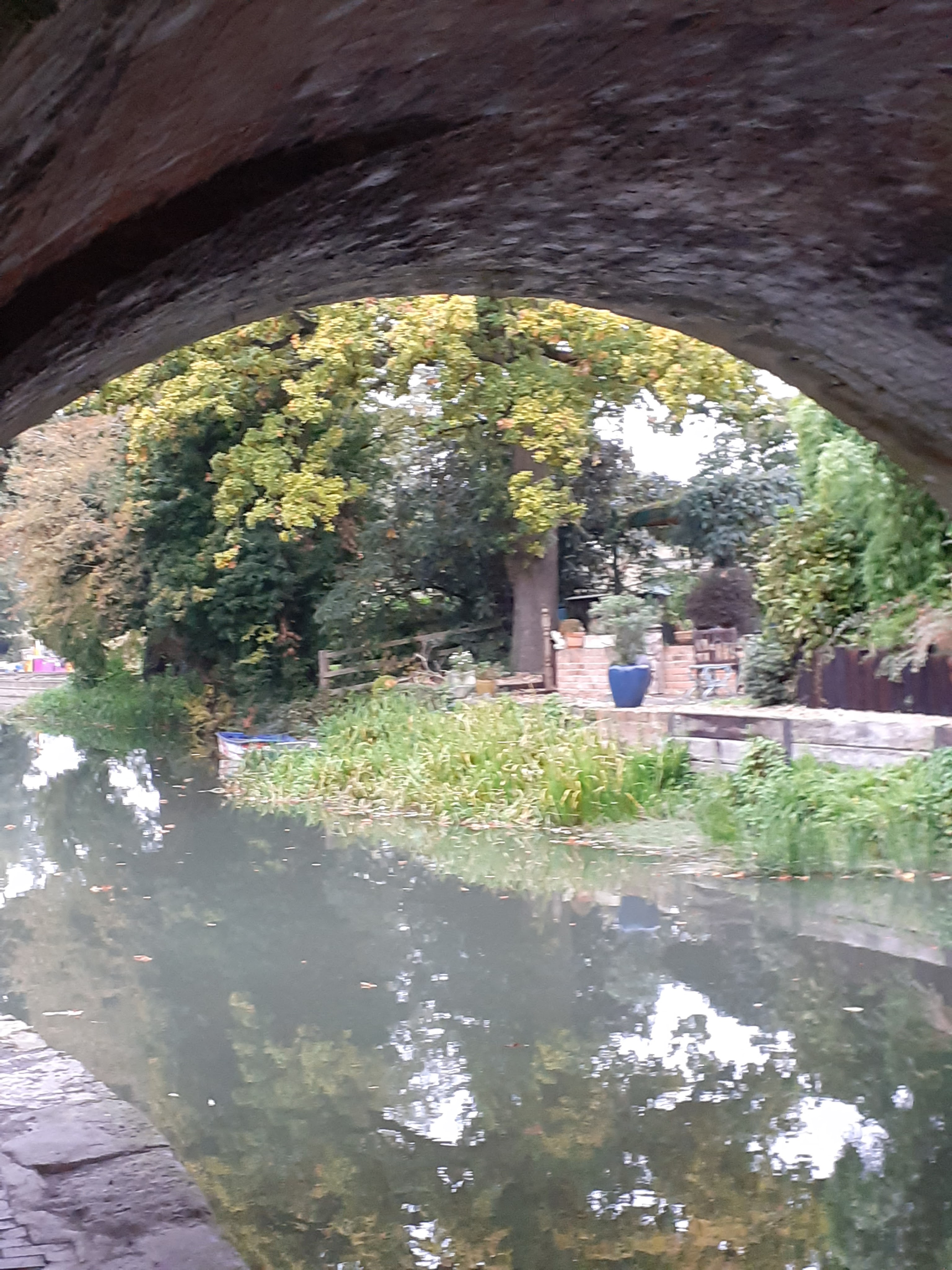
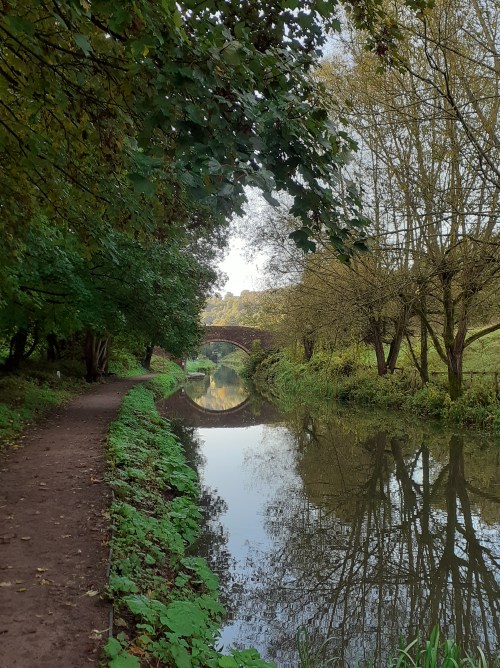
I enjoy built environments up to a certain level of density, when they become oppressive and too much. Here, a canal bridge blends in with ivy, water, trees and undergrowth without any sign of artificial arrangement. The place has been largely left to itself to make its own accommodations and adjustments. They are what they are. They haven’t been created for effect. I notice that I feel in tune with this space.
I live in an urban setting that is not at war with trees. The early morning absence of traffic helps me to appreciate the autumn colours opposite. Today is a day when I am easily pleased by life and I find myself caught up in a moment of spontaneous gratitude.
Now, I am under an arch, looking at the canal, at reflections in the water, and at a canal side entrance to somebody’s house. I have the sense of a congenial, inhabited space. The stretch that I have been walking on today is relatively built up, still part of the town. My walk has involved the interplay of town and country. In one way it has been very ordinary. In another it has been a trigger for happiness. I have enjoyed being part of it.
The picture above – somehow, for me, beyond words. I lose myself in it.
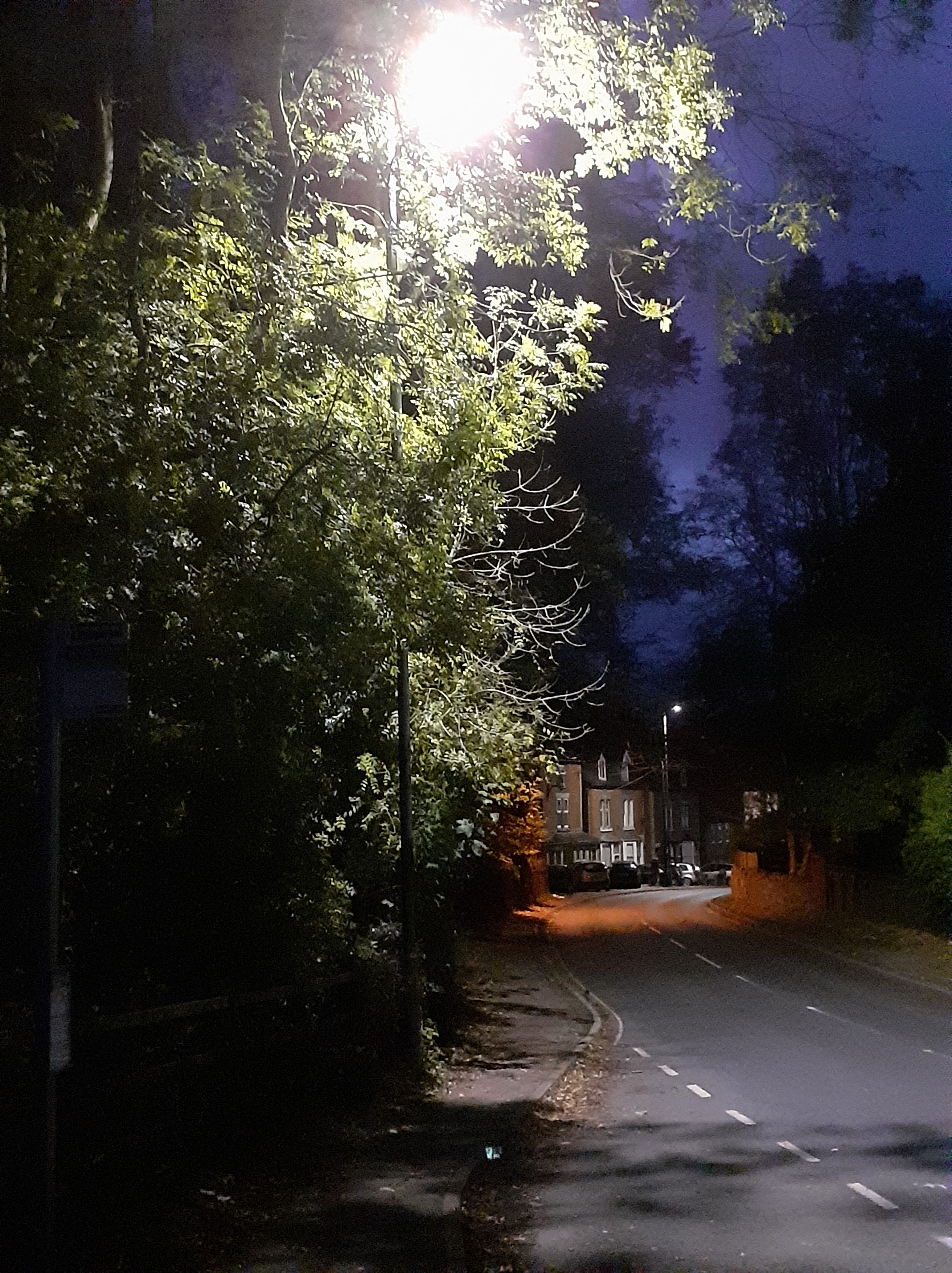
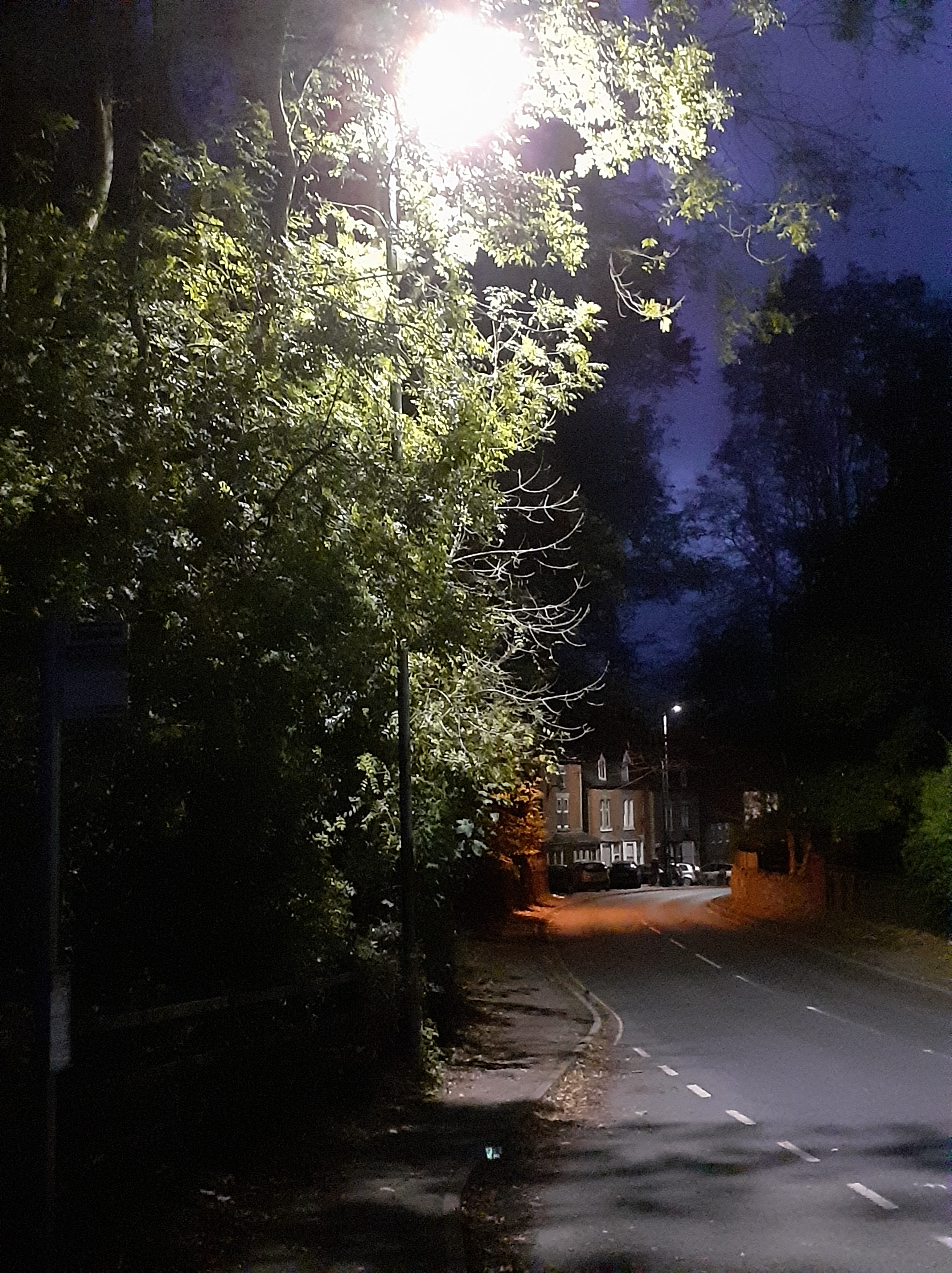
Sunday, 11 October, 6.40 am. My plan is to walk towards the dawn of a new day, but I take time to stop and photograph this liminal moment. It is still, on this normally busy road. It makes me almost nostalgic for the early days of lockdown in the spring.
In this moment, there are no cars and no other people. I am fine with the artificial light. I like the contrast of the street lights (bright and focused) with the softer light in the sky, dim yet with a promise of expansiveness. I enjoy the shadows and the presence, too, of outright darkness at this stage of my walk.
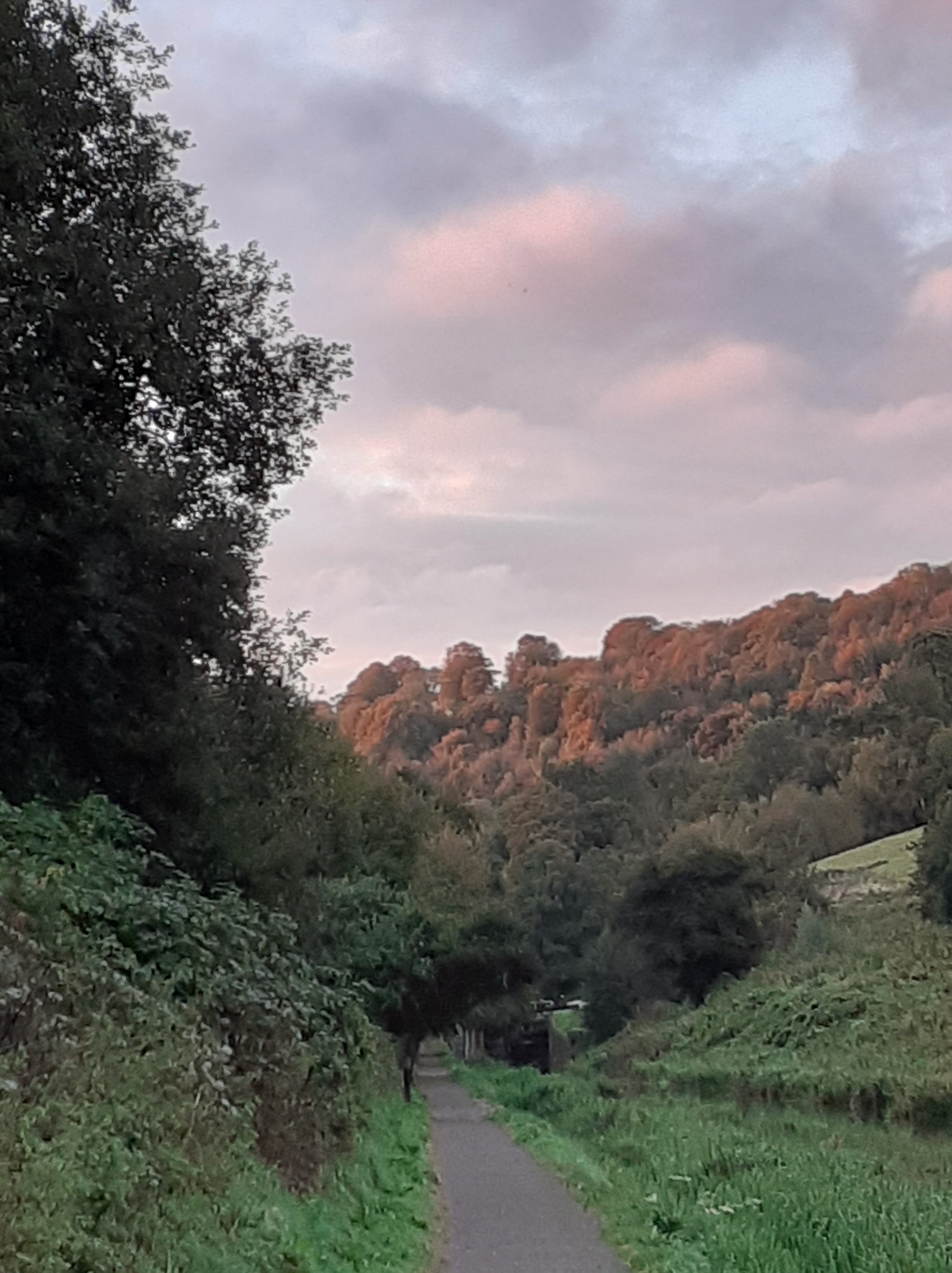
It takes me twenty minutes of enchanted meander to reach my next point, pictured above. The scene is inherently more spacious. Water and sky are prominent. It takes notable artefacts to make their presence felt. The main theme of the picture, as I look in a generally eastern direction, is the coming of the light. Clouds do not obscure it. The buildings have become more than silhouettes. There are the beginnings of colour and the detail it brings. I judge it OK to walk on the canal path itself, just visible on my right.
Another twenty minutes and the light seems to predominate, though I am not yet in full daylight. I am on the canal path. Even though the surroundings of the towpath are lushly green, the world I stand in is a little dusky, or dawny if there were such a word. Crepuscular. Looking up, I see pinkness in the sky, white clouds, hints of blue. I feel heartened and strangely moved by the effects of light on the autumn trees. They give me a warm sense of walking towards the sunrise, and encourage me to move on.
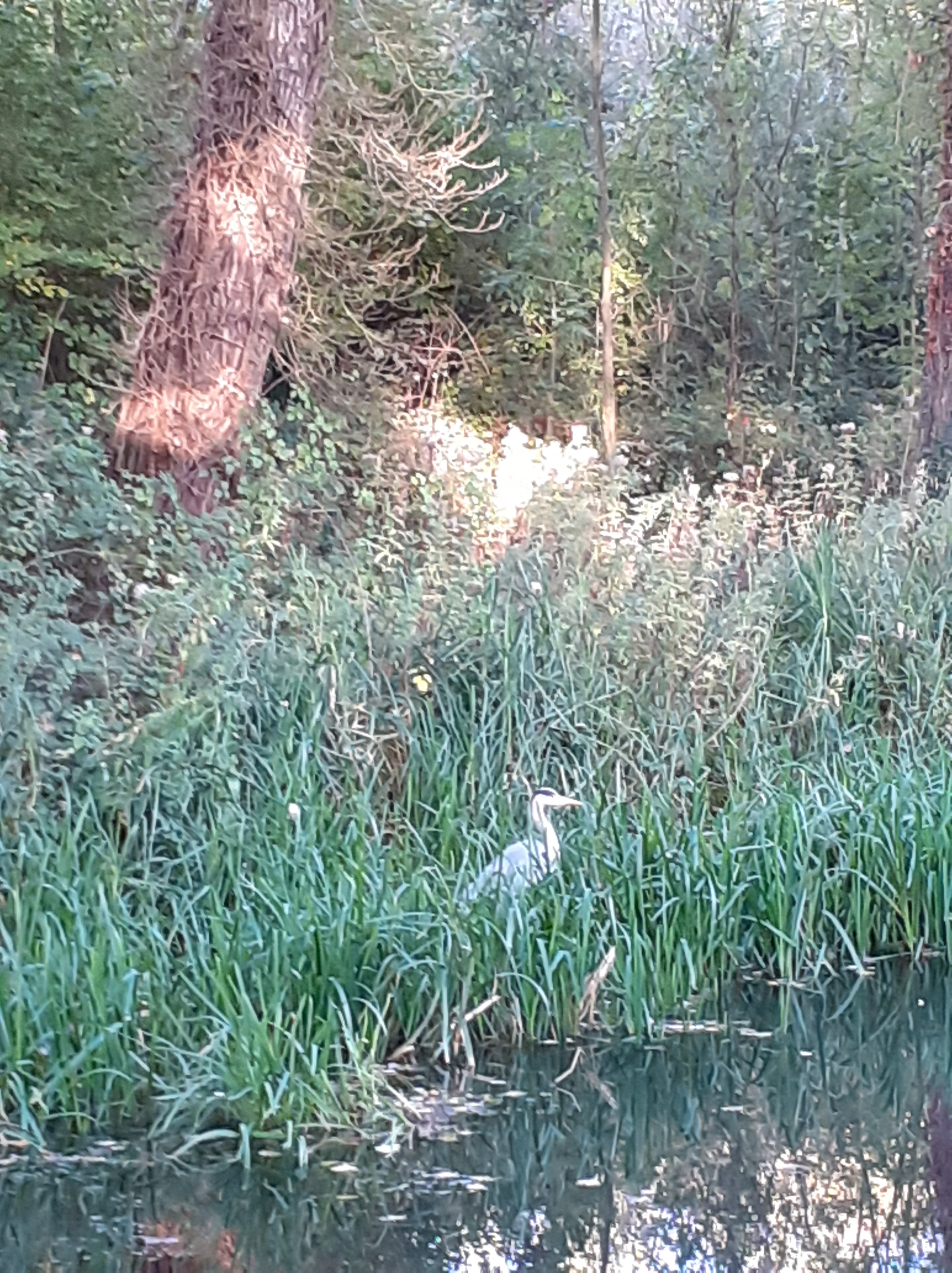
The picture immediately above is not part of my plan. It stems from delighted surprise followed by purposeful calm. Knowing about the heron in advance, I would likely have botched my picture in an anxious, clumsy effort to put the bird on record. I always have before. I think that herons fly away from me out of disdain rather than fear. This time I am a quiet human in a quiet world. I stand still for awhile and am almost elegant in my use of the phone. I wait for an intuited ‘right time’ before pressing the button. There is no drama at all. I do not know if the heron even notices me. The whole incident feels like a blessing of the still early morning.
Now, further on in my walk, the sun is on its ascent through the sky and I can picture it indirectly. The contrast between the sun kissed light areas and the shady ones is strong and vivid. I notice that, as the fading trees accept that their season is over, the ‘parasitic’ mistletoe – even the Druid Plant Oracle (1) calls it that – is gleefully green.
Now I am on my way back home. What draws my attention, after a little exploration, is the white owl. To me it looks very present and collected, situated just where it wants to be. It seems also to be acting as gatekeeper for its own arch.
I make stream of consciousness connections. I began my walk on the Bath Road. Bath is less than 30 miles away. There, the Romans turned a Celtic shrine into a city and called it Aquae Sulis (see http://www.romanbaths.co.uk/), acknowledging Sulis the Celtic goddess of the shrine. She was concerned with its waters and their healing potential whilst doubling up as a solar deity as well. The Romans called her Sulis Minerva, and that links her with owl wisdom. The white owl has a rich hinterland of associations for me. It makes the encounter significant. I note that two resonant avian images have met me on this walk into the sunrise, offering avenues for further contemplation.
(1) Philip & Stephanie Carr-Gomm The Druid Plant Oracle: Working with the Magical Flora of the Druid Tradition London: Connections, 2007. Illustrated by Will Worthington.
As the autumn deepens, I find that my canal walking has slowed down and detached itself from notions of exercise. It has become spontaneously and informally meditative. I am simply noticing what is available, rather than striving to get to some other place in myself or in the world. Followers of the Headless Way (1) describe such attention as ‘being capacity for the world’, since the world knows itself through this awareness. One of the Headless Way’s poets, Colin Oliver, has the lines (2) “In the oneness of things/ I am nowhere in sight”. I am like that with my phone/camera. I rarely have it in the selfie mode, so it is a good device for the purpose.
My combined walking and photography have become a contemplative opportunity, an informal opening to the magic of what is given, here and now, which I sometimes refer to as ‘at-homeness in the flowing moment’. They have taken their place, unplanned, at the heart of my contemplative Druidry. They enable immersion in the apparent world, and provide a setting for what I like to call valley experiences, to distinguish them from the peak experiences more often discussed. I notice also an aversion to calling this activity a ‘spiritual practice’, a feeling that comes with the image of a caged bird. Not right for the context. Not right for that in me which does this.
Through this contemplative lens I can be appreciatively open even to appearances of dereliction and decay. They are simply part of what is. When I see an old and roofless building without this accepting contemplative gaze, I can become irritated and grumpy. Why isn’t it being renovated or pulled down, one or the other? Who is responsible? But in my picture taking mode, through the lens of contemplation, I am entirely at ease. The building has its place, just the way it is.
My meditative walk can highlight processes as well as still images. A decaying rose becomes a rose hip. The dying flower makes way for fruit, which will die back in its turn after seeding the next generation. ‘Decay’ is relative.
The lens of contemplation makes space for things that would be easy to miss otherwise. A waning moon, for example at 8 a.m. …
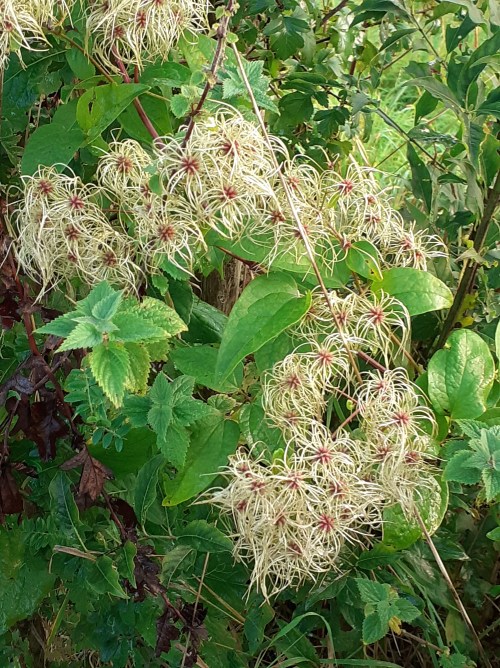
… or the delicacy, close-up, of old man’s beard …
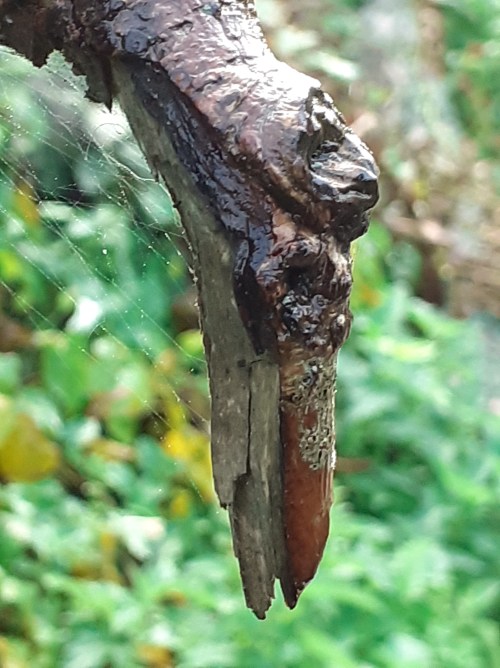
… or a naturally sculpted head of an unknown bird or reptile, which also offers space for a cobweb …
These walks have taught me a lot. There must have been a gestation period between the time I gave them up – what with Covid-19 and my concerns about narrow paths and passing – and the time I resumed them. Along the way I’ve gained a different perspective on their role in my contemplative life. I used to see them as ancillary. Now they seem central.
I tend to feel thrown around energetically over two or three days during the autumn equinox period, and then a new calm takes over. I have crossed into the darker half of the year. I reached that place this year on 25 September and went out for a walk at 7.15 a.m., about 20 minutes after sunrise. The temperature was 8 degrees (46.4 F), not exactly cold, but enough to indicate a change in the year. I was glad to be wearing gloves. They demonstrated my acceptance of a new seasonal identity. There have been still lower morning temperatures in more recent days.
Walking by my local canal, I could see that 2020 has been a good year for its swans. I saw ten near-grown cygnets in a 3-4 mile stretch of water: the group of five in the picture, a group of three a couple of miles away, and two others on their own. I’m inclined to think that the full lockdown from late March until early June has played a role in making the swan population safer. A happy thought and a sad one at the same time.
I walked further out of town this time than I had since the beginning of the Covid-19 crisis and went past more open fields. The grass was green but not growing wildly. I saw only subtle signs of a turn in these distant trees, and none really of a fall. The horses were contentedly outside: no need even for coats. It was dry. By this stage of my walk it was a little warmer, though never beyond 10 degrees (50F). The edge created by a cold breeze had gone. For me this image captures a tranquil moment, that represents my sense of this post-harvest moment in the year. The weather is adequately benign. The energy of nature feels partly withdrawn, into a subterranean state of latency.
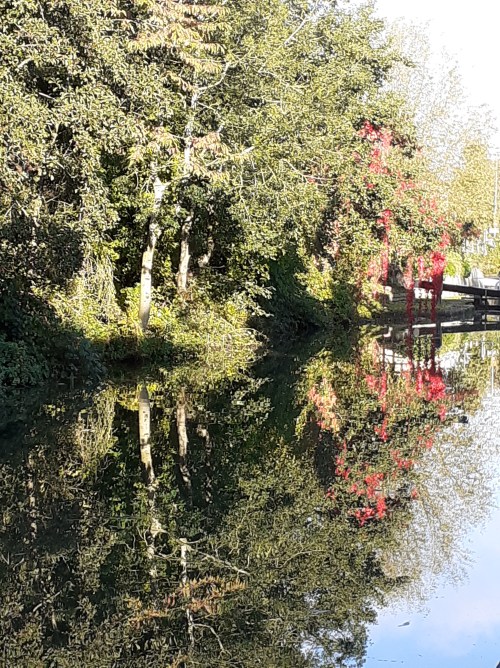
Among the trees on the canal bank, I found much greater evidence of a turn. This is one of the times when I become particularly drawn to reflections in water, and the way in which they to an extent mirror the world above whilst also offering something of their own. The much quoted phrase, ‘as above, so below’ is altogether too neat and formulaic to describe a living world.
I took this picture on 17 September at Weston-super-Mare, a seaside town located where the Severn estuary becomes what is now called, in English, the Bristol Channel. Weston faces Cardiff, the Welsh capital, on the other shore (too far away to see in the picture). Looking at it gives me a sense of tranquillity whilst also showing clearly the major forces in play. We notice the descent of the sun, as if into the water. A change in the light is linked with this process. In the near distance, not far from our feet, the tide is coming in – rapidly, as it turns out just a little later.
Until Tudor times this stretch of water was known as the Severn Sea in line with the Welsh name Mor Hafren (Cornish Mor Havren). For me, the name ‘Bristol Channel’ makes a claim as much as it describes a place. It disrupts my sense of psychogeography and I am drawn to the Welsh ‘Mor Hafren’ as a name to connect me to these waters. It is older, naturalistic and retains a link with the river.
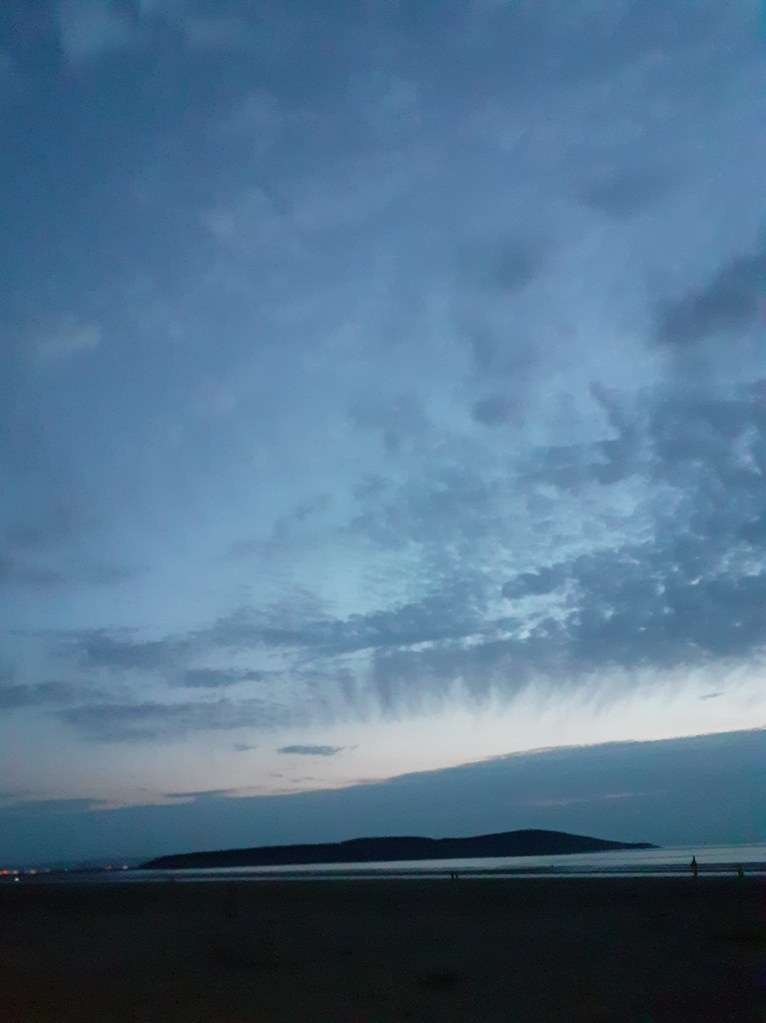
Weston-super-Mare is, by nature, a liminal space, not least of an autumn evening. The picture below is of Brean Down – brilliantly used in Dion Fortune’s occult novel The Sea Priestess – and the sky above it, a little after sunset.
Sky, sea, land. From this distance, the head, like many coastal promontories, has a slightly serpentine or dragon-like look. You half expect it to rear up and move. But it doesn’t. It remains quiescent, power in potential. The active power, here and now, is in the clouds and the afterglow of the sun.
On this visit, I discovered the cycle track, also a pedestrian path, that allows improved access to Brean Down from the Weston side. This helped me to revive a connection to Brean Down which I had allowed to lapse over recent years.
My final picture gives more space to the water element as an incoming tide, whilst recording the sun sinking below the horizon near the island of Steep Holm. The name is of Norse derivation (‘holm’ referring to an island in an estuary). The Welsh name is Ynys Rhonech and the early English called it either Ronech or Steopanreolice – ‘reolice’ being derived from an Irish word referring to a church yard or graveyard, suggesting a sense of a one-time sacred space. These names give a sense of the different peoples who took an interest in this stretch of water in early times. Steep Holm is in England, although Flat Holm, Ynys Echni, a little closer to the opposite shore, is in Wales.

















 Contemplative Inquiry