Contemplative Inquiry

This blog is about contemplative inquiry
March 24, 2015
POEM: THE RAILWAY CHILDREN
When we climbed the slopes of the cutting
We were eye-level with the white cups
Of the telegraph poles and the sizzling wires.
Like lovely freehand they curved for miles
East and miles west beyond us, sagging
Under their burden of swallows.
We were small and thought we knew nothing
Worth knowing. We thought words travelled the wires
In the shiny pouches of raindrops,
Each one seeded full with the light
Of the sky, the gleam of the lines, and ourselves
So infinitesimally scaled
We could stream through the eye of a needle.
From Seamus Heaney, Station Island London & Boston: Faber & Faber, 1984
March 21, 2015
AT TATE LIVERPOOL
I spent time at the Tate Liverpool yesterday. Currently there is an exhibition of work by Leonora Carrington the mystical surrealist and feminist. It was almost too much to take in. For me the work, among other things, aptly illustrated one of her own comments.
“One cannot understand reality. Paradigms are a transitory convention for man. It is to our advantage to believe that we know, but it is obvious that absolute truths that were accepted in the times of Newton and Euclid do not exist.
“Sorcerers and alchemists know about animal, vegetable and mineral bodies. To hack away the crust of what we have forgotten and rediscover things we knew before we were born.
“There are things that are not sayable. That’s why we have art.”
March 18, 2015
EVENTS UPDATE
The Contemplative Druid residential retreat (17-19 April 2015). at Anybody’s Barn, Birchwood Hall, Storridge, Nr. Malvern, Worcestershire WR13 5EZ. is now fully booked. However anyone interested should still contact us as there is a waiting list and there is the possibility of future residential retreats.
Looking ahead, we will have a presence at Druid Camp (29 July – 2 August 2015) and we will also be holding an open Contemplative Day in Stroud on 3 October 2015, from 10.30 a.m. – 4.30 p.m. at the St. Luke’s Medical Centre, 53 Caincross Road, Stroud Gloucestershire GL5 4EX. This will be facilitated by James Nichol, Nimue Brown and Elaine Knight. We will work with a maximum of twelve other participants, continue to build on the working methods we have developed in our local group over the last three years..
Contact grovelight@hotmail.co.uk for further information or to make a booking.
See http://contemplativedruidevents.tumblr.com for fuller events information, including the Stroud day on 3 October. For Druid Camp information see www.druidcamp.org.uk and www.facebook.com/groups/druidcamp/
March 16, 2015
POEM: A POSTCARD FROM ICELAND
As I dipped to test the stream some yards away
From a hot spring, I could hear nothing
But the whole mud-slick muttering and boiling.
And then my guide behind me saying,
‘Lukewarm. And I think you’d want to know
That luk was an old Icelandic word for hand.’
And you would want to know (but you know already)
How usual that waft and pressure felt
When the inner palm of water found my palm.
In Seamus Heaney, The Haw Lantern London: Faber & Faber, 1987
March 14, 2015
HEARTFULNESS & EMBODIMENT
I decided to kindle a Mindfulness 101 book* and do a spot check out how far my own practice meets ‘mindfulness’ criteria as currently understood. I was glad to find – as a wayward intuitive Druid – that I still seem to be incorporating the essential principles. I especially enjoyed the comment: “Ask someone from Tibet where their mind is and they may point to their chest – the word for mind and heart in Tibetan, and many other eastern languages, is the same. When we practice mindfulness, we’re recalibrating our centre downwards – as such, the practice might better be described as ‘heartfulness’ or even ‘bodyfulness’.” On this reading mindfulness becomes “an open hearted awareness of what’s happening, and learning from what we find” so that something which in English sounds like a quality of thinking in fact brings us down from our heads and into our whole bodies. Body sensations are driven at a deeper level than thought, which is why we can’t change how we feel simply be thinking about it. “By bringing attention to sensations within the body … we work with them more skilfully.”
My personal practice includes devotional, energetic and meditative elements with the meditative slightly more emphasised than the others. It includes a review of body, senses, life energy, feelings, thoughts and images. It also includes a period of either breath meditation or ‘choiceless awareness’. All of these elements are in the mindfulness book. What re-assured me most was the implicit validation of my recent choice of Duidsg mo chridhe/dooshk mo chree (awaken my heart) as an affirmation and reminder phrase during this period. This phrase comes from a Ceile De Fonn, and called to me strongly when I chose it. I’d already thought of ‘heartfulness’ as my preferred term for an awakened state – a fuller, more spacious and generous kind of presence than is conveyed to me by the term mindfulness itself. So I liked getting synchronous support from a book about mindfulness practice.
* Ed Halliwell Mindfulness: how to live well by paying attention Hay House Basics
Information about the Ceile De is available on http://www.ceilede.co.uk
March 13, 2015
BOOKMARK
The other day I glanced at a bookmark I was using. It drew me in and I really took notice of it. I realised that this was an old bookmark, as bookmarks go, and that I’d been holding on to it and intermittently using it since about the dawn of the millennium. I know that because it advertises Banyen Books & Sound, 2671 West Broadway, Vancouver. I’ve only been to Vancouver once, for a conference in August 2001. I remember liking the city and the summer atmosphere. Retrospectively it feels like the last breath of the 1990’s, such a short time before 9/11 and all that has happened since.
One side gives the information about the store – I’ve no idea whether it’s even there now, books and music being sold so differently now. The other has a traditional Chinese picture – mountain, river, mist, all somehow spaciously portrayed within a restricted area of card – together with this quote from Joseph Campbell.
“To have a sacred place is an absolute necessity for anybody today. You must have a room, or a certain hour or so a day, where you don’t know what was in the newspapers that morning, you don’t know who your friends are, you don’t know what you owe anybody, you don’t know what anybody owes to you. This is a place where you can simply experience and bring forth what you are and might be. This is the place of creative incubation. At first you may find that nothing happens there. But if you have a sacred place and use it, something eventually will happen.”
It’s true, and a great thing to bring forward from that time.
March 10, 2015
BOOK REVIEW: CELEBRATING PLANET EARTH A PAGAN/CHRISTIAN CONVERSATION
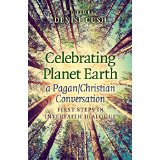 Highly recommended and available for pre-order via Amazon. This blog is an enthusiastic early alert concerning Celebrating Planet Earth, edited by Denise Cush The book comes out of a weekend ‘conversation’ held at the Ammerdown Centre near Radstock, Somerset, England, from 31 January-2 February. Originally devised as a Druid/Christian event, it was widened to include other Pagans and was intended to generate “dialogue, reconciliation and renewal”. The hope was that the participants could explore their prejudices and preconceptions, learn more about each other, and find common ground in ‘Celebrating Planet Earth’, as the event was called. The book’s contributors were all involved in the conversation.
The book is aimed at Pagans and Christians interested in making connections; academics and undergraduate students in Study of Religions taking courses on inter-faith dialogue, Paganism and Christianity; and anyone with an interest in inter-faith activities. Some of the contributors are academics in the field, but as well as academic input, there is a practical emphasis on personal spirituality and ritual practice.
I’m part of the core audience. Whereas I experience the spiritual path as ultimately beyond names and forms, I stand in the world as a Pagan Druid. I had a Christian upbringing and in recent years I have learned from the Buddhist tradition, as well as Christian-based movements such as Sophian Gnosticism and the Ceile De. All of these have supported me in my own practice and in my personal concern with developing a stronger contemplative current within Druidry. So I’m at ease with what Philip Carr-Gomm, Chosen Chief of the Order of Bards, Ovates and Druids (OBOD), calls “fusion paths” in his chapter in this book.
From where I stand the ‘Celebrating Planet Earth’ more than meets its aims. It’s a feast. I felt that each contributor had thoroughly earned their place in it. It is divided into three parts, before moving on to editor’s reflections and conclusions. I want to say something about one chapter that spoke to me particularly strongly from each of the parts, as the best way in a short space of honouring the collection as a whole.
The first part is about ‘Addressing Our Fears and Prejudices’ and for this I pick out Graham Harvey’s chapter, ‘Fears and prejudices: a Pagan view’. For me, he has a very helpful analysis of what the task is and how to accomplish it. He makes it clear that “not everyone thinks alike” or should be expected to and that diversity has room for healthy opposition – properly handled, this can be a real gift. He makes the subtle point that the negotiation of difference is not just about fear and prejudice. It is also about avoiding the presupposition that “others are like us but not quite … that other people mean what we would mean when we say or do things”. Hence we need a refined quality of listening to avoid “talking past each other”. On the question of fear and prejudice specifically, he suggests that the two things to remember are that we should indeed “resist and challenge the small visions and petty fantasies that are imposed on others” and that “when we talk about what people do, rather than what systems are alleged to do, we will keep diversity in clear view”. He usefully writes down polarised lists of what ‘Christians’ and ‘Pagans’ are contrastingly stereotyped as standing for – and invites us to make a reality check on the items in the list. It’s a very useful way of opening the reader up to the actual experiences of individuals and groups in later chapters.
The second part is about ‘Possibilities for Co-operation’ and for this I pick out Tess Ward’s chapter, ‘Better together: transformation through encounter’. Early in her life as an ordained priest, Tess Ward went into her own version of Dante’s ‘dark wood’, a wilderness in which she needed to die to one life so as to be born into another. She lost her existing theological frameworks and says of that time: “in that wilderness, what sustained me was not theology, but poetry, silence and nature”. Without leaving her Church, she found pointers in Buddhist ideas (Anthony Gormley, Pema Chodron), Earth paths and feminist spirituality. She quotes Carol Christ as saying: “awakening suggests that the self needs to notice what is already there … the ability to know is within the self, once the sleeping draft is refused … for women, awakening is not so much a giving up as a gaining … a grounding of selfhood … rather than a surrender of self”. She also quotes Kenneth White’s poem ‘Labrador’ – “I was loathe to name it too soon – simply content to use my senses – feeling my way – step by step – into the new reality”. As, renewed, she moves back into the world and her role, she knows that interventions in the world only have value when they come from personal experience. She shares with Matthew Fox the view that the result of such a crisis is not to abandon one’s own tradition “but to demand more of it”. She now leads celebrations of the Celtic Wheel of the Year as an affirmation of her transmutation of faith within a Christian framework. Partly this is an enhanced appreciation of being grounded in the natural world and its cycles. Partly it is an appreciation of the place that resources outside her traditional faith have had in deepening her journey.
The third part is about ‘The role of ritual practice, myth, music and for poetry in each tradition and in inter-faith encounter’. For this I pick out Alison Eve-Cudby’s chapter: ‘Woven together: can Christians and Pagans engage in shared ritual?’ The author has a leading role in the Ancient Arden Forest Church in a burgeoning movement of Forest Churches. She describes this movement as “a small and growing number of Christians responding to the Call of the Earth”. Ancient Arden has an emphasis on ritual and her formal answer to the question she poses is a carefully contextualised ‘yes’. She says: “if we take earth celebration, care and connection as our basis for doing ritual together, to contribute towards re-enchanting the land in this time of ecological crisis then I think that shared ritual is possible”. She offers a fresh and energised discussion of ritual and its purpose. She describes ritual as an embodied event, and a process of framing in which dramaturgy, rather than theology, is the organising principle. Whereas logocentric approaches assume that the symbolic system expressed in ritual must be coherent, performance as an unfolding event lays out symbols in a way that reveals their inconsistencies and contradictions. The work therefore involves negotiating and holding these within the ritual container. We fashion rituals that enable liveable, regenerated worlds. Ritual is a transformative process, “the pattern of actions is designed to synchronise the awareness of the different participants – human, non-human and other than human”.
The book’s conclusions suggest that meeting itself was of great benefit, and make it clear that the people involved want to continue their work in some way (topic based subgroups are mentioned). I would simply add that this book is a gift to us all, and that I am grateful for it.
March 9, 2015
HAIKU BY SHIKI
Without my journey
And without the spring
I would have missed this dawn.
Zen Haiku, selected and translated by Jonathan Clements
London: Frances Lincoln, 2000
March 6, 2015
FUINN II: THE POETRY OF PRACTICE
I’m a Pagan Druid, happily placed in a tradition that values poetry and seership over dogma and system building. I experience my practice as a sort of poetry. In this poetry of practice, I am held in a compelling myth of origin, an ever-now origin, and I have found a new way of working with it.
My new collection of Fuinn (Ceile De chants in Scottish Gaelic) includes a very simple one which goes A Hu Thi (ah – hoo – hee) repeated over and over again. The Ceile De interpretation, a Celtic Christian one, is that this chant “represents the three stages of the unfolding of creation … A– the Great Mystery draws in its breath … Hu – that breath is breathed out, and creation is born from out of the Mystery … God becomes matter … Thi – the Divine nature, beingness and intention acts within the field of intention … Some Ceile De would say that this final stage represents Christ Consciousness.”
It’s a bit different for me. I’ve been working with this Fonn daily for a couple of weeks now. I don’t chant. I use slow deep breathing with a silent awareness of the sounds. I find that for me, the A sets up a sense of latency, a subtle pulse and vibration on the brink of becoming. I feel it in the quality of my inbreath, as a kinaesthetic song. Hu the outbreath feels more vigorous and intentional; there’s a real sense of movement, expressed as exhalation – the breath moves out from my body, through my nostrils. Thi breathed in feels like the delighted expression of a new reality, one that I share in, distinct yet inseparable as a sentient being. This generally brings up feelings exhileration, gratitude and joy. It leads me on to the use of another Fonn as a contemplative and devotional prayer, which I wrote myself using my collection of Fuinn as a model.
A Brighde, A Brighde, solus an domhain; A Brighde, A Brigdhe, Brighde mo chridhe
A Vree-jah, A Vree-jah, solus an dowan; A Vree-jah, A Vree-jah, Bree-jah mo cree
Brighde, Brighde, light of the world; Brighde, Brighde, Brighde my heart
Brighde is the breath, the practice and the Fuinn. When writing my Fonn I wanted to build a felt sense of Brighde as cosmic birther, initiator into being, with a seat in my heart. Her name evokes power and the prayer invokes relationship – identified as She is with primal generativity and the deep powers of life and land, and also One who inspires skill and accomplishment in those She supports and fosters. Through my experience of relationship and connection, deep levels of feeling and intuition are satisfied, in some way met. I feel empowered, with a sense of having more resources available to me. Why would this be? I don’t really know. What I do know is the value of practice as poetry, and the magic it holds.
The Ceile De can be found on http://www.ceilede.co.uk

