
LONGEVITY AND WELLBEING IN DARK TIMES
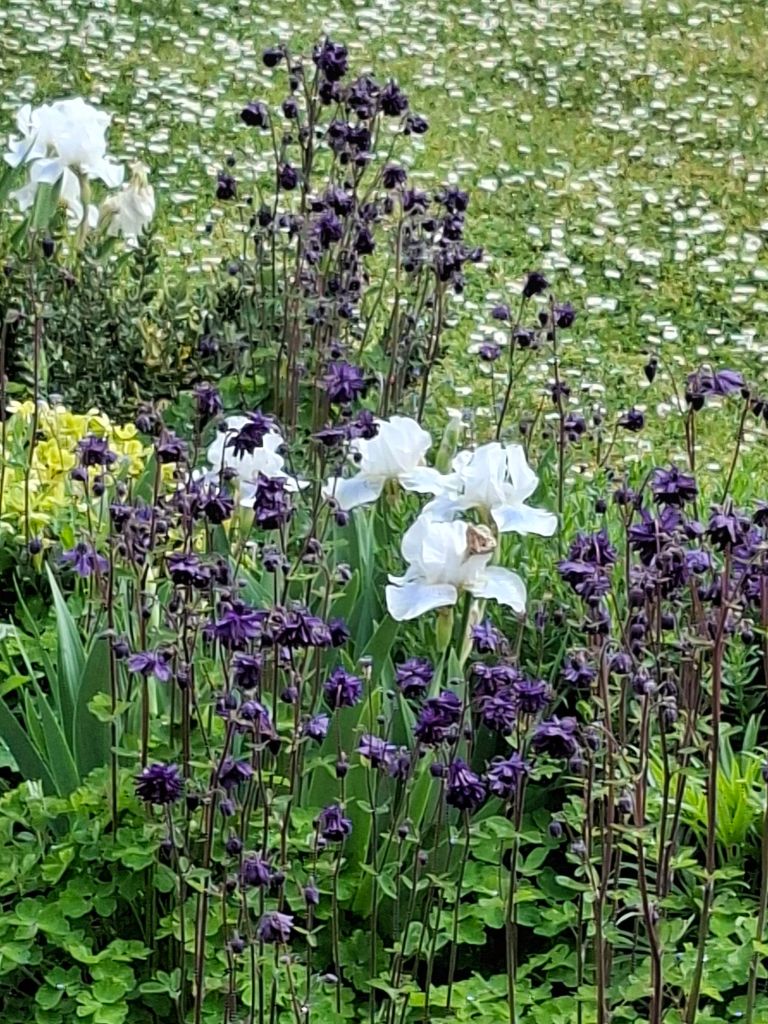
The Llanthony Secunda Priory’s physic garden in Gloucester feels like a healing space, though it lost that role in the sixteenth century. When it was in use, a great many health problems could not be fixed. But healers could still provide compassion and care. An after echo remains.
In the 1400’s and 1500’s overall life expectancy at birth in England was only 30-35, largely due to high levels of infant and childhood mortality. Added to this, maternal mortality has been estimated at 1-1.5% of all births, with a lifetime risk of 1 in 18 to 1 in 20. Because of these risks, a significant number of women died before the age of 45. Men over 21 could hope to live until 60 – aristocrats until 69. For them, ‘three score years and ten’ was not just an aspirational slogan. It was a real possibility though relatively few people made it.
If I map my own history onto the period, I could not have survived beyond my mid 50’s. The physicians of the day (and for a long time afterwards) did not have the knowledge and resources to fix my prostate cancer. In today’s world it has been banished for 20 precious years and has shown no sign of returning. I celebrate my 77th birthday in 18 days. I have survived into a time when I have been wonderfully fixed, for which I feel a deep gratitude. It has been a happy and fruitful period.
The health limitations I have now are not fixable in the same way. They go with the privilege of longevity. They are currently well-contained but they will not go away in my lifetime. So I look at well-being in other ways. Here is somebody else’s list of the ‘real luxuries of life’ (1):
Slow mornings
Freedom to choose
A good night’s sleep
Peace of mind
Calm and boring days
Being present
People you love
People who love you
These are all present for me, and they do alot to support my wellbeing. Sadly, I realise that in the world we now live in, they count as a form of privilege. Taken together, they are easier to experience when time rich with some material security. Being a retiree is the most common way of achieving this and I really like it. But I wonder if our successors will get the same opportunities.
I have experienced the economic justice aspects of social progress going backwards for much of my adult life. Now all aspects seem to be threatened. Life expectancy is beginning to slip, with growing inequalities.
We also know, if we take evidence seriously, that the continuity of human life on earth is at risk. The largely unchecked climate crisis is the main threat, but nuclear war and an unstoppable lethal pandemic are also serious possibilities. Yet mechanisms to prevent them are being ignored by many people and actively undermined by some.
When I think of these things I feel a range of emotions: anger, fear and especially grief. I experience a sense of limited agency. I am also, to say the least, concerned about the capacity and good faith of major decision makers domestically and around the world. I worry about a future that I won’t be part of. Any sense of legacy or contribution to pass on is deeply compromised.
I am glad that I can manage my feelings and put space around them. I can switch my attention and go somewhere else – to prevent myself becoming blinkered and obsessive. But my distress needs to be there, included in my psychic ecology, as a valid reponse to bad collective circumstances that will be very hard to change. It’s part of being human. In such times, mature wellbeing can be a complex business.
(1) Facebook group Woodlarking

