
MAP AND TERRITORY

The Empress Wu Zetian ruled the Chinese empire alone from 690-705, the only woman ever to do so. It was the time of the Tang dynasty, when China was open to central Asian and Indian cultural influence. Wu herself had a strong Buddhist commitment.
She was curious about the world view of an esoteric Buddhist school, the Hwa Yen. In this view, all the universes were seen as a single living organism, characterised by mutually interdependent and interpenetrating processes of becoming and unbecoming. The Empress asked for a simple and practical demonstration of this complex vision.
The Hwa Yen sage Fa-tsang was given a palace room in which he placed eight large mirrors, each at one of the eight points of the compass. He placed a ninth mirror on the ceiling and a tenth on the floor. Then he suspended a candle from the ceiling in the centre of the room. The Empress was delighted at the effects thus created. ‘How beautiful! How marvellous!’ she cried. Fa-tsang explained how the reflection of the flame in each of the ten mirrors demonstrated the relationship of the One and the many, and also how each mirror also reflected the reflections of the flame in all the other mirrors, until myriad flames filled them all. The reflections were mutually identical. In one sense they were interchangeable; in another sense they existed individually. Then Fa-tsang covered one of the reflections to show the significant consequences this had for the whole. He described the relationship between the reflections as ‘One in All; All in One; One in One; All in All ‘.
Hwa Yen Buddhists also spoke of ‘The Great Compassionate Heart’. They understood it as a quality of awareness that sees all phenomena including ourselves as arising out of Emptiness, remaining part of the Emptiness whilst assuming a temporal form, and finally falling back into Emptiness and being reabsorbed. “It is a quality of awareness that quite naturally expresses itself in acts of deepest, yet quite unsentimental reverence and compassion for all that is, the just and the unjust, humans, animals, plants and stones”.*
Fa-tsang was careful to provide a ‘the-map-is-not-the-territory’ caveat. “Of course, I must point out, Your Majesty, that this is only a rough approximation and static parable of the real state of affairs in the universe – for the universe is limitless and in it an all is in perpetual, multidimensional motion”. Yet he had still taken care to provide his Empress with a beautiful, memorable and instructive map. Such maps, and the sense of ‘Great Compassionate Heart’ which they foster are of great value. They can nourish the seeker and illuminate the way, for rulers and non-rulers alike.
*Richard Miller Yoga Nidra: a Meditative Practice for Deep Relaxation and Healing Boulder, CO: Sounds True, 2005 (A more extended version of the story is included in this book.)


 This is my image of Autumn for this year. Before Samhain. Before most of the fall. Leafy and watery. The sun is still an influence, a soft one. I took the picture this morning whilst walking in Ninesprings (one word), the gem of the Yeovil Country Park.

 This is Wyndham Hill, Yeovil. I was born only a few hundred yards away, and I felt a close connection with it throughout my childhood. As representing ‘nature’ or the countryside, it felt safe when I was little and reassuring later on. It hasn’t changed much, and I am still reassured.
 Above is the house I grew up in – the grey one. It was a pharmacy when I lived there, though it ceased to be that in 1973, three years after I left home at the age of 21. Its value as a retail site and community resource had long been weakened by a movement of people away from the old town and the building of a ring road within the modern town rather than around it. I don’t know about the later history of the house that brought about its dereliction. Clearly the house doesn’t now evoke the sense of safety and reassurance that it once did.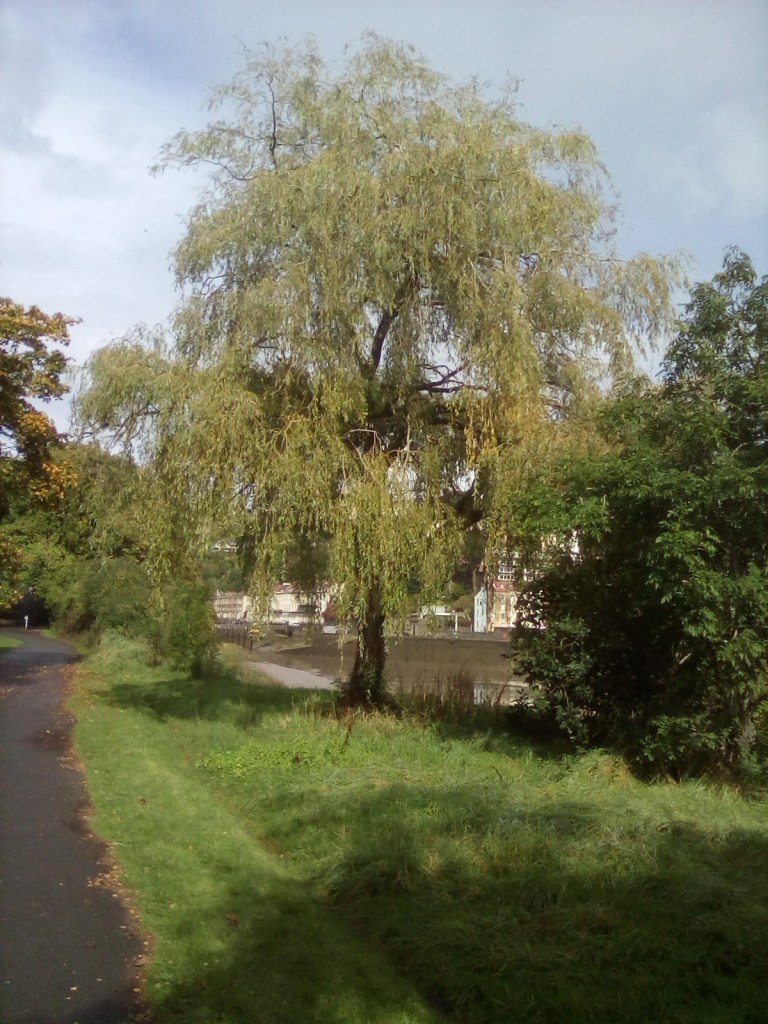



 Contemplative Inquiry