Months, and moments within them, have their own atmosphere and meaning for me. I try to indicate these through pictures. Where I live, early September takes us fully into autumn, and the fruiting of the horse chestnut tree (above) is a marker for the transition.
Early in the month, the sun sets a little after 7.30 p.m. and reminds us that the nights are drawing in more quickly. It still seems early for sunset, but I notice that my sense of ‘evening’ is adjusting to a more autumnal perspective. The picture below was taken on September 3rd.
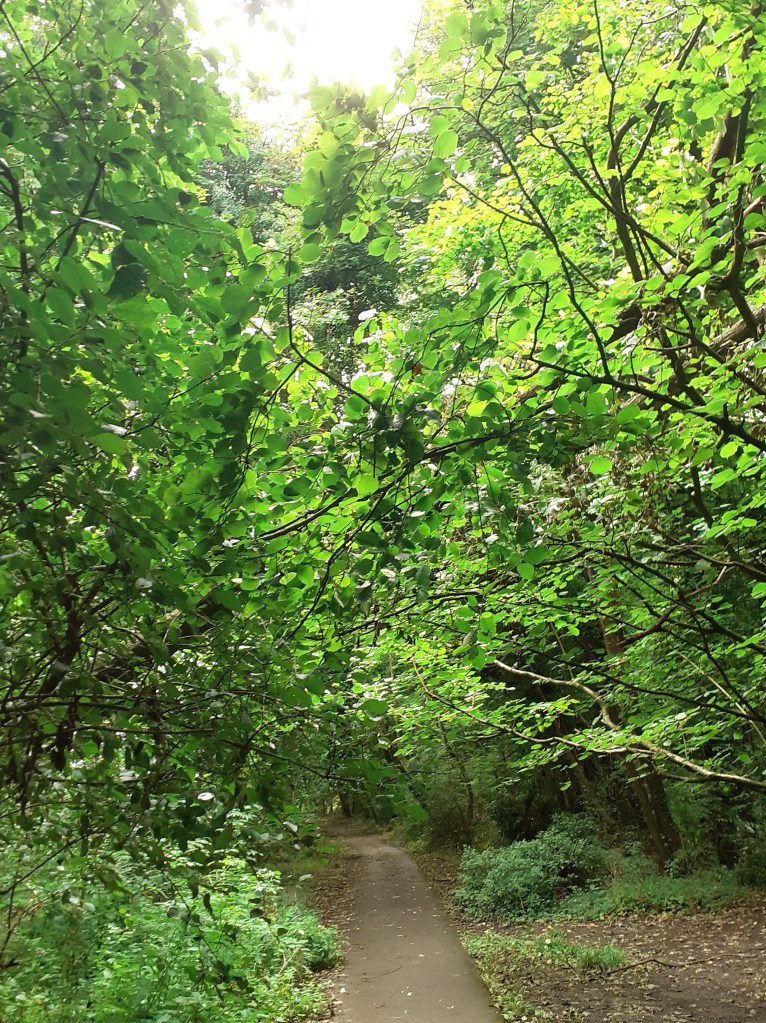
The feeling-tone of this period is not yet equinoctial. Wooded spaces are still vigorously green, still majestic, still imaging what my heart wants more of the world to look like. The light of day remains strong, even though temperatures are characteristically lower. There is a lingering aftertaste of summer at the beginning of the new season.
Nonetheless, it is easy to find muted colours leaning in to decay. These have their own fragile and poignantly fleeting beauty, as the alchemy of the waning year does its work. Early September has a character of its own, to be enjoyed while it lasts, as the wheel continues to turn.
In my mandala of the year (1), I have sixteen trees. In the quarter from Lughnasadh (or Lammas) to Samhain, these are apples, blackberry, hazel and rowan. Blackberry presides over the days from 24 August to 15 September.
My choices have as much to do with personal memories as with natural processes, traditional lore, or the ogham alphabet in which Blackberry is Muin. In England we have an August Bank Holiday in which the weekend is extended to include the last Monday of the month. This year it will be August 31st. I have early memories of blackberry picking walks during this holiday, with family groups doted around a wooded hillside, and an air of informal ritual. Although balmy days might follow, this was the final act of summer.
The plant, of course, is with us throughout the year. The Druid Plant Oracle (2) names it as Bramble. “If you have ever tried digging up Bramble roots, you will know how tenacious they are – they travel long and deep, and some root systems can cover a wide area and be of great age”. Blackberry was said to be the bush into which Lucifer fell when he was thrown out of Heaven. Bramble provided a challenge for the prince in Sleeping Beauty.
Bramble also provided much needed sustenance for the famished wayfarers in The Voyage of Maeldun. In Joanne Harris’ Blackberry Wine (3) a small rural community in the south of France is saved from unwanted gentrifying ‘development’ through the prickly stubbornness of key individuals. These, quietly supported by most of their community, defend their own vision of how to live in the face of personal, commercial and threatened legal pressures. Neglected flora, overlooked forms of intoxication and a little magic all contribute to the holding of a much loved space. Mr Bramble is a good friend to have.
(2) Philip and Stephanie Carr-Gomm The Druid Plant Oracle: Working with the Flora of the Druid Tradition London: Connections, 2007 (Illustrated by Will Worthington)
(3) Joanne Harris Blackberry Wine London: Black Swan, 2000
(4) The image at the top is from John Matthews & Will Worthington The Green Man Oracle: Ancient Wisdom from the Greenwood London: Connections, 2003
On recent walks I have been noticing trees in nearby woodland, and becoming aware of how I experience them at this moment in the year. The three tree pictured in this post illustrate my story for later August.
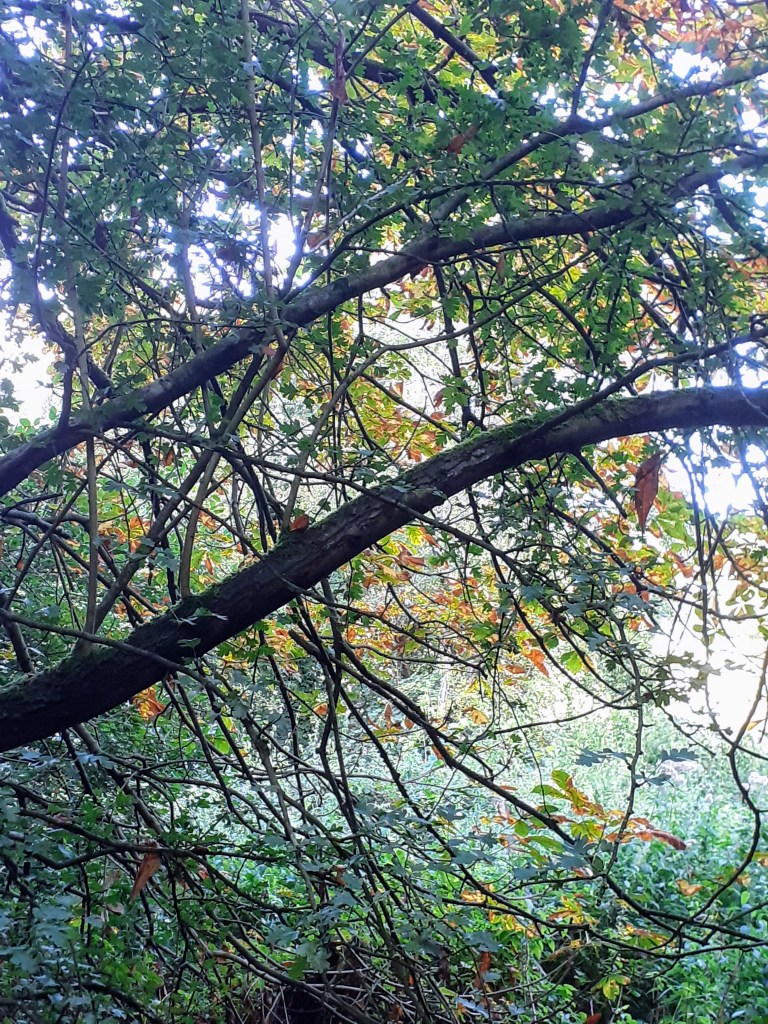
In the first, I saw my first real hint of autumn, as green starts to turn yellow and brown. At this stage, it is a subtle shift affecting only a few trees. But it is a harbinger, like street lights at 8.30 pm.
My liking for this time goes back to my later childhood. It was still summer and I had a lot of freedom. My hay fever was gone. Temperatures were a little down. It was easier for me to spend longer periods out in the sun. I felt at home in my environment. In these precious days, I felt expansive. The world was on my side, and a hopeful place to be in.
In an earlier post (1) I talked about this as being a time of apples in my Innerworld. This is true of my outer world too. I grew up in Somerset, in England, where apples are abundant. It is cider country, and the summer country of Arthurian romance. My home town, Yeovil, is 19 miles from Glastonbury, aka Avalon. When I was small, I was puzzled by injunctions not to take apples from the tree or eat the ones which fell on the ground, though these might possibly be cooked. Only the ones in shops were truly safe. Commerce made them righteous. For me, this got a little mixed up with forbidden fruit story in Genesis 3, since “the tree in the garden” was identified as an apple in our part of the world.
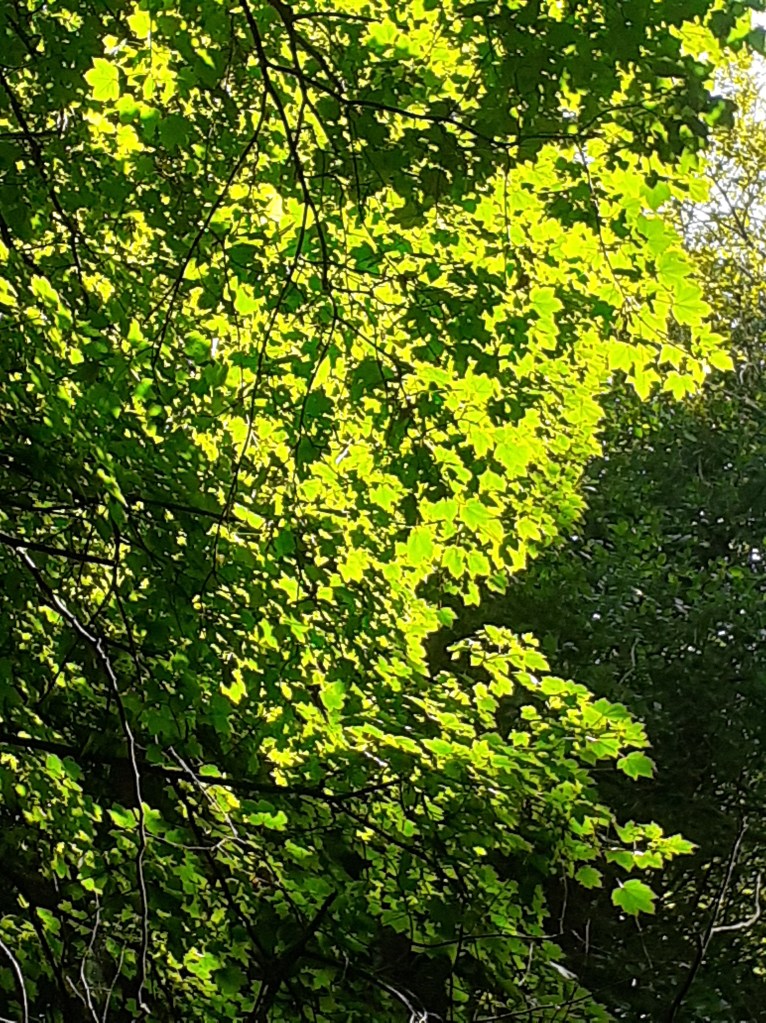
For all the autumnal qualities of this time, it still offers a naturalistic ‘tree of light’ experience if I am open to it. I experience this most when sunlight catches green leaves, especially if they shine from recent rain. I am glad that the metaphor of the tree of light – like those of the tree of life, or world tree – does not remove us far from our experience of the living world. One of my attractions to Druidry is that even its more esoteric, Otherworldly dimension stays loyal to nature.
This picture was taken early one morning, at a moment slightly defended from the heat of early August. I was walking through woods to shelter from the sun.
Those days, intense in their moment, have already receded into the past. After a period of somewhat lower temperatures, and of flashes and rumblings in the sky followed by modest rainfall, we found ourselves in a flash flood on Sunday evening. For a relatively brief period, the A46 (a main road, locally) turned into a fast-flowing river not far from our house. Guttering held, but needs attention.
It was as if, following a period of contest, water had succeeded fire as the prevailing element. Now, the situation is less clear cut. But we are in a cooler and wetter place than we were at the beginning of the month. Daylight hours are reducing. We are leaning in to autumn.
During this time I have been busy with my own harvesting. The meditations presented in my last three posts (1) complete a basic repertoire of formal solo practice in my renewed Druidry. I have been fruitfully indoors during both heat wave (beyond my comfort zone) and the return of rain. I have been inwardly focused.
In my own Innerworld wheel of the year, apple presides over the first three weeks or so of the post Lughnasadh/Lammas quarter. Apple, in many traditions, is a Goddess tree, associated with both wisdom and healing (2). It is linked to a visionary ability to see beyond the surface: perceptions grow wiser and the heart sees further than it might otherwise do.
In Irish myth, Lugh was sent to collect apples from a Tree of Light found in the Otherworld. In Britain, after the Battle of Camlann, Arthur was taken by three Celtic goddesses to be healed on the Isle of Avalon (=Island of Apples).
In a more everyday way, my meditations serve the same goals. The timing of my work on them wasn’t exactly planned. But it doesn’t surprise me that my commitment to living the wheel of the year has led to this result.
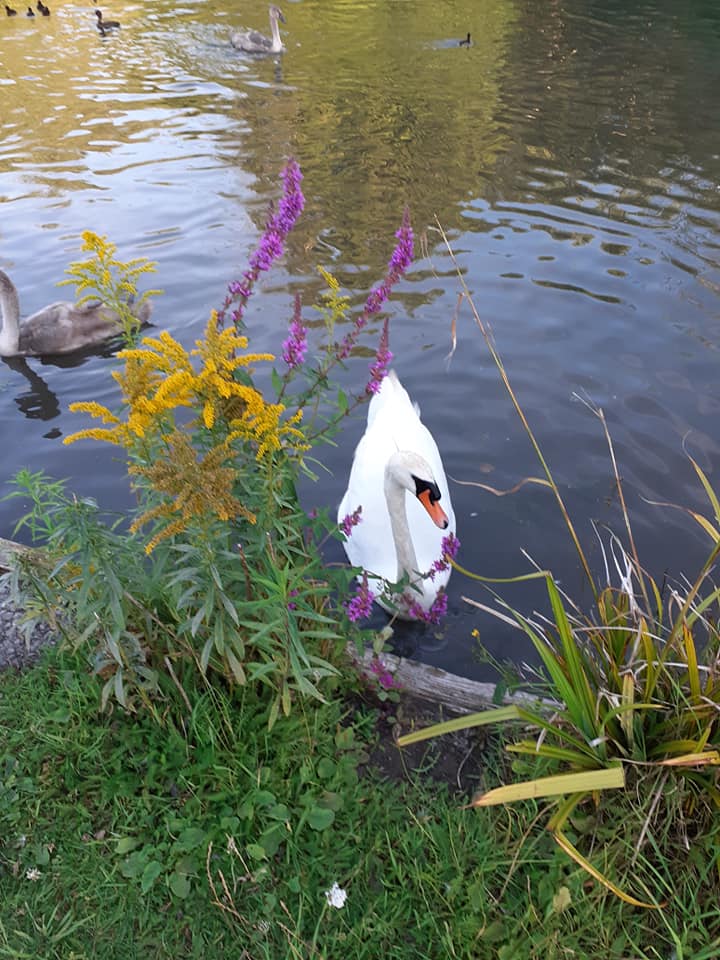
I notice swans at this time of year. They are mute swans, the largest birds in Britain, and they live here throughout the year. In my locality, there is an abundance of fresh water and they tend to do well. Now they are in their family groups, with the cygnets becoming adolescent.
Watching swans, even this soon after Lammas, cues me in to an elegaic mood, a slight bitter sweetness in the heart. Their family life is in its later stages. The generations will go their own ways before long. The parents will stay together since the swans mate for life, but they will be moving into a new cycle of life and parenting. There’s an anticipatory poignancy about this, where the current moment knowingly invites images of a probable future. I sense impending separation, not precisely fixed in time.
I am influenced by literature and legend, as I slip in to the autumnal quarter. Yeats sets The Wild Swans at Coole (1) at a moment when “the trees are in their autumn beauty”. He counts 59 swans “upon the brimming water among the stones” and the poem gives voice to the soreness of heart that goes with a feeling of unwanted change, and the foreknowledge of their departure from the lake. There are resonances here of the legendary Dream of Oengus, where King Oengus and his secret Cymric lover Caer Ibormeith (Yewberry) can meet only for a brief time at Samhain, and then only every other year, in the form of swans (2).
But the main reference for me is Tennyson’s Tithonus, a Tojan hero who asks for eternal life, and is granted it, by his divine lover Eos the Goddess of Dawn. He neglects to ask for eternal youth, with very sad results.
“The woods decay, the woods decay and fall,
The vapours weep their burthen to the ground,
Man comes and tills the field and lies beneath,
And after many a summer dies the swan.
Me only cruel immortality
Consumes: I wither slowly in thy arms,
…
To dwell in presence of immortal youth,
Immortal age beside immortal youth,
And all I was, in ashes.” (3)
Aldous Huxley published his novel After Many a Summer in 1939 (4). This was a year or two after he moved to California to become a Hollywood screen writer, and also to engage in earnest with Eastern spirituality. In a youth worshipping culture, a self-referential multi-millionaire hires an ambitious doctor/research scientist to extend his life span. What could possibly go wrong?
Meanwhile, in the wider world, Barcelona falls and the Spanish Republic is extinguished. At one level, the novel is a simple satire. At another it is a vehicle for Huxley’s view, on the eve of World War II, that political and military solutions to the world’s problems will, by themselves, always fall short. A spiritual dimension is needed to make a difference. Without such a dimension, ‘peace’ will be sought by unskillful means and ‘eternity’ will be confused with extended time. Both are found authentically in another – counter-cultural yet nonetheless accessible – approach to life. Huxley explores these ideas in more depth, with more of a sense of how to develop and maintain a healthy society, in his last novel Island (5) published in 1962.
Politically and culturally, I feel perplexed and disoriented. Individually, I have many ways of responding to my experiences of love and loss, growth and decay, life and death. Anxious anticipations of unwanted experiences and events are certainly a feature. My contemplative inquiry is in part about learning to be lovingly open and engaged with experience, whilst at the same time wisely anchored in the peace and stillness of living presence. An acceptance of falling short is baked into this stance.
(1) W. B. Yeats The Wild Swans at Coole In:A. Nroman Jeffares Poems of W. B. Yeats London: MacMillan, 1964 (Selected, with an introduction and notes)
(2) Philip and Stephanie Carr-Gomm The Druid Animal Oracle: Working with the Sacred Animals of the Druid Tradition New York, NY: Fireside, 1994
(3) Alfred, Lord Tennyson Tithonus (extract) In: Tennyson Poems and Plays London: Oxford University Press, 1968
(4) Aldous Huxley After Many a Summer Vintage Claasics e-book edition. (Original publication 1939)
Lughnasadh (or Lammas) marks an important moment in my year. I move from a season of ripening to a season of bearing fruit. At the point of transition, both of these processes are happening. My distinction between ‘ripening’ and ‘bearing fruit’ is a soft one, allowing for continuities. But I know a harvest when I see one, and I celebrate it when it comes.
The Celtic fire festivals have a stronger hold on me than the solstices and equinoxes, with the exception of midwinter. I don’t know why this is. The quarter beginning in Samhain is one of dying and regeneration. I am happy to start and end my year in the middle of it: I have moved from the dying of the year to its point of regeneration. But it is the quarters that tell the most compelling story: from the time of dying and regeneration, to one of early growth – and then on to those of ripening and of bearing fruit.
August, though very much a summer month, comes with a withdrawal of light and intensity, very noticeable to me, where I live, in the last ten days of the month. September and October continue this whilst including fine and balmy days. Throughout much of my life, this is the quarter that has especially moved me. All periods have their magic. Compared to its predecessor, the quarter beginning with Lughnasadh has, at least for me, a quality of reduced intensity and greater subtlety.
2020 specifically continues to be odd and unsettling. I have not had my usual summer. I was essentially housebound for four months. I have not left my town since February. My upside, as a contemplative, has been an unseasonable permission to turn inwards. I have refreshed my solo Druid practice and I feel re-grounded in Druid culture.
I have recently crafted three forms of sitting meditation for use within my daily practice: I describe them as Light Body, Living Presence and Wisdom’s House. I will write more fully at a later date. This development marks a return to an older contemplative approach – I have moved away from formal sitting meditations in recent years. Each meditation is based on, or descended from, a practice previously used over a long period. This work has tenacious roots yet happily feels new and fresh. I look forward to its fruits.
The dog days of summer are by reputation hot, sultry and ill-aspected. As high summer becomes late summer, we can fall out of love with the season. We may find ourselves less comfortable than we would like to be, on the edge of storms that may or may not break. Nature can seem rank and overblown. Insect life is busy, in ways not always to our taste.
Yesterday I walked on the banks of our local canal between Stroud and Brimscombe. I had not done this walk since early March. At the height of the Covid crisis, I decided to leave the narrow towpath alone. For a long stretch of time through spring and summer this section of canal and I have gone our separate ways. It was early in the morning and not especially hot. The canal itself gave me my dog days feeling. What I noticed was a wild, rank fecundity, not conventionally photogenic. It is as if the space were resisting the (interrupted) attempts to make it navigable once again, sustainably beneficial to us. A different ecology had established itself. In my feelings, and imagination, the ‘dog days’ energy became a counterpoint to convenience conservation.
I like convenience, and I like walking on the towpath. I respect the restoration project, and the volunteers who are making it happen. I also respect the ever-renewing power of nature. I look at the picture below, where evidence of canal can barely be seen – just a suggestion on the far bank. I reflect that this stretch of water was once deep and wide enough for trows, traditional canal boats used on the Severn and Wye rivers. Brimscombe Port was as far east as they could go. The canal going on to Lechlade had a narrower gauge, and cargo had to be transferred to Thames barges. That early industrial world has long gone. The new development, whilst making inroads, has not yet ocupied this space. In the meantime, nature is free to be inconvenient, and to some people doubtless unsightly, whether we like it or not.
Walking in the woods yesterday, I was struck by the vitality of rowan leaves and berries. I haven’t done this walk for a while, so I’m not quite sure when the berries became so vivid. All I can say is that they powerfully drew my attention. They were just what I needed, in this time of tentative emergence from Covid-19 lockdown. I look forward to their companionship as the high summer leans into autumn and beyond.
Sometimes I feel ambivalent about tree lore. Too much lore can get in the way of living connection with a tree, or even displace it. But in this case it seems to fit. To me, rowan does look magical, and feels potentially protective. I am not surprised that our ancestors planted it for this use down the ages – to guard stone circles, sacred groves, churchyards and houses. The very name rowan is linked to the Norse runa, meaning ‘charm’. In Ireland, rowan was considered a Druid tree and linked to the blackbird as a Druid bird. The berries themselves present a pentagram image, linking us to notions of magical protection.
Rowan is said to be concerned with wisdom and foresight. Breathing in smoke from the burning wood was an aid to foreseeing danger. Rowan is associated with solar goddesses of wisdom, skill and fire energy: in Ireland, Brigid; and in Britain, Brigantia. Both are said to have possessed arrows of rowan, which could catch fire if necessary.
I find the presence of rowan subtly morale boosting as I negotiate a new normal with my wife Elaine and, together, with the wider world. We work with the knowledge that Covid-19 is not going away and that we do need to re-engage more directly with that world. The very physicality of the rowan tree is an invitation to step out, whilst also encouraging a sense of what to look out for, and how the next phase is likely to be.
My wife Elaine created this midsummer cauldron fire, now ten days ago. It was fuelled in part by dry dead leaves. She chose the evening of the day itself rather than the traditional eve. The point about midsummer (24 June) is that the sun is on the move again after its moment of stasis, clearly beginning its decline. It acts as the polar opposite of the Sol Invictus or Christmas festival in late December. The Church gives 24 June to John the Baptist, decapitated at the wish of his nemesis Salome.
In our neighbourhood, there is a paradox about July. It is the quintessential summer month, in which the light begins to diminish. At the moment, sunrise is at about 4.50 am., with sunset at 9.20 pm. By Lughnasadh, it will be rising at 5.25 am and setting before 8.50 pm. In August, the process will accelerate while the earth and sea remain warm by North Atlantic standards. Getting up an hour or so after sunrise I am tending to find a dull and cloudy sky. There can be a stillness in the air, disturbed perhaps by blackbird pair flying low amongst the trees. I have a sense of latency.
The inquiry phase beginning at the 2019 winter solstice has settled a number of issues. I am re-confirmed in a modern Druid practice that is held within a circle and seven directions (E, S, W, N, below, above, centre), and is mindful of the wheel of the year. I also settled my approach to ethics at the beginning of this inquiry year (1) drawing on the work of modern Pagan philosopher Brendan Myers with his re-visioning of ancient Greek ‘virtue’ ethics (2). I have deepened in my experience of an at-homeness in the flowing moment, and its therapeutic benefits, which I wrote about last year (3). Fully established in my life, these are no longer fundamental inquiry issues. The uncertainties I formerly had with them are like dead leaves, now safe to burn.
For all that I have gained from other paths – Tantra, Tao, Zen, other forms of Buddhism, and Christian Gnosticism – I know that I will not be practising or following them. I will continue to appreciate their literatures and cite them in this blog, but this will be from the perspective of the appreciative outsider. Here too the active inquiry is over. Uncertainties have shrunken into dead leaves, and are safe to burn.
I know that, in the turbulent, airy mental realm, I have contending gnostic and agnostic energies. They are co-arising twins, and neither is going away. I still have work to do to find a settled home for them both. I am also concerned about how, more elegantly, to fit an ‘emptiness’ understanding into an earth pathway. A feeling about myth, and the truth and beauty of myth, is tied up with this. In the coming phase, I will look again at R. J. Stewart’s Merlin work for help with these questions. This reprise is also part of my older person’s looking back, recalling what I have valued, and asking what role it can still play. It sets my direction for the second half of the year.
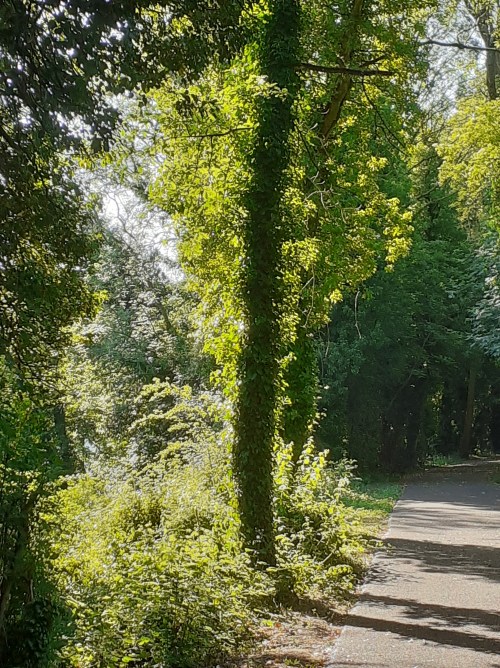
The picture shows the power of sunlight on trees to an observer – me, using my sight and my phone camera. I am not sure what it is like for the trees themselves, but I imagine it to be a positive experience.
This post is about the effects of the same power in my own psychic life. In a personal meditation, “I find myself in a walled garden. It has a fountain at the centre, surrounded by four flower beds of alternating red and white roses. There are fruit trees, apple, pear and plum, trained around the walls. It is a warm and radiant midsummer morning. The full bright sunlight strikes the dazzling water of the fountain, warming and illuminating each drop as it falls. I can hear the plashing of the fountain, and birdsong a little further off. My bare feet are on the lush grass. The air is sweet. The sun is at my back, recharging my energy, in particular activating the sun in my heart”. From that point, the meditation can continue and deepen in a number of ways.
This garden is the Garden of Wisdom, the Wisdom of William Anderson’s Green Man poem (1), a poem of 13 four-line verses, where each line covers a week. Though the Green Man has a lover in the spring, Wisdom is named, as Wisdom, in only one verse.
26 Oct-1 Nov: The reedbeds are flanking in silence the islands
2 Nov–8 Nov: Where meditates Wisdom as she waits and waits.
9 Nov-15 Nov: ‘I have kept her secret’, say the Green Man.
16 Nov -22 Nov: ‘I have kept her secret’, says he.
But at the present time of year, the focus is on the transformation of the Green Man himself, his head having been offed between 25 May and 7 June.
8 June – 14 June: Green Man becomes grown man in flames of the oak
15 June-21 June: As its crown forms his mask and its leafage his features
22 June -28 June: ‘I speak through the oak’, says the Green Man,
29 June – 5 July: ‘I speak through the oak’, says he.
Late in 2019, I stopped calling my inquiry path a ‘Sophian Way’ and re-centred it in Druidry. It was the right decision, and I have found it very fruitful. But at the psychic, Innerworld level, I have experienced a sense of loss concerning aspects of the Sophian Way, especially the space I called Sophia’s Garden. Now, thankfully, I have found that a simple re-naming as Wisdom’s Garden has been enough to re-integrate it within my current Druid practice. A more specific link with William Anderson’s Pagan, earth-centred poem also helps. Wisdom speaks through the wheel of the year, and acts as a companion and guide within my Druid path, on both the physical and psychic levels. She is also Zoe, the life beyond time, and the Green Man Bios, the life which is born, dies and is born again. It seems to me that we are both of them. Perhaps that is Wisdom’s secret.
(1) William Anderson Green Man: Archetype of Our Oneness with the Earth: London and San Francisco: HarperCollins, 1990 (Photography by Clive Hicks)








 Contemplative Inquiry