It was 26 November 2022, 11 a.m. I was at the Gloucester end of the Gloucester-Sharpness canal. I found myself accepting the arrival of winter. I was observing three cygnets, now without their parents but still keeping company with each other. The underlying temperature was around 7 C (44.6 F) and good for walking, But I was feeling the pinch of a cold wind. In memory I am feeling it now. The water and sky looked grey. The trees were starting to feel skeletal, whilst still retaining some leaves. My lingering sense of autumn had finally drained away.
To accept winter’s arrival in the presence of swans felt numinous. Swans are otherworldly birds in Celtic tradition. The three together, not yet in their full adult plumage, seemed auspicious. They suggested coming opportunities for creativity, love and celebration. Winter can be a preparation for renewal, both as season and as state of mind. My acceptance goes with a faith in winter’s regenerative darkness, and the riches this can bring.
Winter shows itself though early twilight. The pictures above and below were taken at about 5 pm (GMT, now, with summer time a fading memory). The sky retains a certain diversity of colour – clouds are still visible. But there is a leaning towards indigo. St. Mary le Crypt sits in stillness and tranquillity.
For me, the artificial lighting behind the stained glass is just right for supporting these qualities. It illuminates but does not glare. It feels homely and welcoming. The heavy stone of this medieval church is softened by dusk. Christmas is coming – a friendly period in the church calendar.
Twilight makes space as well for another, more carnival mood. Gloucester holds a lantern procession and Christmas light switch-on every year at approximately this time and date (19 November). It winds through the old town, lights switched on overhead as it passes, to the Cathedral where a carol service is held. This year’s event was very well supported, with large numbers of people either following the procession or lining the route. It was as if everyone was ready for a festive moment, a chance for celebration and fun in a generally tough time.
Local artists had teemed up with local schools to work on an Alice in Wonderland theme for 2022. Hence the Mad Hatter in the shifting and slightly out of focus picture below. I think the makers have successfully created a Tricksterish image for him. Not entirely safe or bland.
In Lewis Carroll’s 1865 book, Alice is annoyed by the twilight zone of the Mad Hatter’s language. It seems to have “no sort of meaning” and yet be “certainly English”. He boasts about the great concert given by the Queen of Hearts, where he sang: “twinkle, twinkle little bat/How I wonder what you’re at/ Up above the world you fly/ Like a tea tray in the sky”.
What is the Mad Hatter bringing to the streets of Gloucester on this early winter’s evening? He is certainly a presence here, if hard to read, for the brief time it takes him to pass through. Winter twilight offers spaces for healing and festivity. As a liminal time, it is an arena for Tricksters too. Many possibilities are latent under this enigmatic sky.
You can just see it, above the buildings, at the last breath of sunset. A sliver of light over murky cloud, the slender crescent of a new moon has appeared. I took the picture just after 6.45 pm on 28 October, still inside British Summer Time. I chose this time on this day because it was not yet dark. The sky is making room for a variety of effects, not just the stark duality of darkness and light. I stand at the cusp of the year’s endarkenment, before the festival of Samhain.
At this time of this year, I find myself tuning in to the lunar cycle as much as the solar one. To me, now, it feels subtler and more nuanced. Anne Baring and Jules Cashford describe its significance in a way I find illuminating:
“The moon was an image in the sky that was always changing yet was always the same. What endured was the cycle, whose totality could never be seen at any one moment. All that was visible was the constant interplay between light and dark, in an ever-recurring sequence. Implicitly, however, the early people must have seen every part of the cycle from the perspective of the whole.
“The individual phases could not be named, nor the relations between them expressed, without assuming the presence of the whole cycle. The whole was invisible, an enduring and unchanging circle, yet it contained the visible phases. Symbolically, it was as if the visible ‘came from’ and ‘returned to’ the invisible – like being born and dying, and being born again.” (1)
When out walking, I noticed that Christmas lights had started to appear. The ones below, at Gloucester Quays, seemed suitable for a new moon. They shifted on and off in a flowing, liquid kind of way, at slightly different times. They did not dazzle or glare or demand my whole attention. They illuminated the space without dominating it. They did not claim that their light was all that mattered.
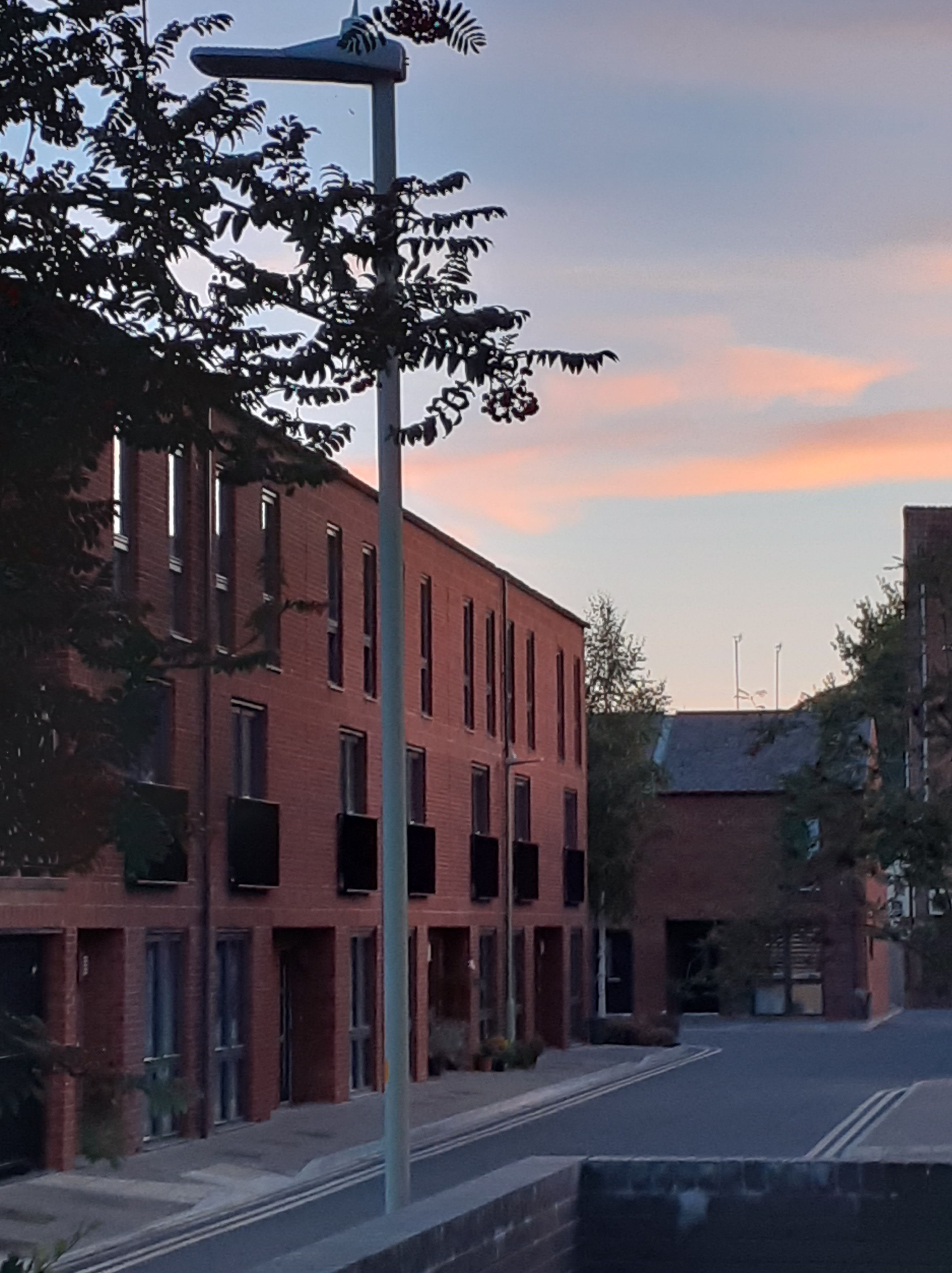
If I tune in the another cycle, the wheel of the day, I remember how much to thank the sun for. Barely half an hour before I took the pictures above, I experienced the very different colours of the two immediately below. In the first, there is the pink of sunset cloud and some draining of blue from the sky – but, still, a sense of vivid green in the grass. An autumn evening in what is still the light of day.
The second shows a tree-lined street, with full autumn colours, fittingly sundown colours, against a misty looking autumn sky.
It seems that I am saying farewell to one season whilst welcoming another, and that my evening walk on 28 October, partially shared with my wife Elaine, somehow enabled this. There is a starkness and wildness in my last image from that walk, below, which draws me in, despite the remarkable contrast with what has gone before. Just to notice, to fully experience, and make meaning of, the cycles of moon, sun, day, year and life itself gains importance for me year by year, as the wheel turns.
(1) Anne Baring Anne and Jules Cashford The Myth of the Goddess: Evolution of an Image London: Penguin, Arkana Books, 1993
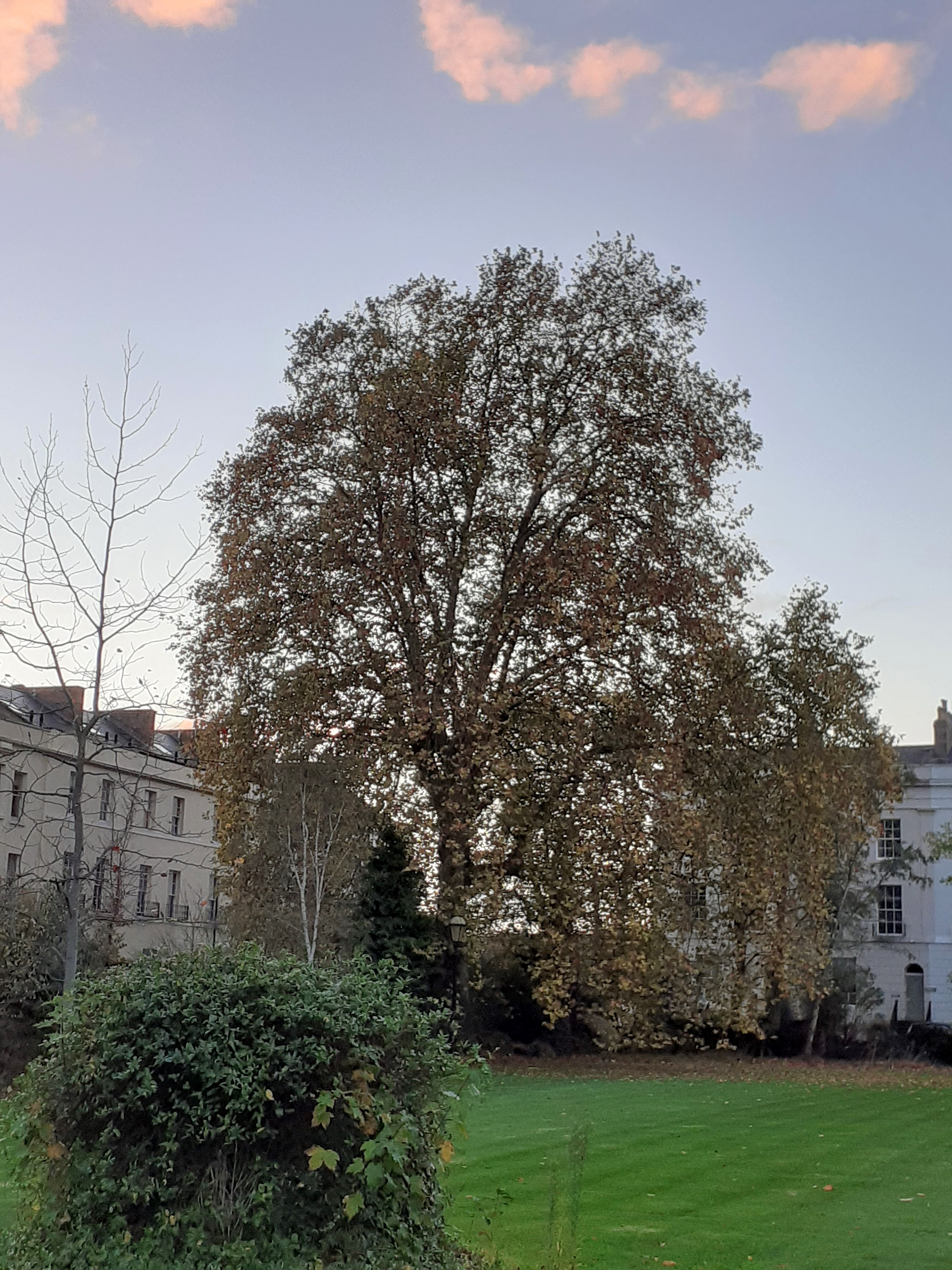
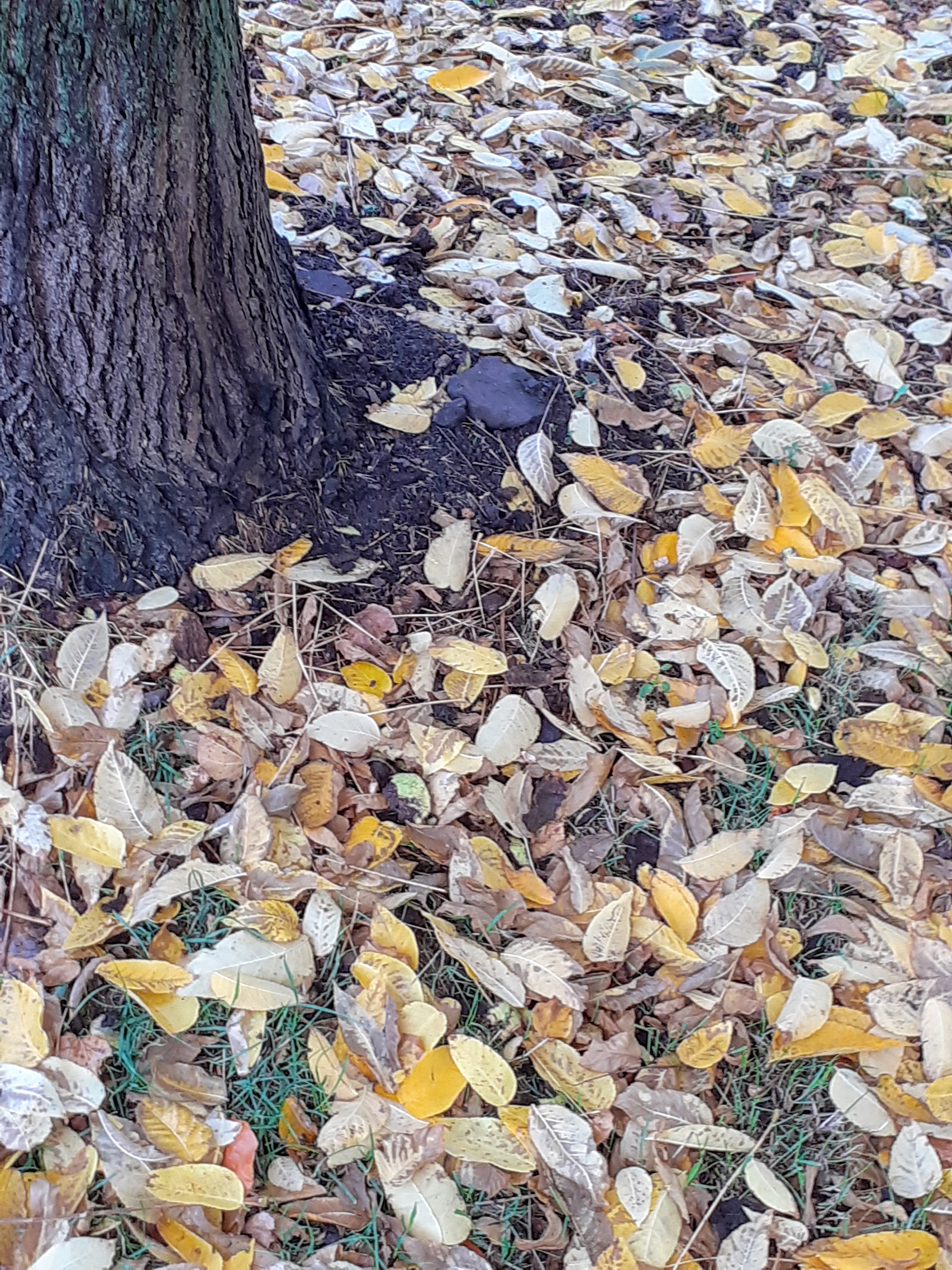
Vivid autumn colour signals a fall. Where I live, we are early in the process as yet. These leaves seem poignantly glorious to me. I respond to a beauty that I know will be short-lived. The tree is immersed in a cycle of dying and regeneration that furthers its larger life. Any sense of poignancy, glory and beauty is about me, being human.
I think of the last thirty years, and my own small deaths and regenerations over this period as I journeyed from my early forties to my early seventies. At the beginning I sensed a pull towards new priorities, which roughly fitted the Jungian notion of the second half of life as having different goals from the first. I experienced a nudge towards an inward, psycho-spiritual turn. I developed interests in experiential inquiry, Druidry/Western Mysteries, and contemplative spirituality, as part of this mid-life nudge.
This reduced my interest in career, acquisition and influence – though such interest had always been limited. In the nineties and noughties, I didn’t need a lot of money both to live well, if modestly, and accrue a reasonable retirement income. It would be much harder now. I am grateful to have experienced (relatively) favourable times, though of course the seeds of our current crises were already being sown.
Now I am ready for a new chapter, as my wife Elaine and I get ready to move to a new place of our own in Gloucester. The next move is into a smaller, more manageable space, and will involve elements of de-cluttering. I am the same tree but I will be shedding leaves and waiting for new ones to grow next year. In the moment I feel fragile, though my unknowing about the future also has an edge of wonder about the magic that may unfold. Falling is an oddly potent process at a special time of year.
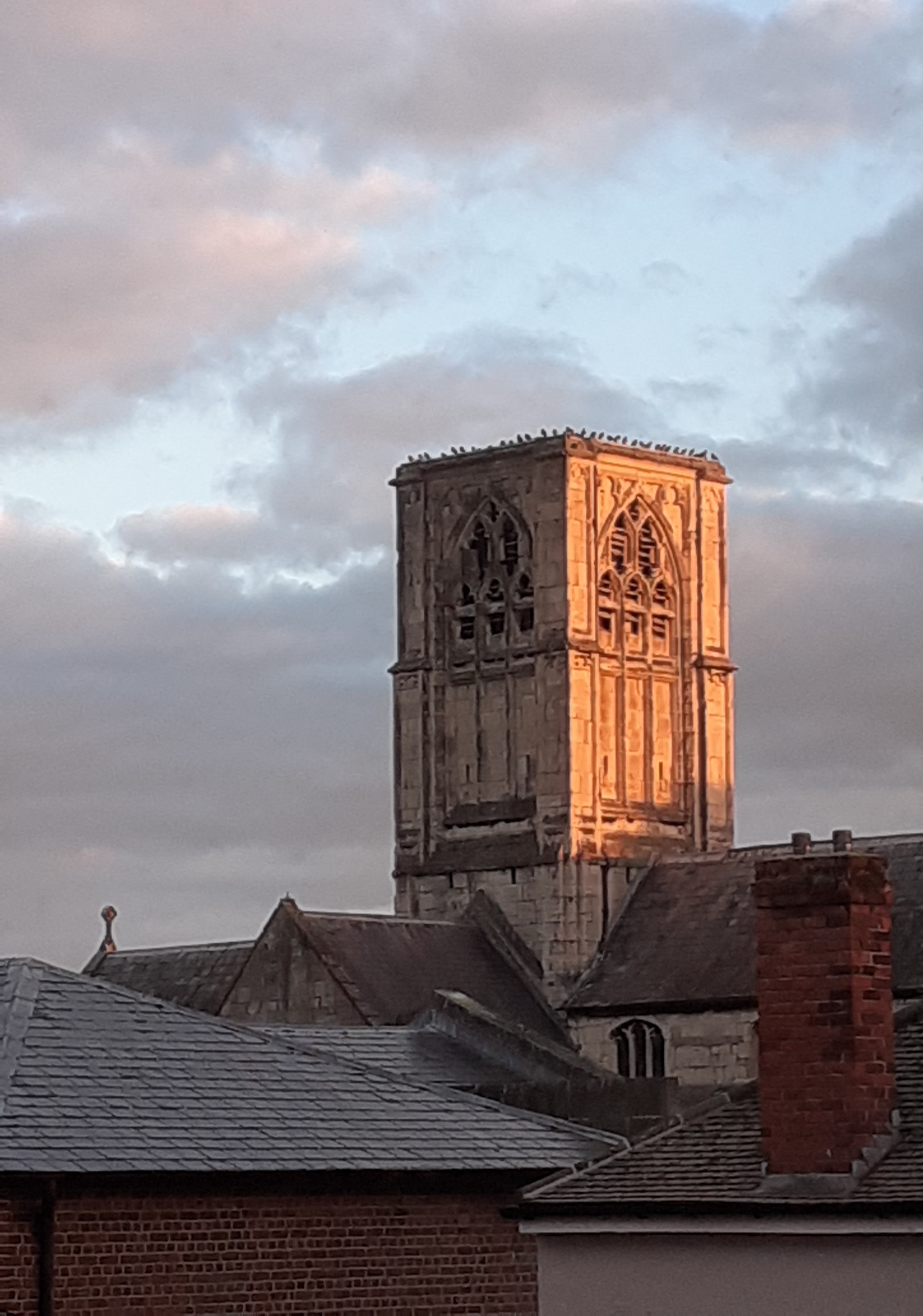
Dawn is late now, and all the more welcome when it comes. Looking out on the world after morning meditation, I see light shining on the tower of St. Mary Le Crypt. I am seeing with fresh eyes, and the knowledge that Elaine and I will be staying in Gloucester. A local house move is planned, conceivably before the turn of the year, a few minutes walk from here.
We will not be migrating north (1). Our plans fell through. We have some disappointment about this. But there’s also an element of relief that at the prospect of a less disruptive move. In many ways we are already settled. Moving house is now a major detail rather than a life-changing event. We can focus on being in place.
For me, this includes deepening my connection with the landscapes I walk in as the wheel of the year turns. Autumn is my favourite season and October can be a special month. This is my first year in Gloucester. Taking these October pictures, I can celebrate the here and now. Having them, I can enjoy the record of a new chapter in my life, with other years, with their own Octobers, to come. I don’t know what the future will bring. I do know that I find this framing nurturing and hopeful. It is part of bringing meaning to my world.
Recently I watched Ronald Hutton’s first Gresham College lecture about Gods of Pagan Britain on youtube (1). It sets the scene for a series, raising questions about what we can know about the spiritual lives of our ancestors, what we can fruitfully imagine, and how to tell the difference.
Professor Hutton explores two specific topics. The first is our current archaeological understanding of the Stonehenge monument on Salisbury Plain, England, together with its legendary history and place in the public imagination. The second is the case of the Lindow Man, who was violently killed and thrown into a peat bog in Derbyshire, thus partly preserving his body for conceivably (but probably not) 2,000 years. He has been widely considered, including at times by archaeologists, to be the victim of a Druid sacrifice, though Hutton points out that there are good reasons to question this.
I was drawn to this lecture, both informative and entertaining, by my interest in learning from an ancestral culture without its own texts, as well as about it. This is part of my reason for following a modern Druidry that embraces indigenous themes long pre-dating the Druidry of the Celtic iron age. The people who built Stonehenge in the third millennium BCE bequeathed us the wheel of the year, with its circle and cycles, and its focus on the solstices and equinoxes. We can be inspired by this and honour the ancestors by embedding it in our own lives in ways that suit our time and culture.
For readers who have not yet seen and heard the lecture, I recommend that you take a look at the video.
Ronald Hutton is Professor of History at the University of Bristol, a specialist in Pagan and Druid studies, and enjoys a very high reputation within both the academic and Pagan communities.
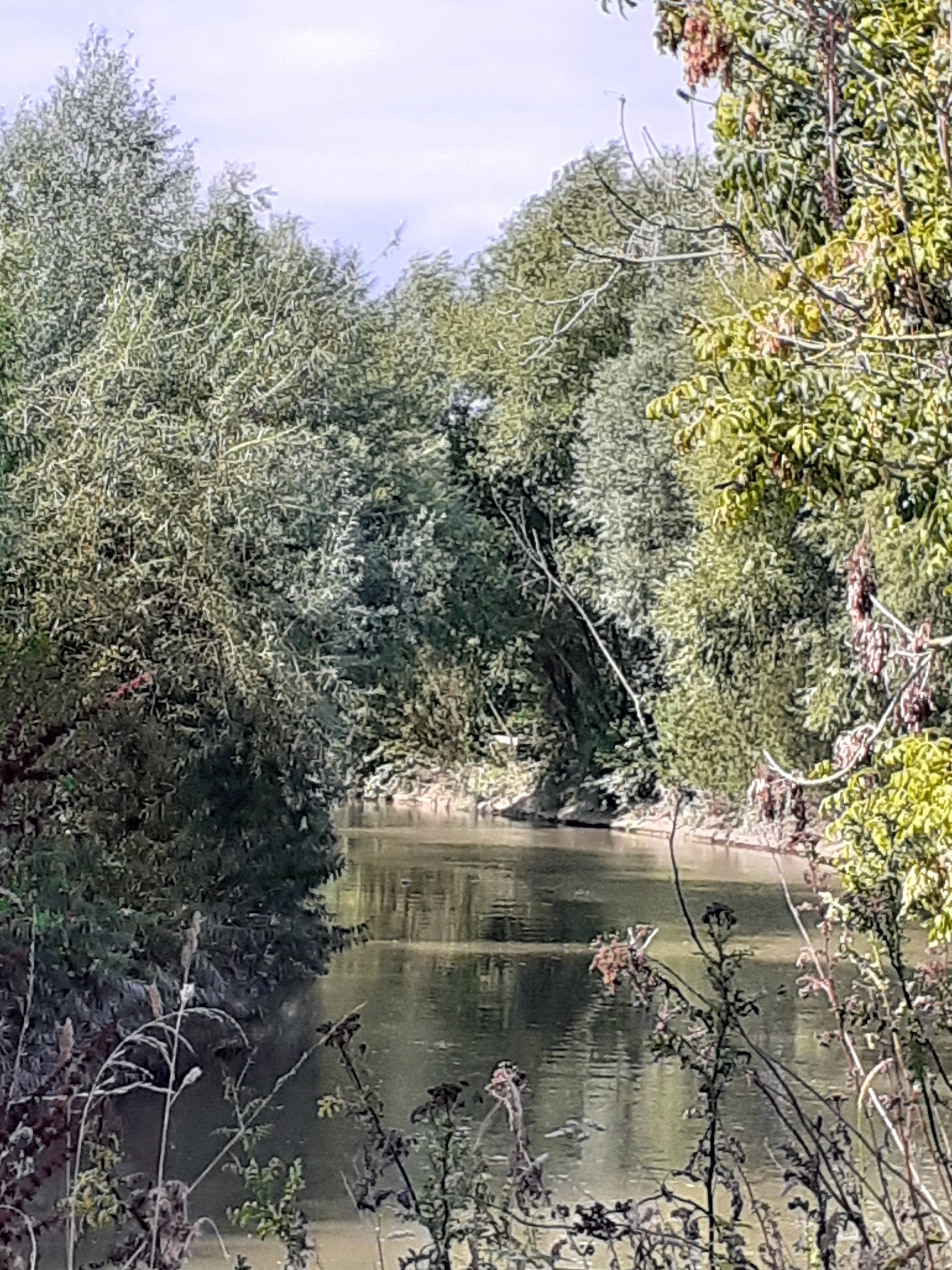
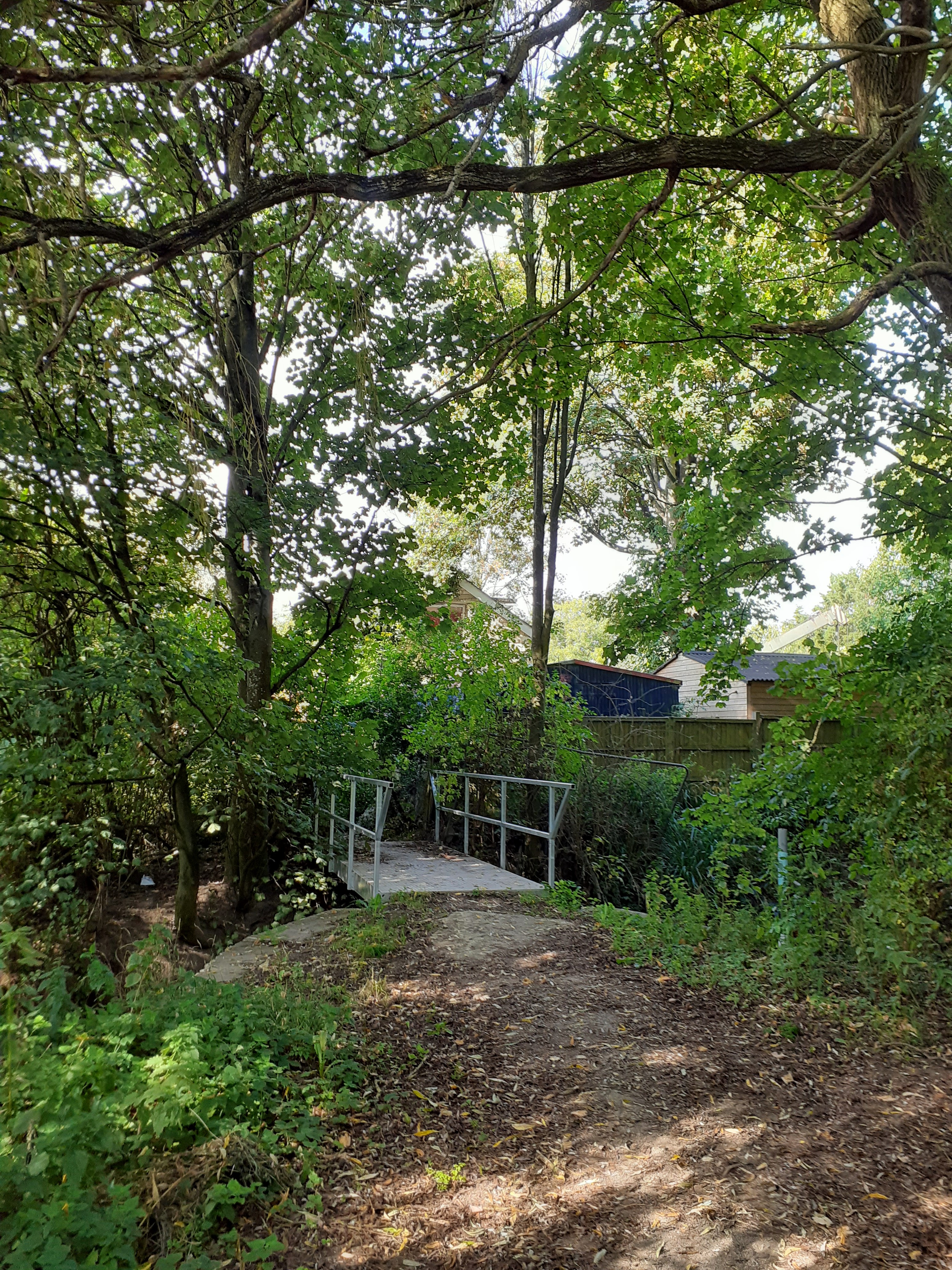
Some days seem truly blessed and easy. For me this autumn moment is one of them. I have stumbled across a previously unknown place that radiates the beauty of the season. Woods and river call to me and I respond. I like being where I am, open to the day, free of complications.
I like not knowing what’s round the next corner, whilst enjoying the new spaces I am already in. I notice how small changes of position alter the feeling-tone of place.
There’s little to say, at a time like this. There is the experience and there is the visual record. I hope the images suggest something of my simple delight in being here.
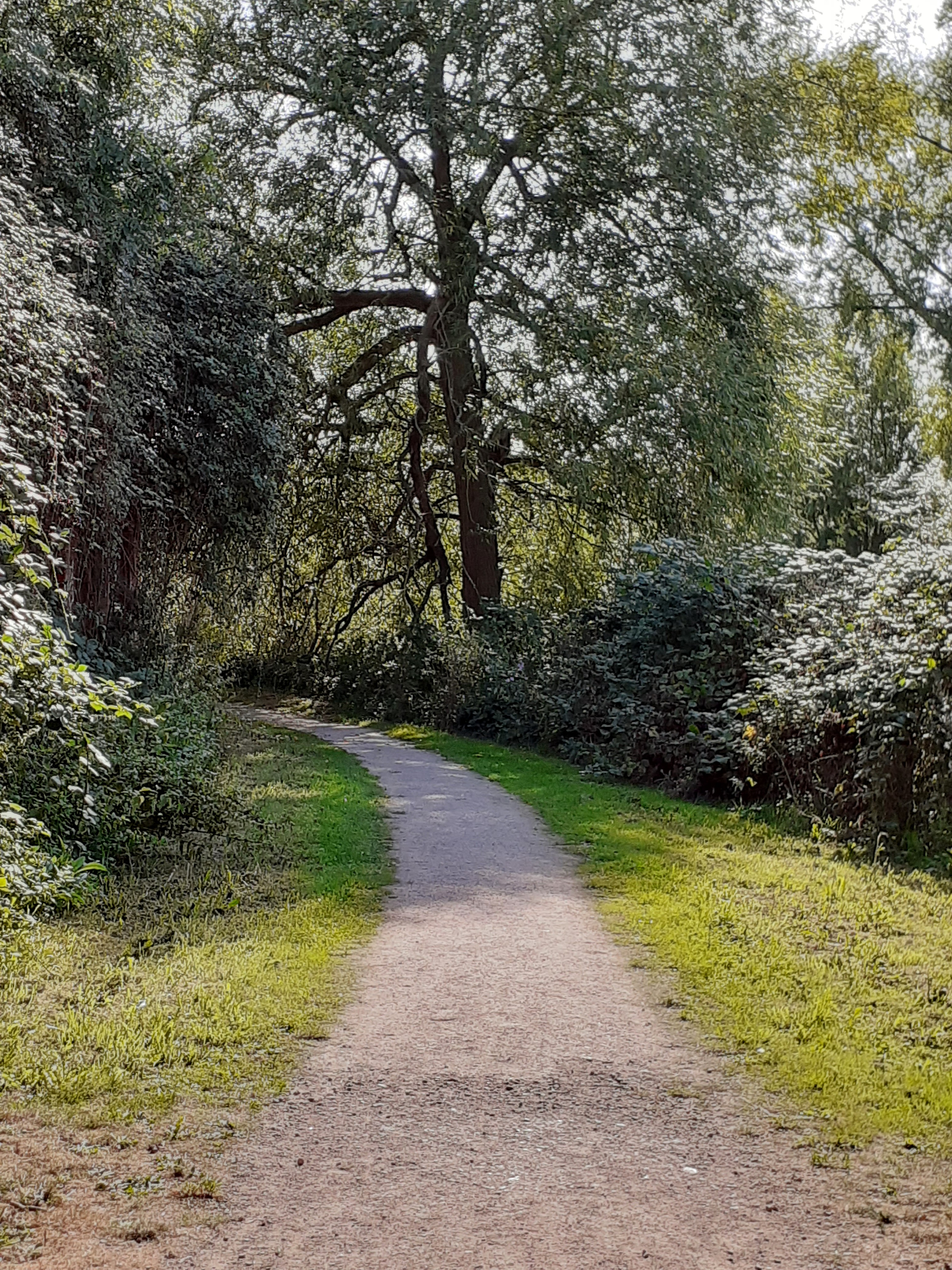
The path below seems to be telling me that there’s always somewhere else to go, but here is where I decide to stop taking pictures. A certain kind of moment is over, and best recognised as such. Nonetheless, I bask in the happiness of connecting with this new and unsuspected space.
Blessings of the season! Where I live, the sun is descending but still has a certain power. We have entered the period of the Autumn Equinox, honoured by modern Druids in the festival of Alban Elfed. Traditionally, the emphasis has been on harvest, but Dana O’Driscoll (1) suggests ‘receptivity’ as a resonant theme, “because with receptivity, rather than cultivating an expectation of what we want and expect to come, we are open to what is and what comes our way”.
She relates her approach to the changes that the world is experiencing now. “It is a counter balance to the effort-reward cultural narrative that is tied to the Fall Equinox and themes of harvest. There is one enormous problem with the effort/reward theme on a larger cultural level. It belongs to a different age. It belongs to the Holocene, an 8,000-11,000 year period of stable climate that allowed humans to develop agriculture, allowed humans to have some predictability about their surroundings, and allowed us to develop symbolic understandings like those drawn upon for the modern wheel of the year. … But we are not in the Holocene any longer, both climate-wise and culturally; we’ve moved on to the Anthropocene … characterized by human-driven planetary changes which destabilize every aspect of our lives.”
I find the call to receptivity challenging. Part of me wants the late Holocene back, in a reformed version – socioeconomically, culturally, technologically. Part of me accepts that it has gone for good but doesn’t want to acknowledge the speed and severity of the transition. Currents of anger, fear and grief cry out for recognition. These are as much part of my life-world as are the climate crisis itself, initiatives for adaptation, and the forces undermining those initiatives. I somehow have to find a receptive space for all of the above, without being overwhelmed.
The good news is that my ‘receptivity’ seems to be sourced by a deep peace at the heart of experience, a peace that grows rather than diminishes with time. In my daily practice as a modern Druid I call for peace in the east, south, west, north, deep earth & underworld [below], and starry heavens [above]. Then I say: “I stand in the peace of the centre, the bubbling source from which I spring, and heart of living presence”. These words are vibrant with life for me however often I declaim them. I experience this deep peace as a fruit of my contemplative inquiry. Perhaps there is a harvest aspect here after all.
Certainly, to stand in such peace empowers my receptivity, linking it to other qualities like reverence, delight and awe. None of this changes the world. But it allows me to contemplate it with an underlying confidence, and to face its challenges in a more resourceful way. I am very happy to mark Alban Elfed as a feast of receptivity.
(1) https://thedruidsgarden.com/ – see Fall Equinox: a Spirit Walk and its internal reference to Equinoxon Receptivity
NOTE: Pennsylvania-based Dana O’Driscoll is steeped in Druidry and the US homesteading movement. She is Grand Archdruid of the Ancient Order of Druids in America (AODA) and an OBOD Druid. She is a Mount Haemus scholar, lecturing on Channeling the Awen in 1912.
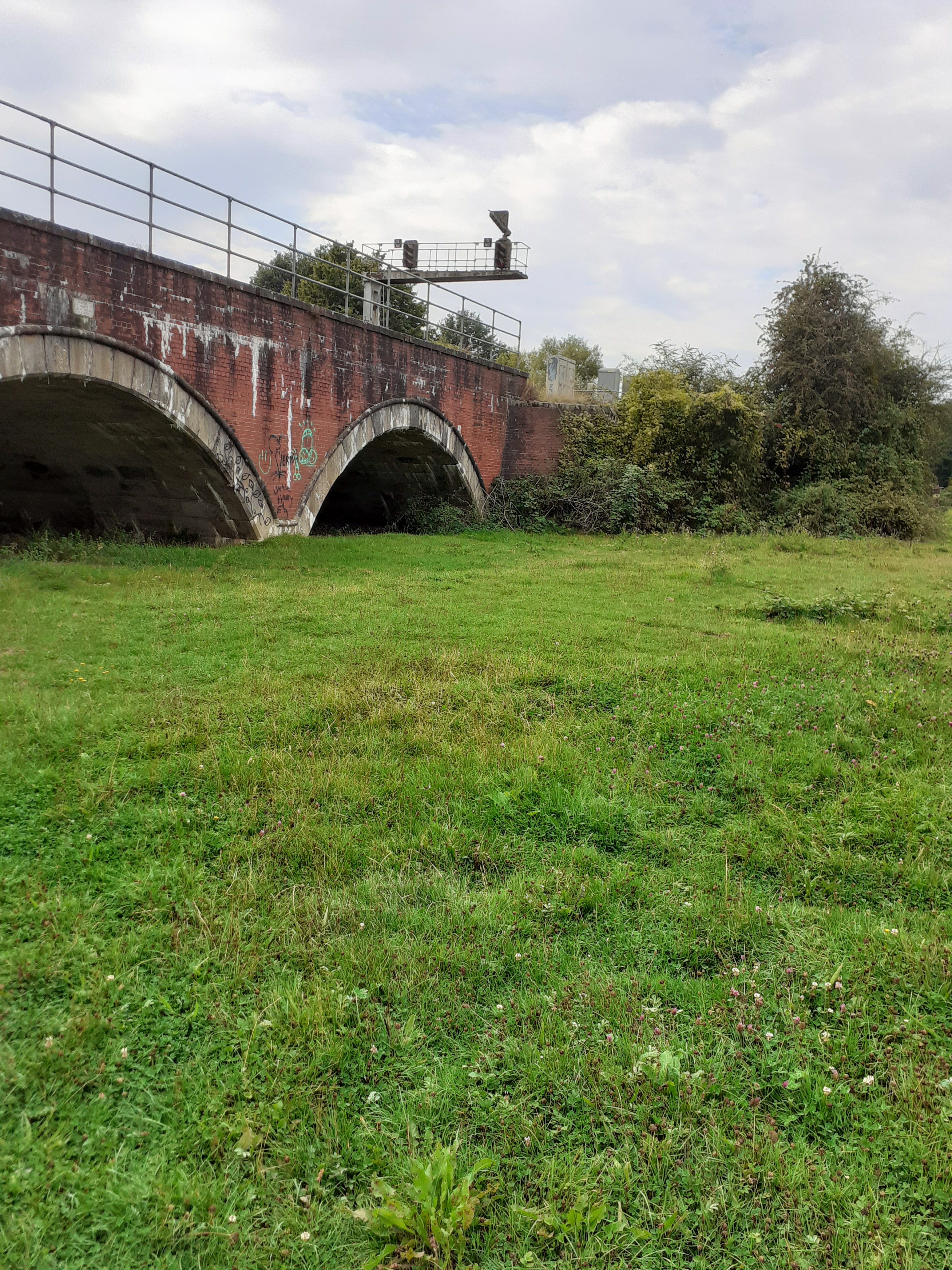
I am in Alney Island again, on the River Severn as it passes through the ancient city of Gloucester. Above, I am looking at the weaker, eastern channel of the river as it flows around the island. After rain, the water level seems adequate if relatively low, and the willows still seem lush. At first glance, as I walk past, the plant life seems healthy in this watery habitat. Stopping to look more closely, the scars of a summer both hot and dry become evident. The horse chestnut leaves, below, are dramatically shrivelled and their conkers are appearing early. Summer is becoming autumn swiftly and abruptly this year.
Much of Alney island is rough water meadow, as below, and it is a joy to see green grass. Normal? No longer a useful word in this, as other, contexts. In a time of climate chaos fatefully intertwined with runaway wealth, ‘normal’ loses shape and definition. Half-reluctantly, I am adjusting to a new, more dislocating and unpredictable reality.
On this walk I discovered a woodland on the island, shown below. It is far from ancient, being planted in 1983 to commemorate the 500th anniversary of a charter given to the people of Gloucester by King Richard III. A rare monument to the monarch in question.
Richard’s Wood is pleasant enough, although subject to somewhat whimsical curation. A decision was first made to plant non-native trees – red oak, turkey oak and horse chestnut; then to add native trees as well; and later still to thin out the trees so as to create a “wood/pasture habitat to contrast with the wetland meadows on the rest of the reserve”. ‘Rare breed’ cattle were introduced, though I have yet to see any.
I may be doing an injustice, but I get a sense of conservation by human taste and fancy, the manufacture of ‘scenery’ on a handy piece of wasteland that isn’t safe to build on. I don’t get any organic sense of the island, its history or its potential. I don’t get any sense of a wondering about what trees might be brought together to create a viable and self-sustaining woodland community, ‘native’ or otherwise. The horse chestnut, imported from Turkey in the sixteenth century, is now a well-loved English tree. The turkey oak is better suited to the southern England of today than the native species. I suspect they are a good choice. But I’m sorry about the thinning out. There’s no shortage of pasture in England. Overall I believe this kind of management to be a relatively innocent manifestation of the very mindset that is killing us.
Perhaps the trees will have a chance to develop in their own way. My feeling on being among them is gentle but muted. If I compare them with the crowded and chaotic wood that has grown up beside the Stroud cycle path, I sense a relative lack of viriditas – Hildegard of Bingen’s word for the green life energy in nature. It is a relative lack, not absolute. But as I go home, I feel a certain sadness all the same.
High summer becomes late summer, in my world, with a gentle movement into the evening of the year. In the picture above, taken a little after 8 pm, I at first feel, as much as see, a suggestion of muting light. On looking up, the blue of the sky seems influenced by a subtle greying effect that is independent of the clouds. Looking down, the buildings are shadowy and their reflections in the water are set within a gathering darkness.
The picture below was taken at 9 pm on the following day. The grey in the sky owes everything to clouds, whereas the orange and yellow are connected to sunset. The latter is reflected in the water, and electric lighting is now also present. The day is changing, but not yet into night. This is an in-between time, twilight. It is its own, extended moment, quietly shifting in the physical world, profoundly influential in my psychic world.
I feel joy with an edge of melancholy. It is a familiar feeling that stretches deeply into my early life, prior to language, older than memory itself. It seems to come from deep time, and to be pre-personal, not just about ‘me’. I am any finite being, moving from day towards night, from summer towards winter, from life towards death. Having shifted decisively away from the zenith, I find myself, for now, in a beautiful moment. The Gloucester docks provide me with a magical space for walking, standing still, experiencing and recording this time.