EVENING IMAGES 14 JUNE

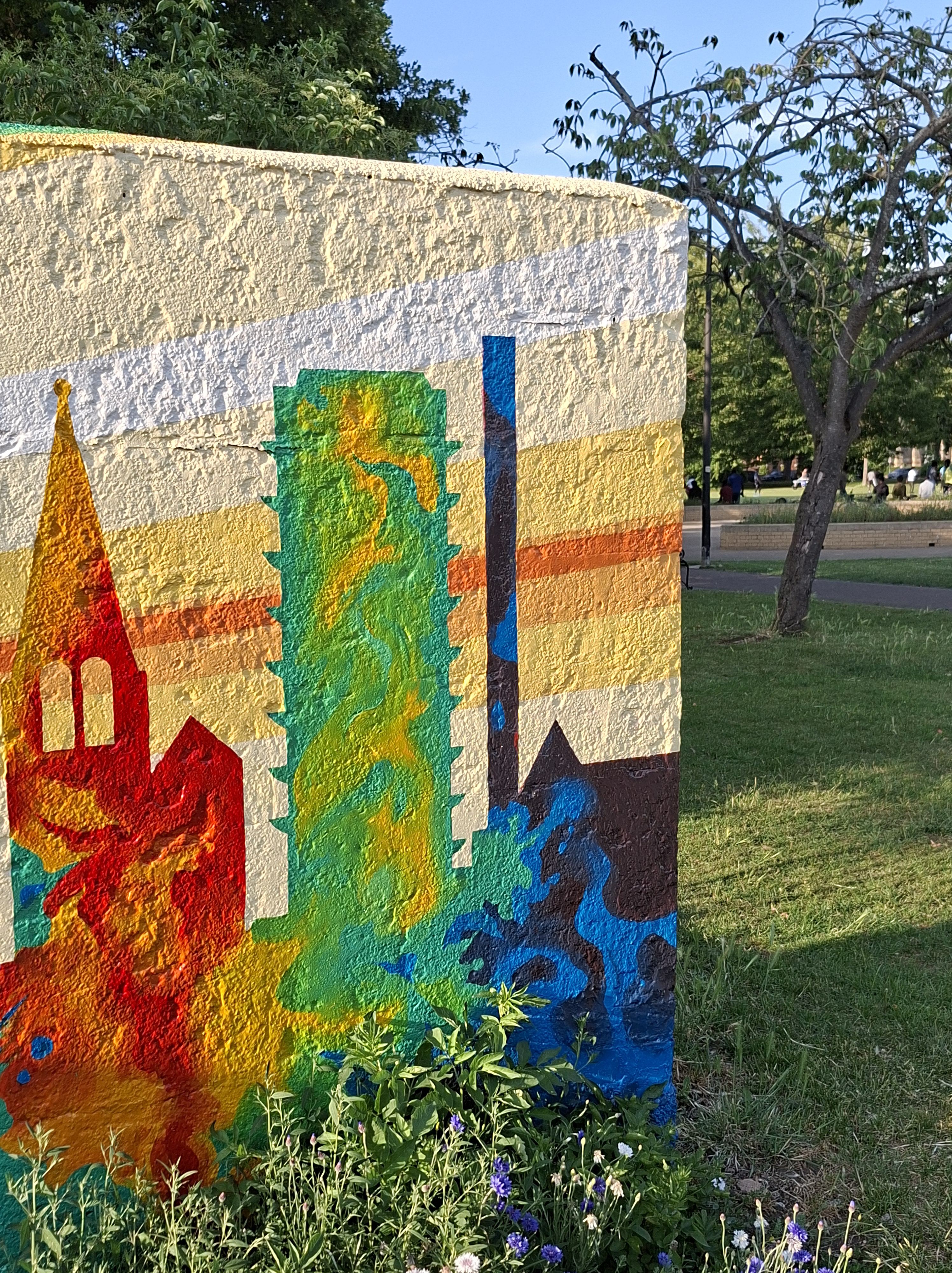
Flowers and a painted wall
Direct us to the park:
People, space, and clouds.
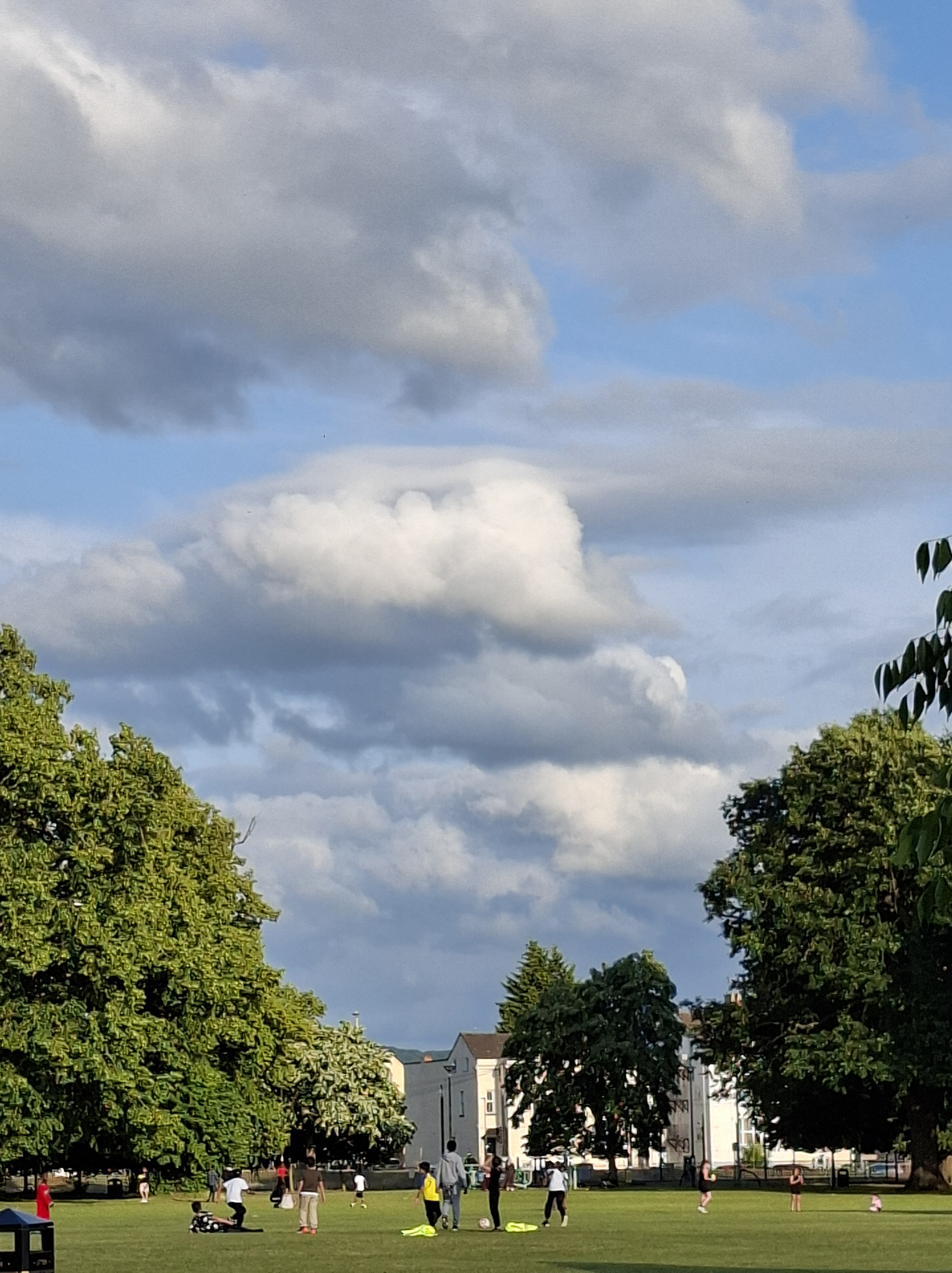

Flowers and a painted wall
Direct us to the park:
People, space, and clouds.

The garden in Gloucester Cathedral’s close is currently a magnificent riot. I was on a walk there with Elaine and we particularly noticed two powerful seeming plants that we couldn’t identify. We simply sat with them, unnamed, and bathed in their energy. It was a glorious 1 June, the first day of our official meteorological summer, and one to savour and enjoy. Only later did we do any research.
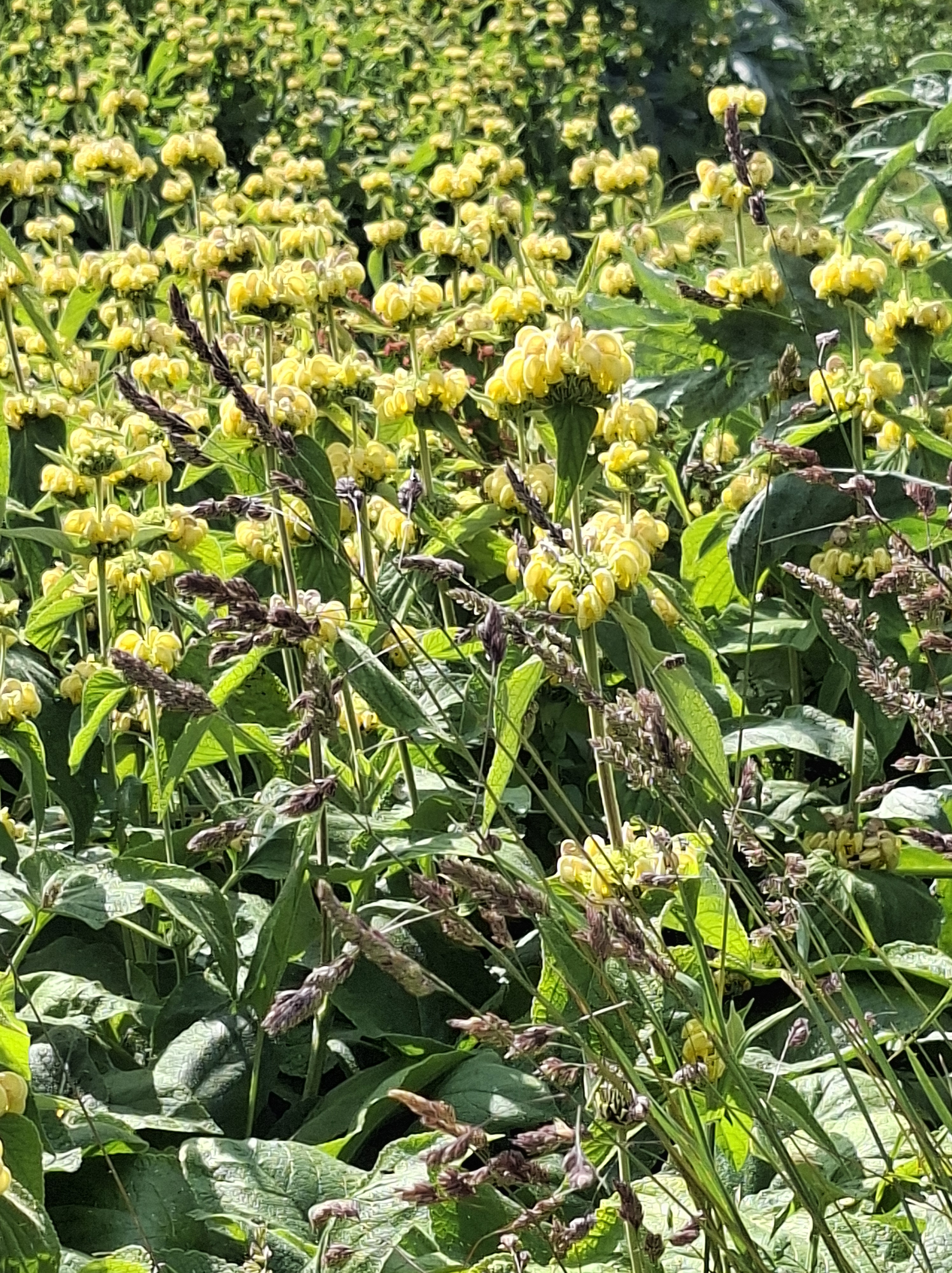
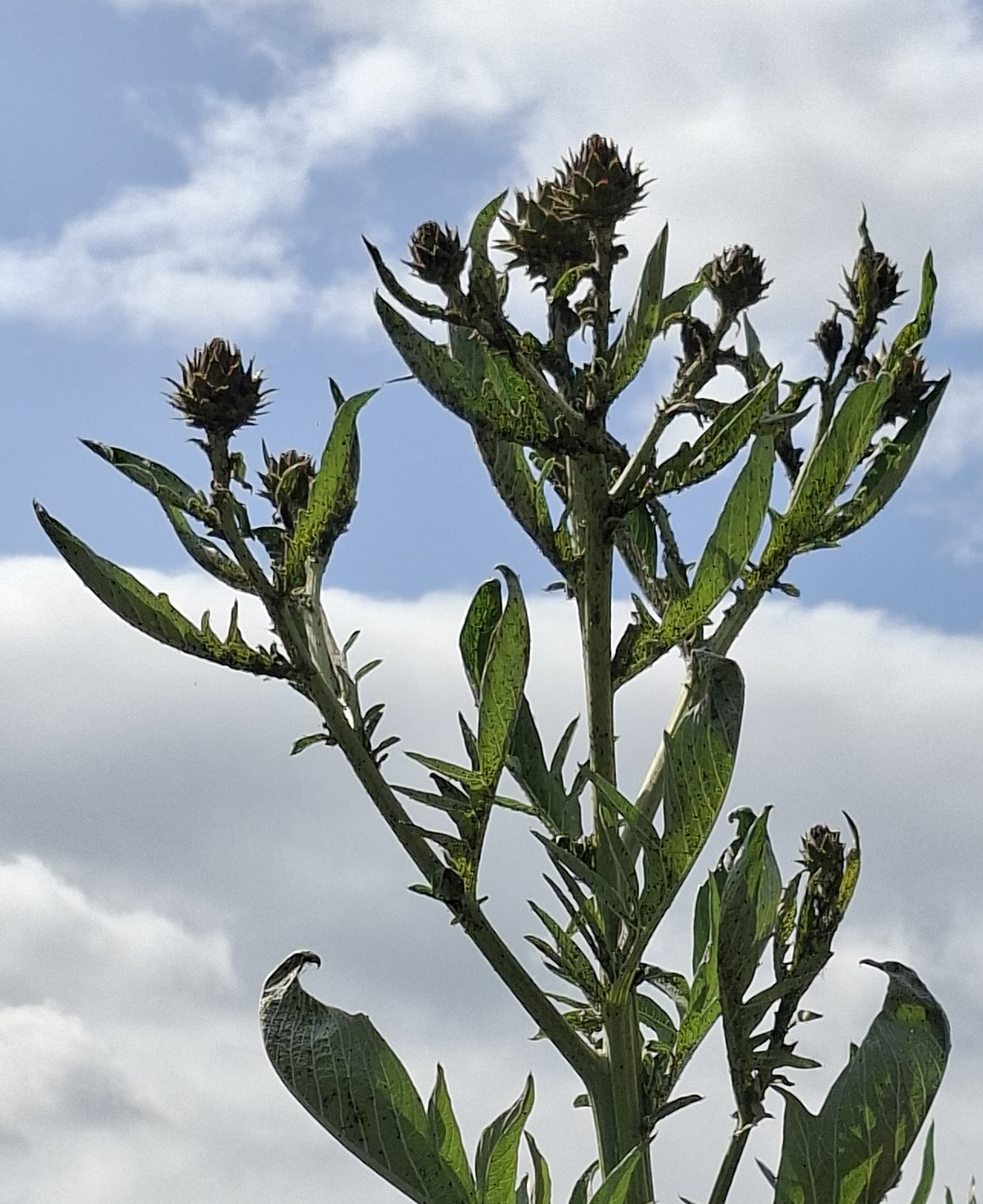
We are fairly sure that the plant above is yellow archangel and the plant below, looking like a giant thistle, is cardoon (canara cardunculus) aka prickly artichoke. Friendly feedback from readers on these identifications is welcome. If we are right both plants have long been recognised as sources of power and healing.
In our older traditions, yellow archangel was a symbol of harmony between flora and fauna. A custodian of wildlife, it fostered a bond that transcends mere survival. Herbalists still use this plant to relieve gout, sciatica and other pains of the joints and sinews. It has also been used to draw out splinters and thorns, clean and heal persistent sores, and to dissolve tumours. Yellow archangel can be used as food, in salads, soups and teas. In the wheel of our year, yellow archangel flowers fully after the bluebells die away.
Cardoon is also a plant of power. Traditionally associated with Mars, it has the virtues of strength, protection and abundance. It is has been credited with the power to ward off evil spirits. It is also connected to ideas of nourishment, the riches of nature and, latterly, sustainable gardening. The plant can grow to 2.5 metres in height. Its thick stalks are used as a vegetable. Its full flowering is in late summer and autumn, with thistle-like purple flowers.
These plants, in this garden, are a celebration of values as well as of nature and healing. I see our world through the lens of Modern Druidry and Paganism. The custodians of this space will have a Christian lens. I am happy to note that in this context they seem to be much the same. When in this space, I feel that I am in a beautiful and energising oasis in the city.

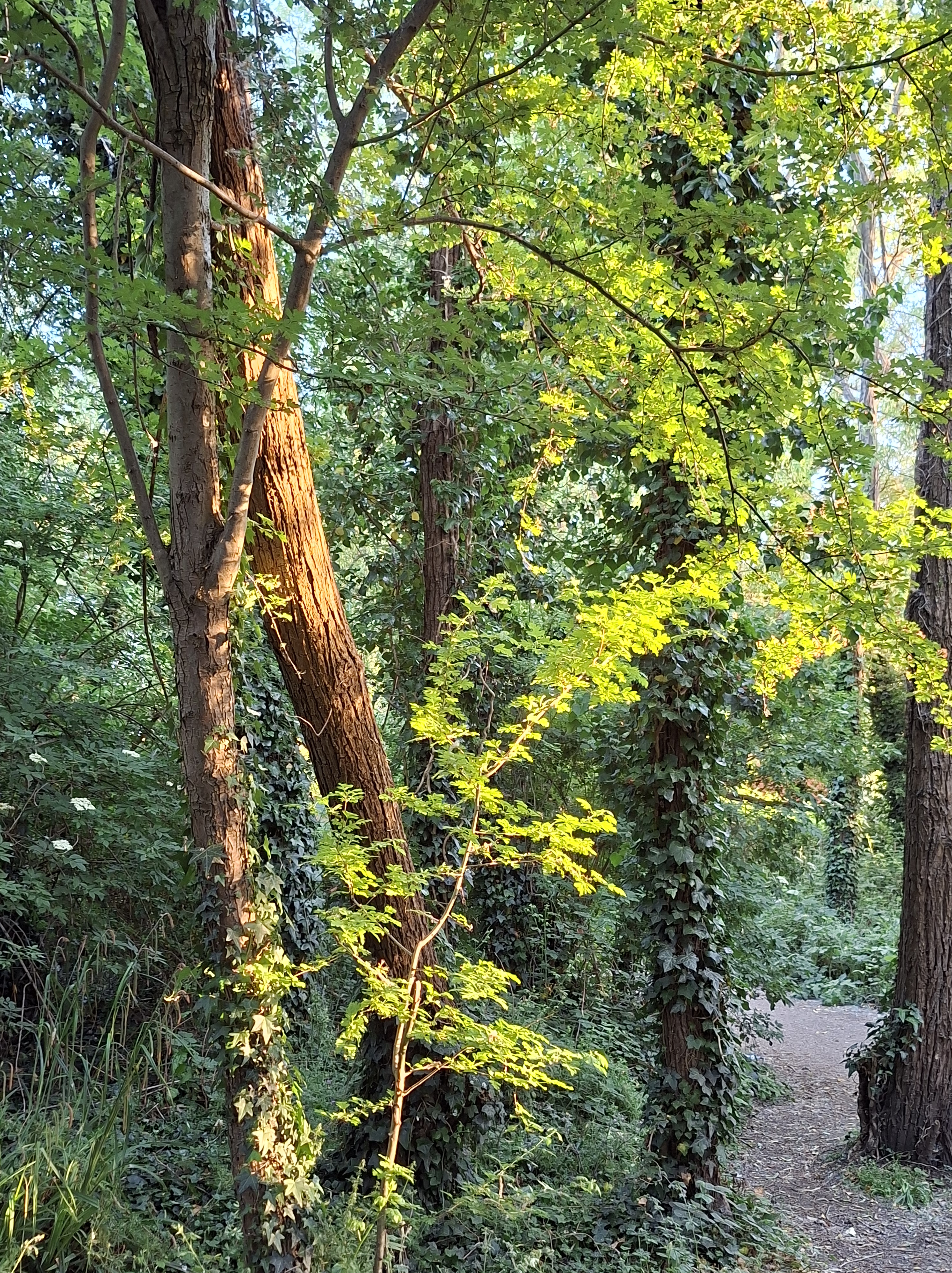
For me, mid May is the beginning of summer. All of the pictures in this post were taken between 16 and 24 May. It was a warm and sunny time that has now morphed into something else – cooler, wetter and windier.

It was a time of brightness and growth. The plant kingdom showed a tremendous will to live and flourish: above, on the canal path as it skirted adjacent apartment buildings; below, close to the Greyfriars ruins, looking out towards the old town.
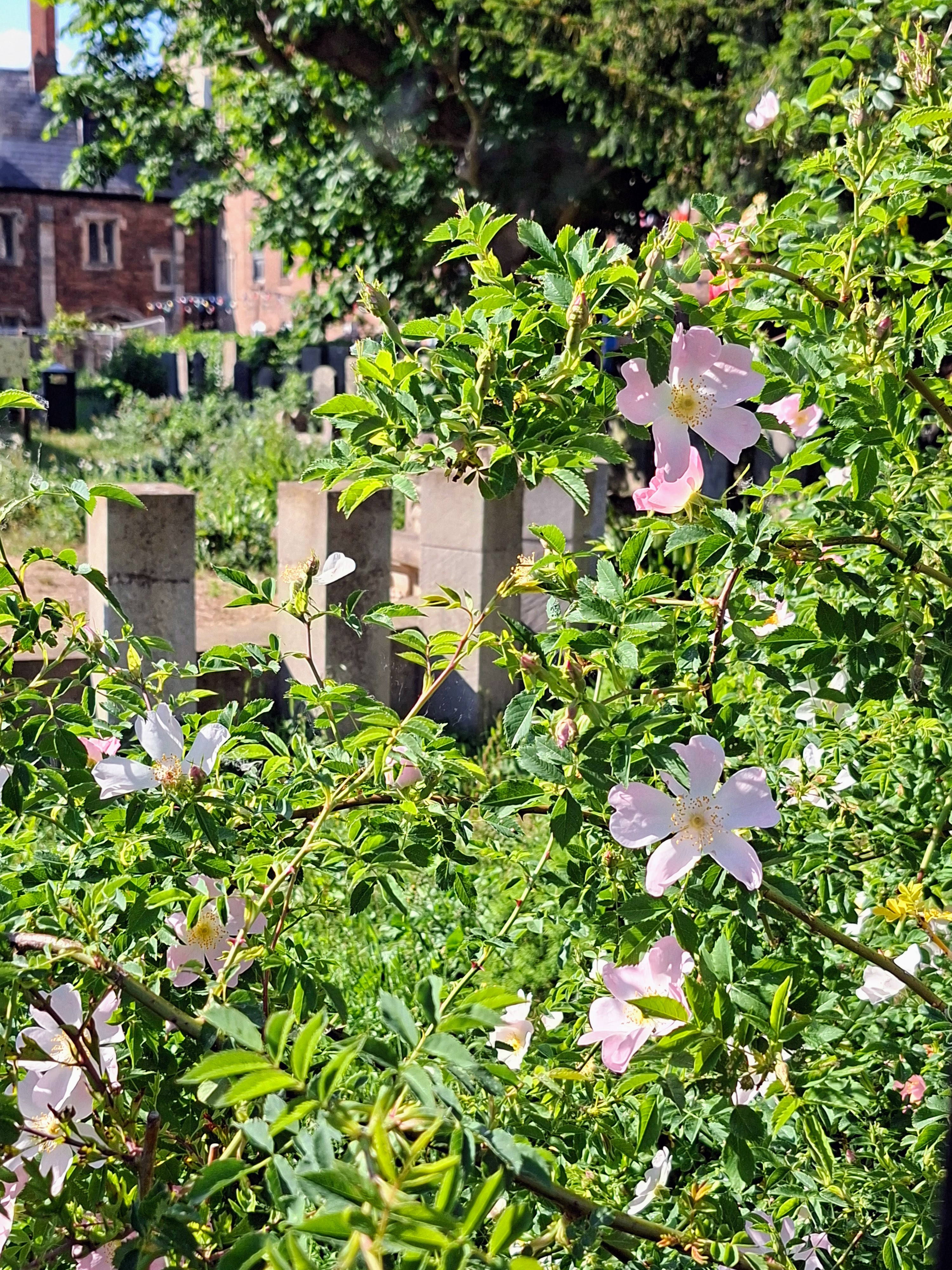
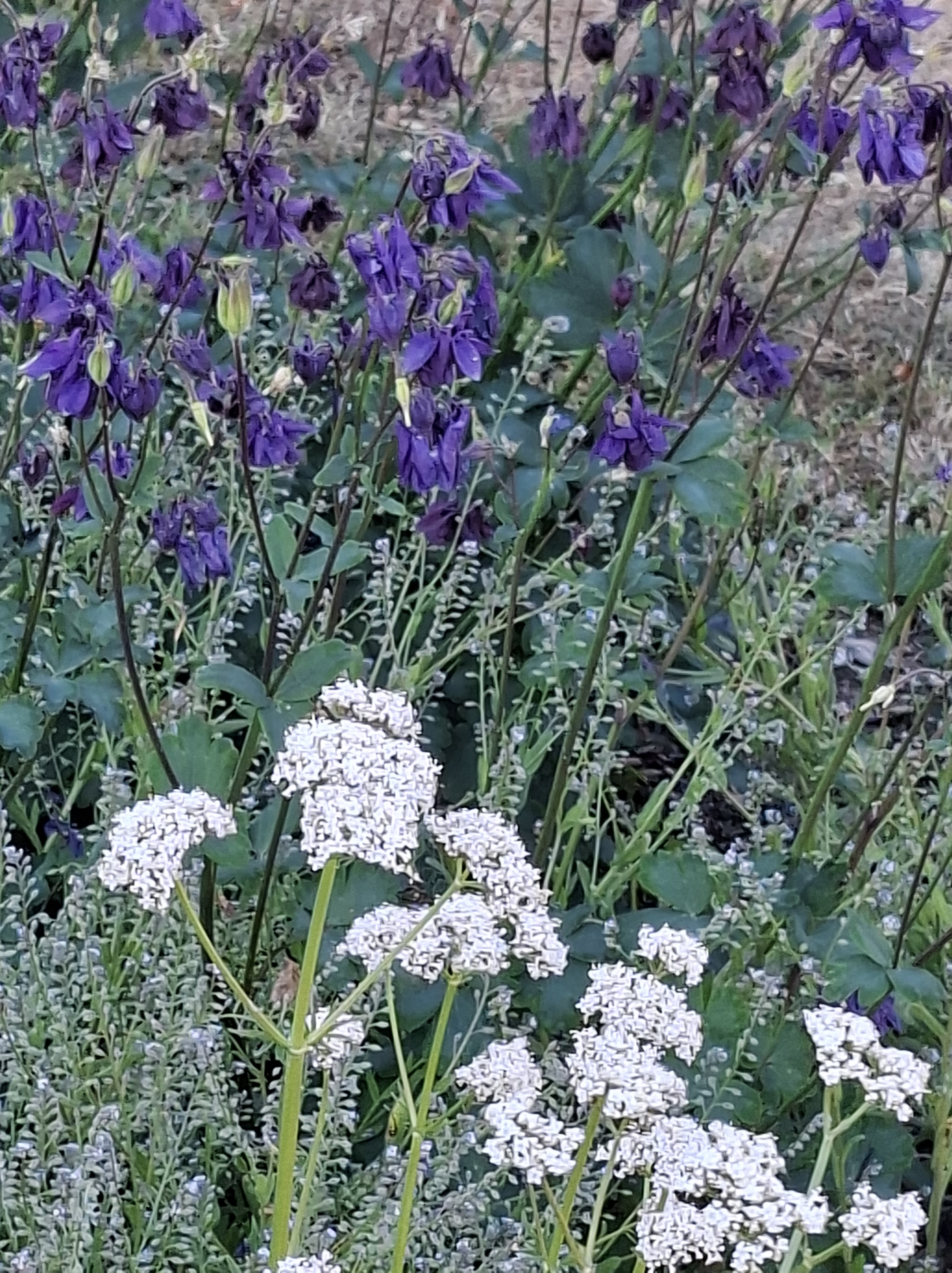
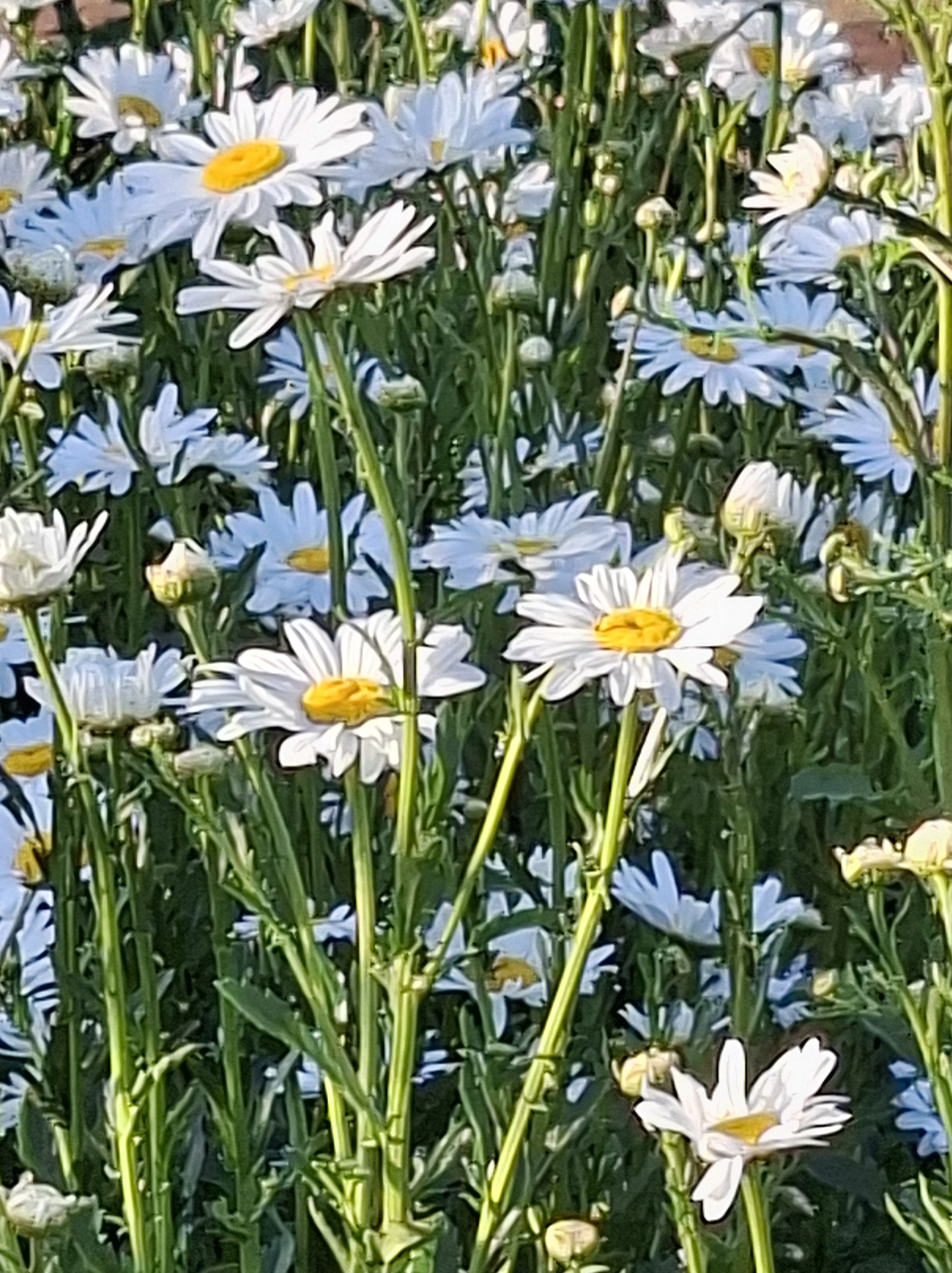
The following three pictures are all from Llanthony Priory, in what was once once the ‘physic garden’ of the monks. What moves me about all of them is the vitality, variety and colour they display. Such an affirmation of abundance.

The same benign and dynamic period saw a big step forward in my wife Elaine’s mobility. She can now leave and return to our flat, sit in pleasant public spaces, walk around town, attend local events and shop on her own. This is new and different for both of us, emancipatory yet still slightly unfamiliar. A new way of life is emerging for both of us.
On 25 May, about the time the weather broke, I celebrated my 76th birthday and entered my 77th year. As I wrote to one of my grandsons, ‘sounds terrible, feels OK’. In truth, it feels more than OK. I feel good.
It was also the anniversary of Elaine’s homecoming after her hip fracture in Gran Canaria, her hospitalisation for a month there, her repatriation and another 12 days in the Gloucester Royal Hospital. The year has been a tough one, especially after the strain on Elaine’s already vulnerable heart became fully manifest. But Elaine herself has been an inspiration with her own will to live and thrive. This feels like a good moment in my life and our lives together. Much gratitude for that.
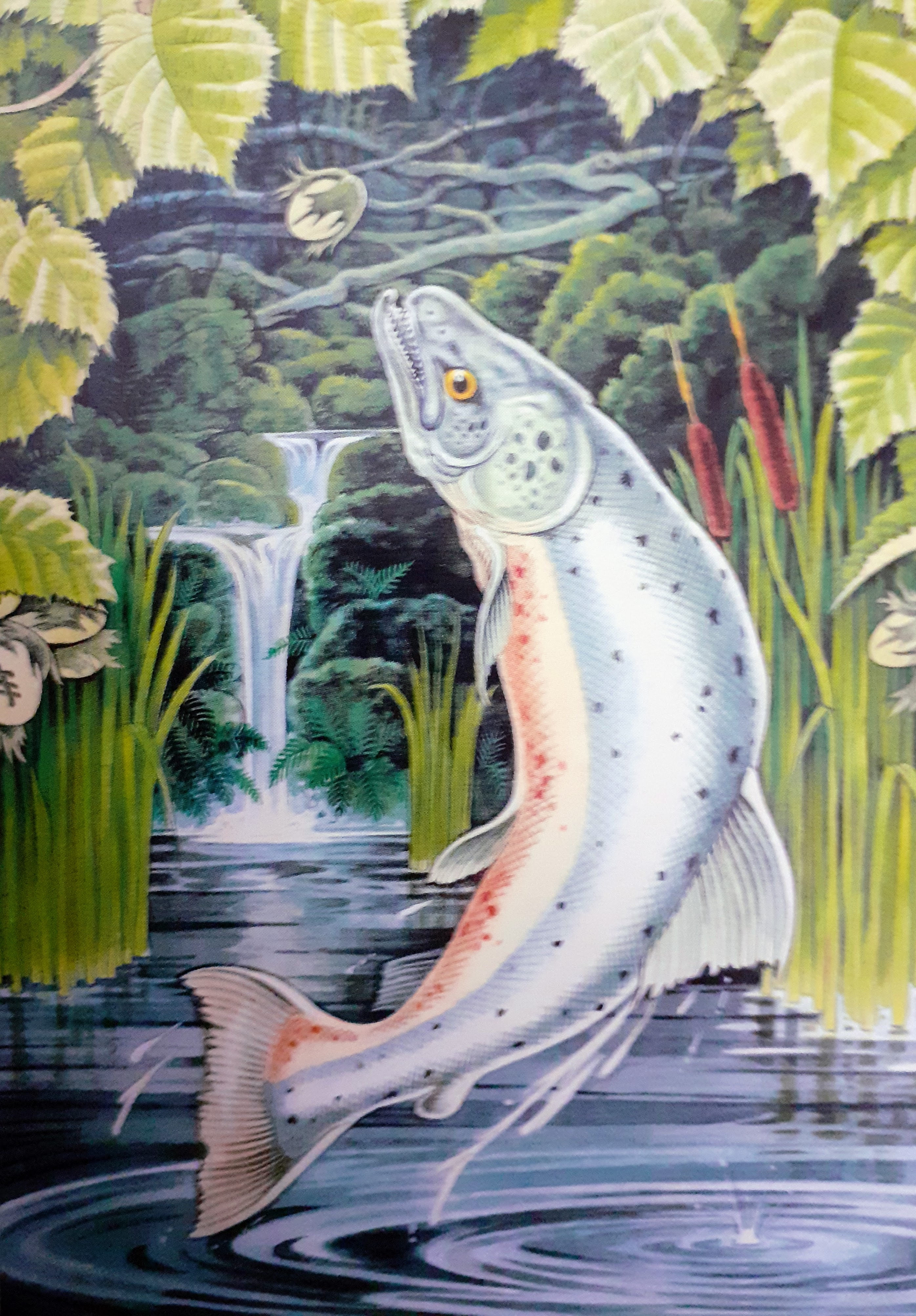
“The hazels are rocking the cups with their nuts
As the harvesters shout when their last leaf is cut;
‘I swim with the salmon says the Green Man,
‘I swim with the salmon’, says he.” (1)
‘I swim with the salmon’ is a bold, clear statement. It evokes powerful images that leap out of their place in the flow of William Anderson’s poem. Green Man as a whole takes us on a wheel-of-the-year journey beginning on 22 December, successively featuring thirteen trees for four weeks each. The hazel is the ninth tree, whose time runs from 3-30 August. As the poem indicates, this is a harvest period, and the last month that fully belongs to the summer. It is also a time when you may find Atlantic salmon swimming home to spawn, though spawning doesn’t begin until October.
In this post I celebrate salmon naturalistically, through an account of their extraordinary life cycle. I am especially aware of the River Tay in Scotland, mostly thanks to a 90 minute documentary The River: a Year in the Life of the Tay (2). My personal experience of the Tay is limited to visits to Dunkeld, Perth and Dundee, where I nonetheless fell in love with the river and its powerful energy.
Salmon begin their lives in mountain streams, as far upstream as their parents have been able to reach in their autumn/early winter spawning period. The new generation undergoes a remarkable series of transformations (3), hatching as alevin or sac fry when the water warms in spring, and growing into parr with camouflaging vertical stripes. They remain in the same environment for two or more years, by which time, as smolts, they have developed a bright silvery colour with scales that easily rub off. Driven by growth hormones, the 10% of smolts who survive to this stage experience the mutations necessary to become salt water fish and make their journey to the ocean.
They spend another two or more years in the North Sea, travelling north into Norwegian waters, becoming sexually mature, with a darkening of the silvery scales, before embarking on their homewards 120 mile journey up the river to its headwaters. They are much larger than they were when on their way out. The largest salmon ever caught in the Tay, in the 1920’s, was over five feet long.
To return to their own birth-place (remembering exactly where they come from) they have to navigate waters that include rapids and waterfalls, evade osprey and human anglers, and achieve the feats of leaping for which they are famous. “The salmon is able to jump upstream not by fighting against the current, but by utilizing its knowledge of the reverse current which flows beneath the surface current” (4). They are returning to their native headwaters in order to spawn and begin the cycle again. 98% of Atlantic salmon spawn only once and die soon afterwards: their adult bodies, equipped for a salt water life, never fully re-adapt to fresh water and this makes them vulnerable.
Swimming with the salmon is not for the faint-hearted. At the present time the population of Tay salmon is in severe decline (70% in the 30 years to 2019) although the river is relatively clean and is now managed to prevent over-fishing. The effects of the climate crisis in the Atlantic are the most likely cause for the decline of Tay salmon, as for Atlantic salmon in general. Yet even in decline they remain magnificent. Long before the Celtic Iron Age, during it, and for long afterwards, they were abundant in the rivers of Britain, Ireland, and other Atlantic maritime countries. With their complex shape-shifting capacity, their far-journeying years at sea, their uncanny homecoming knowledge and their extraordinary leaps, they seem marked out for another life, in human song and story. I would like to think that the salmon’s mythic reputation can help to save it in this interconnected world.
”’I swim with the salmon says the Green Man,
‘I swim with the salmon’, says he.”
(1) From: William Anderson Green Man: Archetype of our Oneness with the Earth Harper Collins: London & San Francisco, 1990 See also: https://contemplativeinquiry.blog/2017/05/11/poem-green-man/
(2) The River: A Year in the Life of the Tay 90 minute documentary made for BBC4 in 2019. Presented by writer and naturalist Helen MacDonald. See: https://youtu.be/ZEmAXQIrDeg?si=wlaI0bNtM6YWevAf The film is well worth watching, covering the journeys of the salmon and much more.
(3) Salmon Wikipedia
(4) Philp and Stephanie Carr-Gomm The Druid Animal Oracle: Walking with the Sacred Animals of the Druid Traditions Fireside: London, 1994 Illustrated by Will Worthington. The face of their salmon card is pictured at the top of this blog.

29 July, 9.20 pm.
Gloucester, UK.
The dog days.
Humid.
In the reducing evening light,
I gaze at a twilit horizon
with its promise of a deepening dark.
Then I notice the house lights below
and their brick-bound interior life.
Like mine.
I prepare, standing in my balcony door,
for the improbable heat of the night.

8 am, 14 July. Local woods. A little after the year’s zenith, I am in strong morning sunshine and enjoying its patterns of light and shade. A green portal lures me forward. What will I find on the next part of my journey?

I am am often moved by the effects of light, and drawn to write about them. Each experience is unique. Today, sunlight on tree bark feels warm and playful.
Below, I find a clearly defined shadow shape on the ground, the effect of the sun passing through a fence. This feels playful too, high summer’s friendly face in this place at this time. Contemplation as simple delight.


My walking time is still restricted. Perhaps because of this, familiar outdoor spaces have become exotic and magical to my eyes. My limiting circumstances are paradoxically making me more focused and attentive, enhancing my felt quality of life. I am readier to find joy in simple, passing experiences.
On my contemplative walks, the shapes and colours of trees move me deeply. Grasses and sky have a similar impact. I am very aware of these July days. I am very aware of summer. I am very aware of my place in the world as the year turns in my immediate neighbourhood.

A little further away, I stand on a canal bridge (below) and look back towards the city, which seems distant and small. Water and sky give me space and perspective. I let the elements of water and air nourish me at a time when I am largely grounded.

Close up at the water margin, I find light shining on the water. There is energy and movement here. The power of the sun is present in both a shifting luminosity on the water and the flowering resilience on the bank.
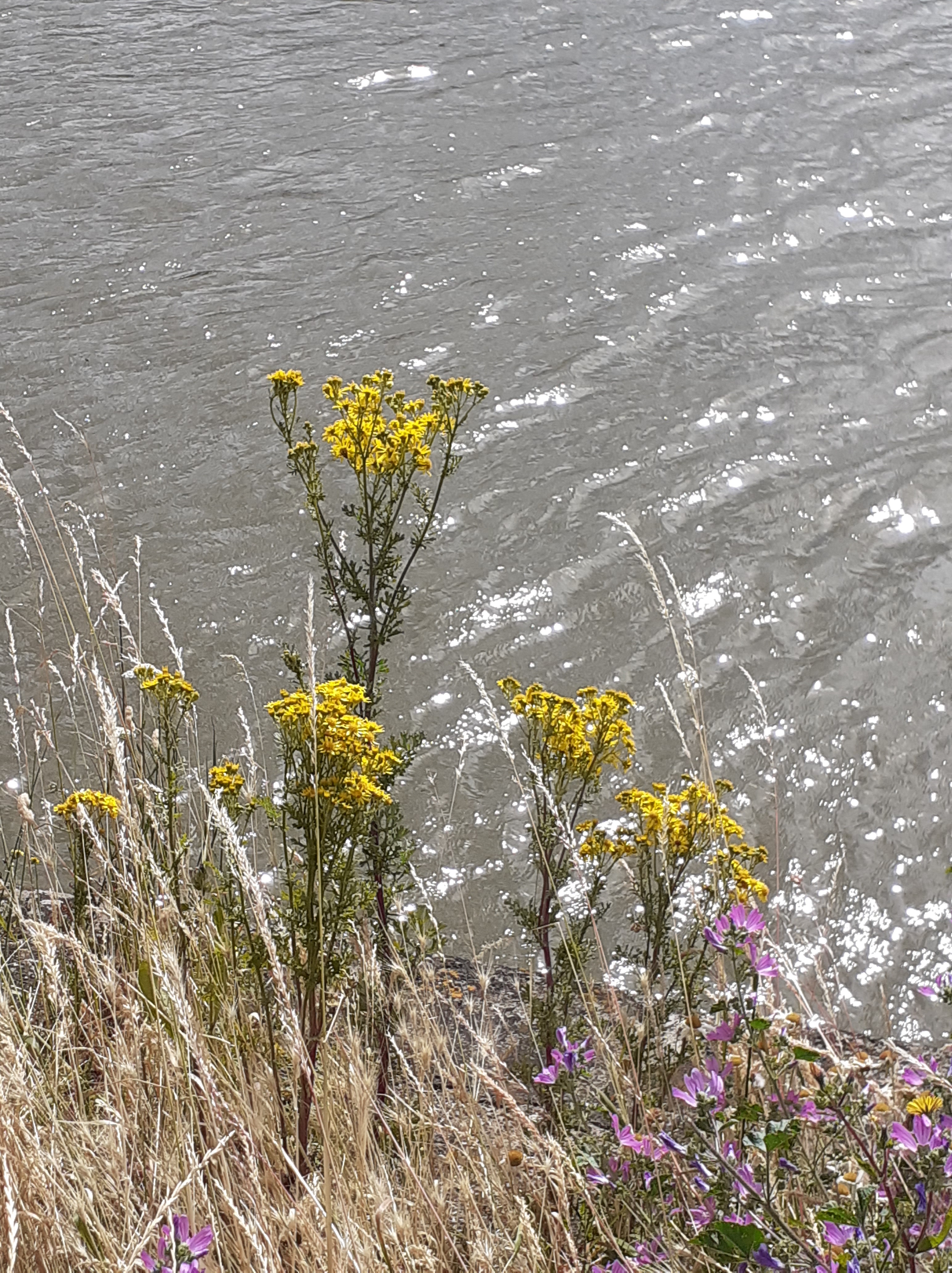
I shift into a meditation on the four classical elements – earth, water, air and fire – and how they work together to make the fifth (life, spirit) possible. Consciously engaged with the four, I can stand as the fifth, resourcing my individual life within a world of impermanence and interbeing.

23 June 2024, around 8.15 pm. I’m enjoying my first contemplative walk for some days. I’m looking at an old wall, once part of the Llanthony Priory estate in Gloucester. The day has been one of rising temperatures and humidity. Even now, as the shadows deepen, I feel an energy and expectancy in the evening light.
The Priory here was for a time the largest landlord in the city and its surrounding district. In those days, midsummer was celebrated on 23/24 June. The Church celebrated the birth of John the Baptist, at the opposite end of the year from that of Jesus. (His beheading is remembered on 29 August). Popular celebrations on the evening/night of 23 June involved bonfires, and local festivities could be attributed to the saint, the season, or both.
In many cultures, the year has been divided into two contending halves, whether at the solstices, the equinoxes, or with the Beltane/Samhain division. Traditional Christianity flirts with this theme. I might think of summer and winter kings, king-slaying and the Goddess. I might also think of John, Jesus, and their respective human fates. In the case of John, Salome and her royal mother Herodias are a presence, along with their fateful demand for his head. These stories are not the same, but in the European Christian imagination they have at times been interwoven.
I might also think of the Green Man maturing to the point where he can “speak through the oak”, as “its crown forms his mask and its leafage his features” (1). To speak through the oak is to speak at another level, or from another dimension, a developmental moment that occurs at the year’s zenith (life’s zenith?) This maturation flows from from a willingness to surrender to a greater power. The purely personal direction can only be towards winter and death. But that’s not the whole story, even to a ‘sacred agnostic’ like me (2.) This is the midsummer evening’s tale that intrigues me the most.
The image below comes from a small patch in Llanthony Priory’s current garden, on the site of the original physic garden. I simply found it beautiful.
(1) Green Man Poem In: William Anderson Green Man: archetype of our oneness with the Earth Harper Collins: London & San Francisco, 1990 See: https://contemplativeinquiry.blog/2017/05/11/poem-green-man
(2) https://contemplativeinquiry.blog/2024/02/16/sacred-agnosticism


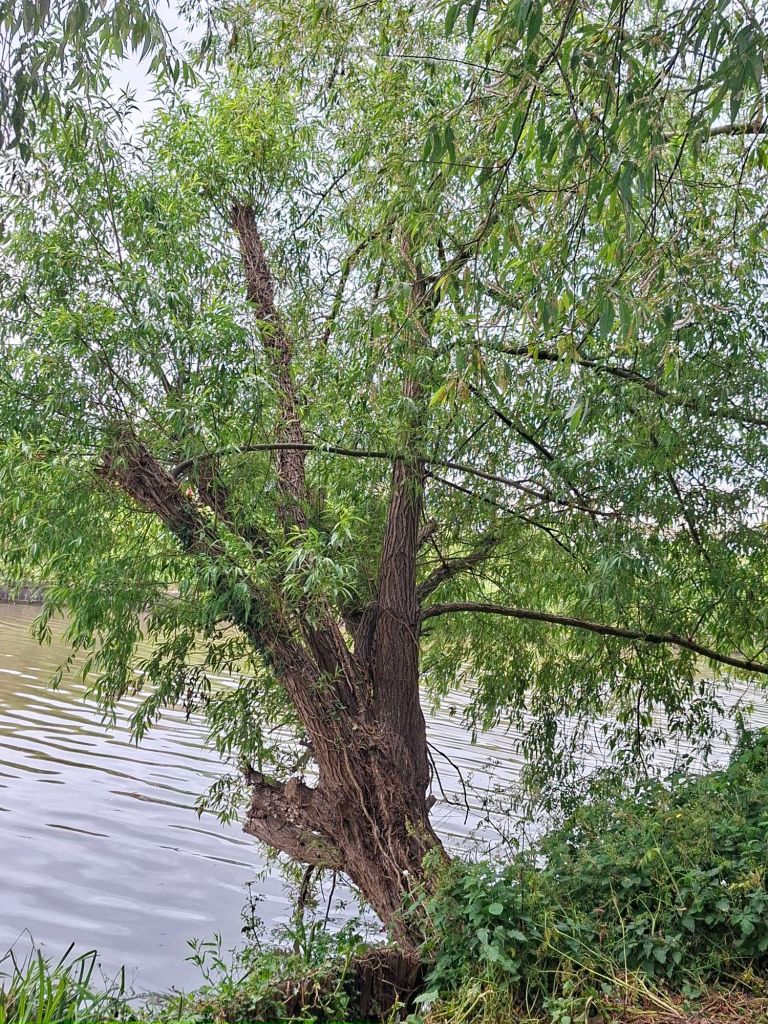
I spend time inside looking out. The sky changes a lot. Its shifts are rapid and dramatic. The trees change too, but over longer periods of time. The high levels of rain this year have encouraged an exceptional verdancy and abundance. Looking out, I can almost forget that I am in a block of newish flats in an old urban area. The person walking on the pavement below seems dwarfed by the splendour of the leaves. The road is very quiet for a late morning. The wheel of the year turns, approaching its summer zenith in this part of the world.
I am settling in to a higher number for my official age. In social gerontology, there are (or have been) three kinds of ‘old’: young-old (50-64), middle-old (65-74) and old-old (75+). I am now old-old and statistically immune from premature death. These classifications don’t quite fit my lived experience, but they are a sort of landmark all the same.
Elaine and I have been together for nine days following her repatriation and subsequent stay in a local hospital. We are learning how to live a new phase of our relationship where she has high needs and is housebound, and I am in a ‘caring’ role in the institutional sense of that term. We are learning as we go along and doing our best to be conscious about our experience as well as practical in an ‘activities of daily living’ sense. I think we are doing OK. We are establishing new patterns of day to day life and Elaine’s capacity is increasing.
Mostly I leave the flat only for shopping and other practical tasks and, because we are so well situated, these don’t take long. On Saturday Elaine and I both felt comfortable and confident with me going out on a one hour recreational walk. I continue with a regular practice and journaling. I still practice within a Druid circle (grove) and I find this healing and re-energising. At the same time my work has been referenced more to five personal commitments rather than to tribal membership, religious devotion or spiritual metaphysics. Recently I have been contemplating my commitments and checking out whether they still work for me. These are:
1. I will work from the stillness of the centre.
2. I will cultivate good will towards self, others, and the wider web of being.
3. I will cultivate positive health and well-being, within whatever constraints may apply.
4. I will cultivate discernment, creativity and wisdom, to the best of my understanding and capacity.
5. I will cultivate a life of abundance in simplicity, living lightly on the earth.
I do see a danger in lists like these: they can become a frozen and pious – an internal rhetorical performance. For me, contemplative inquiry keeps my commitments alive, suggesting revisions if necessary. This is my direction, going forward, in the unfolding chapter of my life.

On 12 May I wrote: “I hope soon to get some sense of how soon Elaine will come home, and what resources we will need for our lives going forward. It’s my 75th birthday on 25 May, and my best present would be to have Elaine home by then.” (1) Today is 25 May, and my wife Elaine is indeed coming home from the Gloucester Royal hospital. It has felt like a long absence for both of us and we are glad to move into a new chapter of our lives.
Yesterday evening I went Alney Island, a Gloucester wetland, for a brief contemplative walk. The footbridge near Gloucester docks has been repaired and after many months the island is easy to reach again. Back on the island, I loved its sense of growth and abundance in the summer evening light. I felt care-free. I had almost forgotten how much experiences like this nourish me.
This is a festive moment in my life: a significant birthday, Elaine’s return, celebrating a moment in the year that makes me glad to be alive. I feel refreshed, heartened and re-energised.
(1) https://contemplativeinquiry.blog/2024/05/12/unsought-journey/

music that celebrates Earth and speaks to the heart
Follow the Moon's Cycle
Meeting nature on nature's terms
A little bit of Mark Rosher in South Gloucestershire, England
A monastic polytheist's and animist’s journal
Selkie Writing…
Images and words set against a backdrop of outsider art.
living purposefully during metacrisis and collapse
The pagan path. The Old Ways In New Times
Spiritual journeys in tending the living earth, permaculture, and nature-inspired arts
a magickal dialogue between nature and culture
The gentle art of living with less
Thoughts about living, loving and worshiping as an autistic Hearth Druid and Heathen. One woman's journey.
An place to read and share stories about the celtic seasonal festivals
Just another WordPress.com site
Exploring our connection to the wider world
Become more grounded and spacious with yourself and others, through your own body’s wisdom
Good lives on our one planet
News for the residents of Hopeless, Maine

