Contemplative Inquiry

This blog is about contemplative inquiry

Tag: stillness

‘MYSTERY’ IN A MORE THAN HUMAN WORLD

“Half-way between the certainty of science on one hand, and the supernatural on the other, is mystery …. Mystery is central to enchanted experience because enchantment is not a rational process of recognition, categorization, knowledge, facts or rationalizations. It is, instead, a pure experience of sensing and being.” (1)

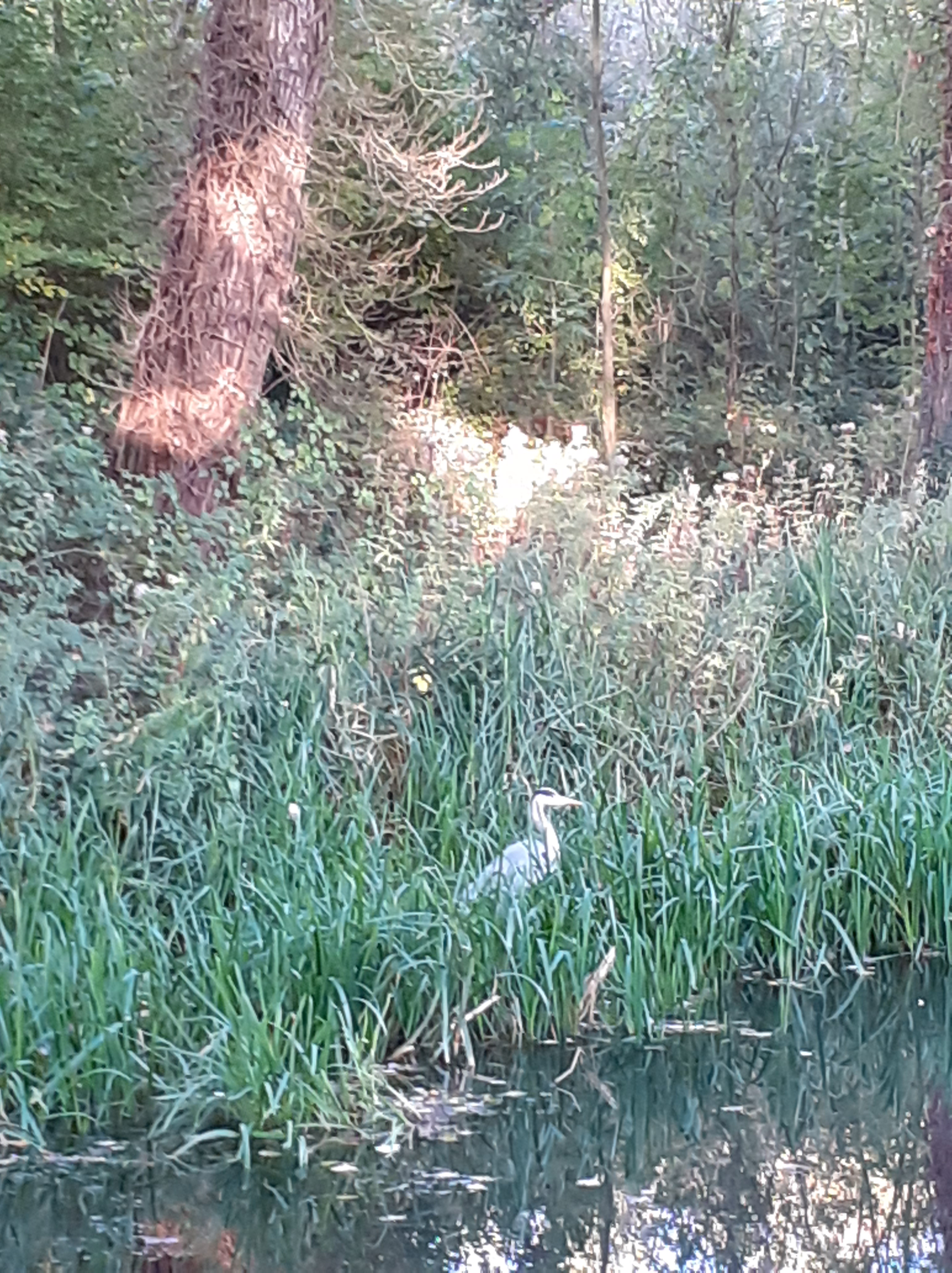
I saw the heron on 11 October 2020, in the first year of the pandemic and just a little after dawn. I had been walking for about forty minutes, beginning in near darkness and experiencing the gradual coming of the light. I described this walk at the time as an “enchanted meander” at a liminal point in that day (2).

My encounter with the heron was unexpected and I responded with “delighted surprise”. Four years later, reflecting on the memory, I note that I was able to experience delighted surprise from within stillness. In that moment I was a still human sharing space with a still heron on a still early morning. So the heron stayed in place, not needing to fly away. Beyond that there was no communing, but this was somehow blessing enough. Stillness of this kind, in contact with our more than human world, allows space for an enhanced bandwidth of experience. It is, perhaps, an opening to what Arran Stibbe calls “mystery”.

On that morning, my enhanced experience was partly displaced into the taking of a picture and also the wider purpose of my walk. That’s fine, a good enough choice. But I wonder what would have happened if I, like the heron, had stayed in place.

(1) Arran Stibbe Econarrative: Ethics, Ecology and the Search for New Narratives to Live By London: Bloomsbury Academic, 2024

(2) https://contemplativeinquiry.blog/2020/10/14/walking-towards-sunrise/

UNFREEZING (SLOWLY) IN WINTER SUN

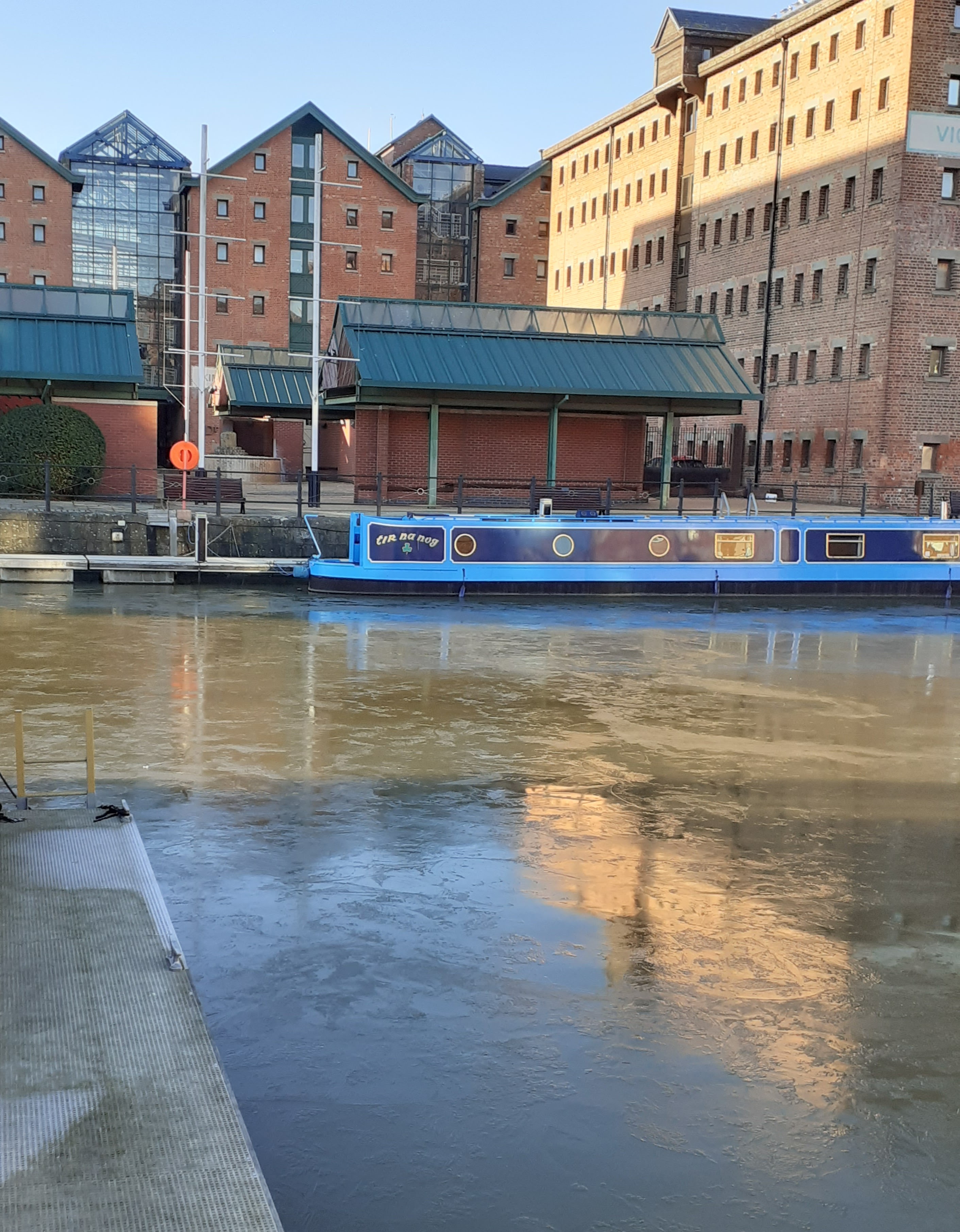
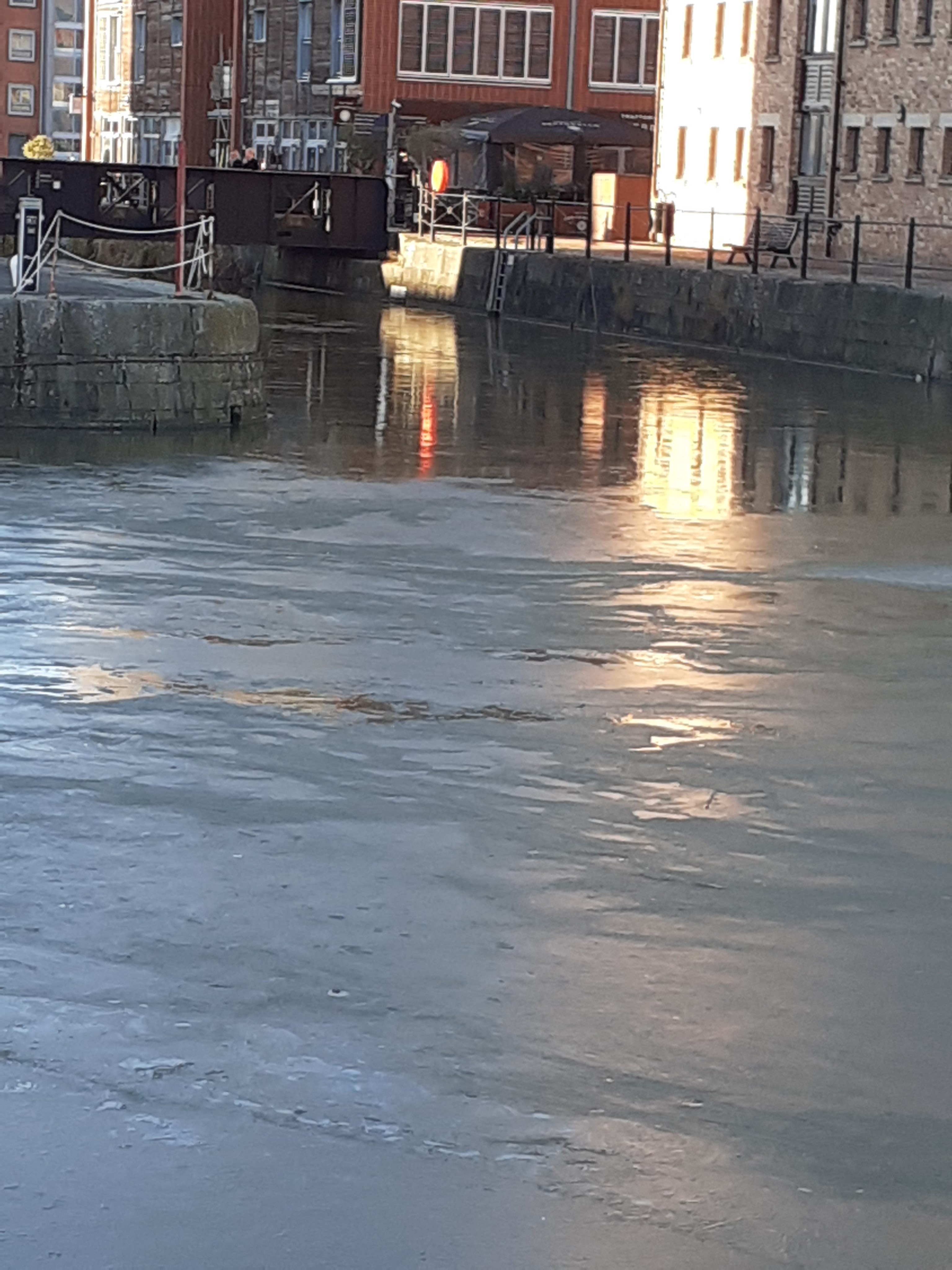
Yesterday – 3.30 pm or so – I was walking home swiftly from a shopping expedition. I was slowed down and halted by the water in Gloucester docks. It drew my eye and asked for a closer look. It had clearly been iced up in the previous cold night, and had been slowly melting in this bracing but above-zero day.

The sky is clear and I experience a strengthening sun now. I recollect that we are now several weeks beyond the solstice. The balance of light, shade, stillness and fluidity sends me into a more deeply meditative state, entirely trumping my original sense of domestic mission and wanting to be home.

Ice and water are made of the same stuff, manifesting in different ways. The patterns on the surface look still but tell a story of transformation – here, from fixed to free. Another drop in temperature could easily end and indeed reverse this process. In this space I see the same essence adopting different forms under different conditions. But here the change is gentle. The contemplative moment extends itself. I am open to the magic of nature. In such beauty, I find peace and stillness within my own being.

CONTEMPLATION AS SERVICE

“They also serve who only stand and waite” (1) wrote the naturally activist poet John Milton. He was coming to terms with his loss of sight and significant worldly defeat. For him, waiting means waiting upon God, as a servant, rather than waiting for an appointment, waiting for salvation, or stuck in the wounded forever-waiting enacted in Samuel Beckett’s play Waiting for Godot. For Milton, waiting, being available, is a form of engagement and of service.

Contemplative living can be understood as service, even without Milton’s theology or master-servant relationship with the Divine. For contemplative life is more than ‘just being’. It asks us to stay present in the activities of daily life and and in our interactions with others. When present, ideally, we bring spacious stillness into the world. With consciousness comes quality. Every task is sacred. Every event is full of meaning. When we are alive to the experience we are having, we feel our oneness with the whole and the Source. Then we can “affect the world much more deeply than is visible on the surface” of our lives (2).

(1) John Milton When I Consider How My Light Is Spent In Delphi Complete Works of John Milton Delphi Classics, 2012 (e-book)

(2) Eckhart Tolle A New Earth: Create Your Better Life Today London: Penguin Books, 2016 (First Edition 2005). My second paragraph above draws on this source whilst somewhat modifying the message.

APRIL AND ‘DRUID MINDFULNESS’

Where I live, April 2023 brings qualities and freshness and new growth. My heart meets the moment as I walk in the bracing breeze. Sunny and overcast periods succeed each other. Moving through this enlivening space, I naturally welcome the energy of change it embodies.

But it’s not quite that simple. There’s an underlying turbulence too, which can easily challenge my balance. Slogans like ‘I am the sky. Everything else is weather’ aren’t enough. I, as natural man, have to ground and embody them. They have be be aligned with my felt sense.

I wasn’t sure how to talk about this when I discovered that someone else had done it for me. Philip Carr-Gomm, who until recently led OBOD (Order of Bards, Ovates and Druids), offers a regular podcast: Tea with a Druid. No 249 is about ‘finding calm in chaos’. It is up on YouTube as: https://www.youtube.com/watch?v=Ew4pD3OJen8

Philip suggests that the best way to deal with chaos, turbulence, or the everyday stress of modern life, is to turn to the stillness inside. Then it becomes possible to stay in the moment whilst expecting nothing. It takes work to get there – to identify ways of finding stability and calm even when all around is unstable and unpredictable.

Philip understands modern Druidry as a tradition of ‘mindfulness in natural settings’, whether real or visualised. The stillness found in those settings isn’t a dead stillness but a living one – leaves rustle, waves crash. The refreshment is somewhat different from that of a more abstract meditation where we sit with thoughts and feelings, finding the space beyond. In the podcast, Philip takes us through a meditation of the kind he describes. I thoroughly recommend it to anyone, whether or not involved in Druidry.

Returning to my recent walk, and the record of it, I see branches, buds and sky. I remember the movement in the sky, and a slight quivering of the wood. Records have their limitations. The stillness wasn’t one of complete stasis, as it may appear below. My current response is complicated by the human gift of memory, which is not the original experience. I am also absorbing someone else’s input. I am in a completely different here and now. But I am held within an enlivened tranquility, not at all that of the ‘tranquiliser’, and this is certainly a wonderful resource. Gratitude to the culture that has enabled it.

EMERSON: ‘IMMORTAL BEAUTY’

“Crossing a bare common, in snow puddles, at twilight, under a clouded sky, without having in my thoughts any occurrence of special good fortune, I have enjoyed a perfect exhilaration. I am glad to the brink of fear. In the woods too, a man casts off his years, as the snake his slough, and at what period soever of life, is always a child. In the woods, is perpetual youth.

“Within these plantations of God, a decorum and sanctity reign, a perennial festival is dressed, and the guest sees not how he should tire of them in a thousand years. In the woods, we return to reason and faith. There I feel that nothing can befall me in life, – no disgrace, no calamity, (leaving me my eyes), which nature cannot repair.

“Standing on the bare ground, – my head bathed by the blithe air, and uplifted into infinite space, – all mean egotism vanishes. I become a transparent eye-ball; I am nothing; I see all; the currents of the Universal Being circulate through me; I am a part or particle of God. The name of the nearest friend sounds then foreign and accidental: to be brothers, to be acquaintances, – master or servant, is then a trifle and a disturbance. I am the lover of an uncontained and immortal beauty.” (1)

In the first paragraph above, I hear my own experience, described in a mid 19th century American voice. I share the sense that the exhilaration comes partly from the land, woods and sky themselves and partly from the continuing life of the child within us.

In the second paragraph, I feel at home with with the overall sentiment, whilst having to work a little with Emerson’s terminology. At the beginning I am not sure what he means by ‘God’. I do understand that ‘plantations of God’ restores innocence, as well as wildness, to the term ‘plantation’. (Emerson was a notable abolitionist.) I also note that the woods are a domain where reason and faith are brought together, in a time and culture where they seemed to be in conflict. Nature isn’t just a word for material reality. Nature is a source of protection and healing that goes beyond the mundane.

The third paragraph makes Emerson’s transcendentalism clear, and with it the true power of contemplation. ‘Standing on the bare ground … uplifted into infinite space – all mean egotism vanishes. I become a transparent eyeball. I am nothing: I see all”. God and Nature become Universal Being, from which ‘I’ am not separate. To be simply present in this space, with no agenda and nothing in mind, is to be “the lover … of an uncontained and immortal beauty”. The nature of our experience is a living nature we perceive, are part of, and relate to – not a reified externality. An open, enlivened receptivity to this reality can allow a deeper awareness (for Emerson, that of the Divine in us) to declare its presence.

(1) Ralph Waldo Emerson Nature Boston, Mass: Thurston, Torry and Company, 1849

NOTE: According to Wikipedia, Ralph Waldo Emerson (1803-82) “was an American essayist, lecturer, philosopher, abolitionist and poet who led the transcendentalist movement of the mid-19th century” who gradually moved away from the religious and social beliefs of his contemporaries, formulating and expressing the philosophy of transcendentalism in his 1836 essay Nature”. He wrote most of his important essays as lectures first and then revised them for print. “Emerson’s ‘nature’ was more philosophical than naturalistic. … Emerson is one of several figures who took a more pantheist or pandeist approach by rejecting the view of God as separate from the world”.

MIDWINTER CONTEMPLATION 2022

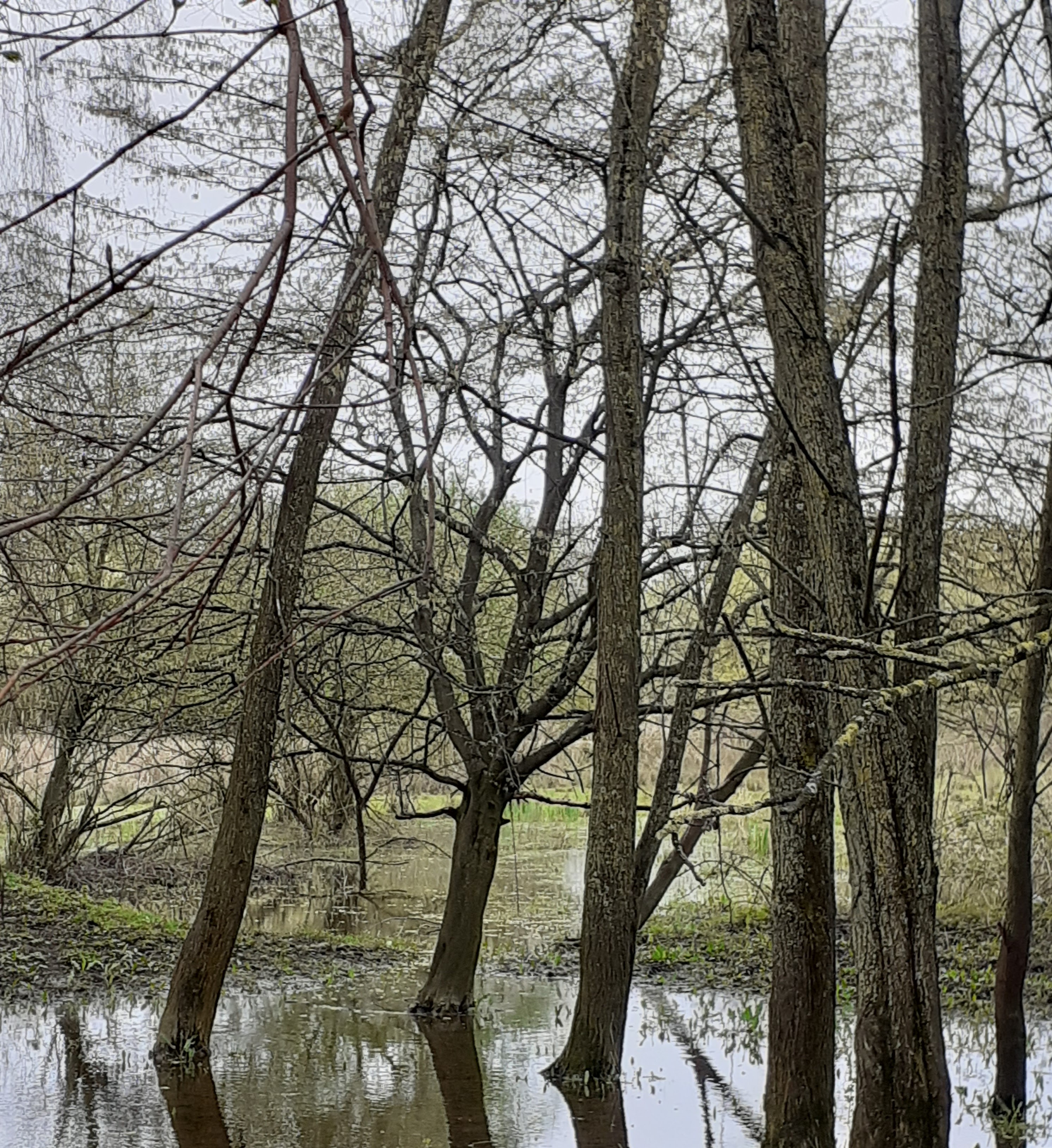
The picture above, taken in the mid-afternoon of the recent Winter Solstice, shows a local water meadow after heavy rain. My eyes are drawn downwards, to the reflections in the water and beyond. But height is there too, with trees and an early sunset sky. All with a sense of stillness. I felt in touch with the unknown within and beyond me, and open to the world.

Earlier in the day I had already been profoundly moved by the live-streamed funeral of John Heron, an elder for me in the field of humanistic and transpersonal psychology, and also in what he called ‘participatory spirituality’. This describes a ‘spiritual animation’ that occurs ‘between people, between people and place and other kinds of beings in place’. He saw this as a spiritual inquiry process, largely outside the traditions.

Over the last several days, I have been contemplating words, not by John himself but by Carl Rogers, the originator of person-centred counselling, about this kind of openness and its power. He wrote them in continuous prose, but I have re-arranged the spacing to help with my contemplative process. I find that they help me to better understand both my failures and my successes. They are a kind of direction for me. Although they are about being with people, they have become linked also with this landscape, because of the openness I felt there, in this liminal space.

“I find that

when I am closest to my intuitive self

when I am somehow in touch with the unknown in me

then whatever I do seems full of healing.

Then simply my presence is releasing and helpful to the other.

When I can be relaxed and close

to the transcendental core of me

it seems that my inner spirit has

reached out

and touched

the inner spirit

of the other.

Our relationship transcends itself

and becomes a part of something larger.”

MEDITATION, AND A BILLION-YEAR-OLD SENSE OF BEING

I enjoyed a recent piece on meditation by poet and spiritual teacher Jeff Foster. He is not talking about a traditional practice regime – whether of a mindfulness, pathworking, or energy-focused kind. Rather, he describes an encounter with the sacred in everyday life. Initially, this meditation attends to the flow of ordinary, embodied experience. It is informal, and not dependent on a dedicated environment or special conditions. As it develops, it sets free a healer in the heart, who stands by and resources the meditator rather than fixing their problems.

Meditation becomes as a ‘field of love, an ever-present ground of safety, presence and stillness’. It is personified through references to a ‘loving friend in the breath’, a ‘mother in the motherless places’, and a ‘billion-year-old sense of Being’. This is not meditation as generally understood. But I notice that I am nourished by Foster’s recommended approach, and I find myself responding to his impassioned language. Part of me wants to resist such intensity, but then happily melts on immersion in the process. Here is his piece in full:

“Meditation is not about getting yourself into altered states. Altered states do not last. It’s about becoming intimate with this state – this present moment, this day, this Now, its textures, tastes, vibrations, contractions and aches.

“Meditation is not an out-of-body experience. It’s the opposite. It’s a full experience of the body and its ever-changing sensations, its amorphous clouds of shivers, tickles, undulations and pulsations, throbbings, fizzles, its pain and its pleasure, its opening and closing, its ever-changing form.

“Meditation does not always make you feel ‘good’. In meditation, you feel exactly as you feel, and you learn to love that, or at least to allow it, or at least to tolerate it a little more than you did yesterday. Meditation makes you feel more like… you.

“Meditation is not about getting anywhere. It’s about discovering that there is nowhere to get to. That you are already home, and your body is the ground of all grounds. It is about discovering true safety in the feet, in the hands, in the pit of the belly. It is about finding a sanctuary in your chest, a sacred shrine between your eyes, a loving friend in the breath, a mother in the motherless places.

“Meditation is not something that you do with your mind. In meditation, the mind relaxes into the heart, seeking relaxes into finding, and even the most intense anxiety finds its home. You cannot make it happen, but you can fall into it.

“Meditation is not for experts, or the ones who know. Meditation is for absolute beginners, those who are willing to face their present experience with wide open, curious eyes.

“Meditation is a field of love, an ever-present ground of safety, presence and stillness, that you remember, or forget, or remember again.

“Meditation never leaves you. It whispers to you in the stillness of the night. And even in the midst of an activated nervous system, a full-on panic attack, suffocating claustrophobia or the urge to get out of your body… meditation is right there, holding you, loving you, gently kissing your forehead, willing you on.

“It will not abandon you, and ultimately, you will not abandon it.

“And closing your eyes to sleep at night, meditation is there, snuggling right up to you.

“Your soft pillow, the rising and falling of your own delicious breath, a light breeze coming in from the window, that billion-year-old sense of Being…

“You are safe in your own body, my love. You are safe.”

– Jeff Foster http://www.lifewithoutacentre.com/

FLIGHT FROM THE SHADOW

“There was a man who was so disturbed by the sight of his own shadow and so displeased with his own footsteps that he determined to get rid of both. The method he hit upon was to run away from them.

“So he got up and ran. But every time he put his foot down there was another step, while his shadow kept up with him without the slightest difficulty.

“He attributed his failure to the fact that he was not running fast enough. So he ran faster and faster, without stopping, until he finally dropped dead.

“He failed to realize that, if he merely stepped into the shade, his shadow would vanish, and if he sat down and stayed still, there would be no more footsteps.”

Thomas Merton (1965 & 2004) The Way of Chuang Tzu Boston & London: Shambhala, 2004. (First published 1965 by New Directions Publishing Corporation.)

Chuang Tzu, one of the great figures of early Taoism, lived around 300 BCE. The frontispiece of this edition says: “He used parables and anecdotes, allegory and paradox, to illustrate that real happiness and freedom are found only in understanding the Tao or Way of nature, and dwelling in its unity. The respected Trappist monk Thomas Merton spent several years reading and reflecting on four different translations of the Chinese classic that bears Chuang Tzu’s name. The result is this collection of poetic renderings of the great sage’s work.”

SURFACE AND DEPTH

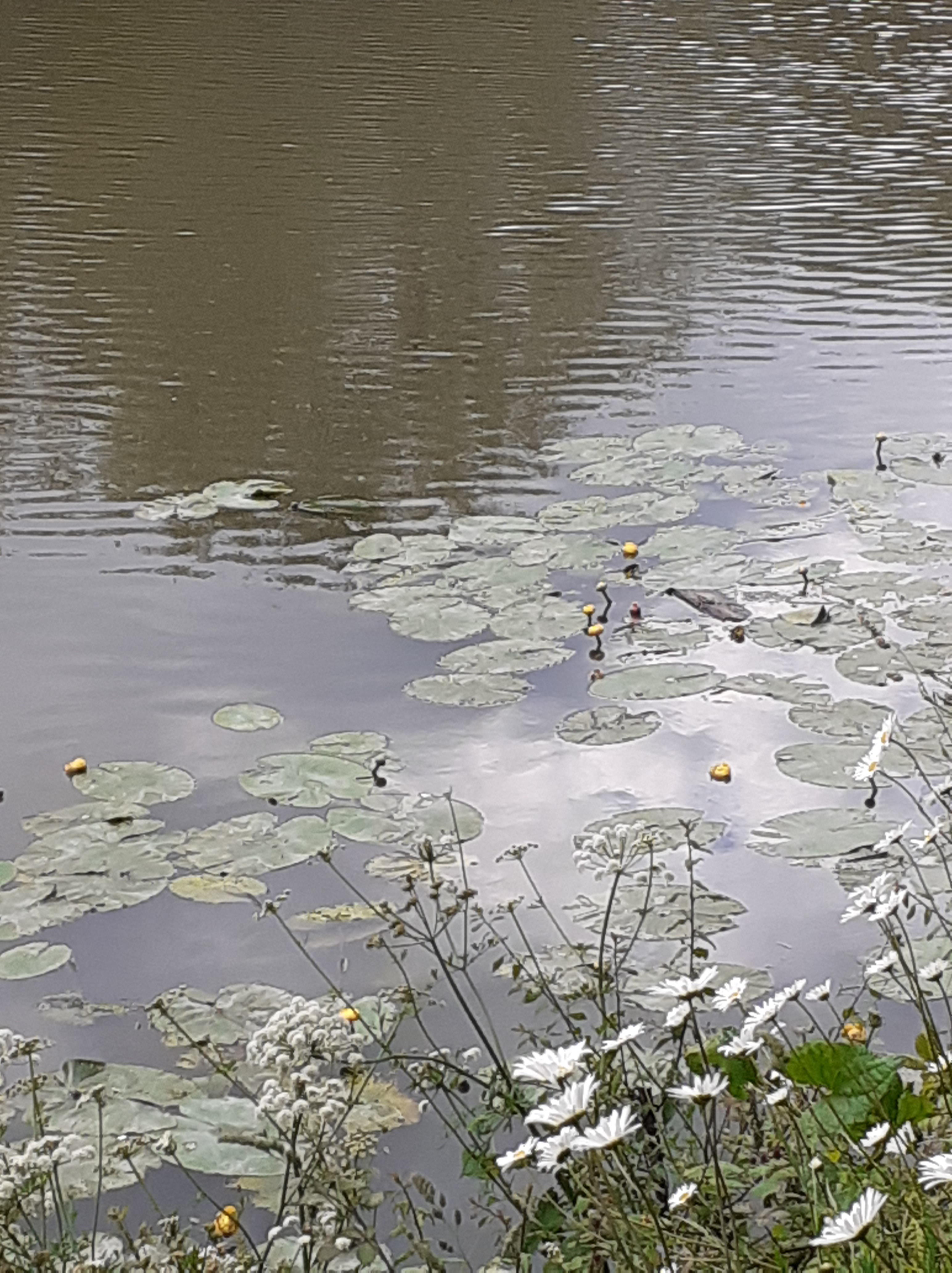
I took this picture some time ago and kept it as an image of tranquillity. Now, when I contemplate it for any length of time, the ripples on the water seem to be alive and moving. The vegetation, also alive, is still.

Although the scene presented here contains both stillness and movement, I identify strongly with the moving ripples in the background. Despite all my contemplative inquiring, movement continues to be my default setting, albeit now less agitated and turbulent than in the past. The phrase ‘stream of consciousness’ comes to mind. The natural flow of this stream includes spaces freed up from cogitation and narrative. But the stream flows on.

I am glad of this. Some traditional teachings, when emphasising the non-separation of ‘ocean and wave’, lean towards invalidating the individuality of the waves even whilst their brief distinctive identities last. But for me, the purpose of being human is to live a human life, knowingly embedded within a rich natural and cultural history. This is why I have stayed with modern Druidry as my main point of spiritual reference.

I have also found a liberating expansion of my human life in realising my non-separation from the living presence of the cosmos. It has busted me out of a certain kind of prison, one of neediness and dependency on surface satisfactions. Just as well, in an age of – increasingly surreal – ‘capitalist realism’ (1). Eckhardt Tolle has offered me the most convincing strategies for standing in the larger life – in particular through his recognition that ultimate satisfaction is inseparable from the present moment, and his account of what is really meant by that much abused term (2). He is currently a second point of reference in my spiritual work.

My photograph continues to offer an image of tranquillity. It is just that, at least for me, tranquillity isn’t as straightforward as it may look.

(1) Mark Fisher Capitalist Realism: Is There No Alternative? Winchester, UK & Washington. USA: O Books, 2009

(2) Eckhardt Tolle A New Earth: Create A Better Life London: Penguin Books, 2016 (Rev. ed. First edition 2005)

STRENGTH IN SIMPLICITY

In recent days, living a pared down life, I have seen the strength in simplicity. Both my contemplation and my inquiry are reflecting this. I have a few simple practices adapted from a variety of sources. At first under the pressure of illness, I have moved away from the kind of system building that was drawing my attention a month ago (1). Now I have reminded myself that customising, using a light touch, and keeping practice relatively simple has been my generally preferred way of responding to influences. It helps me to avoid half-awarely ventriloquising teachers and to maintain my own discernment.

As an example (2), I describe a simple meditation. It focuses on the breath because that is something I am busy with – and ambivalent about thanks to my COPD. In it I draw on the understanding that breath and spirit share the same word in some languages (e.g pneuma in Greek). No more than ten minutes is needed for a session.

Although simple, the practice does have a liturgical framing – for instance adapting one of Stewart’s Qabalistic crossing forms from The Miracle Tree. I also draw on my OBOD background, especially the commitment to finding peace. This kind of framing helps. In formal practices like this, I am not just plunging into raw experience. I have other opportunities for that. Rather, the practice affirms an already existing perspective, developed over time, and this is what the words proclaim.

(1) https://contemplativeinquiry.blog/2022/04/05/towards-an-integration/

(2) See text below:

Crossing, using my right hand, I say: In the name of Wisdom (forehead), Love (pubic bone), Justice (right shoulder), Mercy (left shoulder), and the Living Breath (both hands over upper chest). I enter stillness. Then I say: Deep within my innermost being, I find peace. Silently, within the stillness of this space, I cultivate peace. Heartfully, within the wider web of life, may I radiate peace.

I do a breath exercise*, and then say: I am a movement of the breath and stillness in the breath; living presence in a field of living presence: here, now, and home.

Then, I begin slow, deep breathing, as if inviting the Cosmos to breathe through me. I may use the I AM mantra. For me it affirms the non-separation of the finite life and the Source, and the gift of a place within the ecology of being.

On completion I repeat the Crossing and say: I give thanks for this meditation. May it nourish and illuminate my life. May there be peace throughout the world.

*11x breathe in through nose, counting to 8; hold, counting to 8; out through mouth, counting to 8, hold, counting to 8.

Earth Eclectic

music that celebrates Earth and speaks to the heart

Sarah Fuhro Star-Flower Alchemy

Follow the Moon's Cycle

Muddy Feet

Meeting nature on nature's terms

Rosher.Net

A little bit of Mark Rosher in South Gloucestershire, England

Becoming Part of the Land

A monastic polytheist's and animist’s journal

selkiewife

Selkie Writing…

Charlotte Rodgers

Images and words set against a backdrop of outsider art.

Prof Jem Bendell

living with metacrisis and collapse

Towint

The pagan path. The Old Ways In New Times

The Druids Garden

Spiritual journeys in tending the living earth, permaculture, and nature-inspired arts

The Blog of Baphomet

a magickal dialogue between nature and culture

This Simple Life

The gentle art of living with less

Musings of a Scottish Hearth Druid and Heathen

Thoughts about living, loving and worshiping as an autistic Hearth Druid and Heathen. One woman's journey.

Wheel of the Year Blog

An place to read and share stories about the celtic seasonal festivals

Walking the Druid Path

Just another WordPress.com site

anima monday

Exploring our connection to the wider world

Grounded Space Focusing

Become more grounded and spacious with yourself and others, through your own body’s wisdom

The Earthbound Report

Good lives on our one planet

Hopeless Vendetta

News for the residents of Hopeless, Maine