Contemplative Inquiry

This blog is about contemplative inquiry

Tag: Spring Equinox

SPRING EQUINOX 2025

Blessings of the season! The picture above was taken at 6.46 am, a little over half an hour after sunrise here in Gloucester. It is 20 March, the day of the Spring Equinox, which will be at 9.01 am this year. It is traditionally a time of celebration, a point of balance as we move into the light half of the year and the promise it brings. After a tough, and largely housebound year, I dare to hope that Elaine and I will be able to widen our horizons as her healing continues.

EARLY SPRING: AFFIRMING LIFE

I am connecting with spring and its urgent affirmation of life – its green shine and fecundity. It is the sunrise season, the season of early growth. For me, where I live, the immediate pre-equinox period often generates a strong feeling of dynamism and emergent potential. I am in sync with the awakening earth.

Elaine’s return from hospital and the enhanced clinical support she is receiving are helping me to live this season more fully. In our joint lives we are both feeling more agency in shaping a new phase in our life together.

In this moment I feel refreshed and optimistic within my Druid contemplative path. I have adjusted my formal practice so that I have two practice sessions in the day, both of them roughly twenty minutes long. The first, at the beginning of the day and standing, is affirmative and dynamic. It includes body and energy work and a theme of healing and rejuvenation. The second, at the end of the day and sitting, is contemplative. It includes breathwork, a mantra meditation using beads, and prayer. In the modern Druid manner it includes a commitment to the collectively imperilled qualities of love, peace and justice. This shift is having a renewing and reinvigorating effect on me, as befits the season: another way of gratefully affirming the gift of a human life.

MARCH 2024: WIND IN THE WILLOWS

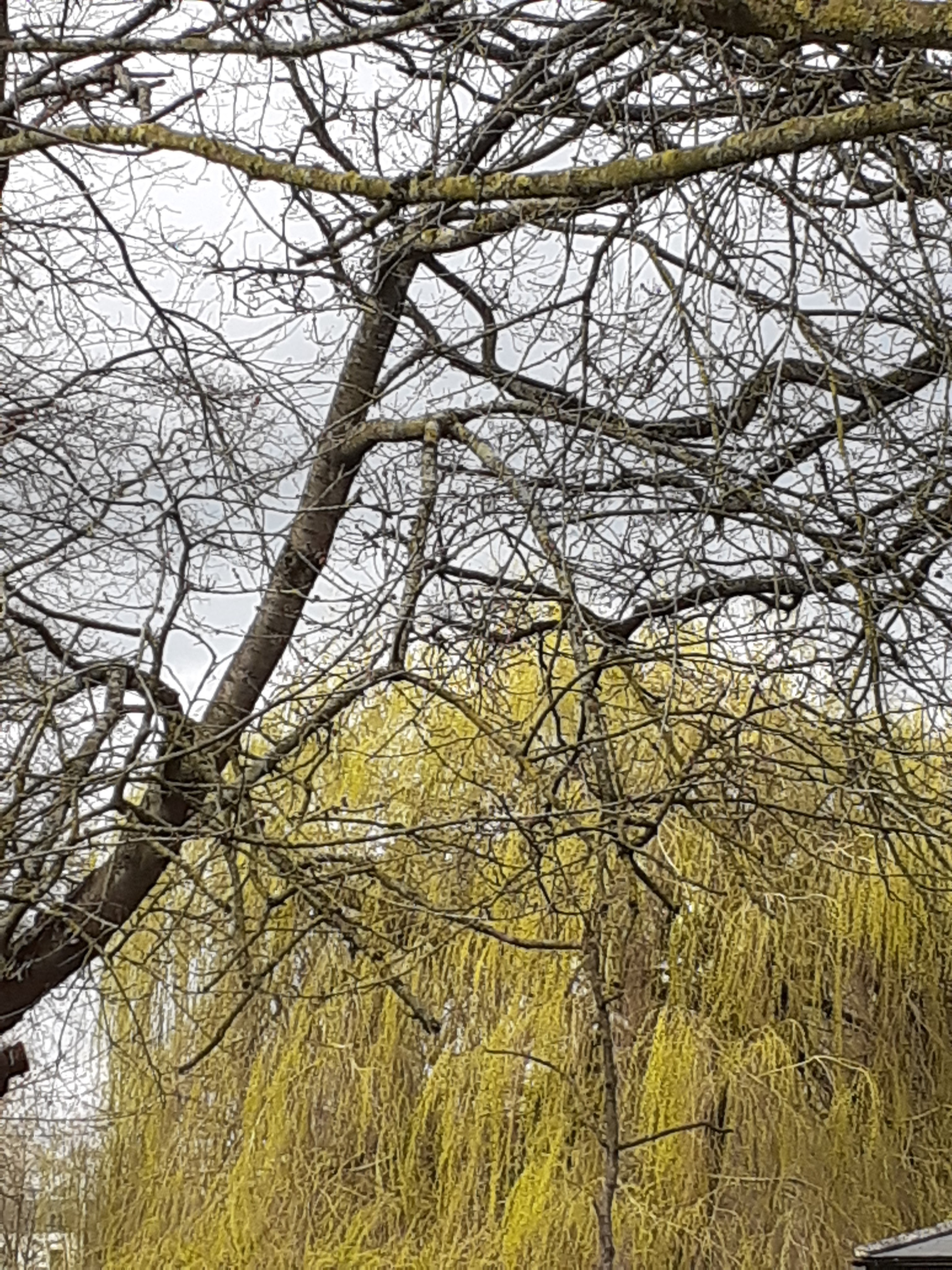
I’m walking in my local park. It’s a dull day in the first half of March. There have been many such days, and I could do with more sun. I certainly feel lifted when it comes. At the same time the days are longer and Mother Nature is busy with the work of spring: an abundance of willow catkins is testament to this.

I get my strongest impression of the strength and fecundity of willow when close up. The individual catkins are clearer, more prominent. The colours are stronger. There’s the sense of a rich and vibrant ecosystem, powerfully alive.

Still images don’t provide movement and sound, or indicate the presence of the March wind. I have tried to capture this in my short video below, illustrating another aspect of this moment in the year. It brought up fond childhood memories of Kenneth Grahame’s The Wind in the Willows which begins with spring cleaning and includes the gently Pagan chapter The Piper at the Gates of Dawn.

Willow became important to me in my early study and practice of Druidry. I began a special relationship with a particular willow in Bristol for many years (2), which continued after I left the city and continues sporadically to this day. I also developed a private tradition of following the wheel of the year through a mandala based on 16 trees, all in easy distance of where I lived, with Willow the focus from 17 March to 7 April, hence presiding over the spring equinox (3). Checking in with the willows is a continuing feature of my walks, though I was a little early this year.

(1) Kenneth Grahame The Wind in the Willows London: Dean, in association with Methuen’s Children’s Books, 1991. (Ist ed. 1908. Illustrated by E. H. Shepard)

(2) https://contemplativeinquiry.blog/2013/1/31/willow/

(3) https://contemplativeinquiry.blog/2021/03/17/tree-mandala-willow/

THE PEACE OF THE GODDESS

This post follows on from my recent post on Patterns and Peace (1). There, I discussed the role of ritual patterning in a sunrise practice. Here, I discuss the role of meditation in a sunset one. In both cases I experience peace as an active energy – empowering, nourishing, and close to the Source.

In the evening I do not cast a circle. I simply sit down facing my altar and say: May there be peace in the seven directions. May I be present in this space. I say the Druids’ prayer, affirming the commitments to a love of justice and the love of all existences. I see them as the necessary context for the manifestation of true peace in the world.

I talk myself in to the meditation itself with other words customised from Druid tradition: Deep in my innermost Being, I find peace. Silently, in the stillness of this space, I cultivate peace. Abundantly, within the wider web of Being, may I radiate peace.

Starting with a focus on my heels, extended to include my feet as a whole, I tune in to my felt sense of body and life energy. Moving gradually up my body, I pay close attention to my emerging experience of a physical and energetic field, which I find to be light and spacious. I also notice the breath. Surrendering to this universe of internal experience, I can enter an awareness of deep peace, joy, and wonder at the miracle of experiencing. This is beyond ‘At-Homeness in the flowing moment’. I call it the Peace of the Goddess.

Coming out of meditation, I say I give thanks for this meditation. May it nourish and illuminate my life. May there be peace in the seven directions. May I be capacity for the world.

I do not meditate for long periods. This whole practice, including liturgy and meditation, takes about half an hour. The phrase ‘capacity for the world’ uses the language of the Headless Way (2) and indicates that if we enter into our true nature as clear awake space, we become, in our everyday lives, ‘capacity for the world’. The meditation is both the experience that it is, and a resource for life and contribution to the world.

I have done meditations of this kind for many years. Recently, this meditation has become richer and more focused. I believe this to be partly due to practice and partly to the season – I find both equinoxes enabling for meditation. But there is also the benefit of increased understanding. I am grateful to Eckhart Tolle, whose work I have begun to engage with, when he says: “What I call the ‘inner body’ isn’t really the body any more but life energy, the bridge between form and formlessness … When you are in touch with the inner body, you are not identified with your body any more, nor are you identified with your mind. … You are moving away from identification to formlessness, which we may also call Being. It is your essence identity”.

(1) https://contemplativeinquiry.blog/2021/03/12/patterns-and-peace/

(2) http://www.headless.org

(3) Eckhart Tolle A New Earth: Create a Better Life Penguin Random House UK, 2016 (First edition 2005)

Re Druids’ prayer see: https://contemplativeinquiry.blog/2021/02/22/ripple-effects-where-prayer-can-be-valid/

IMAGES OF LOCK-DOWN

I am still going for walks, though not every day, and not for so long. The pictures I am sharing are from Tuesday 24 March, with a new social reality now firmly in place. The road above is the A46, running through Rodborough Parish into Stroud Town. The time is late morning. Normally, it takes a far greater volume of traffic, including much heavier traffic, than it was built for. It is frequently gridlocked. There are too few crossings, and it is a real obstacle for pedestrians. A mile or so away, close to a large Tesco supermarket, we find a roundabout where much the same could usually be said. Not any more.

Walking right across the middle of the roundabout with ease, I went on to Stratford Park, one of the town’s great amenities. The Museum in the Park in particular is a major cultural hub.

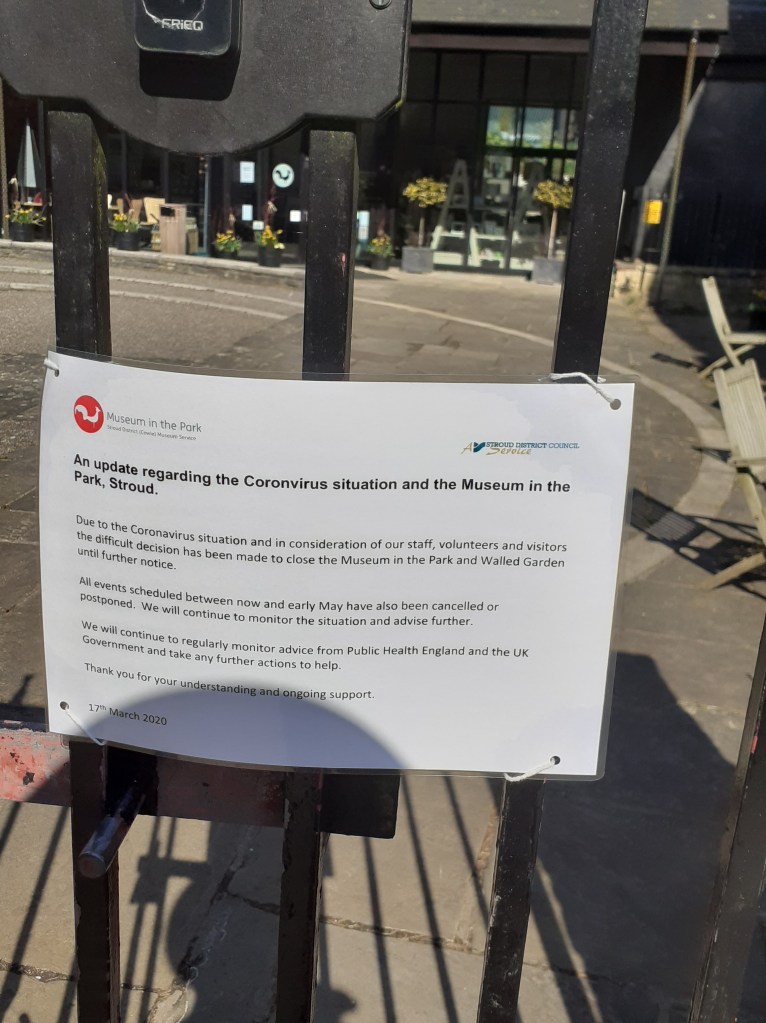
When I got here, I experienced a change of mood. I’d been enjoying the state of the roads. It felt like a holiday. I wish I lived in a world of much lighter traffic. But the museum notice was sobering. I had a real sense of loss.

The park itself felt surreal. It wasn’t quite deserted. There were a few people like me, now careful in keeping a distance from each other, in some cases wryly smiling or gesturing a friendly sense of shared plight in our manoeuvres of avoidance. Major features in the park, like the orangery, and the trees behind it, had an aura of lonely magnificence. The human element was dwarfed.

Entering the orangery, I felt sad that the flower beds laid out there won’t be seen by many people this year. In this bright, sunny day, they were stunning.

This walk was the first on which I felt less relaxed about being out – a little on guard and wary. I was somewhat reassured by the built and cultivated environment I was in. It hadn’t changed and in some ways was easier to enjoy, with fewer people, greatly reduced traffic and little obvious busyness. The people I encountered were clearly doing their best. But I was also conscious that this is an early stage in a process that has a long way to go. There was surface tranquillity on a beautiful spring day. But I was uneasily aware of a great deal going on that I didn’t see, in the many houses I passed by, and which my camera hasn’t captured.

SPRING EQUINOX 2020: IMAGES OF HOPE?

A lone fawn protected by a dolmen. Boxing hares. A drill bow kindles a flame. As I move beyond the equinox into the second quarter of the year, what are these images telling me?

I am working with the Wildwood Tarot* as a resource for my journey through the wheel of the year. I’ve done a three card reading to intuit themes for the three months ahead. Each card is a lens on the whole period, revealing different aspects of the year’s second quarter, perhaps with an element of progression.

The key word for the 4 of stones, the one with the fawn, is ‘protection’. The supporting Wildwood text is largely a reflection on spiritual warriorship, with themes of testing, endurance, ethics and compassion. They help me to understand our public health crisis as also a spiritual crisis. Fortunately, the dolmen holding the fawn in immobilised physical safety can also be a space for spiritual renewal.

The 2 of stones, with its boxing hares, is another earth card and stereotypically seasonal. Its key word is ‘challenge’. In the traditional universe of the Tarot, One becomes two, and then three, and then the multitude. The opportunity for I-Thou relationship, diversity and the world of interbeing have been created. At the same time stress, tension and potential conflicts of interest have been born along with them. Interconnectedness sounds rich, creative and dynamically supportive. So it can be. Yet relationships involving dominance, submission, predation and parasitism are also forms of interconnection. Viruses too.

I don’t know what it’s like to be a hare. I have been told by other humans that boxing hares are playing a mating game, enacting a mating ritual, or demonstrating that female hares are capable of seeing off unwanted advances from males. Perhaps all of the above. They certainly demonstrate the complexities of interconnection. Currently I describe myself as ‘self-isolating’, and this is likely to go on for at least the whole quarter. Actually, I am self-isolating with my wife Elaine, and we are very conscious of needing to take active care of our own relationship and to maintain good distance links with others. The health of the interconnectedness within which we live is more important than ever. I take some comfort here from the boxing hares. Their energies are successfully held in balance. Their collective life and its continuation over the years are enabled. They are resourceful creatures and our traditional lore about them speaks of shape shifting capabilities and closeness to the Otherworld. They are survivors.

The key words for my third card, the Ace of Bows, are ‘spark of life’. In a reading without major trumps or court cards, this stands out as the fountainhead of the fire suit and in the Wildwood Tarot it points to the later stages of this quarter, from Beltane to the Summer Solstice and indeed beyond. It introduces human agency and technology, and is associated with creativity, enterprise and science: “The drill bow suggests the human element, our partnership with the environment in which we live and the mastery of its gifts”. I find myself placed in a somewhat passive position, but I am part of a wider community. I do have confidence that creatively scientific and genuinely enterprising efforts will be brought to bear on the current health crisis. ‘Spark of life’ resonates favourably for me, without saying anything specific about my individual future.

The three cards together encourage a strong focus on my contemplative inquiry, including this blog. The inquiry is personal, and in the language of Wildwood maintains my link to the Otherworld. It is also public, because of the blog, and can therefore play a role in a larger effort to use blogging and social media in the service of healthy interconnection. Wildwood’s suit of bows talks of ‘philosophical and esoteric pursuits’ as a form of “skilful ability fuelled by will”, along with the creativity, science and enterprise already noted. I would like to think of my contemplative inquiry as a manifestation of this, and I hope that it can be a form of service in the forthcoming quarter and beyond.

*Mark Ryan & John Matthews The Wildwood Tarot Wherein Wisdom Resides London: Connections, 2011. Illustrations by Will Worthington

THE FIRST QUARTER

I began closely following the wheel of the year – not only the festivals – just before the winter solstice. I wrote then that “my current warm up process is already changing the way I think and feel about contemplative inquiry and will re-shape how I do it”*. How has the first quarter been?

I’ve been outside, taking pictures, concerned with visual images and the stories they tell. There’s been some tension between communing with nature and being a self-conscious observer, actively selecting images. But on the whole it works. Taking pictures slows down my walks, opening up opportunities for stillness and mindful micro movement. Special moments come by themselves – or not. In sharing my experience, the process offers the opportunity to show as well as tell.

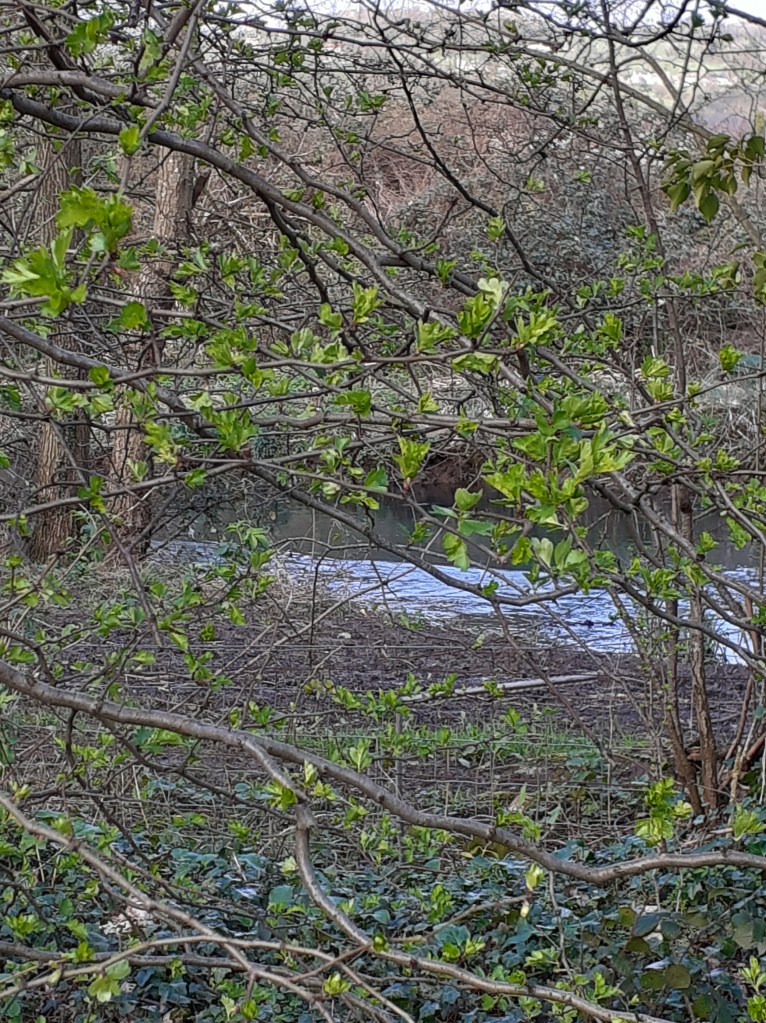
The quarter has been very wet – the picture above, taken on 15 March – shows a continuing abundance – to the point of excess – of water. It is beautiful and entirely natural, but for me also part of a story of times out of joint, and the increasing impact of the climate crisis. The picture below, also taken on 15 March, adds to this story in two ways. One is the suggestion of dank fecundity in the abundance of moss on a branch. The second is the indication of a lost branch from the same tree. High winds have caused considerable destruction in the woods in my neighbourhood. In both pictures, there are cues for appreciation and tranquillity, whilst also an indication that significant other things are going on. My current approach to contemplative inquiry has helped me to notice this and pay greater attention to it than I might otherwise have done.

The second quarter of the year will be different. I have self-isolated in response to Covid-19 though I am still going out on walks. I am likely to double down on contemplative practice and inquiry at home. I strongly believe in contemplative practice as, among other things, a resiliency factor in personal wellbeing, enhancing my experienced quality of life. I will talk more about this in future posts.

SPRING, GRATITUDE AND COVID-19

On Friday 13 March I tasted spring in its fullness. I was flooded with gratitude. Yet ‘gratitude’, especially in religious settings, was for a long time a tainted term in my life.

Growing up, I faced demands to be grateful whether I felt it or not. Over time I came to link this idea to formal performance and competitive public piety: being seen to be ‘good’. It also left my natural feelings of gratitude, when they came up, unrecognised and untended. In this stunted state I developed a cynicism about how language is used, rather than finding ways about how, authentically, to identify and cultivate my own sense of gratitude.

I am sad about this, because, even from a self-referential perspective, the capacity for gratitude is linked to wellbeing, happiness, self-acceptance and a sense of purpose in life. Psychological studies (1) show that gratitude is an active agent and not simply the result of already existing wellbeing. Exercises in gratitude work for many people, for much of the time. There are now considerable academic and self-help literatures on the subject.

Most spiritual traditions recommend gratitude, and for many of them this is linked to a sense of the divine, or some other ultimate point of reference. But this isn’t necessary. Gratitude is named as the third of thirteen principles in Atheopaganism (2), which is based on an entirely naturalistic, science-based cosmology. Here too, gratitude is seen as a habit that has to be learned and practised. The practice can alter both our internal dialogue and our behaviour. “It is good for ourselves, our relationships, our society and our world”.

I came late to gratitude, in the sense being discussed. But I’m a convert now. Being older has somehow helped. There was a decisive moment just under fifteen years ago, when I was 56 years. I was diagnosed with a cancer that might have killed me and I started to ask myself how I was going to maintain my quality of life remaining if I found myself on a downward slope.

I concluded that I would need to do what I could to count my blessings whilst I still lived. I recovered – with the insight still in place. I have built on that with greater awareness over the years, especially since beginning my contemplative inquiry. Now I’m nudged by the coronavirus and the same principles apply. I’m enjoying the experience of spring, usefully aware of my mortality, and grateful to be here, now.

(1) Rupert Sheldrake Science and Spiritual Practices Coronet, 2017

(2) Mark A. Green Atheopaganism: an Earth-Honoring Path Rooted in Science Green Daragon Publishing, 2019 (Foreword by John Halstead)

RESILIENCE AND REGENERATION

In my world, early March is a pre-equinoctial period of its own. In the emergence from winter, it manifests both resilience and regeneration. This year I have experienced an elephant’s ears plant (bergenia cordifolia) as an marker for resilience. This evergreen lives close to our back garden gate. It has been flowering, and it leaves have kept shiny, for most of 2020 so far. It has given me a lift every time I have walked past it, in all manner of weather. I feel grateful to it just for being there.

Why have I noticed it this year in particular? In the past I’ve taken this plant for granted. I’ve walked past without seeing it. I’ve only paid attention when the leaves need pruning, having strayed onto a path. Yet now this plant feels like a friend and nourishes me with its presence. It doesn’t just demonstrate its own resilience. It supports mine. I’ve been experiencing 2020 as tough and likely to stay that way, so I suppose that something in me has been looking for ways of feeling resilient. As a result, I’ve been able to notice something that’s been there all along, though largely neglected.

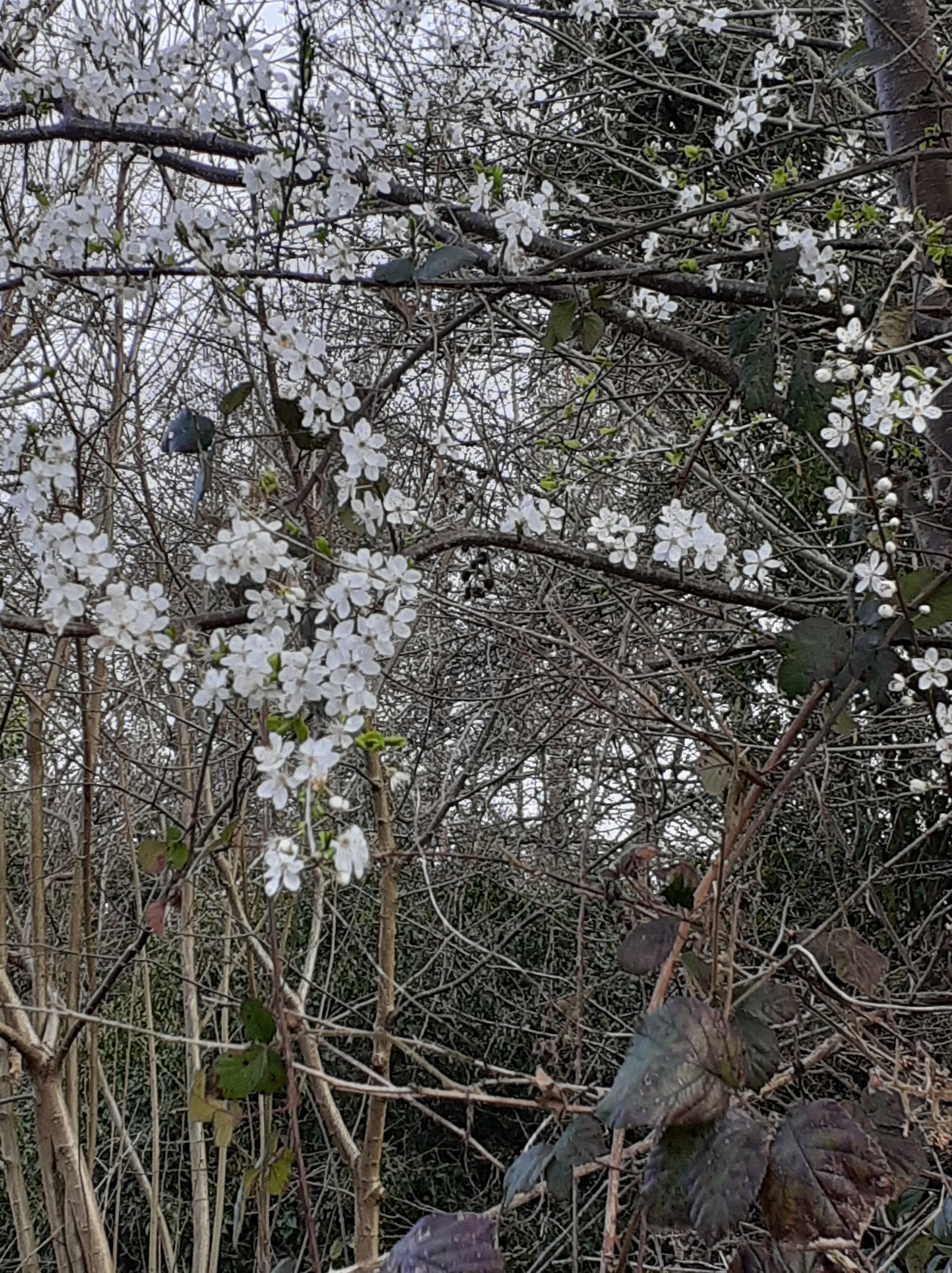
As well a resilience, I’ve been having a sense of regeneration, though the dynamics are a little different. One difference is that I expect to be leaning into regeneration at this time because it’s part of my wheel of the year narrative. I also expect it to be linked to the presence of willow trees (see picture below) because I befriended one many years ago. I have stayed in touch even after moving to a different town. The early re-greening of willow trees is part of my direct experience, and also part of my myth. It feels as if I am being taken by the hand and led towards the equinox.

I don’t want to get there prematurely. A patient, attentive journey emphasises the freshness and novelty of each year. I took the photograph below a couple of days ago on impulse, and it felt like a nudge into a process of renewal that I don’t want to undertake too quickly and don’t want to make assumptions about. Regeneration happens. Although I’m starting to feel my age, I’m still part of it. Let’s see how it goes in 2020.

Earth Eclectic

music that celebrates Earth and speaks to the heart

Sarah Fuhro Star-Flower Alchemy

Follow the Moon's Cycle

Muddy Feet

Meeting nature on nature's terms

Rosher.Net

A little bit of Mark Rosher in South Gloucestershire, England

Becoming Part of the Land

A monastic polytheist's and animist’s journal

selkiewife

Selkie Writing…

Charlotte Rodgers

Images and words set against a backdrop of outsider art.

Prof Jem Bendell

living with metacrisis and collapse

Towint

The pagan path. The Old Ways In New Times

The Druids Garden

Spiritual journeys in tending the living earth, permaculture, and nature-inspired arts

The Blog of Baphomet

a magickal dialogue between nature and culture

This Simple Life

The gentle art of living with less

Musings of a Scottish Hearth Druid and Heathen

Thoughts about living, loving and worshiping as an autistic Hearth Druid and Heathen. One woman's journey.

Wheel of the Year Blog

An place to read and share stories about the celtic seasonal festivals

Walking the Druid Path

Just another WordPress.com site

anima monday

Exploring our connection to the wider world

Grounded Space Focusing

Become more grounded and spacious with yourself and others, through your own body’s wisdom

The Earthbound Report

Good lives on our one planet

Hopeless Vendetta

News for the residents of Hopeless, Maine