Contemplative Inquiry

This blog is about contemplative inquiry

Tag: Spirituality

CONTEMPLATIVE DRUIDS UPDATE

2016-01-10 16.50.19Update on our presence at public events in 2016. These are the Pagan Federation Wessex Conference on 9 April, the Barmoor Druid Weekend 19-21 August, and our own Day Retreat at Stroud on 1 October. Here are the details.

Elaine and I will be on a stall at the Pagan Federation Wessex Annual Conference for the morning and part of the afternoon. The conference is on Saturday 9 April at The Village Hall, Whitminster, Gloucestershire. If you are going you are welcome to have a chat to us in between the talks, pick up a leaflet or buy a book or an original art work. Doors will open at 09:45 with the opening ceremony performed by the PF Wessex Team taking place at 10:15. The talks are scheduled to end at 17:15.

In the evening the doors will open at 19:30. A fully licensed bar will be available and entertainment will be provided by Tinkerscuss and Finnegans Wok Ceilidh Band.
Tickets for the whole event costs £20 for Pagan Federation members and £24 for non-members. You can also purchase tickets for just the day or the evening. Further details here: http://conference.pfwessex.org.uk/

Barmoor Weekend 2016 On their Facebook page Barmoor Druid Weekend the organizers make this invitation: “For all those on a druid/pagan/nature-based spiritual path, please join us for the 4th annual Barmoor Weekend at Hutton-le-Hole, a delightful village in the North Yorkshire Moors National Park near Pickering. The dates are Friday 19 – Sunday 21 August 2016. The main theme this year is divination but there will also be a variety of other workshops”. One of those workshops will be a contemplative session lead by Elaine and me, and thus far scheduled for the Saturday morning.

The weekend is about sharing friendship, sharing our skills, our dreams and spiritual practices. The cost is £45 all-inclusive of vegetarian meals and accommodation. There is a facility to message the organizers on the Facebook page. Hannah Silcock is the primary contact.

On 1 October we are offering a dedicated Contemplative Day Retreat in Stroud, Gloucestershire, in the group room of the former St. Luke’s Medical Centre. led by James Nichol, Elaine Knight, Nimue Brown and Tom Brown. Tom is an addition to the 2015 team and will be offering a session on contemplative drawing. The day will also include contemplative walking outdoors and our ‘Awen space’ practice. Arrive at St. Luke’s Medical Centre from 10 a.m. for 10.30 start, ending at 4.30 pm. £30 full, £15 concessionary. For full details see http://contemplativedruidevents.tumblr.com and for questions and booking write to grovelight@hotmail.co.uk 2016-01-10 16.50.19

SOPHIAN MAGIC 101

My Temple of Sophia is a magical space. So what do I mean by magic? What is its place in a contemplative inquiry? What makes it Sophian?

On magic, I tend to take my cue from R.J. Stewart (1). He says: “Magic is a set of methods arranging awareness according to patterns. The serious application of magical methods leads to transformation; it is the transformation that is of value, not the magical methods themselves. The basis of magic is utterly practical and experiential”.

This is very good news from an inquiry point of view. Stewart is careful to say that magic is neither a truth or religion – nor yet a philosophy, though “echoes of profound philosophy” are to be found within magical traditions. In my universe, the Way of Sophia is more than a magical tradition. But magic, with its precise focusing of will and intention, its experimental approach, and its interest in outcomes, has a strong and valued place.

When starting an inquiry, I prefer to start with some sort of model, from which I will depart over time after I have gained enough experience to evaluate and modify it. R.J. Stewart – again – is a good model of Western Way integration, in particular through bringing together Celtic traditions and Kabbalah. In my Way of Sophia work I will be drawing on  Kabbalist patterning – again with the intention of gaining experience and then playing creatively. Indeed, this process has already begun.

I inaugurated my Temple of Sophia at about 4 a.m. on Tuesday 22 March and I am following Stewart in his view of five fundamentals in magical practice. As I move around the circle, I notice a cousinship with my previous OBOD Druid practice, whilst also recognizing difference.

CONCENTRATION – linked to the east, the element of air, and a view of origination.

MEDITATION – linked to the south, the element of fire, and a view of creation.

VISUALISATION – linked to west, the element of water, and a view of formation.

RITUAL PATTERNING – linked to the north, the element of earth, and a view of expression.

MEDIATION – the fifth fundamental, associated with Spirit, and in circle terms at the centre. Stewart points out that in mystical and religious discourse, the word ‘inspiration’ is used as an alternative. But in this context I find mediation the better word, more powerful as well as more specific. In the most general terms, we mediate the “constant power of Spirit”.

I want to say a little bit about all five fundamentals, with a particular emphasis on CONCENTRATION at this stage. Stewart says that before even starting, we need some ability to achieve inner silence, stilling the repetitive dialogue that we all have. In this context we are simply looking for a level of silence that will allow us to switch our focus fully onto the relevant inner disciplines. We are not here in the business of investigating the monkey mind itself. Stewart (1) offers brief exercises specifically for stilling the mind and generating silence. Having achieved this, we launch the work. Achieving silence is the first use of concentration. Holding it throughout the magical working is the next. Will Parfitt (2) has a valuable comment about concentration. It is often seen as strenuous, about being “very deliberate”, indeed somewhat compulsive – and above all an effort. He reminds us that it does not have to be this way. He notes that children at play concentrate effectively – to the point where it is hard to draw them away – yet without obvious strain and effort. This is possible because they are interested and excited. He says “it is that simple – if you are interested you can concentrate; if you are not interested you can’t and would be better off doing something else”. When I re-read this I felt sad for the many children and adults who lack adequate choices in this matter. More happily, I have noticed that I am finding concentration in the Temple of Sophia easy. My will and enthusiasm are behind it.

R.J. Stewart offers concise and simple definitions of meditation, visualization and ritual in magical work, and I will see how I go with these, in this inquiry, as time goes on:

MEDITATION: the discipline of directing consciousness inwardly upon chosen subjects.

VISUALIZATION: the act of controlled image making and development of inner vision.

RITUAL PATTERNING: the fusion of creative imagination with effective expression.

On MEDIATION I need to say a bit more, because this is where I become specifically Sophian. The purpose of my Temple is to mediate the Light of Sophia. For me, at this stage, this involves both energetic and contemplative work.

The energetic work is based around a strong development of Kabbalist middle pillar practice where I open myself to the light presence and light energy of Sophia, and let them fill me. Over the last few days this has had very strong effects. At an inquiry level, outside the Temple, it raises a Kabbalist version of the “are chakras real?” question. I’ll be writing about that in due course. On the contemplative side – again using an R.J. Stewart definition relating to magical work – I enter into a “wordless, formless fusion of consciousness with a chosen subject”.

This is the Light of Sophia – and I sit within the light generated by the energy work, and indeed go through a process that leads, when the work is going well, to the wordless, formless fusion described, wrapped and rapt in a form of Samadhi. But the larger aim is both to be and to represent that Light in the world – to mediate it. I will say more about all this, and what it means, when I better understand the implications for me. So far I know only that I have a strong sense of contact and a general direction. The inquiry itself will show me the way.

  • J. Stewart (1987) Living Magical Arts: Imagination and Magic for the 21st. Century Poole: Blandford Press
  • Will Parfitt (1988) The Living Qabalah: A Practical and Experiential Guide to Understanding the Tree of Life Shaftesbury: Element Books

WESTERN WAYS II: MOVING TOWARDS SOPHIA

In my earlier Western Ways post I talked about a distinction between a ‘Native’ Tradition and a ‘Hermetic’ one, acting as “complementary opposites”. The first was said to be concerned with “ancestral earth-wisdom”, whilst the second was described as a “path of evolving consciousness”. (1)

I am influenced by this idea and the distinction that is being drawn. But I have a different sense of the detail, and a different experience of how these themes have played out in my life. My original choice to ground myself in Native tradition resulted from an experience in the Orkney’s. I was allowed to hold an ancient eagle claw necklace and an extraordinary energy shot through me – ancestral power, certainly, and a lesson in taking the heritage of land and ancestors seriously. However my current  of Druid doesn’t directly follow on from this experience, but is, rather, a contemplative nature mysticism. This is spacious and gentle and from my perspective generally works well in both its personal and collective versions. I feel satisfied with what I am doing and, in a good way, my inquiry energy for it is waning, even as my practitioner energy is present and available..

For me, now, the call of Sophia is more dynamic. It is a call from the other half of the Western Way – though not strictly Hermetic, because not concerned with the Greek-Egyptian figure Hermes Trismegistos. So I have decided to make my Way of Sophia the focus of a new  personal inquiry cycle. It is not like starting something new. It is more about making this aspect of my spirituality more focused and specific.

In my private sacred space I will establish a Temple of Sophia and this will be separate from from my involvement in Druidry. Ultimately there will be an integration and unity, but I’m aiming to craft a coherent overall Way. I’m not happy to treat pick’n’mix eclecticism and pluralism as more than a staging post. I want to give the Goddess her due and discover for myself how these apparently diverse approaches fit together. I hope that this may be of interest to other Druids, since many of us have a simultaneous engagement with other traditions.

I will report developments in this blog, and I will also continue to write posts outside the inquiry, including book reviews, poems, Druid contemplative developments, and other news and events.

  • Caitlin & John Matthews (1986) The Western Way: A Practical Guide to the Western Mystery Tradition: Volume 2 – the Hermetic Tradition London: Arkana

CONTEMPLATIVE INQUIRY IN ACTION

For me, active spirituality is based on inquiry rather than faith. Formal inquiry moves in cycles, and in my experience each cycle has a number of phases:

  • Intuitive musing, gradually distilling into a sense of direction
  • Crystalizing intent, and refining it with the work of preparation
  • Actualizing the intent
  • Relaxing after the intent is achieved
  • Reflection/review on the process and harvesting its fruit
  • Wondering whether the inquiry needs another cycle, which may move me on to more intuitive musing …

I’ve just had a period of down time from intensive practice. For a few weeks I let it go, my attention elsewhere. I’m just beginning to pick the work up again, at a reduced level of intensity. My sense of things after the break is not quite the same as my sense of things before, even though there is a great deal of continuity. Now as I return to the work, I would describe my Druid contemplative inquiry as being in the reflection phase of a long cycle.

Late in 2011 – specifically at Samhain – I was sufficiently prepared and intentional to launch an inquiry into contemplative practice within a Druid setting. This launch was fully ritualized and dedicated to the Goddess in her wisdom aspect. It was both a personal and collective inquiry from the beginning, and in this post I’m thinking mostly about the collective work. From the beginning of 2012 I was reaching out to and involving other people, with the first retreat day in July of that year.

Along the way we have co-created specific forms of group work. By the Spring of 2014 I had enough sense of the work and its direction to devise the questions for the interviews in Contemplative Druidry: People Practice and Potential and in this period I began the interviews themselves. The book was published in the following October. Two years later we have an available and tested means of doing Druid contemplative practice in group settings. Speaking for myself, this has made contemplative Druidry easier to talk about as a community practice, because I have a point or reference which involves things that people do and ways in which we benefit. This helps to keep the conversation grounded.

I now feel confident to let the process evolve by itself. I expect change and development and I expect to have a role in them. I want to reflect on how the process went and draw some conclusions. I will continue to integrate the work into my life. But I don’t think I need another inquiry cycle.

I’m in a parallel process in my personal contemplative practice – also at the reflection/review stage, but I’m not as far on with that and not yet clear about further cycles. More of that later. If there is another cycle I’m not sure that it will be either entirely contemplative or entirely Druid, though it will certainly incorporate elements of both and the learning from them.

BOOK REVIEW: BRIGID

jhp563383c26ba72

Timely and highly recommended. Brigid: Meeting the Celtic Goddess of Poetry, Forge and Healing Well is shortly due for release in Moon Books’ Pagan Portals series. Author Morgan Daimler describes it as “a resource for seekers of the pagan goddess specifically”, offering “both solid academic material and anecdotes of connecting with Brigid in a format that is accessible and designed to be easy to read”. On my reading, this is an accurate description, and in my estimation Brigid takes its place as a valuable addition to modern pagan literature.

As Daimler points out, the Celtic Goddess Brigid is well known and popular. In the Gaelic-influenced world, she has an alter ego as a powerful Christian saint. Yet what we know, or think we know, is selective and potentially confusing for today’s pagan seeker. “The lore of the Catholic saint is attributed to the pagan Goddess, and some people see shadows of the Goddess in the saint. For many people new to Brigid, or to studying Celtic or Irish mythology, it can be extremely confusing to try to sort out the old beliefs from the modern, to tell the Irish from the Scottish. The end result is that some people who are drawn to honor the Goddess Brigid find themselves lost in a seemingly endless assortment of possibilities”. Yet, in an intentionally short and simple book, Daimler does a great deal to sort out potential points of confusion and help her readers to find their way. She also includes an important chapter on Brigid by Other Names – which include the Brythonic Brigantia, the Gaulish Brigandu and the name Ffraid in Welsh.

Brigid devotes considerable attention to mythology, and to traditional lore and festivals (including a reference to the American groundhog day). But, as a modern Polytheist Pagan, she also has a lot to say about Brigid as she is today, including modern versions of practices like the making of offerings, flame-tending, the creation of altars, divination, meditation and prayer. There is a complete chapter on Prayers, Chants and Charms. Above all, Daimler shares something of her own journey, and the numinous experiences she has had through her Brigid connection from the beginning of adolescence to a present in which she is devising Imbolc rituals with her children. Standing as she does in Irish Reconstructionist Polytheism, she says that “I do not think that the religious framework we use to connect to the Gods matters as much as the effort to honor the old Gods itself. I think that we can all do this respectfully and with an appreciation of history without the need for any particular religion”. Brigid: Meeting the Celtic Goddess of Poetry, Forge and Healing Well amply fulfills its author’s aim of helping its readers to benefit from time spent “getting to know Brigid”.


TWO RINGS

Last Wednesday, 17 February 2016, I married Elaine Knight. We’ve known each other for something like 25 years. We’ve been partners for nearly 11 years, living together for over 7 of them. Elaine is still Elaine Knight – she’s not changing her name. We will continue to have large spheres of autonomy  as well as togetherness. Yet we agree that our simple ceremony and the exchange of rings has made a significant difference. Just looking at mine, or touching it, inspires feelings of peace, joy, love and gratitude – towards Elaine, and in the wider what-is.

Jpeg

Jpeg

There’s a possibly related process running in my formal spirituality, which for around a decade has been predominantly though not exclusively under the aegis of OBOD Druidry. In recent months I’ve sensed a reduction in intensity. The flavour now seems to be one of consolidating and easing into a new normal, a spirituality, alive as an ever-present background influence and less compelling as a foreground pre-occupation. I intend to continue my service roles – OBOD mentoring, and the offer of contemplative spaces with Elaine and other companions – whilst finding that I feel more relaxed about them. That’s probably good for my performance of the roles.

In the meantime Elaine and I will be spending time together and with close relatives in York and Edinburgh over the next 10 days and I won’t be writing another blog post until my return.


POEM: VISITING A HERMIT AND NOT FINDING HIM


Where the dogs bark

By roaring waters,

Whose spray darkens

The petals’ colours,

Deep in the woods

Deer at times are seen;


The valley noon:

One can hear no bell.

But wild bamboos

Cut across bright clouds,

Flying cascades

Hang from jasper peaks;


No one here knows

Which way you have gone:

Two, now three pines

I have lent against.


Li Po (701-62)


‘Visiting a Hermit and Not Finding Him’ is a common theme in Chinese poetry. The full title for the particular poem above is: ‘On Visiting a Taoist Master in the Tai T’ien Mountains and Not Finding Him’. Li Po is regarded as one of China’s greatest poets and wrote it between the ages of 17 and 19.

According to translator Arthur Cooper, such a poem is more than a ‘nature poem’ but “relates in its thought to the ‘spirit journeys’ of which Li Po himself was particularly fond and which are to be found in early Chinese poetry”.  In such poems the wise hermit ‘teaches without telling’, by letting the poet wait and not even meet him. Awakening to the landscape (external or internal) carries more spiritual meaning than speculation about the whereabouts of the hermit.

Another approach to the same theme is offered in a famous poem by Chia Tao (777-841):


Under a pine,

I asked his pupil

Who said, “Master’s

Gone gathering balm


Only somewhere

About the mountain:

The cloud’s so thick

That I don’t know where.


Li Po and Tu Fu Poems Selected and translated with an introduction and notes by Arthur Cooper. Harmondsworth: Penguin, 1973


AWE, HEALTH & MINDFULNESS

Good news for Druids, I think, and for all followers of life-affirming paths. A study from the University of California, Berkeley, published in the journal Emotion (1) suggests that “the feeling of awe we may experience during encounters with art, nature and spirituality has an anti-inflammatory effect, protecting the body from chronic disease”. The researchers found a correlation between feelings of awe and lower levels of cytokines, markers that put the immune system on high alert by triggering a defensive reaction known as inflammation. While inflammation is essential to fighting infection and disease when the body is presented with a specific threat, chronically high levels of cytokines have been linked to a number of health problems, including heart disease, Alzheimer’s, depression and autoimmune conditions.

Dacher Keltner, a member of the research team, defines ‘awe as’ being “in the upper reaches of pleasure, on the border of fear”. She says the finding that “awe, wonder and beauty promote healthier levels of cytokines suggests that the things we do to experience these emotions -– a walk in nature, losing oneself in music, beholding art – have a direct influence upon health and life expectancy” (2).

Meanwhile other studies have shed light on the relationship between awe and mindfulness, seen as two of the core elements of many spiritual traditions. Here, awe is defined as a “feeling of fascination and amazement invoked by an encounter with something larger than ourselves that is beyond our ordinary frameworks of understanding”. In one experiment the researchers recruited 64 undergraduate participants to view and respond to a number of images. All of participants were shown two sets of images: one set of images was used to inspire awe (the Grand Canyon, majestic mountains, a view of the Earth from space) while the others were meant to inspire feelings of positivity (kittens, flowers, baby chicks), and asked to rate their awe and positivity responses on a scale of 1 to 7. Prior to viewing the images, half of the participants listened to a 10-minute mindfulness audio tape, while the other half listened to non-mindfulness control audio. The participants who took part in the brief mindfulness exercise experienced a greater awe reaction than the control group in response to the awe-provoking images.

University of Groningen psychologist Dr. Brian Ostafin , quoted in Huffpost Science (3), theorises quite generously from this limited data that  “you can’t digest [the object of awe] with your cognitive structures — it’s too big for you. So there’s a need for accommodation, to change your mental structures to understand what that is. This is the key element of the spiritual experience in a number of different religions. … And mindfulness is a little bit about that too, because you’re paying attention and exercising non-conceptual awareness, so you should be more open to the immensity that’s there. You step out of the small frame that you have and this small idea of what the world is… You’re not stuck in your own story … When we practice mindfulness (the cultivation of a focused, non-judgmental awareness on the present moment), we’re more able to open our mind to make sense of new experiences”.

This research is indicative rather than conclusive, especially it seems to me in the case of the Groningen study.  The research design there seems to me to be based on the offer of rather modest doses of mindfulness and somewhat modest opportunities for awe. Yet there was a real difference in the reported experiences of the mindfulness participants and the control group – so something at least is being suggested about states of attention and experienced quality of response. I find it heartening that this kind of research is going on and intend to keep an eye on it as part of my inquiry.

(1) Stellar, Jennifer E. (et al) Positive affect and markers of inflammation: discreet positive emotions predict lower levels of inflammatory cytokines Emotion Vol 15 (2), April 2015, 129-133

(2) Caroline Gregoire Experiences of Art, Nature, and Spirituality May Help Prevent Disease, Study Finds Huffpost Science, 5 Feb 2015, updated 2 April.

(3) Caroline Gregoire How Meditation Primes the Mind for Spiritual Experiences Huffpost Science 3 January 2015, updated 1 March 2015

POEM: A WITHERED TREE

Not a twig or leaf on the old tree,

Wind and frost harm it no more.

A man could pas through a hole in its belly,

Ants crawl searching under its peeling bark.

Its only lodger, the toadstool which dies in a morning,

The birds no longer visit in the twilight.

But its wood can still spark tinder.

It does not care yet to be only the void at its heart.


By Han Yü (768-824)

From: Poems of the Late T’ang translated from the Chinese with an introduction by A.C. Graham Harmondsworth: Penguin, 1965

Han Yü was primarily an essayist and polemicist, and initiated an ultimately successful Confucian revival at a time of Buddhist cultural dominance. When writing verse, he adopted devices traditionally confined to prose and to fu (prose poems) and sought to attend to the social and human content of poetry.

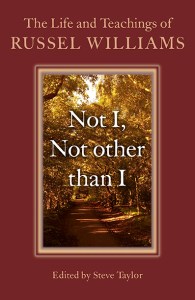
BOOK REVIEW: NOT I NOT OTHER THAN I

Not INot I, Not Other than I is an inspiring story of spiritual awakening. For me, the book has a skilful balance of biography and wisdom in which each throws light on the other. Highly recommended to people involved or interested in contemplative spiritualities.

Russel Williams left school aged 11. Both of his parents were dead and he was too old for Barnado’s.  So he was licensed to work for a living, though in 1932 and the years that followed it was hard to make ends meet. He describes himself in his teenage years as existing but not living. He was angry and aggressive, with no empathy, a quick temper, and prone to getting into fights. What frustrated him most was a sense of his own ignorance.

In 1939 war broke out and Williams joined the British army. He recalls that being a soldier “saved me from a bad end, kept me out of trouble – and most importantly it took away the worry of keeping myself alive. I had regular food and shelter for the first time since my parents died. It was easy, compared me to the life I had before. It also taught me self-discipline to control my emotions”.

After the war he went “walking, walking …” until he making contact with another man, who was starting up a small circus. Williams accepted the job of looking after the horses, and he began to feel a strong connection with them. He wanted to understand them better. “I set my mind to watching and observing every detail, every moment of the day, for days on end”. This process became “more and more concentrated”. He was “not thinking any more”. His mind had “gone quiet”. He was experiencing states of “spontaneity” and “living in the moment”. He began to “look through the horses’ eyes”, as the boundaries fell away, and he became notable for his calming and healing presence when working with them.

Still in his 20’s, Williams began to discern a path in life. Later he framed his life with the horses – 20 hours a day, 7 days a week, for 3 years – as a naturally occurring education in mindfulness meditation: his life a continual service, “with no thought of myself”. He still experienced frustration and disappointment, because he couldn’t find anyone to talk to about this who seemed willing to treat him seriously. But eventually he ran into a small number of kindred spirits, people with whom he could enter into close rapport, and this led to his joining the Manchester Buddhist Society in 1957.

Although the Society made a connection with Thai Buddhism in 1954 (one of their members trained as a monk) Williams himself has kept a distance from formal Buddhism. He has been President of the Society for over 40 years and he still doesn’t call himself a Buddhist. His life and work has included esoteric Christian influences and a resonance with Ramana Maharshi. One of his sayings is that whereas “Buddhism is a belief system … the way of the Buddha is a recognition system”. Acknowledging that Buddha didn’t go beyond dealing with suffering, never mentioning spiritual worlds as such or communicating with other entities, he added “but we do”. Williams’ way of the Buddha is also a way of the free spirit.

Russel Williams is now 93. He is still going strong. My contemplative Druid companion Rosa Davis mentioned this book at our last group meeting. Williams says that his life experience and practice have led him to a “natural state” of oneness with everything, and with the universe itself. “We are part of the unmanifest. We are part of the pure consciousness which has given rise to the whole universe. That consciousness is our true nature, and, when we rest within it, we feel a powerful sense of ease and contentment”. He believes that this is the only meaningful way of understanding the term ‘God’, and what Jesus of Nazareth meant when declaring “I and the Father are one”. This kind of experience, “stillness, pure consciousness, emptiness of being” is the inheritance of us all, and potentially available to us all. It is based on sense-feeling, and on filling the emptiness with loving-kindness.

Williams doesn’t support long meditation practices, though he does believe in frequent ones. He saying “once you get the process going” 10 or 15 minutes should suffice, and recommends doing it 7 times a day. For him, the way in to a full meditative state is through the realm of subtle feeling, and he invites us in with him about a third of the way through the book:

“Feel down here, a little bit above the navel you’ll find the right place. Centre yourself there, in feeling. Observe your breathing, in the sense of the expansion and contraction of the outer part of the body, as if it were a balloon …” From here we are guided to notice the calming and peaceful effects of this “gentle movement, this comfortable gentle movement … absence of agitation, peacefulness … a kind of heartfelt warmth of feeling … it feels homely, as though you belong there … And as though it were a light”.  We then move outwards from the “balloon” to include the whole physical body and then go beyond it. “It reaches out in all directions … and begins to feel at home with all its surroundings, whether it be animate or inanimate … of the same nature” …. And so on into silence for a few minutes. At the end of the meditation the practitioner is asked to draw back into the “very centre”, making sure it is “still peaceful and warm” before returning to normal consciousness.

What I learned from this was the flavour of ‘sense-feeling’, a specifically located warmth, a sense of quiet movement, qualities of gentleness and peace. Nurturing is another favourite Williams word. These qualities fill the body-mind and move beyond it, filling emptiness, engendering loving-kindness. In a group meditation, they can create a deep rapport and subtle meeting place between participants. The aim is to develop “such gentle perception that you could compare it to a finger, soft and warm, touching a snow flake, but so delicate that the flake doesn’t melt”. From there, we begin to see into the nature of things, becoming aware of a different reality, expanding into it until we become “boundless”. This is achieved not by any great effort, but by simply letting go.

‘Sense-feeling’ has already helped me in my own practice. It enriches my experience of ‘presence’ (a key word for me), placing it more clearly beyond witnessing awareness as normally understood. The meditative experience becomes participatory and nurturing in a more complete way, yet one that also seems easy, obvious, almost remembered rather than newly learned. I’m grateful for the recommendation and glad to be passing it on.

Russel Williams (2015) Not I, Not Other than I: the Life and Spiritual Teachings of Russel Williams (Edited by Steve Taylor) Winchester & Washington: O Books

 

Earth Eclectic

music that celebrates Earth and speaks to the heart

Sarah Fuhro Star-Flower Alchemy

Follow the Moon's Cycle

Muddy Feet

Meeting nature on nature's terms

Rosher.Net

A little bit of Mark Rosher in South Gloucestershire, England

Becoming Part of the Land

A monastic polytheist's and animist’s journal

selkiewife

Selkie Writing…

Charlotte Rodgers

Images and words set against a backdrop of outsider art.

Prof Jem Bendell

living with metacrisis and collapse

Towint

The pagan path. The Old Ways In New Times

The Druids Garden

Spiritual journeys in tending the living earth, permaculture, and nature-inspired arts

The Blog of Baphomet

a magickal dialogue between nature and culture

This Simple Life

The gentle art of living with less

Musings of a Scottish Hearth Druid and Heathen

Thoughts about living, loving and worshiping as an autistic Hearth Druid and Heathen. One woman's journey.

Wheel of the Year Blog

An place to read and share stories about the celtic seasonal festivals

Walking the Druid Path

Just another WordPress.com site

anima monday

Exploring our connection to the wider world

Grounded Space Focusing

Become more grounded and spacious with yourself and others, through your own body’s wisdom

The Earthbound Report

Good lives on our one planet

Hopeless Vendetta

News for the residents of Hopeless, Maine