Contemplative Inquiry

This blog is about contemplative inquiry

Tag: Spirituality

BOOK REVIEW: DRUIDRY AND THE FUTURE

Highly recommended. Druidry and the Future is intended as “antidote to despair” according to author Nimue Brown. She continues:
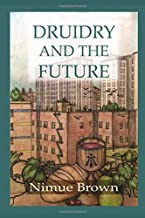
Druidry & Future 51hWUITk4HL._AC_UY218_ML3_

“This book explores the many ways in which the Druid path can help us to respond to climate chaos, necessary cultural change and political uncertainty. By mixing the spiritual and practical we can be more resilient and resourceful, and aspire to live in regenerative and generous ways.”

An affordably priced and relatively slender volume, Druidry and the Future is full of ideas. It is built around 16 essays covering diverse topics: working with Pagan stories: seasonal living: bardic powers; ‘pragmatic’ animism; working with the elements (three essays); de-colonising your soul; your body is nature; justice and balance; honouring the divine through action; putting ourselves back in the landscape; community solutions; self-care and kindness; trees and wetlands; regeneration and restoration. For me, there is a single overarching theme: enlisting the resources of modern Druid culture to build resilience in the face of climate catastrophe. This resilience includes personal and collective aspects, where humans and their communities are understood as wholly embedded in the wider web of life.

Nimue Brown is clear that “it is not enough to be sustainable”. The crisis invites, or rather requires, a radical change in values and behaviour. Human civilization is ‘just people’ and we have the capacity to live differently. For her, “this is what Druidry means right now. It’s about answering the question of how to put civilization in balance with our living planet. This is Druidry for radical change and I think we’re well placed to take on this work and to inspire others. Philosophy has always been part of Druidry, so has teaching and communication, inspiration and vision. We can, and must make a difference.”
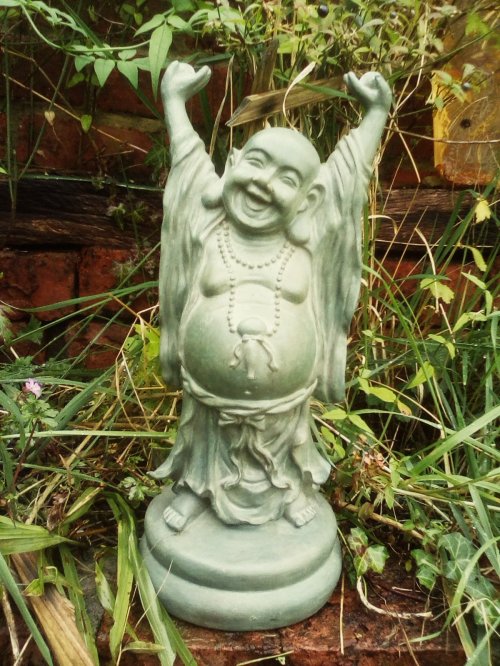
A SMALL GOD OF THE EARTH ATTAINS BUDDHAHOOD

IMG_20191011_101101_kindlephoto-8745263

I have had this statue for awhile, and intend to pay it more attention. He might be a small god. or he might be a human priest or shaman, acting as guardian of a sacred place. I imagine it as including a waterfall and springs, with  rocks and earth and trees. Either way he would be eligible to become, or realise that he latently is, a Buddha or Taoist Immortal, to use another framework from his culture of origin.

There are even rumours of his being Maitreya, the next world saviour, on account of his laughing, ecstatic demeanour. For me, this works best in a model where we could all be prompted into saving the world together. I’m not sure how best to name and describe him – what words to use, or references to make. So I took this picture instead.

POEM: WALKING

Poem by seventeenth century Anglican mystic Thomas Traherne, whose life will be celebrated tomorrow, 10 October.

To walk abroad, is not with Eys

But Thoughts, the Fields to see and prize;

Els may the silent Feet,

Like Logs of Wood,

Mov up and down and see no Good,

Nor Joy nor Glory meet.

Ev’n Carts and Wheels their place do change,

But cannot see, tho very strange

The Glory that is by;

Dead Puppets may

Move in the bright and glorious Day,

Yet not behold the Sky.

And are not Men than they more blind,

Who having Eys yet never find

The Bliss in which they mov;

Like statues dead

They up and down are carried,

Yet neither see nor lov.

To walk is by a Thought to go;

To mov in Spirit to and fro;

To mind the Good we see;

To taste the Sweet;

Observing all the things we meet

How choice and rich they be.

To note the Beauty of the Day,

And golden Fields of Corn survey;

Admire the pretty Flow’rs

With their sweet Smell;

To prais their Maker, and to tell

The Marks of His Great Pow’rs.

To fly abroad like active Bees,

Among the Hedges and the Trees,

To cull the Dew that lies

On evry Blade,

From evry Blossom; till we lade

Our Minds, as they their Thighs.

Observ those rich and glorious things,

The Rivers, Meadows, Woods and Springs,

The fructifying Sun;

To note from far

The Rising of each Twinkling Star

For us his Race to run.

A little Child these well perceivs,

Who, tumbling among Grass and Leaves,

May Rich as Kings be thought.

But there’s a Sight

Which perfect Manhood may delight,

To which we shall be brought.

While in those pleasant Paths we talk

‘Tis that tow’rds which at last we walk;

But we may by degrees

Wisely proceed

Pleasures of Lov and Prais to heed,

From viewing Herbs and trees.

Denise Inge (ed.) Happiness and Holiness: Thomas Traherne and His Writings Norwich: Canterbury Press, 2008 (Canterbury Studies in Spiritual Theology)

BOOK REVIEW: SEEK TEACHINGS EVERYWHERE

This post is about Philip Carr-Gomm’s Seek Teachings Everywhere: Combining Druid Spirituality with Other Traditions. I highly recommend this book to anyone interested in the specific topic and/or the development of modern spiritual movements more generally.

Elegantly and accessibly presented, the book testifies both to a personal journey and a key role in developing modern British Druidry. Both the journey and the role are an interweaving of Pagan and Universalist threads. PCG’s approach has been to adopt Druidry as a ‘meta-path’, one able “to transcend religious distinctions”, and allowing of involvement in other paths as well. The Jain path, shared with his Druid mentor Ross Nichols, is the one given the greatest individual attention in the book, in a long section on Druidry and Dharmic traditions. This section touches also on other Indian derived movements and practices (Buddhism, Yoga Nidra) and speculates on ancient cultural and linguistic resonances between early Indian traditions and early European Druidry. PCG dedicates other sections of the book to Christianity and Wicca, with suggestions about how they too can harmonise with Druidry.

This overall approach is reflected in the lived culture of the Order of Bards, Ovates and Druids (OBOD), which PGC has led for thirty years. He is now in a process of stepping down from the role, and so the book is a timely account of both vision and legacy. He says: “each spiritual way has gifts to offer, and some people find in Druidry all the spiritual nourishment they need. Others combine their Druidry with other approaches, such as Wicca, Taoism, Christianity, Buddhism, Hinduism or Jainism”. OBOD’s ancestry as a movement derives from Celtic and Western Way currents within early twentieth century theosophy. The Order remains true to that heritage – as evidenced by a website that actively describes synergies with other paths and provides links to them – see www.druidry.org/ .

My personal takeaway from the book concerns PCG’s substantial presentation of Jain ethics, grounded in three key principles: ahimsa, aparigraha and anekant, here described as the Triple A. PCG explains: “Ahimsa is the doctrine of harmlessness or non-violence, made famous by Gandhi, and espoused by the other Dharmic traditions of Buddhism and Hinduism”. Aparigraha, the doctrine of non-attachment, non-possessiveness or non-acquisition, likewise appears in these other schools. Anekant, a doctrine of many-sidedness, multiple viewpoints, non-absolutism or non-one-sidedness, is unique to The Jains. The three principles can be seen as completing each other – with many-sidedness an aspect of non-violence and non-attachment, and so on.

PCG recommends these principles for our time. They inform his own vision of Druidry. “We know that the world suffers from too much conflict, too much fundamentalism, and too much consumption. This suffering can be alleviated by applying the Triple A doctrines: seeking non-violent solutions, respecting and learning from others’ opinions and beliefs, and reducing consumption to sustainable levels”. In the Jain tradition, such an approach to life is supported by practices of ritual and meditation that work towards the release of negative attachments. PCG recommends versions of these as well.

Part of the beauty of this book is that different readers will find different reasons to take note and learn from it. I have found it valuable both as an authoritative record of a current in modern Druidry, and as a personal inspiration.

Philip Carr-Gomm Seek Teachings Everywhere: Combining Druid Spirituality with Other Traditions Lewes, UK: Oak Tree Press, 2019 (Foreword by Peter Owen Jones)

OPENING TO SUBTLE CHANGES

A good reflection on giving attention from Mark Green’s in Atheopaganism blog.

SOPHIAN REMINISCENCE

For me, sacred images are sometimes filled with life and potency and sometimes not. The important ones  explode as gifts from the hinterlands of the psyche. They are intensely moving, perhaps shocking, certainly state altering. They may be nurturing and easy to welcome. They may be surprising and demand unlooked-for adjustments. Over time they may continue to be influential, changing and developing with me. They may become formal and emblematic – no longer living yet still anchoring insight. Eventually they may fade. Such images are not possessions. Attempts to grasp or hoard them do not work.

I call my path a Sophian Way. I have an icon of Sophia on my desk and I check in with her from time to time. It still feels authentic and makes sense to me. At the same time, I am aware of how much has changed since Sophia erupted into my life twelve years ago.

In the summer of 2007, I was immersed in my OBOD Druid studies. It was one of the few times in my life when I have cleared whole days for ritual work, and whole days for recovering afterwards. I found the work generating its own momentum, in some ways fulfilling the agenda of my course and in some ways pointing in a different-seeming direction. Images and dreams of dove feathers, either falling or lying on the ground – and then their actuality – became very prominent. Key images and ankh images were present as well.

The powerful dove imagery evoked Goddess associations from the Pagan tradition and Holy Spirit from the Judaeo-Christian one. To honour both, I found a reference in a modern Gnostic group ( www.thepearl.org/ ) that seemed to fit:

“Mortals have been created to dwell in the Garden of delights. … In the Garden stands the holy Tree of Life. High in its branches sings a bird. Listen to the voice of the bird, for when you are properly aligned with heaven and earth, she will tell you all things. … This bird or dove is also called Sophia”.

This felt like an authentic, and unifying, message for me because of its attitude towards the Garden. I as a human belong there. My belonging is not in question. There is one tree, the tree of life. The ‘knowledge’ aspect, such a disaster in mainstream Christianity, is very different here. There’s no apple to pick from the bough, but a bird who will sing to me. But something is expected of me, all the same, if I want to enhance my life and understanding. I am asked to align myself with heaven and earth. If I do this, I am assured that “she will tell you all things”. I don’t understand this as a discourse on metaphysics. I understand it as me listening in another key, listening to bird song in this metaphor, and so refining my sensitivity. For me, the imagery of the tree and the singing bird high in its branches is as resonant of a Shamanic or Pagan world view as it is of a Gnostic or Christian one. I do not have to choose.

The Pearl website turns to Joseph Campbell, a modern spokesman for the meaning of myth, on this point. He says: “people say that what we’re all seeking is the meaning of life. I don’t think that’s what we’re really seeking. I think that what we are seeking is an experience of being alive, so that our life experiences on the purely physical plane will have resonances within out innermost being and reality … as we get to know our innermost being we receive the keys that open up a life that is truly Life, for it is everlasting”.

My own sense of the ‘Life everlasting’ doesn’t pre-suppose an afterlife, re-incarnation, or any other world. Eternity, if anywhere, is present in the now. The song of the bird represents a neurosomatic wisdom, not a cognitive one, of living connectedness within one stream of life.

What I like about this reminiscence is that I have been given a chance to renew my sense of Sophia by returning to source. The original work is well-documented, so I haven’t had to rely on memory. I had completely forgotten about the ‘Pearl’ group. I’m also glad that I’ve seen more than first time round in terms of the tree and birdsong. At the time, I just recorded the images and threw down the references. It has renewed my relationship to the Sophia image in the now.

For information about OBOD see

OBOD | Order of Bards, Ovates & Druids | Druidry

LETTING GO

I have been experiencing a pull towards letting go, but until now it hasn’t been very specific. What do I want to let go of? How do I expect to feel and be, once this letting go has happened?

My personal life is already very simple. The pull toward letting go is about my inquiry and spiritual stance. Some aspects of this feel redundant, whilst others have become naturalised and simply part of how things are.

Over my years of inquiry, I have familiarised myself with many spiritual movements and their understandings, practices and literatures. The literatures include overviews of how these movements have evolved over time, place and culture and how they stand in relationship with each other. I’ve never seen them in isolation or selected one as providing a uniquely authoritative guide. I have been blessed with companions along the way, but I no longer seek or belong to a spiritual tribe.

I am now done with the intentional study aspect, having reached the point of diminishing returns. I might read out of cultural interest, but it won’t be as part of my inquiry. I don’t expect to be entering into new mindsets and following new practices. I have a fundamental sense, or understanding, of being held within a greater life. This greater life is a background presence, except when it becomes the foreground and simply what there is, with ‘me’ no longer apparent. It is this sense of a greater life that supports my At-Homeness, and my commitment to leaning into the flowing moment, the fountain of experiencing. That’s enough: ‘just being’, with an open heart. This simple sense provides my internal compass and my practice is also my inquiry.

I wrote recently – https://contemplativeinquiry.wordpress.com/2019/07/17/inquiry-and-heart/ – about ‘inquiry as self-abiding’ and this, essentially, what I am left with after my exploration of traditions; what remains after letting go. With clarity on that point, I can let go with ease.

POEM: RAPT FORM

FIRE upon Night the way flashing

Cove within Earth the seed receiving

South into North of us –

Eagle upon mountain and the light ascending

The Bowl of the daily dark descending

Stars beyond the shore of us

The Centre stays and the pattern fixes

The Centre moves and the diagram mixes

For many and more of us.

The Eye shines as the cast is shining

The Bowl gathers darkness as the shade is spreading

The Pentagram weaves its tent overheading

The stars and the Polestar turning and twining

Until the rotating of day.

O day and night O night of time

[the weft upon the warp of rhyme}

I backward step to the abyss

Where Form ends and Nothing is –

Where Nothing ends and All-Thing is.

Ross Nichols Prophet Priest and King: The Poetry of Ross Nichols Lewes: The Oak Tree Press, 2001 (Edited and introduced by Jay Ramsay)

“Ross Nichols, who was a contemporary of Eliot, and rated highly by many including Edwin Muir, was Chief of the Order of Bards, Ovates and Druids (OBOD) until his sudden and unexpected death in 1975. An accomplished prose writer, essayist, editor and water colourist who exhibited at the Royal Academy, we can now see him as one of the ‘Apocalypse poets’ of the 1940’s As Chief of the Order from 1964, his contribution was substantial, re-introducing into modern Druid practice the Winter Solstice Festival and the four Celtic Fire Festivals, which he led at London and in Glastonbury.”(Book blurb)

For information about OBOD see http://www.druidry.org/

AT-HOMENESS REVISITED

A year ago, I wrote: “within my Sophian Way, I have found healing and grounding in a flowing now, the site of an unexpected At-Homeness. Everything else grows out of that”(1). This post is to re-affirm this insight and to take it forward.

I wrote of a ‘flowing now’ since ‘now’ is not a frozen unit of time but a living stream of experience. Past and future can indeed be conceived and imagined, but only within the flowing now. The experience of At-Homeness can either steal up of itself or I can invite it by slowing down and attentively companioning the flow as it moves, whatever is going on. It is a way of marking this space and time as sacred. My opening and attention are a sacrament, the means through which the flowing now – all that I can be sure of in this life – is recognised and blessed.

I didn’t invent the term At-Homeness. It comes from the proponents of ‘bio-spirituality’, who say (2) “that the beginning of a bio-spiritual awareness … is finding a way to some larger At-Homeness written deep within bodily knowing”. For them, an enabling and loving attention to the body and its processes gives the felt sense of At-Homeness a chance to ripen. My experience of Focusing over the last 15 months tells me this is true. My experience of Headless Way (3) opens up a world of vivid shapes and colours, all boundaries gone, no self in sight. Immersed in this world, I experience a lightness of being, and stillness in a world of movement. This, too, is At-Homeness in the flowing now.

I sense now, more clearly than before, that I am not at home in the realm of abstractions and absolutes. I do not find Sophia there. I flourish, rather, in processes and relationships. I can stand as awareness only through being aware (a process) of something/someone (a relationship). I find the love and magic in the cosmos, as well as its stresses and horrors, only within the play of movement and connection.

For me, Thich Nhat Hanh’s understanding of ‘Interbeing’ provides the most helpful presentation of a non-dual spirituality (4). “The insight of inter-being is that nothing can exist by itself alone, that each thing exists only in relation to everything else. The insight of impermanence is that nothing is static, nothing stays the same. Interbeing means the absence of a separate self. Looking from the perspective of space, we call emptiness ‘inter-being’; looking from the perspective of time we call it impermanence”. Another modern Buddhist writer adds (5), “if you look at experience there are not fixed elements or even moments; there is simply a process, a transformation … the Buddha called himself tathagata or ‘that which is thus coming and going’. He described himself as merely a flowing occurrence, and the outward form that took was constant, calm, compassionate availability to people who came to him for help.”

Reading this, I am pushed uncomfortably into the recognition of my own volatility. I explored this theme in October 2017 (6). However, because I found Buddhist practice, with its emphasis on long periods of sitting meditation, not right for me, I appear to have lost some of this insight, at least consciously. I am somewhat comforted that ‘At-Homeness in a flowing now’ at least preserves the gist, and the simple practices I’m using work well within an ‘inter-being’ framework. This is not so much because of its Buddhist origin, as because as an approach it seems to me to be on the side of life, relationship and movement. It brings me down to earth and closer to Sophia (Prajnaparamita, Guanyin).

(1) https://contemplativeinquiry.wordpress.com/2018/08/20/

(2) Peter Campbell & Edward McMahon Bio-Spirituality: Focusing as a Way to Grow Chicago, Ill: Loyola Press, 1985

(3) www.headless.org/

(4) Thich Nhat Hanh The Other Shore: a New Translation of the Heart Sutra with Commentaries Berkeley, CA: Palm Leaves Press, 2017

(5) Ben Connelly Inside Vasubandhu’s Yogacara: A Practitioner’s Guide Somerville, MA: Wisdom Publications, 2016

(6) https://contemplativeinquiry.wordpress.com/2017/10/21/the-uses-of-emptiness/

CHILD OF THE NOW

“They said to him

‘Tell us who you are

so that we may believe in you.’

He answered them

You search the face

of heaven and earth,

but you do not recognise

the one who is in your presence

and you do not know how to experience

the present moment.

“We are always asking for signs and omens so that we may believe. It is as if we want to be compelled from outside ourselves. But Yeshua offers no proofs, omens or explanations. He is what he Is. All who question must encounter him in the present if they want to see.

“He reminds us again that what we are looking for is already here and now. Here and now are the place and time to recognize, to experience, to taste the vastness of the present moment in all its dimensions of time, of space and of beyond space-time.

“The Gnostic is the Child of the Now.”

Jean-Yves Leloup The Gospel of Thomas: The Gnostic Wisdom of Jesus Rochester, VT: Inner Traditions, 2005 (Translation from the Coptic and commentary by Jean-Yves Leloup; foreword by Jacob Needleman. English translation by John Rowe. Original French edition published 1986)

Earth Eclectic

music that celebrates Earth and speaks to the heart

Sarah Fuhro Star-Flower Alchemy

Follow the Moon's Cycle

Muddy Feet

Meeting nature on nature's terms

Rosher.Net

A little bit of Mark Rosher in South Gloucestershire, England

Becoming Part of the Land

A monastic polytheist's and animist’s journal

selkiewife

Selkie Writing…

Charlotte Rodgers

Images and words set against a backdrop of outsider art.

Prof Jem Bendell

living with metacrisis and collapse

Towint

The pagan path. The Old Ways In New Times

The Druids Garden

Spiritual journeys in tending the living earth, permaculture, and nature-inspired arts

The Blog of Baphomet

a magickal dialogue between nature and culture

This Simple Life

The gentle art of living with less

Musings of a Scottish Hearth Druid and Heathen

Thoughts about living, loving and worshiping as an autistic Hearth Druid and Heathen. One woman's journey.

Wheel of the Year Blog

An place to read and share stories about the celtic seasonal festivals

Walking the Druid Path

Just another WordPress.com site

anima monday

Exploring our connection to the wider world

Grounded Space Focusing

Become more grounded and spacious with yourself and others, through your own body’s wisdom

The Earthbound Report

Good lives on our one planet

Hopeless Vendetta

News for the residents of Hopeless, Maine