Contemplative Inquiry

This blog is about contemplative inquiry

Tag: Spirituality

DRAGONS, ARCHETYPES & STORYTELLING

Extract in which Ursula K. Le Guin looks at the creative evolution of her six Earthsea books. The focus is on new perspectives in the fourth book, Tehanu.

“In Tehanu, Tenar is brushing her hair on a windy dry morning, so that it crackles and makes sparks, and the one-eyed child Therru is fascinated, seeing what she calls ‘the fire flying out all over the sky’.

“At that moment, Tenar first asked herself how Therru saw her – saw the world – and knew that she did not know; that she could not know what one saw with an eye that had been burned away. And Ogion’s words – ‘they will fear her’ – returned to her, but she felt no fear of the child. Instead, she brushed her hair again, vigorously, so the sparks would fly, and once again, she heard the little husky laugh of delight.

“Soon after this scene, Tenar herself has a moment of double vision, seeing with two different eyes. An old man in the village has a beautiful painted fan; on one side are figures of lords and ladies of the royal court, but on the other side, usually hidden against the wall:

Dragons moved as the folds of the fan moved. Painted faint and fine on the yellowed silk, dragons of pale red, blue, green moved and grouped, as the figures on the other side were grouped, among clouds and mountain peaks.

‘Hold it up to the light’, said old Fan.

She did so, and saw the two sides, the two paintings, made one by the light flowing through the silk, so that the clouds and peaks were the towers of the city, and the men and women were winged, and the dragons looked with human eyes.

‘You see?’

‘I see,’ she murmured.

“What is this double vision, two things seen as one? What can the blinded eye teach the seeing eye? What is the wilderness? Who are the dragons?

“Dragons are archetypes, yes; mind forms, a way of knowing. But these dragons aren’t St. George’s earthly worm, nor are they the Emperor of China’s airy servant. I am not European, not Asian, and I am not a man. These are the dragons of a new world, and the visionary forms of an old woman’s mind. The mythopoeticists err, I think, in using the archetype as a rigid, filled mold. If we see it only as a vital potentiality, it becomes a guide into mystery. Fullness is a fine thing, but emptiness is the secret of it, as Lao Tze said. The dragons of Earthsea remain mysterious to me.”

(1) Ursula K. Le Guin Earthsea Revisited In Books of Earthsea: The Complete Illustrated Edition London: Gollanz, 2018 Illustrated by Charles Vess.

Earthsea Revisited is a printed version of a lecture delivered in 1992, in which Ursula K. Le Guin described the lifelong revisioning of gender and culture which changed her approach to storytelling. This evolution moved her decisively away from the traditional, masculine, ‘hero’s journey’ framework with which she started. Books of Earthsea brings together all six books, with additional stories and authorial reflections from different periods. Some of this work has been familiar to me for a long time, and some is new. I found it helpful to have all of the material collected in one volume.

BOOK REVIEW: RIDERS ON THE STORM

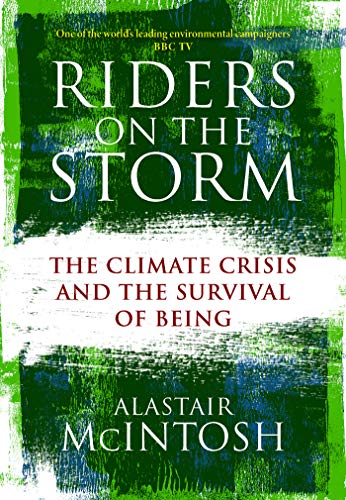
“It is with the dignity of life on earth, and our human part in it, that the passion of this book is concerned.” Alistair McIntosh is a Scottish ecologist based on the Hebridean Isle of Lewis. Riders on the Storm (1) interweaves reflections on the scientific, social-ecological and spiritual aspects of the climate crisis. He writes from the standpoint of 2020, where this overarching existential threat enfolds the more limited and specific crisis of the Covid-19 pandemic.

The early chapters consider the current science, “sticking closely to the peer-reviewed publications of the U.N.’s Intergovernmental Panel on Climate Change (IPCC)”. There are individual chapters on land; oceans and ice; and on 1.5 degrees. They make it clear that scientific truth-telling in this complex domain is a work of establishing levels of confidence on how climate change is unfolding, and “narrowing uncertainty”, rather than establishing facts. McIntosh upholds the IPCC approach, “for all its limitations”, as a peer-reviewed, panel-appraised, consensus-settled science. He sees it as an outstanding model of co-operative working and the most reliable route to take.

The next chapters look at the wider community’s response to the scientific evidence, given the tension between what the science says and how different groups use it. McIntosh discusses the denialism spear-headed by lobby groups disguised as ‘think-tanks’ and their disastrous effects on public discourse, such as the false balance practised by media organisations, including until recently the BBC, in holding futile ‘debates’ between climate scientists and deniers. He also discusses the roles of climate change contrarianism and dismissal in the current moment when outright denial has become harder to maintain. McIntosh goes on to look at the psychology of denial amongst the wider public. He has a section on the intimidation of the scientists themselves, including the dissemination of conspiracy theories accusing their whole community of deliberate deception, and its psychological effects on them.

On the other side of the argument, McIntosh has a chapter on ‘rebellion and leadership in climate movements’. He sees Greta Thunberg as authentically taking on the traditional prophet’s role, which is “to pay heed to their inner calling, to read the outer signs of the times, and to speak to the conditions found upon the land to call the people and their leaders back to what gives life”. McIntosh does have concerns about ‘alarmism’ among some activists. Without giving it a false equivalence with denialism in terms of damage it may do, he sees a tendency to edge out of step with the science, “pushing a point to make a point”. He identifies this as a tendency within Extinction Rebellion (XR) (2), though not extending to XR as a whole. In this context, he also discusses the difference between his understanding of satyagraha, Mahatma Gandhi’s grounded way of peace and social transformation, and instrumentalist versions of non-violent direct action applied simply as a tactic.

After an ambivalent consideration of proposed technical solutions to climate change, the later chapters “shift into story-telling mode” in order to “enter further into depth psychology and beyond”. McIntosh asks questions familiar from his other work (3): what does it take to reconnect with the earth, with spirituality, and with one another – with soil, soul and society? McIntosh’s own work is grounded in close-to-the-ground community development informed by the lens of human ecology, with its strong focus on interactions between the social environment and the natural environment in which we live. McIntosh emphasises grass roots led consensus building and decision making, drawing on emancipatory action research methodologies developed largely in the global south. The spiritual dimension of this, for McIntosh, lies essentially in “the interiority of outward things”, the profound interconnection of all things, and “the meanings of life as love made manifest”. Traditional stories and the wisdom they hold have a valuable role to play in such a project. In an earlier post (4) I extracted a Chinese rainmaker story presented in Riders in the Storm. Within the book, the value of traditional wisdoms is explored through a meeting between Hebridean and Melanesian community leaders and activists when the latter visited Lewis as guests of the former.

I found this book a rich and dense exploration of where we now stand with the existential threat posed by climate crisis. It does not read like a novel but is worth the effort and a great resource. McIntosh himself urges readers to use it in whatever way we want. To anyone committed to “the dignity of life on earth, and our human part in it”, this book has something to say.

(1) Alastair McIntosh Riders on the Storm: the Climate Crisis and the Survival of Being Edinburgh, Scotland: Birlinn, 2020

(2) For a review by an XR insider, see https://earthbound.report/2020/08/24/book-review-riders-on-the-storm-by-alastair-mcintosh/

(3)Alastair McIntosh Soil and Soul: People versus Corporate Power London, England: Aurum Press, 2001

(4) https://contemplativeinquiry.blog/2020/09/11/rainmaker/

EXPERIENCING LATE SEPTEMBER

I tend to feel thrown around energetically over two or three days during the autumn equinox period, and then a new calm takes over. I have crossed into the darker half of the year. I reached that place this year on 25 September and went out for a walk at 7.15 a.m., about 20 minutes after sunrise. The temperature was 8 degrees (46.4 F), not exactly cold, but enough to indicate a change in the year. I was glad to be wearing gloves. They demonstrated my acceptance of a new seasonal identity. There have been still lower morning temperatures in more recent days.

Walking by my local canal, I could see that 2020 has been a good year for its swans. I saw ten near-grown cygnets in a 3-4 mile stretch of water: the group of five in the picture, a group of three a couple of miles away, and two others on their own. I’m inclined to think that the full lockdown from late March until early June has played a role in making the swan population safer. A happy thought and a sad one at the same time.

I walked further out of town this time than I had since the beginning of the Covid-19 crisis and went past more open fields. The grass was green but not growing wildly. I saw only subtle signs of a turn in these distant trees, and none really of a fall. The horses were contentedly outside: no need even for coats. It was dry. By this stage of my walk it was a little warmer, though never beyond 10 degrees (50F). The edge created by a cold breeze had gone. For me this image captures a tranquil moment, that represents my sense of this post-harvest moment in the year. The weather is adequately benign. The energy of nature feels partly withdrawn, into a subterranean state of latency.

Among the trees on the canal bank, I found much greater evidence of a turn. This is one of the times when I become particularly drawn to reflections in water, and the way in which they to an extent mirror the world above whilst also offering something of their own. The much quoted phrase, ‘as above, so below’ is altogether too neat and formulaic to describe a living world.

POEM: SENT TO A HUA MOUNTAIN MONK

I do not know of a Druid or Pagan currently living contemplatively in a mountain cave. But I would not be surprised to learn of one, somewhere in the world. The poem below comes from the contemplative culture of ancient China, where the Taoist and Ch’an Buddhist traditions, in some ways rivals, developed in a mutually influencing way. I believe that there is something for contemplatively inclined Druids and Pagans to appreciate and learn from these traditions. I like this poem because it is a nature poem as much as a contemplative one. Even the meditative turn towards mind is embedded in its natural setting, as the distinction between ‘inner’ and ‘outer’ is softened to the point of vanishing.

“From afar,

I know your white-rock hermitage,

hidden in a haze

of evergreen trees.

When the moon sets,

it’s mind-watching time;

clouds rise

in your closed eyes.

Just before dawn, temple bells

sound from neighbouring peaks;

waterfalls hang thousands of feet

in emptiness.

Moss and lichen

cover the cliff face;

a narrow, indistinct path

leads to you.”

Poem Sent to a Hua Mountain Monk from When I find you again, it will be in mountains: selected poems of Chia Tao (2000) Somerville, MA, USA: Wisdom Publications. English translation by Mike O’Connor.

Chia Tao (779 – 843) an erstwhile Ch’an monk, became a poet during China’s Tang Dynasty. Ch’an was the Chinese predecessor of Japanese Zen.

MOR HAFREN

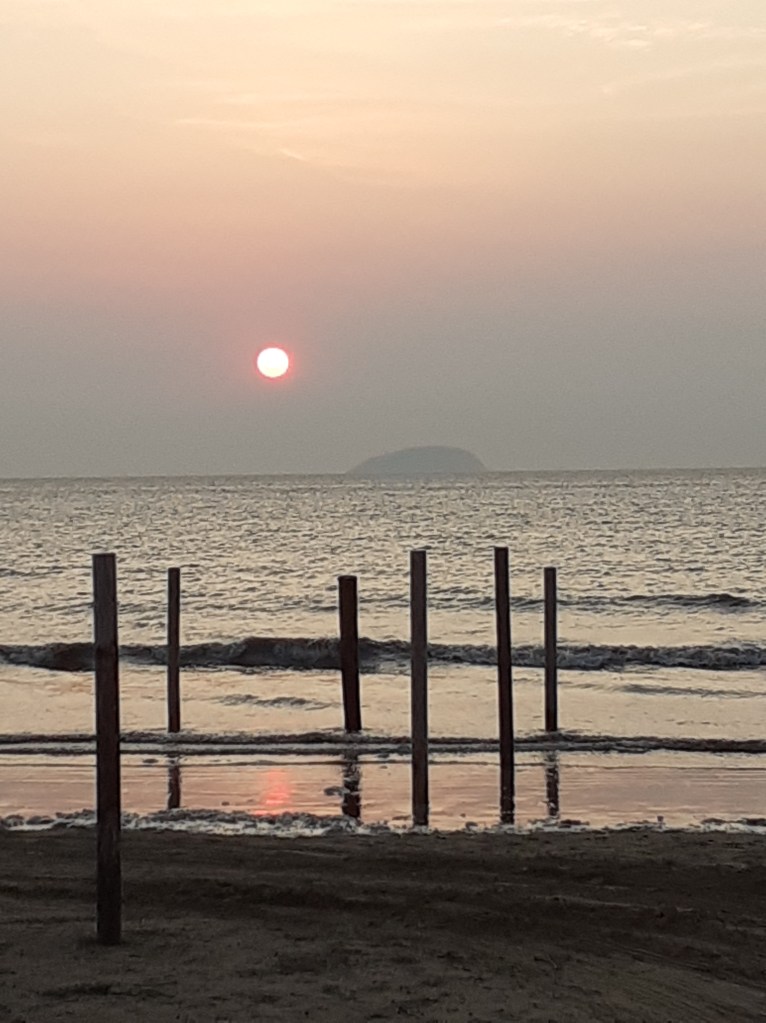
I took this picture on 17 September at Weston-super-Mare, a seaside town located where the Severn estuary becomes what is now called, in English, the Bristol Channel. Weston faces Cardiff, the Welsh capital, on the other shore (too far away to see in the picture). Looking at it gives me a sense of tranquillity whilst also showing clearly the major forces in play. We notice the descent of the sun, as if into the water. A change in the light is linked with this process. In the near distance, not far from our feet, the tide is coming in – rapidly, as it turns out just a little later.

Until Tudor times this stretch of water was known as the Severn Sea in line with the Welsh name Mor Hafren (Cornish Mor Havren). For me, the name ‘Bristol Channel’ makes a claim as much as it describes a place. It disrupts my sense of psychogeography and I am drawn to the Welsh ‘Mor Hafren’ as a name to connect me to these waters. It is older, naturalistic and retains a link with the river.

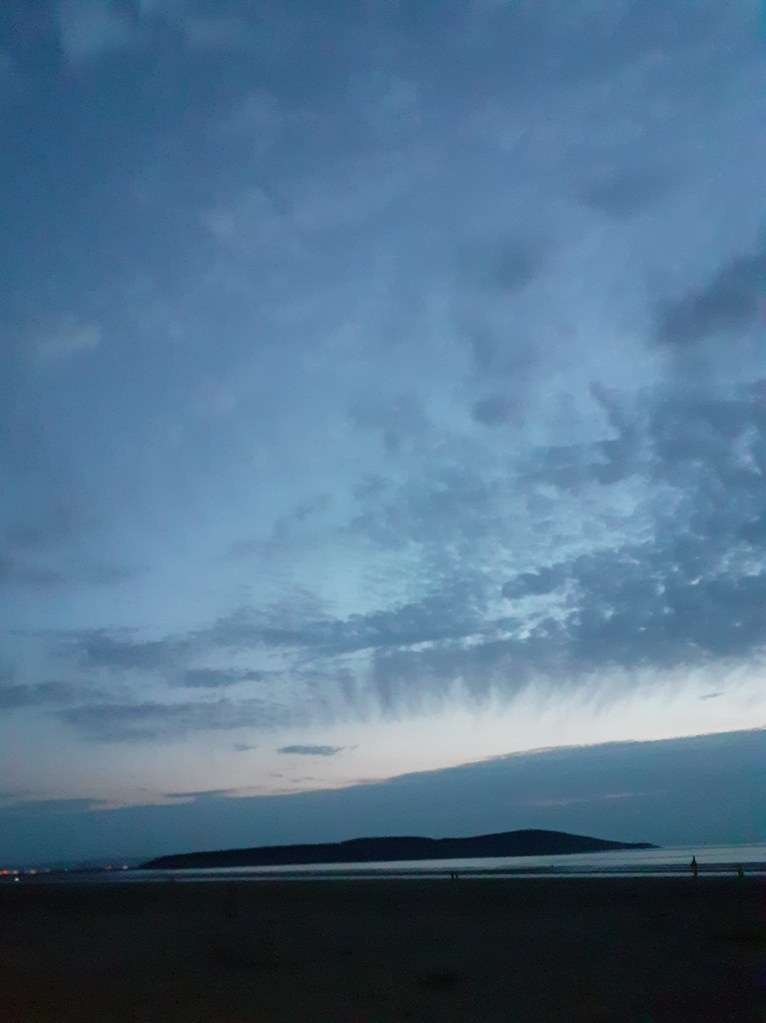
Weston-super-Mare is, by nature, a liminal space, not least of an autumn evening. The picture below is of Brean Down – brilliantly used in Dion Fortune’s occult novel The Sea Priestess – and the sky above it, a little after sunset.

Sky, sea, land. From this distance, the head, like many coastal promontories, has a slightly serpentine or dragon-like look. You half expect it to rear up and move. But it doesn’t. It remains quiescent, power in potential. The active power, here and now, is in the clouds and the afterglow of the sun.

On this visit, I discovered the cycle track, also a pedestrian path, that allows improved access to Brean Down from the Weston side. This helped me to revive a connection to Brean Down which I had allowed to lapse over recent years.

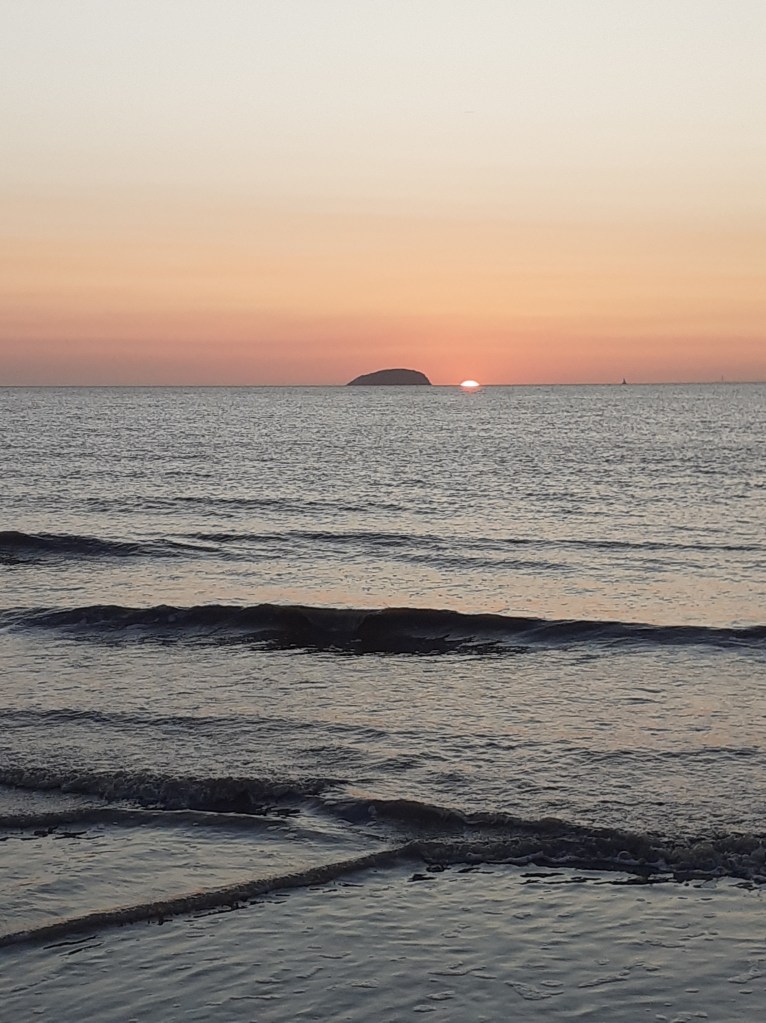
My final picture gives more space to the water element as an incoming tide, whilst recording the sun sinking below the horizon near the island of Steep Holm. The name is of Norse derivation (‘holm’ referring to an island in an estuary). The Welsh name is Ynys Rhonech and the early English called it either Ronech or Steopanreolice – ‘reolice’ being derived from an Irish word referring to a church yard or graveyard, suggesting a sense of a one-time sacred space. These names give a sense of the different peoples who took an interest in this stretch of water in early times. Steep Holm is in England, although Flat Holm, Ynys Echni, a little closer to the opposite shore, is in Wales.


AUTUMN EQUINOX 2020: HAZEL, SALMON, AWEN

In the outer circle of my mandala of the year (1), hazel presides over the days from 16 September to 8 October.

In the middle circle, divided into quarters, the one beginning at Lughnasadh/Lammas is represented by a salmon.

In the inner circle, where there is no sub-division, I have three seed pearls standing for the Awen. The Autumn Equinox is a time when images from the three layers of the mandala line up particularly well. (See NOTE below)

The lore and legend surrounding hazel have a stronger hold on me than the physical tree, though I do find hazels in my locality. For the ancient Celts, the tree was linked with wisdom and known as the food of the gods. Irish tradition (2,3) speaks of the sacred salmon who swim in a pool surrounded by nine hazel trees. This pool was known as Conla’s Well or the Well of Segais and it is the source of the River Boyne. When the trees drop their nuts into the water below, the salmon eats them and so carries them into the sea and back in their annual spawning run. “The cycle was seen as a metaphor for the passing of wisdom from age to age and from person to person” (2). The ancient Druid temples of Newgrange, Knowth and Dowth are to be found in the Boyne Valley.

Ireland and Western Britain are watery places, well-located for intimations of wisdom in watery forms. In modern Druidry, circle work makes links between the west, water and autumn, understood as the quarter following Lughnasadh/Lammas. There are suggestions, too, of love and intuition flowing together in harmony. The Autumn Equinox stands at the point where the light half of the year gives way to the dark half – not suddenly, or violently, but as part of a gentle transition, where the qualities are more or less balanced on both sides of the divide. Tradition also gives us the image of the Well of Segais  as “a shining fountain, with five streams flowing out of it” (3). Here, the invitation, at least for ‘the folk of many arts’, is to drink from the five streams (the five senses) and from the fountain itself (the source of life). In a nutshell, our wisdom is best served by drawing on both the life of the senses and on the flow of inner inspiration (Awen). Neither needs to be sacrificed to the other.

(1) See the ‘house’ section of: https://contemplativeinquiry.blog/2020/08/12/meditation-wisdoms-house/

(2) John Matthews & Will Worthington The Green Man Oracle London: Connections, 2003. Also source of the image at the top.

(3) Philip and Stephanie Carr-Gomm The Druid Animal Oracle: Working with the Sacred Animals of the Druid Tradition London: Fireside, 1994 (Illustrated by Will Worthington)

NOTE The two pictures below give a rough sense of the mandala, and of relationships at the Autumn Equinox, though not the way it looks as a mosaic in my innerworld. The tree images are taken from The Green Man Tree Oracle (2). They stand in for the ones in my mandala, which are more naturalistic and sometimes involve more than one plant: hazel, west; rowan, west-north-west, yew, north-west; elder, north-north-west; holly, north; alder, north-north-east; birch, north-east; ash & ivy, east-north-east; willow, east; blackthorn, east-south-east; hawthorn, south-east; beech & bluebell, south-south-east; oak, south; gorse, south-south-west; apple, south-west; blackberry & vine, west-south-west. The selection as a whole is based on my personal experience of trees in the neighbourhood as well as traditional lore. The elemental images are from R. J Stewart The Merlin Tarot London: Element, 2003. Illustrated by Miranda Grey.

THE SPACE BETWEEN BREATHS

“When a pendulum swings, there is a fraction of a moment at the end of each swing when the movement stops, before the pendulum starts to swing back. That moment of pause is the madhya, the central still point out of which the pendulum’s movement arises. All movement – whether the swing of an axe, the movement of the breath, or the flow of thought – arises out of such a point of stillness.

“That still point is an open door to the heart of the universe, a place where we can step into the big Consciousness beyond our small consciousness. As the medieval English saint Julian of Norwich wrote, ‘God is at the midpoint between all things’.

“… Such points exist at many different moments. One of these is the pause between sleeping and waking, the moment where we first wake up before we become fully conscious. Another is the moment before a sneeze or at the high point of a yawn. Another is the space between thoughts.” (1)

For Sally Kempton, this is the inner realm that mystics and sages have called the Heart – not the physical heart, or even the heart chakra, but “the Great Heart that contains All-that-is … the consciousness that underlies all forms”. Her recommendation to meditators is to follow the breath, and to enter the madhya in the spaces between the inhalation and the exhalation, and between the exhalation and the inhalation. Focusing on the sound of the breath with a subtle and relaxed attention, we find the gaps and over time, without forcing the process, we find them expanding.

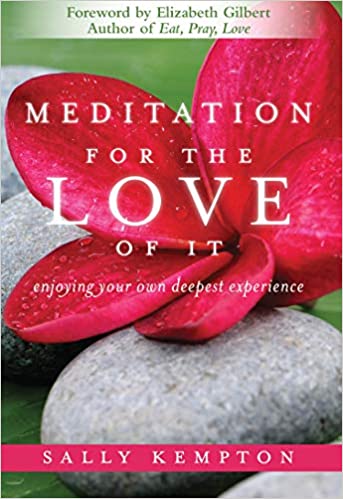
Sally Kempton’s Meditation for the Love of It has companioned me for the better part of a decade, and I am grateful for her influence on me as a contemplative practitioner. I do not follow her path of Kashmir Shaivism and the Tantric philosophy that underpins it. But I have always liked her framing of ‘meditation for the love of it’, which I see as a Druid and Pagan friendly approach. I also like the quality of her writing, and many of her practical recommendations.

In the present instance, I have found that the space between breaths is indeed a portal – placing me, in my own language, as ‘living presence in a field of living presence’. My experience is that the discovery of the space between breaths can lead on to a discovery of stillness even within the breath as it rises and falls. Stillness in the breath, co-existent with the movement of the breath, is potentially available at all times. It is largely through Sally Kempton’s work that I learned this lesson, and I am grateful to her for the experience and insight that I have gained.

(1) Sally Kempton Meditation for the Love of It: Enjoying Your Own Deepest Experience Boulder, CO: Sounds True, 2011

RAINMAKER

The story of the Rainmaker, below, is from Hebridean ecologist Alastair McIntosh‘s Riders on the Storm: the Climate Crisis and the Survival of Being. I will the review the book as a whole in a later post. The story was originally recounted by Richard Wilhelm in the early years of the twentieth century. Wilhelm was a long-term resident in China whose German translation of the I Ching included a foreword by C. G. Jung. McIntosh’s context for the story is a discussion of spiritual groundedness in the application of Satyagraha, Mahatma Gandhi’s way of peace and social transformation.

“In the province that surrounded Tsingtao there befell a terrible drought. The grass scorched, the animals were failing, and the people knew that they’d be next. In desperation, they called upon the Protestant missionaries, who came and presumably said their prayers and read their bibles and gave suitably long sermons. No rain.

“So then they called the Catholic missionaries, who came and presumably said Hail Marys and prayed with rosary beans and sprinkled holy water. Still no rain.

“So they called the traditional Taoist and Confucian priests, who came and lit some joss sticks, and set off guns to frighten away the hungry ghosts that presumably had caused the drought. But not a single drop.

“Finally – and interestingly, as the last resort – they called in the Rainmaker. The Rainmaker was a wizened little old man who lived far away. He had to walk a considerable distance from a neighbouring province. ‘What do you need?’ they asked when he arrived.

“’I need nothing,’ he said. ‘Just a hut to go and sit.’

“After three days, there was an unseasonable fall of snow. It melted and relieved the drought. The peasants soon resumed their normal lives. But Richard Wilhelm, being not just any old scholar but a German professor, wanted to know exactly what the little old man had done.

“‘I did nothing,’ said the Rainmaker.

“‘Oh come on,’ said Wilhelm. ‘Was it magic spells, or incantations, or did you just hit lucky that you only had to wait three days?’

“‘None of those,’ he sad honestly.

“‘Well, what was it then?’ demanded the exasperated Wilhelm.

“’It’s like this,’ said the Rainmaker. ‘When I was in my home province, my spirit was in the Tao, the cosmic harmony. But when I got to this province, I found that it no longer was in the Tao.

“’So I went and sat inside the hut, and when my spirit settled back into the Tao, that’s when the clouds began to form.’”

Alastair McIntosh Riders on the Storm: the Climate Crisis and the Survival of Being Edinburgh: Birlinn Limited, 2020

EXPERIENCING EARLY SEPTEMBER

Months, and moments within them, have their own atmosphere and meaning for me. I try to indicate these through pictures. Where I live, early September takes us fully into autumn, and the fruiting of the horse chestnut tree (above) is a marker for the transition.

Early in the month, the sun sets a little after 7.30 p.m. and reminds us that the nights are drawing in more quickly. It still seems early for sunset, but I notice that my sense of ‘evening’ is adjusting to a more autumnal perspective. The picture below was taken on September 3rd.

The feeling-tone of this period is not yet equinoctial. Wooded spaces are still vigorously green, still majestic, still imaging what my heart wants more of the world to look like. The light of day remains strong, even though temperatures are characteristically lower. There is a lingering aftertaste of summer at the beginning of the new season.

Nonetheless, it is easy to find muted colours leaning in to decay. These have their own fragile and poignantly fleeting beauty, as the alchemy of the waning year does its work. Early September has a character of its own, to be enjoyed while it lasts, as the wheel continues to turn.

THICH NHAT HANH ON LIVING BEINGS

In the extract below, Thich Nhat Hanh offers Buddhist thoughts, which seem to me to have considerable resonance for Druids, with their animist and earth-honouring perspective and their support for deep ecology.

“There is no absolute dividing line between animate and inanimate, between living matter and inert matter. In so-called inert matter there is life, and living beings are dependent on so-called inert matter. If we took the so-called inanimate elements out of you and me, we would not be able to live. We are made of non-human elements. This is what is taught in the Diamond Sutra, an ancient Buddhist text that could be considered the world’s first treatise on deep ecology. We cannot draw a hard distinction between human beings and other living beings, or between living beings and inert matter.

There is vitality in everything.

The entire cosmos is radiant with vitality.

“If we see the Earth as just a block of matter lying outside of us, then we have not yet truly seen the Earth. We need to be able to see that we are part of the Earth, and to see that the entire Earth is in us. The Earth is also alive; it has intelligence and creativity. … Looking with the eyes of non-discrimination, we can establish a very close relationship with the Earth. We look at the Earth with our heart and not with the eyes of cold reasoning. You are the planet, and the planet is you. The well-being of your body is not possible without the well-being of the planet. And that is why to protect the well-being of your body, we must protect the well-being of the planet. This is the insight of emptiness*.” (1)

  • To be empty, for Thich Nhat Hanh, is to be empty of a permanent, separate self. Hence ‘to be’ is to ‘inter-be’. He coined the word ‘inter-being’ to emphasise this point in his teaching.

(1) Thich Nhat Hanh The Art of Living London: Rider, 2017

Earth Eclectic

music that celebrates Earth and speaks to the heart

Sarah Fuhro Star-Flower Alchemy

Follow the Moon's Cycle

Muddy Feet

Meeting nature on nature's terms

Rosher.Net

A little bit of Mark Rosher in South Gloucestershire, England

Becoming Part of the Land

A monastic polytheist's and animist’s journal

selkiewife

Selkie Writing…

Charlotte Rodgers

Images and words set against a backdrop of outsider art.

Prof Jem Bendell

living with metacrisis and collapse

Towint

The pagan path. The Old Ways In New Times

The Druids Garden

Spiritual journeys in tending the living earth, permaculture, and nature-inspired arts

The Blog of Baphomet

a magickal dialogue between nature and culture

This Simple Life

The gentle art of living with less

Musings of a Scottish Hearth Druid and Heathen

Thoughts about living, loving and worshiping as an autistic Hearth Druid and Heathen. One woman's journey.

Wheel of the Year Blog

An place to read and share stories about the celtic seasonal festivals

Walking the Druid Path

Just another WordPress.com site

anima monday

Exploring our connection to the wider world

Grounded Space Focusing

Become more grounded and spacious with yourself and others, through your own body’s wisdom

The Earthbound Report

Good lives on our one planet

Hopeless Vendetta

News for the residents of Hopeless, Maine