Contemplative Inquiry

This blog is about contemplative inquiry

Tag: Spiritual inquiry

EMBRACING INTERBEING

“If you are a poet, you will see clearly that there is a cloud floating in this sheet of paper. Without a cloud, there will be no rain; without rain, the trees cannot grow; and without trees, we cannot make paper. The cloud is essential for the trees to exist. If the cloud is not here, the sheet of paper cannot be here either. So we can see that the cloud and the paper inter-are. ‘Interbeing’ is a word that is not in the dictionary yet, but if we combine the prefix ‘inter‘ with the verb ‘to be’, we have a new verb ‘inter-be’” (1).

Thich Nath Hanh extends his proposition to include sunshine, the logger, the saw mill, the bread sustaining the logger (thus also wheat) and the logger’s parents. We are there too, because the paper is part of our perception. In fact, “you cannot point out one thing that is not here – time, space, the earth, the rain, the minerals in the soil, the sunshine, the cloud, the river, the heat. Everything co-exists with this sheet of paper. … You cannot just be by yourself alone. You have to inter-be with every other thing. This sheet of paper is, because everything else is. … As thin as this sheet of paper is, it contains everything in the universe in it.”

I have embraced ‘interbeing’. It is the most accessible and elegant way I know of talking about non-duality: clear, workable and sensitized to an ethics of empathy. It leans into the affirmation of embodiment, of loving relationship with the Earth, and a willingness to be socially engaged. I prefer this account to ones that tend in the direction of ‘I am the One’ or union with the Divine. We each seek the language with the most resonance and integrity for ourselves, whilst also knowing that any language is a finger pointing at the moon and not the moon itself.

For some time, I have been working towards a view like interbeing through my personal contemplative inquiry. My chapter in the compilation Pagan Planet is called Living presence in a field of living presence: practising contemplative Druidry (2). There I raise questions about paths that lack a felt sense of embodiment, inter-connectedness and inter-dependence even when they do valuably encourage agency, personal responsibility, self-cultivation and independence of mind.  I specifically note two apparently contrasting effects of meditation, beyond its being a “green anti-depressant”. The first is that it “makes me very aware of my fragility … and complete embeddedness in a web of interdependence, and the narrow limits of my usual consciousness and perception”. The second is to find myself almost melting “with love and gratitude for the miracle of being alive at all”, moved too “by the world’s seeming ability to be irrationally generous as well as unfairly hurtful (3)”.

I now have an outer court membership of Thich Nhat Hanh’s Community of Interbeing and have recently begun attending a weekly meditation session with the local sangha. It seems like a good place to be. It continues, in a new setting, an aspect of what I have already been doing in my contemplative inquiry.

(1) Thich Nhat Hanh The heart of understanding: commentaries on the Prajnaparamita Heart Sutra Berkeley, CA: Parallax Press, 2009 (20th anniversary ed. Editor Peter Levitt)

(2) James Nichol Living presence in a field of living presence: practicing contemplative Druidry in Nimue Brown (ed.) Pagan Planet: Being, believing and belonging in the 21st century Winchester, UK & Washington. USA: Moon Books, 2016

(3) http://www.newstatesman.com/culture/2014/12/rowan-williams-why-we-need-fairy-tales-now-more-ever

HERE-AND-NOW STONE

I am carefully sitting in a balance of warmth and shade. In the palm of my right hand is a small sandy brown stone. My four fingers are gently folded over it, the thumb resting beside them, unobtrusively pointing out. The stone is a good fit and the texture relatively smooth, with just enough variation to offer tactile interest. This is a pleasing stone to hold, as it exchanges warmth with my friendly hand. I feel in relationship with this stone, most likely collected from a beach though I don’t know when and where.

I am doing this as part of a formal exercise – you might think, a Druid one. I can recall ones very like it. But in this case, it is linked to a Mindful Self Compassion programme, research based but with an explicitly Buddhist inspiration. I’m asked to enjoy the stone. After some time I open my hand and gaze at the subtle variations in colour, and a dusting of tiny white crystalline spots. I pick the stone up and rub it against my skin. There’s just enough roughness in the contact to generate a real aliveness.  The taste is slightly salty. I am thoroughly engaged with the stone.

The framers of the exercise link this combination of focus and appreciation with coming home to the present moment, a place with no room for regret or worry, past or future. Their recommendation, going forward, is to keep the stone in my pocket, or somewhere handy. Then, whenever I feel swept up in hurt feelings or distracted ones, I can take myself back home by rubbing the stone with my fingers. I am sure that this is true and I will begin using it this way. Overnight, it can be the first stone on my Guanyin altar.

I also believe that my Druid background adds value. If I treat this action purely as a psychological exercise, it might come to seem a little calculated and Pavlovian. In my universe, I am entering a relationship with an entity from the mineral kingdom, receiving a gift, and hopefully offering one too. I believe that this understanding will add power, beauty and magic to an apparently simple activity.

POEM: SILENT ILLUMINATION


Silently and serenely, one forgets all words,

Clearly and vividly, it appears before you.

When one realizes it, time has no limits.

When experienced, your surroundings come to life.

Singularly illuminating this bright awareness,

Full of wonder is the pure illumination.

The moon’s appearance, a river of stars,

Snow-clad pines, clouds hovering on mountain peaks.

In darkness, they glow with brightness.

In shadows, they shine with a splendid light.

Like the dreaming of a crane flying in empty space,

Like the clear, still water of an autumn pool,

Endless eons dissolve into nothingness,

Each indistinguishable from the other.


Chan Master Sheng-Yen The Poetry of Enlightenment: poems by ancient Chan Masters New York: Dharma Drum Publications, 1987

This is the first section of a longer piece by Hongzhi (in this text transliterated as Hung Chi), who lived in China from 1097-1157. He developed a version of what we now call mindfulness meditation called Silent Illumination.


MINDFULNESS MUST BE ENGAGED

Social action: what to do and how to do it. An issue for any spiritual community ….

“When I was in Vietnam, so many of our villages were being bombed. Along with my monastic brothers and sisters, I had to decide what to do. Should we continue to practice in our monasteries, or should we leave the meditation halls in order to help the people who were suffering under the bombs? After careful reflection, we decided to do both – to go out to help people, and to do so in mindfulness. We called it engaged Buddhism. Mindfulness must be engaged. Once there is seeing, there must be acting. Otherwise, what is the use of seeing?

“We must be aware of the real problems of the world. Then, with mindfulness, we will know what to do and what not to do to be of help. If we maintain awareness of our breathing and continue to practice smiling, even in difficult situations, then many people, animals, and plants will benefit from our way of doing things. Are you massaging our Mother Earth every time your foot touches her? Are you planting seeds of joy and peace? I try to do exactly that with every step, and I know that our Mother Earth is most appreciative. Peace is every step. Shall we continue our journey?”

Thich Nhat Hanh Peace is every step: the path of mindfulness in daily life London: Rider, 1995

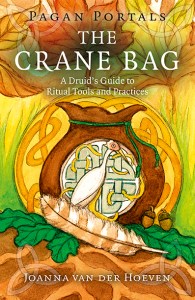
BOOK REVIEW: THE CRANE BAG

The Craane BagThe Crane Bag, Joanna van der Hoeven’s forthcoming book*, offers an introduction to the ritual tools and practices found in the Druid tradition. It achieves this briefly, simply and with a light touch – as books in the Pagan Portals series are designed to do. Yet it much more than a tick box guide. It provides context and meaning, showing the modern evolution of the Druid tradition itself.

The author makes it clear that she wants readers “to develop their own path in their own time in their own fashion”. Re-enchantment is both path and goal. With proper use, the crane bag “can further the Druid in working with the tides of nature, finding his or her own place in the environment, living in balance, harmony and peace”. The movement overall is “toward reintegration with the natural world”.

At its simplest, the crane bag is the container for Druid ritual tools and as such enables the practices. Bag and tools provide the practitioner with “something tangible to express the spiritual”, acting as a portable “map of the soul”. Behind the crane bag lies an ancient Irish story beginning with the contention between two sisters and the transformation of one of them, Aoife, into a crane. The story is beautifully told and its relevance clearly explained in the first chapter of the book.

In ritual, a period of time and an area of space are set apart and dedicated. This is not to create a lasting duality of sacred and mundane, but a step on the way to experiencing everything as sacred. “Ritual helps us to step back from the busyness, into another way of being. It is a change of consciousness, where we can shift our perception away from a singular view to a more plural view, realising that we are part of an ecosystem”. There is a clear preference for working outdoors, where awareness can shift more readily, though this is not insisted on.

A Druid’s tools will vary with the Druid. The book identifies the following: a silver branch; a staff; cups/bowls/cauldrons; drums; a sickle or knife; robes; altars; fire/candles; incense. People may make or buy them. Ethical sourcing of tools and materials is discussed in some detail, in line with the values of The Crane Bag overall.

What goes into a ritual is explored under the headings of call for peace; preparing the nemeton; honouring spirits of place, three worlds, four directions, ancestors, deities; ritual action; prayers and magic; offerings; eisteddfod; sacrifice; feast; closing. There’s encouragement to practitioners to craft what is right for them from within this set of suggestions and beyond it. The author adds, “I have been in circles with Christian Druids and Buddhist monks, as well as other religions from all over the world”. What matters in ritual is being present and performing the ritual with mindfulness, so that “any words that you speak, any gesture or movement you make will flow more easily, be more graceful and filled with meaning”.

There’s a final chapter on ‘altered states’. I don’t use the term myself, because it makes an ‘altered’ vs ‘normal’ distinction that doesn’t really work for me in my own life. But I recognise it as a term that is widely and usefully employed. Here, it facilitates valuable discussions of meditation, drumming, chanting and song, sensory deprivation, sacred landscape and sitting out. Three kinds of meditation are distinguished: calming the mind and re-tuning the body, journeying and problem solving. Guidance is offered on each kind. Different suggestions are also explored within the other topics. For sensory deprivation, there are two. One is the Celtic version of the sweat lodge, called teach an alais. The other is total immersion in darkness for a considerable period before being brought out into the light. The author refers to early medieval accounts of this, where it was done in aid of Bardic inspiration and prophesy: imbhas forosna.

I found The Crane Bag a very useful contribution to its topic and highly recommend it.


Joanna van der Hoeven The Crane Bag: a Druid’s guide to ritual tools and practices Winchester UK & Washington USA: Moon Books, 2017

*According to the publisher, the book is due for release on 28 July, and can be pre-ordered through Amazon US & UK, Indiebound and Hive.

ANOTHER SHORE?


My sacred space at home has undergone a complete makeover. I am effectively in a different place. It happened this way. On 7 May, I ordered a statue of Guanyin, partly as a birthday present to myself and partly with reference to ‘the true thought of the heart’. Perhaps the true thought of the heart is the real gift. In a blog post I wrote on that day (1), I described Guanyin as sitting on a crescent moon, playful and androgynous. I said: “it is the note that I am looking for”.

When the statue arrived from China, it was much bigger than I expected. It was over two metres high and quite broad, because Guanyin is sitting on a crescent moon, which takes up space. Caught up in the elegance of the design, I had completely misread the dimensions. No room in my room for the true thought of the heart?

Making room involved a complete clearing and cleaning of the place, and a considerable re-arranging of furniture. During an afternoon, I reshaped the space entirely with Guanyin as the predominant focus. Other imagery is still there. The Western Way is still well represented. A Green Man represents our oneness with the Earth, and our apparent separation from it and need for healing stories. A somewhat Marian (both of them) Sophia is there, imaging sacred fertility, sacramental relationship and the challenge to awaken. So are other familiar objects – a dragon sitting on an egg, an abstract and geometrical mandala picture, a tiny wooden Buddha, (not new) contained and serene. (A hopefully only slightly larger and more expansive laughing one is on his way.) Around the walls I find a C17th map of Somerset, my native county; pictures of Glastonbury Tor and the Eildon Hills; a small painting of a crane; and a painting I commissioned in the early 1990s of the Pictish Dancing Sea Horses from the Aberlemno Stone in Angus.

Yet the defining presence is now Guanyin. It happened as if by itself. The rest of the room is familiar and understood. She by contrast is numinous, dynamic and unknown, as well as large. The relationship is not yet established. Close-up, she is indeed playful and androgynous, but she is much more than that. As Guanyin, s/he hears the cries of the world. In her male aspect, s/he is Avolokitesvara, who shared the wisdom gained from deep practice in The Prajnaparamita Heart Sutra. S/he opens the way to the whole tradition of Mahayana Buddhism and its Vajrayana or Tantric variants. Thich Nhat Hanh reminds us of the seeming riddle of this path. “The Prajnaparamita Sutra says, ‘The Bodhisattva helps row living beings to the other shore but in fact no living beings are being helped to the other shore’ (2). Inevitably, it seems, I am drawn by this proposition. Necessarily, it seems, I am gathering Buddhist resources and accessing Buddhist networks, now attracted to the path as well as the Bodhisattva. I did not anticipate this.

This transcends contemplative inquiry, whilst emphatically including it. The Guanyin Oracle (3) tells me that I am under a God’s protection, and gives me a verse called After the Rain.

“After a long rain, we joyously watch the heavens clear.

The sun and moon grow slowly brighter.

The gloomy days are over, so be happy and joyous.

You will bound through the Dragon Door in one leap.

I am reminded of Penny Billington’s use of the term ‘egrigore’ in Contemplative Druidry (4). In Chapter 4 Druid Identity and Values, she says that spiritual movements have an egrigore, “an inner reality made up not only of the ideas of the members, but also the invisible influences from the other realms that resonate with that ‘flavour’ of spiritual thought; and as Druids we are dedicated to making connections not only in the natural world but on the other planes as well, other states of consciousness.” I certainly find that images and their associations can have a tremendous power if I am open to them, and for me, now, the Guanyin image is one of those. It is focusing my energy and attention, and making a Buddhist inspired matrix of references, aspirations, values, traditions and practices vividly present to me. This kind of process works much faster than ordinary thinking. Assembling a new Chinese statue out of three separate parts, cleansing and reordering a room, took me into a new space, and here I still am.

  • https://contemplativeinquiry.wordpress.com/2017/05/07/sophia-and-guanyin/
  • Thich Nhat Hanh The miracle of mindfulness: a manual on meditation London: Rider, 1991
  • Stephen Karcher The Kuan Yin Oracle: the voice of the Goddess of compassion London: Piatkus, 2009
  • James Nichol Contemplative Druidry: people practice and potential Amazon/KDP, 2014 (Foreword by Philip Carr-Gomm)

REBLOG: SCIENCE IN SERVICE TO MOTHER EARTH

Science is, after all, an endeavor of humans and our machines. What would it mean to put this endeavor at the service of Mother Earth? Presumably, our efforts must always be guided by human discernment, in all its fallibility. Who decides what best serves this vision of the Greater Good?

via [A Pedagogy of Gaia] Science in Service to Mother Earth, by Bart Everson — Humanistic Paganism

CONTEMPLATING TIME

“The most widely accepted notions about the universe are central to how we view reality. One striking example links birth and death. In the age of faith, religion existed to reassure believers about a higher plane of reality. On this plane, the everyday experience of birth and death was negated. Souls were immortal aspects of being human. Depending on your religion, the soul either went to Heaven, if one were good, after death or existed perpetually in a cycle of birth, death, and rebirth.

“Ironically, science has stuck to these possible scenarios with the universe, even though what science is supposedly famous for is its defeat of religion, or to be more specific, its defeat of metaphysics and the whole notion of a higher plane. If you look closely, the way the universe was born in the big bang and will one day, presumably die, is pure metaphysics. In fact, the big bang and expansion of the universe was first proposed by Georges Lemaitre, a Catholic priest, who was an astronomer and professor of physics at the Catholic University of Leuven. Many have pointed to the agreement of the big bang view with Biblical accounts in the book of Genesis. Unwittingly, the public that accepts a casual idea about the universe being born and dying is adopting a metaphysical position about human birth and death, not simple, unvarnished, provable facts.


…..

“If you drop every model, something surprising happens. They are not needed. For example, you can view your daily life as occurring entirely in the present moment. The present moment is not a clock phenomenon. Clocks measure intervals–seconds, minutes, hours–while the present moment has no interval. It’s always here, endlessly renewing itself, unmeasurable, and fleeting. Because the instant you try to capture it, it’s gone. This implies that the ‘now’ is outside time. It can be defined either as instantaneous or eternal. Both are valid as verbal descriptions but in the end invalid, since the vocabulary of time doesn’t apply to the timeless.

…..

Without settling the vexing questions of “What came before the big bang?” “Where did time originate?” and “What is the timeless like?” we only want to point out that time has no meaning outside a specific frame of reference. There is no “real” time, only models of time constructed in human awareness. Once we realize this simple fact, the capacity to move beyond all models, to truly lose our fear of death, comes alive. The spiritual concept that we were never born and will never die then becomes viable, too.”

Deepak Chopra & Menas Kafatos, discussing their new book in a recent Science and Non-Duality newsletter


  • Deepak Chopra and Menas Kafatos You are the universe: discovering your cosmic self and why it matters Globnet, 2017


POEM: GREEN MAN

William Anderson’s classic Green Man poem has thirteen verses of four lines each, and follows the wheel of the year from the Winter Solstice. As I write we have just reached the sixth verse, which has an off with my head theme. The honey of love is over and speaking through the oak is yet to come.

Like antlers, like veins in the brain, the birches

Mark patterns of mind on the red winter sky;

‘I am thought of all plants’, says the Green Man,

‘I am thought of all plants’, says he.

The hungry birds harry the last berries of rowan

But white is her bark in the darkness of rain;

‘I rise with the sap’, says the Green Man,

‘I rise with the sap’, says he.

The ashes are clashing their boughs like sword-dancers

Their black buds are tracing wild faces in the clouds;

‘I come with the wind’, says the Green Man.

‘I come with the wind’, says he.

The alders are rattling as though ready for battle

Guarding the grove where she waits for her lover;

‘I burn with desire’, says the Green Man,

‘I burn with desire’, says he.

In and out of the yellowing wands of the willow

The pollen-bright bees are plundering the catkins;

‘I am honey of love’, says the Green Man,

‘I am honey of love’, says he.

The hedges of quick are thick with may-blossom

As the dancers advance on their leaf-covered king;

‘It’s off with my head’, says the Green Man,

‘It’s off with my head’, says he.

Green Man becomes grown man in flames of the oak

As its crown forms his mask and its leafage his features;

‘I speak through the oak’, says the Green Man,

‘I speak through the oak’, says he.

The holly is flowering as hay fields are rolling

Their gleaming long grasses like waves of the sea;

‘I shine with the sun’, says the Green Man,

‘I shine with the sun’, says he.

The hazels are rocking the cups with their nuts

As the harvesters shout when the last leaf is cut;

‘I swim with the salmon’, says the Green Man,

‘I swim with the salmon’, says he.

The globes of the grapes are robing with bloom

Like the hazes of autumn, like the Milky Way’s stardust;

‘I am crushed for your drink’, says the Green Man,

‘I am crushed for your drink’, says he.

The aspen drops silver on leaves of earth’s salver

And the poplars shed gold on the young ivy flower heads;

‘I have paid for your pleasure’, says the Green Man,

‘I have paid for your pleasure’, says he.

The reed beds are flanking in silence the islands

Where meditates Wisdom as she waits and waits;

‘I have kept her secret’, says the Green Man,

‘I have kept her secret’, says he.

The bark of the elder makes whistles for children

To call to the deer as they rove over the snow;

‘I am born in the dark’, says the Green Man,

‘I am born in the dark’, says he.

From:  William Anderson Green Man: archetype of our oneness with the Earth Harper Collins: London & San Francisco, 1990

SOPHIA AND GUANYIN


The Moon rising on the indigo sea,

A pearl like a seed.

Open your heart to compassion and change:

The protector will blossom there.


Sophia journeyed along the Silk Road to the wild west of China and became the Bodhisattva Guanyin*. In Mahayana Buddhism, a Bodhisattva vows to wake up and work for the happiness of sentient beings. At the point of entry to nirvana, or ‘no-wind’, where the hot winds of desire and compulsion are forever stilled, you choose to remain in the world of samsara, the world of illusions that we all inhabit, and fulfil your promised role. This pledge is inaugurated by the Prajnaparamita Heart Sutra, in which the Buddha’s disciple Avolokitesvara addresses another disciple, Shariputra. Guanyin emerges in history as Avolokitesvara’s female manifestation some hundreds of years later. Her emergence may well be owed to the influence of Sophia, who in that time and place is looked to as a Gnostic redeemer. I am grateful to Stephen Karcher for taking me through the history (1).

“Between 400-600 CE, various sects associated with the ‘great heresy’ of Gnosticism entered Northwest China, driven out of the Mediterranean area by the violent persecution of the Orthodox Church. Gnostics were not really heretic Christians; they were pseudo-Christian just as they were pseudo-Jewish and pseudo-Pagan. They represented an ancient strain of thought that attached itself to various symbol systems and ‘deconstructed’ them to orient us towards the gnosis or direct ‘acquaintance with the spirit’, a practice that may have originated in an old, pre-Rabbinic form of Jewish worship. This Gnostic stream flows through Manichean and Mandaean thought into the great melting pot of North West China, the beginning and end of the Silk Road. …  The Gnostic figure of Sophia the Redeemer who reaches out to awaken the divine spark in each being may have been the catalyst that produced Kuan Yin, the compassionate one, out of her male form Avolokitesvara”.

Once born, Guanyin takes on non-Buddhist characteristics local to the region, including powers such as that of the Mare associated with the K’un Field in the I Ching. She has strong Dragon associations. “These animal powers are still with us in dreams and visions as representatives of the sources of life. They speak with gigantic voices, the movers of the world”. She is also “clothed in the mystery of the Tao, the Taoist valley spirit or ongoing process of the real that nourishes all the myriad beings. … There are many images for this: flowing water, the uncarved block, child, female, mother, valley spirit, dark door, empty vessel, for it is the womb of creation. We can open this space within ourselves and return to the source of all things … [When] we have become empty within, we can return to the source and … watch the Tao shaping the universe out of chaos, while yin and yang continually transform it. When we grasp this process, our whole identity becomes fluid. We become like a spirit, a shen”.

Karcher concludes: “Born from this great spiritual melting pot, partaking of its many traditions, Kuan Yin, the One Who Sees and Hears the Cries of the World, walked forth among the beings she vowed to cherish and enlighten, breaking all sectarian boundaries. She is equally at home with Buddhists, Taoists, Pagans and Gnostics. The stories of her miracles of healing, deliverance and enlightenment have proliferated in East and West. Her compassion and wisdom offer an exit from the compulsive worlds of greed, lust and power and a return to the true thought of the heart.”

One of my attractions to this story is that it identifies the spiritual traditions that have at different times, and indeed the same time, influenced my heart and imagination: Gnosticism, Buddhism, Paganism and Taoism. By implication, it excludes the ones that haven’t: the essentially God fearing Abrahamic traditions and God drunken Vedic ones, including their ‘non-dualist’ presentations. This is a matter of feeling and imagination, not of cosmology or belief. Although I can’t make a complete assimilation of Sophia and Guanyin, their iconography does, for me, help to bind these influences together. “Return to the true thought of the heart” is not a bad summary. I have bought a statue of Guanyin, as a birthday present to myself for later this month. In this statue she sits on a crescent moon, playful and androgynous. It is the note that I am looking for.

  • I use the form Guanyin. Stephen Karcher uses Kuan Yin.

(1) Stephen Karcher The Kuan Yin Oracle: The Voice of the Goddess of Compassion London: Piatkus, 2009


Earth Eclectic

music that celebrates Earth and speaks to the heart

Sarah Fuhro Star-Flower Alchemy

Follow the Moon's Cycle

Muddy Feet

Meeting nature on nature's terms

Rosher.Net

A little bit of Mark Rosher in South Gloucestershire, England

Becoming Part of the Land

A monastic polytheist's and animist’s journal

selkiewife

Selkie Writing…

Charlotte Rodgers

Images and words set against a backdrop of outsider art.

Prof Jem Bendell

living with metacrisis and collapse

Towint

The pagan path. The Old Ways In New Times

The Druids Garden

Spiritual journeys in tending the living earth, permaculture, and nature-inspired arts

The Blog of Baphomet

a magickal dialogue between nature and culture

Musings of a Scottish Hearth Druid and Heathen

Thoughts about living, loving and worshiping as an autistic Hearth Druid and Heathen. One woman's journey.

Wheel of the Year Blog

An place to read and share stories about the celtic seasonal festivals

Walking the Druid Path

Just another WordPress.com site

anima monday

Exploring our connection to the wider world

Grounded Space Focusing

Become more grounded and spacious with yourself and others, through your own body’s wisdom

The Earthbound Report

Good lives on our one planet

Hopeless Vendetta

News for the residents of Hopeless, Maine

barbed and wired

All content on this site is now located at www.jonberrywriter.co.uk