Contemplative Inquiry

This blog is about contemplative inquiry

Tag: simplicity

SIMPLE PLEASURE IN AUTUMN LEAVES

Recently, Elaine and I walked to our local park after a  considerable absence. We were both adequately bold and mobile at the same time. We found a park very different, at least visually, to the sad, dried-up space of late  August and its premature turn.

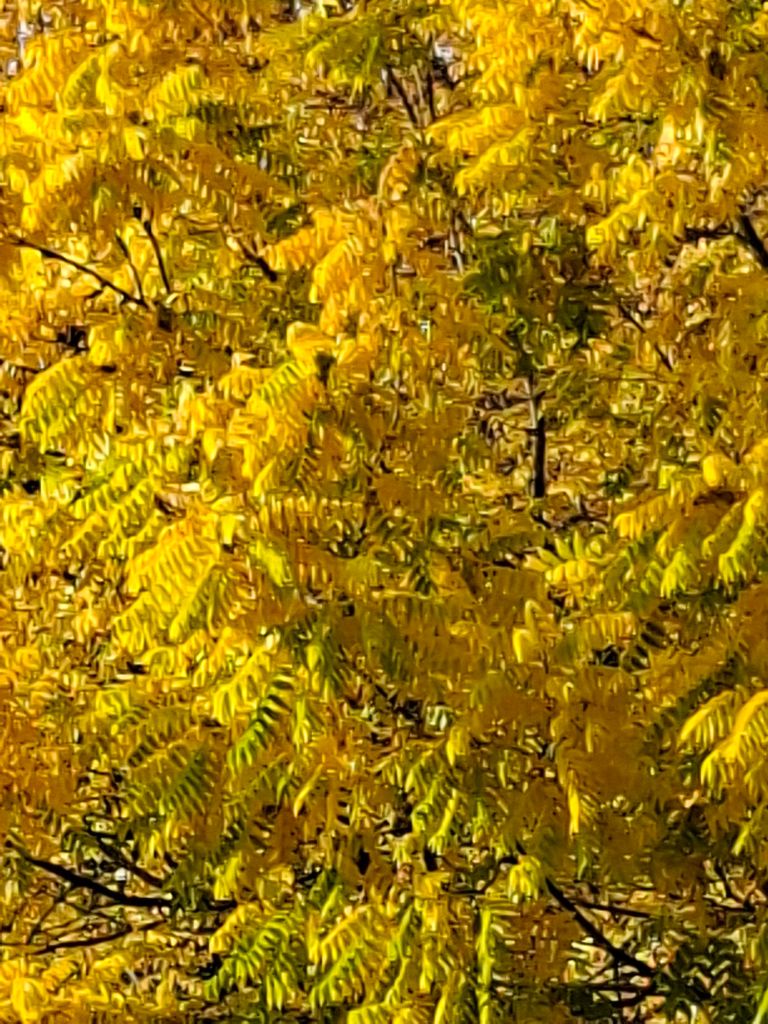
Here, above, is lush life against a background suggestive of mist. Close up, we enjoy the patterns and colours of the leaves. They seem fresh, radiant and alive.

Below, the distinctive yellow of the tree of heaven, and its fern-like leaves, provide a powerful contrast that adds to our enjoyment.

Looking from a somewhat greater distance, below, I experience a sense of majesty in seeing the whole tree (right) leaning into blue sky. Its slightly closer neighbour (left) provides a subtle colour contrast with a deep green intermingled with brown leaves ready to fall.

Below, I have stepped back further from the trees. My picture is of a clump of trees in the park. They are largish trees. The person walking past them is dwarfed. But I’m still enjoying leaves. I like the reddish brown emerging from residual green. I see Nature at work in a way that is both understated and beautiful. I know also that it can be a sheltering space within a generally flat and open park.

I still have a particular affection for willow, going back 20 years when I was studying Druidry. I was in Bristol and befriended a willow on the banks of the Bristol Avon, where it moves out from the old city towards the Clifton suspension bridge and the gorge. I became a literal tree hugger. It was part of a process that indeed changed my life. Hence my affection for willow. I am glad that there are willows in the Gloucester  City park.

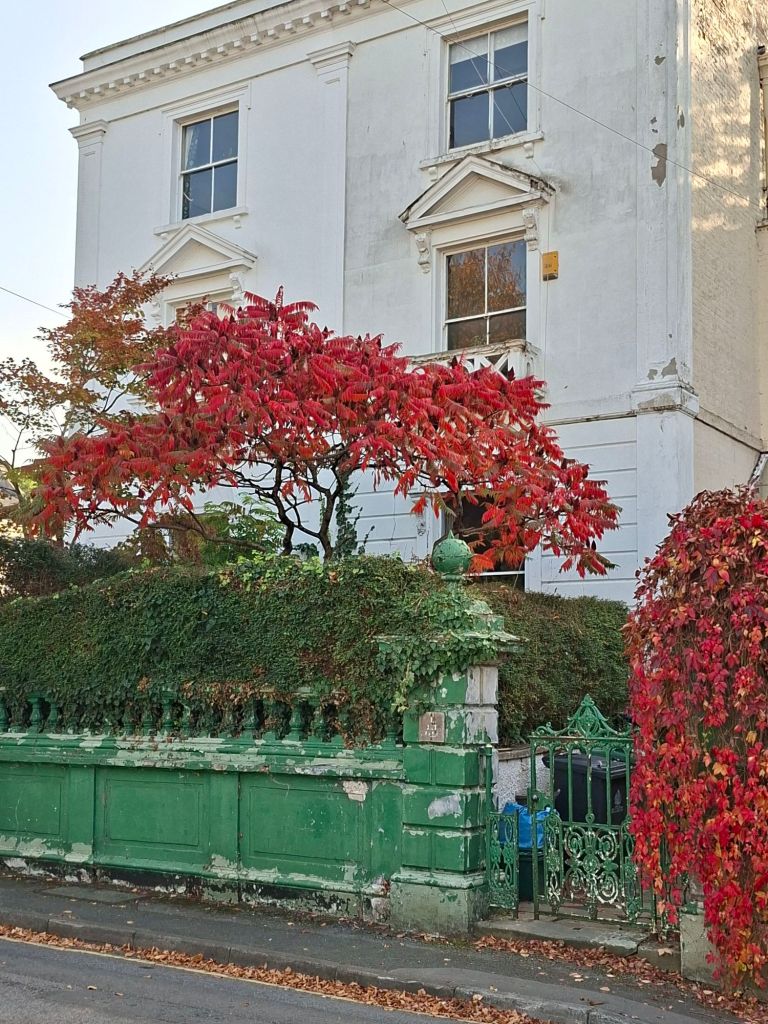
The road we took to and from the park offered leaves of autumnal red. I  believe that the tree in the front garden is a stagshorn sumac. When I walk past the tree I get a little distracted by the property’s obvious  need for a little tlc. Elaine however celebrates the opportunity taken by the Virginia creeper, as seen particularly in the second of the pictures below. It is great to see such abundance in this unpromising space.

For me, the great virtue of simple pleasures is their simplicity itself. Paying attention to the everyday  Nature around us can be deeply nurturing and involves little risk. Yet for some, it can be a portal to re-enchantment in a largely disenchanted world.

BOOK REVIEW: ELEGANT SIMPLICITY

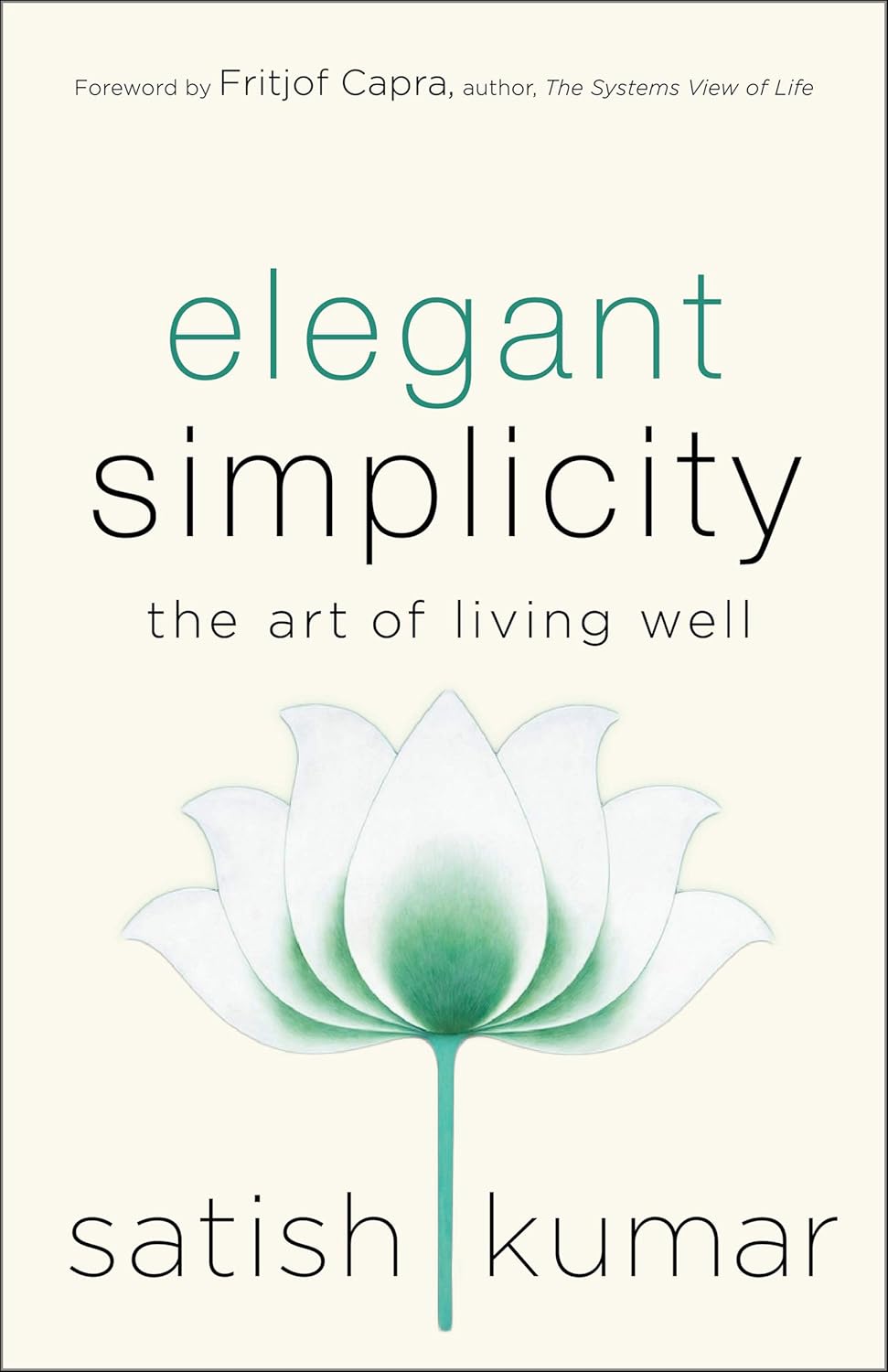
Highly recommended. Satish Kumar (born in 1936) published Elegant Simplicity: the Art of Living Well in 2019 (1). It begins with a foreword by Fritjof Capra and a preface by the author Let’s be Simple which quotes the 1848 Shaker song ‘Tis the gift to be simple, ‘Tis the gift to be free. The book summarises the author’s personal story as well as discussing his values. I have written posts based on some of his other work before (2). I especially recommend this book to anyone interested in knowing more about Satish Kumar’s practice (grounded in Jain spirituality and Gandhi’s non-violent activism) and his influence on deep ecology, creative arts and education.

Elegant Simplicity has a summarising quality, looking back on decades devoted to sacred activism in different forms. It is divided into fourteen chapters: Each is preceded by a brief and relevant quotation from another thinker. The chapter then becomes a meditation on the quote:

1 My Story: Beginnings – ‘True happiness lies in contentment’ Mahatma Gandhi.

2 Simplicity of Walking – ‘All truly great thoughts are conceived by walking’ Friedrich Nietzsche.

3 Life is a Pilgrimage – ‘Faith is not the clinging to a shrine but an endless pilgrimage of the heart’ Abraham Joshua Heschel.

4 Elegant Simplicity – ‘Any fool can make things complicated, it requires a genius to make them simple’ E. F. Schumacher.

5 A Society of Artists – ‘This world is but a canvas to our imagination’ Henry David Thoreau.

6 Yoga of Action – ‘Life is a process not a product’ Brian Goodwin.

7 Learning is Living – ‘Education is not preparation for life; education is life itself’ Thomas Dewey.

8 Right Relationships – ‘We are all related – relationships based on obligation lack dignity’ Wayne Dwyer.

9 Love Unlimited – ‘There is no charm equal to tenderness of the heart’ Jane Austin.

10 Power of Forgiveness – ‘It’s one of the greatest gifts you can give yourself, to forgive. Forgive everybody.’ Maya Angelou.

11 Dance of Opposites – ‘Life and death are one as the river and the sea are one’ Kahlil Gibran.

12 Deep Seeing – ‘To see clearly is poetry, prophecy, and religion, all in one’ John Ruskin.

13 Union of Science and Spirituality – ‘Science is not only compatible with spirituality; it is a profound source of spirituality’ Carl Sagan.

14 Soil, Soul and Society – ‘We live in an interconnected world and in an interconnected time so we need holistic solutions to our interconnected problems‘ Naomi Klein.

Fellow activist and author Vandana Shiva describes Elegant Simplicity as “the distillation” of Satish Kumar’s ideas and actions. “It shows the intimate connections between the inner and the outer world, soil, soul and society, beauty joy and non-violence. It indicates that the solutions to the big problems of our time – climate change, hate, violence, hopelessness and despair – lie in thinking and living with elegant simplicity, reducing our ecological footprint while enlarging our hearts and minds”.

For me, Satish Kumar is an inspiration rather than a direct model. Even in the conditions of the early 1960’s I would not have walked, or aspired to walk, from New Delhi to Washington DC without carrying any money. Yet Satish Kumar and his companion E. P. Menon succeeded and made a huge public impact at the time. Their peace pilgrimage gave oxygen to the campaign for nuclear disarmament. No state gave up its arms, but treaties limiting the numbers and testing of nuclear arms became normalised for some decades. Satish Kumar’s initiatives in deep ecology and education, especially the ‘small school’ and Schumacher College, have changed lives. Directly and indirectly, his influence has awakened many people from the dystopian trance of our dominant cultures. Satish Kumar is a widely revered elder: a peaceful warrior for a more liveable, generous and creative world.

(1) Satish Kumar Elegant Simplicity: The Art of Living Well New Society Publishers (https://www.newsociety.com): Gabriola Island, BC, Canada: 2019

(2) See previous posts:

NEWS OF A DEATH

TWO VIEWS OF THE DIVINE

OUTDOOR WALKING MEDITATION

NOTE: “Satish Kumar (born 9 August 1936)[1] is an Indian British activist and speaker. He has been a Jain monk, nuclear disarmament advocate and pacifist.[3]Now living in England, Kumar is founder and Director of Programmes of the Schumacher College international center for ecological studies, and is Editor Emeritus of Resurgence & Ecologist magazine. His most notable accomplishment is the completion, together with a companion, E. P. Menon, of a peace walk of over 8,000 miles in June 1962 for two and a half years, from New Delhi to MoscowParisLondon, and Washington, D.C., the capitals of the world’s earliest nuclear-armed countries.[4][5] He insists that reverence for nature should be at the heart of every political and social debate.” (Wikipedia)

STRENGTH IN SIMPLICITY

In recent days, living a pared down life, I have seen the strength in simplicity. Both my contemplation and my inquiry are reflecting this. I have a few simple practices adapted from a variety of sources. At first under the pressure of illness, I have moved away from the kind of system building that was drawing my attention a month ago (1). Now I have reminded myself that customising, using a light touch, and keeping practice relatively simple has been my generally preferred way of responding to influences. It helps me to avoid half-awarely ventriloquising teachers and to maintain my own discernment.

As an example (2), I describe a simple meditation. It focuses on the breath because that is something I am busy with – and ambivalent about thanks to my COPD. In it I draw on the understanding that breath and spirit share the same word in some languages (e.g pneuma in Greek). No more than ten minutes is needed for a session.

Although simple, the practice does have a liturgical framing – for instance adapting one of Stewart’s Qabalistic crossing forms from The Miracle Tree. I also draw on my OBOD background, especially the commitment to finding peace. This kind of framing helps. In formal practices like this, I am not just plunging into raw experience. I have other opportunities for that. Rather, the practice affirms an already existing perspective, developed over time, and this is what the words proclaim.

(1) https://contemplativeinquiry.blog/2022/04/05/towards-an-integration/

(2) See text below:

Crossing, using my right hand, I say: In the name of Wisdom (forehead), Love (pubic bone), Justice (right shoulder), Mercy (left shoulder), and the Living Breath (both hands over upper chest). I enter stillness. Then I say: Deep within my innermost being, I find peace. Silently, within the stillness of this space, I cultivate peace. Heartfully, within the wider web of life, may I radiate peace.

I do a breath exercise*, and then say: I am a movement of the breath and stillness in the breath; living presence in a field of living presence: here, now, and home.

Then, I begin slow, deep breathing, as if inviting the Cosmos to breathe through me. I may use the I AM mantra. For me it affirms the non-separation of the finite life and the Source, and the gift of a place within the ecology of being.

On completion I repeat the Crossing and say: I give thanks for this meditation. May it nourish and illuminate my life. May there be peace throughout the world.

*11x breathe in through nose, counting to 8; hold, counting to 8; out through mouth, counting to 8, hold, counting to 8.

WHAT IS GIVEN

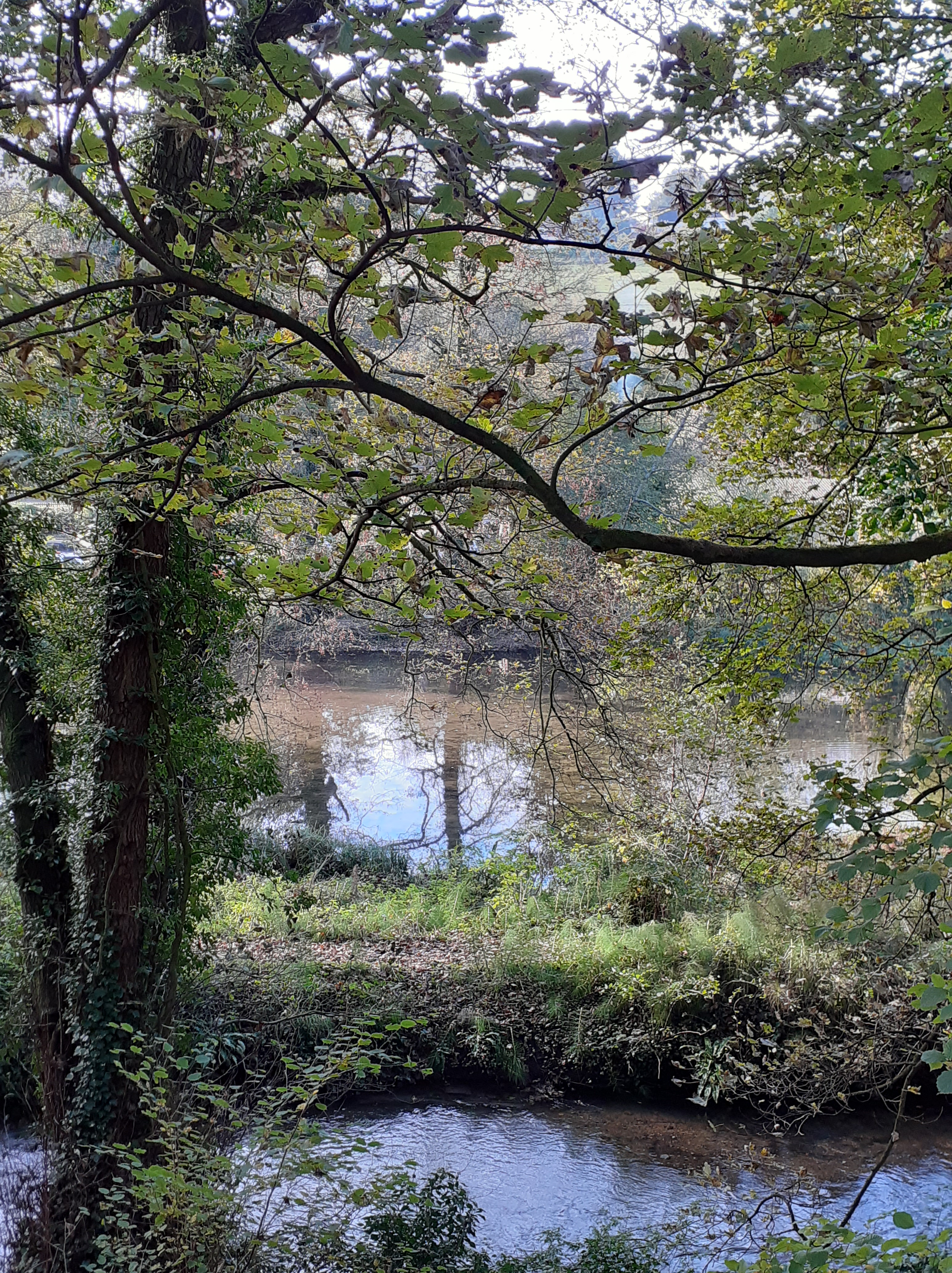
It is colder now, and gloomier indoors for much of the day. But outside, this November keeps on giving. My walking range has increased again with a walk to nearby Nailsworth, a leisurely lunch in this little town, and a walk back again: ten miles. The picture above includes both a stream beside my path and a small lake nearby.

But my attention hasn’t been all on the world around me. I have been reflecting on an old statement about my practice, currently included in my About section, and finding that it still holds. “My inquiry process overall has helped me to discover an underlying peace and at-homeness in the present moment, which, when experienced clearly and spaciously, nourishes and illuminates my life. It is not dependent on belief or circumstance, but on the ultimate acceptance that this is what is given. I find that this perspective supports a spirit of openness, an ethic of interdependence and a life of abundant simplicity.”

There is no reliance on metaphysics here. This allows me a pared down focus on experience and values. My practice has been relatively stable over a long period, whereas my thoughts about metaphysical questions are more volatile. I experience thinking as volatile by nature, and fine within its limits. Over the years this blog has found room for diverse approaches to the meaning, if any, of terms like divinity and consciousness. I have wondered about the possibility (or desirability) of establishing any foundational truth about absolute or indeed conventional ‘reality’. I notice now that when I explore these questions – especially when reading – I am more interested in seeing how people put their worlds together than I am in identifying insights or finding answers to the questions themselves. It has become a human interest rather than a philosophical quest.

I have noticed this especially over recent days when engaging with Carlo Rovelli’s discussion of the Buddhist philosopher Nagarjuna (1,2). My interest was in seeing how a distinguished physicist makes use of Nagarjuna’s emptiness doctrine. I have less stake in assessing the view itself, because my peace and at-homeness are the result of an experiential inquiry, and not of speculative thinking. I continue to find that this perspective supports “a spirit of openness, an ethic of interdependence, and a life of abundant simplicity”, My inquiry focus, if ‘inquiry; is even the right word, is about how best to walk the talk.

(1) Carlo Rovelli Helgoland global.penguinrandomhouse.com 2020 (Translated by Erica Segre & Simon Carnell, 2021). Carlo Rovelli is a theoretical physicist who has made significant contributions to the physics of space and time.

(2) https://contemplativeinquiry.blog/2021/11/08/exploring-emptiness-carlo-rovelli-and-nagarjuna

THE PASSAGE OF TIME

The years roll on, with ever increasing speed. This is me in 1952, sitting to have my picture taken in a photographer’s studio. I just about remember the occasion as a significant event, for which I was carefully dressed and coached. I am pleased to report that this eager, inquisitive (if slightly anxious?) boy has never died, though at times he is hard to find. His image reminds me of the magical, light bringing child in each of us, whatever else we have become. Buried, it may be. Wounded, confined or hiding, in some cases, at some times. But still there, still embodied in old and hidden places, awaiting renewed recognition and love.

This is midwinter and a time of reminiscing and stocktaking. On 20 December 2019 I wrote: “I’m peering in to the 2020s. Calendar numbers might be arbitrary, but they are numbers of power in our culture. They award shape and identity to years and decades. Part of me sees the 2020s as pure science fiction, with an increasingly dystopian tilt. Themes of alarm, determination, resourcing and resilience come up for me at multiple levels”. (https://contemplativeinquiry.blog/2019/12/20/approaching-the-years-turn/).

At that time I undertook to give more attention to the wheel of the year, and to cultivate certain values: lovingkindness; positive health and well-being; a life of abundant simplicity; and a spirit of openness, creativity and wisdom (https://contemplativeinquiry.blog/2019/12/27/values-for-2020). Sometimes during the year I have been on point and sometimes I have not. I do feel overall that these were good choices for the year of Covid-19 and I have at least paid them conscious attention.

I do not approach 2021 with new and different thinking. I expect it to be another challenging year, especially in the early months, no doubt in a slightly different way. I will bring the same approach to 2021 as to 2020, perhaps enhancing the qualities of simplicity and openness, leaning more towards the centre rather than the periphery of the wheel. This could be the role of the elder within. There is room both for youth and age in one person.

Earth Eclectic

music that celebrates Earth and speaks to the heart

Sarah Fuhro Star-Flower Alchemy

Follow the Moon's Cycle

Muddy Feet

Meeting nature on nature's terms

Rosher.Net

A little bit of Mark Rosher in South Gloucestershire, England

Becoming Part of the Land

A monastic polytheist's and animist’s journal

selkiewife

Selkie Writing…

Charlotte Rodgers

Images and words set against a backdrop of outsider art.

Prof Jem Bendell

living with metacrisis and collapse

Towint

The pagan path. The Old Ways In New Times

The Druids Garden

Spiritual journeys in tending the living earth, permaculture, and nature-inspired arts

The Blog of Baphomet

a magickal dialogue between nature and culture

This Simple Life

The gentle art of living with less

Musings of a Scottish Hearth Druid and Heathen

Thoughts about living, loving and worshiping as an autistic Hearth Druid and Heathen. One woman's journey.

Wheel of the Year Blog

An place to read and share stories about the celtic seasonal festivals

Walking the Druid Path

Just another WordPress.com site

anima monday

Exploring our connection to the wider world

Grounded Space Focusing

Become more grounded and spacious with yourself and others, through your own body’s wisdom

The Earthbound Report

Good lives on our one planet

Hopeless Vendetta

News for the residents of Hopeless, Maine