Contemplative Inquiry

This blog is about contemplative inquiry

Tag: shamanism

EVERGREEN OVERVIEW

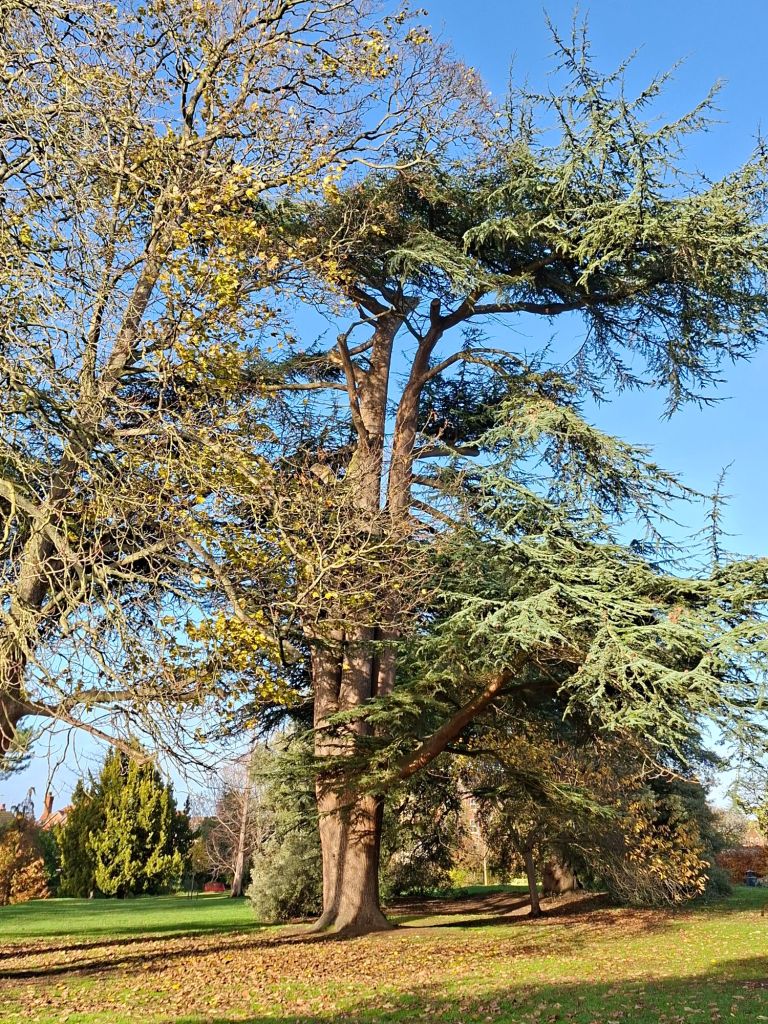
A Scots pine in Hillfield Gardens (1), 28 November, 10.32 am. It stands out both as a tall tree and an evergreen. It asks me to look up and pay attention to it, and beyond it, almost  losing sight of its deciduous neighbour. For me, this representative of the ‘eternal green’ has a commanding presence.

The Scots pine is one of the oldest trees native to Britain. It is also one of the trees associated with ogham lore (2), where the Scots pine is linked to the wisdom of overview. According to The Green Man Tree Oracle, ancient shamans of many traditions would literally climb to the top of a central tent pole or tree and “from this vantage point they could see clearly into the spirits’ inner world and come back with knowledge for the tribe or family they served” (2).

For me as for many people, the end of the calendar year is a time for reflection and taking stock. New year resolutions are a possible modern version of this process, but mine never really worked.  They were overprescriptive and a way of setting myself up to fail.

‘Overview’ asks for a less driven and more contemplative approach, one more connected with Spirit. This is a good reminder as I start to wonder about how I am going to navigate 2026: divining what my contributions and satisfactions might look like as the Wheel continues to turn.

(1) Re Hillfield Gardens, Gloucester, see https://contemplativeinquiry.blog/2024/11/22/

(2) John Matthews and Will Worthington The Green Man Tree Oracle: Ancient Wisdom from the Greenwood London: Connections, 2003

PHILIP CARR-GOMM AND FRANK MCEOWEN: A CONVERSATION

An Interview with Frank McEowen (1) is the latest offering in Philip Carr-Gomm’s This Magical Life podcast. The overall aim of This Magical Life is to explore the intersection of Druidry, Psychology and Wisdom. Philip is a clinical psychologist and led OBOD (the Order of Bards, Ovates and Druids) for some 30 years. Frank is the author of, among other works, The Mist-Filled Path: Celtic Wisdom for Exiles, Wanderers and Seekers.

This wide-ranging interview covers three main topics: Celtic bards, Chinese hermit poets and politics in America today. All of these are tied into Frank’s journey and service. He was born in Mississippi, USA, of Irish, Scottish, Welsh and English ancestry. At an early age he experienced mystical encounters with the other world. These later prompted him to work with indigenous elders in North America, and later with teachers in Britain and Ireland, especially Ireland, opening himself also to the spirit(s) of place. He speaks of his journey as a whole as one of ‘soul retrieval’. His early books – The Mist-Filled Path, Meditations on the Irish Sprit Wheel, and The Spiral of Memory and Belonging, come out of this experience.

For reasons explained in the interview, Frank then made a decision to ‘disappear inward’, becoming a hermit and poet. As well as working in Celtic spirituality, Frank was also a student of Zen. He had a natural attraction to Chinese and Japanese wayfaring hermit poetry and modelled the life style as well as the art, adjusted to a different time and culture. This period led to three books of poetry published under the name of Frank LaRue Owen: The School of Soft Attention, The Temple of Warm Harmony and Stirrup of the Sun and Moon.

Like Philip, part of Frank’s service is in the field of psychological healing and personal development, principally as a student of Arnold Mindell. Mindell coined the term ‘Dream Body’ – a psycho-spiritual approach that is also Earth reverencing. It is within this framework that they talk about American politics today. First they identify distressed energies within the national psyche which the current President has uncorked and used in a darkly charismatic and disinhibited way. The discussion takes off from there, looking at issues of grief, loss (of democracy) and possible  hope. Connecting this predicament to the bard/poet vocation, Frank quotes Ukrainian poet Ilya Kaminski: “the project of Empire is to dull the senses. The project of the poet is to wake up the senses”. Projects of Empire are not unique to the USA. There is something to reflect on for us all.

I recommend this podcast as a rich and varied conversation, covering a lot of ground in its 36 minutes.

(1) The YouTube post spells Frank’s surname as McEowen and the covers of his early books use MacEowen. I don’t know if he has altered the spelling over time.

TALIESIN THE SHAPE SHIFTER

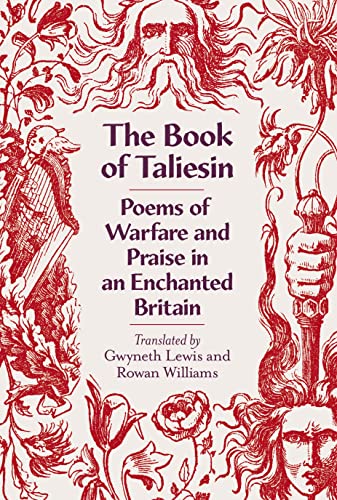
This is my third in a series of posts drawing on Gwyneth Lewis’ and Rowan Williams’ modern English version of The Book of Taliesin (1), an anthology of bardic poetry from medieval Wales. My first post introduced the book and offered extracts from A Song of the Wind (2). The second looked at the importance of ‘The Old North’ (territories in north-west England and southern Scotland that shared the same history, language and culture as the people of Wales) (3). This, final, post looks at the development of the Taliesin figure in the later middle ages. In particular, I focus on the anthology’s section entitled Legendary Poems and on the translators’ understandings of bardic poetry, shapeshifting and awen. I also look at their reasons for interpreting the Taliesin of these poems as “a kind of Christian shaman”.

In these poems, the use of shapeshifting language is presented as being a feature of competition between rival bards. “The Taliesin figure demonstrates his superiority … by spelling out at triumphant length the questions he can answer about which his rivals are ignorant, and by listing the various embodiments he has experienced”. The translators give an example of this in the opening of The Battle of the Trees.

“I was in many forms

Before my release:

I was a slim enchanted sword,

I believe in its play.

I was a drop in air,

The sparkling of stars,

A word inscribed,

A book in a priest’s hands,

A lantern shining

For a year and a half.

A bridge in crossing

Over threescore abers (= estuaries).

I was path, I was eagle,

I was a coracle at sea.

I was bubbles in beer,

I was a raindrop in a shower.

I was a sword in the hand;

I was a shield in battle.

I was a harp string,

Enchanted nine years

In water, foaming.

I was tinder in fire,

I was a forest ablaze”.

The editors comment: “these extraordinary poems reflect a sophisticated and complex understanding of poetic composition in which the concept of awen is central. It would be misleading to translate this idea of inspiration as ‘Muse’: it is better thought of as a state of altered consciousness in which the poet receives knowledge of matters beyond what can routinely be learned. According to Gerald of Wales’ description of the awenyddion, or inspired soothsayers, of the 12th century CE, the gift of awen produces the same kinds of extreme behaviour as are associated with spirit possession: loud shouting, trance and catalepsy, disconnected but also very elaborate speech, narrated experiences of supernatural encounters which trigger the exercise of this gift, and a subsequent inability to remember what was said under its influence”.

Poems like The Battle of the Trees may be “an attempt to reflect the style or register of such ecstatic states of consciousness”. However, the poems themselves may not be “transcriptions of specific compositions originating in altered states”. In cultures that have a “routine ritual space” for “ecstatic phenomena”, the irruption of the supernatural will follow a familiar pattern. “There will be expectations about both the actual expression and the transmission of what has been delivered”. If poetry is to be recognised as the authentic voice of ecstatic perception, “it must follow certain classical, normative exemplars of poetic ecstasy”. The Taliesin of these poems is a composite figure modelling how to speak as an awenydd. He demonstrates a particular way of being a poet and sounding like a poet of this kind.

Religious tensions appear in The Spoils of Annwfn. The bard rails against the ignorance of monks.

“And the monks herd together, a pack of dogs,

In the contest with those

Who have mastered the lore –

Whether wind takes one path,

Whether the sea is one water,

Whether fire’s unstoppable force is one spark.

The monks herd together, a pack of wolves,

In the contest with those who have mastered the lore –

They don’t know how darkness is severed from light,

They don’t know the course of the wind in its rushing,

Where the wind will lay waste, what land it strikes,

How many saints in the sky’s vault, and how many shrines.

I will praise the Prince, the Lord, the Great One.

Let me not be sad: Christ will repay me.”

The translators point out that the shapeshifter Taliesin of the 12th century CE, is “multifaceted” compared to the court bard of the 6th-9th centuries. The later literature links Taliesin “especially with stories involving the figure of the sorcerer Gwydion and the ‘children of Don'”. His status as dewin (sage or sorcerer) or occasionally derwyd (druid) is “so equal in importance to his standing as a poet that the two might more accurately be said to become inseparable”. But he is also shown, as in the extract above, dutifully commending his work to God and as “being familiar with theological questions, most notably those relating to the Incarnation, and with apocryphal traditions surrounding the biblical narratives”.

Lewis and Williams conclude that “this later Taliesin becomes a bridge figure between traditional Welsh lore and the cosmopolitan world of early medieval ecclesiastical learning”. The extract above reflects “a resentment of the new monastic foundations after the Norman Conquest, the Benedictine houses that sprang up in proximity to the new castles and settlements in the Welsh Marches (English/Welsh border counties). Monks from continental Europe are unlikely by this date to have been familiar with or sympathetic to the rather older style of clerical learning represented by the riddling and legendary elaborations of the Christian story found in the Irish or Anglo-Saxon texts of the early Middle Ages; Taliesin thus becomes a mouthpiece for this archaic Christian lore as well as the archetypal bard and seer”. This is why the translators characterise Taliesin in his shape-shifting period as a “Christian shaman”.

(1) Gwyneth Lewis and Rowan Williams The Book of Taliesin: Poems of Warfare and Praise in an Enchanted Britain Penguin Random House UK, 2020 (First published in hardback in Penguin Classics and 2019) Gwyneth Lewis was National Poet in Wales, 2005-6 and teaches at Middlebury College Vermont. Rowan Williams is a former Archbishop of Canterbury, subsequently Master of Magdalene College, Cambridge.

(2) https://contemplativeinquiry.blog/2023/08/07/

(3) https://contemplativeinquiry.blog/2023/08/10/

TAO TE CHING AND THE DARK NEW MOON

“The Tao Te Ching is at heart a simple book. Written at the end of the sixth century B.C. by a man called Lao-tzu, it’s a vision of what our lives would be like if we were more like the dark new moon.

“Lao-tzu teaches us that the dark can always become light and contains within itself the potential for growth and long life, while the light can only become dark and brings with it decay and early death. Lao-tzu chose long life. Thus, he chose the dark.” (1)

Red Pine’s translation of the Tao Te Ching has been around in its present form since 2009, but I have come across it only recently. It has given me a new lens on this much loved ancient text. Red Pine is the nom de plume for Bill Porter, who was born in Los Angeles in 1943, grew up in the Idaho Panhandle, served a tour of duty in the US army (1964-7) and went on to study anthropology. Dropping of graduate school in 1972, he moved to a Buddhist monastery in Taiwan for four years before becoming involved with English language radio stations in Taiwan and Hong Kong. In 1993 he moved back to America, since which time he has been an independent scholar specialising in Chinese Buddhist and Taoist texts.

The word Tao (road or way) is made up of two characters, one meaning ‘head’ and the other meaning ‘go’. Red Pine cites a modern scholar of comparative religion, Professor Tu Er-wei, to suggest that : “the ‘head’ in the character tao is the face of the moon. And the meaning of ‘road’ comes from watching this disembodied face as it moved across the sky”. He also reminds us that the symbol Taoists have used since ancient times to represent the Tao shows the two conjoined phases of the moon.

China was divided in Lao-tzu’s time. and he was based in the state of Ch’u, described as being on the ‘shamanistic periphery’ of Chinese culture. The Ch’u rulers took for their surname hsiung (bear) and they called themselves Man or Yi, “which the Chinese in the central states interpreted to mean ‘barbarians’… The influence of Chu’s culture on Lao-tzu is impossible to determine, but it does help us better understand the Tao Te Ching, knowing that it was written by a man who was no stranger to shamanistic conceptions of the sacred world. Certainly as Taoism developed in later centuries, it remained heavily indebted to shamanism”. Specifically in relation to the Tao Te Ching, “Lao-tzu redirects vision to that ancient mirror, the moon. But instead of pointing to its light, he points to its darkness. Every month the moon effortlessly shows us that something comes from nothing”. For it is the new moon that holds the promise of rebirth. The first verse of his translation reads:

The way that becomes a way

Is not the Immortal Way.

The name that becomes a name

Is not the Immortal Name.

No-name is the maiden of Heaven and Earth.

Name is the mother of all things.

Thus in innocence we see the beginning

In passion we see the end

Two different names

For one and the same.

The one we call dark

The dark beyond dark

The door to all beginnings.

At other points in the text, according to Red Pine, Lao-tzu says that the Tao is between Heaven and Earth; it’s Heaven’s Gate; it’s empty but inexhaustible; it doesn’t die; it waxes and wanes; it’s distant and dark; it doesn’t try to be full; it’s the light that doesn’t blind; it has thirty spokes and two thirteen-day (visible) phases; it can be strung like a bow and expand or contract like a bellows; it moves the other way (relative to the sun, it appears/rises later and later); it’s the great image, the hidden immortal, the crescent soul, the dark union, the dark womb, the dark beyond the dark. These can all be seen as lunar images.

There is of course a place for the light as well. We approach the elusiveness and namelessness of the Tao through Te – virtue, both in a moral sense and as the power to act. Without the Tao, Virtue would have no power: without Virtue, the Way would have no appearance. These are the two poles: the Tao, the body, the essence, the Way; and Te, the light, the function, the spirit, Virtue. In terms of origin, the Tao comes first. In terms of practice, Te comes first. The dark gives the light a place to shine. The light allows us to see the dark. But too much light blinds. “Lao-tzu saw people chasing the light and hastening their own destruction. He encouraged them to choose the dark instead of the light, less instead of more, weakness instead of strength, inaction instead of action”.

This is not the only way to read, or work with, the Tao Te Ching. For me, it’s not the kind of text that offers fixed meanings and interpretations. But it does seem clear to me that a lunar inspiration, and lunar imagery, stand behind this work and are part of its construction. I feel enriched by having this pointed out and demonstrated through Red Pine’s translation.

(1) Red Pine Lao-tzu’s Taoteching: with Selected Commentaries from the past 2,000 years Copper Canyon Press, 2009 https://www.coppercanyonpress.org/ (First edition published in 1996)

BOOK REVIEW: THE GREATEST ACHIEVEMENT IN LIFE (REVISED AND UPDATED EDITION)

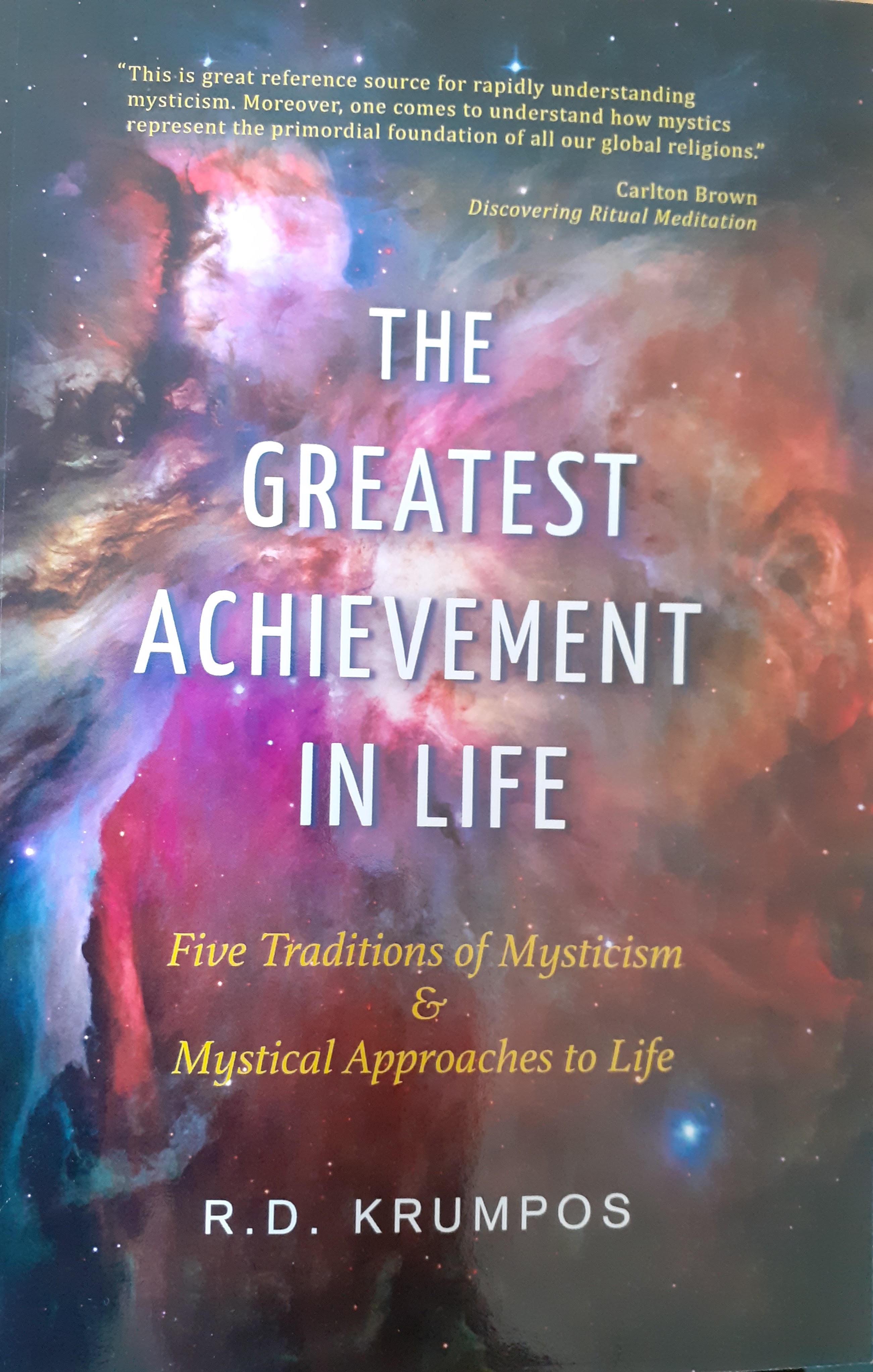
Highly recommended for anyone drawn to contemplative and mystical traditions. R. D. Krumpos’ The Greatest Achievement in Life: Five Traditions of Mysticism & Mystical Approaches to Life (1) is now available in print, in a new revised edition. I like having it now as an old-fashioned physical book that I can leaf through easily both for reference and for inspiration.

The book explores the mystical traditions embedded within Hinduism (Vedanta, Tantra), Buddhism (Zen, Vajrayana), Judaism (Hasidism, Kabbalah), Christianity (Gnostic and Contemplative currents) and Islam (Sufism). Krumpos shows how, underneath their manifold differences, they share an understanding of mysticism as the direct intuition or experience of God, or of an ultimate Reality not conceived as God.

Mystics are described as people whose spiritual lives are grounded “not merely on an accepted belief and practice, but on what they regard as first-hand knowledge”. Krumpos spells out the uncompromising idealism of this project. “Mysticism is the great quest for the ultimate ground of existence, the absolute nature of being itself. True mystics transcend apparent manifestations of the theatrical production called ‘this life’. Theirs is not simply a search for meaning, but discovery of what is i,e, the Real underlying the seeming realities. Their objective is not heaven, gardens, paradise or other celestial places. It is not being where the divine lives, but to be what the divine essence is here and now”.

The book is divided into two main sections: Five Traditions of Mysticism and Mystical Approaches to Life. Within these sections there is a further division into short essays, which can be read either in sequence or independently of the whole. The essays are based both on conversations with mystics and engagement with mystical literatures. Krumpos draws directly on the words of well-known mystics themselves, with 120 quotations interspersed with the essays. He also offers his own commentary and reflections. The book can either be seen as a source and reference book, or as a practitioner aide. It includes sentences and paragraphs that can themselves be used as a basis for formal contemplation. It is not just an ‘about’ book, though it serves that purpose well.

The traditions presented are seen as having much in common at the core, and The Great Achievement bears witness to that commonality. Yet there is enough interior diversity to make it clear that mystics in these traditions are not all the same, or saying the same thing, in the way that is sometimes lazily claimed. Overall Ron Krumpos’ sense of ‘direct experience’ and his definition of gnosis describe a gold standard for what ‘the greatest achievement’ is, based on the accounts of the mystics cited and discussed. In the second half of this book, the focus valuably shifts from the nature of mystical experience itself, to a consideration of its implications for how to live and serve.

For me, the cultural moment in which The Great Achievement has been offered is significant one. Perennialism’s ideas have been popularised and repackaged over the period since World War II at an ever increasing rate. There is now an extraordinary global spiritual hunger at least partly influenced by the spiritual paths that it includes – some, indeed, speak of a ‘spiritual market place’. This is a promising development, yet one with its downside. Krumpos’ work reminds us what these older traditions are and where they stand. For readers in new (or new-old) spiritual traditions with a different approach, the book offers opportunities for comparing and contrasting the fruits of the five traditions with those of their own chosen paths. Krumpos does acknowledge the value of shamanic and indigenous traditions, and practitioners within these traditions, reading this book, might be inspired to develop this conversation further.

(1) R. D. Krumpos The Greatest Achievement in Life: Five Traditions of Mysticism & Mystical Approaches to Life Tucson, AZ: Palomar Print Design, 2022. (Originally a free e-book available from http://www.suprarational.org/ as a printable pdf, published in 2012).

NB This review is a revision of my review of the original edition. See:

https://contemplativeinquiry.blog/2021/03/06/

BOOK REVIEW: A STORY WAITING TO PIERCE YOU

Peter Kingsley is a scholar of early Greek philosophy, and A Story Waiting to Pierce You (1) links Pythagoras (ca 590-470 BCE) with central Asian shamanism. Pythagoras got most of his own education outside of the Greek cultural sphere, and Kingsley focuses here on his relationship with Abaris the Hyperborean*, using ancient texts to guide him.

Abaris is not a personal name. It places its bearer as an Avar. The Avars are one of the peoples ancestral to modern Mongols. They still and still live under their older name in Dagestan, a Russian republic in the northern Caucasus. Kingsley’s Abaris walked, or in some sense flew, from his homeland to meet Pythagoras. He carried a golden arrow in his hand, though in a way it carried him. For Abaris was a wind walker, and on a mission.

Kingsley explains, using evidence from pre-Buddhist Tibet (where the practice has survived within Buddhism) as well as Mongolia: “Wind walkers could go anywhere; cover enormous distances with apparently effortless ease; find their way over every conceivable obstacle and straight past the most impassable landscapes … in one unbroken trance, holding their god inside them. That single-pointed focus, just like the intense attention required of an arrow maker or demanded of someone shooting arrows at their mark, had to be totally undisturbed”.

Abaris had been shown by the god within him that in Pythagoras he would find a living incarnation of the same god. Greek texts name the god as Apollo –  understood here primarily as a god of healing, trance and prophecy. Abaris gave his arrow, as planned, to Pythagoras, in recognition of his true nature. Through Pythagoras, he hoped, the Greek world would be healed and purified.

Pythagoras had considerable success. He attracted an enthusiastic following, and coined the term philosopher (lover of wisdom) to describe his work. He taught kindness to humans and animals and championed an honest and simple life. He believed in metempsychosis (transmission of the soul after death into a new body, human or animal), and in the explanatory power of number. But he was one teacher among others, and even his enthusiastic followers played down the influence of Abaris and his culture. It did not suit the self-image of the Greeks to recognise nomadic barbarians as possible teachers. They were not alone in this. A similar view prevailed in China.

Why does this matter to us? Because we have kept on making the same mistakes. The early stigmatisation of Hyperborean culture in the ancient world has been repeated in the stigmatisation of the cognate cultures of First Nations people in North America. The Chinese version survives in their current governance of Tibet and Xinjiang. In the spiritual domain, we still maintain a disparaging distinction between shamanism and ‘higher’ traditions. By contrast, Kingsley describes shamanism as “constantly engaged with practising respect and consideration towards all forms of life in an overall framework of concern for both visible and invisible worlds” He adds, “the fact that a transcendent realm beyond the senses happens, in the hands of most true elders and shamans, to be seamlessly interwoven with this world to the point where the two become one is a sign not of inferiority but of a far greater capacity for integration.”

A Story Waiting to Pierce You is not Peter Kingsley’s most recent book, but for me it is the most accessible, in both price and presentation. The first half is written in a simple, spacious, almost mythic style that goes straight to the heart. The second half, comprising notes, offers more than a set of references, looking at scholarly arguments and matters of interpretation. I find this arrangement a satisfying way of handling the material overall. I strongly recommend this book for people interested in the cultural history of spirituality and the issues it raises.

(1) Peter Kingsley A Story Waiting to Pierce You: Mongolia, Tibet, and the Destiny of the Western World Point Reyes, CA: The Golden Sufi Center, 2010

*Hyperborean = from Hyperborea, beyond the north wind.

BOOK REVIEW: THE GREATEST ACHIEVEMENT IN LIFE

The Greatest Achievement in Life is a free e-book available from http://www.suprarational.org/ as a printable pdf, published in 2012. Author R. D. Krumpos looks at five traditions of mysticism, in which mysticism is understood as a direct intuition or experience of God, or of an ultimate Reality not conceived as God. Mystics are described as people whose religion and life are grounded “not merely on an accepted belief and practice, but on what they regard as first-hand knowledge”. Krumpos himself speaks of finding that “preeminent Reality is the holy One in All and All in the wholly One”.

The five mystical traditions examined are those embedded within Hinduism (e.g. Vedanta, Tantra), Buddhism (Zen, Vajrayana), Judaism (e.g. Hasidism, Kabbalah), Christianity (e.g. Gnostic and Contemplative currents) and Islam (e.g. Sufism). I imagine that many people reading this blog will be working outside these traditions. But I recommend the book to anyone with a serious interest in mysticism, however you define it, given that the influence of these traditions is pervasive to the point where it can be virtually unconscious. As a person on a modern Druid path committed to inquiry and with a leaning towards mysticism, I have found Krumpos’ work very helpful in reminding myself of what the ‘five traditions’ are pointing to.

The book is brief and divided into two main sections: Five Traditions of Mysticism and Mystical Approached to Life. Within these sections there is a further division into short chapters, which can be read either in sequence or independently of the whole. Krumpos draws heavily on the words of well-known mystics themselves, as well as offering his own commentary and reflections. The book can either be seen as a source and reference book, or as a practitioner aide. It includes sentences and paragraphs that can themselves be used as a basis for formal contemplation. It is not just an ‘about’ book, though it serves that purpose well.

The traditions presented are seen as having much in common at the core, and The Great Achievement bears witness to that commonality. Yet there is enough interior diversity to make it clear that mystics in these traditions are not all the same, or saying the same thing, in the way that is sometimes lazily claimed. Overall Ron Krumpos’ sense of ‘direct experience’ and his definition of gnosis describe a gold standard for what ‘the greatest achievement’ is, based on the accounts of the mystics cited and discussed. In the second half of this book, the focus valuably shifts from the nature of mystical experience itself, to a consideration of its implications for how to live and serve.

For me, the cultural moment in which The Great Achievement has been offered is significant one. Perennialism’s ideas have been popularised and repackaged over the period since World War II at an ever increasing rate. There is now an extraordinary global spiritual hunger at least partly influenced by the spiritual paths that it includes – some, indeed, speak of a ‘spiritual market place’. This is a promising development, yet one with its downside. Krumpos’ work reminds us what these older traditions are and where they stand. For readers in new (or new-old) spiritual traditions with a different approach, the book offers opportunities for comparing and contrasting the fruits of the five traditions with those of their their own chosen paths. Krumpos does acknowledge the value of shamanic and indigenous traditions, and practitioners within these traditions, reading this book, might be inspired to develop this conversation further.

DREAMING THE MAGICAL CHILD

I often experience winter as a time of powerful dreams, and I had one yesterday night. It moved through three phases, ending with the image of a magical child as guide.

First phase: I am in a crowded place in a sizeable town. I am apparently in charge of two or three young children – close relatives, by the feel of it, though I am not clear on the specific relationships. I do know that I am of the grandparental generation. Suddenly, I notice them running off towards a stretch of park and woodland. I need to catch up and keep them safe.

Second phase: As I mobilise and follow, I am not catching up as rapidly as I had hoped. I notice that the terrain is wetter and rougher than fits with the initial image. The location feels quite different. I may have to cross water and am I not dressed for it for this eventuality. I assume that the children find this easier than I do, and I have confidence that they are OK. I am less sure about myself. This pursuit is a bit of a stretch.

Third phase: I halt at a riverbank. The boy – only one child, the others somehow no longer present or relevant to this dream – has stripped to the waist and taken like a fish to the water, swimming strongly against the current. He seems to be older than when I last looked. I have a moment of panic and dismay before leaping in after him. Fortunately for me, a sort of backpack I have been wearing turns into a comically inflatable throne. There is no doubt now that the boy knows what he is doing and is purposefully leading me upstream towards the source of the river. Paddling with my hands and arms, my task now is to follow as best I can. As I start following in earnest, I wake up.

The ‘I’ of the first phase is apparently in charge, yet vague and inattentive. Only action by the children gets me to notice and pay attention, though I continue to sport an air of responsible authority, with the felt need to keep the children safe. In the second phase ‘I’ am different, becoming aware of a more rugged environment and feeling challenged by it. I am more positive about the children’s capacity, and less so about my own. The third phase is different again. Halting at a riverbank, I recognise the boy as a version of the archetypical magical child, who naturally finds the sacred in all things, connecting us to a larger life. He is numinously present in this phase of the dream. He is the leader. I am the follower. My means of locomotion is clumsy and absurd. But at least I have one, and I do follow. The constructed ego has a significant part to play, it seems, on this journey, but not the leading role it has imagined for itself. Once I start ‘following in earnest’, I am free to wake up.

At the outer world level, culturally, perhaps the wisdom of age includes recognising and making space for the wisdom of youth. In Irish myth, the elderly poet, shaman and sage Finnegas spent seven years trying to catch the salmon of knowledge. When he finally caught the salmon, he asked his apprentice Demne to cook it. As he worked, the boy burned his thumb and instinctively sucked it – and so it was he, not his teacher, who became imbued with the salmon’s wisdom. Finnegas graciously gave Demne the whole salmon to eat, renaming him Fionn. Fionn went on to become the legendary hero Fionn mac Cumhaill (Finn McCool).

IMBOLC 2020

Spaces ‘between’ can be numinous. They feed the soul. Imbolc for me is like a pre-dawn light. I am not yet out of winter, but something else is happening, and palpably growing in strength.

The hierophant of the Wildwood Tarot – the Ancestor – is placed as a power of Imbolc. An antlered figure clothed in reindeer skins and evergreen leaves, she has a resonance of Elen of the Ways, the reindeer goddess who stands for the sovereignty of the land. She calls to us from a deep past where Ice Age hunters followed reindeer through ancient forest, “following the deer trods” (1,2) responsive to the herds and attuned to the landscape. They lived with little personal property and without long hours of alienating work. The Ancestor invites us to wonder what these early ancestors  might have to teach us under our very different conditions.

On the card, the Ancestor is sounding a drum and calling us into another consciousness – one more open and aware of our place within the web of life. In her world, deer and people are kin. She herself is ambiguous – she might be wearing a mask, or she might be a truly theriomorphic figure. I respond to her call by sinking deeply into my felt sense – the embodied life of sensation, feelings and belly wisdom. The call of the Ancestor  is a pathway to greater wholeness and connection, both personally and collectively. As the year wakes up, it is a good call to hear.

(1) Elen Sentier Elen of the Ways: British Shamanism – Following the Deer Trods Arlesford, Hants: Moon Books, 2013 (Shaman Pathways series)

(2) Elen Sentier Following the Deer Trods: A Practical Guide to Working with Elen of the Ways Arlesford, Hants: Moon Books, 2014 (Shaman Pathways series)

See also book review at: https://contemplativeinquiry.blog/2014/06/22/

APPROACHING THE YEAR’S TURN

We have a small patch of garden at the front of our house, remodelled only a week ago. It has a modestly zen pagan reference, with just a hint of spiral. In the bigger picture, where I live, we are rapidly approaching the turn from an inward to an outer arc of life energy. The Winter Solstice is very close.

I’m not experiencing deep stillness this year. It feels more like an extended pause for breath – a time for taking stock and regrouping. I’m peering in to the 2020s. Calendar numbers might be arbitrary, but they are numbers of power in our culture. They award shape and identity to years and decades. Part of me sees the 2020s as pure science fiction, with an increasingly dystopian tilt. Themes of alarm, determination, resourcing and resilience come up for me at multiple levels.

I have checked out older resources which have been neglected for awhile. One of these is the popular and respected Wildwood Tarot. I bought it years ago but didn’t much engage. Now its time has come round, prompted by an impulsive consultation. It happened in the early hours of a recent morning, at a rare time of sleeplessness. I spent several hours getting to know it. Here it is enough to say that I am drawn by its strong wheel of the year orientation, by its choice of imagery for the major trumps in particular, and by its own focus on resiliency.

I am going to live the year from 22 December with heightened attention to the wheel of the year, and with this resource as my companion. My current warm up process is already changing the way I think and feel about contemplative inquiry and will re-shape how I do it. In the meantime I enjoy the front garden and await the return of the sun.

Mark Ryan & John Matthews The Wildwood Tarot Wherein Wisdom Resides London: Connections, 2011. Illustrations by Will Worthington

Earth Eclectic

music that celebrates Earth and speaks to the heart

Sarah Fuhro Star-Flower Alchemy

Follow the Moon's Cycle

Muddy Feet

Meeting nature on nature's terms

Rosher.Net

A little bit of Mark Rosher in South Gloucestershire, England

Becoming Part of the Land

A monastic polytheist's and animist’s journal

selkiewife

Selkie Writing…

Charlotte Rodgers

Images and words set against a backdrop of outsider art.

Prof Jem Bendell

living with metacrisis and collapse

Towint

The pagan path. The Old Ways In New Times

The Druids Garden

Spiritual journeys in tending the living earth, permaculture, and nature-inspired arts

The Blog of Baphomet

a magickal dialogue between nature and culture

This Simple Life

The gentle art of living with less

Musings of a Scottish Hearth Druid and Heathen

Thoughts about living, loving and worshiping as an autistic Hearth Druid and Heathen. One woman's journey.

Wheel of the Year Blog

An place to read and share stories about the celtic seasonal festivals

Walking the Druid Path

Just another WordPress.com site

anima monday

Exploring our connection to the wider world

Grounded Space Focusing

Become more grounded and spacious with yourself and others, through your own body’s wisdom

The Earthbound Report

Good lives on our one planet

Hopeless Vendetta

News for the residents of Hopeless, Maine