Contemplative Inquiry

This blog is about contemplative inquiry

Tag: Samhain

INQUIRY NINE YEARS ON

My contemplative inquiry began as part of a Druid initiative launched nine years ago on 1 November 2011. The inquiry “soon broadened into a wider exploration of contemplative spiritualities, drawing on the enduring wisdom of many times and places.” (1)

By August 2018, I had anchored the discovery of “an ‘at-homeness’ in the flowing moment, which nourishes and illuminates my life. Such at-homeness is not dependent on belief or circumstance, but on the ultimate acceptance that this is what is given. I have found that, for me, the realisation of this at-homeness has supported a spirit of openness, an ethic of interdependence and a life of abundant simplicity.” (1)

This is still my core insight. It does not tell me to be a Druid, or not to be a Druid. It does not give me a metaphysical or religious foundation of any kind, though it is possible to build these around it. It does not make my existential choices for me. I do find myself distant from faith based and devotional approaches to contemplation and spirituality. Recently, I have lost interest in debates about consciousness as foundational, or in distinctions between ‘lower’ and ‘higher’ manifestations of it. I was drawn to this philosophical openness in part by the ancient Greek philosopher Pyrrho of Elis, himself influenced by (probably) Buddhist and Jain teachers in India (2).

Experientially, it is as if I exist within a field of awareness, or presence, whilst also living a human life between earth and sky. Here, I am intimate with the stream of experience, but not fused with it – allowing a space for compassion towards the apparently unwanted sensations, feelings, thoughts, images, and strings of cogitation that continue to arise. Stepping back from demands for ‘healing’ and ‘transformation’, I discover myself to be simply and securely held.

Looking out, I find a living world. I am part of the web of life, deeply interconnected with other lives and with the whole. Here I align myself to those Pagans, identified by Graham Harvey (3,4), who “use ‘animism’ as a shorthand reference to their efforts to re-imagine and re-direct human participation in the larger-than-human, multi-species community. This animism was relational, embodied, eco-activist and often ‘naturalist’ rather than metaphysical.”

Understandings like this have re-anchored me in Druidry and Paganism. The Wheel of the Year is a wonderful basis for outward attention in spirituality. I am now also strongly drawn to questions of culture, history and human imagination, which I will explore more in future. Here again, I find an open and inclusive Druid perspective to be a good base to work from.

I seem to have satisfied myself on the questions with which I started in 2011, though not in the way I expected to. But new questions arise, and I no longer see an end point to my contemplative inquiry.

(1) https://contemplativeinquiry.blog/about/

(2) https://contemplativeinquiry.blog/2019/04/27/pyrrho-scepticism-arne-naess/

(3) Graham Harvey (ed.) The Handbook of Contemporary Animism London & New York: Routledge, 2014 (First published by Acumen in 2013)

(4) https://contemplativeinquiry.blog/2020/02/22/animism-is-a-hard-working-word/

Share this:
DEATH (THE APPLE WOMAN)

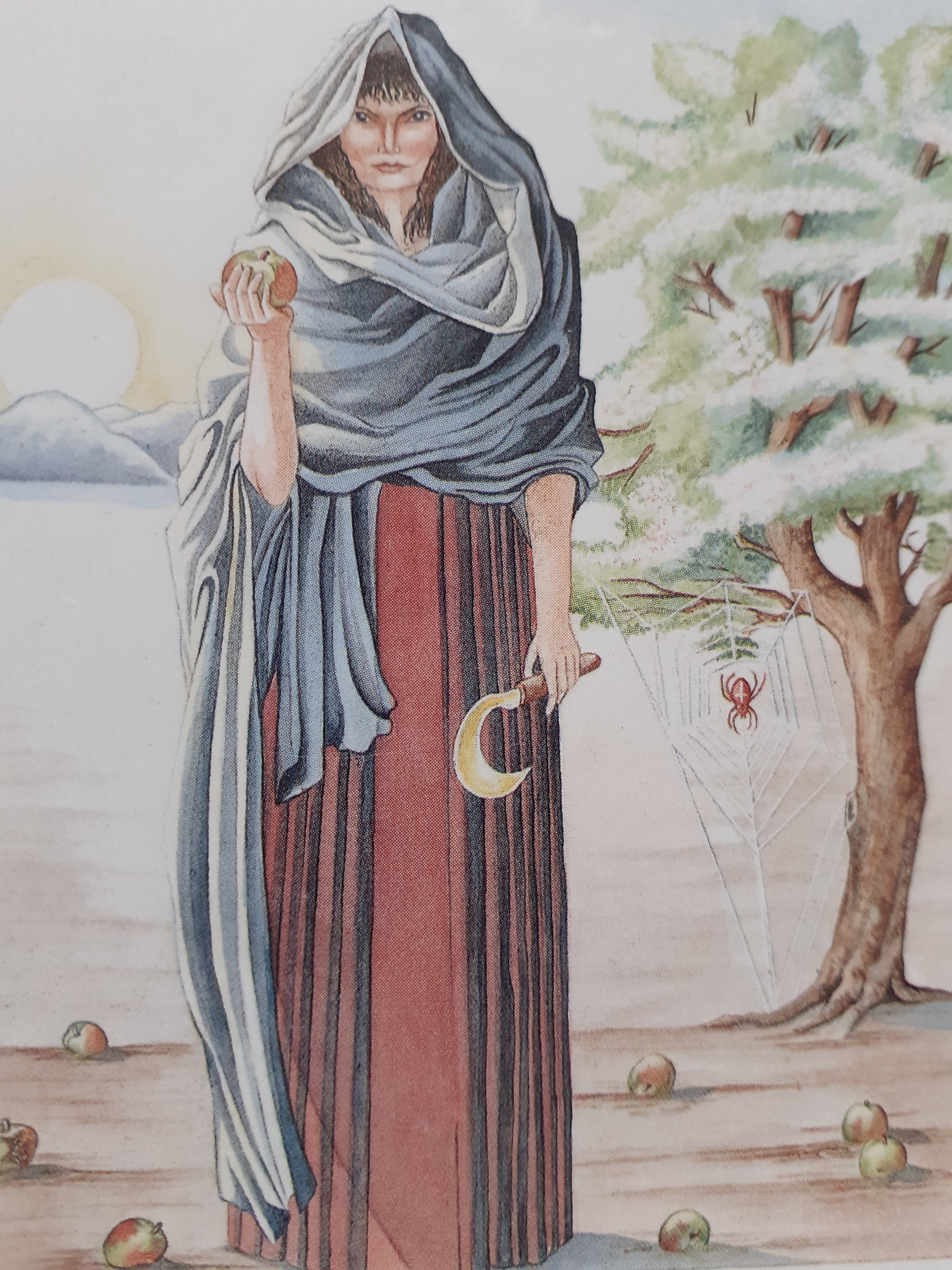
In the approach to Samhain, thoughts turn to death. In R. J. Stewart’s Merlin Tarot (1,2) the Death card has The Apple Woman as an alternate name.

Stewart explains that “the original image for Death is that of the taking or destroying Goddess”, for “who but the creatrix may truly destroy and withdraw created life?” He adds that, in Celtic tradition, she often appears as a female power offering magical fruit.

In his source text, Geoffrey of Monmouth’s Vita Merlini (Life of Merlin), we find a mysterious woman – ex-lover of Merlin – who lays out poisoned apples to entrap him. These apples, arranged “under a tree upon a pleasant green”, are eaten by Merlin’s boon companions: they are either killed or driven insane. Although Merlin escapes the apples, he does not escape his own later insanity in the Caledonian Forest, brought on by the traumatising Battle of Arfderydd.

For Stewart, the Apple Tree is one of the simplest expressions of the Tree of Life. “It is the Otherworld or Underworld Tree that reveals eternal potential, the fusion of ending and beginning in one paradoxical form”. The apples are the fruit of raw, untransformed power. Whereas Merlin’s companions snatch at the apples and eat them greedily, the legendary Thomas Rhymer volunteers to pick magic apples for the Fairy Queen, who recognises his gallantry by giving him the bread and wine that can nourish him. He wins the gift of prophecy and the tongue that cannot lie.

Both lover and killer, the Goddess of Death and Change is young and ancient, weaver and unweaver of a web that is the universe. She is destroyer of hope and giver of hope, for “in her hand she bears the fruit of perpetual life and rebirth, and the razor Sickle that cuts the tread of continuity”.

Stewart ends with this reflection: “perhaps Merlin’s sub-story of The Apple Woman simply means that adulthood is our most deluded period of life. We reject understanding and substitute self-image, habit and even dogma, in our convoluted attempts at survival; the hostility we experience is not that of the Goddess, but our own hostility reflected upon us. Reject love, risk poisoned apples – such fruits are deadly to the greedy and unprepared. But if we accept the fruit or any of its many transformations (such as bread and wine) from the Goddess, she blesses us with gifts of timeless understanding. These gifts may appear in the outer world as prophecy, attuning to the land; death itself is a timeless moment of understanding when all relative interactions cease. Ultimately, we are the fruit”.

(1) R. J. Stewart The Complete Merlin Tarot: Images, Insight and Wisdom from the Age of Merlin London: The Aquarian Press, 1992 . Illustrated by Miranda Grey ISBN 1 85538 091 9 No cards, but a full explanation and discussion of the system and its imagery.

(2) R. J Stewart The Merlin Tarot London: Element, 2003. Illustrated by Miranda Grey ISBN 000 716562 5 (First published by London: The Aquarian Press, 1992). Cards, handbook and notebook for record keeping.

ATLANTIC ANCESTORS

I am beginning to feel the pull of Samhain. It is not here yet, but its themes are drawing my attention. One of these is the remembrance of ancestors.

A recent post by poet and awenydd Lorna Smithers (1) has prompted me to look again at Barry Cunliffe’s work, and the book I have to hand is Facing the Ocean (2). It is about early human history in Atlantic maritime Europe. including Britain and Ireland. One of its threads concerns living with the ocean. Another, related to the first, looks at communication by sea at a time when land travel was difficult. I will follow up these threads in future posts. In the meantime, Cunliffe’s sense of the interaction between nature and culture is shown in the extract below.

“To stand on a sea-washed promontory looking westwards at sunset over the Atlantic is to share a timeless human experience. We are in awe of the unchanging and unchangeable as all have been before us and all will be. Wonder is tempered with reassurance: it is an end, but we are content that the cycle will reproduce itself the sun will reappear. The sea below creates different, more conflicting, emotions. True, there is the comfortable inevitability of the tides, but there is also an unpredictability of mood, the sea constantly changing, sometimes erupting in crescendos of brute force destroying and remoulding the land and claiming human life. The sea is a balance of opposites. It gives and takes. It can destroy quickly and build new; it sustains life and it can kill. Small wonder that through time communities have sought to explain these forces in terms of myth and have attempted to gain some puny influence over them through propitiation.

“Nowhere is this relationship more apparent than in the legends and folk traditions of Brittany. In the howl of the wind can be heard the screams and laments of those drowned at sea, and much of human life – birth and the gender of the newborn and death – was believed to be conditioned by the tides. Below a thin veneer of Christianity lie beliefs deeply rooted in time. A century ago, in the parish of Ploulec’h on the north Breton coast, the first Sunday in May saw the people in procession climb to La Croix du Salut – an isolated landmark that could be seen from far out to sea offering assurance of the approach to a safe haven. Here the sailing community gave thanks for their safe returns before descending to the chapel of Notre-Dame across the bay on the headland of Le Yaudet. In the church today, fine model sailing ships hanging from the roof beams are among the more evocative offerings made to the Virgin by grateful mariners. The deep underlying awe of the ocean is poignantly expressed by the Breton poem

War vor peb ankenn

War vor peb peden

(Sur la mer toute angoisse, sur mer toute priere

At sea all is anguish, all is prayer).”

(1) https://lornasmithers.wordpress.com/2020/10/04/britain-begins-debunking-the-myth-of-celtic-invasions/

(2) Barry Cunliffe Facing the Ocean: The *Atlantic and Its Peoples 8000 BC-AD 1500 Oxford: the University Press, 2001

*NOTE: I wish the subtitle had specified ‘eastern Atlantic’, since every corner of the Americas has been populated for periods ranging from 12,000-24,000 years. The western Atlantic coastal people amongst them are not my focus, but in a post about ancestors I don’t want them to be implicitly erased.

BELTANE 2020

Greetings and Blessings for the fast approaching festival of Beltane/Samhain. May we all find ways to stay safe and to flourish! This post focuses on my sense of the Wheel at Beltane – aware also that each season contains the seed of its opposite.

For The Wildwood Tarot, Beltane is the moment when “the polarised energies of the land interweave and intertwine around the staff of the heavens, generating the pulse of life”. It is also concerned with balance, and linked to the traditional trump for temperance. There’s a call to discover what balance, balancing and re-balancing might look like in 2020. Where might different balancing acts take us? How does ‘balance’ apply collectively, with a continuing public health crisis?

In the card, the primal energies of the serpents, echoing both the caduceus symbol and the double helix, are vividly in the foreground. By contrast the mask-like human head towards the bottom of the picture is almost hidden. For me, it is sombre, an image inviting uncertainty and unknowing rather than ‘balance’ or any steady state. Beltane 2020 finds a world in flux. Anything is possible. At the personal level, balance might morph into a kind of poise, without attachment to specific outcomes, yet with a preparedness to navigate uncharted waters.

HOODED HERMIT

Winter in the  Wildwood Tarot lasts from Samhain (1 November) to Imbolc (1 February), whereupon the spring quarter begins. The hooded man, hermit of this deck, is shown as solstice figure whose influence pervades the whole winter. The image depicts a hooded figure, staff in the left hand and lantern in the right, standing by a great oak tree. The lantern illuminates a door in the tree, which itself suggests, through cracks in its timbers, an illuminated space inside. A wren sits on a stone nearby.

There is power in this image. The world tree, standing for life and wisdom, is both source and refuge. The hooded hermit seems to model intention and training, and his lantern and staff are potent tools. The wren once won a contest to be king of the birds by riding on the back of an eagle and thus flying highest. An animal ally, perhaps.

The face of the hooded hermit is hidden: no visible sign of a forest rebel; no sign, specifically, of a man. Does this suggest a talent for invisibility or shape-shifting? Perhaps. But what I chiefly sense is a Zen emptiness, of which Thich Nhat Hanh (2) says: “At first, we think emptiness is the opposite of fullness but, as we saw earlier, emptiness is fullness. You are empty of your separate self, but full of the cosmos.” According to another Zen writer (3), “the Buddha called himself tathagata or ‘that which is thus coming and going’ …a flowing occurrence, and the outward form ,,, was constant, calm, compassionate availability to people who came to him for help.”

I am not a Buddhist and I do not seek to appropriate the hooded hermit for Buddhism. Similar ideas about the emptying out of personality to make room for a greater life can be found in Taoism (4) and Douglas Harding’s Headless Way (5). There’s a reminder here that path and goal are one, and that an emptied fullness of experiencing is available at any point of the journey.

(1) Mark Ryan & John Matthews The Wildwood Tarot Wherein Wisdom Resides London: Connections, 2011. Illustrations by Will Worthington

(2) Thich Nhat Hanh The Other Shore: A New Translation of the Heart Sutra with Commentaries Berkeley, CA: Palm Leaves Press, 2017

(3) Ben Connelly Inside Vasubandhu’s Yogacara: A Practitioner’s Guide Somerville, MA: Wisdom Publications, 2016

(4) Lao Tzu Tao Te Ching: A Book about the Power and the Way Boston & London: Shambhala, 1998 (A new English version by Ursula K. Le Guin, with the collaboration of J.P. Seaton, Professor of Chinese, University of North Carolina, Chapel Hill)

 (5) http://www.headless.org

NOVEMBER REFLECTIONS

In recent years, I have experienced November as a special month. Moving on from Samhain, it begins winter, and where I live it sees most of the fall. It is a reorientation towards darkness and inwardness. I began my contemplative inquiry, at first limited to OBOD, then to Druidry more widely, finally becoming universal, in November 2011 following a Samhain ritual.

I find November calmer than December, where I tend to feel jangled by the agitated dominance of capitalist consumerism and its appropriation of a Christian festival, itself the appropriation of a Pagan one. The old festivals had an offer for everyone, at least in principle. Now you have to have money to participate, and increasing numbers of people don’t. So I find December an awkward, uneasy time, a ‘festive season’ that, collectively, doesn’t quite ring true.

This sense of a problematic December has made the whole month of November special to me, and powerful for my inquiry. This year I have rejigged my daily practice and replaced a long morning session with shorter sessions in the morning and evening. In the morning I wake up and greet the day with a slightly ritualised (thanks to Druidry) set of exercises. Before going to bed I do a yoga nidra meditation, listening to an audio download. Both practices are grounded in what I would now call a sacrament of presence, and awareness that every experience points towards a source of being from which I am not separate. In this intersection of time and eternity I find my home. I don’t need special ‘spiritual’ experiences. This spirituality doesn’t require them: the work is to enhance my capacity to welcome any experience, including my resistance to negative ones, and find ways to respond. Hence I look to simple, regular practices that provide pragmatic benefits and also remind me of this core insight.

I find that the inquiry aspect of my contemplative inquiry is shifting its focus to personal life, relationships, culture and nature. What’s going on? How am I placed? How am I responding? What difference does my Sophian Way – with contemplative inquiry as its main expression – actually make? These are my November reflections for 2019.

A NEW WINTER

I’ve been in transit to winter for the last three weeks. Today is the day that I got here. The part of me that senses this movement is aware of only two seasons, summer and winter. There is a debatable zone twice a year, over varying lengths of time depending on events on the ground. I notice that the heavens are less important – sun, moon and stars impact only through the way they look and feel to me, and the way they affect my light. I am not, in this mode, a maker of calculations.

I’m not bringing in cattle for preservation or slaughter, the classic harbinger of Samhain. So I look for other signs. This year’s process began on my visit to Yeovil, where I was born and lived with my parents many decades ago. They are long gone, but I have naturally been thinking about them, and the life that we had there. Our old home is desolate and the picture above is a shop front from the same street. The Unknown sign is from well after my time, presumably once a catchy name for a modest business. Now it too is stripped out and empty, so that I don’t even know what Unknown once meant. This unknown is scripted only as a single word, a fuller story hard to find.

Yet there the sign is – Unknown – on the door, and I cannot help but wonder about it. Imaginatively I entered that door when I took the picture, in the limited sense that I’ve been conscious of it for the last three weeks, and it has flavoured my experience. I knew that I would write about it at some point. I’ve had dreams of disconnection, dislocation and dissolution. They haven’t stimulated anything so gothic as terror, but they have created a low level discombobulation, a sense of the times being out of joint. Two people close to me have had to weather unexpected misfortunes. There has been a theme of grey skies and heavy rain, interspersed though with jewel-like periods of sunshine in the continuing fall.

I recognised the decisive shift to winter when I saw ice today, outside the kitchen door. I embraced winter, and surrendered to it: a simple act of will, as I responded to the sight of ice. To some extent, during today, I have felt, briefly, the reassurance of being in a ‘season’, where the world follows its appointed course. Winter is here. It happens every year. But I still see that bleak door marked Unknown. The much celebrated wheel of the year, with its times and seasons, basis for a bedrock practice in modern Druidry and Paganism, is itself volatile and perceptibly changing. I don’t find much comfort or certainty there. I feel as if I have been woken out of a trance – and am called to a fuller relationship with unknowns and unknowing.

ORPHIC HYMN TO PERSEPHONE

An Orphic hymn to Persephone addresses her as the ‘much honoured spouse of Plouton’, who commands ‘the gates of Hades in the bowels of the earth’. ‘Queen of the nether world’, she reigns underground through four months of  winter, but the rest of the year, she is the ‘maiden rich in fruits, brilliant and horned, only beloved of mortals’. She nourishes us all, always, and kills us too. The hymn comes from a collection likely to have been compiled in the third century CE in Pergamum, a city in modern Turkey. It offers a glimpse of Greek-inspired pagan religion in what turned out to be its last phase.

Persephone, blessed daughter

of great Zeus, sole offspring

of Demeter, come and accept

this gracious sacrifice.

Much honoured spouse of Plouton,

discreet and life-giving,

you command the gates of Hades

in the bowels of the earth,

lovely-tressed Praxidike,

pure bloom of Deo,

mother of the Erinyes,

queen of the nether world, secretly sired by Zeus

in clandestine union.

Mother of loud-roaring,

many-shaped Eubouleus,

radiant and luminous,

playmate of the Seasons,

revered and almighty,

maiden rich in fruits,

brilliant and horned,

only beloved of mortals,

in spring you take your joy

in the meadow of breezes,

you show your holy figure

in grasses teeming with grass-green fruits,

in autumn you were made

a kidnapper’s bride.

You alone are life and death

To toiling mortals,

O Persephone, you nourish all,

Always, and kill them, too.

Hearken, O blessed goddess,

send forth the fruits of the earth

as you blossom in peace

and in gentle-handed health

bring a blessed life

and a splendid old age to him who is sailing

to your realm, O queen, and to mighty Plouton’s kingdom

Apostolos N. Athanasskis and Benjamin M. Wolkow The Orphic Hymns: Translation, Introduction and Notes Baltimore: MD: The John Hopkins Press, 2013.

In his introduction to this collection, Apostolos Athanassakis talks about Orphic hymns as instances of a devotional mysticism that uses “the power of clustering epithets” for the creation of “an emotional and spiritual crescendo that might raise our human spirit and help approach the divine”. They remind him of Vedic hymns, Rumi’s verses within the Islamic Sufi world, and aspects of his own Christian Orthodox upbringing. The hymns are beautiful to read – though it is worth remembering that they are designed for group practice in a charged, incense laded atmosphere, with repetition upon repetition, perhaps accompanied by swaying, movement or dance of various kinds.

The Orphic hymns date from a time of philosophical and religious change in the Roman Empire. They were popular for as long as it was possible to maintain a syncretistic religion forged of traditional pagan elements in those parts of the world (chiefly the Eastern Roman sphere) where it was practised. The hymns name specific pagan deities, yet appeal to universal spiritual powers. Devotees are not praying directly for a change in their fate, but in their own thoughts and feelings, in the hope that the energy of the goddess may assist them.

SAMHAIN GIFT

Pentacle_background_whiteA Samhain gift from Sophia. Here, the pentagram image stands for a cycle of meditations, a pathway to wisdom. We move from peace (bottom left, the earth position) to joy (right hand, the water position) to love (left hand, the air position) to healing (bottom right, the fire position) to wisdom (top, the spirit position) and back to peace again.

It seems that for me inner peace, as well as being a condition of any real peace, is also the beginning of wisdom. Inner peace is a blessing and it is also a skill. We can learn how to access and develop it, though for many of us it doesn’t come easy.

The learning and practice are likely to involve encounters with distraction, agitation and turmoil. I find that there are two ways of addressing this – one is to have ways of diminishing and dispersing them; the other is to find a still point of peace within the distraction, agitation and turmoil themselves. Peace has its place within aroused states as well as calm ones. Essentially, I experience peace as a fundamental at-homeness, an affirmative being and belonging in the world.

Peace is the bedrock. But it isn’t everything. Rather, it opens possibilities. The first is joy, a kind of joy that comes from within peace. This joy may be still. It may be flowing. It may be calm. It may also be ecstatic. Peace and joy together create a very powerful internal state and in my view form the basis for the outward turn to love and aware engagement. This in turn enables the energy of healing – in relation to self, other and world.

The step to wisdom is next, though it assumes a parallel work of knowledge-building and understanding outside the meditative setting.  Wisdom depends on these, yet is qualitatively different. In my experience it’s the qualities nurtured by intentional contemplative practice that make the difference.

In this view I acknowledge the influence of the Mahayana Buddhist idea of prajna, where wisdom is a union of spiritual knowledge (jnana) and compassion. The core text of Mahayana Buddhism is the Prajnaparamita Heart Sutra (1), with prajnaparamita represented as a deep meditative state and also personified as Prajnaparamita mother of the Buddhas, just as further to the west Sophia has been represented as the mother of angels. In the text of the Heart Sutra the Buddha Gautama Siddhartha provides instruction to his disciple Avolokitesvara, who went on to develop a powerful female alter ego as the great Chinese bodhisattva Guan Yin – another Sophian figure.

The Sophian pentagram first came to me as a compelling image; then as a sequence of words. From there I quickly identified specific practices (already individually familiar) to work with the named qualities and states. It feels as if I’ve been given a direction for the next phase of my personal inquiry and practice, and it’s good to have that direction as a Samhain gift from Sophia.

  1. The Heart Sutra: the Womb of the Buddhas Translation and Commentary by Red Pine. Berkeley, CA, USA: Counterpoint, 2004


ORPHIC HYMN TO NIGHT

Today, where I live, we changed our clock time. Yesterday’s 7 p.m. is today’s 6 p.m. and the evenings get dark. This introduces the Samhain season for me and all that it brings. Here is a Hymn to Night, conventionally ascribed to Orpheus. According to translator and editor Apostolos Athanassakis, they were most likely written in their present form in the early third century AD in Pergamum, a city in modern Turkey .

I shall sing of Night,

mother of gods and men;

We call Night Kypris,

she gave birth to all.

Hear, O Blessed Goddess,

jet-black and starlit, for you delight in the quiet

and slumber-filled serenity.

Cheerful and delightful, lover

of the nightlong revel, mother of dreams,

you free us from cares,

you offer us welcome respite from toil.

Giver of sleep, beloved of all,

you gleam in the darkness as you drive your steeds.

Ever incomplete, terrestrial,

and then again celestial,

you circle around in pursuit

of sprightly phantoms,

you force light into the nether world,

and then again you flee

into Hades, for dreadful Necessity

governs all things.

But now, O blessed one – beatific,

desired by all – I call on you

to grant a kind ear

to my voice of supplication,

and to come, benevolent,

to disperse the fears that glisten in the night.

Apostolos Athanassakis  talks about Orphic hymns as instances of a devotional mysticism that uses “the power of clustering epithets” for the creation of “an emotional and spiritual crescendo that might raise our human spirit and help us approach the divine”. They remind him of Vedic hymns, Rumi’s verses within the Islamic Sufi world, and aspects of his own Orthodox Christian background. The hymns are beautiful to read – and it is worth remembering that they are designed for group practice in a charged, incense laden atmosphere, with repetition upon repetition, perhaps accompanied by swaying, movement or dance of various kinds.

Earth Eclectic

music that celebrates Earth and speaks to the heart

Sarah Fuhro Star-Flower Alchemy

Follow the Moon's Cycle

Muddy Feet

Meeting nature on nature's terms

Rosher.Net

A little bit of Mark Rosher in South Gloucestershire, England

Becoming Part of the Land

A monastic polytheist's and animist’s journal

selkiewife

Selkie Writing…

Charlotte Rodgers

Images and words set against a backdrop of outsider art.

Prof Jem Bendell

living with metacrisis and collapse

Towint

The pagan path. The Old Ways In New Times

The Druids Garden

Spiritual journeys in tending the living earth, permaculture, and nature-inspired arts

The Blog of Baphomet

a magickal dialogue between nature and culture

This Simple Life

The gentle art of living with less

Musings of a Scottish Hearth Druid and Heathen

Thoughts about living, loving and worshiping as an autistic Hearth Druid and Heathen. One woman's journey.

Wheel of the Year Blog

An place to read and share stories about the celtic seasonal festivals

Walking the Druid Path

Just another WordPress.com site

anima monday

Exploring our connection to the wider world

Grounded Space Focusing

Become more grounded and spacious with yourself and others, through your own body’s wisdom

The Earthbound Report

Good lives on our one planet

Hopeless Vendetta

News for the residents of Hopeless, Maine