Contemplative Inquiry

This blog is about contemplative inquiry

Tag: Sacred trees

ALDER (FEARN) PROTECTION
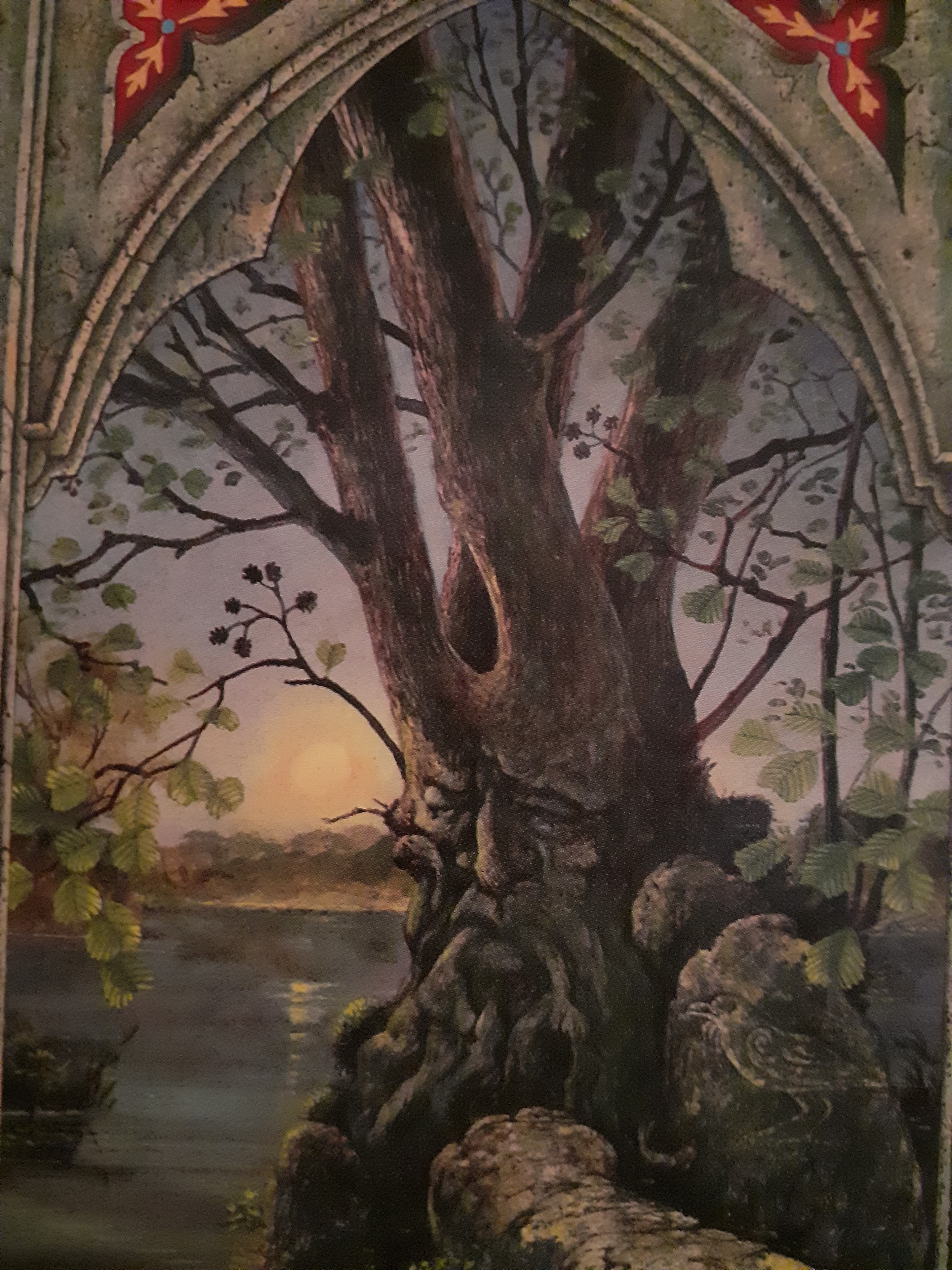
Within my mandala of the year (1) Alder (2) is the fourth and final tree for the winter quarter that begins at Samhain. The overall movement of this quarter, in my world, is through death to regeneration. Alder presides from 8-31 January and links the regenerative aspect to a continuing need for protection already signalled by Holly (3). There is something foundational about protection. The late eighteenth century Druid prayer (4), which set the note for modern Druidry, begins by asking for protection, as the beginning of a journey that leads through the quest for justice to a place of universal love.

I live in a watery place and there are alders around, though – in contrast to willow – I have never been on hugging terms with this tree. But the oily and water resistant timber is well-adapted to its surroundings, and for humans has provided good timber for boats, bridges, and underwater foundations. Many medieval cathedrals were built on alder piling. Although the wood makes poor fuel, it is good for charcoal.

Round alder shields were once used as protection for warriors in Ireland, and “in Celtic myth, we read of palisades of alders that deter invasion of keep prisoners confined, and these fences are sometimes described as being decorated by a row of severed human heads” (2) . The Welsh hero Benedegeit Bran (Bran the Blessed) is reputed to have used his body to span the River Linon, forming a bridge to raise his followers above the dangerous waters, as the wood does when used as a building material. Later, when mortally wounded in a battle against the Irish, he gave them instructions to cut off his head and carry it with them. They were rewarded with song and prophecy from the head over many years.

Much more can be said about Bran (whose name means raven). My overall learning from alder is about a willingness and capacity to hold boundaries Bran adds sensitivity and openness to the larger context in which events are playing out. Placed at the end of the winter quarter, I see alder as guarding the tentative return of spring, as the light slowly returns and we find increasing signs of growth in the natural world. The weeks before Imbolc can be cold and dreary, but life is stirring both outwardly and inwardly. Alder reminds me of the need for protected spaces to nurture a latent abundance.

(1) The image is from: John Matthews & Will Worthington The Green Man Oracle London: Connections, 2003.

(2) This mandala is based on my personal experience of trees in the neighbourhood as well as traditional lore. Moving around the winter quarter from 1 November, the positions and dates of the four trees are: Yew, north-west, 1-23 November; Elder, north-north-west, 24 November – 16 December; Holly, north, 17 December – 7 January; Alder, north-north-east, 8 – 31 January. The spring quarter then starts with birch at Imbolc. For a complete list of the sixteen trees, see https://contemplativeinquiry.blog/2020/autumn-equinox-2020-hazel-salmon-awen/

(3) https://contemplativeinquiry.blog/2020/12/23/holly-tinne-the-turn/

(4) https://contemplativeinquiry.blog/2020/08/27/my-druid-prayer/
HOLLY (TINNE) THE TURN

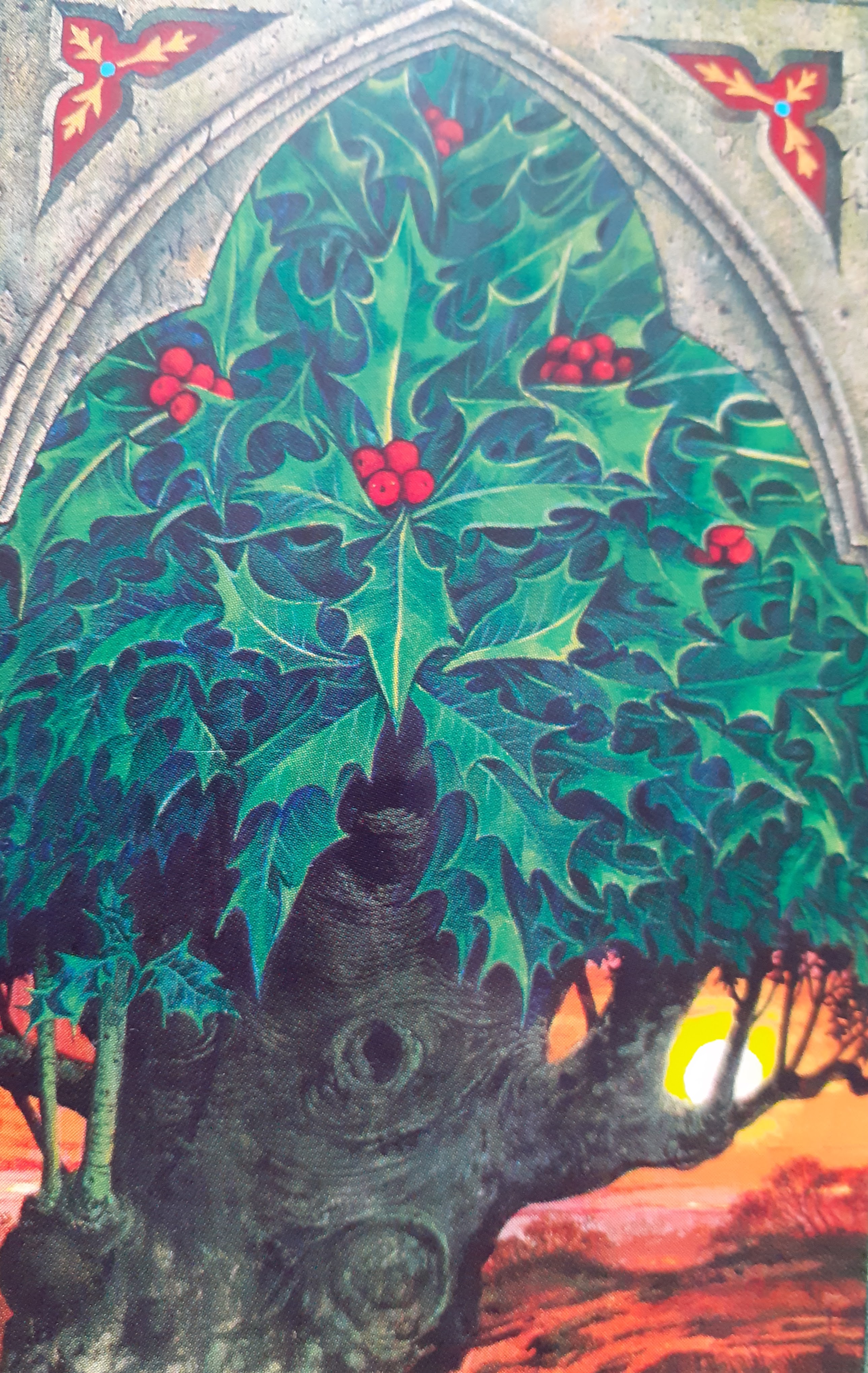
Holly (1) is a vivid, vital plant, and especially so at midwinter with its rich spiky evergreen leaves and its blood red berries. It is not afraid to take a strand in the world. Tradition names it as fiery in nature and it is described as ‘best in the fight’. In Celtic times the wood of the holly was used to fashion spear shafts. Amergin, the warrior bard and shaman who invaded Ireland, links himself to holly when declaring that ‘I am a battle waging spear’ among his many identifications.

Within my mandala of the year (2) holly initiates a major change of energy and direction. The winter quarter beginning on 1 November is a time of dying and regeneration, in the life of the land that I live in and in some sense in me. Elder has completed the work of descent into a form of death already signalled by the yew. Now, from 17 December to 7 January, it is for the holly energy to ignite my regenerative potentials and aid my birth into the life of another year.

Holly helps me with its vitality, strength, clarity of direction and balance. My worry this year has been about my own capacity to step up. But now, on 22 December, I feel the first stirrings of renewal. Under the aegis of holly I am in protected space and time. I can draw strength from the holly and regenerate in safety, during an extended holiday sheltered from the world. A blessing, indeed.

(1) The image is from: John Matthews & Will Worthington The Green Man Oracle London: Connections, 2003.

(2) This mandala is based on my personal experience of trees in the neighbourhood as well as traditional lore. Moving around the wheel of the year from 1 November, the positions and dates of the trees are:

Yew, north-west, 1-23 November

Elder, north-north-west, 24 November – 16 December

Holly, north, 17 December – 7 January

Alder, north-north-east, 8 – 31 January

Birch, north-east, 1 – 22 February

Ash & Ivy, east-north-east, 23 Feb. – 16 March

Willow, east, 17 March – 7 April

Blackthorn, east-south-east, 8 – 30 April

Hawthorn, south-east, 1 – 23 May

Beech & Bluebell, south-south-east, 24 May – 15 June

Oak, south, 16 June – 8 July

Gorse, south-south-west, 9 – 31 July

Apple, south-west, 1 -23 August

Blackberry & Vine, west-south-west, 24 August – 15 September

Hazel, west, 19 September – 8 October

Rowan, west-north-west, 9 – 31 October.

See also https://contemplativeinquiry.blog/2020/autumn-equinox-2020-hazel-salmon-awen/

ELDER AGAIN

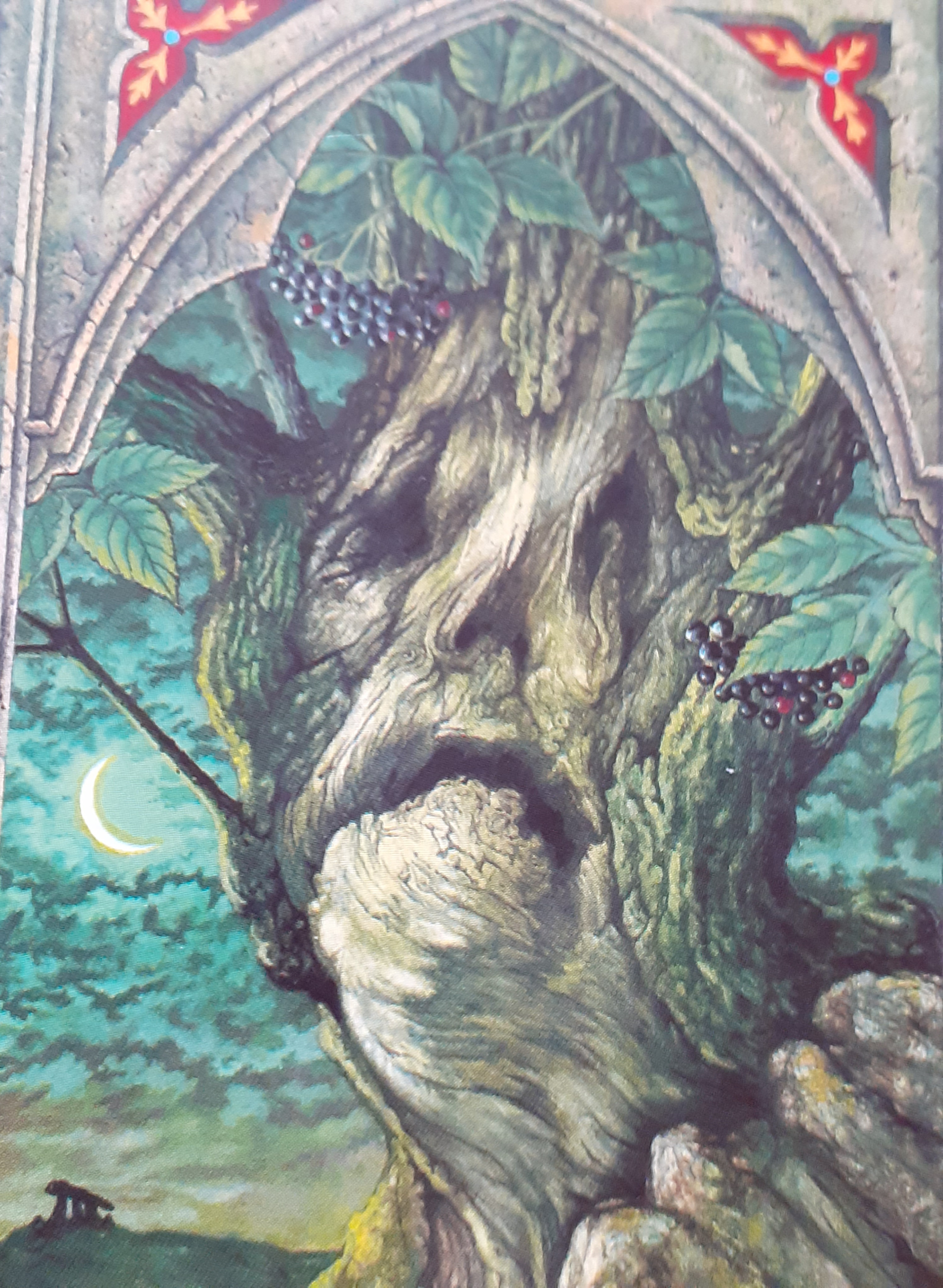
I am drawn to write again about the elder, the tree of the caileach, or crone (1). In my sixteen tree mandala of the year, it covers the period from 24 November to 16 December. I am writing on the last day, tuning into the image more deeply, open to an intuitive personal response.

I see grief, loss and limitation there, in a face both haunted and haunting. Survival at a price. It is what it is. I see neither the pretence of a good time, nor the shadow of self pity. The tree is alive and bearing fruit – alchemical fruit which is poisonous raw and safe after cooking. Perhaps it is the fruit of severity. In the face of a sacred tree, I see a face of the Goddess – an ageing, winter face, yet one that is strong and indomitable. I see this mirrored outside, and also within. Something in me is like this too.

From about the beginning of November, I have been dealing with a succession of minor health problems, not dangerous, but draining in their cumulative effects. I have had frequent experiences of lethargy and a kind of fog in the brain. I move between fundamental acceptance of the experience I am given, and a pragmatic need to push back. I am working at reduced capacity, I have some frustrations about this, and I am finding a new balance. I am glad to have made the core of my life and practice simple and easy to maintain. For me, simplicity allows focus on what really matters. Focusing on what really matters is what I need to do.

(1) The image is from: John Matthews & Will Worthington The Green Man Oracle London: Connections, 2003.

(2) This mandala is based on my personal experience of trees in the neighbourhood as well as traditional lore. Moving around the wheel of the year from 1 November, the positions and dates of the trees are:

Yew, north-west, 1-23 November

Elder, north-north-west, 24 November – 16 December

Holly, north, 17 December – 7 January

Alder, north-north-east, 8 – 31 January

Birch, north-east, 1 – 22 February

Ash & Ivy, east-north-east, 23 Feb. – 16 March

Willow, east, 17 March – 7 April

Blackthorn, east-south-east, 8 – 30 April

Hawthorn, south-east, 1 – 23 May

Beech & Bluebell, south-south-east, 24 May – 15 June

Oak, south, 16 June – 8 July

Gorse, south-south-west, 9 – 31 July

Apple, south-west, 1 -23 August

Blackberry & Vine, west-south-west, 24 August – 15 September

Hazel, west, 19 September – 8 October

Rowan, west-north-west, 9 – 31 October.

See also https://contemplativeinquiry.blog/2020/autumn-equinox-2020-hazel-salmon-awen/

ELDER (RUIS) ENDING A CYCLE

Elder is the tree of the caileach, the crone, the wise older woman. The image above comes from the Green Man Tree Oracle (1), but for me an earlier work, Liz and Colin Murray’s The Celtic Tree Oracle: A System of Divination (2), offers a more illuminating narrative:

“This Ogham card is linked to the eternal turnings of life and death, birth and rebirth. It represents the end in the beginning and the beginning in the end; life in death and death in life; the casting out of the devils of the old year and the renewal of creativity of the new; the timelessness of the cycle by which the fading of old age is always balanced by the new start of birth.

“The card has no reversed position. The circle will always turn afresh, change and creativity arising out of the old and bringing about the new. All is continuously linked as phases of life and experience repeat themselves in subtly different forms, leading always to renewal”.

In my sixteen tree mandala of the year (3) elder covers the period from 24 November to 16 December, following Yew and preceding Holly. If the winter quarter beginning on 1 November is a time of dying and regeneration, then elder deepens the descent into death signalled by the yew, whereas holly brings in the note of regeneration and makes the transition into rebirth. So it is not surprising to me that in Christian folklore elder provided the wood both for the cross of Christ and the self-hanging of Judas Iscariot. There was also a belief that people living in houses built in the shadow of the elder were likely to die young. Indigenous folklore, more benignly, said that to sleep beneath an elder tree is to wake in the Otherworld. If you stood under an elder tree on Midsummer’s Eve you would see the faery troop go by. Casting away fear, and whatever the weather, we may find magic in this tree.

(1) John Matthews & Will Worthington The Green Man Oracle London: Connections, 2003.

(2) Liz & Colin Murray The Celtic Tree Oracle: A System of Divination London: Eddison/Sadd Edition, 1988. (Illustrated by Vanessa Card).

(3) NOTE: This mandala is based on my personal experience of trees in the neighbourhood as well as traditional lore. Moving around the wheel of the year from 1 November, the positions and dates of the trees are:

Yew, north-west, 1-23 November

Elder, north-north-west, 24 November – 16 December

Holly, north, 17 December – 7 January

Alder, north-north-east, 8 – 31 January

Birch, north-east, 1 – 22 February

Ash & Ivy, east-north-east, 23 Feb. – 16 March

Willow, east, 17 March – 7 April

Blackthorn, east-south-east, 8 – 30 April

Hawthorn, south-east, 1 – 23 May

Beech & Bluebell, south-south-east, 24 May – 15 June

Oak, south, 16 June – 8 July

Gorse, south-south-west, 9 – 31 July

Apple, south-west, 1 -23 August

Blackberry & Vine, west-south-west, 24 August – 15 September

Hazel, west, 19 September – 8 October

Rowan, west-north-west, 9 – 31 October.

See also https://contemplativeinquiry.blog/2020/autumn-equinox-2020-hazel-salmon-awen/

ROWAN

Walking in the woods yesterday, I was struck by the vitality of rowan leaves and berries. I haven’t done this walk for a while, so I’m not quite sure when the berries became so vivid. All I can say is that they powerfully drew my attention. They were just what I needed, in this time of tentative emergence from Covid-19 lockdown. I look forward to their companionship as the high summer leans into autumn and beyond.

Sometimes I feel ambivalent about tree lore. Too much lore can get in the way of living connection with a tree, or even displace it. But in this case it seems to fit. To me, rowan does look magical, and feels potentially protective. I am not surprised that our ancestors planted it for this use down the ages – to guard stone circles, sacred groves, churchyards and houses. The very name rowan is linked to the Norse runa, meaning ‘charm’. In Ireland, rowan was considered a Druid tree and linked to the blackbird as a Druid bird. The berries themselves present a pentagram image, linking us to notions of magical protection.

Rowan is said to be concerned with wisdom and foresight. Breathing in smoke from the burning wood was an aid to foreseeing danger. Rowan is associated with solar goddesses of wisdom, skill and fire energy: in Ireland, Brigid; and in Britain, Brigantia. Both are said to have possessed arrows of rowan, which could catch fire if necessary.

I find the presence of rowan subtly morale boosting as I negotiate a new normal with my wife Elaine and, together, with the wider world. We work with the knowledge that Covid-19 is not going away and that we do need to re-engage more directly with that world. The very physicality of the rowan tree is an invitation to step out, whilst also encouraging a sense of what to look out for, and how the next phase is likely to be.

CONTINUITY AND CHANGE

IMG_20191001_124254

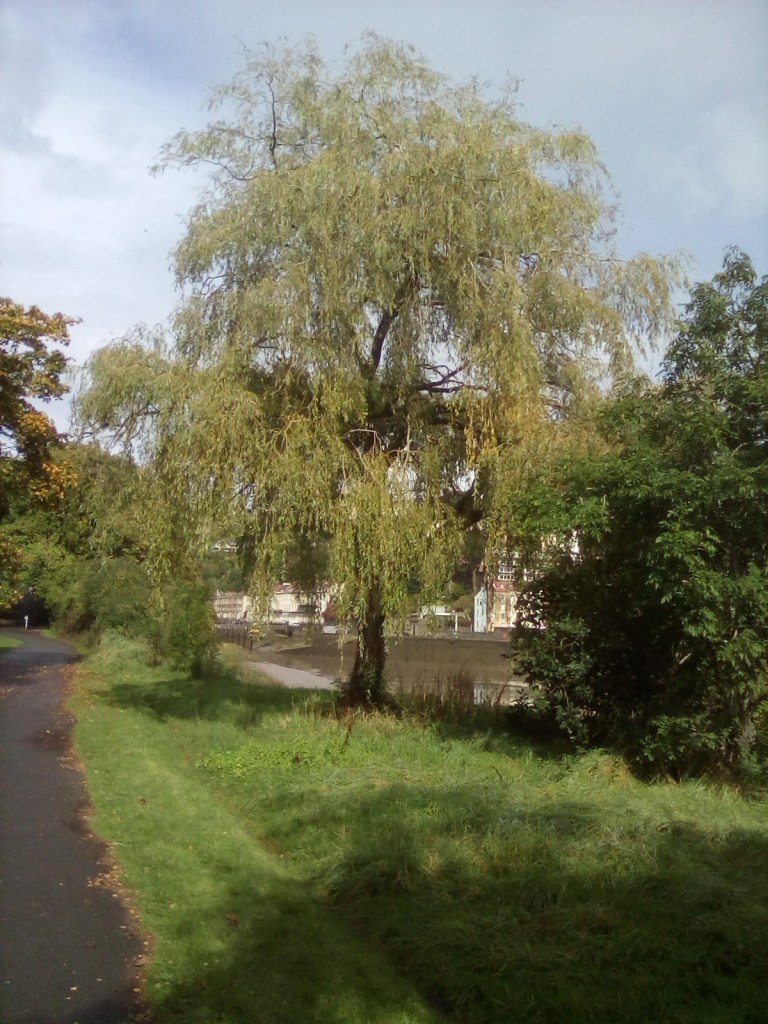
I took this picture on 1 October this year. The subject is a willow tree I befriended many years ago as part of my Druid training. It lives in Bristol beside the Avon as the river begins to leave the city, passing through the Clifton gorge and under the suspension bridge. The path, here at the edge of a park, is also a cycle track and continues towards the Severn estuary beside the river. Although I no longer live in Bristol, I continue to visit the willow from time to time and renew the contact.

My strongest link with the tree was in early spring. where I got the most powerful sense of its pulse and vibration, felt especially whilst touching the trunk with the palms of my hands. But I was careful to follow it through a year of regular communion during which it lost a substantial branch to a violent storm. I learned to associate this tree with regeneration, resilience and  generativity. The tree re-established its balance. The dead branch rotted gently in the ground, and contributed to other forms. Nothing was lost.

I’m about to go on a rare visit to my home town, partly to contemplate the continuities and discontinuities of my life and consider future directions. The image of the willow is with me.


SOPHIAN REMINISCENCE

For me, sacred images are sometimes filled with life and potency and sometimes not. The important ones  explode as gifts from the hinterlands of the psyche. They are intensely moving, perhaps shocking, certainly state altering. They may be nurturing and easy to welcome. They may be surprising and demand unlooked-for adjustments. Over time they may continue to be influential, changing and developing with me. They may become formal and emblematic – no longer living yet still anchoring insight. Eventually they may fade. Such images are not possessions. Attempts to grasp or hoard them do not work.

I call my path a Sophian Way. I have an icon of Sophia on my desk and I check in with her from time to time. It still feels authentic and makes sense to me. At the same time, I am aware of how much has changed since Sophia erupted into my life twelve years ago.

In the summer of 2007, I was immersed in my OBOD Druid studies. It was one of the few times in my life when I have cleared whole days for ritual work, and whole days for recovering afterwards. I found the work generating its own momentum, in some ways fulfilling the agenda of my course and in some ways pointing in a different-seeming direction. Images and dreams of dove feathers, either falling or lying on the ground – and then their actuality – became very prominent. Key images and ankh images were present as well.

The powerful dove imagery evoked Goddess associations from the Pagan tradition and Holy Spirit from the Judaeo-Christian one. To honour both, I found a reference in a modern Gnostic group ( www.thepearl.org/ ) that seemed to fit:

“Mortals have been created to dwell in the Garden of delights. … In the Garden stands the holy Tree of Life. High in its branches sings a bird. Listen to the voice of the bird, for when you are properly aligned with heaven and earth, she will tell you all things. … This bird or dove is also called Sophia”.

This felt like an authentic, and unifying, message for me because of its attitude towards the Garden. I as a human belong there. My belonging is not in question. There is one tree, the tree of life. The ‘knowledge’ aspect, such a disaster in mainstream Christianity, is very different here. There’s no apple to pick from the bough, but a bird who will sing to me. But something is expected of me, all the same, if I want to enhance my life and understanding. I am asked to align myself with heaven and earth. If I do this, I am assured that “she will tell you all things”. I don’t understand this as a discourse on metaphysics. I understand it as me listening in another key, listening to bird song in this metaphor, and so refining my sensitivity. For me, the imagery of the tree and the singing bird high in its branches is as resonant of a Shamanic or Pagan world view as it is of a Gnostic or Christian one. I do not have to choose.

The Pearl website turns to Joseph Campbell, a modern spokesman for the meaning of myth, on this point. He says: “people say that what we’re all seeking is the meaning of life. I don’t think that’s what we’re really seeking. I think that what we are seeking is an experience of being alive, so that our life experiences on the purely physical plane will have resonances within out innermost being and reality … as we get to know our innermost being we receive the keys that open up a life that is truly Life, for it is everlasting”.

My own sense of the ‘Life everlasting’ doesn’t pre-suppose an afterlife, re-incarnation, or any other world. Eternity, if anywhere, is present in the now. The song of the bird represents a neurosomatic wisdom, not a cognitive one, of living connectedness within one stream of life.

What I like about this reminiscence is that I have been given a chance to renew my sense of Sophia by returning to source. The original work is well-documented, so I haven’t had to rely on memory. I had completely forgotten about the ‘Pearl’ group. I’m also glad that I’ve seen more than first time round in terms of the tree and birdsong. At the time, I just recorded the images and threw down the references. It has renewed my relationship to the Sophia image in the now.

For information about OBOD see

OBOD | Order of Bards, Ovates & Druids | Druidry

POEM: GREEN MAN

William Anderson’s classic Green Man poem has thirteen verses of four lines each, and follows the wheel of the year from the Winter Solstice. As I write we have just reached the sixth verse, which has an off with my head theme. The honey of love is over and speaking through the oak is yet to come.

Like antlers, like veins in the brain, the birches

Mark patterns of mind on the red winter sky;

‘I am thought of all plants’, says the Green Man,

‘I am thought of all plants’, says he.

The hungry birds harry the last berries of rowan

But white is her bark in the darkness of rain;

‘I rise with the sap’, says the Green Man,

‘I rise with the sap’, says he.

The ashes are clashing their boughs like sword-dancers

Their black buds are tracing wild faces in the clouds;

‘I come with the wind’, says the Green Man.

‘I come with the wind’, says he.

The alders are rattling as though ready for battle

Guarding the grove where she waits for her lover;

‘I burn with desire’, says the Green Man,

‘I burn with desire’, says he.

In and out of the yellowing wands of the willow

The pollen-bright bees are plundering the catkins;

‘I am honey of love’, says the Green Man,

‘I am honey of love’, says he.

The hedges of quick are thick with may-blossom

As the dancers advance on their leaf-covered king;

‘It’s off with my head’, says the Green Man,

‘It’s off with my head’, says he.

Green Man becomes grown man in flames of the oak

As its crown forms his mask and its leafage his features;

‘I speak through the oak’, says the Green Man,

‘I speak through the oak’, says he.

The holly is flowering as hay fields are rolling

Their gleaming long grasses like waves of the sea;

‘I shine with the sun’, says the Green Man,

‘I shine with the sun’, says he.

The hazels are rocking the cups with their nuts

As the harvesters shout when the last leaf is cut;

‘I swim with the salmon’, says the Green Man,

‘I swim with the salmon’, says he.

The globes of the grapes are robing with bloom

Like the hazes of autumn, like the Milky Way’s stardust;

‘I am crushed for your drink’, says the Green Man,

‘I am crushed for your drink’, says he.

The aspen drops silver on leaves of earth’s salver

And the poplars shed gold on the young ivy flower heads;

‘I have paid for your pleasure’, says the Green Man,

‘I have paid for your pleasure’, says he.

The reed beds are flanking in silence the islands

Where meditates Wisdom as she waits and waits;

‘I have kept her secret’, says the Green Man,

‘I have kept her secret’, says he.

The bark of the elder makes whistles for children

To call to the deer as they rove over the snow;

‘I am born in the dark’, says the Green Man,

‘I am born in the dark’, says he.

From:  William Anderson Green Man: archetype of our oneness with the Earth Harper Collins: London & San Francisco, 1990

BOOK REVIEW: TREES OF THE GODDESS

jhp52d894a224871Highly recommended. ‘Trees of the Goddess’ is the latest in a series of books written by Elen Sentier for Shaman Pathways. It is both deeply traditional and highly innovative – very much this author’s note. It goes with her championship of the way of the awenyddion, standing for the ever-renewing indigenous seership of Britain.

The innovation is simple yet profound. This book directly concerns our relationship with the trees, rather than letters or divination. That relationship, like everything on the planet, has a context of cycles and seasons. Our life-world, and that of the trees, is defined by the dance of earth, moon and sun. We have this in common with our ancestors, attested by their lore and stories, and it establishes our continuity with them. The book is a reflective celebration of these simple truths and their archetypal resonance. The framework of the ogham tree alphabet provides a strong and focused conceptual foundation, in service to direct experience. The suggested activities at the end – in sections on ways to work with the trees, moon bath, allies, making your ogham staves and spirit keeping, are an invitation to experiential exploration.

The book is traditional in its use of the ogham tree alphabet and largely faithful to Robert Graves’ ‘The White Goddess’. The author endorses his linking of 13 of the trees to Ogham consonants as they move through the 13 months of the lunar year from the winter solstice; and the linking of the 5 Ogham vowels to 5 stations of the solar year (the solstices, equinoxes and Samhain). She largely follows Graves’ trees, in his order, though there are some exceptions – the vine is banished, leaving bramble to take the full weight of Muinn; and there are some changes of terminology, like guelder rose instead of ‘dwarf elder’. I realise that many people today are highly sceptical of Graves’ work, but its problems are for me not relevant to this book. For ‘Trees of the Goddess’ is not much concerned with the history of ogham, its specific cultural origin, or its use as an alphabet. It is about here-and-now relationship with the trees, honouring the Goddess and aware that our ancestors had some such relationship too.

WILLOW

Some systems of training – R.J. Stewart in ‘The Way of Merlin’ and the OBOD Ovate Course for example – ask us to develop a long term relationship with a specific tree.  In my case it was a willow.  At that time I had already made a willow wand from wood that had fallen off another tree, and though I don’t use wands or other tools much in circle casting, I do use this wand occasionally.  It’s a wood that I find it easy to connect with.

My willow stands on the banks of the Avon at Bristol, in sight of the Clifton suspension bridge and the gorge.  I was living within walking distance of it at the time.  In terms of ‘head knowledge’ I wasn’t quite sure whether it was technically a weeping willow or a hybrid and decided it didn’t matter.  Its branches certainly bowed to the flowing Avon water and to the ground.  Through dedicated tree hugging practice I discovered a strong Nwyfre  or life force, running up and down the tree.  This was about the time of the Spring Equinox in a prematurely warm and burgeoning year.  I had the pleasure of watching catkins and early leaves growing and of active bees.  So I created an energetic bond with the physical tree, at the edge of a public park, greeting it and fare-welling it at each encounter without developing a detailed botanical knowledge.

I also did inner work with the tree, through visualization.  Usually the visualization was an idealized version of the physical reality, prompting a slightly different set of feelings and reflections.  There was one major difference.  During a gale, the wind broke one of the major branches from the tree.  I was very distressed to see that branch partly on the ground and partly hanging on to the rest of the tree by thin strands of bark.  Then the branch got chopped off.  I was in mourning.  Yet my visualization didn’t change.  At that level, the tree was still there and whole.  And in fact the physical changed and grew new branches, not in quite the same place, to fill the gap of the big one that had gone.  I supplied the distress and mourning.  The tree simply adapted.  Throughout the physical process, I felt little difference in its energy.

In the back of my mind I was also aware of traditional knowledge, both specific to Ogam lore and the more diffuse inheritance of popular tradition.  I tended to hold this lightly, feeling imaginatively enriched whilst putting personal lived experience first.  I do know that leaning against the tree whilst looking across the water to the bridge and the gorge were (and are) good for refreshment, reverie and lazy, half conscious forms of reflection.  Out of this can come a creativity that doesn’t come from the willed marshaling of correspondences.  And to be fair, the traditional willow correspondences say as much, when they talk of openness and receptivity to Otherworld and the inspiration of the Goddess.  When I first knew the willow, it was at a time of fecundity – I’ve already mentioned the vibrancy of catkins and new leaves, the early appearance of bees.  So I’m not surprised that William Anderson’s green man poem says, for the period running from 13 April to 10 May:

 In and out of the yellowing wands of the willow

The pollen-bright bees are plundering the catkins;

‘I am honey of love’, says the Green Man

‘I am honey of love’, says he.

It doesn’t surprise me at all that in the Romanian Gypsy Festival of Green George (needless to say on 23 April)  a young and leafy willow, already felled, is erected and decorated with streamers and ribbons.  The community’s pregnant women gather around the tree, each laying out one piece of clothing.  If, overnight a leaf falls from the tree on to the clothing, it is said that the goddess of the tree promises both an easy delivery and a gifted child.”

Such associations are in the background of my relationship to Willow if not the foreground.  They touch my imagination, especially the parts that are nurtured by a sense of place and of history.  They amplify my direct here-and-now experience, adding emotional texture to sensory immediacy.  They extend what’s already there, in the tree, the setting, my presence, and our connection.

Earth Eclectic

music that celebrates Earth and speaks to the heart

Sarah Fuhro Star-Flower Alchemy

Follow the Moon's Cycle

Muddy Feet

Meeting nature on nature's terms

Rosher.Net

A little bit of Mark Rosher in South Gloucestershire, England

Becoming Part of the Land

A monastic polytheist's and animist’s journal

selkiewife

Selkie Writing…

Charlotte Rodgers

Images and words set against a backdrop of outsider art.

Prof Jem Bendell

living with metacrisis and collapse

Towint

The pagan path. The Old Ways In New Times

The Druids Garden

Spiritual journeys in tending the living earth, permaculture, and nature-inspired arts

The Blog of Baphomet

a magickal dialogue between nature and culture

This Simple Life

The gentle art of living with less

Musings of a Scottish Hearth Druid and Heathen

Thoughts about living, loving and worshiping as an autistic Hearth Druid and Heathen. One woman's journey.

Wheel of the Year Blog

An place to read and share stories about the celtic seasonal festivals

Walking the Druid Path

Just another WordPress.com site

anima monday

Exploring our connection to the wider world

Grounded Space Focusing

Become more grounded and spacious with yourself and others, through your own body’s wisdom

The Earthbound Report

Good lives on our one planet

Hopeless Vendetta

News for the residents of Hopeless, Maine