Recently, Elaine and I walked to our local park after a considerable absence. We were both adequately bold and mobile at the same time. We found a park very different, at least visually, to the sad, dried-up space of late August and its premature turn.
Here, above, is lush life against a background suggestive of mist. Close up, we enjoy the patterns and colours of the leaves. They seem fresh, radiant and alive.
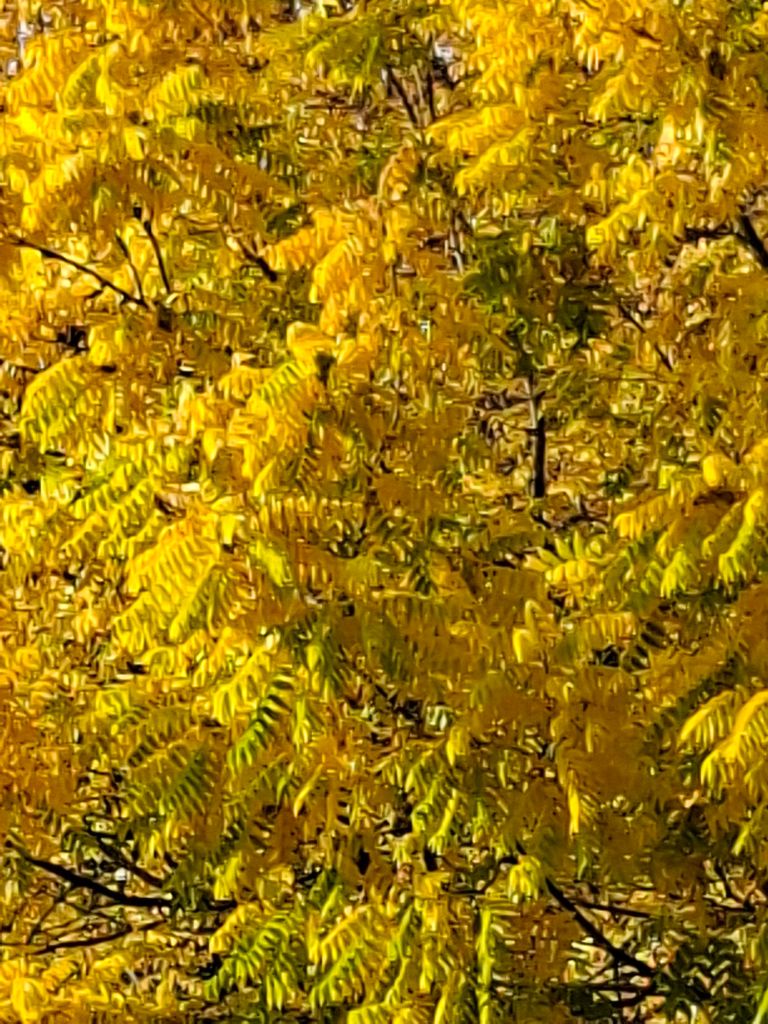
Below, the distinctive yellow of the tree of heaven, and its fern-like leaves, provide a powerful contrast that adds to our enjoyment.
Looking from a somewhat greater distance, below, I experience a sense of majesty in seeing the whole tree (right) leaning into blue sky. Its slightly closer neighbour (left) provides a subtle colour contrast with a deep green intermingled with brown leaves ready to fall.
Below, I have stepped back further from the trees. My picture is of a clump of trees in the park. They are largish trees. The person walking past them is dwarfed. But I’m still enjoying leaves. I like the reddish brown emerging from residual green. I see Nature at work in a way that is both understated and beautiful. I know also that it can be a sheltering space within a generally flat and open park.
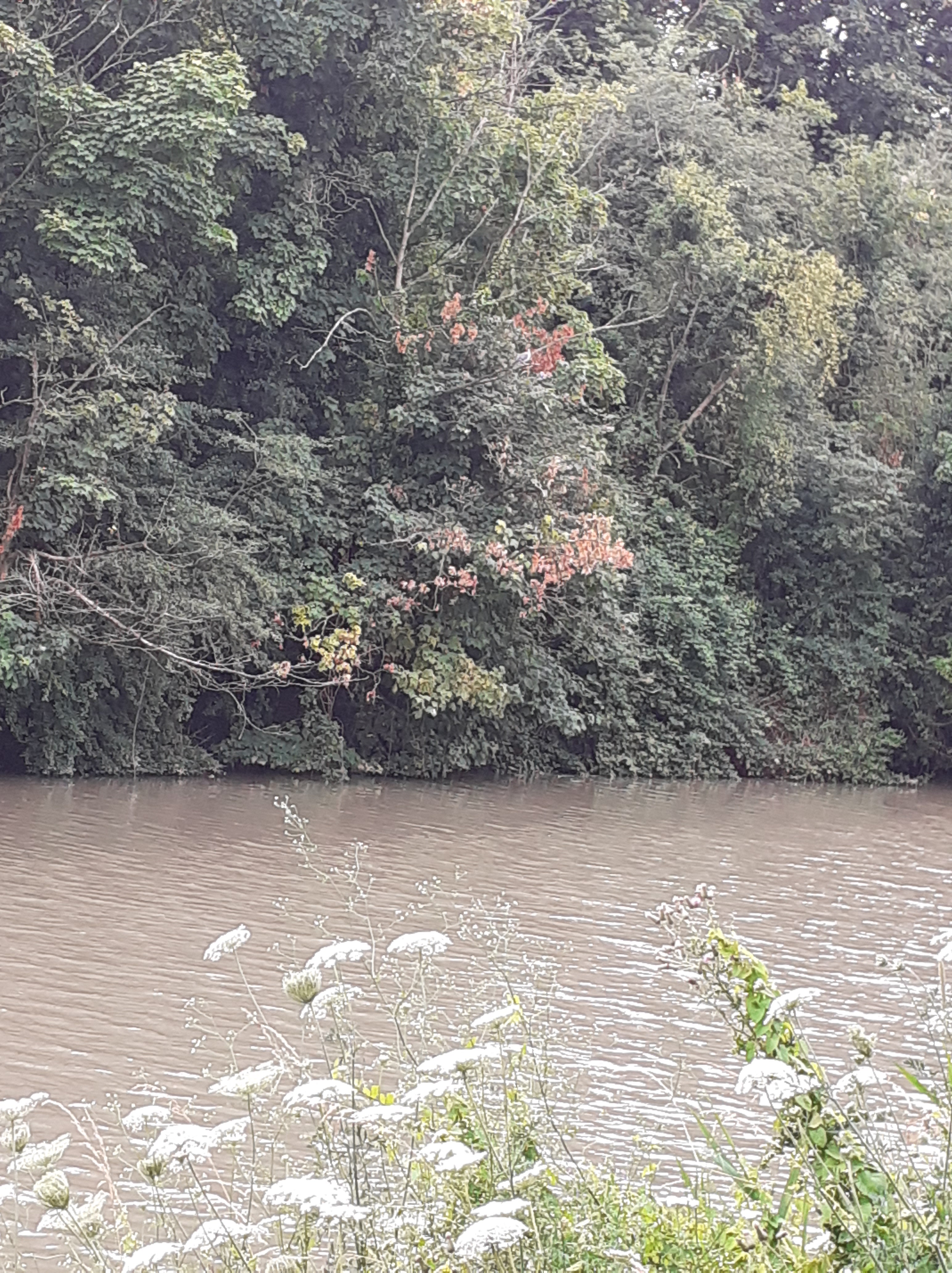
I still have a particular affection for willow, going back 20 years when I was studying Druidry. I was in Bristol and befriended a willow on the banks of the Bristol Avon, where it moves out from the old city towards the Clifton suspension bridge and the gorge. I became a literal tree hugger. It was part of a process that indeed changed my life. Hence my affection for willow. I am glad that there are willows in the Gloucester City park.
The road we took to and from the park offered leaves of autumnal red. I believe that the tree in the front garden is a stagshorn sumac. When I walk past the tree I get a little distracted by the property’s obvious need for a little tlc. Elaine however celebrates the opportunity taken by the Virginia creeper, as seen particularly in the second of the pictures below. It is great to see such abundance in this unpromising space.
For me, the great virtue of simple pleasures is their simplicity itself. Paying attention to the everyday Nature around us can be deeply nurturing and involves little risk. Yet for some, it can be a portal to re-enchantment in a largely disenchanted world.
Above, through the trees, we can see one of the chapels belonging to the Arnos Vale Cemetery in Bristol, England. It was built as a garden cemetery extending over 45 acres in 1839, as the city’s old parish graveyards were becoming overcrowded and a health hazard. The new venture was designed to be spacious, with sunlight, fresh air, trees and shrubs.
It worked well for nearly 150 years. But in 1987 the owners announced their intention to clear a large section for ‘development’. An Association for the Preservation of Arnos Vale Cemetery swiftly sprang up. It fought successfully for a safe future for the site, gaining the support of the Bristol City Council, Bristol citizens and many people worldwide.
Now, as the Friends of Arnos vale, they continue to manage what they describe as “a hillside Victorian cemetery and conservation park, with heritage and wild life tours, plus a café”. It takes a lot of effort and activity to keep this precious space going, yet on my occasional visits I still find it tranquil and unspoilt.
For me it is a magical place, largely because the graves are being allowed to sink back into the land. There is something primal about the cross above, rough hewn, almost equal armed, and decorated with foliage. Still a cemetery, Arnos Vale has become something wilder than a garden. At this time of year, the paths become green tunnels, deftly concealing their destinations.
Yesterday I walked in Arnos Vale with a friend, and our direction of travel required a descent towards the main buildings. The steps we went down were not as overgrown as the ones below, but l found them challenging enough. The imagery and effortful activity of descent give me the feeling of a deep earth and underworld journey, and the sense of enchantment that goes with it.
Towards the bottom of the slope, my recognition of a re-enchanted space in a largely disenchanted world is further strengthened. A cross again. Evergreen ivy growing up it. Vivid summer blooms behind and in front. Tall wild grass. Trees in the background. Green abundance enhancing the gravestone rather than diminishing it. Life and death companioning each other without drama or fuss. Contemplating this natural harmony, I feel heartened and refreshed.
“Contrary to the current genetic determinism that sees increased longevity as a wasted aberrance created by civilisation, The Force of Character presents an explosive new thesis: the changes of old age, even the debilitating ones, have purposes and values ordained by the psyche. The older we become, the more our true natures emerge. Thus the final years have a very important purpose: the fulfilment and confirmation of character.” (1)
I have known and walked with James Hillman’s book for a number of years, but only recently have I felt it coming into its own in my life. Hillman, originally a pupil of Carl Jung, went on to found his own school of Archetypal Psychology – a psychology which remembers that ‘psyche’ first meant ‘soul’. He describes his own journey as about challenging what he sees as limiting beliefs that “clamp the mind and heart” (1) into positivistic science, bottom-line capitalism and religious fundamentalism.
I am growing old and experiencing frailties together with a beloved partner in the same position. What is happening in the depths of my psyche? I notice that I do not perceive a single entity here, but multiple aspects, including a dialogue between youth and age. Both have always been present. But their roles have changed. I now find myself seeking them out, engaging with them and listening to them.
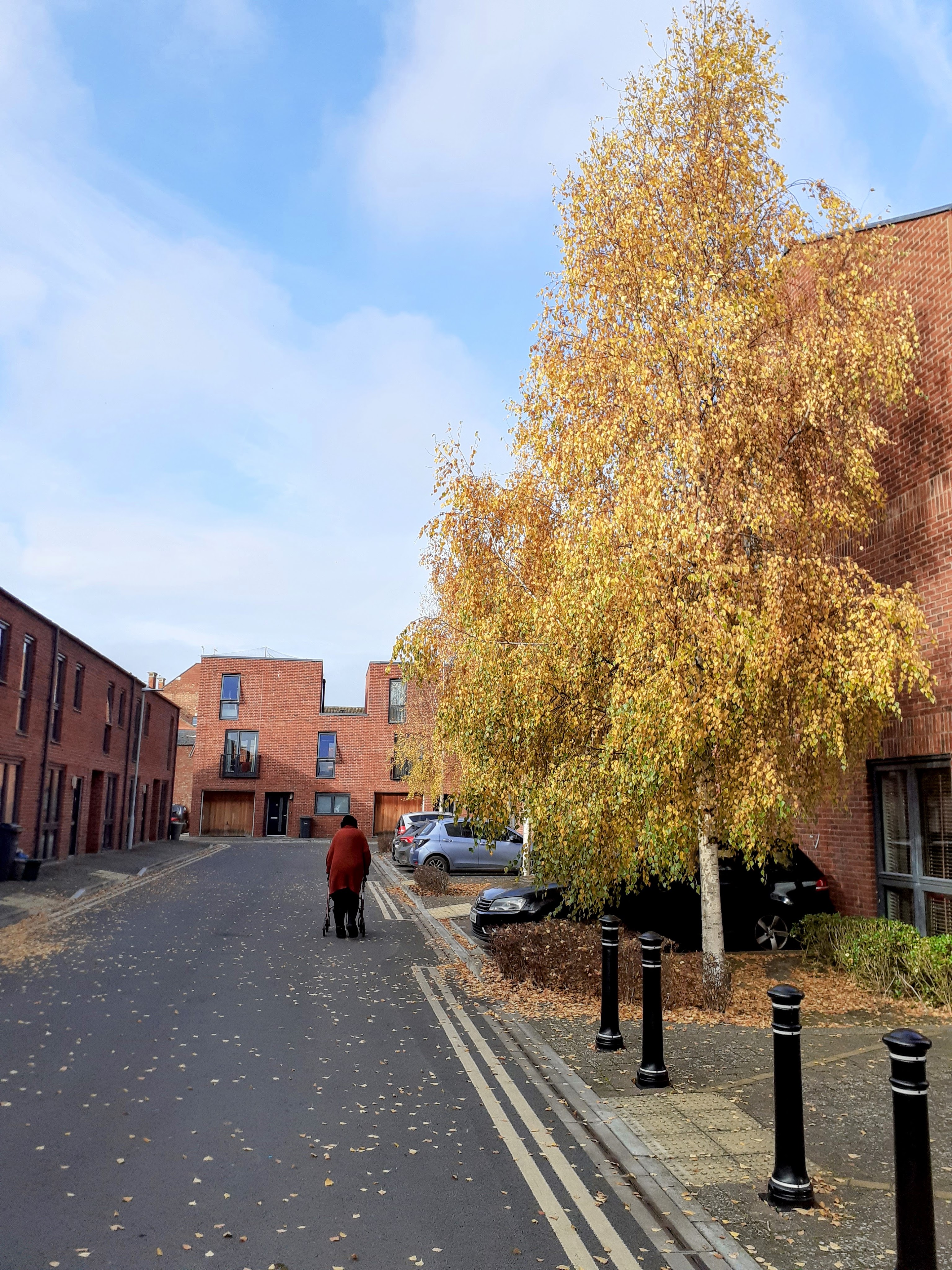
How do I recognise re-enchantment in my everyday life? Simply being open and alert to experiences as they come. On the morning of 10 November there was blue sky for a limited period. We walked around our Greyfriars Estate (once the site of a Franciscan Priory). There was a good-natured Remembrance Parade close-by: a custom beginning in 1919 after Word War I, when people hoped they had been through the war to end all wars. I am not very military minded but I’m glad we have this occasion all the same. I’ve made it to 75. A lot of the people we think about at this time didn’t make to 20 and they shouldn’t be forgotten. Honour was being paid to the dead, and an intentional act like that always changes the space.
Elaine and I however were at some distance from the event so that she could practice her walking. Whilst I was looking at some young birch trees with vigour still in their end-of-autumn leaves, Elaine carried on walking on her own. She didn’t need me hovering around her. It was the first time she’d walked outside on her own since her accident in Gran Canaria six months ago. I had witnessed a wonderful emancipation and, more than that, a fulfilment and confirmation of character.
(1) James Hillman The Force of Character and the Lasting Life Milsons Point, NSW: Random House Australia, 1999. First quote from back of cover blurb, second from main text.
Highly recommended. Unseen Beings: How We Forgot the World Is More Than Human (1) is about the many beings we humans have actively ‘unseen’ and the consequences of our human-centric lens. Author Erik Jampa Andersson describes his book as a diagnostic exploration of the roots of the climate crisis, itself an extreme consequence of a much wider malaise. Whereas the common view of ‘saving the planet’ tends to be one of ‘guarding the storehouse’, a better focus would be on ‘supporting the welfare of living beings’.
Andersson has a background in Tibetan Buddhism and Tibetan medicine. In the manner of Buddhism’s Four Noble Truths, and of his medical training, he divides his book into four parts: Diagnosis, Causes and Conditions, Prognosis, Treatment.
Diagnosis concerns “our ecological disease”. Andersson reminds us of what the climate crisis is, how far it has been allowed to go, and the “fanciful stories” with which we have soothed our fears: “full of human exceptionalism, divine protection, techno-fixes and post-apocalyptic salvation”. For Andersson, the foundational root cause is “the sundering of human and non-human beings, and our perceptual separation from ‘Nature’. He refers to “the poison of anthropocentricity”. He reviews the evidence for plant and fungal sentience and awareness as well as that of the animal kingdom. He concludes that Nature is not a place, but “a tightly knit community of interconnected beings, some seen, many unseen, all engaged in their own affairs and with their own experience of reality”. He describes this relational approach to the living world as “what most scholars now call ‘animism’ … neither a religion nor a system of belief, but a paradigm of more-than-human relationship”. He sees this stance toward the world as “our natural state”.
Causes and Conditions A mini-ice age some 13,000 years ago interrupted an early agricultural period in some places and prompted a series of innovations. The domestication of the horse was especially significant. Andersson sees a move away from our ‘natural state’ beginning at this time. But it is not fully evident to us until the age of written philosophy and scripture. The Greek philosophers Plato and Aristotle declare a hierarchy of sentience from plants up to animals and then humans at the top, uniquely endowed with a rational soul. In the Hebrew book of Genesis, God gives dominion over the Earth and its animals to man for his use. In the Western Christianity of the 13th century CE, Thomas Aquinas says that Christians have no duty of charity to non-humans because they are resources, not persons. In the 17th century CE, early in the West European led colonial era, Descartes holds public vivisections of dogs and other animals declaring that they are soulless automata and that their apparent distress is meaningless. In the mid 19th century CE, Darwin restores other beings as our ancestors and cousins, but but without much sense of kinship or empathy.
Prognosis Here Andersson introduces two concepts from Tibetan medicine: ‘provocation’ and ‘spirit illness’. The provocation of other sentient beings is a health risk. He discusses the origins of the recent Covid-19 pandemic in these terms, as human become ever more invasive of our remaining wild spaces. In cases of deforestation, pollution, and any disruption of air, water, soil and trees, there is a price to pay for the wounding of other spirits, whether seen by the eye, seen through a microscope and normally unseen but recognised by tradition. (‘Supernatural’ is an unhelpful word here – everyone is part of nature). In Tibetan tradition, the cultivation of a clear mind is highly prized and works within human psychology, but not for disruptive events like these. There is a need to make amends. Rituals are held in sensitive and damaged places. The damage caused in these circumstances and the resultant chronic collective disease can only be addressed by learning how to care for eachother, non-human beings and the planet itself.
Treatment Using the Buddhist 8-fold path as a structure, Andersson recommends ‘cultivating care’ over a system of rules and regulations aimed at a ‘sustainability’ which tries to restore the old status quo. We cultivate care of the Earth, one another and non-human beings. Hence: 1 right view is a return to our ‘natural state’, as described under Diagnosis; 2 right intention describes commitment to a path of rewilding and regeneration; 3 right speech is the use of “life-affirming language” (e.g. using ‘they’ as an alternative to ‘it’ for non-human beings); 4 right action is causing as little harm as possible to other beings; 5 right livelihood means adopting principles of authentic sustainability and non-exploitation; 6 right diligence is based on “the durability of the heart-felt ethic; 7 right mindfulness means “paying attention to nature’s vitality”; 8 right concentration involves imaging a new future with “authentic myth-making”.
Concerning 8 above, Andersson has been profoundly moved by the work of J. R. R. Tolkien from his later childhood onwards. As a result, he developed a high valuation of authentic myth-making and enchantment. In this realm, the non-human is essential. Tolkien had his own life-changing moment of enchantment when, as a student, he first read the Old English words: Eala earendel engla beorhtast, ofer middangeard monnum sended. (Hail Earendel brightest of angels, above the middle-earth sent unto men). Of this evocation of Venus arising as the morning star, in the old language, Tolkien later wrote: “there was something very remote and strange and beautiful about these words, if I could grasp it, far beyond ancient English”. For Andersson, authentic myth and authentic science work together in support of a redemptive animist vision. By contrast, the form of discourse to worry about is ‘fallacy’ – a complete dissociation from the truth. Andersson again quotes Tolkien: “if men were ever in a state in which they did not want to know or could not perceive truth (facts and evidence) then Fantasy would languish until they were cured. If they ever get into that state (it would not seem at all impossible) Fantasy will perish and become morbid delusion”. For Andersson, this too has become a symptom of our current ecological disease, making the need for honest and healthy communication all the more urgent.
For me, Andersson has made a valuable addition to a growing literature about the current crisis, whose most alarming symptom is climate breakdown. He goes to the root of the problem, offering a clear and coherent view about how to stand in the face of it. It is a well-researched, well-crafted and compassionate contribution to the genre.
(1) Erik Jampa Andersson Unseen Beings: How We Forgot the World is More Than Human Carlsbad, CA & New York City; London; Sydney; New Delhi: Hay House, 2023
I attach a links to conversations between the author and Andrew Harvey below. It adds considerably to what I can present in a review:
“If our place is imperilled, so are our myths. If we heal the one, we heal the other … So said priestesses who long ago spoke in the voice of doves. So said the prophetic oaks they tended, who murmured to their suppliants through wind blown leaves.”(1)
Staff of Laurel, Staff of Ash: Sacred Landscapes in Ancient Nature Myth is an inspirational collection of interwoven contemplations on landscape and myth; on enchantment, disenchantment and re-enchantment. I strongly recommend it to anyone with an interest in these themes.
Author Dianna Rhyan says of her own approach to writing: “assembled, these pages refused to assemble, and so altogether, they form a series of sketches, fallen like samaras*, whose order is ultimately undetermined. The priestess of Apollo wrote her prophecies on leaves. When strong winds came, they scattered all over her cave. Did she mind? Amidst the leaves, voices of winds and voices of trees, lost and found, thread their way.” This review shares something of the book’s flavour, rather than attempting a linear account of what is covers.
Rhyan draws strength from wild and marginal spaces, especially the Cuyahoga River in north eastern Ohio. She describes her close relationship with the land but is all too aware of a sadness in its silence. The genocidal displacement of the people who once lived there has erased their stories about this land and their relationship with it. As a mythologist, she looks further afield for inspiration, especially ancient Mesopotamia (now Iraq) and the early Greek speaking world. Even four thousand years ago, in the early Sumerian world, people had doubts about ‘civilisation’. We find the contrasting influences of the laurel, which blooms, and the ash, “a battle-earned artifact”.
In the Epic of Gilgamesh (2) the hero destroys a forest and its guardian at an early stage of his “futile immortality quest” and then goes out of his way to offend the Mother Goddess Inanna. In The Descent of Inanna, she herself must experience death, losing her identity and powers as she descends through seven gates to the Underworld controlled by her sister Ereshkigal. Asking, at each gate, ‘Gatekeeper, why is this done?’, she receives the reply ‘Silence, Inanna. Do not open your mouth against custom. The rules of the Great Below are flawless. You may not question what is perfect.’ Rhyan’s reading of this ritualised and repeated reply finds a new order in which free nature, and the Goddess perceived as its embodiment, need to be rigorously controlled. She comments on the way in which perfection “deadens” and rules “disarm”. For three days Inanna hangs dead, a carcass on a hook. But the upper world needs Inanna in order to reproduce itself and flourish. The Wisdom God Enki sends emissaries to Ershkigal to secure Inanna’s release. She does not stay dead.
Rhyan also draws on Greek sources from different periods. One of them, from Sophocles’ last play, Oedipus at Colonus, is about the final days of Oedipus, after he has blinded himself and been been exiled from his erstwhile kingdom of Thebes. These misfortunes follow the discovery that he has (unwittingly) killed his father, married his mother and thereby, as a source of pollution, caused a plague in the city. He is told: “seek no more to master anything”.
Oedipus is now a pauper, wandering in a wasteland. Letting go of his civic and social identities and surrendering to this fate, he survives. He is reborn as a child of nature on the goddess haunted mountain Cithaeron. For his awakened inner vision has guided him to the place where he was once, as an infant, left out to die. The compassionate nymphs who nursed him then are perhaps looking out for him once more. He has journeyed from palace to periphery, freed from all power and self-determination. At that point, he is given a new role, as guardian of the sacred grove at Colonus. It is a place beloved by immortals, a place of lush growth, where the nightingale sings, and with “cool waters” that never fail. Here, as this new version of himself, he will live out his days.
Late on in her book, Dianna Rhyan says: “if we look over our shoulder, not only what we threw away as detritus is following us. What we had despaired we had lost forever, long ago in the depths of ancient ages, is following us too. We require myth, intensely alive myth, to see it. It is very good at not being seen.” I see her as making a great contribution to making ‘intensely alive myth’ visible once more.
(1) Dianna Rhyan Staff of Laurel, Staff of Ash: Sacred Landscapes in Ancient Nature Myth Winchester, UK & Washington, USA: Moon Books, 2023
A familiar sight at this time of year: a family of swans, adolescent cygnets with their parents. A superficial glance at the picture gives me a satisfying sense of near completion, of an annual cycle showing its results. It is a still image, literally a snapshot. Nothing in it can change.
Yet when I took the photo, the swans were highly mobile, constantly shifting their relative positions while sometimes gliding elegantly along the canal and sometimes pausing to investigate its banks. I also foresaw their likely passage through a more extended time. Soon enough, the cygnets will be grown up and on their own. A new beginning enabled by an ending.
I live in southern England, where daylight hours have begun noticeably to shorten. Lughnasadh (Lammas) marks the beginning of August. This festival initiates a quarter that moves through the autumn equinox and ends at Samhain. These three months embrace decline, decay and eventually death, whilst also celebrating grain and fruit harvests and (in past times) the culling of livestock to see us through the winter. The themes belong together.
I treasure this attunement to cycles of time. Part of my contemplative life rests in the timeless. Another part, more worldly, enriches my experience of time. By contrast mainstream western culture characterises time as a limited resource to be measured and priced; to be ‘spent’ productively and not ‘wasted’. The phrase ‘time is money’ comes to mind. This time hurtles onwards like a runaway train into a future always packaged as better, even redemptive, but now looking increasingly dystopian.
But any time we can know is a matter of human perception, and therefore malleable. There are, and have been, many ways for humans to live in time. For me, living the cyclical time of the eightfold wheel of the year, widely practised in Druid and Pagan culture, continues to be a re-enchanting experience.
For me, the skilful patterning of experience provides a gateway to re-enchantment. It reminds me that there are multiple ways of seeing the world, some obvious and others more occluded. The early morning can be a time of affirmation through ritual patterning that makes a mark on the day.
Mine begins with a morning circle which emphasises peace. Peace, here, is an active energy, not a passive absence of overt conflict, or a blind eye to dysfunction and injustice. Peace has to struggle, in this world, through skilful means that do not compromise its essence. Ritual can be one. I describe my morning circle below.
I go into my practice space, stand in the east facing west, ring my Tibetan hand bells and say the St. Patrick’s prayer (aka Cry of the Deer).
I arise today through the strength of heaven, light of sun, radiance of moon, splendour of fire, speed of lightning, swiftness of wind, depth of sea, stability of earth and firmness of rock.
Then I cast a Druid circle, calling on the four directions, each associated with a cosmic power, an element, a power animal, a quality, a time and a season.
East: May there be peace in the east, power of life, element of air, domain of the hawk, quality of vision, time of sunrise, season of spring and early growth.
South: May there be peace in the south, power of light, element of fire, domain of the dragon, quality of purpose, time of midday, season of summer and of ripening.
West:, May there be peace in the west, power of love, element of water, domain of the salmon, quality of wisdom, time of sunset, season of autumn and bearing fruit.
North: May there be peace in the north, power of liberation, element of earth, domain of the bear, quality of faith, time of midnight, season of winter, of dying and regeneration.
I also call the Below, the Above and the Centre, to make seven directions in all. Moving to the vertical dimension indicates a deepening, enacted by my spinning in place before bringing it in, and by the use of mythic names for the Below and Above.
Below: May there be peace below, in Annwn , realm of the the deep earth and underworld.
Above: May there be peace above, in Gwynvid, realm of the starry heavens.
This is followed by a further deepening into the centre, enacted through another spinning in place. Here, I am no longer calling for peace, but standing in its source.
I stand in the peace of the centre, the bubbling source from which I spring, and heart of living presence. Awen (chanted as aah-ooo-wen)
After a pause, I walk the circle, sunwise, east to east, and say I cast this circle in the sacred grove of Druids. May there be peace throughout the world. At this point I have established my sacred grove, my nemeton. All that follows is within this dedicated space until I uncast the circle on completion of my practice.
This ritual patterning, made substantial both physically and verbally, includes a celebration of sacred nature, provides a structure and a set of meanings to hold and guide me, and emphasises the commitment to peace.. Although I have personally customised this framework, most of it – anything to do with personality and external world – anchors me in modern Druid culture.
The centre is different. The centre is universal. It is the point where Oneness is recognised. “The bubbling source from which I spring” has a naturalistic feel whilst also referencing Jean-Yves Leloup’s translation of the Thomas Gospel, logion 13, where Yeshua says to Thomas: “I am no longer your master, because you have drunk , and become drunken, from the same bubbling source from which I spring” (1). ‘Heart’, as used here, is neither the physical heart nor the heart chakra, but “the Great Heart that contains All-that-is … the consciousness that underlies all forms” (2). ‘Living presence’ too points to the state of underlying conscious awareness that is here being recognised (3,4). For ritual language that honours that recognition, I draw on the mystical inheritance of the world and place myself in a wider circle of care.
At one time I tended to experience casting circles as a preliminary to practice, whilst also ‘knowing’ in a roof-brain kind of way that this was a mistake. Now I find it a powerful means of bringing me into the new day. Above all, it affirms my core understanding of world and life with every sunrise.
(1) The Gospel of Thomas: the Gnostic Wisdom of Jesus (Translation from the Coptic, introduction and commentary by Jean-Yves LeLoup. English translation by Joseph Rowe. Foreword by Jacob Needleman) Rochester, VT: Inner Traditions, 2005
(2) Sally Kempton Meditation for the Love of It: Enjoying Your Own Deepest Experience Boulder, CO: Sounds True, 2011
(3) Kabir Edmund Kabinski Living Presence: A Sufi Way to Mindfulness & the Essential Self New York, NY: Penguin Putnam, 1992
(4) Eckhart Tolle Oneness with All Life: Awaken to a Life of Purpose and Presence Penguin Random House UK, 2018 (First ed. published 2008)
Book review of Savage Grace: Living Resiliently in the Dark Night of the Globe, by Andrew Harvey and Carolyn Baker. The book has a U.S. centre of gravity and was written in the early months of 2017, triggered by Donald Trump’s assumption of the presidency.
The ‘dark night of the globe’ refers to an increasing risk of a wrecked biosphere (including human extinction) through runaway climate change or nuclear war. In such a scenario, resilience is a key quality demanded of us. They authors define this as a ‘life-giving ability to shift from a reaction of denial or despair to learning, growing and thriving in the midst of challenge’. The emphasis of this book is as much on essential psycho-spiritual resourcing as it is on direct political action. The authors see these as belonging together, recommending a staged strategy of reconnection, resistance, resilience and regeneration to its readers.
‘Reconnection’ is much like the ‘re-enchantment’ we talk about in Druidry. It is a response to disconnection from “our sacred inner wisdom, from all other living beings as a result of our delusional belief in separation, and from Earth and the reality that we are not only inherently connected with Earth, but, that in fact, we are Earth”.
‘Resistance’ is, first, about discerning “the nature of the myriad enemies of the mind, body and spirit with which we are being confronted in the current milieu” and to learn how to stand for “transparency and integrity in the face of massive assaults on our fundamental humanity”.
‘Resilience’ needs to be cultivated physically, emotionally and spiritually as an “essential life skill” in the face of increasing dangers and uncertainties in our communities and world.
‘Regeneration’ is about committing “to living lives of regeneration in all stages, even in what could be the terminal one”. If humanity is destined to vanish, “what matters most is not the outcome of our efforts, but rather, our inmost intention”.
Savage Grace is built around five main chapters. The first, Kali Takes America, explores the image of a country archetypally possessed by the dark side of the destroyer/creator goddess. Here ‘reconnection’ is about finding transformative possibilities within this predicament. The adoption of Savage Grace as the title owes something to this. Here the authors cite the work of Vera de Chalambert, which can also be found on https://youtube.com/results?search_query=vera+de+chalambert+kali/
The second chapter, Resisting the Modern Face of Fascism in the Age of Trump contains most of the social and political analysis offered in this book. It usefully draws on a 14-point list, devised by Umberto Eco in the 1990’s. on what ‘Fascism’ can be usefully thought to mean, and what makes it dangerous and wrong, given that it will look different in every incarnation, depending on time and leadership. (Eco grew up under Mussolini.) For strategies of resistance, they draw on Naomi Klein’s No Is Not Enough*, already published by the time Savage Grace was completed.
The remaining chapters are entitled Living Resiliently Amid Global Psychosis; Regeneration: the Legacy of Love in Action; and Celebrating Reconnection, Resistance, Resilience and Regeneration. These explore the building of psycho-spiritual resources at the personal, interpersonal and collective levels, and can be successfully accomplished only by looking at our own shadow sides. Otherwise we simply project them on to our opponents.
Savage Grace is written with urgency by authors who have been addressing its core themes for many years. I highly recommend it to anyone who acknowledges the personal and political, inner and outer, mundane and spiritual realms as facets of one interconnected life. No convenient compartmentalizing here. Savage Grace is a document for our historical moment. It asks readers to reflect on where we stand and how we are responding.
Andrew Harvey and Carolyn Baker Savage Grace: Living Resiliently in the Dark Night of the Globe. Bloomington, IN: iUniverse, 2017 . (Foreword by Matthew Fox)
In an earlier post (1) I began a discussion about personal vows, and how they support of our flourishing. The key is to identify specific intentions about how we want to live, to declare them and then to work with them. In this context, it is important that they are personal and not connected to a third party or cause. We decide them for ourselves. We interpret them ourselves. We monitor them ourselves. It is an inner authority that gives them their power.
Later (2) I discussed the ancient Greek concept of ‘virtue ethics’ as a rationale for this approach. I would probably not use this label for myself. Modern English gives ‘virtue’ as slightly pious and solemn ring. It suggests the possibility of presenting an inauthentic front, not present in the earliest understandings. These concerned crafting a life with self-awareness and cultivating desired qualities and skills. The emphasis is on process and practice
In both posts I described personal work using this method. I have now completed a set of five vows, which for me seems like the maximum to work with. They are notes to myself as I move through time and chance, enough to set directions, but not enough to regulate specific conduct in specific situations. The core idea is to improve my own quality of life and that of others.
May I be mindful, open hearted and creative
May I honour and enjoy the gift of life, in my sensing, feeling, thinking, and intuition
May I be loving and compassionate towards myself and others
May I experience abundance in simplicity
May I work for the welfare of all beings, using the loving forces that work from individual to individual, as well as through supporting larger projects
I believe in these vows, whilst knowing that I will not fulfil them all the time, or in the fullest measure. Yet I do expect them to make a difference. I have already opened myself to continuous learning about what the key value words mean in practice. How do I recognize, in sensory, behavioural and social terms: my mindfulness, open heartedness, creativity, honouring, enjoyment, love, compassion, abundance, simplicity and welfare?
If I am not actively in process with them, these words can fade into pompous rhetoric. Worse still, they could become ammunition in a form of virtue signaling. Meanings themselves may vary in different contexts, and one aspect of ‘creativity’, will be sensitivity to different circumstances, and flexibility within them.
I have been working with personal vows for a couple of months now, long enough to get used to the process and develop what seems like the full set using the best language. Although these vows draw on my life in both Druid and Buddhist settings, they are personal. I do not see them as belonging either to a Druid or a Buddhist path. They are about mindful living in a re-enchanted world They are my personal guide on how to flourish.










 Contemplative Inquiry