Contemplative Inquiry

This blog is about contemplative inquiry

Tag: R.J. Stewart

MIDSUMMER DREAMING 2024

In the original edition of The Dreampower Tarot (1) The Sleeper is an androgyne figure in a field of corn and poppies. Their face is turned towards the flowers. Their right arm is outstretched, with palm and fingers turning a little towards the ground. Their forefinger hints that we should look to the earth and underworld for healing and inspiration. The whole image evokes deep evening slumber.

In this midsummer period, I’m in a regime of going to bed early, before the light has gone. It reminds me of delicious childhood moments and I feel comforted. During this period I have tended to dream of abstract images and unfathomable events, with background sounds so soft that I can barely hear them.

In these dreams, I have no language and can make no real sense of anything. I’m OK about this, because I’m aware of being aware and safe in awareness without the slightest ability to formulate a sentence like this one. The recognition is primal and wordless. At times, I experience a push towards understanding of a sort, but it is not (yet?) agitated or dominant in consciousness. I seem, in this dreaming (as perhaps once in pre-natal life), to be in realm of divinely simple potential.

When I wake up in the early morning. at this time of year, I find light again, and a different feeling of wonder. Using my resources of language and culture, I am able to make cognitive sense of my world once more. The gift of the dream is that my everyday experience feels, for a while, strange and new. It makes room for the luminosity and magic that I can easily forget in my ‘waking’ hours. The morning light outside my window confirms their presence here. They nourish me, and I am porous to the world.

(1) R. J. Stewart The Dreampower Tarot: The Three Realms of Transformation in the Underworld London: The Aquarian Press, 1993 Illustrated by Stewart Littlejohn

THE ROOKERY: MAGIC IN A FORMAL GARDEN

Streatham’s Rookery (1) is a formal garden within Streatham Common, one of south London’s many remarkable green spaces. I made a connection with it in 1992 when living close by.

About a year before I discovered OBOD Druidry, I was working with R. J. Stewart’s The Way of Merlin (2). This taught me, first of all, about sacred space. “Sacred space is space enlivened by consciousness. Let us be in no doubt that all space is sacred, all being. Yet if humans dedicate a zone, a location, something remarkable happens within that defined sphere of consciousness and energy. The space talks back”.

I was an urban seeker and used what the city gave me. From an early age I had been fed by imagery of secret and magical gardens. The Rookery, built in the then Spa village of Streatham (1) became my sacred space. Towards its centre, a wishing well testified to the power of healing waters. It was a good place to begin my journey. The space became more alive, and I, included within the gestalt, became more alive with it.

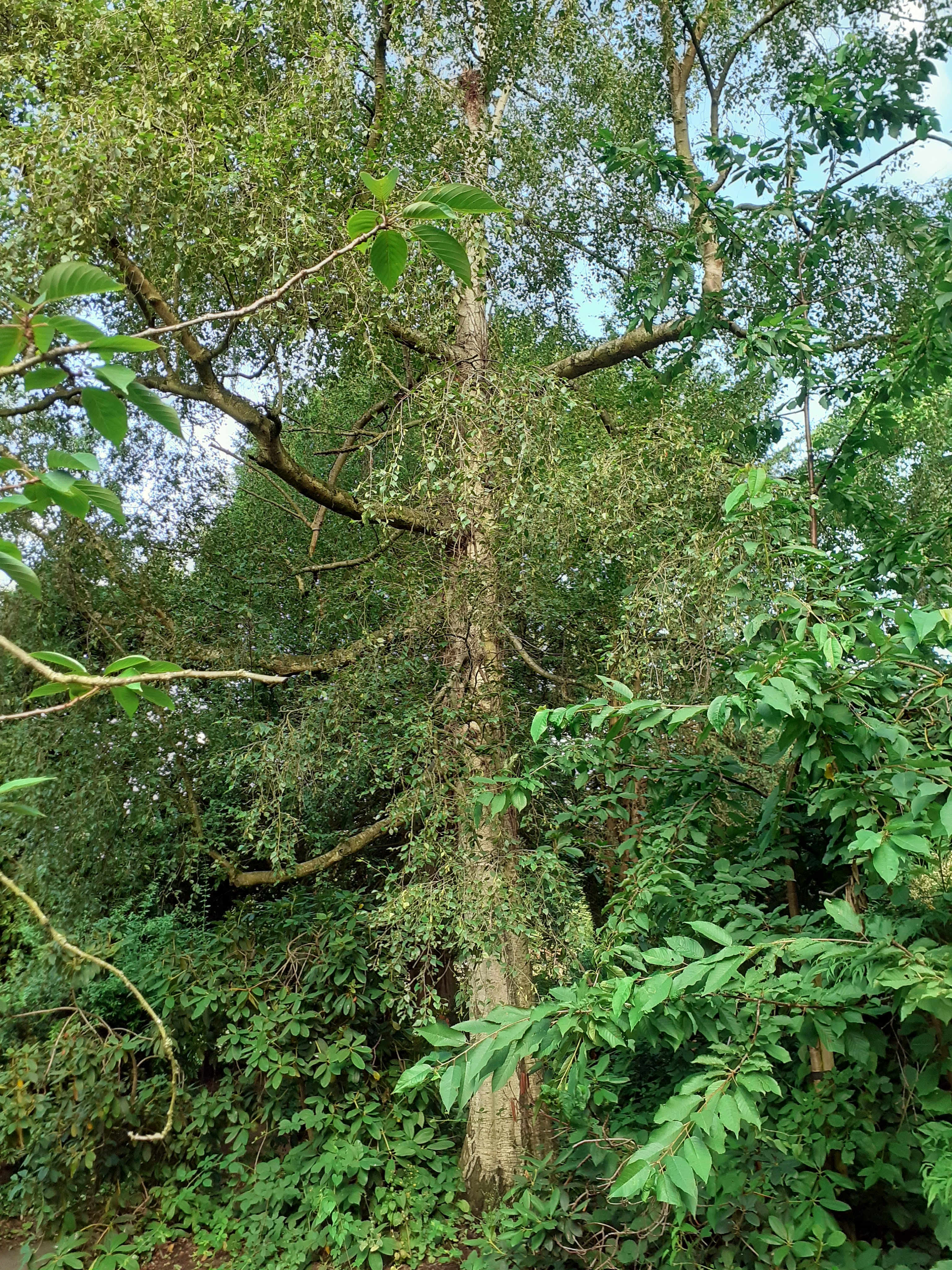
After establishing a sacred space, I was asked to begin a relationship with a spring and a tree. Stewart said: “we need to relate to such locations. This is a physical relationship first and foremost … we are one with the land, and trees, springs and caves are power points that tap into the energies of the land, and then reach into other dimensions altogether”. I found my spring quite easily (above). But there were almost too many trees to choose from, and I recall hesitating about my choice, to the point even of changing trees on my second or third visit. On my recent re-visit – woven into a rare family weekend in London – I found it easy to find the spring again but harder to remember my tree. I settled on the mature birch below, a good choice for a new, Goddess related undertaking (2). But I cannot vouch for it as my choice in 1992.

Sacred space (“the land talks back”), and befriending a spring and a tree: for me, these were the most powerful lessons from R. J. Stewart’s work. They were a helpful preparation for my later Druid training. I was very pleased to revisit this space in July 2023 and share it with family members.

(1) Streatham was in Surrey before becoming part of the County of London in 1889, and then Greater London in 1965. It began as a settlement around the old Roman road (Street Ham) from London to the south coast at Portslade, Brighton, the site a Roman port long lost to erosion. It appears in the Domesday Book of 1086 as Estreham. The village remained largely unchanged until the 18th century, when its natural springs, known as Streatham Wells, were first celebrated for their health-giving properties. The reputation of the spa, and improved turnpike roads, attracted wealthy city of London merchants to build their country residences in Streatham.

The Rookery began as a large private house with its own landscaped gardens. Much later, when the house and gardens were threatened with disposal and redevelopment, it was bought by public subscription and laid out as a formal open space, first opening to the general public in 1913. The Rookery is now one of the London Borough of Lambeth’s Green Flag Award-winning parks, directly managed by Streatham Common Cooperative (SCCoop), a local community-led enterprise.

(2) R. J. Stewart The Way of Merlin: The Prophet, The Goddess and the Land London: The Aquarian Press, 1991

STRENGTH IN SIMPLICITY

In recent days, living a pared down life, I have seen the strength in simplicity. Both my contemplation and my inquiry are reflecting this. I have a few simple practices adapted from a variety of sources. At first under the pressure of illness, I have moved away from the kind of system building that was drawing my attention a month ago (1). Now I have reminded myself that customising, using a light touch, and keeping practice relatively simple has been my generally preferred way of responding to influences. It helps me to avoid half-awarely ventriloquising teachers and to maintain my own discernment.

As an example (2), I describe a simple meditation. It focuses on the breath because that is something I am busy with – and ambivalent about thanks to my COPD. In it I draw on the understanding that breath and spirit share the same word in some languages (e.g pneuma in Greek). No more than ten minutes is needed for a session.

Although simple, the practice does have a liturgical framing – for instance adapting one of Stewart’s Qabalistic crossing forms from The Miracle Tree. I also draw on my OBOD background, especially the commitment to finding peace. This kind of framing helps. In formal practices like this, I am not just plunging into raw experience. I have other opportunities for that. Rather, the practice affirms an already existing perspective, developed over time, and this is what the words proclaim.

(1) https://contemplativeinquiry.blog/2022/04/05/towards-an-integration/

(2) See text below:

Crossing, using my right hand, I say: In the name of Wisdom (forehead), Love (pubic bone), Justice (right shoulder), Mercy (left shoulder), and the Living Breath (both hands over upper chest). I enter stillness. Then I say: Deep within my innermost being, I find peace. Silently, within the stillness of this space, I cultivate peace. Heartfully, within the wider web of life, may I radiate peace.

I do a breath exercise*, and then say: I am a movement of the breath and stillness in the breath; living presence in a field of living presence: here, now, and home.

Then, I begin slow, deep breathing, as if inviting the Cosmos to breathe through me. I may use the I AM mantra. For me it affirms the non-separation of the finite life and the Source, and the gift of a place within the ecology of being.

On completion I repeat the Crossing and say: I give thanks for this meditation. May it nourish and illuminate my life. May there be peace throughout the world.

*11x breathe in through nose, counting to 8; hold, counting to 8; out through mouth, counting to 8, hold, counting to 8.

TOWARDS AN INTEGRATION?

I contemplate an image is from R. J. Stewart’s The Merlin Tarot (1). It is the Ace of Beasts, the Earth suit. I sense it guiding me to a new phase of my inquiry, I hope a phase of integration. The stag has reached the point of stillness. There is nowhere to run, and no longer any need for running. Between his antlers sits a black mirror, showing the four powers of Life, Light, Love and Law unified by a central fifth. Here, it is the magical implement of the Earth element, an alternative to the shield or pentacle.

Stewart says of this image: “its deep power is that of Law and Wisdom, the Mystery of Night and Winter. Thus it can indicate a force or restriction that leads to liberation …. the Wisdom of endings that bring beginnings”. For the next phase of my formal inquiry practice, I will work through the programme of R. J. Stewart’s The Miracle Tree (2). I am already familiar with it, but I can drop into a beginner’s mind readily enough. The novelty is in being focused and systematic, as I was over the years of my training in OBOD (3), but here with a more closely defined and demarcated programme.

Why this? And why now? The Miracle Tree is based on the Western Way Qabalah, and its version of the Qabalistic crossing practice runs: “In the Name of the Star Father (right hand over forehead) Deep Mother (genitals) True Taker (right shoulder) Great Giver (left shoulder) We are One Being of Light (circle right and downwards from top of forehead to genitals, completing left and upwards to back of forehead)”. I like its integrative quality, and its way of presenting a non-dualist perspective – especially the use of ‘We’ in a statement affirming ‘One Being of Light’. It does not use the Absolute to crush the human and natural. It acknowledges the diversity held in ultimate unity, and embraces multiple forms and dimensions of Being. The Cosmic Tree shelters all, whilst not being separate from any.

Stewart says of this system: “the idea of relationship holds good for all world views and models. It is not so much a matter of their accuracy, for their accuracy is relative and ephemeral, but of their value to us as models of relationship to, and participation within, the greater world of which our human world is a small part”. The way to test the value of the model is experiential, and this is what I will do. For me, contemplative inquiry involves a surrender to, and immersion in, the work, whilst retaining a capacity to track and appreciate its effects. I do not expect this cycle to negate what has gone before but, rather, to complete it. Where appropriate, I will discuss this in the blog from time to time.

(1) R. J. Stewart The Complete Merlin Tarot: Images, Insight and Wisdom from the Age of Merlin: London: The Aquarian Press, 1992 (Illustrated by Miranda Gray)

(2) R. J. Stewart The Miracle Tree: Demystifying the Qabalah Franklin Lakes, NJ: New Page Books,2003

(3) Order of Bards, Ovates and Druids – https://www.druidry.org/

BENDIGEIDFRAN (BRAN THE BLESSED)

Bendigeidfran, Bran the Blessed, is a legendary King of the Britons. He is best known to us through the medieval Welsh text The Second Branch of the Mabinogi (1). The primary theme is hope betrayed, most chillingly by Efnysien, Bran’s “brother on his mother’s side”. A marriage feast ends in a series of disasters. But this is not the whole story.

The marriage is between Bran’s sister Branwen and Matholwch the King of Ireland, intended to bring the two kingdoms together in peace and amity. But Efnysien mutilates the Irish party’s horses at the celebration hosted by Bran. It is among the worst things he could do.

In one savage, impulsive act, Efnysien opens the space for an outpouring of resentment, suspicion and hostility – eventually, from both the Irish and the British people. Bran’s efforts to resolve the situation through explanation, consultation and negotiation end in failure. The level of compensation and apology he offers is too much for the British and too little for the Irish. The time comes when Branwen is seriously abused in Ireland. The absolute breakdown of trust between the two countries leads to a bitter, brutal war.

After the war, Bran returns from Ireland with seven surviving companions, his only victory being that he has got them home. Ireland is completely devastated. Bran has been wounded in the foot by a poisoned spear, probably a mortal wound. Bran makes a radical decision, leading to a period of healing and renewal for his companions and a new protective role for his country. “Bendigeidfran ordered his head to be cut off. ‘And take my head’, he said, ‘and carry it to the Gwynfryn in London (the White Mount, now the Tower of London) and bury it with its face towards France. And it will take you a long time; you will feast in Harlech for seven years, with the birds of Rhiannon singing to you. And you will find the head to be as good company as it ever was when it was on me. And you will stay for eighty years in Gwales in Penfro. And so long as you do not open the door to Aber Henfelin, facing Cornwall, you can remain there, and the head will not decay. But as soon as you open that door you can stay no longer. Make for London and bury the head. And now set off across the sea”.

Bran has never been an average human. Too big “to fit inside any house”, he wades across the sea to Ireland “carrying all the stringed instruments on his back”. Later, he bridges the River Liffey by lying down across the river: “hurdles were placed on him, and his men walked on top of him to the other side”. Bran is more than a physical giant. There is something numinous and otherworldly about him, built into his name Bendigeidfran, Bran the Blessed.

The term ‘blessed’ points to something other than it would in the life of a Celtic saint. Caitlin & John Matthews call Bran the Blessed a “titanic god of the Celts … a god of earth and mountain” (2). R. J. Stewart and Robin Williamson describe him as a “primal guardian deity” (3) enacting a role of sacred king traditionally concerned with music, poetry and bridging. In the narrative world of the The Second Branch, such roles are alluded to rather than fully described, but the world is full of magic and spiritually ambiguous, with formal religion little mentioned.

The decapitation of Bran is a magical act. It has two successive effects, both of them benign. The first is when the presence of the head enables an extended period of protected respite for Bran’s companions: the seven years when they feast and hear the birds of Rhiannon (4), and then eighty years as “the Assembly of the Noble Head”. During this time, they forget “all the sorrow they had themselves seen and suffered, [and] … any grief in the world”. Life is pleasurable and delightful and no one seems to age.

It has to end, for the story to continue. The western door is opened, by Heilyn son of Gwyn, driven by curiosity. Grief, loss and ageing return to the companions’ world. They hasten to London to complete their destined task. As long as the head remains buried, no enemy can conquer the kingdom. This is where The Second Branch story ends. Bran, through the agency of his buried head, is confirmed as enduring protector of the land.

There is a coda. It is said that King Arthur dug the head up in later days in the belief that no one but he should protect the country, and that subsequently the head was lost. In later days, the power of the head was transferred to the presence of resident ravens. Bran’s name means raven (also crow), which allows the ravens to take on his power. He is them. They are him. Ravens are kept in the Tower of London to this day, a practice insisted on by Charles II, concerned for the preservation of his country as a kingdom. During World War II the ravens fled after a bombing raid, and every effort was made to ensure that they were swiftly replaced. Seven ravens, the responsibility of Ravenmaster Chris Skaife, live in the Tower now. (5).

(1) The Mabinogion Oxford: the University Press, 2007. (Translated with an introduction by Sioned Davies)

(2) Caitlin & John Matthews The Western Way: A Practical Guide to the Western Mystery Tradition London: Arkana, 1985 (Foreword by Gareth Knight)

(3) R. J. Stewart & Robin Williamson Celtic Bards, Celtic Druids London: Blandford/Cassell plc, 1996 (Colour illustrations by Chris Down)

(4) https://contemplativeinquiry.blog/2017/8/4/a-bird-of-rhiannon

(5) https://www.hrp.org.uk/tower-of-london/whats-on/the-ravens

DANCING SEAHORSES II

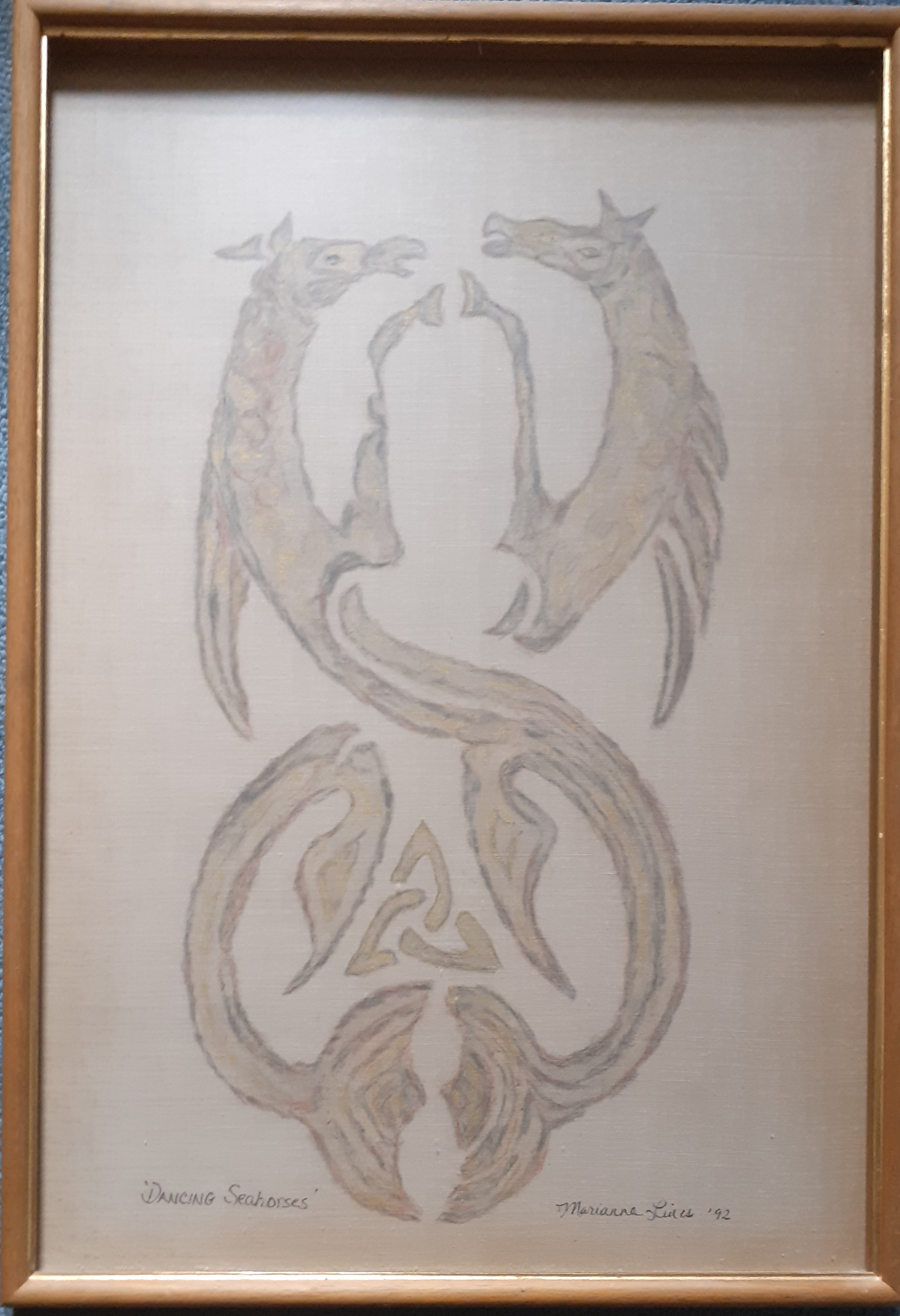
I have already written about the Dancing Seahorses image (1) found on a Pictish stone from Aberlemno in the Scottish county of Angus. After seeing the stone on a visit there, in 1992, I bought Marianne Lines’ painting. I have felt strongly involved with this image ever since. I think of it as a friend and guide. In a sense, this post is about the modern use of archaic images by people, like Druids, who are drawn to them.

I do not know the intentions of the original carver. beyond celebrating beings who are half of this world, half of the otherworld, and who embody powerful water energies for Celtic peoples on the Atlantic coasts of Britain, Ireland and Brittany in ancient times. They are remembered in folklore to this day. I do know that the carving made a strong impression on me, when I first saw it on the stone itself. It stayed in my imagination, and over time has deepened and grown new meanings.

Four years after acquiring the painting, I had the image tattooed on each arm. By that time I knew of the way in which it had influenced the cover design for R. J. Stewart’s The Prophetic Vision of Merlin (2). This variant form was used to refer to the story of the young Merlin at Vortigern’s subsidence prone tower in Snowdonia, prophesying his way out of becoming a human sacrifice, and identifying two contending dragons under the foundations. In the book illustration, there is a yin-yang reference, with a suggestions of interdependent primal forces, each of which already contains the seed of the other, seeking balance and alignment. In the Western Mysteries quest for healing and transfiguration, the energy bodies of the land and of humans are deeply interwoven.

There is another, more recent level of understanding, that I derive from the painting and tattoos, but not evident in The Prophetic Vision of Merlin. I see both the dancing seahorses and a second image, behind and containing the immediately apparent one. As I wrote before, “the space where the horses legs are raised defines a shape, suggesting a head. The very emptiness there is a paradoxical mark of presence. To me it became the head of a goddess, with the seahorses then becoming her body. Still clearly appearing as a water being, her arms – if they are arms – are raised in blessing”. I would now add that in this way, she demonstrates the dance of emptiness and form. They are balanced. Neither is privileged over the other. The Celtic knot points both to interconnection and infinity.

I identified the Goddess whilst gazing directly at the original Dancing Seahorses picture, which hangs of a wall directly above my altar. However I believe I received a subconscious nudge from the High Priestess card in The Druidcraft Tarot (3). She wears the image herself. Her hands are raised. She stands as the Goddess. In the Druidcraft narrative, she “represents the magical power of stillness and depth”. For me, the Goddess in Dancing Seahorses represents the ultimate union of emptiness and form, and the rebirth of the cosmos in each moment. Her representation combines the aware potential of the void and a primal aquatic generativity that can inhabit other elements. The Druidcraft priestess is human, but one who wears an image that bespeaks the divine to me, and her role asks for “stillness and depth”.

In my work, the entry into stillness and depth is, firstly, to enter into I-Thou communion with the primal Goddess (Modron) and then to recognise my own true nature, as (mythically) her divine child (Mabon) – sensitive and busted open to the world. This recognition becomes a prayer of gratitude and a surrender of my passing private concerns to Who I really am.

Words and pictures are not enough, but, cherished and contemplated lovingly over time, together they can point the way..

(1) https://contemplativeinquiry.blog/2020/06/25/dancing-seahorses/

(2) R. J. Stewart The Prophetic Vision of Merlin London & New York: Arkana, 1986

(3) Philip & Stephanie Carr-Gomm The Druidcraft Tarot: Use the Magic of Wicca and Druidry to Guide Your Life London: Connections, 2004 (Illustrated by Will Worthington)

‘WHIRLPOOL’: THE POWER OF AN IMAGE

For R. J. Stewart (1), the deepest vision and reality of the Underworld is “that the stars are within the Earth, within ourselves, not distant and remote”. He explains a vision in which our habitual awareness, personal and collective, “is on the surface of existence” and that “the primal reality is in the depths, not only of ourselves, but of the land and planet, which are of the universal Being. So we do not reach out and away from ourselves, but plunge into the otherworld that is the source of our own and, more important, is the source of the stars themselves.  In the Whirlpool realm, we find the deepest intimations of our inherent universal Being. It leads us to the sacredness of the planet, of the body, for deep within is all that is, the source of the four Powers emerging from the Void”*.

The Dreampower Tarot, which Stewart devised together with artist Stuart Littlejohn, is structured around a descent from the surface through three realms: stone, pearl and whirlpool. To a large extent these correspond to the traditional western distinctions of body, soul and spirit, though emphasising a journey of descent rather than ascent. The Whirlpool realm, and the individual Whirlpool card, involve a quest “for truth and reality that reaches within towards the source of Being. In this sense it also shows wonder and awe, the Mystery within that turns all existence, setting the worlds in motion through the cycle of the Powers and Elements.” Hence the Whirlpool can be called an archetypal image – putting a star field in the foundational depths of consciousness. The use of the term ‘whirlpool’ for a “spiralling nebula of stars” skilfully introduces water references into the picture, offering further disruptions of common sense for the imagination to make use of.

In an earlier work (2), Stewart places a star field at the centre of a creation myth, one that begins with darkness and void until light begins to appear, and “the light that spreads through the darkness is starlight, and we find that we are in the centre of a vast wheel of stars, rising and falling all around us”. Here he introduces the Goddess Ariadne, “Weaver of Being and Unbeing”, creator of form. Her description is too specific and too anthropomorphic for me. But there is something in the process which unfolds that resonates: “Out of the silence a sound emerges … It is the sound of breath. We become aware of a breathing in and out, and realize that this breathing is our breath and yet the breath of all Being. We breathe, Being breathes. Slowly we feel form assemble from the breathing, and realize that we have a body which is the body of all Being.  The stars are within us, we are formed of the Weaving.” 

I have a powerful sense of the motherhood of the cosmos, and of being companioned, though not instructed, in learning to breathe. I have intrauterine and early post natal experiences – not readily accessible, but held within me – to influence my shaping of experience. I have adult experiences of rebirthing and holotropic breathing that have enabled me to reprise the original process and helped me distinguish personal from transpersonal and universal elements. Today I can add the sense of a universe born with every breath, here and now. Somewhere here I do indeed find the Goddess, as I also find her in everything around me.

(1) R. J. Stewart The Dreampower Tarot: The Three Realms of Transformation in the Underworld London: The Aquarian Press, 1993 Illustrated by Stewart Littlejohn

(2) R. J. Stewart The Way of Merlin: the Prophet, the Goddess and the Land London: The Aquarian Press, 1991

*In this vision the Void is the source of all being, and the four powers are life, light, love and law – with the last being alternately understood as liberation. These powers are associated with the four elements, respectively air, fire, water and earth.

THE SACRED HEAD OF BLADUD

The historic city of Bath is about thirty miles from where I live and – from another direction – thirty miles from where I was born. It has always been part of my psychogeography. This post concerns both its ‘historical’ and ‘legendary’ past.

“A satisfying connection between modern archaeology, ancient legend, sacred kingship and Celtic religion is found at Aquae Sulis, the Roman name for Bath, England. In his legendary Historia Regum Britanniae [History of the Kings of Britain] (1) Geoffrey of Monmouth reports that King Bladud, grandfather of Bran and Branwen, founded the site and taught the druidic arts of ancestor magic and flight, eventually crashing to his death on the site of what is now London (the name Bladud means ‘light-dark’ or ‘bright-shadow’). In his Vita Merlini [Life of Merlin] (2), Geoffrey of Monmouth has Bladud and his consort Aleron (‘wings’) presiding over the hot springs of Bath, which are at the centre of the Bardic universe described by Taliesin to Merlin, forming the gateway to the Otherworld.

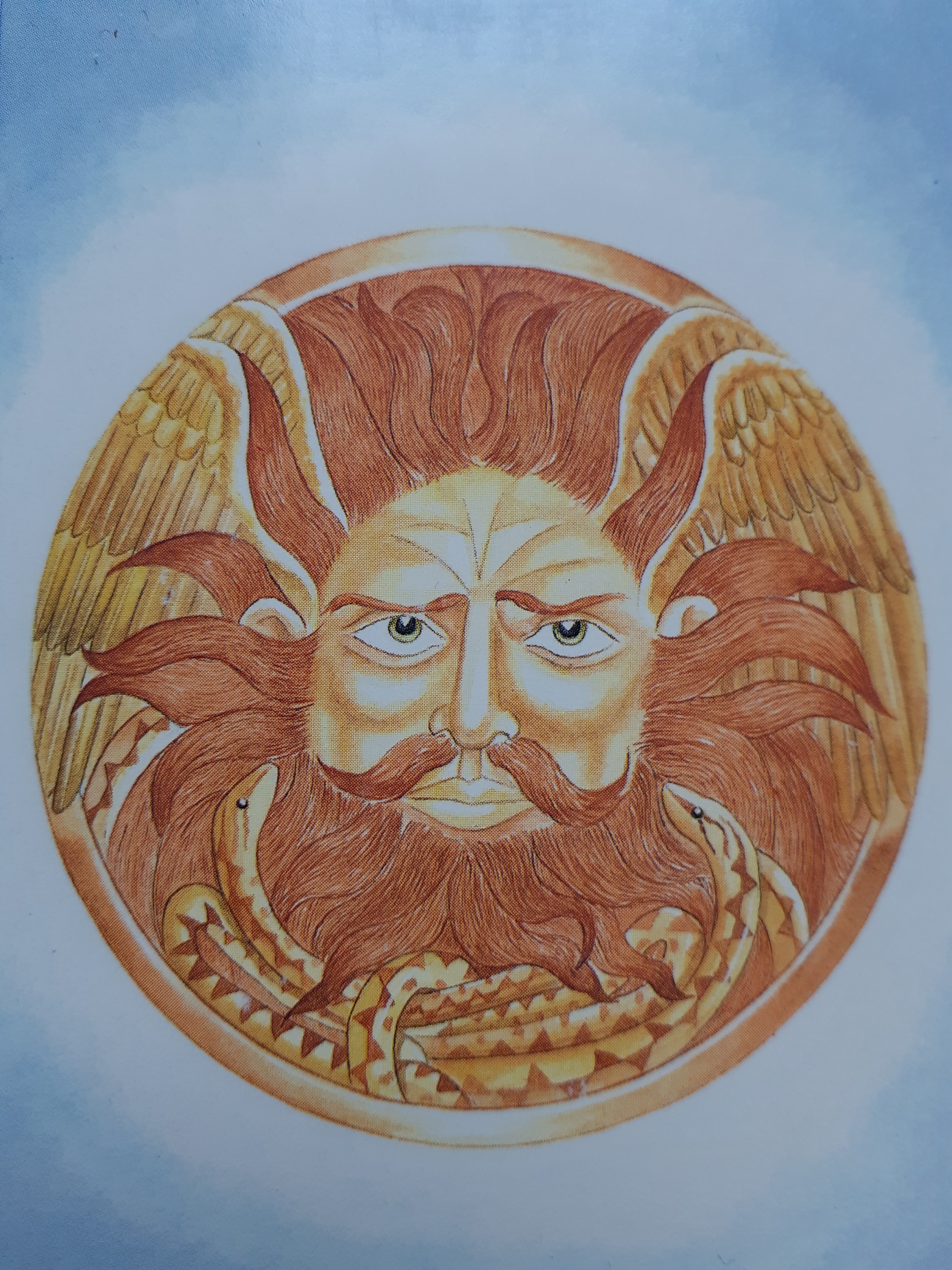
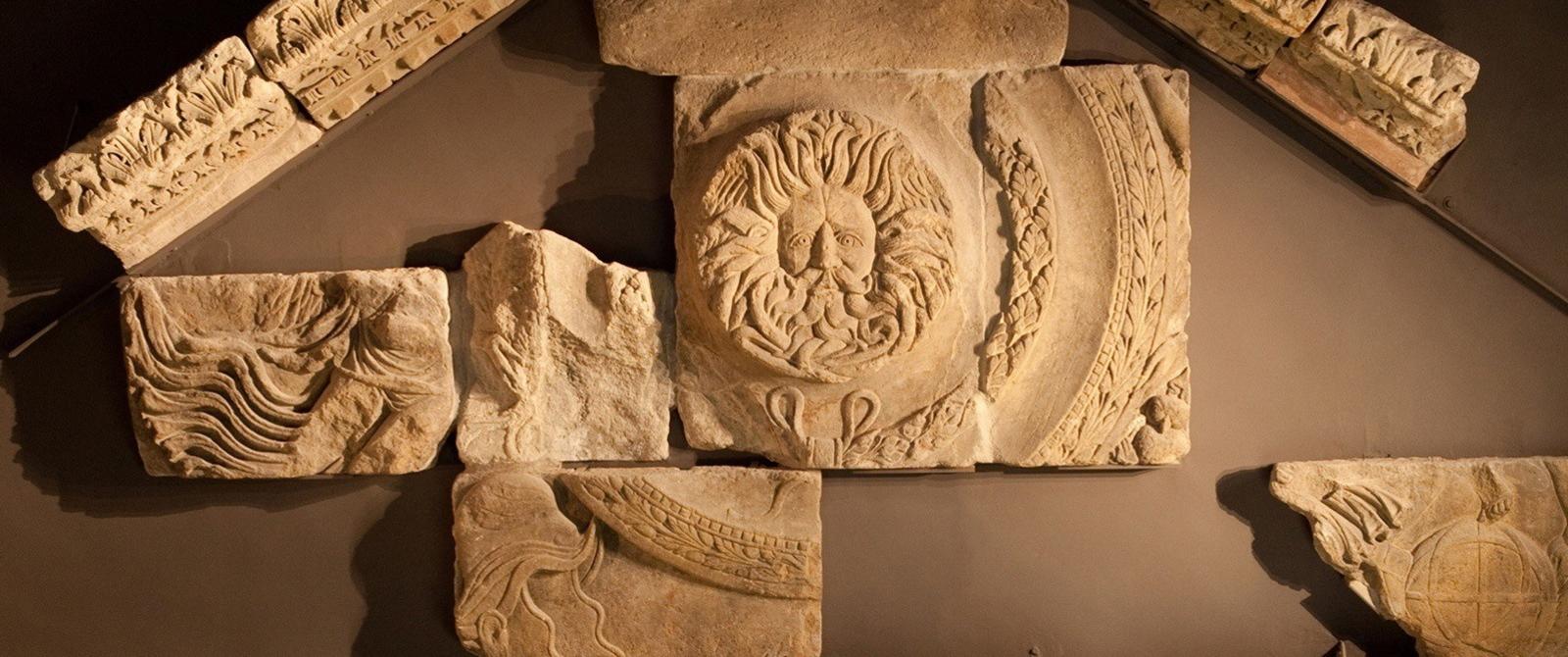
On show in the museum at Bath is a superb Celtic solar head (often inaccurately called a Gorgon’s head). The carving is a circular relief of an imposing male face with wild hair, long moustaches and staring eyes. He has wings on either side of his head and is surrounded by flames. Beneath his chin are two serpents, linked in the manner of a torque, the Celtic symbol of royalty. This solar deity is probably the being called Bladud in the legendary histories, connected to magic, flight and a fall from the heights to the depths. He has upon his brow the mark of the three rays, which are very often described as the primal three powers of universal creation.

The goddess at Bath, presiding over the sacred hot springs, was called Sul or Sulis, which means ‘eye’ or ‘gap’ (with a sexual connotation), for she is a variant of Ceridwen, the goddess of the Underworld. The entire Celtic/Roman complex of Aquae Sulis is an excellent example of ancestral Underworld magic refined by Roman politics into a temple of Minerva.

“The sacred or prophetic head is an embodiment of the relationship between the three worlds, for it is aware in all worlds, through all time. While we may have ideas that an anthropologist would suggest originated in primitive head-hunting magic, the theme of the sacred head becomes an allegory of divine and human perception and declaration.

“There is a further element to the sacred-head theme, for it is also interlinked with beliefs and practices concerning the regeneration of life, particularly with the cauldron. Titanic figures such as Bran, acting as sacred kings and guardians of the land, also partake of the mystery of the sun at midnight, light regenerating out of darkness. And this, after all, is the secret of inspiration, a sudden light born out of fruitful darkness.”

R. J. Stewart and Robin Williamson Celtic Bards, Celtic Druids London: Blandford, 1996

(1) Geoffrey of Monmouth History of the Kings of Britain London: Penguin, 1966 (Translated with an introduction by Lewis Thorpe)

(2) Mark Walker Geoffrey of Monmouth’s Life of Merlin: A New Verse Translation Stroud: Amberley, 2011

NOTE: the first illustration is from R. J. Stewart The Merlin Tarot London: Element, 2003 , illustrated by Miranda Grey. The Bladud image is on the reverse of each card, implicitly re-ascribed to Merlin as embodying the same archetype in a different way. The second illustration can be found on http://www.romanbaths.co.uk – click on discover and then walkthrough.

DEATH (THE APPLE WOMAN)

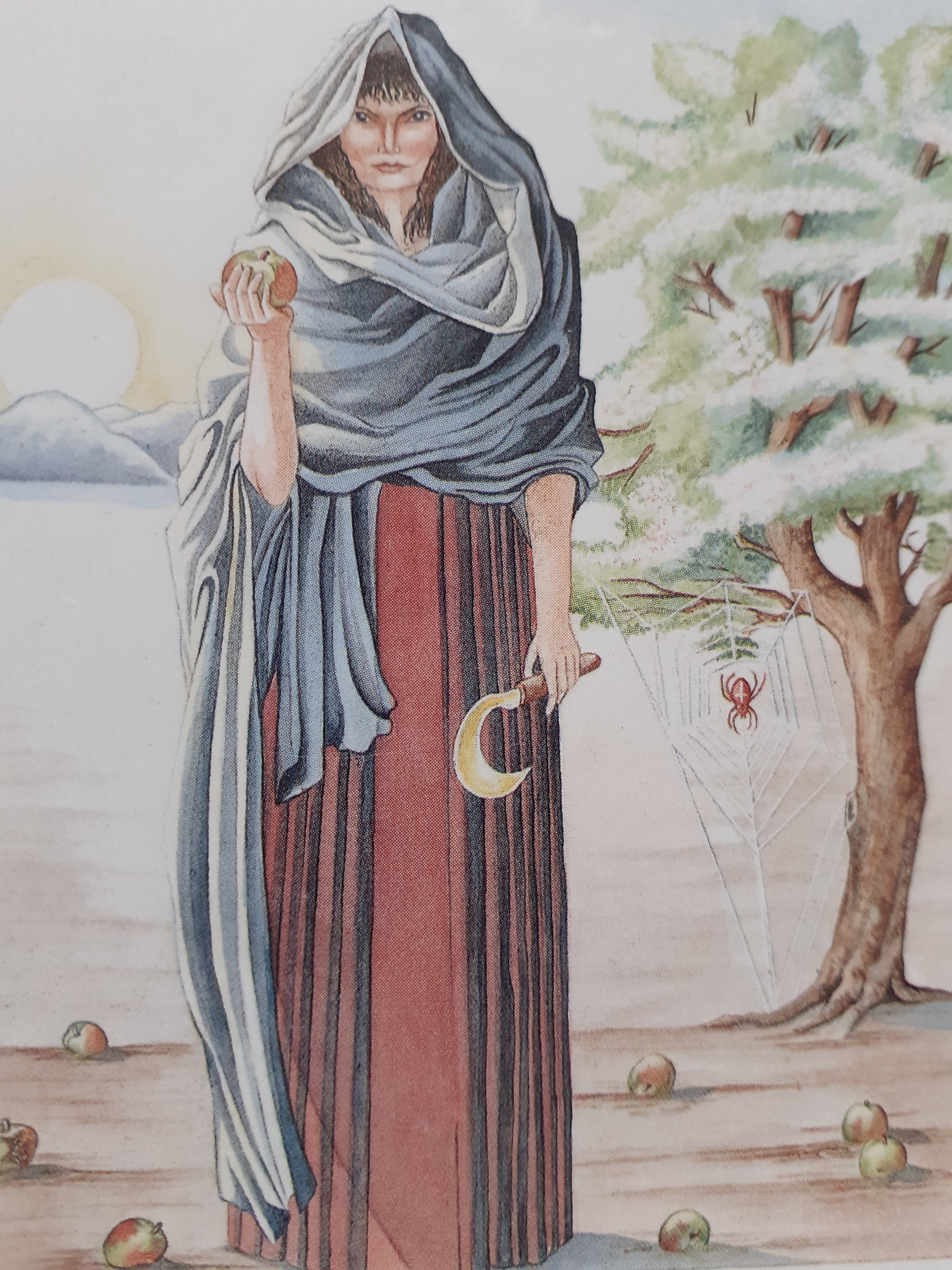
In the approach to Samhain, thoughts turn to death. In R. J. Stewart’s Merlin Tarot (1,2) the Death card has The Apple Woman as an alternate name.

Stewart explains that “the original image for Death is that of the taking or destroying Goddess”, for “who but the creatrix may truly destroy and withdraw created life?” He adds that, in Celtic tradition, she often appears as a female power offering magical fruit.

In his source text, Geoffrey of Monmouth’s Vita Merlini (Life of Merlin), we find a mysterious woman – ex-lover of Merlin – who lays out poisoned apples to entrap him. These apples, arranged “under a tree upon a pleasant green”, are eaten by Merlin’s boon companions: they are either killed or driven insane. Although Merlin escapes the apples, he does not escape his own later insanity in the Caledonian Forest, brought on by the traumatising Battle of Arfderydd.

For Stewart, the Apple Tree is one of the simplest expressions of the Tree of Life. “It is the Otherworld or Underworld Tree that reveals eternal potential, the fusion of ending and beginning in one paradoxical form”. The apples are the fruit of raw, untransformed power. Whereas Merlin’s companions snatch at the apples and eat them greedily, the legendary Thomas Rhymer volunteers to pick magic apples for the Fairy Queen, who recognises his gallantry by giving him the bread and wine that can nourish him. He wins the gift of prophecy and the tongue that cannot lie.

Both lover and killer, the Goddess of Death and Change is young and ancient, weaver and unweaver of a web that is the universe. She is destroyer of hope and giver of hope, for “in her hand she bears the fruit of perpetual life and rebirth, and the razor Sickle that cuts the tread of continuity”.

Stewart ends with this reflection: “perhaps Merlin’s sub-story of The Apple Woman simply means that adulthood is our most deluded period of life. We reject understanding and substitute self-image, habit and even dogma, in our convoluted attempts at survival; the hostility we experience is not that of the Goddess, but our own hostility reflected upon us. Reject love, risk poisoned apples – such fruits are deadly to the greedy and unprepared. But if we accept the fruit or any of its many transformations (such as bread and wine) from the Goddess, she blesses us with gifts of timeless understanding. These gifts may appear in the outer world as prophecy, attuning to the land; death itself is a timeless moment of understanding when all relative interactions cease. Ultimately, we are the fruit”.

(1) R. J. Stewart The Complete Merlin Tarot: Images, Insight and Wisdom from the Age of Merlin London: The Aquarian Press, 1992 . Illustrated by Miranda Grey ISBN 1 85538 091 9 No cards, but a full explanation and discussion of the system and its imagery.

(2) R. J Stewart The Merlin Tarot London: Element, 2003. Illustrated by Miranda Grey ISBN 000 716562 5 (First published by London: The Aquarian Press, 1992). Cards, handbook and notebook for record keeping.

MERLIN’S TRANSFORMATION

The hermit card from The Merlin Tarot (1,2) shows a traditional image of the contemplative. The accompanying narrative points to evolution beyond the life of this world, whilst still in service to it. Stories of this kind characterise many spiritual paths. This one is Druid friendly, alive in my heart and imagination. Here, I want both to pay homage to heritage and to note a personal divergence.

Merlin has reached the top of the mountain, the austere end of his ascending path. All that remains is to bid the outer world farewell, “not as an inspired youth or madman seeking nature, but in full understanding”. The understanding is that of the Great Mother herself, typified by simplicity, clarity, and a will to withdraw from manifest existence. This is the moment to relinquish the earthly plane. A simple leap will do it. But Merlin’s destiny is not to abandon the world. In a greening of Mahayana Buddhism’s bodhisattva concept, Merlin, discarnate, will continue to serve the Goddess and the land.

Even as hermit, in this frozen moment on the cusp of anticipated transformation, Merlin is not quite alone. The seer is steadied by his staff, a branch from the tree of life itself. A wren, sacred bird of kingship and blessed of the Great Mother, has companioned and witnessed him throughout his journey. Soon it will be free to return to the green safety of its beloved low hedges. Merlin contemplates a crystal lamp – crystal being the underworld’s mineral equivalent of light. Caught inside the lamp, two primal dragons, dynamic yin and yang energies, underworld born, are held in a static balance that is described as “perfect”. A heretical thought arises: is the candidate for transformation, at the very last moment, questioning the ‘perfection’ of this absolute, frozen, stillness? What price the infinite?

In The Merlin Tarot, this is the last we see of Merlin. But for us, there is the path of descent, right down to its completion in an image of embodied realisation. The Tarot trump following that of the hermit Merlin, and complementary to him, is the Innocent, a young Sophian wisdom figure. Linking with the active energy of a Star Father who seeds the cosmos, she initiates pathways of giving and sharing on the descent, so that the earth itself may be changed.

R. J. Stewart is in a line of Western Mysteries teachers including Dion Fortune, Israel Regardie and W. C. Gray. In this tradition, discarnate beings linked to a cosmic hierarchy and dwelling on other, more spiritual planes, are real. They are not metaphors, aspects of the human psyche, or opportunities to think with stories. R. J. Stewart is clear about this, and I have always had to take respectful note of this view whilst not committed to sharing it. But I am moved and inspired by stories. On the contemplative path, the rational mind has at best an ancillary role. It doesn’t do well by itself. One option is to move into stillness and silence, and sometimes I do that. Another is to engage the heart and imagination, which are fed and watered by stories, their resonance, and their play intrapsychic relationships. The story told in The Merlin Tarot has nourished me for a long time, and continues to do so, in ways that satisfy me, without my wanting to be him.

(1) R. J. Stewart The Complete Merlin Tarot: Images, Insight and Wisdom from the Age of Merlin London: The Aquarian Press, 1992 . Illustrated by Miranda Grey ISBN 1 85538 091 9 No cards, but a full explanation and discussion of the system and its imagery.

(2) R. J Stewart The Merlin Tarot London: Element, 2003. Illustrated by Miranda Grey ISBN 000 716562 5 (First published by London: The Aquarian Press, 1992). Cards, handbook and notebook for record keeping.

Earth Eclectic

music that celebrates Earth and speaks to the heart

Sarah Fuhro Star-Flower Alchemy

Follow the Moon's Cycle

Muddy Feet

Meeting nature on nature's terms

Rosher.Net

A little bit of Mark Rosher in South Gloucestershire, England

Becoming Part of the Land

A monastic polytheist's and animist’s journal

selkiewife

Selkie Writing…

Charlotte Rodgers

Images and words set against a backdrop of outsider art.

Prof Jem Bendell

living with metacrisis and collapse

Towint

The pagan path. The Old Ways In New Times

The Druids Garden

Spiritual journeys in tending the living earth, permaculture, and nature-inspired arts

The Blog of Baphomet

a magickal dialogue between nature and culture

This Simple Life

The gentle art of living with less

Musings of a Scottish Hearth Druid and Heathen

Thoughts about living, loving and worshiping as an autistic Hearth Druid and Heathen. One woman's journey.

Wheel of the Year Blog

An place to read and share stories about the celtic seasonal festivals

Walking the Druid Path

Just another WordPress.com site

anima monday

Exploring our connection to the wider world

Grounded Space Focusing

Become more grounded and spacious with yourself and others, through your own body’s wisdom

The Earthbound Report

Good lives on our one planet

Hopeless Vendetta

News for the residents of Hopeless, Maine