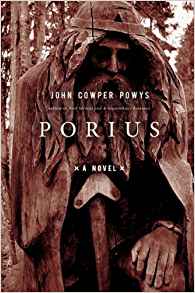
Porius (1) is John Cowper Powys’ last novel. It took him seven years to write, and he completed it in 1949, when he was 77. It is set in the year 499 CE, in North Wales. Porius is a Romano-British prince. Arthur, a suspect foreigner to most local people, reigns as Emperor. Rome is ruled by Goths, but links are maintained with Constantinople. The Saxons are an existential threat. People have to find a way of dealing with the situation in which they find themselves. But the book is at least as much about the inner lives of the characters as it is about the action they take.
Powys thought of Porius as his masterpiece. His publishers did not agree and insisted that he cut it by a third, which he did over two agonising years. Fortunately, a complete edition is available now thanks to modern editors Judith Bond and Morine Krissdottir. In her foreword Krissdottir says, “I am always reminded when I read the novel of these lines: ‘we are always in error, lost in the wood, standing in chaos, the original mess, creating a brand-new world’. Powys was as gloriously lost by the time he had written Porius as the reader sometimes is … but he was still the superb craftsman, who knew that it was the story itself that had the power to shape the forest within and without, that had the power to create a brand-new world”.
Instead of writing a review, I want to focus on one character, Taliesin, and what Powys has to say through him about the creative life. Powys has a number of point of view characters, with a variety of stances. He seems to give them equal air-time, making Porius a genuinely multi-vocal novel. Taliesin is portrayed as a young, mercurial bard, popular thanks to outstanding skill in cooking as well as poetry. (The cover illustration above is of Merlin – old, saturnine, more central to the book as a whole). Powys builds Taliesin’s bardic character, and the idiosyncratic working of his awen, with care.
“Taliesin had indeed worked out for himself, quite apart from his power of expressing it in such assonances and alliterations as had never been heard before, a really startling philosophy of his own. This philosophy depended on a particular and special use of sensation; and its secret had the power of rendering all matter sacred and pleasure giving to the individual soul. And it had the power … of fusing the immense past with the immeasurable future and of doing this, moreover, not by means of an ‘eternity’ beyond experience and imagination, but by means of a quivering vibrating, yet infinitely quiescent moment of real Time.”
Taliesin can rely on an easy fluency with language. More important is his capacity for open creative reverie, based on a deep sensitivity to the perceptions of the moment. He is described as sitting on a four-legged stool in the deepening of a late October evening. As he sits, he feels the full warmth of a fire and is able to see “the glittering path of moonlight on wind-ruffled water”. He can see a hawk’s nest, and the “ancestral sword of Cynan ap Clydno, thrust to the depth of half its blade, in the buried stump of a vanished oak tree”. The sword is reminiscent of a cross. Taliesin muses that “any sort of thing happening near a cross, not to speak of a sword, always seems in some way to be watched – if not heard and guarded against”. J.C. Powys comments, “considering the sword and the cross, the moonlit space between that figure on the four-legged stool and Clydno’s rusty weapon may well have vibrated with dangerous antipathy as the words ‘The Mothers’ and ‘Nothingness’ and ‘Annwfn’ floated away towards the lake. Rather than writing, Taliesin speaks into the darkness. Writing may come later. The piece that follows is lengthy, and eventually settles into a contemplation of “the thing none can utter, the thing inexpressible” yet “known from before the beginning”. Here is the final section:
“I know it from pond slime and
frog spawn and grub spit,
From bracken’s green coral,
white lichen, yellow mosses,
Newts sinking with their arms
out to reedy pools’ bottoms,
Swords rusting in their oak
stumps, wrapped in the long rains,
Eggs rotting in their lost nests,
enjoying the wild mists, I know it from all these, and to
men proclaim it:
The ending forever of the Guilt
sense and God sense,
The ending forever of the Sin
sense and Shame sense,
The ending forever of the Love
sense and Loss sense,
The beginning forever of the Peace paradisic,
The ‘I feel’ without question,
The ‘I am’ without purpose,
The ‘it is’ that leads nowehre,
the life with no climex,
The ‘Enough’ that leads forward
to no consummation
The answer to all things, that
yet answers nothing,
The centre of all things, yet all
on the surface,
The secret of Nature, yet Nature goes blabbing it
With all of her voices from
earth, air, fire, water!
Whence comes it? Whither
goes it? It is nameless; it is
shameless;
It is Time free at last from its Ghostly Accuser,
Time haunted no more by a
Phantom Eternal;
It is godless; but its gods are as
sea sand in number;
It’s the square with four sides
that encloses all circles;
Four horizons hath this Tetrad
that swallows all Triads;
It includes every creature that
Nature can summon.
It excludes from Annwfyn nor
man, beast nor woman!”
The mid twentieth century was a time of considerable interest in the Matter of Britain and Arthurian themes. But generally, then, we find a polished and rather conservative Christian perspective, applicable even to Taliesin. The Inkling Charles Williams wrote two collections of linked verse about him – Taliessin Through Logres and The Region of the Summer Stars (2). The latter collection includes these lines from the poem Taliessin in the Rose Garden:
“I was Druid-born and Byzantium trained.
Beyond Wye, by the Cauldorn of Ceridwen, I saw
the golden cycle flash in the forest, and heard
the pagans mutter a myth; thence by the ocean
dreaming the matter of Logres I came where the heirarchs
patter the sacred names on the golden floor
under the throne of Empire.”
John Cowper Powys, too, was a man of his time. But insofar as his Porius relies on legendary history, he borrows more from archaic Welsh tradition than the better known pan European literature that developed out of it. He himself is much more nature friendly and Pagan in sensibility. I see him as following a broadly emancipatory direction in modern spiritual culture, and we are his heirs.
(1) John Cowper Powys Porius: a Romance of the Dark Ages Overlook Duckworth, 2007. Edited by Judith Bond and Morine Krissdottir, with a foreword by Morine Krissdottir. The first abbreviated edition was published in 1951.
(2) Charles Williams Taliessin Through Logres & The Region of the Summer Stars Berkeley, CA: The Apocryphile Press, 2016. Edited with an introduction by Sorina Higgins. (Taliesin Through Logres first published in 1938; The Region of the Summer Stars in 1944)