Contemplative Inquiry

This blog is about contemplative inquiry

Tag: OBOD

HARVESTING INSIGHT

Noticing a single corn stalk under our neighbouring birch trees, I wonder whether the seed simply blew in or was planted by an unknown hand. If the latter, what was their intention? I realise that I will never know.

I do know how much I enjoy its presence in this space at this time. I experience it as a miracle inviting gratitude and it has marked the seasonal moment for me, this first harvest of a now declining year.

With increasing clarity I understand that I do not work well with personified and individualised images of the divine. Something seems subtly off, as if I am failing to sound my own authentic note in the Great Song of the world.

I believe that we are given different gifts in our encounters with the Cosmos, leading to legitimately different understandings. When I lean in to the notion of divine personality – even when using the term ‘Spirit’ in that sense – I am not fully living my own truth. I subtly disempower myself and weaken my connection.

For in my universe, when I rest in my own clarity, there is no separation between nature (including culture) and spirit. In the awkward activity of identification and labelling, I answer to terms like animist, panentheist and nondualist.

These words are approximations, with the power to be distracting and slightly depressing. I can find words that point to my experience well enough. But the explanatory words, the more formal and generalised terms, feel clumsy. There’s a necessary level of unknowing that these isms don’t recognise.

When consciously living in spirit, I am neither alone, as a single human person, nor am I with another being. I am simply in a different dimension of embodied awareness, supported and empowered by the bubbling source from which I spring. For me, Nature is more than the ‘nature’ of dualist spiritualities and of the scientific humanism that grew out of them.

As I harvest the learning, or relearning, of this lesson, I renew my commitment to practice and path, once again revising the beginning and end of the modern Druid’s prayer (1). I move from from ‘Grant, Spirit your protection, and in protection, strength … ‘ to ‘In spirit I find protection, and in protection, strength …’. I end with ‘and in the love of all existences, the love of this radiant Cosmos’ rather than ‘the love of God/Goddess/Spirit and all goodness’. These small changes formalise and anchor my understanding.  For me, they are an important affirmation, illuminating my path.

(1) Traditionally, this prayer runs:

Grant O God/Goddess/Spirit, your protection,

And in protection, strength,

And in strength, understanding,

And in understanding, knowledge,

And in knowledge, the knowledge of justice

And in the knowledge of justice, the love of it

And in the love of it, the love of all existences

And in the love of all existences, the love of God/Goddess/Spirit and all goodness”.

NB Providing the options of God/Goddess/Spirit is I think an OBOD (Order of Bards, Ovates and Druids) innovation. The original version, from the late 18th century, simply said ‘God’. Some modern Druids say ‘God and Goddess’.

FIRE ON WATER

8pm, 25 July. Alchemy on the canal. The evening sun, low and potent in the sky, strikes the flowing water. At points the union of the two creates a molten liquid light, clearly defined in the still image above.

By contrast, the short video below reveals light and water together in movement. Flow, and patterns in the flow, draw my attention. They show me an energised harmony, becoming more than the sum of their parts.

I notice also that when I play the video without sound, I find it contemplative and reflective. When I play it with sound, the birds immerse me in living nature. I value both experiences.

I usually feel a transition into late summer about now, a little before Lammas/Lughnasadh. The days here are still long, though now clearly not as long as they have been. It’s a warm time, often the warmest of the year. Blackberries have appeared on their bushes, a foretaste of autumnal fruit bearing.

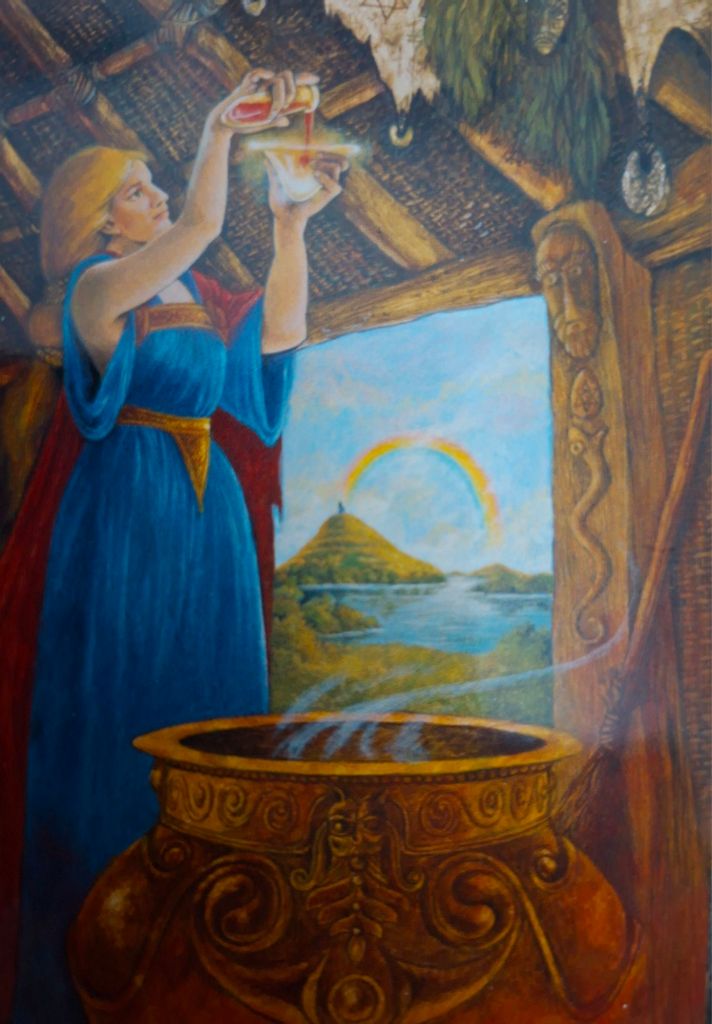
I am reminded, too, of the Fferyllt, the Druid alchemist in OBOD tradition. She is a woman of power and a devotee of Brigid. In the Druidcraft Tarot (1) she is represented by Trump XIV, standing for fluency between worlds, creativity, harmony, peace, alchemy and magic. My canal side encounter with fire on water nudged my imagination towards this figure, who somehow completed it.

(1) Philip and Stephanie Carr-Gomm The DruidCraft Tarot: Use the Magic of Wicca and Druidry to Guide Your Life London: Connections, 2004. Illustrated by Will Worthington.

PHILIP CARR-GOMM AND FRANK MCEOWEN: A CONVERSATION

An Interview with Frank McEowen (1) is the latest offering in Philip Carr-Gomm’s This Magical Life podcast. The overall aim of This Magical Life is to explore the intersection of Druidry, Psychology and Wisdom. Philip is a clinical psychologist and led OBOD (the Order of Bards, Ovates and Druids) for some 30 years. Frank is the author of, among other works, The Mist-Filled Path: Celtic Wisdom for Exiles, Wanderers and Seekers.

This wide-ranging interview covers three main topics: Celtic bards, Chinese hermit poets and politics in America today. All of these are tied into Frank’s journey and service. He was born in Mississippi, USA, of Irish, Scottish, Welsh and English ancestry. At an early age he experienced mystical encounters with the other world. These later prompted him to work with indigenous elders in North America, and later with teachers in Britain and Ireland, especially Ireland, opening himself also to the spirit(s) of place. He speaks of his journey as a whole as one of ‘soul retrieval’. His early books – The Mist-Filled Path, Meditations on the Irish Sprit Wheel, and The Spiral of Memory and Belonging, come out of this experience.

For reasons explained in the interview, Frank then made a decision to ‘disappear inward’, becoming a hermit and poet. As well as working in Celtic spirituality, Frank was also a student of Zen. He had a natural attraction to Chinese and Japanese wayfaring hermit poetry and modelled the life style as well as the art, adjusted to a different time and culture. This period led to three books of poetry published under the name of Frank LaRue Owen: The School of Soft Attention, The Temple of Warm Harmony and Stirrup of the Sun and Moon.

Like Philip, part of Frank’s service is in the field of psychological healing and personal development, principally as a student of Arnold Mindell. Mindell coined the term ‘Dream Body’ – a psycho-spiritual approach that is also Earth reverencing. It is within this framework that they talk about American politics today. First they identify distressed energies within the national psyche which the current President has uncorked and used in a darkly charismatic and disinhibited way. The discussion takes off from there, looking at issues of grief, loss (of democracy) and possible  hope. Connecting this predicament to the bard/poet vocation, Frank quotes Ukrainian poet Ilya Kaminski: “the project of Empire is to dull the senses. The project of the poet is to wake up the senses”. Projects of Empire are not unique to the USA. There is something to reflect on for us all.

I recommend this podcast as a rich and varied conversation, covering a lot of ground in its 36 minutes.

(1) The YouTube post spells Frank’s surname as McEowen and the covers of his early books use MacEowen. I don’t know if he has altered the spelling over time.

MODERN DRUIDS (RONALD HUTTON) 2 MODERN DRUID MOVEMENTS

Modern Druids is the most recent public lecture (2 April 2025) presented by Professor Ronald Hutton in his tenure as Professor of Divinity at Gresham College, London. I provide a link below (1). This is the second of two posts about the lecture, focusing on Modern Druid movements in Britain from 1781. The first, concerning Hutton’s take on early modern perceptions of ancient Druidry, is published at https://contemplativeinquiry.blog/2025/04/08/ . It distinguishes four understandings, named by Hutton as Nationalist, Green, Demonic and Confessional.

Turning to modern Druid movements, Hutton also distinguishes four different kinds, emerging from the later eighteenth century up to the present:

  1. Masonic Druids The Ancient Order of Druids was launched in London in 1781, as a closed society with initiation rites, secret memberships, signs and passwords, loosely modelled on Masonry. Its purpose was to give working men opportunities for participation in the performing arts. By 1820 it had become a huge success, moving beyond London to the Midlands and North of England. Some members wanted more focus on the insurance side of friendly society life, and in 1833 the United Ancient Order of Druids was formed, splitting off from the AOD. The UAOD lasted until the late twentieth century. The original AOD still exists.
  2. Theosophical Druids emerged in the period from 1910 as an esoteric spiritual group. It followed the ideals of the Theosophical Society and worked towards the recovery of ancient mystical wisdom from all religions and philosophies. Founded by George Watson MacGregor Reid, and originally called the Order of the Universal Bond, the new group mixed Egyptian, Greek, Zoroastrian, Muslim, Jewish and Buddhist ideas with Irish and Welsh literature and using Druid names, roles and status. In 1912 a group of members went to Stonehenge to celebrate the Winter Solstice. Increasingly identified as The Ancient Druid Order they continued their association with Stonehenge for over 70 years. Always unpopular with the archaeologists of that period, the ADO sometimes had the support of the government and site administrators and sometimes not. In 1985 the festival that had grown up on the site was banned under Margaret Thatcher.
  3. New Age Druids is the name Hutton gives to the Order of Bards Ovates and Druids (OBOD). The first iteration of OBOD was a split-off from the ADO in 1964 led by Ross Nichols, who took the new group to Glastonbury for their public ceremonies. On his death in 1975, the Order went into hibernation until 1988, when Philip Carr-Gomm, who had been a youthful apprentice of Ross Nichols, re-awakened it. By 1988 the human potential movement, and a new Celtic revival strand in western alternative spiritualty, were both gathering in strength. True to its Theosophical roots, OBOD declared itself to be a spirituality rather than a religion and opened itself up to people of all religions and none. The bulk of the membership identified as either Pagan, Christian or Buddhist. OBOD declared an aim of “uniting humans with the natural world and their own true selves”, to “heal the disorientation implicit for many in an urbanised and atomised social existence” and “to give peace”. Hutton goes on to mention The British Druid Order (BDO) and The Druid Network (TDN) but doesn’t say much about them. Although they hived off from OBOD, dual or multiple membership is common.
  4. Counter Cultural Druids When the Stonehenge Festival was banned in 1985, many people felt they had lost a clergy and a temple as well as a festival. Some wanted to fight for a religion they saw as under attack. (Hutton does not specifially mention the ‘Battle of the Beanfield’.) The single most prominent leader who arose was Arthur Pendragon, ex-soldier, ex-biker gang leader, and mystic. He was prominently associated with the Glastonbury Order of Druids (GOD), the Secular Order of Druids (SOD) and the Loyal Arthurian Warband (LAW). These groups campaigned for civil liberties and preservation of the countryside. They held demonstrations against laws that limited the former, and organised protest camps on the routes of controversial road and building schemes. Arthur was frequently prosecuted and invariably acquitted by juries. Hutton identifies Arthur as part of a long tradition of working class protest, in which the use of costume and theatre is used to make disempowered people visible. Arthur himself had a more mystical view of his mission. Once, while looking for a sign, he noticed an attractive ceremonial sword in a local shop. Asked where it had come from, he was told that it had been Excalibur in the movie of that name.

Modern Druidry in Britain continues to mutate and develop, but Hutton ends his analysis at this point. I recommend readers to visit the link below and draw their own conclusions.

(1) https://www.gresham.ac.uk/watch-now/modern-druids/

BRIGHID AT IMBOLC: A SONG BY DAMH THE BARD

Imbolc/Candlemas is celebrated on either 1 or 2 February as part of the Celtic  wheel of the year. It signals the loosening of winter’s grip. Brighid, Goddess of poets, smith-work and healing is its patron. Damh the Bard is a prominent member of OBOD (1), best known for his music. A singer song writer revisioning ancient Bardic tradition for modern times, he has been an inspirational and much loved force in modern Druidry and Paganism. His lyrics for this song are below as presented on  YouTube.

There’s a tree by the well in the wood,

That’s covered in garlands,

Clooties and ribbons that drift,

In the cool morning air.

That’s where I met an old woman,

Who came from a far land.

Holding a flame o’er the well,

And chanting a prayer.

(Chorus) Goddess of fire, Goddess of healing,

Goddess of Spring, welcome again.

The told me she’d been a prisoner,

Trapped in a mountain,

Taken by the Queen of Winter,

At Summer’s end,

But in her prison, she heard the spell,

The people were chanting,

Three days of Summer,

And snowdrops are flowering again.

She spoke of the Cell of the Oak,

Where a fire is still burning,

Nineteen priestesses tend the Eternal Flame

Oh but of you, my Lady,

We are still learning,

Brighid, Brigantia,

The Goddess of many names.

Then I saw her reflection in the mirrored well,

And I looked deep in her face,

The old woman gone, a maiden now knelt in her place,

And from my pocket I pulled a ribbon,

And in honour of her maidenhood,

I tied it there to the tree by the well in the wood.

(1) Order of Bards, Ovates and Druids

OBOD | Order of Bards, Ovates & Druids | Druidry

See also: https://contemplativeinquiry.blog/2023/01/23/brigid-at-imbolc

THE ROOKERY: MAGIC IN A FORMAL GARDEN

Streatham’s Rookery (1) is a formal garden within Streatham Common, one of south London’s many remarkable green spaces. I made a connection with it in 1992 when living close by.

About a year before I discovered OBOD Druidry, I was working with R. J. Stewart’s The Way of Merlin (2). This taught me, first of all, about sacred space. “Sacred space is space enlivened by consciousness. Let us be in no doubt that all space is sacred, all being. Yet if humans dedicate a zone, a location, something remarkable happens within that defined sphere of consciousness and energy. The space talks back”.

I was an urban seeker and used what the city gave me. From an early age I had been fed by imagery of secret and magical gardens. The Rookery, built in the then Spa village of Streatham (1) became my sacred space. Towards its centre, a wishing well testified to the power of healing waters. It was a good place to begin my journey. The space became more alive, and I, included within the gestalt, became more alive with it.

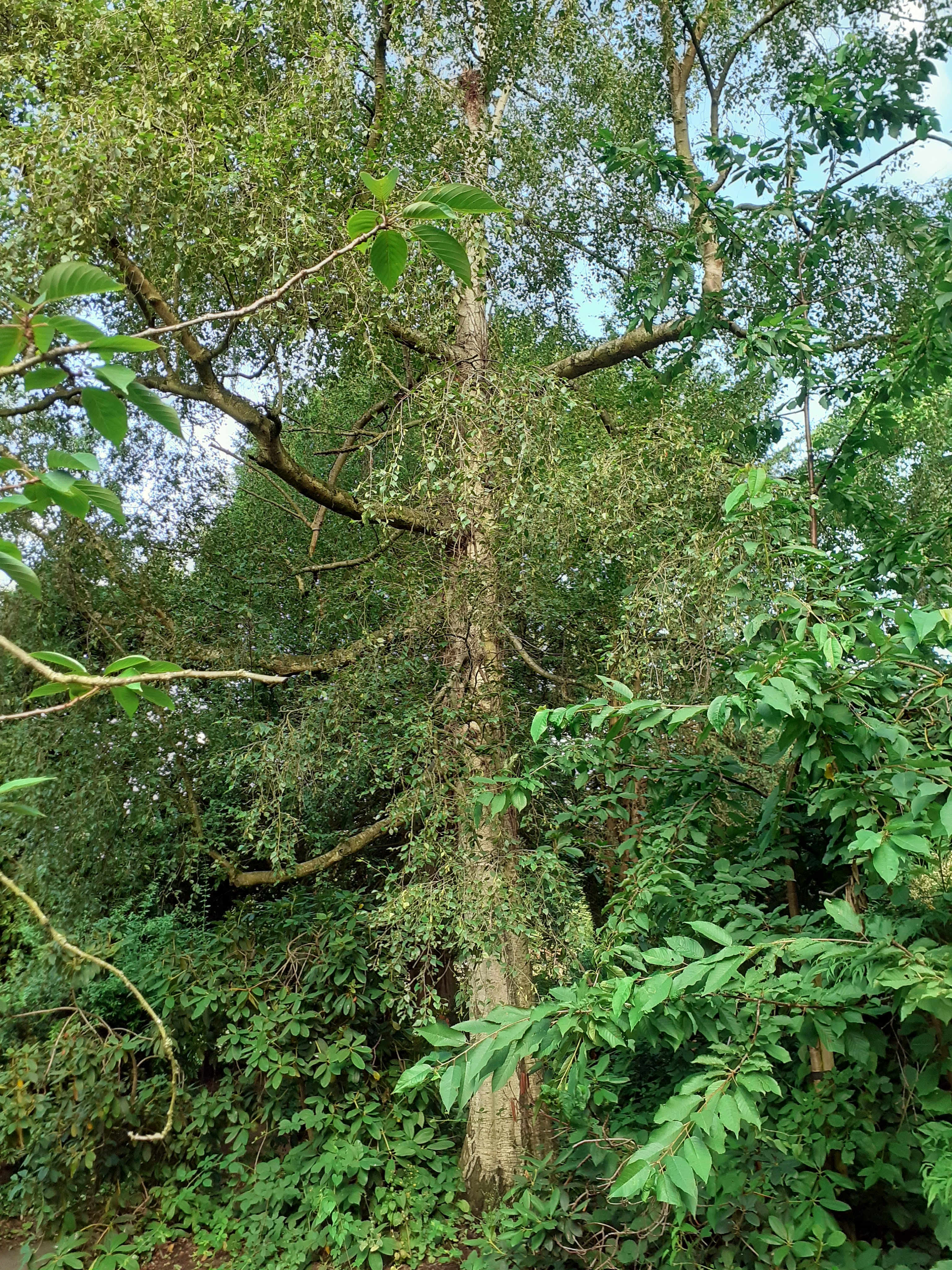
After establishing a sacred space, I was asked to begin a relationship with a spring and a tree. Stewart said: “we need to relate to such locations. This is a physical relationship first and foremost … we are one with the land, and trees, springs and caves are power points that tap into the energies of the land, and then reach into other dimensions altogether”. I found my spring quite easily (above). But there were almost too many trees to choose from, and I recall hesitating about my choice, to the point even of changing trees on my second or third visit. On my recent re-visit – woven into a rare family weekend in London – I found it easy to find the spring again but harder to remember my tree. I settled on the mature birch below, a good choice for a new, Goddess related undertaking (2). But I cannot vouch for it as my choice in 1992.

Sacred space (“the land talks back”), and befriending a spring and a tree: for me, these were the most powerful lessons from R. J. Stewart’s work. They were a helpful preparation for my later Druid training. I was very pleased to revisit this space in July 2023 and share it with family members.

(1) Streatham was in Surrey before becoming part of the County of London in 1889, and then Greater London in 1965. It began as a settlement around the old Roman road (Street Ham) from London to the south coast at Portslade, Brighton, the site a Roman port long lost to erosion. It appears in the Domesday Book of 1086 as Estreham. The village remained largely unchanged until the 18th century, when its natural springs, known as Streatham Wells, were first celebrated for their health-giving properties. The reputation of the spa, and improved turnpike roads, attracted wealthy city of London merchants to build their country residences in Streatham.

The Rookery began as a large private house with its own landscaped gardens. Much later, when the house and gardens were threatened with disposal and redevelopment, it was bought by public subscription and laid out as a formal open space, first opening to the general public in 1913. The Rookery is now one of the London Borough of Lambeth’s Green Flag Award-winning parks, directly managed by Streatham Common Cooperative (SCCoop), a local community-led enterprise.

(2) R. J. Stewart The Way of Merlin: The Prophet, The Goddess and the Land London: The Aquarian Press, 1991

APRIL AND ‘DRUID MINDFULNESS’

Where I live, April 2023 brings qualities and freshness and new growth. My heart meets the moment as I walk in the bracing breeze. Sunny and overcast periods succeed each other. Moving through this enlivening space, I naturally welcome the energy of change it embodies.

But it’s not quite that simple. There’s an underlying turbulence too, which can easily challenge my balance. Slogans like ‘I am the sky. Everything else is weather’ aren’t enough. I, as natural man, have to ground and embody them. They have be be aligned with my felt sense.

I wasn’t sure how to talk about this when I discovered that someone else had done it for me. Philip Carr-Gomm, who until recently led OBOD (Order of Bards, Ovates and Druids), offers a regular podcast: Tea with a Druid. No 249 is about ‘finding calm in chaos’. It is up on YouTube as: https://www.youtube.com/watch?v=Ew4pD3OJen8

Philip suggests that the best way to deal with chaos, turbulence, or the everyday stress of modern life, is to turn to the stillness inside. Then it becomes possible to stay in the moment whilst expecting nothing. It takes work to get there – to identify ways of finding stability and calm even when all around is unstable and unpredictable.

Philip understands modern Druidry as a tradition of ‘mindfulness in natural settings’, whether real or visualised. The stillness found in those settings isn’t a dead stillness but a living one – leaves rustle, waves crash. The refreshment is somewhat different from that of a more abstract meditation where we sit with thoughts and feelings, finding the space beyond. In the podcast, Philip takes us through a meditation of the kind he describes. I thoroughly recommend it to anyone, whether or not involved in Druidry.

Returning to my recent walk, and the record of it, I see branches, buds and sky. I remember the movement in the sky, and a slight quivering of the wood. Records have their limitations. The stillness wasn’t one of complete stasis, as it may appear below. My current response is complicated by the human gift of memory, which is not the original experience. I am also absorbing someone else’s input. I am in a completely different here and now. But I am held within an enlivened tranquility, not at all that of the ‘tranquiliser’, and this is certainly a wonderful resource. Gratitude to the culture that has enabled it.

INNERWORLD HARVESTING

The Innerworld has its own times and seasons. When I attune myself carefully, it speaks to me through images in the DruidCraft Tarot (1). Today (20 July) I encountered the 7 of Pentacles (above), with its image of winter harvest. A Druid, equipped with a golden sickle, takes mistletoe from a tree. Where is the wisdom here? What am I being told?

‘Take note of the obvious’ is an early thought. ‘Be willing to state it’. After ten years of contemplative inquiry, I am still anchored in Druidry. Yes: my practice forms are idiosyncratic and contemplatively inclined. Yes: my inquiry process is personal and self-directing. Yes: I continue to learn from other traditions and sources outside the traditions. But what I do comes out of an immersive OBOD training of many years and would not be the same without it. I continue to belong to the Order and identify with the modern Druid tradition. Being clear about this is a fruit of my inquiry.

The form of words that we know as the St. Patricks’ Prayer, alternatively as the Cry of the Deer, runs: “I arise today through the strength of heaven, light of sun, radiance of moon, splendour of fire, speed of lightning, swiftness of wind, depth of sea, stability of earth and firmness of rock”. In my own usage I think of ‘heaven’ simply as a sky or firmament word, majestically naturalistic. But my greatest sense of support comes from the words ‘stability of earth and firmness of rock’. The 7 of Pentacles Tarot image includes seven pentacle signs carved on to mossy rock. It is a strongly earth-related image. I feel grounded and affirmed by this powerfully Pagan imagery.

There is much more to be learned from the 7 of Pentacles image, but these obvious recognitions, easily taken for granted and thus overlooked, are a good place to start. They have allowed me to identify some fundamental understandings that my inquiry has provided, and to clarify its direction for the future.

(1) Philip and Stephanie Carr-Gomm The DruidCraft Tarot: Use the Magic of Wicca and Druidry to Guide Your Life London: Connections, 2004 (Illustrated by Will Worthington)

REFLECTIONS IN A PRIORY GARDEN

In my formative years, high summer presented me with a world of manicured green. Mown grass dominated both private and public spaces. Garden lawns, parks, tennis courts, cricket grounds, golf courses, bowling greens: all highly managed. Much water was lavished on their severely cropped verdure, given its enhanced tendency to dry up in hot weather.

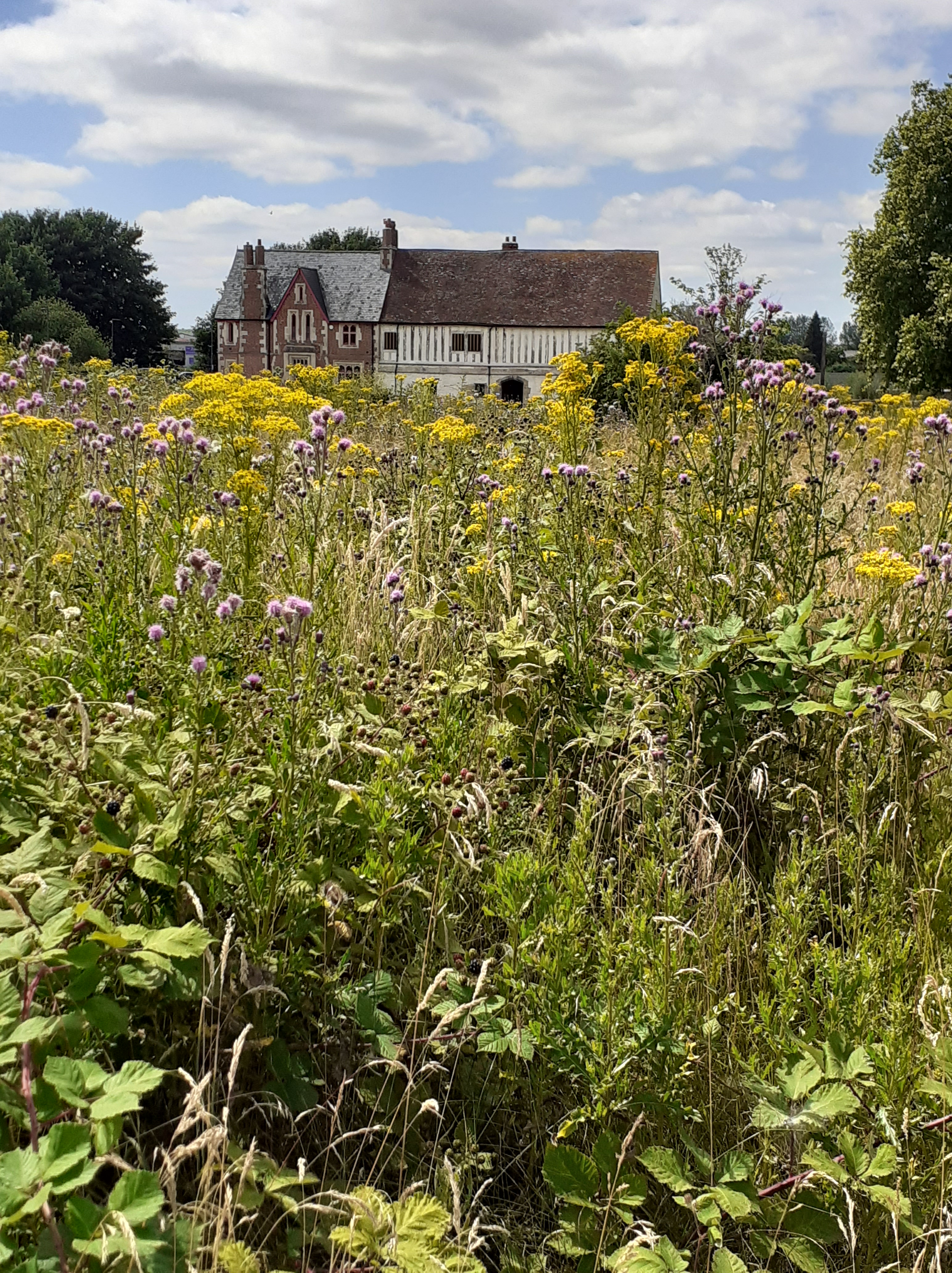
This is still happening, but fashions have changed to a degree. The photos above and below show the grounds of the Llanthony Secunda priory in Gloucester. In line with new custom, space is now given to a limited urban rewilding. I am inspired by this small miracle of growth and abundance.

This is an odd summer for me. I am at ease in a congenial place. My wife Elaine and I have moved house successfully. I have stabilised after a period of illness. But this is a transitional period. We are not at our destination, and anticipate more upheaval in the second half of the year. I am divided between here-and-now enjoyment of my surroundings, and concern over possible futures, strategising next steps and feeling the tensions of uncertainty.

In the ABOUT section of this blog, I write of “an underlying peace and at-homeness in the present moment, which, when experienced clearly and spaciously, nourishes and illuminates my life”. That statement is a fruit of my inquiry – it wasn’t there at the beginning. That is the nature of contemplative inquiry: my understanding changes over time, in line with deepening experience.

I am finding that my peace and at-homeness have room for both my day-to-day contentment and my anxiety about possible futures, personal and collective. I don’t strip out my ‘future’-based concerns (themselves part of my present time experience) to tidy up my mental and emotional states. That seems like a superficial understanding of here-and-now acceptance. I find, rather, an invitation to embrace the turbulence too, as part of what is given. The peace arising from innermost being makes room for turbulence, for such peace is not just another passing state. In some hard-to-understand way, it has the capacity to be infinitely spacious, and present in the flux of time and events. All I have to do is trust this peace and let it in.

I do not think of myself as a person of faith. I am more of a ‘philosophical’ Druid rather than a religious one, though I don’t believe that we have to choose between the two. But trusting the peace of innermost being is certainly, in part, a matter of faith, where ‘faith’ involves harmonising with my deepest intuition rather than signing up to statements of belief.

OBOD liturgy includes the words: “deep within my innermost being may I find peace”. This resonates powerfully with me, but I have recently let go of the word ‘my’, because ‘innermost being’ no longer feels exactly personal – it seems, experientially, to be more like being resourced from a timeless, unboundaried dimension from which I am not separate. This realisation, if it is a realisation, is now at the core of my spirituality. I am reluctant to make metaphysical truth claims about it, but it is firmly implanted in my experience. The opportunity, now, is to give it the freedom to grow, within my inquiry and my life.

TOWARDS ALBAN HEFIN: EVENING LIGHT, FLOWERING PLANTS

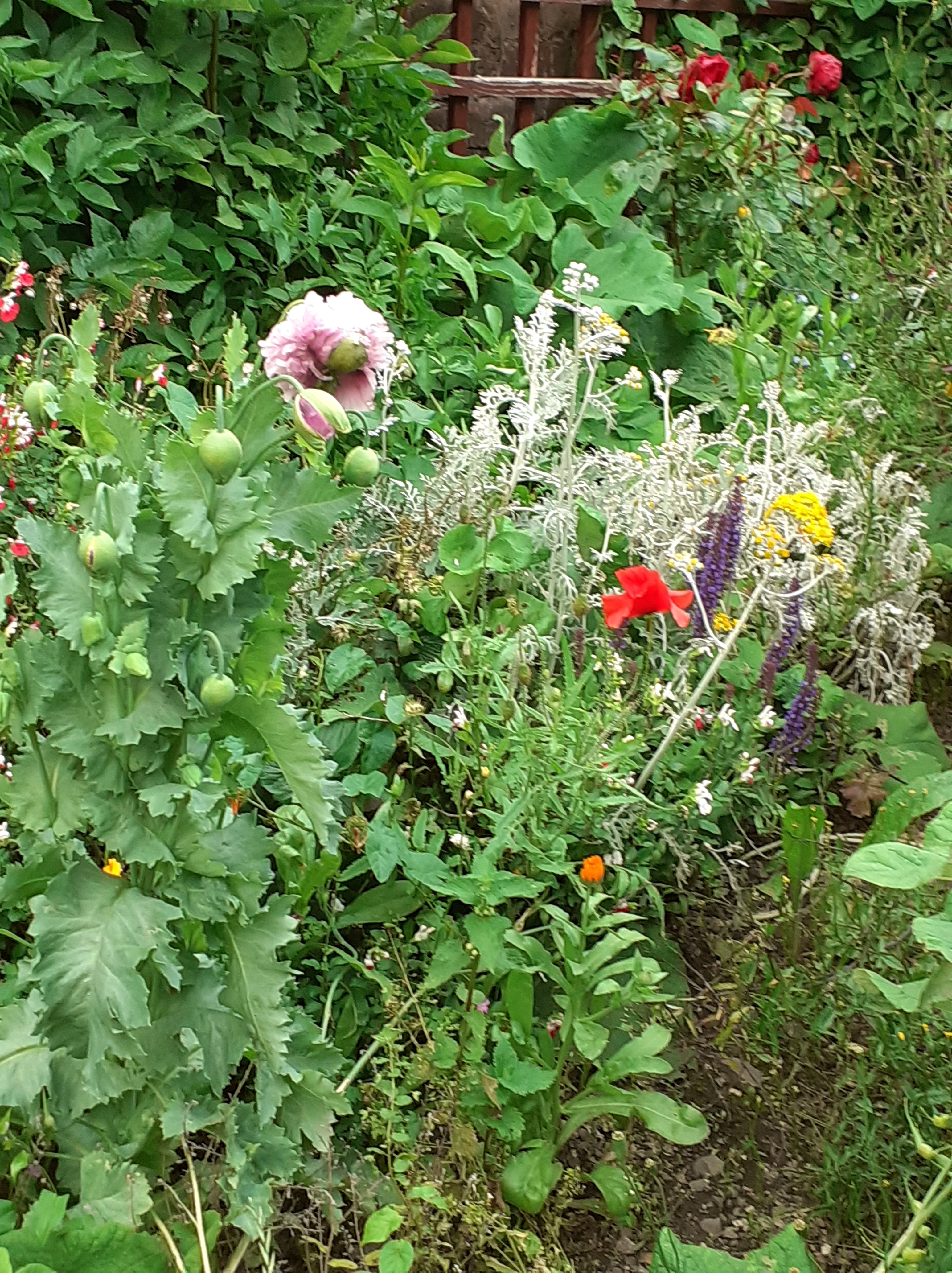
An evening walk on 10 June, around 7pm. We are approaching the summer solstice, Alban Hefin in OBOD Druidry. It is a late moment in the rising year. We are in a now familiar Georgian neighbourhood, where I often focus on sky and buildings. But here my attention is on the earth, and patches of green growth a little recessed from the kerbside. What draws me is a strong sense of light enabling life, relatively late in the day, touching the plants to ensure their thriving.

Flowering plants appeared quite late in this history of our planet, less than a hundred million years ago. Over time they helped to shape the habitat in which we have appeared and made our home. Seemingly fragile, they have, over time, exerted a tremendous collective power. It seems only right to honour them and recognise what they have done for us. May we preserve the habitat on which they and we depend.

Earth Eclectic

music that celebrates Earth and speaks to the heart

Sarah Fuhro Star-Flower Alchemy

Follow the Moon's Cycle

Muddy Feet

Meeting nature on nature's terms

Rosher.Net

A little bit of Mark Rosher in South Gloucestershire, England

Becoming Part of the Land

A monastic polytheist's and animist’s journal

selkiewife

Selkie Writing…

Charlotte Rodgers

Images and words set against a backdrop of outsider art.

Prof Jem Bendell

living with metacrisis and collapse

Towint

The pagan path. The Old Ways In New Times

The Druids Garden

Spiritual journeys in tending the living earth, permaculture, and nature-inspired arts

The Blog of Baphomet

a magickal dialogue between nature and culture

This Simple Life

The gentle art of living with less

Musings of a Scottish Hearth Druid and Heathen

Thoughts about living, loving and worshiping as an autistic Hearth Druid and Heathen. One woman's journey.

Wheel of the Year Blog

An place to read and share stories about the celtic seasonal festivals

Walking the Druid Path

Just another WordPress.com site

anima monday

Exploring our connection to the wider world

Grounded Space Focusing

Become more grounded and spacious with yourself and others, through your own body’s wisdom

The Earthbound Report

Good lives on our one planet

Hopeless Vendetta

News for the residents of Hopeless, Maine