Contemplative Inquiry

This blog is about contemplative inquiry

Tag: neo-Paganism

HOW PAGAN WAS MEDIEVAL BRITAIN?

How Pagan Was Medieval Britain? is the sixth and final lecture in Professor Ronald Hutton’s Gresham College series on early Pagan history in Britain (1). The simple answer, according to Hutton, is: not as much as was widely believed in the twentieth century, by scholars and the lay public alike. Some thought that full medieval Christianity was an upper class faith, with commoners, especially in the countryside, being ‘cheerful semi-Pagans’, Christian by day and following the old ways by night. Others thought that the two religions ran in parallel, with the latter being necessarily clandestine whilst some of its iconography was visible. Green Man and Sheela na Gig images, often present in the churches themselves, seemed to indicate the survival of a Pagan sensibility at the very least – canny concessions by the Church to the people. Witch persecutions were seen as evidence of an active, surviving woman centred nature religion. Indeed, such ideas influenced cultural and religious developments in the twentieth century itself – specifically, the rise of neo-Paganism; more broadly, the Feminist and Green movements that were dynamically emerging at the time.

However, turning to the medieval period itself, Hutton, does not find evidence of actually existing Pagan religion in the available sources. Witch trials have been carefully examined in recent years, and the victims don’t fit the profile. In Anglo-Saxon times, the legal codes and church councils stopped bothering to forbid Christian converts their old ways by 800 CE. The prohibitions reappeared in the tenth century, in relation to Viking settlers, but ceased again by 1030 CE. In the later middle ages there was serious concern over Christian heretics (Lollards) and some concern over ale-house cynics expressing anti-religious views. In medieval society people tended be nosy about other people’s business and there was social pressure to conform. There are court cases that draw on this kind of informal surveillance, but none concerned with Pagan religious practice. Hutton traces Sheela Na Gig images to the Church in France, saying that they had an anti-erotic intent. Likewise, Green Man, Wild Man and Jack in the Green figures have specific historical origins not concerned with any Pagan deity. Hutton quite reasonably offers no comment on their widely perceived role as archetypal images, because these are outside the remit of the empirical historian. His focus is on self-defined and organised Pagan religion during a specific period in Britain.

But it is true, according to Hutton, that the medieval church offered religious continuity in other ways. The veneration of saints, who were very diverse and numerous, allowed polytheist habits of mind to continue, especially in the realm of petitionary prayer. Individual saints might be local, or specialists in specific forms of help. For many people they seemed more approachable than the persons of the trinity. However in Britain there seem to have been no saints who had themselves once been gods*. Likewise Christians had holy wells, but they were different from the old Pagan ones, rather than the same ones repurposed. The temple of Sulis Minerva at Bath, for example, was left alone. Few temples or ancient religious sites became churches, even though Pope Gregory had recommended this approach when he sent his mission to Kent in 597 CE.

Church attendance was not compulsory in the middle ages. It is estimated that only around 50% of parishioners attended regularly, though they did turn up in much larger numbers for the major festivals. During these, ‘secular revelry’ was allowed, even encouraged, and the festivals raised a lot money for Parish churches, enabling them at times to abolish Parish rates. This widely beneficial outcome was seen as ‘cheating the Devil’. Even on normal days, the Church offered spectacle – with the mass, libations and incense. Local priests came from the people, didn’t have to be literate, and didn’t have to preach. That was done by specialist friars with notable performance skills, often very popular. Additionally, many people belonged to guilds linked to their churches, usually focused around a saint. There were lay religious guilds for both women and men, which had a variety of purposes, officered by their own lay members. Craft guilds performed plays at festival times. This form of Christian culture lasted in Britain until the middle of the sixteenth century, when the old church fragmented into a plurality of new ones over hard-fought time. Different kinds of Christian culture, generally even less Pagan friendly, emerged.

(1) https://www.gresham.ac.uk/watch-now/medieval-pagan/

* An exception would be the Gaelic speaking areas in Scotland and Brighid

BOOK REVIEW: THE TORCH OF BRIGHID

Highly recommended for anyone interested in Brighid, Celtic spirituality and the evolving culture of modern Paganism. In The Torch of Brighid, Erin Aurelia eloquently describes her flame tending path as a devotee of the Goddess Brighid. For her, this is a path of celebration, contemplation, creativity and deep personal change. Her book shares the fruits of a remarkable journey.

The author makes clear that she is not reconstructing a past Pagan practice. No such practice is known. She references a Christian history dating from 480 CE, where nuns maintained a sacred flame at Kildare in Ireland. This was documented as still in place in the later 12th century CE by Gerald of Wales in his History and Topography of Ireland. It was repressed by the English King Henry VIII – who also ruled Ireland – as part of his violent religious revolution of the 1530s and 40s. On 1 February 1993, flame tending was revived both by Catholic Brigantine sisters in Kildare by the neo-Pagan Daughters of the Flame in Vancouver, BC. Both groups were influenced by Gerald of Wales’ description.

Erin Aurelia has been a flame tender for 20 years. She began in the Daughters of the Flame and then founded her own Order, the Nigheanan Brigde Flametending Order, going on to lead it for eight years. The original model involved moving through cycles of twenty days, in which nineteen flame tenders take a day each to tend the flame, leaving the Goddess to take care of the twentieth. Erin found that she wanted an intensified practice and a closer fellowship with other Brighid devotees. During those years, she writes: “Brighid inspired me to develop guided meditations to use during vigils, seasonal feasts, and lunar phases”. Later came “the template for a whole new way to practice flame tending: the way that the flame tending cycle matches with the twenty letters of the traditional Irish tree ogham alphabet, in which each alphabet letter is denoted by a tree and infused with esoteric meaning”. She describes herself as “enthralled and excited” by this discovery, which lead on to daily communing with Brighid and a fuller development of her work.

She found the process transformative, and learned that “growth is not only made through obtaining wisdom, but by implementing it. And Brighid showed me that I can effectively implement it by embodying her own skills as Shaper, Healer, Seer, and Transformer. Through embodying her skills, I became empowered”. In the narrative of her own journey, Erin shows her willingness to innovate, take initiatives, lead when called to do so, and also step back from leadership. Her relationship with ancient culture is to be inspired by it without being bound by it. I see her as modelling the best of modern Pagan practice in these respects.

Erin provides extensive information on her flame tending vigils, and how to set them up. She shares prayers, meditations and path workings. She includes her unique approach to ogham work, and also her own way of working energetically with the traditional ‘three cauldrons’ (of warming, vocation and knowledge). She shares her ways of working through the four Irish fire festivals from Imbolc (1 Feb.) to Bealtaine (1 May} to Lughnasadh (1 Aug.) to Samhain (1 Nov.). She has an Imbolc advent practice centred around the four Sundays prior to Imbolc – because it starts the year in this tradition and is specifically dedicated to Brighid. Her book is a powerful addition to the growing literature about Brighid as a much loved Goddess.

IOLO MORGANWG: 3 RAYS OF AWEN

According to Kristoffer Hughes, the three ray symbol for Awen, as it appears today: “is mostly inspired by the efforts of one individual, a Welsh bard of the late eighteenth and early nineteenth centuries called Edward Williams, who took the bardic name of Iolo Morganwg*”.

Hughes goes on to tell us something of Iolo’s story: “I touch briefly on the Awen-filled story of this remarkable individual, for it sings loudly of the power of Awen to transform, not just an individual, but the future. His symbol for the Awen has become directly associated in Neopaganism with Cerridwen, making an exploration of his influence a valuable exercise in our understanding of Awen in the modern world.

“Iolo Morganwg was a stonemason from South Wales, an imaginative, poetic genius who made elaborate claims of ancient documents and wisdom that he had discovered and preserved for the world to see. Blighted by ill health, he was addicted to the narcotic laudanum for over fifty years of his life, spending most of his days in a drug-induced state, and yet poems in their thousands fell from his frenzied mind onto scraps of parchment. He composed elaborate poetry, inspired prose, but falsely claimed that some of the poems were written by ancient bards. … And yet through all of the accusations of forgery and deception, Iolo dreamed something into being that those in the different streams of Celtic spirituality today, both monotheistic and polytheistic, are descendants of. He dreamed a new mythology into being and planted seeds that would gestate a profound wisdom in the future.

“In a time of great social crisis, he dreamed an identity for the Welsh that took as its foundation that the bardic tradition of Wales was a direct line to the ancient Druids of Britain, who he perceived as the true ancestors of the Welsh. He longed for his people to connect to the might and power that the Romantic movement imagined the Druids to express. And, in doing so, he deliciously imagined a new identity that the Welsh could be proud of: he blended fact with fiction, legend with history, myth with reality. His bewildering array of notes and journals continue to baffle modern academics who strive to make sense of this enigmatic figure.”

Reflecting on Iolo’s story, Hughes concludes that, “in a profoundly logocentric world where new thoughts and ideas were expected to be substantiated by manuscripts, Iolo simply invented a past that we, as the Welsh, could be proud of . … He carried the seeds of Awen and profoundly influenced a future he could not have imagined. In the twenty-first century, those drawn to the Cerridwen and Taliesenic mysteries (2) who may artistically express, understand, or wear the symbol of the Awen all carry the dream of Iolo Morganwg. He is testament to the Awen’s consistent stream and how it too changed its countenance to meet the needs of different people at different times. The period he occupied was a cauldron of new ideas, with the new era of bardic tradition in its infancy and occult fascination among the learned of the time increasing in popularity”.

(1) Kristoffer Hughes Cerridwen: Celtic Goddess of Inspiration Woodbury, MN: Llewellyn Publications, 2021. See also my review at: https://contemplativeinquiry.blog/2021/03/26/book-review-cerridwen-celtic-goddess-of-inspiration/

(2) See also: John Matthews Taliesin: Shamanism and the Bardic Mysteries in Britain and Ireland London: Aquarian Press, 1991. It includes a complete English translation of the Hanes Taliesin (Story of Taliesin) and English translations of the major poems of Taliesin Pen Beirdd from The Book of Taliesin as well as other medieval Welsh and Irish material. In the Taliesin story, the three rays of Awen become three drops from the brew in Cerridwen’s cauldron).

*NOTE: Iolo Morganwg (=Ned of Glamorgan, his native county). In his own words, the Awen sign /|\ is “a symbol of God’s name from the beginning”. He goes on to say: “from the quality of this symbol proceed every form and sign of voice, and sound, and name, and condition”. It is when God pronounced his Name that “all the universe leapt together into existence of life, with the triumph of a song of joy. The same song was the first poem that was ever heard, and the sound of the song travelled as far as God and His existence are, and the way in which every other existence, springing in unity with Him, has travelled for ever and ever. And it sprang from inopportune nothing; that is to say, so sweetly and melodiously did God declare his name, that life vibrated through all existence, and through every existing materiality”. J. William Ab Ithel (editor) The Bardas of Iolo Morganwg: A Collection of Original Documents, Illustrative of the Theology, Wisdom, and Usages of the Bardo-Druidic System of the Isle of Britain Forgotten Books, 2007 http://www.forgottenbooks.org (First published 1862, from notes and journals left by Iolo on his death at 79 years of age in 1826).

BOOK REVIEW: SEEK TEACHINGS EVERYWHERE

This post is about Philip Carr-Gomm’s Seek Teachings Everywhere: Combining Druid Spirituality with Other Traditions. I highly recommend this book to anyone interested in the specific topic and/or the development of modern spiritual movements more generally.

Elegantly and accessibly presented, the book testifies both to a personal journey and a key role in developing modern British Druidry. Both the journey and the role are an interweaving of Pagan and Universalist threads. PCG’s approach has been to adopt Druidry as a ‘meta-path’, one able “to transcend religious distinctions”, and allowing of involvement in other paths as well. The Jain path, shared with his Druid mentor Ross Nichols, is the one given the greatest individual attention in the book, in a long section on Druidry and Dharmic traditions. This section touches also on other Indian derived movements and practices (Buddhism, Yoga Nidra) and speculates on ancient cultural and linguistic resonances between early Indian traditions and early European Druidry. PCG dedicates other sections of the book to Christianity and Wicca, with suggestions about how they too can harmonise with Druidry.

This overall approach is reflected in the lived culture of the Order of Bards, Ovates and Druids (OBOD), which PGC has led for thirty years. He is now in a process of stepping down from the role, and so the book is a timely account of both vision and legacy. He says: “each spiritual way has gifts to offer, and some people find in Druidry all the spiritual nourishment they need. Others combine their Druidry with other approaches, such as Wicca, Taoism, Christianity, Buddhism, Hinduism or Jainism”. OBOD’s ancestry as a movement derives from Celtic and Western Way currents within early twentieth century theosophy. The Order remains true to that heritage – as evidenced by a website that actively describes synergies with other paths and provides links to them – see www.druidry.org/ .

My personal takeaway from the book concerns PCG’s substantial presentation of Jain ethics, grounded in three key principles: ahimsa, aparigraha and anekant, here described as the Triple A. PCG explains: “Ahimsa is the doctrine of harmlessness or non-violence, made famous by Gandhi, and espoused by the other Dharmic traditions of Buddhism and Hinduism”. Aparigraha, the doctrine of non-attachment, non-possessiveness or non-acquisition, likewise appears in these other schools. Anekant, a doctrine of many-sidedness, multiple viewpoints, non-absolutism or non-one-sidedness, is unique to The Jains. The three principles can be seen as completing each other – with many-sidedness an aspect of non-violence and non-attachment, and so on.

PCG recommends these principles for our time. They inform his own vision of Druidry. “We know that the world suffers from too much conflict, too much fundamentalism, and too much consumption. This suffering can be alleviated by applying the Triple A doctrines: seeking non-violent solutions, respecting and learning from others’ opinions and beliefs, and reducing consumption to sustainable levels”. In the Jain tradition, such an approach to life is supported by practices of ritual and meditation that work towards the release of negative attachments. PCG recommends versions of these as well.

Part of the beauty of this book is that different readers will find different reasons to take note and learn from it. I have found it valuable both as an authoritative record of a current in modern Druidry, and as a personal inspiration.

Philip Carr-Gomm Seek Teachings Everywhere: Combining Druid Spirituality with Other Traditions Lewes, UK: Oak Tree Press, 2019 (Foreword by Peter Owen Jones)

ETHICS AND ‘CIVILIZATION’

In his Reclaiming Civilization (1), modern Pagan philosopher Brendan Myers asks three questions: What is civilization? What is wrong with it? What should we do about it? As part of his work with the third question, he looks at ethics. He starts with the proposition that a flourishing life is ethically desirable and good. This proposition may seem simple and obvious, yet it has not been a reliable quality of ‘civilization’ as we know and have known it.

Myers goes on to describe virtue ethics as the branch of philosophy that investigates character and identity. To live a flourishing happy life, we need to install ways of understanding, responding to, and acting in the world that will tend to support it. These are the virtues. Through the process of identifying and working with virtues, we reach towards the person we want to be and the world we want to live in. Myers implies a necessary inner work, when he speaks of “the possibility of a greater depth of life-experience that can appear when I am willing to let go of my illusions, willing to risk harm and despair, in pursuit of a more honest relationship with reality”. He then presents his own list, offering his virtues as ways of responding to three ‘immensities’: earth, interpersonal otherness, and solitude/death.

For earth, the virtues are “those ways of being in the world that enable you to look upon the earth, in all its beauty and danger yet feel no need to own it all, nor to destroy it … but to explore it, play with it, know it. Myers recommends “virtues of wonder: including imagination, creativity, open-mindedness, aesthetic taste, and curiosity”. He adds that this does not preclude practices such as farming but does call for them to be “conducted in careful (as in full-of-care), sustainable and co-operative ways”.

For interpersonal otherness, the virtues are “those ways of being that enable you to look upon your neighbor, however strange or different she may be, and feel no need to make her conform to your demands, nor a need to send her away (such as, to her death) … the virtues … enable you to see another earth, in a manner of speaking … your neighbor’s eyes are another way of looking upon the earth … you have another way of exploring it”. Here, Myers recommends “virtues of humanity” – care, courage, friendship, generosity and the “Seven Grandfathers of Wisdom, Truth, Humility, Bravery, Honesty, Love and Respect”.

For “the immensity of solitude, and of death”, the virtues are qualities that contradict any need to avoid solitude and death at “any cost, however destructive to yourself and others”. These, for Myers, are “virtues of integrity: including reason, consistency, dignity, Socratic wisdom, acknowledged vulnerability, forgiveness, mercy, the will to establish a legacy, and the will to let go”.

When I reviewed Reclaiming Civilization last year (2) I knew that I would want to return to it and examine its ethical approach more closely. What I like about this approach is that it avoids both a ‘follow your bliss’ vagueness and a rigid prescriptive system. It fits very well with my sense of a Sophian Way. It suggests principles and a method and then challenges us to develop our own list. Here, we have an ethics that asks for close attention, questioning and (I would suggest) a continuous work of understanding our chosen ‘virtues’ and checking them out in practice. For me, the notion of a flourishing life for ourselves and others has to extend to the biosphere. A purely human approach no longer serves even we humans ourselves. I also like an approach that (without being partisan) has political implications. It is not just an ethics for private life. Myers provides a tool for living the ‘good life’, and perhaps, identifying possible contributions to reclaiming (and re-framing) ‘civilization’ – the central theme of Myers’ book and the context for his ethical discussion.

(1) Brendan Myers Reclaiming Civilization: A Case for Optimism for the Future of Humanity Winchester, UK & Washington, USA: Moon Books, 2017

(2)  https://contemplativeinquiry.wordpress.com/2017/08/24/book-review-recl…ing-civilization/ ‎

SOPHIA SOURCE OF WISDOM

“The Holy Spirit of Wisdom as the guiding archetype of human evolution is one of the great images of universality. Transcending the limitations of any one religious belief, it is an image that embraces all human experience, inspiring trust in the capacity of the soul to find its way back to the source.  … To discover the root of the idea of Wisdom we have to go back once again to the Neolithic era, when the goddess was the image of the Whole, when life emerged from and was returned to her, and she was conceived as the door or gateway to a hidden dimension of being that was her womb, the eternal source and regenerator of life … the idea of Wisdom was always related in the pre-Christian world to the image of the goddess; Nammu and Inanna in Sumeria, Maat and Isis in Egypt, and Athena and Demeter in Greece. Even the passages in the Old Testament that describe Hokhmah, the Holy Spirit of Wisdom, powerfully evoke her lost image, though here the image is dissociated from the world.

“But as we move into the Christian era there is a profound shift in archetypal imagery as Wisdom becomes associated with Christ as Logos, the Word of God, and the whole relationship between Wisdom and the Goddess is lost. Now, the archetypal feminine is finally deleted from the divine, and the Christian image of the deity as a trinity of Father, Son and Holy Spirit becomes wholly identified with the masculine archetype. … This theological development effectively erased the ancient relationship between Wisdom and the image of the goddess. Gnostic Christianity, however, retained the older tradition and the image of Sophia as the embodiment of Wisdom survived. Here she was the Great Mother, the consort and counterpart of the God head. When the Gnostic sects were repressed by the edicts of the Emperor Constantine in AD 326 and 333, the image of Sophia as the embodiment of Wisdom was again lost. However, after an interlude of several hundred years, it reappeared in the Middle Ages, in the great surge of devotion to the Virgin Mary and the pilgrimages to the shrines of the Black Virgin … then, in the sudden manifestation of the Order of the Knights Templar, the Grail legends, alchemy, the troubadours and the Cathar Church of the Holy Spirit, Sophia, or Sapientia, as the image of Wisdom, became the inspiration, guide and goal of a spiritual quest of overwhelming numinosity.” (1)

I am committed to a Sophian Way. My view and practice are largely settled. I have worked, studied and sometimes simply surrendered over a long period, exploring methods and movements and gaining insights from them. That phase is done. On several occasions now, the phrase ‘it’s over’ has flashed into my mind, imprinting itself with the force of command. A quest is fulfilled. I know how best to maintain (to use my own language) a sense of At-Homeness, a living ‘not-I-not-other-than-I’ interconnectedness with the Divine. With this, my contemplative inquiry has reached the high-water mark of ‘contemplative’. It is therefore set to become a contemplation-and-action inquiry, in which I will, among other things, look at my understanding of ‘action’ at this time in my life.

One concern, given this confirmation of personal path, is the question of affiliation, and of social identity in the spiritual domain. How do I place myself in culture and community? Merely to name a ‘Sophian Way’ is an invocation of sorts, yet I am neither a Christian nor a Gnostic in the sense of the old movements. My valuing of a wisdom text like the Gospel of Thomas is on a par with my valuation of texts from other traditions – the Prajnaparamita Heart Sutra, the Tao Te Ching, or Rumi’s poetry. I don’t have a category called ‘scripture’. I value the concept of gnosis, especially as defined by Baring and Cashford: “knowledge in the sense of insight or understanding, which requires participation not merely of the intellect but of the whole being. It is knowledge discovered with the intuition – the eye of the heart – which has no need of the intermediary of a priesthood”. But people in many spiritual movements would stand by this definition, and I have limited resonance with the specific frameworks of the ancient and medieval movements that we call Gnostic.

I have talked recently about being ‘spiritual but not religious’, but this now feels somehow weak and lacking in content. My sense is that both words have lost precise definition in the English language. Thinking of my commitment, and conscious of the Baring and Cashford passage above, I feel Pagan, and still held within modern Paganism. Baring and Cashford describe a twelfth century image of Mary in her Sophia aspect at an Oxfordshire church. It is in a Christian setting but for me works most powerfully with a Pagan understanding. She is “seated on a lion throne, as were all the goddesses before her. The divine child is held on her lap and her right hand holds the root of the flower, which blossoms as the lily, disclosing that she is the root of all things. The dove, for so many thousand years the principal emblem of the goddess, rests on the lily, and a stylized meander frames the right-hand side of the scene. All these images relate the medieval figure of Sophia to the older images of the goddess, which reach back into the Neolithic past. But in her the goddess is given a specific emphasis, which offers an image of wisdom as the highest quality of the soul, and suggests that, evolving from root to flower, the soul can ultimately blossom as the lily and, understanding all things, soar like a bird between the dimensions of earth and heaven. Nor is this Christian image unrelated to that of the shaman lying in trance in the cave of Lascaux, for there, also, the bird mask he wears and the bird resting on his staff symbolize the flight his flight into another dimension of consciousness”.

From about the twelfth century, people in the West have increasingly made themselves creators of their own mythology (2), at an increasing rate. As a modern Pagan I know this and respond to the challenge. As a modern Pagan I can honour the tree of life, which is also the tree of knowledge, one tree, the Goddess’s tree, from root to crown. I can be At Home.

(1) Anne Baring & Jules Cashford Sophia, Mother, Daughter and Bride, Chapter 15 in The Myth of the Goddess: Evolution of an Image London” Arkana Penguin Books, 1993

(1) Joseph Campbell The Masks of God: Creative Mythology Harmondsworth: Penguin, 1976 (First edition published 1968 in New York by the Viking Press. Creative Mythology is fourth in a series of The Mask of God)

VIRTUES AND VOWS

Pagan philosopher Brendan Myers describes virtue ethics as the branch of philosophy that investigates character and identity (1). To live a fulfilling and happy life, we need to install ways of understanding and being in the world that support our aim: these are the virtues. Specifically, he talks about the virtues of wonder, such as open-mindedness, curiosity, creativity; the virtues of humanity, such as care, courage, respect and generosity; and the virtues of integrity, like reason, acknowledged vulnerability, forgiveness and the will to let go.

The approach of the Buddhist inspired Center for Mindful Self-Compassion – https://centerformsc.org/ – is remarkably similar. The Center teaches a process for identifying “core values”, where we ask ourselves what values we embody that give our life meaning. Center suggestions resemble those of Brendan Myers, and include compassion, generosity, honesty, courage, family, loyalty, service, curiosity and nature. The designers of my Four Noble Truths course – https://learn.tricycle.org/ – are on a similar track. Stephen Batchelor says: “Buddha’s vision was centrally ethical. I’m not referring to the moral precepts here”, but rather a way of life in which “you try to become the person you aspire to be and try to create a world that you aspire to live in”. He says more about this in a series of podcasts taken from a seminar sponsored by the Western Chan Fellowship in Bristol, England on 4 March 2017 and available on YouTube.

I’ve been prompted to look again at my MSC course in June/July of this year. I found the work on vows very valuable and wrote about it in a blog post at the time – https://contemplativeinquiry.wordpress.com/2017/07/26/making-personal-vows/ . I have developed them a little more. I continue to find the process of identifying core values very helpful. But in all cases I went straight to a ‘doing’ statement. I didn’t isolate nouns that nominate virtues. These, even words like love, courage and wisdom, can seem both static and vague. These are the vows:

  • May I honour and enjoy the gift of life – through sensation, feeling, thinking, and intuition
  • May I be loving and compassionate towards myself and others
  • May I experience abundance in simplicity
  • May I work for the welfare of all beings, using the loving forces that work from individual to individual, as well as supporting larger projects

In terms of organized spiritual movements, I find myself in a debatable zone between neo-Paganism and modern Buddhism. It’s just as well that both traditions have open borders, able to accommodate people who are not signed up. The four vows to myself are the product of multiple influences, as well as my inner sense of direction.  The first owes much both to C. G. Jung and to modern Druidry (especially OBOD – www.druidry.org -); the second to the Buddhist tradition; the third and fourth to all the above. In the last vow, I owe the piece about ‘using the loving forces that work from individual to individual’ to the late C19th/early C20th American psychologist William James at a time when he was fed up with public life.

These vows are a work in progress, and will guide me in my inquiry going forward.

(1). Brendan Myers Reclaiming Civilization: a case for optimism for the future of humanity Winchester, UK & Washington, USA: Moon Books, 2017 See also https://contemplativeinquiry.wordpress.com/2017/08/24/book-review-reclaiming-civilization/


BOOK REVIEW: RECLAIMING CIVILIZATION

Publication date 25 August 2017. Highly recommended. Contemporary Pagan philosopher Brendan Myers offers a nuanced and reflective discussion of civilization, its evident dysfunction, and how to respond. Overall, he takes the view that: “civilization is not an unambiguously good thing. The ‘shining city on a hill’ is a mirage. It lessens the suffering of one group by entrenching the suffering of others; and it promises things to the protected and privileged that it can never entirely deliver. Nevertheless, civilization may yet be a salvageable enterprise”.

Reclaiming Civilization: a case for optimism for the future of humanity is a study of the sacred, from a socio-political perspective. The book is presented musically, with an overture leading on to three movements punctuated by interludes. The overture – a ‘meditation upon a lake’ begins with a personal question: ‘why should I return to the city?’ given that this entails going back to debts, responsibilities and ‘absurdities’.

These absurdities go well beyond the personal level. they include: modern working and consumerist lifestyles; rampant economic inequalities; double-speak in politics and religion; a pervasive sense of alienation and division; war and the effects of war; and the accelerating effects of climate change. So Myers’s first, personal, question leads on to three other, general ones: what is civilization? what’s wrong with civilization? What, if anything, should be done for civilization? These questions are explored in the three movements that follow.

To answer the first, Myers looks at human innovations like fixed houses, settled farming and the domestication of animals, and the subsequent appearance of cities and their walls – designed to keep some people out and other people in. He suggests that ‘civilization’ has been a long experiment by which we resolve what it means to be human “not by discovery, but by invention”. Civilized people are those whose qualities are their civilization’s virtues. Myers calls civilization humanity’s ‘most metaphysical project’ – humanity ‘realizing itself’ (for some people) by living up to a ‘civilized’ ideal.

The second, ‘what’s wrong’, question identifies the intensification of social hierarchy and domination with increasing economic surplus overall. Myers discusses the accompanying ideology in terms of “illusions which exalt us” (i.e. those of us who are ‘winners’). These include: the permanent self; notions of ‘higher’ and ‘lower’ men and of the virtuous prince; the devious enemy; the self-made man; a human birthright of dominion over the earth. In part, such illusions enable exploitation with an easy conscience. More deeply, they help to fend off nihilism and despair – themselves not an “existential condition of human life” but “a feature of reason and rationality”. There has been something essentially distressed about civilization as a project. Its distortions aren’t just accidents or mistakes.

Myers’ response to the third question (‘what should be done’) makes political suggestions, supported by the author’s ethical lens. Virtue ethics is the branch of philosophy that investigates character and identity. To live a fulfilling and happy life, according to Myers, we need to install ways of being in the world that support this aim: these are the virtues. For Myers, we develop virtues in the face of existential ‘immensities’. Awakening to the earth, we respond with the virtues of wonder – and take a stance of open-mindedness, curiosity and creativity. Awakening to people and relationship, we respond with humanity – with care, courage, respect and generosity. Awakening to solitude and the certainty of death, we respond with integrity – reason, acknowledged vulnerability, forgiveness and the will to let go.

Myers is encouraged by what he calls four lamps:

  1. Human nature is malleable – so culture and society can and do change.
  2. Empathy, co-operation and compassion are among the qualities that are embedded in our species and have helped to build civilization so far.
  3. Casting away illusions is hard, yet on the other side of despair lies a greater depth and life.
  4. We are already doing most of the things we need to do.

Reclaiming Civilization is a valuable addition to our literature. If the above account has stimulated any interest in the questions, I recommend getting the book. The issues are more fully explored, and Myers also shares something of his personal journey, especially in the Interludes.

Brendan Myers Reclaiming Civilization: a case for optimism for the future of humanity Winchester, UK & Washington, USA: Moon Books, 2017

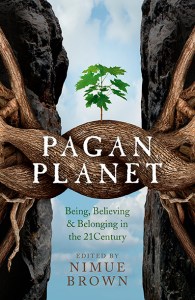
BOOK REVIEW: PAGAN PLANET

jhp55ddc04c930d1“For this reason I am doing what I do, working towards …. the more beautiful world our hearts know is possible”. Simon Wakefield is a biologist, Druid and contributor to Pagan Planet: Being, Believing and Belonging in the 21st Century. He talks about the “most profound experience of my life” when observing a nesting sea turtle on a starlit Greek beach. “Putting aside all the requirements to measure and monitor I decided just to be present, and I opened up to an experience of deep time and an ancient longing by another creature simply to be, to express its uniqueness, which has never left me”.

For me, Simon has expressed a point of unity in this diverse collection of essays edited by Nimue Brown and published by Moon Books. The authors come from a variety of Pagan traditions, though with a tilt towards Druidry. Many stand witness to a growing movement of Pagan activism, where people find themselves involved in the demanding, draining and potentially perilous work of resistance, protection and defence. The value of Simon’s words (which he attributes originally to Charles Eisenstein) is to keep an eye on the prize: “the more beautiful world our hearts know is possible”. Beauty, of course, depends on our ability to perceive, name and cherish it. Reading the essays in Pagan Planet, I come away with a sense of this as a unifying Pagan commitment.

What moves me most, I think, is an overall sense of resilience and optimism – not so much an optimism of calculation as an optimism of the heart. In his piece about the foundation of PaganAid, Ian Chandler says: “I have heard people’s stories that make me cry, I have seen destruction that has brought me to my knees with despair. But I have also met people whose dedication against all odds fills me with awe. I have seen achievements that make me want to sing and dance in the street. Now is not the time for us to give up on the future – it is time for us to decide what we want and to make that future happen”. Edwina Hodkinson talks about the frontline herbalism of the Wild Sistas in anti-fracking protection camps. “We dispensed tinctures, teas, creams, cough syrups, health advice, general nurturing and lots of first aid. Protectors who had been injured from interaction with the police wanted treatment for badly bruised ribs and groins, sprained wrists, and grazes … people had great faith in what we did, compliance was good and the results of the herbs spectacular … I’ve come to believe that when we go out of our comfort zones and are prepared to make some kind of sacrifice for ourselves and the earth, the earth responds and works with us”. One of their successes was the ‘warrior drops’ created to deal with trauma, stress and anger on the front line. “Protectors said that these really made a difference in calming them down” and one said “it grounded him and reminded him why he was doing the protest”.

A number of the essays stand witness to the creative energy of Pagan vision and life practice at this moment in history. These include Lorna Smithers’ visionary evocation of Castle Hill, Penwortham, described as “a magical place, in spite of the damage”, whose “alternative story” has been passed on “by its spirits, by decree of the fay king”. Hearth Moon Rising says that “my vision for some time has been to ground modern witchcraft more completely and more concretely in the natural world, to create a deeper understanding of what it means to have an animistic practice”.  Other people are exploring roads less travelled, like Laura Perry in Walking the Modern Minoan Path or Calantirniel in Working with Tolkien, where part of the purpose is to integrate the “Christ energy” into a Pagan path. Irisanya from the Reclaiming tradition offers a piece on Lifestyle/Work/Relationships which is centred on overlapping considerations of gender and peer communication and the magic of knowing how to track the energy in a conversation, when to listen, when to speak up and how to be supportive of voices that are not being heard. There are a number of pieces about the family context, including supporting dependent elders and raising children. In The Teachings of Children, Romany Rivers reports that people ask her whether her spirituality affects her parenting; her view is that it’s the other way round – her parenting affects her spirituality. “I realised how one small person’s emotional state can impact an entire environment. I have learned more about Reiki from working with my children during times of pain and stress, peace and snuggles. I have discovered new reasons to meditate. I have reconnected with the power of imagination. I have found new creative expressions”. She concludes, “I believe that is my children who are Pagan, and it is they who raise me.”

There is much more. I’ve got a piece called Living Presence in a Field of Living Presence: Practicing Contemplative Druidry. I would certainly have thought of it as supporting “the more beautiful world that our hearts know is possible” at the levels of perception, recognition and cherishing. But I didn’t think of it, and have only done so now as a result of reading the rest of this book: the value of community! Because of my involvement, I’m not going to review the book outside this blog or award points. I hope instead that I’ve been able to demonstrate something of its energy, diversity and commitment – and that the Modern Pagan movement from which it comes.


Nimue Brown (ed.) Pagan Planet: Being, Believing & Belonging in the 21st Century Moon Books, 2016

SOPHIA, GNOSTICISM AND CONTEMPLATION

When I wrote Contemplative Druidry I said that “in many ways this is a story of neo-Pagan sensibility and its growth since World War Two”. In addition to their Druidry, many of the book’s contributors reported involvement in Witchcraft and/or the indigenous Shamanism of other lands.

I also said in many cases this sensibility was modified by other influences, “most notably Buddhist philosophy and meditation, Christian mysticism and other Western Way paths with Gnostic and Hermetic traditions specifically mentioned”. I made the point that such influences are significant for contemplative practice, because to an extent they provide models. In the book I mostly focused on Buddhist influences, because they were the most common. I also paid  attention to the Christian ones, notably the Ceile De, Anglican mysticism in the tradition of Evelyn Underhill, and the partly Franciscan inspiration behind the (Druid and Pagan) Order of the Sacred Nemeton. I didn’t say much about other Western Way traditions, though I mentioned R. J. Stewart as a personal influence on me and also my training at the London Transpersonal Centre. This was essentially Jungian and thus based on a modern Gnostic psychology.

The key images from my last post, Sailing to Byzantium, were images of Sophia and the Holy Fool from The Byzantine Tarot. They made an intense and (in common sense terms) disproportionate impact on me. For they reminded me of my own Gnosticism, a current that qualifies and modifies my Druidry. I am talking about modern Gnosticism, “based in an affirmation of nature and the world and a positive relationship to embodiment, not the classical Gnosticism of world-denial or pure transcendentalism.  It is a gnosis based on bringing the world fully to life, while also enjoying the state of embodiment and sensual pleasure, without excess or obsessive appetite”*.  Thus far, I could be talking about modern Druidry without any need to look elsewhere.

But, to follow Irwin further, Gnosticism also talks of “visionary awakening” through the power of archetypal imagery. From such a perspective, affirmation of the world also requires an affirmation of the World-Soul as “the primary ground of a living and animate nature”. This can inspire “states of unity and participation in the creative founding of human experience”. The key is the “animating vitality” of images, which can arouse “a cascade of energy and potential surpassing the image and leading into a more luminous condition of being and seeing”.

According to Irwin, the traditional fields for study and practice in Western Gnosticism are neo-Platonism, hermetics, alchemy, kabbalah, mystical theology, comparative theology and meditative disciplines: quite a curriculum. But the essence is quite simple. We are invited to work with Being as embodied (through exercise, body awareness and energy work), imaginal (connected to the mundus imaginalis, open to its power) and illuminated (through contemplative practice and insight).  Much of this is offered within Druidry – for example, to anyone who takes full advantage of the OBOD distance learning course. Yet for me, here and now, once again, it is the image and name of Sophia that gives me my orientation and guides me on my path. I’ll explain that resonance and consequences more fully in later posts. In practical terms, for now, I’ve made two small adjustments in my morning practice. One is to cast my circle specifically in the sacred grove of Sophia. The other is to begin sitting meditation, or contemplative communion, by saying “I open my heart to the Light of Sophia”. It doesn’t seem much, but it shifts my centre of gravity to a place where a feel more empowered and more at home.

  • Irwin, Lee Gnostic Tarot: Mandalas for Spiritual Transformation York Beach, ME, USA, 1998 (There is no pack of cards with this book. It’s a set of interpretations emphasising “spiritual transformation and illumined states of awareness”. The Universal Waite Deck and the Ravenswood Tarot Deck have been used as points of reference.)
Earth Eclectic

music that celebrates Earth and speaks to the heart

Sarah Fuhro Star-Flower Alchemy

Follow the Moon's Cycle

Muddy Feet

Meeting nature on nature's terms

Rosher.Net

A little bit of Mark Rosher in South Gloucestershire, England

Becoming Part of the Land

A monastic polytheist's and animist’s journal

selkiewife

Selkie Writing…

Charlotte Rodgers

Images and words set against a backdrop of outsider art.

Prof Jem Bendell

living with metacrisis and collapse

Towint

The pagan path. The Old Ways In New Times

The Druids Garden

Spiritual journeys in tending the living earth, permaculture, and nature-inspired arts

The Blog of Baphomet

a magickal dialogue between nature and culture

This Simple Life

The gentle art of living with less

Musings of a Scottish Hearth Druid and Heathen

Thoughts about living, loving and worshiping as an autistic Hearth Druid and Heathen. One woman's journey.

Wheel of the Year Blog

An place to read and share stories about the celtic seasonal festivals

Walking the Druid Path

Just another WordPress.com site

anima monday

Exploring our connection to the wider world

Grounded Space Focusing

Become more grounded and spacious with yourself and others, through your own body’s wisdom

The Earthbound Report

Good lives on our one planet

Hopeless Vendetta

News for the residents of Hopeless, Maine