Contemplative Inquiry

This blog is about contemplative inquiry

Tag: Nature

POEM: A POSTCARD FROM ICELAND

As I dipped to test the stream some yards away

From a hot spring, I could hear nothing

But the whole mud-slick muttering and boiling.

And then my guide behind me saying,

‘Lukewarm. And I think you’d want to know

That luk was an old Icelandic word for hand.’

And you would want to know (but you know already)

How usual that waft and pressure felt

When the inner palm of water found my palm.

In Seamus Heaney, The Haw Lantern London: Faber & Faber, 1987

NATURE ALIVE

“A cry went through late antiquity: ‘Great Pan is dead!’. Plutarch reported it in his On the failure of the oracles, yet the saying has itself become oracular, meaning many things to many people in many ages. One thing was announced: nature had become deprived of its creative voice. It was no longer an independent voice of generativity. What had had soul, lost it: or lost was the psychic connection with nature.

“With Pan dead, so to was Echo; we could no longer capture consciousness through reflecting within our instincts. They had lost their light and fell easily into asceticism, following sheepishly without instinctual rebellion their new shepherd, Christ, with his new means of management. Nature no longer spoke to us – or we could no longer hear. The person of Pan the mediator, like an ether who invisibly enveloped all natural things with personal meaning, with brightness, had vanished. Stones became only stones – trees, trees; things, places and animals no longer were this god or that, but became ‘symbols’, or were said to ‘belong’ to one god or another.

“When Pan is alive then nature is too and it is filled with gods, so that the owl’s hoot is Athena and the mollusc on the shore is Aphrodite. These bits of nature are not merely attributes or belongings. They are gods in their biological forms. And where better to find the gods than in the things, places and animals that they inhabit, and how better to participate in them through their concrete, natural presentations. Whatever was eaten, smelled, walked upon or watched, all were sensuous presences of archetypal significance.” (1)

The above is an extract from a piece by James Hillman, one time director of studies at the Jung Institute in Zurich. Hillman later went on to develop his own variant form of archetypal psychology. Here he is a strong proponent of panpsychism, a world view very similar to the forms of animism being articulated today. Panpsychism literally means the ensoulment of everything (from the Greek), though the word ‘pan’ also cues in a reference to the Roman god of that name. I find his approach both passionate and liberating as a stance to take towards ‘nature alive’.

(1) Hillman, James (1989) The essential James Hillman: a blue fire London: Routledge (Introduced and edited by Thomas Moore in collaboration with the author)

THE SOUND OF SILENCE: MASS EXTINCTION AD THE MUSIC OF THE WORLD

Dana's avatarThe Druid's Garden

I recently came across an article from The Guardian in 2012 detailing the work of scientist Bernie Krause, who has spent his life recording sounds of nature. Krause’s major finding is simple: the loss of biodiversity, from the depths of the reefs to the rain forests, can be clearly tracked by listening to audio recordings over a 40-year period. He reports that he now hears deafening silence in so many ecosystems that once teemed with life. The article detailed his book, The Great Animal Orchestra. I bought the book, compelled to read more, the cryptic words of Simon and Garfunkle’s Sound of Silence echoing in my ears. This blog post is a bit different than some of my others, in that it is simply a response, a real and human response, to the growing sound of silence upon our landscape.

In restless dreams I walked alone
Narrow streets of…

View original post 1,185 more words

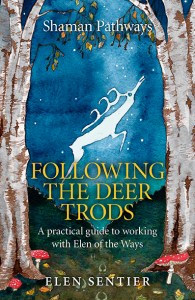
BOOK REVIEW: FOLLOWING THE DEER TRODS

jhp5423fc87b679cThe full title of this book is Following the Deer Trods: a practical guide to working with Elen of the Ways. It is written as part of Moon Book’s Shaman Pathways series, and is positioned as a stand-alone introduction to its topic, which includes working methods for the aspiring practitioner. As such this book certainly meets its criteria.

I personally think it works best in tandem with Elen Sentier’s other book on the topic, also a Shaman Pathways book, Elen of the Ways; following the deer trods – the ancient Shamanism of Britain, which I reviewed in July 2014. This earlier book establishes the overall context much better and for me they belong together.

Following the Deer Trods begins with a summary of the ideas offered in Elen of the Ways. This works well, even magically, in the opening pages – but I was saddened by a seeming loss of perspective when we get to the Romans and beyond. The author shows no recognition of Christianity as a diverse, complex and internally contested path, not least in the Celtic lands; or of the effects which holding political power can have on religious traditions, regardless of the actual faith. There’s also no clear flagging of the extent to which the positive, Pagan side of the story is necessarily reliant on intuitive reconstruction, relevant records being sparse and problematic, oral traditions highly mutable over time, and material remains providing only limited insight into hearts and minds. There is so much we don’t know, and will never know, about our ancestors, their traditions and what it was like to be them. When talking about them, we do best to avoid the language of certainty.

For me the book picks up from that point, providing the promised guide to working in a series of well-organised practice chapters. The main areas covered (in my language) are meditation, energy work, service, shamanic journeying, relationships with familiar spirits (power animals), and working with trickster figures. The author also discusses the ‘journey horse’ or method of trance induction – and the relative merits for this purpose of drumming, the sound of waves, rain, or a flowing stream; the steady roaring of wind; the recorded purring of cats. That bit of the discussion is a true gem, reflecting a lot of playful trial and experience.

These chapters also lay out a basic cosmology for the work – a cosmology of three worlds (middle, lower, and upper) on the vertical axis and four elements radiating out from the middle world on the horizontal, with the nigh universal notion of the world tree/tree of life very much in mind. Elen describes the image of the six armed cross as a means of bringing them together. She talks about her understanding of the inner world of the journey as a place of ‘interface’, the portal which she, as awenydd, and the Otherworld co-create as a meeting place between them.

The instructions for practice are highly specific and directive and therefore best-suited to people who are new to this kind of work, who don’t have access to hands-on teaching or established learning communities, and who need nonetheless to be strongly held as they begin their exploration. Other readers will look to the offerings provided as a source of new or variant ideas, or information about a specific way of working.

My heart didn’t sing, when I read this book, as it had when I read its predecessor. But it makes its contribution and, with the one significant reservation about the presentation of history, I’m happy to recommend it.

POEM: WOLF VOICE

Happy New Year to all readers of this post! My very best wishes for 2015. I offer a poem by Martin Pallot, a wolf’s life-world in the northern winter.

Martin is my fourth poet from the collection ‘Moon Poets: Six Pagan poets’ published by Moon Books and edited by Trevor Greenfield. Martin has been writing poetry since the early 1980s, mainly inspired by Nature and his pagan beliefs. He admires the early poets and story tellers and the way they engaged the ear, as well as the mind of their audience, and encourages people to say his poetry as well as just reading it. The collection as a whole also includes work by Tiffany Chaney, Lorna Smithers, Robin Herne, Romany Rivers and Beverley Price.

Wolf Voice

Wolf, howling to the moon,

The wind hears your words,

The earth feels your voice,

Sending out your spirit sound,

Calling to the great She wolf

Who shakes the stars from her fur.

Loping in the light of her one great eye,

Silver, shadowing the pack path,

Snow, scented by the passing prey,

Guides you on your killing way.

The trackless whiteness,

Sculpted by spirits of the air,

Into shape of deer and bison.

These insubstantial ghosts,

A pulsating presence in your

Preternatural eye.

When the kill is made,

The pack song rises,

To thank the She Wolf

For her gift of life,

To the den of generations.

And the moon,

Resting on a bed

Of winter branches,

Smiles, to hear

The voice of Wolf.

NATURE LANGUAGE

Philip Carr-Gomm wrote an essay, Deep Peace of the Quiet Earth: the Nature Mysticism of Druidry, as his foreword to Contemplative Druidry (1). Emma Restall Orr talked about her own nature mysticism in a recent radio interview, published on Joanna Vander Hoeven’s Down the Forest Path blog (2). Last year Thich Nhat Hanh, the Vietnamese Buddhist scholar and teacher who leads the ‘Community of Interbeing’ (and is now perhaps near the end of his journey) wrote a deceptively simple-seeming work called Love Letter to the Earth (3), with chapter headings like: We are the Earth, Practices for Falling in Love with the Earth and Ten Love Letters to the Earth.

These prompts have led me to reflect more deeply on how I use Nature language and what, specifically, I mean by it. Thich Nhat Hanh’s starting point (3) is a helpful one: “at this very moment the Earth is above you, below you, all around you, and even inside you. The Earth is everywhere. … The Earth is not just the environment we live in. We are the Earth and we are always carrying her within us. Realizing this, we can see that the Earth is truly alive … we can begin to transform our relationship to the Earth.”  The overall point, familiar enough yet made here with fresh elegance and clarity, is one with which Druids and Buddhists alike can find a ready resonance. But its main effect on me this time round was to get me wondering about the language of Nature.

What do I understand by Nature? For me, the key word is Nature rather than Earth. The Earth is a subset of Nature, larger than you and me who are indeed contained within it, but still a subset. In my understanding, Nature is simply what there is. And ‘what there is’ seems to us, in this culture at this time, to have exploded out of a remarkably fertile emptiness, into the 3D and time-bound reality that our perceptions somewhat mesh with, and of course a great deal more outside our normal range and beyond our range entirely. We humans are wholly natural with all our known and realised potentials – and others too that are but dimly intuited and largely untapped.

We cannot individually encompass the whole of Nature. We must choose, at whatever levels of relative awareness, where to put our efforts and attention. Thich Nhat Hanh is pretty clear about his: he has a strong intent, which involves a mutually sustaining balance of contemplation and action. My key ‘contemplative’ choice, not feeling very accomplished, is to enter more fully into the Heart identity I spoke in my Heart Language post. This seems like a good thing for me, and likely to improve my relationships and connections, particularly with my local world – the Earth and its inhabitants. I could call it extending the human side of human nature, a natural thing for a human to do.

(1) Nichol, James (2014) Contemplative Druidry: People, Practice and Potential Amazon CreateSpace and Kindle Direct Publishing

(2) http://downtheforestpath.wordpress.com/2014/11/07/interview-with-emma-restall-orr/

(3) Thich Nhat Hanh (2013) Love Letter to the Earth Berkeley, California: Parallax Press

Earth Eclectic

music that celebrates Earth and speaks to the heart

Sarah Fuhro Star-Flower Alchemy

Follow the Moon's Cycle

Muddy Feet

Meeting nature on nature's terms

Rosher.Net

A little bit of Mark Rosher in South Gloucestershire, England

Becoming Part of the Land

A monastic polytheist's and animist’s journal

selkiewife

Selkie Writing…

Charlotte Rodgers

Images and words set against a backdrop of outsider art.

Prof Jem Bendell

living with metacrisis and collapse

Towint

The pagan path. The Old Ways In New Times

The Druids Garden

Spiritual journeys in tending the living earth, permaculture, and nature-inspired arts

The Blog of Baphomet

a magickal dialogue between nature and culture

This Simple Life

The gentle art of living with less

Musings of a Scottish Hearth Druid and Heathen

Thoughts about living, loving and worshiping as an autistic Hearth Druid and Heathen. One woman's journey.

Wheel of the Year Blog

An place to read and share stories about the celtic seasonal festivals

Walking the Druid Path

Just another WordPress.com site

anima monday

Exploring our connection to the wider world

Grounded Space Focusing

Become more grounded and spacious with yourself and others, through your own body’s wisdom

The Earthbound Report

Good lives on our one planet

Hopeless Vendetta

News for the residents of Hopeless, Maine